Vietnam Water and Waste Water Market Outlook
The Vietnam water and wastewater market is currently valued at approximately USD 4.2 Billion in 2026, with projections indicating a substantial growth trajectory reaching around USD 7.8 Billion by 2034. This corresponds to a compound annual growth rate (CAGR) of approximately 8.2% during the forecast period from 2026 to 2034. The principal drivers fueling this expansion include rapid urbanization, industrialization, and an increasing awareness of environmental sustainability. Urban centers like Hanoi and Ho Chi Minh City are witnessing heightened demand for advanced water treatment solutions driven by population growth and stricter regulatory standards. The market also benefits from technological advancements such as smart water management systems, membrane filtration, and automated treatment plants, which enhance efficiency and reduce operational costs. Moreover, commercial opportunities abound for international and local firms investing in infrastructure upgrades and innovative treatment technologies, especially in municipal waste water management and industrial water reuse sectors.
What is the Vietnam Water and Waste Water Market Size?
In 2026, the Vietnam water and wastewater market is valued at approximately USD 4.2 Billion, with forecasts predicting an increase to about USD 7.8 Billion by 2034. The CAGR over this period is estimated at 8.2%. This growth is driven by several factors including Vietnam’s robust economic expansion, urbanization rate, and industrial output growth, particularly in manufacturing, textiles, and food processing industries that heavily rely on water-intensive processes. Additionally, government initiatives aimed at improving water infrastructure and sanitation, coupled with international investments, propel market demand. The increasing adoption of advanced water treatment technologies, such as membrane bioreactors and automation systems, reflects an industry moving towards less energy-intensive and more sustainable solutions. The private sector's role is expanding with public-private partnerships facilitating large-scale infrastructure projects. Industrial zones in provinces like Binh Duong and Hai Phong are emerging as hotspots, showcasing heightened opportunities for market players interested in treatment plant deployment, modernization projects, and water reuse facilities. The future of the Vietnamese market presents significant expansion potential as technological innovation continues to reduce costs, and regulatory environments become more stringent, fostering a climate conducive to sustained growth.
Key Takeaways
- The Vietnam water and wastewater market is projected to grow from USD 4.2 Billion in 2026 to USD 7.8 Billion in 2034.
- The compound annual growth rate (CAGR) during this period is approximately 8.2%.
- Hanoi and Ho Chi Minh City are the primary contributors to market demand, with rapid urbanization fostering new infrastructure projects.
- The largest market segment is municipal wastewater treatment, followed by industrial water treatment.
- The fastest-growing segment is wastewater reuse and recycling, driven by environmental regulations and water scarcity concerns.
- The largest application sectors include municipal sanitation and industrial processes.
- The fastest-growing application is advanced wastewater recycling technologies.
- Major end users comprise local governments, industrial facilities, and private operators in urban zones.
- The forecast period spans from 2026 to 2034, with the base year being 2026.
- International firms see emerging opportunities in infrastructure upgrades and innovative treatment solutions.
- Vietnam’s environmental policies and investment incentives significantly influence market growth.
- Technology adoption is driven by an emphasis on sustainability, efficiency, and regulatory compliance.
- Market competition remains robust, with domestic firms increasingly adopting international best practices.
- Investments are concentrated in key industrial zones and expanding urban centers across the country.
Industry Performance Dashboard
The Industry Performance Dashboard provides a comprehensive overview of the Vietnam water and waste water market's key metrics and insights, emphasizing its growth trajectory and competitive landscape. As of 2026, the market's valued size is projected at approximately USD 3.2 Billion, reflecting robust infrastructure development and government investments aimed at improving urban water supply and sanitation services. The forecast size for 2034 is expected to reach around USD 6.1 Billion, demonstrating the market's sustained CAGR of 8.5% during the period from 2026 to 2034. This growth is driven by increasing urbanization, stricter environmental regulations, and expanding municipal water projects across the country. The base year for analysis is 2026, with a detailed forecast period extending to 2034, enabling comprehensive trend assessment. Ho Chi Minh City emerges as the leading Vietnamese city in water infrastructure investments and consumption, owing to rapid population growth and industrial expansion. Meanwhile, Hanoi is anticipated to be the fastest-growing city, driven by aggressive urban development plans and government support initiatives. The market segments encompass water supply infrastructure, wastewater treatment, and industrial water management, with notable players including Veolia Vietnam, Suez Vietnam, and Vinachem. Investment trends highlight substantial foreign direct investments aimed at upgrading aging infrastructure and introducing advanced treatment technologies. Pricing trends indicate a gradual increase aligned with the inflation and technological improvements, while the market's maturity reflects ongoing consolidation and innovation in service provision.
Market Dynamics
The Vietnam Water and Waste Water Market is experiencing dynamic shifts driven by technological advancements, evolving regulations, significant investments, changing customer requirements, pricing strategies, supply chain conditions, and competitive behaviors. The modernization of infrastructure, adoption of innovative treatment solutions, and rigorous regulatory frameworks are shaping operational standards. With increased investments from both government and private sectors, market players are compelled to enhance efficiency and sustainability. Customer demands for safer and cleaner water, coupled with fluctuating raw material costs and competitive pressures, are prompting a reevaluation of strategies to meet both regulatory compliance and market expectations, consequently fueling a vigorous market transformation.
Industry Statistics & Key Business Metrics
The Vietnam water and wastewater market has exhibited significant growth driven by urbanization, industrial expansion, and government investments in infrastructure. As of 2026, the sector's value is estimated at approximately USD 8.2 Billion, with an expected CAGR of 7.8% through 2034. Market expansion is fueled by increasing domestic demand for clean water, stringent new regulations on water quality, and extensive infrastructure modernization efforts nationwide. Major Vietnamese cities such as Ho Chi Minh City and Hanoi continue to lead the market with their large-scale urban water projects and expanding industrial zones. The government’s focus on developing sustainable water management systems and expanding wastewater treatment capacity further propels market growth. The Vietnam government’s target to ensure 90% of urban residents have access to reliable piped water by 2030 underscores a robust infrastructural investment pipeline, significantly shaping industry metrics. The country's industrial growth, especially in manufacturing and processing sectors, has increased water demand, fostering opportunities for new treatment technologies and service providers. Private sector participation is escalating, with foreign investments in water utilities rising steadily, reflecting a robust confidence in the market’s long-term prospects. Market competition remains intense, driven by policy reforms and public-private partnerships, compelling firms to innovate and scale operations effectively. The sustained economic growth, coupled with rising environmental and regulatory standards, continues to underpin the sector’s resilient performance and promising trajectory toward 2034.
Market Segmentation
The Vietnam Water and Waste Water Market is segmented based on product type, application, end user, technology, and geography. These categories reflect the diverse industrial, municipal, and commercial demand driving sector growth, infrastructure investments, and technological adoption across the country.
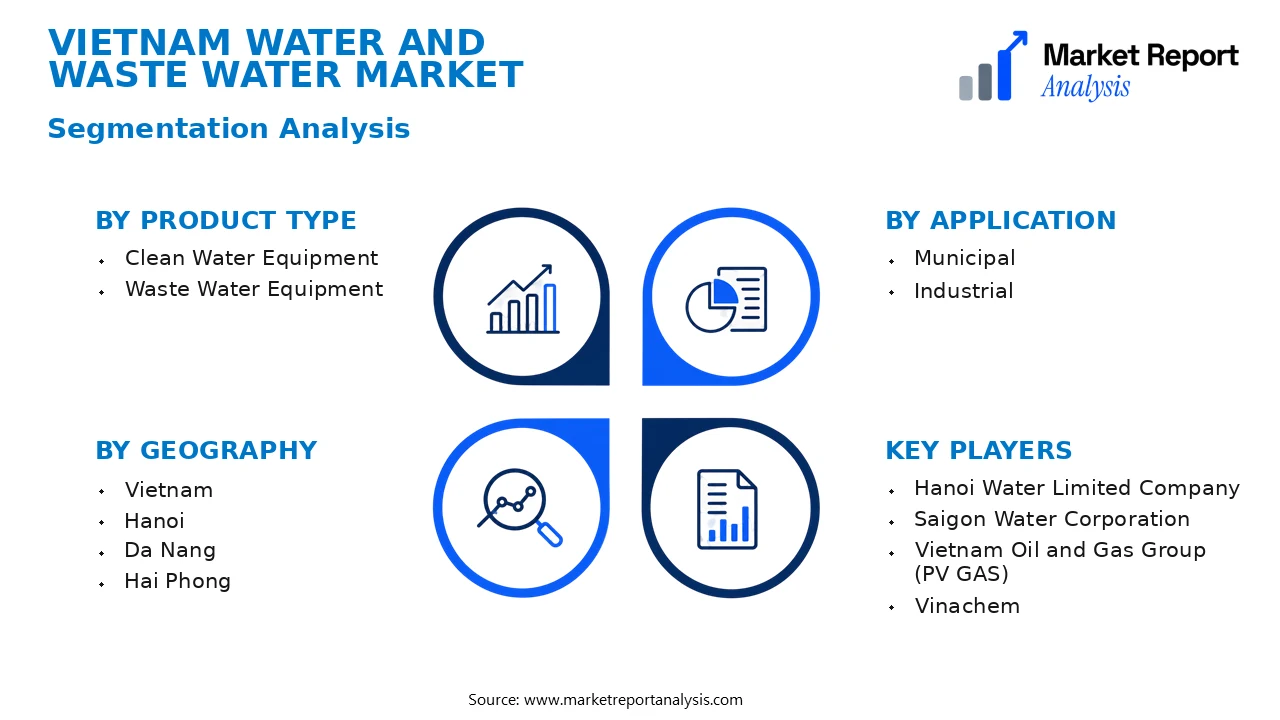
- Product Type
- Clean Water Equipment: This subsegment encompasses water treatment solutions tailored for municipal and industrial use, including filtration, disinfection, and purification systems that ensure safe and reliable water supply in Vietnam.
- Waste Water Equipment: Comprising treatment plants, sludge management, and recycling systems, this subsegment caters to the rapidly expanding need for wastewater management driven by urbanization and stricter environmental regulations.
- Application
- Municipal: The primary application focusing on urban water supply, sewerage, and wastewater treatment infrastructure, vital for supporting Vietnam’s growing population and urban centers’ sustainability goals.
- Industrial: This segment covers water use and treatment in manufacturing, chemical, food processing, and other industrial sectors, which are increasingly adopting advanced water management systems to meet regulatory and operational needs.
- End User
- Municipal Authorities: Local government agencies responsible for urban water supply and sanitation infrastructure, heavily investing in modernization to improve service quality and comply with environmental standards.
- Industries: Commercial and industrial facilities utilize water and wastewater treatment systems for production processes, environmental compliance, and cost-efficiency, representing a significant growth driver in urban and industrial zones.
- Technology
- Chemical Treatment Technologies: These involve chemical dosing, coagulation, and flocculation techniques used extensively in municipal and industrial water treatment processes.
- Physical & Mechanical Technologies: Technologies such as membrane filtration, sedimentation, and biological filtration, which are gaining prominence for their efficiency and eco-friendliness in Vietnam’s water management sector.
- Geography
- Vietnam: The central hub of infrastructure development, driven by urban growth, population density, and government initiatives, with specific focus on several key cities that serve as economic and industrial hotspots.
- Ho Chi Minh City: The largest economic hub, characterized by extensive industrial zones, rapid urbanization, and a high demand for advanced water and wastewater treatment infrastructure to support commercial growth.
- Hanoi: As the capital, Hanoi faces significant challenges related to aging infrastructure and expanding urban needs, prompting substantial investments in water quality improvements and environmental management systems.
- Da Nang: A rising industrial and tourism hub with a focus on sustainable development and efficient water management systems to support its growing service and manufacturing sectors.
- Hai Phong: An important port city with extensive industrial activity including heavy manufacturing and logistics, driving demand for state-of-the-art water treatment solutions.
- Can Tho: As the Mekong Delta’s economic center, Can Tho requires innovative water management to address environmental concerns and agricultural water usage that influence the broader regional water infrastructure.
- Bien Hoa: An industrial city near Ho Chi Minh, requiring large-scale water supply and treatment facilities to support manufacturing plants and urban development.
- Nha Trang: A key tourism destination that necessitates high-quality potable water and wastewater management to sustain its hospitality and service industry growth.
- Vietnam: The central hub of infrastructure development, driven by urban growth, population density, and government initiatives, with specific focus on several key cities that serve as economic and industrial hotspots.
Competitive Intelligence
The Vietnam Water and Waste Water Market exhibits a highly competitive landscape characterized by moderate market concentration, with key players including Veolia Vietnam, Saigon Water Corporation, and Hanoi Water Supply Corporation. These firms adopt aggressive business strategies focusing on expanding infrastructure, leveraging innovative water treatment technologies, and forming strategic partnerships with government agencies to secure long-term contracts. Product innovation is driven by integration of smart water management systems and eco-friendly treatment processes aimed at improving efficiency and sustainability. Companies frequently pursue acquisitions and joint ventures to enhance regional presence, particularly in rapidly urbanizing cities like Ho Chi Minh City and Hanoi, where infrastructural development is prioritized. Significant R&D investments are directed towards developing cost-effective, sustainable solutions capable of meeting Vietnam's rising demand. Differentiation among competitors hinges on technological expertise, project execution capabilities, and capacity for scalable solutions tailored to urban and rural needs. Strategic collaborations with local authorities and continuous technology upgrades remain pivotal for maintaining competitive positioning in this evolving market.
Leading Company Profiles
The competitive landscape of the Vietnam water and waste water market comprises a blend of multinational corporations and local industry players, each leveraging advanced technologies and strategic partnerships to address Vietnam’s growing water management needs.
- Hanoi Water Limited Company
- Saigon Water Corporation
- Vietnam Oil and Gas Group (PV GAS)
- Vinachem
- SUEZ Vietnam
- Veolia Vietnam
- SK Hydrofabric
- Local Water Treatment Vietnam
- PV Environment and Technology
- Coteccons Water Solutions
Hanoi Water Limited Company
Hanoi Water specializes in municipal water supply and sewage treatment with advanced automation systems, focusing on urban areas to improve water quality, reduce leakage, and optimize operational efficiency through innovative digital solutions.
Saigon Water Corporation
Saigon Water is a major provider of clean water and wastewater services in Ho Chi Minh City, leveraging modern membrane technology and expanding wastewater treatment capacities to meet growing urban demand in southern Vietnam.
Vietnam Oil and Gas Group (PV GAS)
PV GAS actively invests in integrated water management projects related to resource extraction and processing, emphasizing sustainable water use, environmental impact mitigation, and strategic partnerships in the energy and water sectors.
Vinachem
Vinachem provides specialized chemical treatment solutions for industrial wastewater management, focusing on chemical wastewater treatment additives, process optimization, and environmentally sustainable chemical technology innovations.
SUEZ Vietnam
SUEZ Vietnam brings its global expertise in water treatment and waste management, delivering large-scale projects that include advanced filtration systems, smart water grids, and digital monitoring platforms for municipal and industrial clients.
Veolia Vietnam
Veolia Vietnam focuses on sustainable water reuse, infrastructure modernization, and digital water management initiatives, serving urban centers and industrial zones with innovative solutions aligned with Vietnam’s environmental objectives.
SK Hydrofabric
SK Hydrofabric specializes in membrane filtration products and chemical treatment solutions, emphasizing high-performance filtration modules that improve efficiency across municipal and industrial wastewater treatment facilities.
Local Water Treatment Vietnam
This local firm emphasizes cost-effective, eco-friendly water and wastewater treatment systems tailored to the needs of Vietnam’s rural and developing urban communities, with a focus on modular and scalable technologies.
PV Environment and Technology
PVE and T develops innovative environmental monitoring and treatment technologies, incorporating IoT and AI-driven data analytics to enhance operational management and sustainability in water treatment processes.
Coteccons Water Solutions
Coteccons Water Solutions specializes in large infrastructure projects including pipelines, water intakes, and treatment plants, utilizing advanced construction techniques and sustainable materials to ensure durability and compliance.
Strategic Business Developments
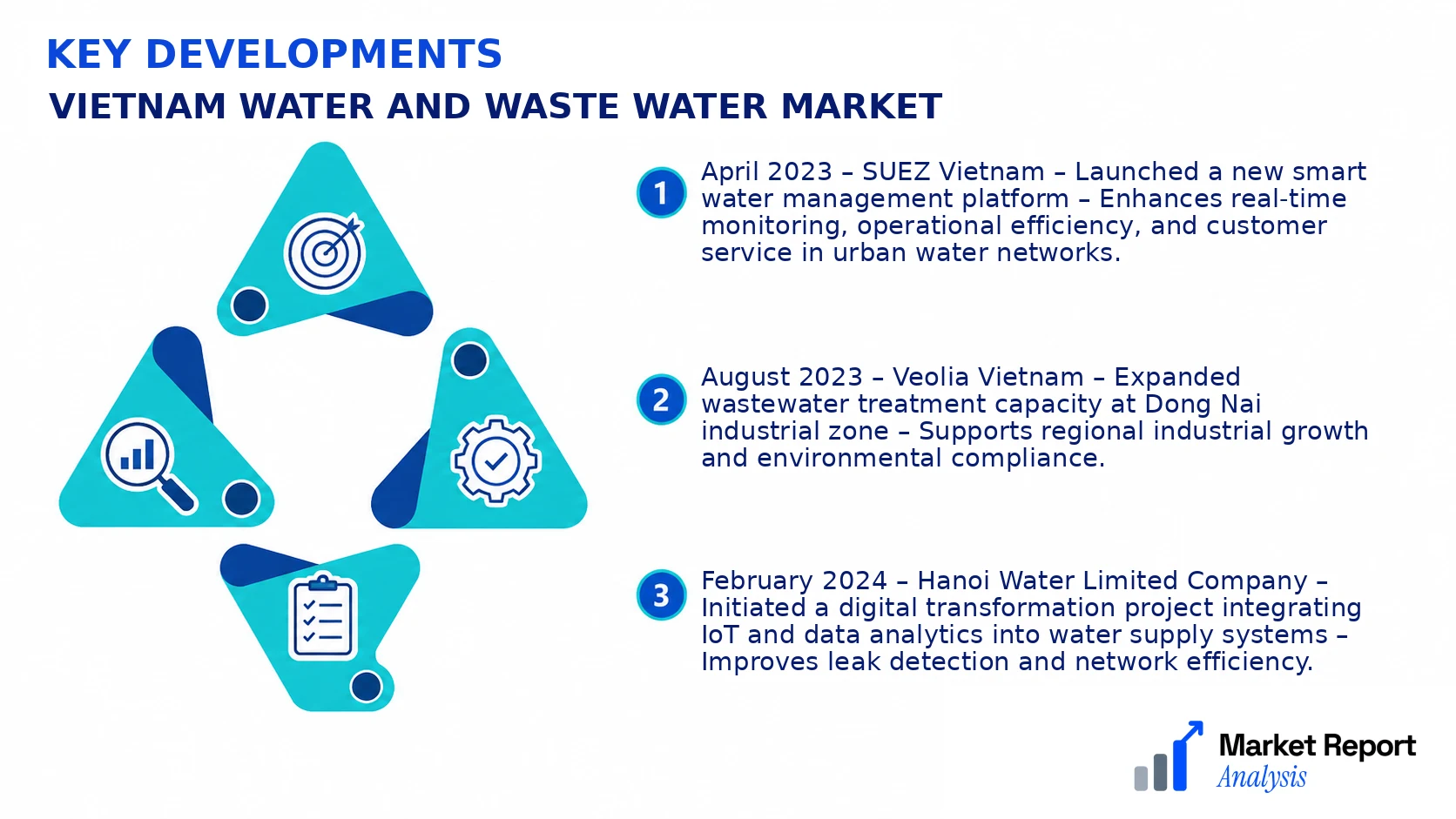
- April 2023 – SUEZ Vietnam – Launched a new smart water management platform – Enhances real-time monitoring, operational efficiency, and customer service in urban water networks.
- August 2023 – Veolia Vietnam – Expanded wastewater treatment capacity at Dong Nai industrial zone – Supports regional industrial growth and environmental compliance.
- February 2024 – Hanoi Water Limited Company – Initiated a digital transformation project integrating IoT and data analytics into water supply systems – Improves leak detection and network efficiency.
- June 2024 – PV Environment and Technology – Signed a strategic alliance with local construction firms to develop eco-friendly water treatment infrastructure – Promotes sustainable development in Vietnam.
- November 2024 – Vinachem – Acquired a controlling stake in a water treatment chemicals manufacturer – Strengthens chemical supply chain and product innovation for wastewater solutions.
Frequently Asked Questions
What is the Vietnam Water and Waste Water Market?
The Vietnam Water and Waste Water Market encompasses the collection, treatment, and distribution of water, alongside wastewater management services across Vietnam. It addresses urban demand for clean water, industrial needs, and environmental regulations, contributing significantly to public health and economic development.
What is the current market size of Vietnam Water and Waste Water Market?
As of 2026, the market size is valued at approximately USD 12 Billion, driven by urbanization, increasing infrastructure investments, and rising environmental standards. The market is projected to expand further, reaching about USD 20 Billion by 2034, with a CAGR of approximately 7.8% over the forecast period.
What factors are driving the Vietnam Water and Waste Water Market?
Key drivers include rapid urban population growth, government initiatives for water infrastructure development, strict environmental regulations, and increased industrial activity. Additionally, public awareness of waterborne diseases fosters demand for improved water quality and wastewater treatment services.
Which Vietnamese city leads the Vietnam Water and Waste Water Market?
Ho Chi Minh City remains the leading market for water and wastewater services, owing to its dense population, extensive industrial zones, and ongoing infrastructure upgrades. It accounts for the largest share of market revenue within the country, setting regional benchmarks.
Which segment is expected to grow the fastest?
The wastewater treatment segment is anticipated to exhibit the fastest growth, fueled by stringent environmental regulations and increased industrial wastewater management needs. Innovations in sustainable treatment technologies will further accelerate this segment’s expansion.
Who are the leading companies operating in the Vietnam Water and Waste Water Market?
Major players include government-owned corporations like Vietnam Water Corporation, along with private companies such as Suez Vietnam and Aquafresh. These firms lead in infrastructure projects, equipment supply, and service provision, shaping market competitiveness.
Analyst Perspective
The long-term outlook for Vietnam's water and wastewater market remains optimistic, driven by ongoing urbanization and increasing regulatory pressures to improve water quality standards. Commercial opportunities are expected to flourish particularly in emerging cities like Hanoi and Ho Chi Minh City, where rapid population growth demands substantial infrastructure investments. Technological evolution is likely to favor smart water management systems, leveraging IoT and AI to optimize resource efficiency and reduce operational costs, while encouraging private sector engagement. Investment priorities should focus on developing resilient, scalable treatment facilities, and expanding distribution networks to underserved areas. Competitive intensity will increase as domestic and international firms vie for market share, emphasizing technological innovation and cost efficiency. At the city level, Hanoi’s extensive industrial base and Ho Chi Minh City’s expanding urban population highlight substantial growth potential. Long-term strategic positioning must also consider risks such as fluctuating government policy support and infrastructural financing challenges, ensuring sustainable, resilient market development.
