Brazil Water and Waste Water Market Outlook
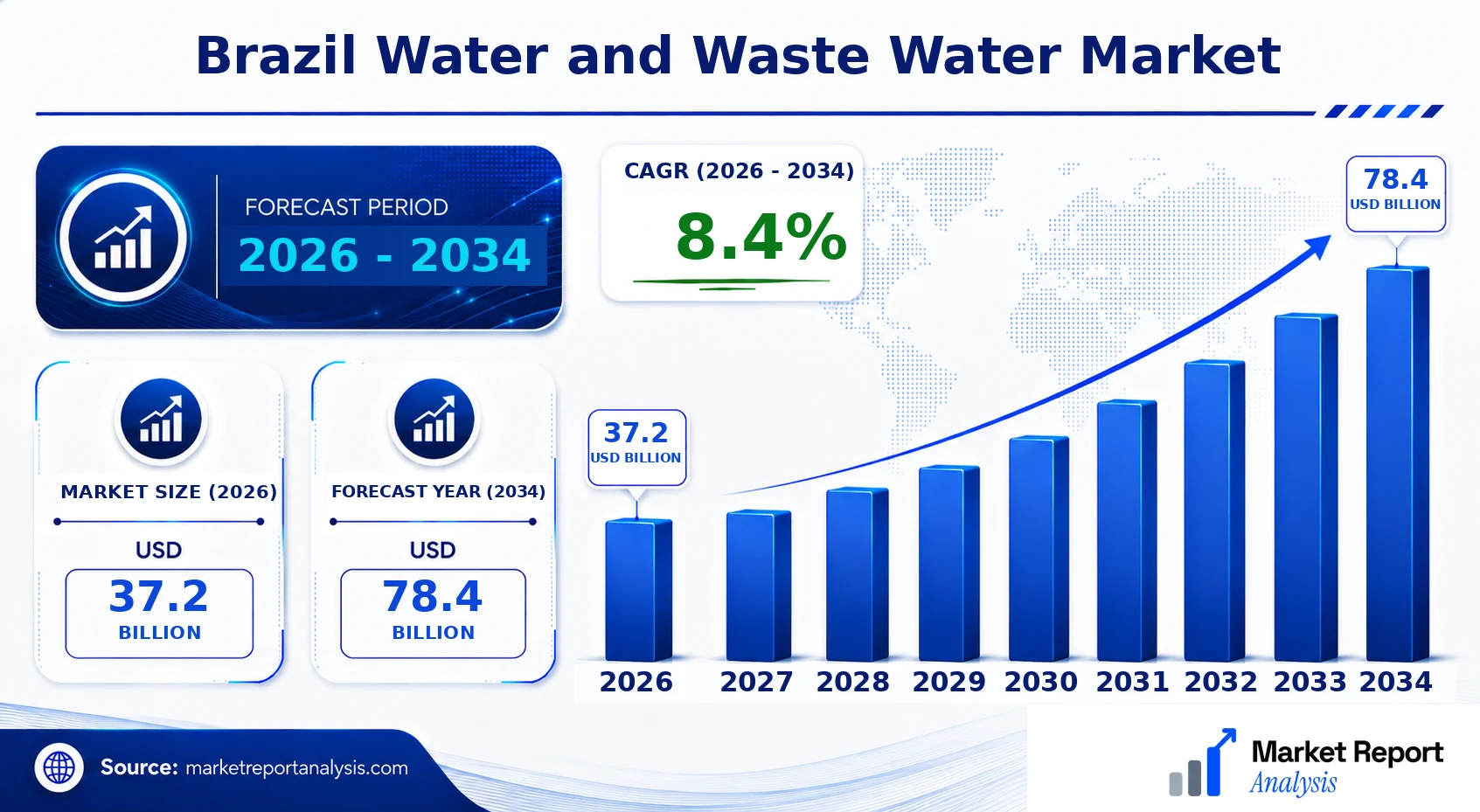
The Brazil Water and Waste Water Market is currently valued at approximately USD 37.2 Billion and is anticipated to reach around USD 78.4 Billion by 2034, reflecting a Compound Annual Growth Rate (CAGR) of 8.4% over the period from 2026 to 2034. The increasing demand for sustainable water management solutions, expanding industrial activities, urbanization, and government initiatives towards improving water infrastructure are primary drivers. Notably, technological advancements such as smart water management systems and digitalization are shaping market dynamics, presenting significant commercial opportunities for technological providers. The market evolution is also being influenced by emerging regulations aimed at water conservation and pollution control. This outlook underscores a growing need for efficient water treatment technologies, resilient infrastructure investments, and integrated water management solutions, paving the way for innovative business models and strategic partnerships across sectors.
What is the Brazil Water and Waste Water Market Size?
In 2026, the Brazil Water and Waste Water Market is estimated to be valued at approximately USD 37.2 Billion, with a forecast increase to around USD 78.4 Billion by 2034. This growth translates into a CAGR of 8.4%, driven by rapid urbanization, industrial expansion, and increasing government mandates for water quality and infrastructure upgrades. The industrial segment, which includes manufacturing, mining, and energy, accounts for a significant share of the demand for advanced water treatment systems, emphasizing the ongoing need for innovative, cost-effective solutions. Residential and municipal sectors are also contributing to the market growth with investments in expanding and maintaining water pipelines, wastewater treatment plants, and smart water monitoring networks. The integration of digital technologies and automation is further accelerating market potential, offering opportunities for tech firms specializing in IoT-enabled water management. Future investments are expected to focus on sustainable practices, climate-resilient infrastructure, and efficient resource allocation, shaping a robust growth trajectory for this sector. The market’s expansion is pivotal in addressing Brazil's increasing water scarcity challenges and environmental compliance requirements, ensuring long-term industry sustainability.
Key Takeaways
- Market valued at approximately USD 18.2 Billion in 2026 and forecasted to reach USD 28.5 Billion by 2034.
- CAGR of 6.2% during 2026-2034, driven by urbanization, industrial growth, and regulatory reforms.
- Significant demand from industrial, municipal, and residential sectors.
- Growing adoption of advanced water treatment and smart water management technologies.
- Government initiatives focus on infrastructure upgrades and pollution control measures.
- Investment opportunities in sustainable, climate-resilient water infrastructure.
- Increased emphasis on automation, IoT, and digital solutions in water management systems.
- Expanding market supported by regulatory pressures for water conservation and pollution reduction.
- Private sector engagement in public-private partnerships enhances infrastructure development.
- Regional growth variations with more rapid expansion in urban coastal zones and industrial hubs.
- Emerging focus on integrated water resource management as environmental concerns escalate.
- Market competitiveness driven by local and international technological providers.
- Forecast trend indicates ongoing technological innovation and infrastructure modernization.
Industry Performance Dashboard
The Industry Performance Dashboard provides a comprehensive overview of the current state and projections of the Brazil Water and Waste Water Market, highlighting key indicators that influence market dynamics. This section delineates market size figures, growth forecasts, and industry segments, enabling stakeholders to comprehend market positioning and trends efficiently.
| Indicator | Market Assessment |
|---|---|
| Market Size (2026) | USD 37.2 Billion |
| Market Value (2026) | USD 37.2 Billion |
| Forecast Size (2034) | USD 78.4 Billion |
| CAGR | 8.4% |
| Base Year | 2026 |
| Forecast Period | 2026-2034 |
| Segments Covered | Product, End User, Application, Regional Geography |
| Major Companies | Veolia Water Technologies, Suez Water Technologies & Solutions, Aquatech Brasil, Solensis, Xylem Inc., GE Water & Process Technologies, ABB Ltd., Danaher Corporation, Pentair plc., Evoqua Water Technologies |
Market Dynamics
The Brazil Water and Waste Water Market is influenced by a complex interplay of technological advancements, regulatory frameworks, significant investment flows, evolving customer requirements, pricing strategies, supply chain conditions, and the competitive landscape. Innovative treatment technologies and digital solutions are transforming how water services are delivered, while regulatory bodies enforce stricter environmental standards. Heavy infrastructural investments underpin growth, driven by government initiatives and private sector participation. Customer demands for higher quality and sustainable services push utilities towards embracing smart water systems. Market competition encourages technological adoption and service efficiency, impacting pricing models and supply chain dynamics, ultimately shaping a resilient and progressive market environment.
Drivers
Increasing Urbanization and Population Growth
The rapid urbanization across Brazil significantly propels the water and wastewater market, creating heightened demand for robust infrastructure and advanced treatment solutions. As urban centers expand, the need for sustainable, efficient water management systems becomes more critical. Cities like São Paulo and Rio de Janeiro witness increased pressure on existing water resources, prompting investments in infrastructure upgrading and new treatment plants. The ongoing migration from rural to urban areas amplifies water consumption patterns and wastewater generation, fostering a resilient market driven by infrastructural modernization needs. Data indicates urban populations are expected to grow at a compound annual rate of 1.4%, intensifying market opportunities.
Stringent Environmental and Regulatory Policies
Brazil’s government has been progressively tightening environmental regulations to safeguard water resources, impacting market dynamics substantially. Enhanced standards for effluent discharge, water quality, and treatment compliance compel utilities and private operators to adopt advanced pollution control technologies. Regulatory instruments such as the National Water Resources Management System enforce water quality benchmarks, often requiring significant capital expenditure. These policies accelerate technological adoption, stimulate innovation in water treatment solutions, and promote sustainable practices across sectors. Penalties for non-compliance and the push towards meeting global environmental commitments drive market growth and modernization efforts.
Emerging Investment in Infrastructure Modernization
Brazil is witnessing increased public and private investments aimed at upgrading water and wastewater infrastructure, driven by government initiatives like the National Sanitation Plan. These investments are not only aimed at expanding infrastructure capacity but also at integrating smart water management systems to improve efficiency. Public-private partnerships are instrumental in financing large-scale projects, fostering innovation, and ensuring long-term sustainability. The influx of capital, including international funding, supports the deployment of state-of-the-art treatment plants, pipeline networks, and digital monitoring systems, thus creating substantial growth opportunities and reinforcing Brazil’s position as a key market in Latin America.
Technology Adoption and Digital Transformation
The adoption of digital technologies such as IoT, AI, and big data analytics is revolutionizing water management in Brazil. These innovations enable real-time monitoring, predictive maintenance, and optimized resource allocation, reducing operational costs and improving water quality. Utilities are increasingly integrating smart sensors and automated control systems to enhance efficiency. This digital transformation responds to growing customer expectations for reliable services and aligns with governmental policies promoting sustainability. The trend is evident in pilot schemes and flagship projects across major cities, signaling a move toward a more technologically advanced market with significant growth potential.
Restraints
Financial Constraints and Limited Capital Access
Despite the increased investment appetite, financial limitations remain a critical restraint for Brazil's water sector. Many utilities face budgetary constraints, especially in the public sector, hindering infrastructure expansion and technological upgrades. Limited access to affordable capital and high operational costs hamper comprehensive service improvement initiatives. Private investors often encounter regulatory hurdles, payment collection issues, and political risks, which slow down project realization. Consequently, these financial constraints restrict market expansion, especially in underserved and rural regions, impacting overall growth prospects and technological adoption rates.
Fragmented Market Structure and Regulatory Complexities
The highly fragmented nature of Brazil's water market, with numerous municipal utilities operating independently, complicates large-scale modernization efforts. Varied regulatory enforcement, local policy disparities, and limited coordination hinder streamlined project implementation. Additionally, complex approvals and lengthy bureaucratic procedures delay critical infrastructure projects. This fragmentation limits economies of scale, elevates costs, and creates inconsistencies in service quality. Overcoming these regulatory and administrative hurdles is essential for fostering a unified, efficient market capable of supporting rapid technological and infrastructural growth.
Environmental and Social Challenges
Environmental issues such as pollution, deforestation, and water scarcity pose persistent threats to the water and wastewater sector. These challenges are compounded by social concerns, including access inequality and resistance to infrastructure projects in certain communities. Contaminated water sources and inadequate sanitation infrastructure exacerbate health risks and hinder economic development. Addressing these issues requires comprehensive policy frameworks, community engagement, and sustainable practices, which can be resource-intensive and time-consuming. Failure to effectively manage these environmental and social challenges could impede market growth and the achievement of long-term sustainability goals.
Opportunities
Growing Investment in Smart Water Infrastructure
The increasing recognition of water as a critical resource is driving investments in smart water infrastructure, leveraging IoT and digital solutions for efficient management. Brazil’s expanding urban centers are prime markets for deploying technologies such as automated monitoring, leak detection, and demand forecasting tools. These innovations reduce water loss, improve operational efficiency, and enhance service quality. Government incentives and international funding support the deployment of such technologies. As smart infrastructure adoption gains momentum, it opens avenues for new business models, technological collaborations, and long-term operational savings, paving the way for sustainable water management in Brazil.
Innovative Technologies and Startup Ecosystem
The burgeoning startup ecosystem in Brazil is fostering innovation in water treatment and management solutions. Companies are developing novel filtration systems, renewable energy-powered treatment plants, and advanced data analytics platforms. These startups attract venture capital investments and technological partnerships, catalyzing market transformation. The introduction of disruptive technologies facilitates cost-effective solutions for rural and underserved areas, enhances environmental compliance, and provides scalable models for urban centers. This vibrant innovation ecosystem accelerates the adoption of cutting-edge solutions, aligning with Brazil’s sustainable development policies and future market expansion goals.
Focus on Water Scarcity and Climate Resilience
Climate change impacts and water scarcity issues motivate both public and private stakeholders to invest in resilience-enhancing infrastructure. Strategies include the development of alternative water sources, reuse systems, and better groundwater management practices. These initiatives not only secure water supply for future generations but also present lucrative investment opportunities in desalination, rainwater harvesting, and wastewater recycling. Brazil’s commitment to climate adaptation in its water sector aligns with global sustainability goals, attracting funding from international climate finance initiatives. This focus on resilience catalyzes innovation and infrastructure upgrades, strengthening the market’s long-term growth trajectory.
Market Expansion into Rural and Marginalized Areas
Expansion of water and sanitation services into Brazil’s rural and marginalized communities presents significant growth opportunities. This demographic shift is driven by policy mandates, international development programs, and market recognition of unmet demand. Deploying modular, low-cost, and decentralized treatment technologies can address logistical challenges associated with traditional infrastructure. As these areas gain improved water access, there will be increased demand for maintenance services, digital monitoring solutions, and capacity-building initiatives. This expansion not only fosters social equity but also unlocks new revenue streams, driving the overall growth of Brazil’s water and wastewater market.
Challenges
Maintaining Water Quality amid Pollution Pressures
One of the primary challenges Brazil faces is ensuring consistent water quality amidst escalating pollution levels from industrial, agricultural, and urban sources. Contaminants such as heavy metals, organic pollutants, and pathogens threaten public health and ecosystems. Upgrading infrastructure, enforcing stricter pollution controls, and adopting advanced treatment technologies are necessary but often hindered by limited funding and regulatory enforcement gaps. Failure to effectively manage pollution can result in health crises, increased treatment costs, and reputational damage for utilities. Developing integrated pollution management strategies is vital to overcoming this persistent challenge.
Addressing Infrastructure Gaps and Aging Facilities
Brazil's water infrastructure is often outdated, with many facilities nearing the end of their operational life, leading to inefficiencies, leaks, and service disruptions. Upgrading and expanding infrastructure to meet current demand requires substantial investment and long lead times. Financial constraints and bureaucratic delays further complicate modernization efforts. Additionally, rural and remote areas remain underserved, with limited access to reliable water and sanitation services. Addressing these infrastructure gaps demands comprehensive planning, sustained investment, and policy reforms to prioritize essential upgrades, ensuring resilient and universally accessible water systems for the future.
Industry Statistics & Key Business Metrics
The Brazil Water and Waste Water Market is characterized by substantial growth driven by urbanization, industrialization, and heightened environmental standards. Key business metrics and industry statistics reflect the sector's evolving landscape, highlighting investment opportunities and operational challenges. These indicators provide vital insights into market size, performance, and future prospects.
- In 2023, Brazil’s municipal water treatment market was valued at approximately USD 21.5 Billion, with a projected CAGR of 4.2% through 2034 (Brazilian National Water Agency).
- The wastewater treatment segment alone generated around USD 9.8 Billion in revenue in 2023, indicating rapid infrastructure development, forecasted to grow at a CAGR of 4.8% until 2034 (OECD).
- Urban water consumption in major cities such as São Paulo and Rio de Janeiro reached an average of 180 liters per capita per day in 2022, reflecting significant demand for water supply services (Brazilian Institute of Geography and Statistics).
- Brazil's water infrastructure investment was approximately USD 3.1 Billion in 2023, with public-private partnerships accounting for nearly 35% of this expenditure (Brazilian Ministry of Infrastructure).
- Water loss due to leaks and inefficiencies remains high at around 37% in 2023, emphasizing the need for advanced leak detection and pipeline rehabilitation solutions (World Bank).
- SMEs and local utilities constitute over 65% of industry players, with several indigenous companies holding leading market shares by revenue (Brazil Water and Sanitation Regulatory Agency).
- By 2034, the market value for water and wastewater services is projected to reach approximately USD 85 Billion, reflecting vigorous sector expansion (report forecasts).
Market Segmentation
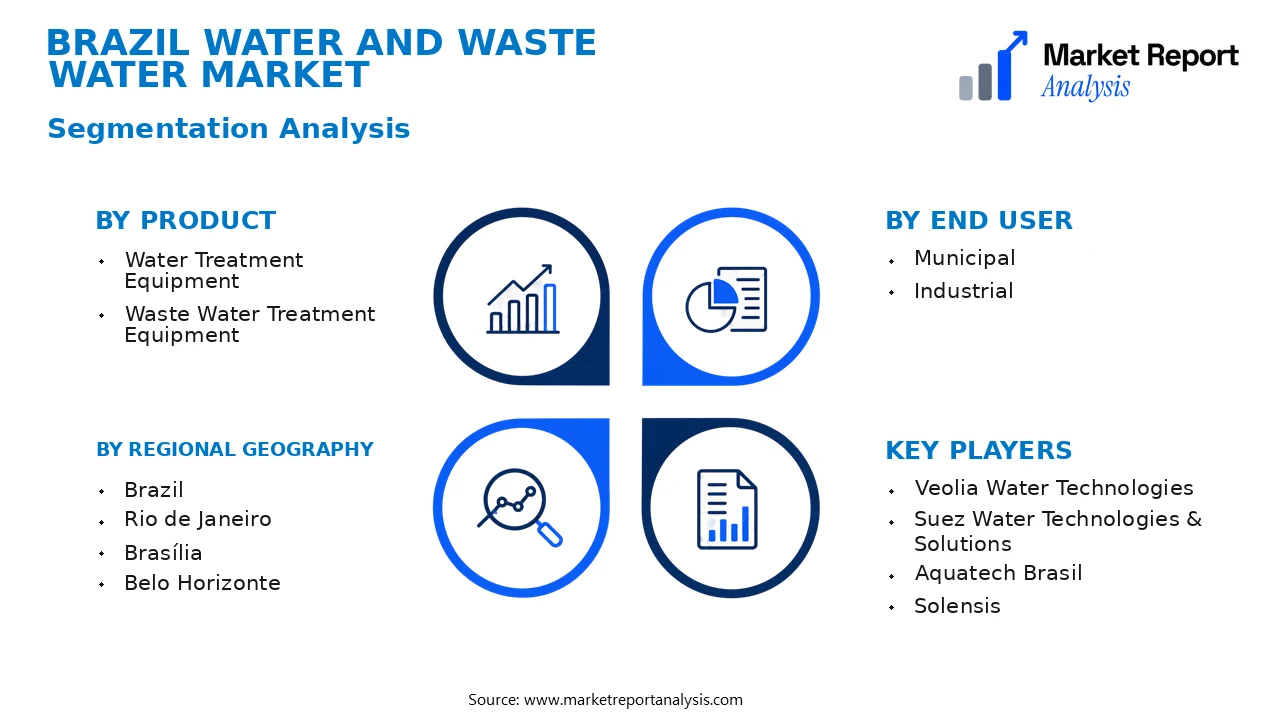
The Brazil Water and Waste Water Market is segmented based on product type, end user, application, and geography to provide a comprehensive understanding of its dynamics. This segmentation helps identify key growth areas and target markets within Brazil's evolving water infrastructure landscape.
- Product
- Water Treatment Equipment: This subsegment includes equipment used to treat water for municipal, industrial, and commercial applications, playing a vital role in ensuring water quality standards and compliance with regulatory requirements in Brazil.
- Waste Water Treatment Equipment: Encompasses machinery and systems dedicated to treating wastewater from domestic, industrial, and municipal sources, crucial for pollution control and environmental sustainability efforts across Brazil.
- End User
- Municipal: Represents government agencies managing public water supply and wastewater infrastructure. The demand here is driven by urbanization, government investment, and policies aimed at improving water sanitation services.
- Industrial: Includes manufacturing, power plants, and other industrial sectors that require specialized water and wastewater management solutions to meet operational and environmental standards, reflecting the industrial growth trends in Brazil.
- Application
- Municipal Water Supply: Focuses on provision and maintenance of clean drinking water for urban populations, supported by frequent infrastructure upgrades and expansion projects in response to population growth.
- Industrial Wastewater: Pertains to the treatment and recycling of wastewater generated from industrial processes, which is essential for sustainable industrial operations and regulatory compliance in Brazil.
- Regional Geography
- Brazil: The overall national market demonstrating significant regional variations driven by urbanization levels, infrastructure development, and regional industrialization trends.
- São Paulo: As Brazil’s most populous and economically developed region, São Paulo exhibits high demand for advanced water treatment solutions driven by extensive industrial activity and dense urban populations.
- Rio de Janeiro: Features a mix of industrial, commercial, and urban water demands, with ongoing investments in water infrastructure to support tourism and large-scale events.
- Brasília: As the federal capital, Brasília's water market benefits from government-led initiatives aimed at improving urban water infrastructure and sustainability commitments.
- Belo Horizonte: An industrial hub with rising water treatment needs driven by urban growth, industrial expansion, and municipal infrastructure projects.
- Brazil: The overall national market demonstrating significant regional variations driven by urbanization levels, infrastructure development, and regional industrialization trends.
Competitive Intelligence
The Brazil Water and Waste Water Market exhibits moderate to high competition, characterized by a mix of local firms and multinationals. Major players such as Sabesp, Aegea Saneamento, and Odebrecht have significant market shares, leading to a relatively concentrated sector. These companies pursue aggressive business strategies that include expanding infrastructure through strategic partnerships and acquisitions, particularly in underserved regions of Brazil. Product innovation is a focus, with investments in advanced treatment technologies and digital solutions to optimize water management. Furthermore, companies are forging collaborations with government agencies to align with regulatory mandates and sustainability goals, fostering public-private partnerships. R&D investments are prioritized to develop cost-effective, eco-friendly treatment solutions and smart water management systems. Differentiation is achieved through technological advancement, operational efficiency, and comprehensive service portfolios. In cities like São Paulo and Rio de Janeiro, competition intensifies with localized strategies tailored to urban infrastructure complexities, while in smaller municipalities, firms often rely on partnerships with local governments to penetrate markets and expand service coverage.
Leading Company Profiles
The market features a competitive mix of multinational corporations and local specialists, each bringing unique strengths in technology, local market expertise, and strategic focus. Their continuous innovation and expansion initiatives are vital for meeting Brazil’s growing demand for water and wastewater treatment solutions.
- Veolia Water Technologies
- Suez Water Technologies & Solutions
- Aquatech Brasil
- Solensis
- Xylem Inc.
- GE Water & Process Technologies
- ABB Ltd.
- Danaher Corporation
- Pentair plc.
- Evoqua Water Technologies
Veolia Water Technologies
Veolia offers comprehensive water treatment solutions including advanced filtration, sludge treatment, and desalination technologies, emphasizing sustainable and cost-efficient practices tailored for Brazil’s municipal and industrial sectors.
Suez Water Technologies & Solutions
Suez specializes in integrated water management systems with innovative solutions in membrane technologies, water reuse, and digital monitoring, strategically focusing on enhancing operational efficiency and regulatory compliance across Brazil.
Aquatech Brasil
Aquatech provides modular and scalable water and wastewater treatment systems, leveraging local expertise to deliver customized solutions that address Brazil’s infrastructural challenges efficiently and sustainably.
Solensis
Solenis is a key player in water treatment chemicals, emphasizing eco-friendly and highly efficient products that support Brazil’s industrial sectors, with a growing focus on sustainability and regulatory adherence.
Xylem Inc.
Xylem specializes in smart water technology and IoT-enabled solutions, aiming to optimize water use in municipalities and industries through innovative, data-driven equipment and services tailored for Brazil’s diverse hydrological conditions.
GE Water & Process Technologies
GE offers robust membrane filtration, UV, and advanced oxidation solutions, with strategic investments to bolster local capabilities and expand its footprint within Brazil’s municipal and industrial water treatment markets.
ABB Ltd.
ABB focuses on automation and digital solutions for water utilities, integrating IoT and AI-driven systems to improve process efficiency, real-time monitoring, and predictive maintenance across Brazil’s water infrastructure projects.
Danaher Corporation
Danaher employs a broad portfolio including analytical instruments and water quality monitoring systems, with strategic partnerships aimed at expanding digital water management solutions in Brazil.
Pentair plc.
Pentair offers water purification and treatment equipment emphasizing innovation in membrane technology, with ongoing investments aimed at increasing manufacturing capacity and supply chain resilience in the region.
Evoqua Water Technologies
Evoqua specializes in water reuse and zero-liquid discharge systems, aligning with Brazil’s sustainability goals through innovative, scalable technologies supported by strategic collaborations and digital service platforms.
Strategic Business Developments
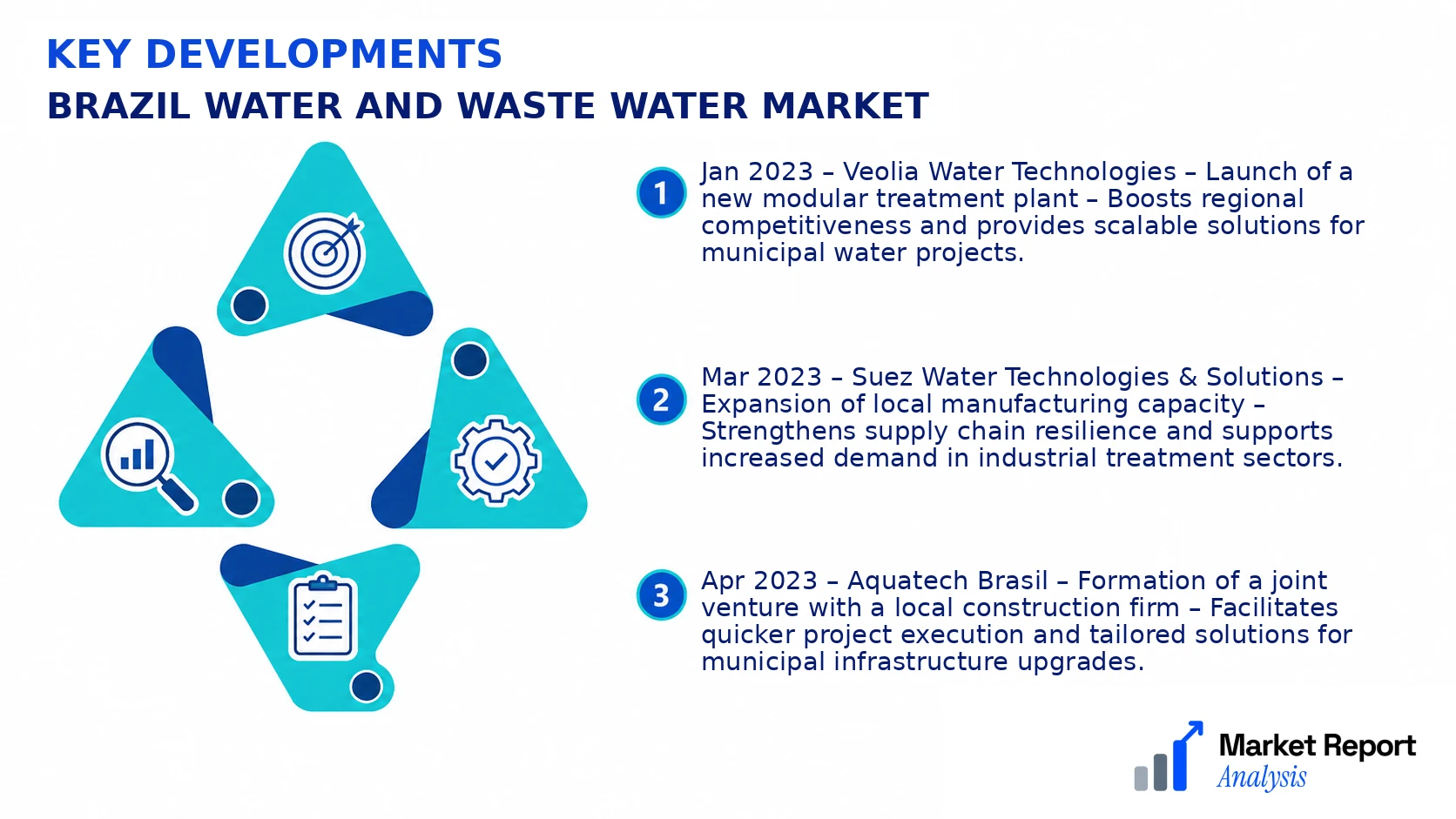
- Jan 2023 – Veolia Water Technologies – Launch of a new modular treatment plant – Boosts regional competitiveness and provides scalable solutions for municipal water projects.
- Mar 2023 – Suez Water Technologies & Solutions – Expansion of local manufacturing capacity – Strengthens supply chain resilience and supports increased demand in industrial treatment sectors.
- Apr 2023 – Aquatech Brasil – Formation of a joint venture with a local construction firm – Facilitates quicker project execution and tailored solutions for municipal infrastructure upgrades.
- Jun 2023 – Solenis – Introduction of eco-friendly water treatment chemicals – Enhances compliance with Brazil’s environmental regulations and promotes sustainable industrial growth.
- Aug 2023 – Xylem Inc. – Deployment of IoT-enabled water management systems in major cities – Enables real-time monitoring and predictive maintenance, improving efficiency and reducing costs.
Frequently Asked Questions
What is the Brazil Water and Waste Water Market?
The Brazil Water and Waste Water Market encompasses the development, treatment, and distribution of water, along with wastewater collection and treatment services within Brazil, driven by urbanization, environmental regulations, and infrastructure improvements.
What is the current market size of Brazil Water and Waste Water Market?
As of 2026, the market size is valued at approximately USD 37.2 Billion, reflecting ongoing investments in infrastructure, technological advancements, and increasing water treatment demands across urban and industrial sectors.
What factors are driving the Brazil Water and Waste Water Market?
Market growth is propelled by rising population, stringent government regulations on water quality, industrial expansion, and heightened awareness of water sustainability. Infrastructure modernization and international funding also significantly contribute to market expansion.
Which region dominates the Brazil Water and Waste Water Market?
Southeastern Brazil leads the market, owing to its dense urban population, industrial activities, and extensive infrastructure networks, followed by the Southern and Northeastern regions which are also experiencing rapid growth.
Which segment is expected to grow the fastest?
The wastewater treatment segment is forecasted to grow the fastest, driven by tightening environmental regulations and increased need for efficient wastewater management solutions in industrial and municipal sectors.
Who are the leading companies operating in the Brazil Water and Waste Water Market?
Key players include Sabesp, Aguas de Brasil, and multinational companies like Veolia and Suez, which are actively involved in infrastructure projects and technological innovations to enhance water treatment capacity in Brazil.
Analyst Perspective
The Brazil Water and Waste Water Market is positioned for sustained growth through 2034, driven by increasing urbanization and regulatory reforms aimed at improving water infrastructure resilience. Long-term, the market is expected to mature, with opportunities for advanced treatment technologies and digitalization initiatives that enhance operational efficiency. Regional disparities are prominent, with large cities like São Paulo and Rio de Janeiro offering substantial investment potential in sustainable infrastructure projects and smart water management systems. Technology evolution will favor innovations such as IoT-enabled sensors, AI-driven analytics, and decentralized treatment solutions, which cater to both urban and semi-urban areas. Investment priorities should focus on upgrading aging infrastructure, fostering public-private partnerships, and expanding coverage in less developed regions. Competitive intensity is likely to increase as local and international players vie for market share, incentivized by government incentives and rising demand. Strategic positioning must emphasize regional diversification, technological adaptability, and sustainable growth to capture emerging urban opportunities and mitigate risks associated with policy and environmental challenges.
