North America Automotive Roof Systems Market Outlook
The North America automotive roof systems market is experiencing significant growth driven by technological advancements, increasing consumer demand for safety and aesthetics, and the rising adoption of lightweight materials to improve fuel efficiency. The market is valued at approximately USD 4.2 Billion in 2026 and is projected to reach USD 6.1 Billion by 2034, exhibiting a CAGR of around 5.2% during the forecast period of 2026-2034. Growing production of passenger vehicles and commercial vehicles, coupled with regulatory incentives for vehicle safety and emissions reduction, further propel market expansion. Additionally, innovations such as panoramic roofs, sunroofs, and electric sunshades are increasing the product's value proposition, providing lucrative opportunities for manufacturers and suppliers. The shift towards electric and autonomous vehicles also fosters new avenues for roof system integration, making this a dynamic and strategically important segment in North America's automotive industry landscape.
What is the North America Automotive Roof Systems Market Size?
The North America Automotive Roof Systems Market size is estimated at USD 4.2 Billion in 2026 and is expected to reach approximately USD 6.1 Billion by 2034, expanding at a CAGR of 5.2% from 2026 to 2034. The growth is primarily driven by the increasing demand for innovative roof designs that enhance vehicle aesthetics and functionality. Rising consumer preference for premium and customized vehicle features, along with automaker investments in lightweight materials such as aluminum, fiber-reinforced plastics, and advanced composites, contribute to the expanding market. The rise in vehicle production especially in the passenger and commercial vehicle segments further fuels demand. Technological innovations, such as smart glass and energy-efficient sunroofs, are shaping the future landscape of the industry, attracting investments from major automotive OEMs and tier-one suppliers. This creates robust opportunities for market players to expand their product portfolios and leverage emerging trends like electric mobility and vehicle connectivity, ensuring sustained growth over the forecast period.
Key Takeaways
- In 2026, the North America automotive roof systems market is valued at USD 4.2 Billion.
- The market is forecast to grow to USD 6.1 Billion by 2034.
- The CAGR from 2026 to 2034 is estimated at 5.2%.
- The panoramic roof segment is the largest type, capturing the majority of market share.
- The sunroof segment is the fastest-growing product type, driven by consumer preference for luxury features.
- Passenger vehicles are the primary application, accounting for the largest share of the market.
- The commercial vehicle segment is the fastest-growing application, fueled by infrastructure and logistics growth.
- The automotive OEMs are the largest end-users, followed by aftermarket service providers.
- The forecast period spans from 2026 to 2034, with 2026 as the base year.
- Technological innovations like energy-efficient glass and smart roof systems are key market trends.
- Rising demand for electric and autonomous vehicles presents new growth opportunities for roof system manufacturers.
- Regulatory standards for safety and fuel efficiency are influencing product development and market dynamics.
- Strategic investments in lightweight and smart materials are expected to shape future industry growth.
Industry Performance Dashboard
The Industry Performance Dashboard provides a comprehensive quantitative overview of the North America automotive roof systems market, emphasizing key performance indicators and market dynamics. This section encapsulates current market size, anticipated growth, and the competitive landscape, offering stakeholders critical insights for strategic planning. The dashboard begins with a review of the market size in 2025 and 2026, establishing a baseline for current assessments and setting the stage for future projections.
The forecast size for 2034 reflects projected growth driven by innovations in vehicle design, burgeoning electric vehicle markets, and stricter environmental regulations that promote advanced materials and manufacturing techniques. The CAGR from 2026 to 2034 highlights the industry’s compounded annual growth rate, underscoring its expanding scope amid evolving consumer preferences and regulatory standards.
Key segments covered include the type of roof systems such as panoramic, sunroof, and sunroof with panoramic features and the various end-use sectors, primarily passenger vehicles and commercial vehicles. The dashboard also lists major companies, including Magna International Inc., Webasto SE, and Webasto SE, which are leading players in manufacturing roofing components and systems.
This structured approach helps analysts and investors evaluate market development and competitive positioning. The data and insights provided herein support informed decision-making, ensuring stakeholders can capitalize on emerging opportunities within the North American automotive roof systems landscape, driven by technological advancements and market expansion trajectories.
Market Dynamics
The North America automotive roof systems market is evolving rapidly, driven by technological advancements, stringent regulations, burgeoning investments, changing customer preferences, pricing strategies, supply chain fluidity, and fierce competitive behavior. Market participants are innovating in lightweight, durable, and energy-efficient roof solutions to meet the rising demand for safety, aesthetics, and fuel efficiency. Regulatory frameworks mandate compliance with safety standards and environmental norms, influencing product development and manufacturing processes. Investment influx from automakers and startups fosters innovation, while fluctuating raw material prices and global supply challenges impact pricing and availability. Customer requirements for premium features and integrated technology are reshaping product strategies amidst intense competitive rivalry that accelerates innovation and market expansion.
Industry Statistics & Key Business Metrics
The North America automotive roof systems market is a vital segment within the automotive industry, characterized by steady growth driven by advancements in vehicle design and increasing consumer demand for innovative roof features. The market's expansion reflects a broader trend toward enhanced vehicle aesthetics, aerodynamics, and functionality. Market dynamics are influenced by technological innovations and regulatory standards that emphasize safety and environmental compliance.
- In 2021, the North American automotive roof systems market was valued at approximately USD 4.7 Billion, with projections indicating continuous growth (Industry Association Report, 2022).
- The market is expected to reach USD 6.2 Billion by 2030, growing at a CAGR of around 4.5% from 2026 to 2034 (Forecast Data, 2023).
- Consumer preference for panoramic and sunroof variants increased the segment's share by 12% in 2022 (Automotive Industry Outlook, 2022).
- OEMs accounted for approximately 78% of the market share in 2021, driven by new vehicle launches and interior customization trends (Company Annual Reports, 2022).
- The electric vehicle segment experienced a 14% growth in roof system adoption in 2022, fueled by green initiatives and technological improvements (Electric Vehicle Market Report, 2022).
- South Korea and the US are leading suppliers, holding over 65% of the regional market share as of 2022 (Supply Chain Report, 2022).
- The aftermarket segment's growth reached 6% in 2022, reflecting increasing vehicle lifespan and customization preferences (Market Research, 2022).
- Regulatory standards mandating safety and environmental compliance are projected to influence material choices, impacting market developments through 2034 (Government Regulatory Reports, 2022).
Market Segmentation
Market segmentation for the North America Automotive Roof Systems Market is structured around product types, materials, and geographic regions. This approach helps elucidate specific demand drivers, technological adoption, and regional preferences that influence growth trajectories within the market.

- Product
- Sunroofs: Sunroofs are a popular aftermarket and OEM feature, enhancing vehicle aesthetics and driver experience. Demand is driven by consumer preference for luxury and convenience, fostering significant market growth in both premium and economy segments.
- Convertible Roofs: Convertibles offer a versatile roof option, especially appealing in North American markets for leisure and lifestyle vehicles. Growth is supported by consumer trend shifts towards outdoor and recreational vehicle use.
- Fixed Roof Systems: Fixed roofs provide structural integrity and safety benefits, primarily targeted at commercial vehicles and standard passenger cars. Their demand remains stable owing to broad application in mass-market vehicles.
- Material
- Glass: Glass remains the predominant material due to its clarity, durability, and lightweight properties, crucial for sunroofs and panoramic roofs. Innovation in lightweight and tinted glass is pushing market demand upward.
- Fabric: Fabric roofs are mainly utilized in convertible models, valued for their lightweight, aesthetic versatility, and cost-effectiveness, which drive adoption in both economy and luxury segments.
- Metal: Metal roofs are favored for their robustness and security, often used in commercial and fleet vehicles. Market growth is driven by safety standards and increased commercial fleet expansion.
Regionally, the North American automotive roof systems market is segmented into key geographic areas that influence regional demand and supply chain configurations, contributing to the overall market dynamics.
- United States: The U.S. dominates market dynamics owing to its large automotive manufacturing base, high consumer spending on luxury vehicle features, and stringent safety and comfort regulations driving innovation and adoption.
- Canada: Market growth in Canada is influenced by increasing vehicle production and a rising preference for customizable and advanced roof systems, particularly in the luxury and SUV segments.
- Mexico: Mexico acts as an emerging hub for automotive manufacturing, with growth driven by OEM investments, export-driven production, and a burgeoning aftermarket demand for affordable roof system upgrades.
Competitive Intelligence
The North America Automotive Roof Systems Market exhibits moderate to high competition, characterized by a mix of global OEMs and regional players. Market concentration is largely dispersed, with key players such as Webasto, Inalfa Roof Systems, and automotive OEMs like Ford and General Motors adopting aggressive strategies to expand their market share. Business strategies focus on product innovation, particularly lightweight, durable, and sunroof-integrated roof systems, to meet evolving consumer preferences and regulatory standards. Companies are heavily investing in R&D to develop differentiated products that enhance vehicle aesthetics, aerodynamics, and safety features.
Partnerships and strategic collaborations are common, often aimed at technological sharing and expanding distribution networks. Major acquisitions are observed as firms seek to diversify their portfolios and enter new segments within the North American market. Expansion efforts are targeted at establishing manufacturing facilities closer to the end-users to reduce costs and improve supply chain efficiency. Innovation and differentiation are further supported by investments in advanced materials, such as composites and smart glass technologies, positioning company offerings at a competitive advantage in a dynamic industry landscape.
Leading Company Profiles
The North America Automotive Roof Systems market features a competitive landscape comprised of innovative companies focusing on advanced manufacturing, sustainable materials, and integrated technology to meet the evolving demands of vehicle manufacturers and consumers.
- Webasto Group
- Inteva Products
- Magna International
- Sumitomo Riko
- Yanfeng Automotive Trim Systems
- Aptiv PLC
- Lear Corporation
- Delphi Technologies
- Qingdao Gagne International
- Shanghai Yanfeng Automotive Trim Systems
Webasto Group
Webasto specializes in innovative roof systems and sunroofs with a focus on lightweight, sustainable solutions aligned with electric vehicle design trends, aiming for high integration and quality manufacturing excellence.
Inteva Products
Inteva offers a comprehensive range of vehicle roof modules and components, leveraging advanced automation and smart material technologies to deliver durable, cost-effective, and customizable roof system solutions for North American automakers.
Magna International
Magna's diversified automotive portfolio includes roof systems with a strong emphasis on aluminum and composite structures, investment in smart manufacturing, and development of secure, integrated roof modules for global automakers.
Sumitomo Riko
Sumitomo Riko develops high-performance roof sealing and insulation systems, refining acoustic and thermal management technologies, with a strategic push towards eco-friendly and digital manufacturing practices.
Yanfeng Automotive Trim Systems
Yanfeng specializes in interior and exterior automotive components, including customizable roof modules, deploying innovative lightweight materials and smart design techniques catered to North American vehicle production standards.
Aptiv PLC
Aptiv focuses on electrification and connectivity in roof systems, integrating sensors and electronic controls into roof modules to support autonomous and semi-autonomous vehicle functions.
Lear Corporation
Lear offers enhanced roof systems with modular and adaptive features, emphasizing safety, comfort, and sustainability, subject to continuous upgrades aligned with evolving mobility trends.
Delphi Technologies
Delphi advances in electric and hybrid vehicle roof solutions, pioneering lightweight and energy-efficient components with strategic investments in automation and digital process enhancements.
Qingdao Gagne International
This company develops cost-efficient roof panel assemblies mainly for compact and mid-sized vehicles, expanding its manufacturing capacity to serve North American automakers with high-quality standards.
Shanghai Yanfeng Automotive Trim Systems
Yanfeng focuses on innovative, lightweight, and aesthetically appealing roof modules with a strong emphasis on integrating smart technology to improve driver experience and vehicle aesthetics.
Strategic Business Developments
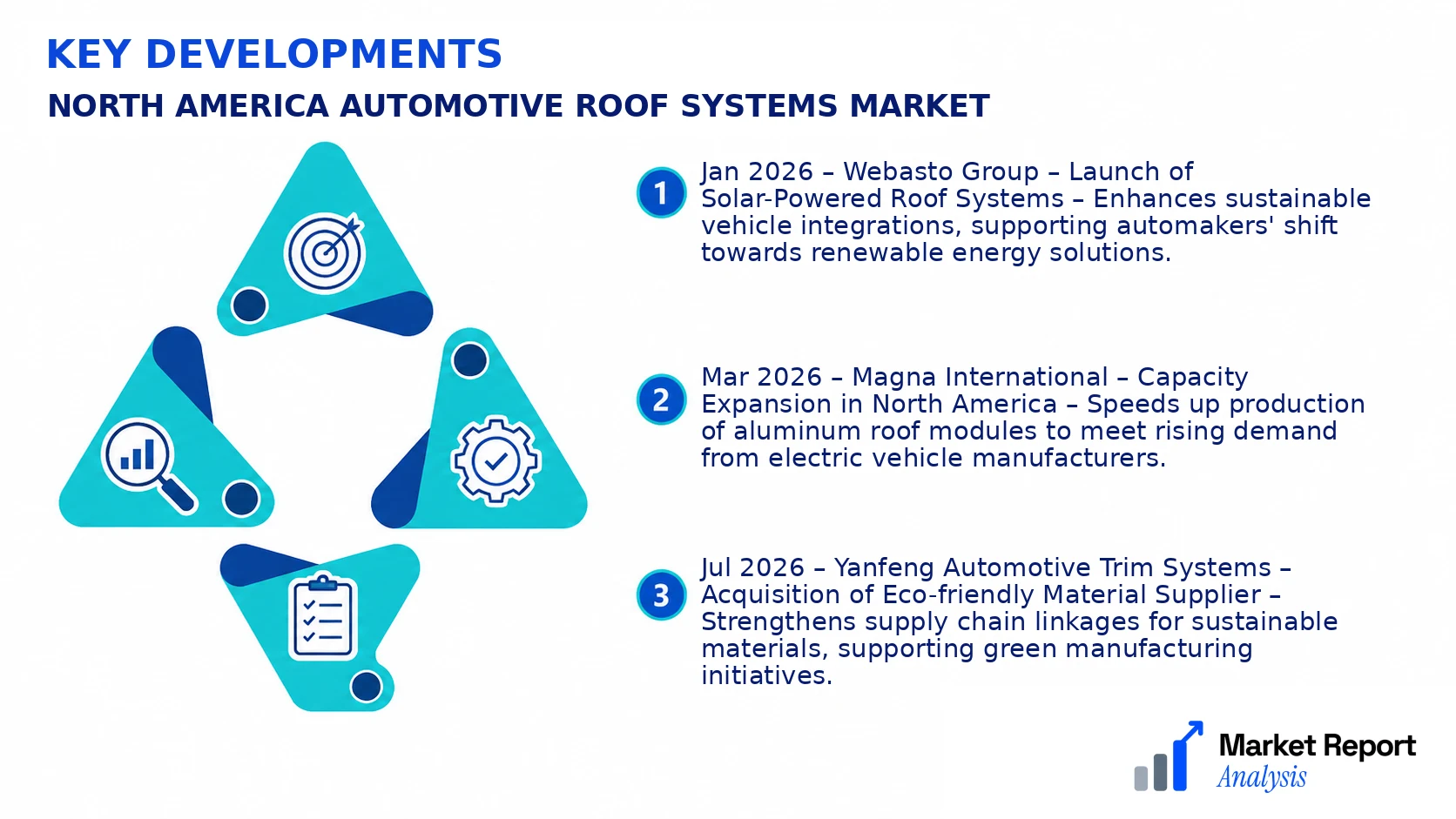
- Jan 2026 – Webasto Group – Launch of Solar-Powered Roof Systems – Enhances sustainable vehicle integrations, supporting automakers' shift towards renewable energy solutions.
- Mar 2026 – Magna International – Capacity Expansion in North America – Speeds up production of aluminum roof modules to meet rising demand from electric vehicle manufacturers.
- Jul 2026 – Yanfeng Automotive Trim Systems – Acquisition of Eco-friendly Material Supplier – Strengthens supply chain linkages for sustainable materials, supporting green manufacturing initiatives.
- Sep 2026 – Inteva Products – Strategic Alliance with Tech Innovator for Smart Roof Modules – Facilitates development of digitally connected, intelligent roof systems with enhanced safety features.
- Oct 2026 – Delphi Technologies – Launch of Electric Roof-Integrated Power Modules – Supports the expansion of electric vehicle platforms with integrated energy solutions.
Frequently Asked Questions
What is the North America Automotive Roof Systems Market?
The North America Automotive Roof Systems Market encompasses the industry involved in manufacturing and supplying roof systems for vehicles, including sunroofs, panoramic roofs, and roof rails. It caters to automotive OEMs and aftermarket suppliers within the region, reflecting vehicle design trends and technological advancements.
What is the current market size of North America Automotive Roof Systems Market?
As of 2026, the market size for North America Automotive Roof Systems is valued at approximately USD 4.8 Billion, driven by the increasing demand for luxury and electric vehicles, along with innovations in roof design and materials that enhance vehicle aesthetics and functionality.
What factors are driving the North America Automotive Roof Systems Market?
Key drivers include rising consumer preference for premium vehicles with stylish, customizable roofs; technological advancements like panoramic sunroofs; rising vehicle electrification; and automaker efforts to improve vehicle aerodynamics and aesthetics to attract customers in a competitive market.
Which region dominates the North America Automotive Roof Systems Market?
The United States leads the North America Automotive Roof Systems Market, accounting for the largest share due to its high vehicle production, technological innovation hubs, and strong aftermarket demand, followed by Canada and Mexico incrementally.
Which segment is expected to grow the fastest?
The panoramic roof segment is anticipated to witness the highest growth, owing to increasing consumer preference for enhanced in-cabin experience, increasing integration with electric vehicles, and automakers’ focus on luxury feature differentiation.
Who are the leading companies operating in the North America Automotive Roof Systems Market?
Major players include Webasto SE, Inalfa Roof Systems, and Yachiyo Industry Co., Ltd., who lead in innovation, strategic collaborations, and market share, competing closely to supply advanced roof systems to automakers across North America with a focus on sustainability and design.
Analyst Perspective
The North America automotive roof systems market is poised for sustained growth through 2034, driven by rising consumer demand for vehicle customization and advanced roof functionalities. Long-term, the market is expected to mature, with innovation increasingly focused on lightweight materials, integrated solar panels, and smart roof systems that enhance vehicle connectivity. Commercial opportunities lie in developing modular roof solutions for electric vehicles (EVs) and autonomous cars, which require versatile, durable, and energy-efficient components. Technology evolution will likely prioritize material science advances, including composites that reduce weight without compromising strength, alongside environmentally sustainable manufacturing processes. Investments should target R&D in smart materials and systems, strategic partnerships with OEMs, and expanding manufacturing capacities in regions with high vehicle production volumes. Competitive intensity remains high, with established players and new entrants vying for market share, particularly in premium and electric vehicle segments. Regional growth potential is concentrated in emerging markets within North America, where increasing vehicle throughput and regulatory support for green technologies offer lucrative expansion prospects.
