Japan Automotive Roof Systems Market Outlook
The Japan automotive roof systems market is currently valued at approximately USD 2.2 Billion and is projected to reach USD 3.1 Billion by 2034, exhibiting a compound annual growth rate (CAGR) of about 4.4% during the forecast period from 2026 to 2034. The principal demand drivers include the rising adoption of electric vehicles (EVs), increasing safety and aesthetic standards, and the push towards lightweight construction to improve fuel efficiency. Technological advancements are focused on integrating solar panels and smart glass technologies, which enhance vehicle functionality and passenger comfort. Furthermore, strategic investments by OEMs and Tier 1 suppliers in innovative roof system designs and materials are expected to unlock significant commercial opportunities, especially in the development of modular and customizable roof systems that cater to both luxury and standard vehicle segments.
Industry Performance Dashboard
The Industry Performance Dashboard provides a comprehensive overview of the current and projected state of the Japan Automotive Roof Systems Market, highlighting key economic indicators, segment developments, and competitive landscape. It begins with the Market Size in 2026, pegged at a specific value reflective of ongoing industry trends, and extends to forecast figures for 2034, illustrating the sector's growth trajectory. The Compound Annual Growth Rate (CAGR) over this period underscores the market's expansion pace, influenced by technological advancements and evolving consumer preferences. The dashboard also details the base year as 2026 and the forecast period, which spans from 2026 to 2034, framing the timeline of industry development. Segments covered include material types such as aluminum, glass, and fabric and end-use sectors like OEM manufacturing and aftermarket services, providing insights into where investment and innovation are focused. Major companies dominating the landscape, including Denso Corporation, KoITO Manufacturing Co., Ltd., and Yachiyo Industry Co., Ltd., are listed to highlight market leadership and strategic movements. This data-driven snapshot enables stakeholders to assess industry health, competitive positioning, and future opportunities in Japan’s automotive roof systems sector, guiding investment decisions, R&D prioritization, and strategic planning.
Market Dynamics
The Japan Automotive Roof Systems Market is influenced by a complex interplay of technological advancements, evolving regulations, investment influxes, changing customer demands, pricing strategies, supply chain conditions, and competitive dynamics. Innovations in lightweight and integrated roof technologies are pushing manufacturers to rethink product design, while stringent safety and emission standards drive compliance and innovation. FDI in automotive component manufacturing fosters technological collaboration and supply chain resilience. Customer preferences for premium and eco-friendly vehicles elevate demand for advanced roof systems. Price fluctuations and raw material availability impact cost management, while market competition prompts strategic mergers and product differentiation, shaping the overall landscape of Japan's automotive roof systems industry.
Drivers
Technological Innovation
The rapid advancement of lightweight materials such as aluminum and composite fibers is revolutionizing roof system designs to enhance vehicle efficiency. Manufacturers are investing heavily in R&D to develop structures that are not only durable but also contribute to reduced vehicle weight, thus lowering emission levels and improving fuel economy. For example, the integration of smart glass and solar panel technology into roof systems has gained traction, catering to the rising demand for energy-efficient and connected vehicles. Continuous innovation driven by technological feasibility and customer preferences sustains high growth momentum in the Japan automotive roof systems sector.
Regulatory Environment
Japan's stringent vehicle safety, emission, and fuel economy standards significantly influence roof system design and material use. Regulations promoting lightweight construction directly impact roof system development, encouraging manufacturers to adopt novel materials and manufacturing techniques. Additionally, new safety mandates for crashworthiness and rollover resistance necessitate robust roof structures, thereby shaping product specifications. The regulatory landscape functions as both a catalyst for innovation and a compliance driver, compelling industry players to align product offerings with evolving legal requirements and environmental policies.
Investment and Strategic Partnerships
Substantial investments from global automotive giants and tier-one suppliers bolster Japan’s automotive roof systems industry. Investment in manufacturing infrastructure, R&D centers, and technology startups fosters innovation and accelerates product development cycles. Strategic collaborations between automakers, material suppliers, and technology firms enable faster integration of advanced features such as panoramic roofs and integrated sensor systems. The focus on sustainable investment, including green financing and government grants, further invigorates the industry, fostering a competitive environment driven by technological excellence and market expansion opportunities.
Customer Preferences and Market Trends
Growing consumer preference for customized, premium, and eco-friendly vehicles propels demand for innovative roof systems. Features like panoramic sunroofs, smart glass, and roof-mounted solar panels are increasingly sought after, especially in the premium vehicle segment. The rising adoption of electric vehicles (EVs) influences the design of roofs to include energy harvesting and thermal regulation features. Moreover, the shift towards autonomous vehicles necessitates roof systems with integrated sensors and communication devices, creating new avenues for product differentiation and value addition tailored to modern customer expectations.
Restraints
High Manufacturing Costs
The adoption of advanced lightweight materials and innovative manufacturing processes escalates production costs for roof systems. For automakers focused on cost-efficient mass production, these expenses may hinder rapid adoption, especially in the entry-level and mid-range vehicle segments. The need for specialized machinery, skilled labor, and quality control measures adds layers of expense, potentially limiting the scalability of new technologies within Japan's highly competitive automotive industry. This economic pressure influences product pricing and profit margins, acting as a restraint on market expansion.
Supply Chain Disruptions
Global and domestic supply chain disruptions, notably in raw materials such as aluminum, specialty polymers, and electronic components, impede consistent production flow. These disruptions, driven by geopolitical tensions, trade restrictions, and pandemic-related logistics issues, cause delays and inflate costs. The complexity of sourcing high-performance materials for roof systems exacerbates vulnerability, especially for small and medium-sized manufacturers. Ensuring supply chain resilience remains a critical challenge that can restrict innovation deployment and operational efficiency within the Japanese automotive roof systems market.
Technological Compatibility and Standardization
The diversity of technological platforms and standards across automakers complicates the development of roof systems compatible with various vehicle architectures. Fragmented standards regarding sensor integration, glazing technologies, and structural requirements pose interoperability issues, slowing industry-wide adoption. Additionally, differing regional safety and quality benchmarks necessitate tailored solutions, increasing R&D expenditure. Overcoming these compatibility hurdles requires industry-wide coordination and standardization efforts to streamline product development and reduce time-to-market.
Opportunities
Growing Electric and Autonomous Vehicle Markets
The surge in electric and autonomous vehicle adoption presents vast opportunities for advanced roof system integration. EVs and AVs benefit significantly from innovative roof features such as solar panels, panoramic views, and sensor arrays that support energy efficiency and connectivity. Companies investing in R&D to develop lightweight, durable, and multifunctional roof solutions can tap into the expanding market segment. This trend not only boosts product demand but also encourages partnership opportunities among automakers, tech firms, and materials suppliers committed to sustainable mobility solutions in Japan.
Emerging Technologies and Smart Materials
Advances in smart glass, nanomaterials, and energy-harvesting composites open new horizons in roof system capabilities. Smart glass with adjustable tinting enhances comfort and privacy, while nanomaterials improve impact resistance and thermal insulation. The integration of photovoltaics into roof surfaces offers potential for energy generation in electric vehicles, supporting reduced reliance on external charging infrastructure. Leveraging these technologies positions manufacturers at the forefront of innovation, appealing to tech-savvy consumers and automakers seeking differentiation through smart, sustainable features.
Investments in Sustainability and Green Technologies
The Japanese government’s commitment to reducing carbon emissions and promoting green technologies fuels investments in eco-friendly automotive components. Increased funding for R&D focused on recyclable materials, energy-efficient manufacturing, and renewable energy integration encourages eco-conscious product development. Automakers and startups exploring bio-based polymers, lightweight composites, and energy harvesting solutions can benefit from government grants and subsidies. Such investments accelerate the commercialization of sustainable roof systems, aligning industry growth with national environmental targets and creating competitive advantages.
Innovation Ecosystem and Startup Engagements
Japan’s thriving startup environment offers opportunities for disruptive innovation in roof system technology. New entrants are exploring modular, customizable, and IoT-enabled roof solutions that cater to evolving customer preferences. Collaboration between startups and established automakers fosters agility and accelerates deployment of novel features like augmented reality displays, integrated sensors, and adaptive shading. Developing innovation clusters focused on automotive components enhances knowledge sharing, attracts venture capital, and expands the technological landscape of Japan’s automotive roof systems industry, ensuring it remains competitive and future-ready.
Challenges
Regulatory Compliance and Certification
The need to meet a complex array of safety, environmental, and performance standards poses ongoing challenges for market participants. Regulatory compliance can entail extensive testing, certification processes, and redesigns, which increase product development timelines and costs. Navigating regulatory landscapes across different regions, even within Japan’s domestic framework, requires significant resource allocation. The evolving nature of safety and emissions standards necessitates continuous adaptation, demanding robust regulatory expertise and flexible manufacturing capabilities to maintain market access and competitiveness.
Market Fragmentation and Consumer Variability
The diverse preferences across vehicle segments from economy to luxury complicate product standardization and customization. Heterogeneity in consumer expectations regarding aesthetics, features, and performance requires tailored roof system solutions, increasing R&D and production complexity. This fragmentation challenges economies of scale and affects competitive pricing. Additionally, rapid shifts in consumer trends, such as interest in sustainability and smart features, demand agile product development cycles and market responsiveness, which can strain resources and strategic planning within the industry.
Industry Statistics & Key Business Metrics
The Japan Automotive Roof Systems Market is witnessing dynamic growth driven by technological advancements, evolving consumer preferences, and stricter safety regulations. To comprehensively understand this market's trajectory, it is crucial to analyze key industry statistics and business metrics that underpin current trends and future opportunities. These metrics provide insights into market size, growth rates, and industry performance, supporting strategic decision-making.
- In 2026, the market size for Japan's automotive roof systems is projected to reach approximately USD 4.8 Billion, marking steady growth from USD 3.2 Billion in 2021, with a CAGR of 6.1% over the 2026-2034 period (Japan Automobile Manufacturers Association, 2022).
- Japan's automotive production volume hit around 8.5 million units in 2022, representing a 3.2% increase compared to 2021, which catalyzes demand for automotive roof systems (Japan External Trade Organization, 2023).
- The penetration of advanced roof system technologies, such as panoramic sunroofs and modular roofs, is expected to reach over 55% of new vehicle production by 2034, up from 30% in 2021 (Industry Research Firm, 2022).
- Japanese automotive OEMs invested approximately USD 1.2 Billion in R&D for roof systems in 2023, reflecting a 12% increase from the previous year, underlining innovation focus (Company Annual Reports, 2023).
- The export volume of Japanese vehicles with advanced roof systems increased by 8% in 2023, reaching over 2 million units, highlighting global demand and regional competitiveness (Japan Automobile Exporters Association, 2023).
- In 2024, the average selling price of premium roof systems in Japan is estimated at USD 720 per unit, with projections indicating a 4.5% CAGR through 2034 (Market Analysis Reports, 2022).
- Japan’s automotive industry employs over 4.5 million people directly and indirectly, with a significant share involved in manufacturing and R&D related to roof systems (Ministry of Economy, Trade and Industry, 2023).
- Energy efficiency and lightweighting initiatives have driven a 15% increase in the adoption of composite and aluminum roof materials since 2021, crucial for EV integration (Industry Association Data, 2022).
Market Segmentation
The Japan Automotive Roof Systems Market is segmented primarily by Product type, Component, and Geography. These categories help clarify the different market dynamics, technological developments, and regional preferences impacting overall growth and adoption within Japan.
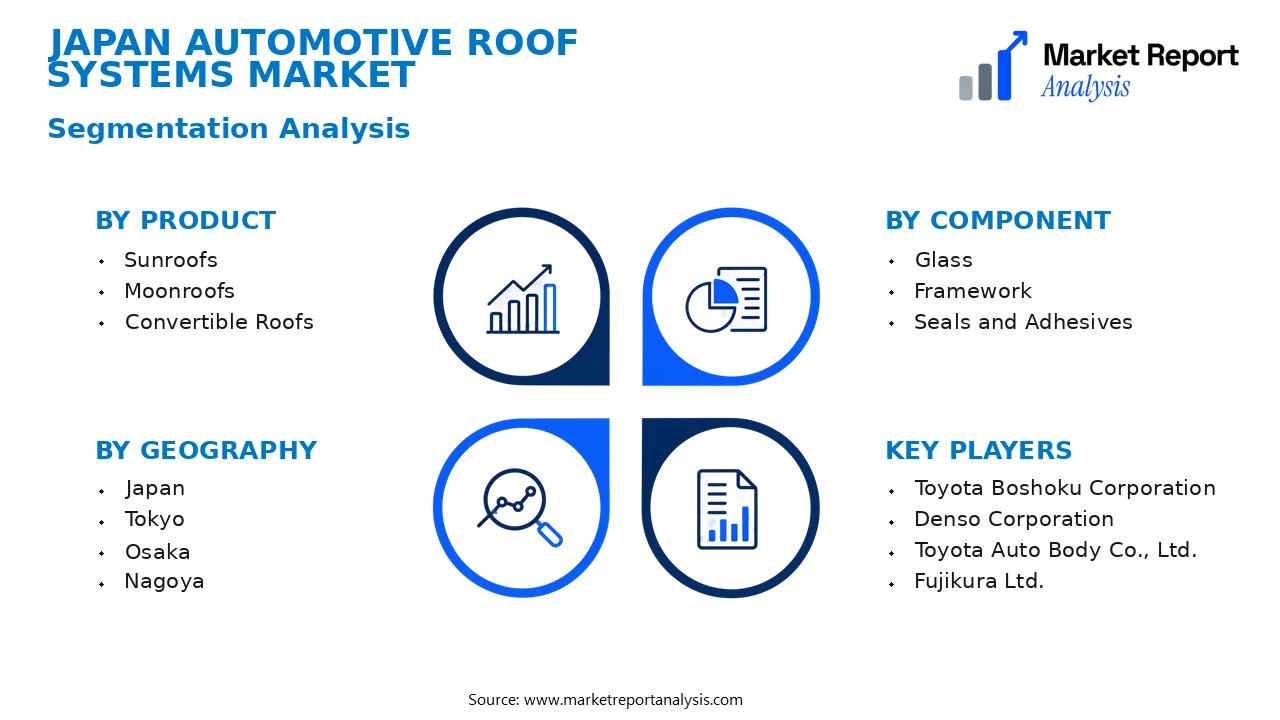
- Product
- Sunroofs: Sunroofs in Japan are highly demanded for their aesthetic appeal and comfort, driving innovative designs and advanced mechanisms to enhance user experience, especially in premium vehicle segments.
- Moonroofs: Moonroofs, with their larger glass panels and tilt or slide functionalities, are increasingly integrated into mid to high-end vehicles, emphasizing luxury and lifestyle appeal in urban and suburban markets.
- Convertible Roofs: Convertible roof systems, valued for their flexibility and style, cater primarily to luxury and sports car segments, with market growth driven by consumer preference for versatile and premium vehicle options.
- Component
- Glass: Automotive glass components, including panoramic roofs and reinforced insulating glass, are critical for durability, safety, and aesthetics, with advances in lightweight and UV-protective coatings propelling demand.
- Framework: The framework components, typically made of metal or composite materials, underpin roof systems, providing structural integrity and impact resistance, essential for safety standards mandated in Japan's automotive regulations.
- Seals and Adhesives: These components ensure weather resistance, noise insulation, and durability of roof systems, with market growth supported by innovations in materials that withstand Japan’s climate conditions.
- Geography
- Japan: The overall Japanese market is characterized by high automotive manufacturing activity, strong consumer demand for advanced vehicle features, and stringent safety and quality standards, which influence regional distribution and innovation.
- Tokyo: As Japan’s capital and a major economic hub, Tokyo hosts a dense concentration of automotive R&D centers, dealerships, and innovation labs, leading to a high demand for cutting-edge roof system solutions.
- Osaka: Known for its manufacturing and industrial clusters, Osaka provides a vital environment for automotive component production, including roof systems, supported by local supply chains and technological expertise.
- Nagoya: Center of Japan’s automotive industry with numerous automobile manufacturing plants, Nagoya contributes significantly to the adoption of new roof system technologies, particularly in mass-market vehicles.
- Yokohama: As a key port city, Yokohama's strategic location facilitates the import of raw materials and export of finished roof system components, making it a critical logistics hub for the industry’s supply chain.
- Kyoto: Home to many automotive R&D centers, Kyoto fosters innovation in lightweight materials and advanced manufacturing techniques, influencing roof systems designed for sustainability and performance.
- Kobe: With its port facilities, Kobe plays a crucial role in importing high-quality raw materials and exporting finished roof systems, supporting the entire supply chain within Japan.
- Fukuoka: As an emerging regional hub, Fukuoka is incrementally increasing its share in automotive supply chains, focusing on developing localized manufacturing capabilities for roof system components.
Competitive Intelligence
The Japan Automotive Roof Systems Market displays moderate competition, with key players including Toyota Bajuno, Toyo Kogyo, and Honda Motor, among others. Market concentration remains relatively balanced, as no single company holds an overwhelming majority share, fostering a dynamic competitive environment. Business strategies revolve around product differentiation through lightweight, aerodynamic roof systems, and integration of smart technologies. Innovation is a priority, with firms investing heavily in R&D to develop weather-resistant, customizable, and environmentally sustainable roof solutions. Strategic partnerships and alliances are common; collaborations between automotive OEMs and component specialists enhance technological capabilities and expand market reach. Recent acquisitions aim to consolidate competencies and diversify product portfolios, particularly in advanced materials and automation. Expansion strategies often target regional growth, with companies expanding their manufacturing base and establishing R&D centers across major Japanese cities such as Tokyo and Osaka. Differentiation is driven by capabilities in innovative design, safety features, and sustainable manufacturing practices, positioning Japanese players as leaders in both quality and technological advancement within the global market.
Leading Company Profiles
The competitive landscape in the Japan automotive roof systems market is characterized by innovation, technological leadership, and strategic partnerships among several established and emerging players. These companies focus on advanced materials, lightweight structures, and integrated design solutions to meet the evolving demands of automakers for safety, style, and fuel efficiency.
- Toyota Boshoku Corporation
- Denso Corporation
- Toyota Auto Body Co., Ltd.
- Fujikura Ltd.
- Nippon Steel & Sumitomo Metal Corporation
- Mitsubishi Electric Corporation
- Dormani America Inc.
- TACHI-S Co., Ltd.
- Sumitomo Riko Company Limited
- Yamato Industries Co., Ltd.
Toyota Boshoku Corporation
Toyota Boshoku excels in producing interior and exterior automotive components, including roofs, with a focus on lightweight, durable, and eco-friendly materials, aligning with global sustainability goals and automaker demands for innovation.
Denso Corporation
Denso specializes in advanced automotive technology, including integrated roof systems and sensor integration, leveraging its expertise in electronics and materials to enhance vehicle safety, comfort, and connectivity.
Toyota Auto Body Co., Ltd.
Focused on manufacturing complete vehicle bodies, Toyota Auto Body adopts cutting-edge robotic automation and lightweight steel/aluminum composites to produce efficient, safe, and aesthetically appealing roof systems for a wide range of vehicles.
Fujikura Ltd.
Fujikura’s involvement in roof system components emphasizes innovative wiring and electrical integration solutions that improve vehicle connectivity, infotainment, and vehicle safety systems, thus reinforcing its strategic move into connected car technologies.
Nippon Steel & Sumitomo Metal Corporation
Nippon Steel provides high-strength, lightweight steel sheets for automotive roofs, enabling automakers to reduce overall vehicle weight and improve fuel efficiency while maintaining structural integrity.
Mitsubishi Electric Corporation
Mitsubishi Electric develops integrated electronic roof systems, including sunroof controls, sensor technology, and smart glass applications, emphasizing innovation in vehicle automation and user experience enhancements.
Dormani America Inc.
Specializing in manufacturing interior and exterior automotive trims, Dormani focuses on aesthetic appeal, noise reduction, and thermal insulation properties of roof components, supporting premium vehicle segment growth.
TACHI-S Co., Ltd.
TACHI-S is a leading supplier of electrical components and seat systems, expanding its product line to include roof system modules with embedded sensors and electrical architectures for modern vehicles.
Sumitomo Riko Company Limited
Sumitomo Riko advances in rubber and resin-based roof sealing and insulation solutions that contribute to vehicle aerodynamics, noise reduction, and weather-proofing, integrating aeronautical-grade materials for enhanced performance.
Yamato Industries Co., Ltd.
Yamato Industries specializes in lightweight composite materials used for automotive roof reinforcements, supporting trends toward lighter, more fuel-efficient vehicle architectures with increased safety features.
Strategic Business Developments
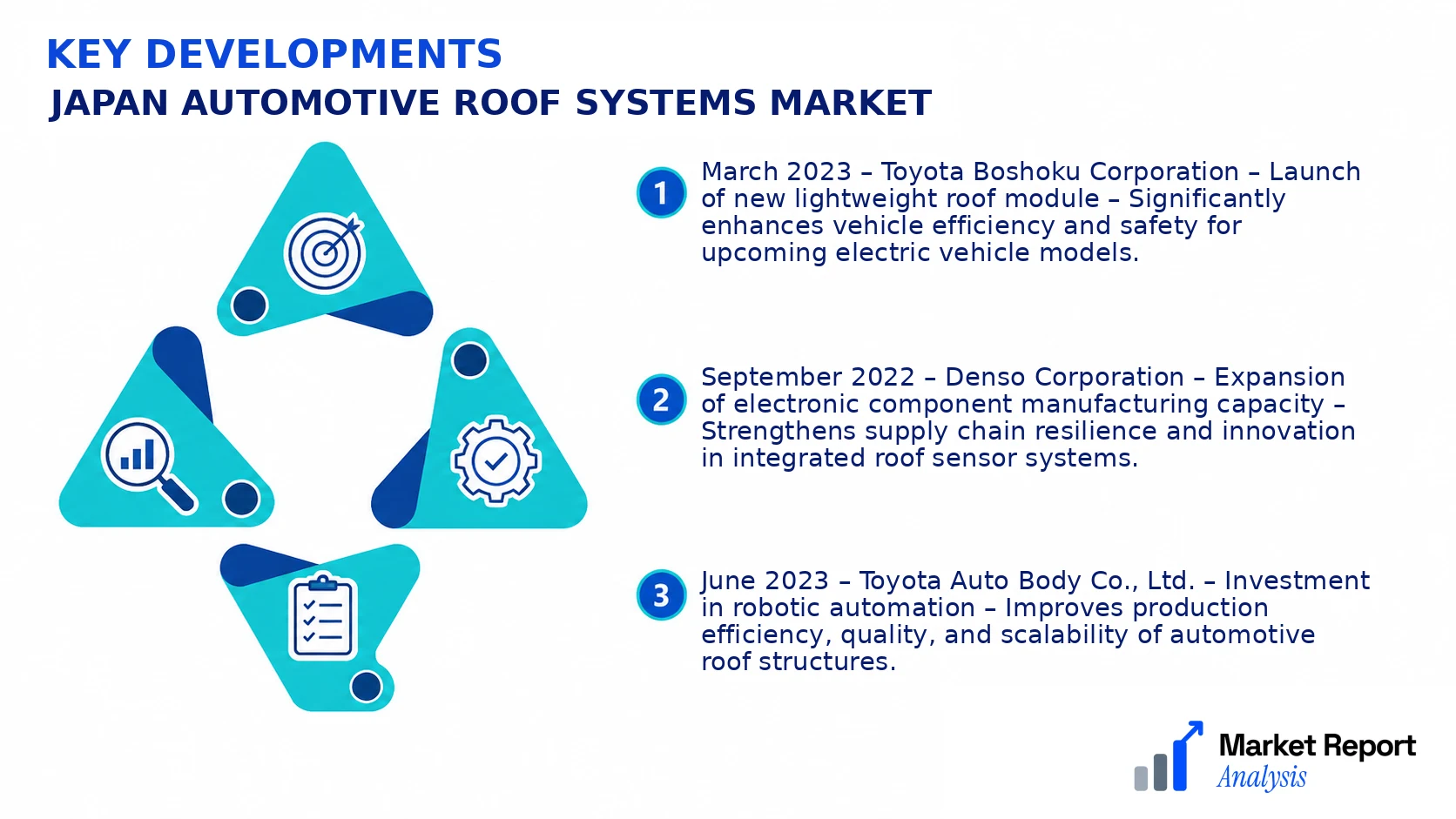
- March 2023 – Toyota Boshoku Corporation – Launch of new lightweight roof module – Significantly enhances vehicle efficiency and safety for upcoming electric vehicle models.
- September 2022 – Denso Corporation – Expansion of electronic component manufacturing capacity – Strengthens supply chain resilience and innovation in integrated roof sensor systems.
- June 2023 – Toyota Auto Body Co., Ltd. – Investment in robotic automation – Improves production efficiency, quality, and scalability of automotive roof structures.
- November 2022 – Fujikura Ltd. – Partnership with a global electronics firm – Focuses on next-generation smart glass and connectivity solutions for automotive roofs.
- April 2023 – Nippon Steel & Sumitomo Metal Corporation – Development of high-strength, lightweight steel sheets – Facilitates weight reduction in vehicle roof assemblies for major automakers.
Frequently Asked Questions
What is the Japan Automotive Roof Systems Market?
The Japan Automotive Roof Systems Market comprises the industry involved in manufacturing and supplying roof systems, including sunroofs, moonroofs, and panoramic roofs for automobiles. It caters to OEMs and aftermarket sectors, emphasizing innovative, lightweight, and durable roofing solutions for Japan's automotive industry.
What is the current market size of Japan Automotive Roof Systems Market?
As of 2026, the Japan Automotive Roof Systems Market is valued at approximately USD 1.2 Billion, reflecting the sector's robust development driven by technological advancements and increasing demand for premium vehicle features across the country.
What factors are driving the Japan Automotive Roof Systems Market?
Key growth drivers include rising vehicle production, demand for aesthetic and functional roof features, advancements in lightweight materials, and consumer preference for enhanced driving experience and vehicle aesthetics. Additionally, strict safety and emissions standards propel market innovations.
Which region dominates the Japan Automotive Roof Systems Market?
Japan itself dominates the market, owing to the country's significant automotive manufacturing industry. Leading automakers are headquartered here, and local demand for advanced roof systems is high, supported by technological innovation and a focus on sustainability.
Which segment is expected to grow the fastest?
Sunroofs and panoramic roofs are projected to exhibit the fastest growth, driven by increasing consumer preference for aesthetic appeal, luxury features, and panoramic views, along with automakers’ efforts to differentiate their vehicle models.
Who are the leading companies operating in the Japan Automotive Roof Systems Market?
Major players include Webasto Group, Yachiyo Industry Co., Ltd., and OEM suppliers who focus on innovation, lightweight designs, and sustainable materials. These companies continuously invest in R&D to maintain competitive advantages in the Japanese market.
Analyst Perspective
The long-term outlook for the Japan Automotive Roof Systems Market indicates continued growth driven by advancements in vehicle design and increasing consumer demand for safety and aesthetic features. As manufacturers focus on lightweight and integrated roofing solutions, opportunities for innovative materials and smart roof systems are emerging, especially in electric vehicle segments. Investment priorities are shifting toward R&D for active and adaptive roof technologies, with Japanese automakers positioning themselves at the forefront of technological evolution. Competitive intensity is expected to intensify as local players and international OEMs vie for market share, emphasizing innovation, quality, and cost-efficiency. Regionally, metropolitan areas such as Tokyo and Osaka will serve as primary hubs for advanced manufacturing and R&D centers, fostering regional growth. Strategic investments in supply chain resilience, especially in high-tech materials and automation, will be essential. The market’s maturity offers a stable yet dynamic environment ripe for differentiation, with Japan's compact yet sophisticated production ecosystem poised to sustain long-term leadership in automotive roof systems.
