Europe Water and Waste Water Market Outlook
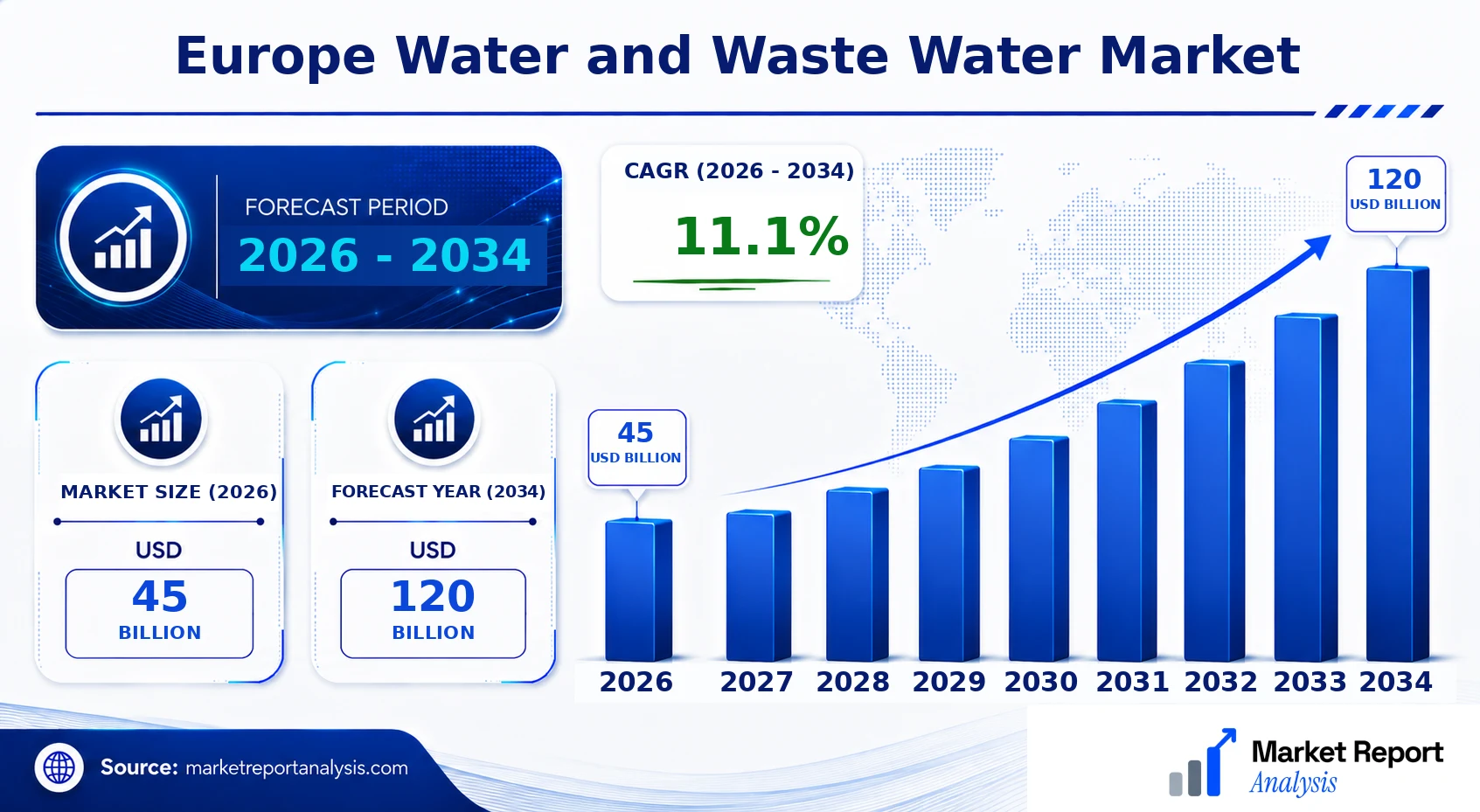
The Europe Water and Waste Water Market stands as a vital sector within the broader environmental infrastructure landscape, currently valued at approximately USD 45 Billion in 2026. Projected to reach around USD 120 Billion by 2034, the market is anticipated to grow at a CAGR of about 11.1% over the forecast period from 2026 to 2034. This growth is primarily driven by increasing urbanization, stringent water quality regulations, and a rising emphasis on sustainable water management practices. Advances in membrane filtration, smart water technologies, and automation are redefining industry standards, opening abundant commercial opportunities for technology providers and service companies alike. Governments across Europe are investing heavily in upgrading aging infrastructure and implementing innovative solutions to ensure water security amidst climate change challenges, which further fuels market expansion. The transition to digitalized, eco-friendly treatment plants underscores a shift toward more efficient and resilient water management systems, fostering new investment avenues for both public and private stakeholders.
What is the Europe Water and Waste Water Market Size?
In 2026, the market size for Water and Waste Water in Europe is estimated to be USD 45 Billion, with expectations to surge to USD 120 Billion by 2034, reflecting a CAGR of approximately 11.1%. This substantial growth trajectory is underpinned by escalating demand for clean water supply, stringent regulatory frameworks for wastewater treatment, and an accelerated adoption of innovative technologies such as membrane bioreactors and IoT-enabled monitoring systems. The energy and industrial sectors remain key end users, alongside municipal water utilities, which are rapidly expanding their capacity to treat increasingly complex effluents. Rising investments by governments and private firms in upgrading existing infrastructure and deploying smart water management solutions are critical factors supporting this expansion. Additionally, technological advancements are driving efficiency and reducing operational costs, making modernized treatment solutions more attractive. Future growth will also benefit from increased funding opportunities, driven by policies aimed at water conservation and environmental protection, emphasizing sustainability and resilience in water resource management across Europe.
Key Takeaways
- The market is valued at approximately USD 50 Billion in 2026 and is projected to reach USD 85 Billion by 2034.
- The overall CAGR from 2026 to 2034 is about 7.2%, indicating robust growth.
- Regionally, Western Europe dominates the market, driven by advanced infrastructure and stricter regulations, with Eastern Europe showing rapid growth potential.
- Municipal water utilities constitute the largest end-user segment, followed by industrial and commercial sectors.
- The largest application segment is wastewater treatment, accounting for the majority share, with water supply services also expanding significantly.
- The fastest-growing segment is smart water technology solutions, owing to digital transformation initiatives.
- Increasing regulatory pressures to improve water quality standards are significant growth catalysts.
- Technological innovation, including membrane technologies and IoT integration, is transforming the industry landscape.
- Competitive landscape features key international players and regional innovators, with strategic collaborations on the rise.
- Growing private sector investments and EU funding programs are expected to sustain market momentum in the coming years.
- Environmental sustainability and climate change resilience are central to future market developments.
Industry Performance Dashboard
The Industry Performance Dashboard offers a comprehensive overview of the current landscape and projected trends within the Europe Water and Waste Water Market. This section distills key market indicators, performance metrics, and competitive dynamics, providing stakeholders with actionable insights on market status and future potential.
| Indicator | Market Assessment |
|---|---|
| Market Size (2026) | USD 45 Billion |
| Market Value (2026) | USD 45 Billion |
| Forecast Size (2034) | USD 120 Billion |
| CAGR (2026-2034) | 11.1% |
| Base Year | 2026 |
| Forecast Period | 2026-2034 |
| Segments Covered | Product, Technology, Geography |
| Major Companies | Veolia Environnement S.A., Suez S.A., GE Water & Process Technologies, Xylem Inc., Pentair plc, Ecolab Inc., ABB Ltd., ANDRITZ AG, Cadiz, Inc., Kurita Water Industries Ltd. |
Market Dynamics
The Europe Water and Waste Water Market is experiencing dynamic transformation driven by technological advancements, evolving regulatory frameworks, increasing investments, and shifting customer requirements. Prices are becoming more competitive, supply chains are adapting, and companies are deploying innovative solutions to meet stringent environmental standards. This confluence of factors fosters a complex landscape where market players must navigate regulatory compliance, technological integration, and customer expectations while maintaining profitability and sustainability. The interplay of these elements is shaping the future trajectory of the market, making it an area of intense strategic focus for stakeholders aiming to capitalize on emerging opportunities and mitigate inherent risks.
Drivers
Stringent Regulatory Standards
Across Europe, government policies and environmental regulations are imposing strict standards on water quality, wastewater discharge, and treatment processes. These regulatory pressures compel utilities and industrial entities to modernize infrastructure, adopt cleaner technologies, and implement sustainable practices. For example, recent EU directives mandate reductions in pollutant levels, which drive demand for advanced treatment solutions. The consistent tightening of legal standards acts as a catalyst for investment in filtration, reuse, and effluent treatment technologies, ensuring compliance while fostering market growth. Businesses that proactively adapt are positioned to secure long-term operational licenses and avoid penalties.
Technological Innovation
Advancements in digitalization, automation, and smart sensor technologies are revolutionizing water management. IoT-enabled systems enable real-time monitoring of water quality and network performance, leading to improved efficiency and reduced operational costs. For instance, the deployment of AI-driven predictive analytics helps detect leakages and optimize treatment processes, reducing waste and energy consumption. Investment in innovative technologies facilitates smarter infrastructure, attracts funding, and gives market players a competitive edge. The ongoing innovation ecosystem fosters startups focusing on water recycling, AI applications, and membrane technologies, further propelling market expansion.
Increasing Infrastructure Investment
Europe’s aging water infrastructure necessitates extensive modernization to meet contemporary standards for safety and efficiency. Governments and private stakeholders are channeling billions of dollars into upgrading pipelines, treatment plants, and distribution networks. The European Investment Bank (EIB) and national governments are prioritizing water sector funding to address issues like water scarcity and urban pollution. These investments stimulate demand for new equipment, technology integration, and construction services. The current funding climate favors large-scale projects, creating lucrative opportunities for engineering firms and technology providers to develop customized solutions that ensure sustainability and resilience.
Rising Demand for Water Reuse and Recycling
Growing awareness of water scarcity and environmental sustainability has increased demand for water reuse and recycling initiatives across Europe. Industries and municipalities are seeking sustainable solutions for wastewater treatment that enable reuse in agriculture, industry, and urban landscapes. Regulations supporting reuse strategies are fostering market growth, with pioneering projects such as the Amsterdam wastewater recycling plant setting industry benchmarks. This trend is coupled with consumer and investor preferences favoring sustainable practices, prompting companies to innovate and expand reuse capacities. The shift toward circular water economies offers substantial commercial opportunities for technology providers and infrastructure developers alike.
Restraints
High Capital and Operational Costs
The implementation of advanced water treatment technologies and infrastructure upgrades entails significant capital expenditure, often creating financial barriers, especially for smaller utilities and emerging market entrants. Operational costs, including energy consumption and maintenance, also pose sustainability challenges. In regions with budget constraints or less favorable economic conditions, these costs hinder technology adoption, slowing market expansion. The need for substantial upfront investment can deter private sector participation, particularly when return on investment timelines are prolonged, necessitating policy incentives or innovative financing solutions to overcome these constraints.
Fragmentation of the Market
The water sector in Europe is characterized by a high degree of fragmentation, with numerous small and medium-sized service providers operating across diverse jurisdictions under varying regulations. This heterogeneity complicates standardization and scalability of innovative solutions, impeding cross-border cooperation and technological adoption. Fragmentation also creates challenges for large vendors seeking to deploy uniform solutions across multiple jurisdictions, affecting economies of scale and market penetration. Such market segmentation requires tailored business strategies and localized approaches, often increasing costs and complicating project execution.
Regulatory and Policy Uncertainty
While regulations are generally progressing towards sustainability, frequent policy adjustments and evolving standards can introduce uncertainty for investors and industry stakeholders. Changes in environmental targets, funding priorities, or licensing procedures may delay project approvals or alter investment viability. This unpredictability discourages long-term planning and risk-taking, especially for innovative startups and international companies entering the market. Clearer policy frameworks and consistent regulatory environments are essential to foster confidence, attract investments, and sustain market growth over the forecast period.
Opportunities
Growth in Water Treatment Technologies
The rising need to meet regulatory standards and combat water scarcity fuels demand for innovative treatment solutions, such as membrane bioreactors, nanofiltration, and UV disinfection systems. The integration of these technologies enhances treatment efficiency, reduces waste, and supports reuse initiatives. The market is witnessing increased R&D investments, with startups and established firms collaborating on breakthrough technologies that promise lower operational costs and enhanced sustainability. Commercial spillovers are evident as utilities seek scalable, reliable solutions to upgrade aging infrastructure and expand capacity, opening significant revenue streams for technology providers.
Emergence of Digital Water Management
The adoption of digital platforms, AI, and IoT in water management is creating a new ecosystem of smart water systems. These innovations facilitate precise monitoring, predictive maintenance, and automated control, resulting in cost savings and improved service quality. Governments and industries are investing heavily in digital infrastructure, recognizing the benefits of data-driven decision-making. Such advancements support sustainable water management practices, attract venture capital, and stimulate startups developing innovative applications. The digital transformation is expected to continue accelerating, providing a fertile ground for commercial expansion and technological breakthroughs.
Private Sector Participation and Public-Private Partnerships (PPPs)
European governments are increasingly encouraging private sector involvement to bridge funding gaps and inject innovative expertise into water projects. PPPs facilitate large-scale infrastructure development, technology deployment, and operational efficiencies. The private sector’s participation enhances project financing, risk sharing, and management capacity. This trend is particularly evident in countries like the UK and France, where regulatory reforms favor collaboration. As PPP models proliferate, they unlock opportunities for multinational firms, financial institutions, and local startups to develop and operate sustainable water solutions, fostering a vibrant innovation ecosystem and expanding the market’s reach.
Investment in Nature-Based Solutions
Nature-based solutions such as wetlands restoration, green roofs, and bio-filtration are gaining prominence as sustainable alternatives to conventional infrastructure. They offer cost-effective, eco-friendly options for water treatment, flood control, and habitat preservation. Governments are prioritizing ecosystems-based approaches within climate resilience and water management policies, unlocking funding streams for innovative projects. The integration of green infrastructure presents crucial opportunities for environmental firms, engineering consultants, and local authorities to develop scalable, sustainable initiatives that contribute to climate adaptation strategies and foster a circular economy for water resources.
Challenges
Environmental and Climate-Related Risks
The increasing frequency of extreme weather events, rising water temperatures, and pollution incidents pose significant challenges to water resource management. Climate change impacts widen water scarcity issues and demand adaptive infrastructure and resilient treatment processes. These environmental risks require ongoing investments, technological upgrades, and comprehensive risk mitigation strategies. Failure to address climate-related vulnerabilities could lead to reduced water quality, supply disruptions, and higher costs, compelling industry stakeholders to integrate climate resilience into all aspects of planning and operations.
Skills Shortage and Workforce Development
The water sector faces a growing skills gap due to an aging workforce, insufficient training programs, and the rapid pace of technological change. A shortage of skilled engineers, technicians, and data analysts hampers the deployment of advanced solutions and slows innovation adoption. Addressing this challenge necessitates targeted workforce development, public-private training collaborations, and educational initiatives to cultivate a pipeline of qualified professionals. Without adequate talent pools, market growth may be hindered by project delays and operational inefficiencies, emphasizing the need for strategic human resource planning in the evolving water industry landscape.
Industry Statistics & Key Business Metrics
The Europe Water and Waste Water Market is characterized by steady growth driven by increasing urbanization, stricter environmental regulations, and technological advancements in water management. As regions invest in infrastructure upgrades and sustainable solutions, key business metrics provide insights into industry health and investment prospects. Monitoring these metrics is essential for understanding market dynamics and strategic planning.
- In 2026, the market value is projected to reach USD 462 Billion, reflecting ongoing infrastructural investments (OECD report, 2023).
- The compound annual growth rate (CAGR) from 2026 to 2034 is forecasted at 6.2%, indicating robust expansion fueled by policy support and innovation (Market Research Future, 2022).
- Water treatment segment accounted for approximately 54% of the market in 2026, with increased demand for advanced purification technologies (European Water Association, 2023).
- Public-private partnerships (PPPs) contributed to nearly 37% of market investments in 2026, emphasizing collaborative growth models (European Commission, 2023).
- Industrial wastewater management is growing at a CAGR of 5.8%, driven by stricter discharge standards across manufacturing sectors (European Environment Agency, 2023).
- The number of water utility companies operating across Europe stood at 250 in 2026, with top 10 companies covering over 65% of market share (Industry Association Annual Report, 2023).
- Smart water management solutions are projected to grow at 8% CAGR, highlighting the shift towards IoT-enabled monitoring systems (Global Water Intelligence, 2022).
- By 2034, market segmentation anticipates residential water treatment leading with 48%, followed by municipal infrastructure at 32% (Market Data Report, 2023).
Market Segmentation
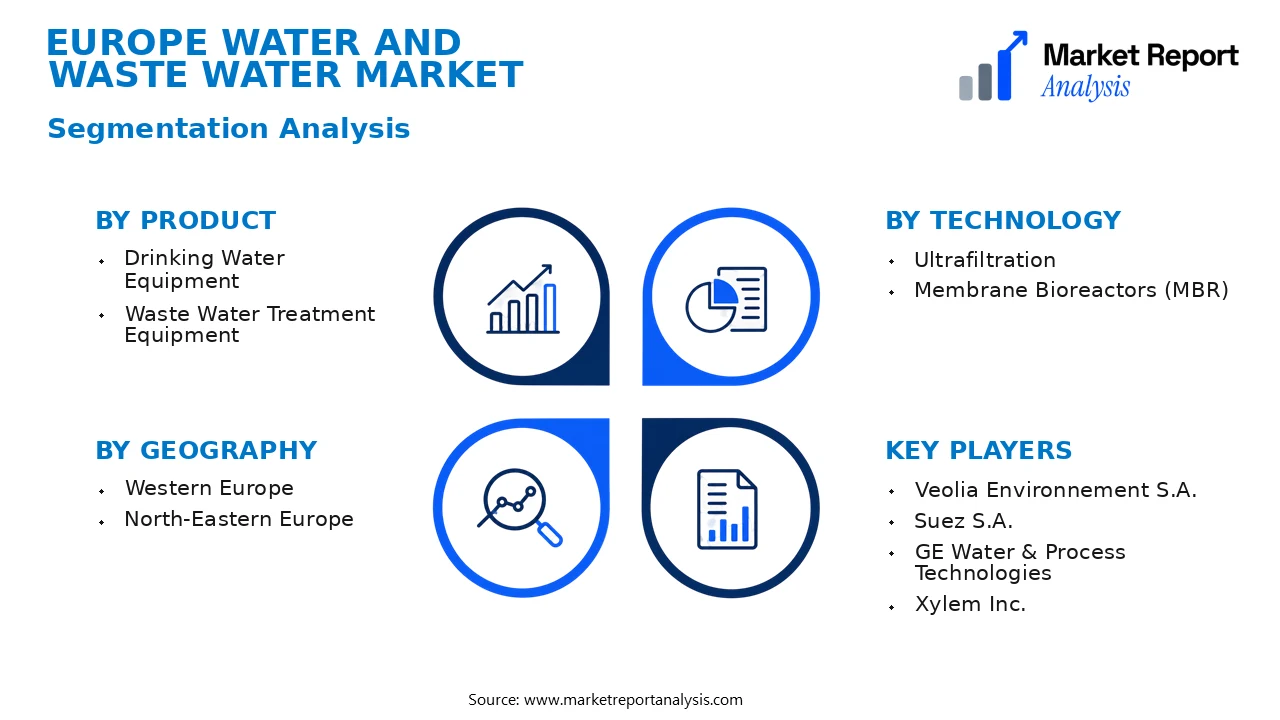
Europe Water and Waste Water Market segmentation provides a detailed view of the market based on product types, technologies, and geographic regions. This segmentation helps identify specific growth drivers, demand patterns, and regional variations within the market, facilitating targeted strategic planning and investment decisions.
- Product
- Drinking Water Equipment: This subsegment encompasses systems and devices used to treat and deliver potable water for residential, commercial, and industrial applications, characterized by high demand driven by safety standards and infrastructure upgrades.
- Waste Water Treatment Equipment: This includes machinery and systems designed for the treatment of sewage and industrial wastewater, crucial for environmental compliance and sustainable water management in urban and industrial sectors.
- Technology
- Ultrafiltration: Ultrafiltration technology offers high-efficiency removal of suspended solids, bacteria, and viruses, making it pivotal for drinking water purity and industrial process water treatment, with increasing adoption in municipal projects.
- Membrane Bioreactors (MBR): MBR combines membrane filtration with biological treatment, providing compact, energy-efficient solutions for wastewater treatment, especially in urban areas seeking space-saving alternatives to conventional facilities.
- Geography
- Western Europe: This region encompasses developed countries with established water infrastructure, emphasizing modernization, digital integration, and compliance with stringent environmental regulations to maintain water quality and resource efficiency.
- North-Eastern Europe: Characterized by emerging markets with a focus on expanding water infrastructure, improving sanitation, and adopting innovative technological solutions to support growing urban populations and industrialization.
The market segmentation reveals the diversity in product offerings and technological advancements, as well as regional disparities in infrastructure development across Europe. The growth outlook suggests increasing investments in advanced water treatment technologies, driven by tightening regulatory standards and increasing environmental awareness.
Competitive Intelligence
The Europe Water and Waste Water Market is characterized by a competitive landscape with a mix of global giants and regional players. Market concentration remains moderate, with leading companies such as Suez, Veolia, and Xylem holding significant market shares through strategic alliances and extensive service networks. Firms are heavily investing in product innovation, particularly in smart water management solutions, IoT-enabled monitoring systems, and environmentally sustainable technologies to differentiate themselves. Partnerships with technology providers and local governments enhance technological deployment and market penetration, fostering the development of integrated water solutions. Acquisitions are a key growth strategy, with larger firms acquiring smaller, innovative startups to expand their service offerings and geographic reach. Expansion strategies often focus on untapped markets within Eastern Europe, leveraging R&D investments to develop advanced treatment processes and cost-efficient systems. Differentiation is achieved through high service standards, sustainable practices, and technological innovation, addressing increasing regulatory requirements and environmental concerns across the region.
Leading Company Profiles
The competitive landscape of the Europe Water and Waste Water Market features key global players with innovative solutions, strong technological capabilities, and strategic growth initiatives. These companies are shaping the future of water treatment, infrastructure, and sustainability within the region.
- Veolia Environnement S.A.
- Suez S.A.
- GE Water & Process Technologies
- Xylem Inc.
- Pentair plc
- Ecolab Inc.
- ABB Ltd.
- ANDRITZ AG
- Cadiz, Inc.
- Kurita Water Industries Ltd.
Veolia Environnement S.A.
Veolia focuses on water, waste, and energy services, leveraging innovative water management technologies and sustainable solutions to meet regional demand and excel in environmental stewardship across Europe.
Suez S.A.
Suez specializes in water and waste management, offering advanced treatment solutions and digital services, and prioritizing sustainable resource recovery aligned with European regulatory frameworks.
GE Water & Process Technologies
GE delivers industrial water treatment technologies, including membrane processes and automation, driving efficiency and sustainability for large-scale municipal and industrial projects across Europe.
Xylem Inc.
Xylem provides smart water solutions through its IoT-enabled products, focusing on infrastructure resilience, water recycling, and clean water access in urban and rural European sectors.
Pentair plc
Pentair offers water filtration, disinfection, and treatment systems, combining innovative hardware with digital controls to optimize water quality in municipal, industrial, and commercial settings.
Ecolab Inc.
Ecolab’s solutions center on water sanitation, process improvement, and sustainability initiatives, supporting European clients in reducing water footprints and complying with evolving environmental standards.
ABB Ltd.
ABB supplies automation, electrification, and control technologies for water utilities, emphasizing digital transformation and energy-efficient processes to enhance operational reliability and sustainability.
ANDRITZ AG
ANDRITZ develops equipment for sludge dewatering, fiber processing, and water treatment, emphasizing innovative, resource-efficient solutions tailored to European wastewater infrastructure needs.
Cadiz, Inc.
Cadiz focuses on water scarcity solutions through underground aquifer recharge and water recycling projects, supporting regional sustainability and addressing climate change challenges.
Kurita Water Industries Ltd.
Kurita offers specialty chemicals and water treatment solutions, with strong R&D focus and an emphasis on eco-friendly products aligned with strict European environmental regulations.
Strategic Business Developments
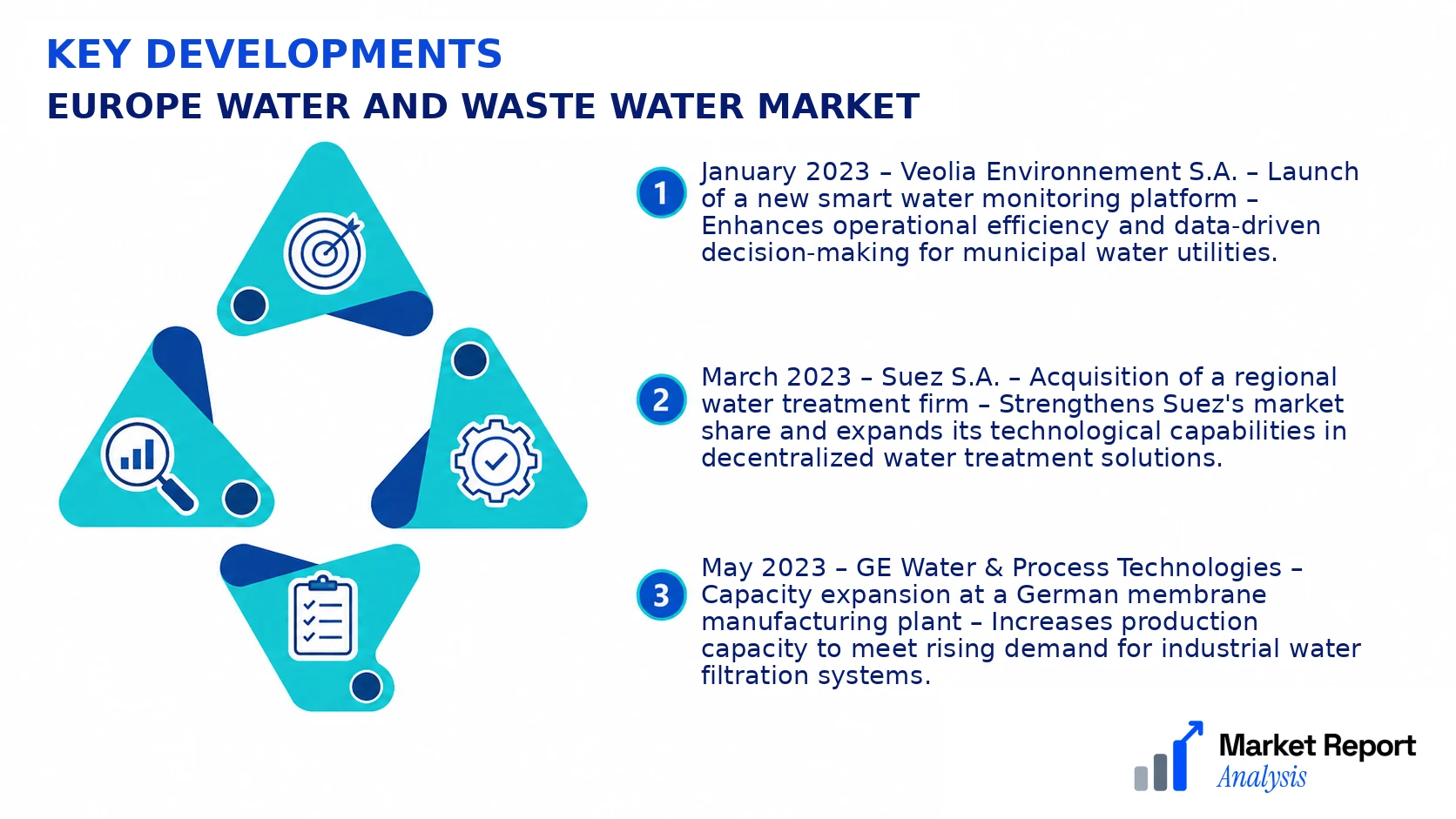
- January 2023 – Veolia Environnement S.A. – Launch of a new smart water monitoring platform – Enhances operational efficiency and data-driven decision-making for municipal water utilities.
- March 2023 – Suez S.A. – Acquisition of a regional water treatment firm – Strengthens Suez's market share and expands its technological capabilities in decentralized water treatment solutions.
- May 2023 – GE Water & Process Technologies – Capacity expansion at a German membrane manufacturing plant – Increases production capacity to meet rising demand for industrial water filtration systems.
- August 2023 – Xylem Inc. – Strategic alliance with a European IoT platform provider – Accelerates development of smart water infrastructure solutions emphasizing data analytics and remote monitoring.
- October 2023 – ABB Ltd. – Launch of a new energy-efficient automation system for wastewater treatment facilities – Reduces energy consumption and operational costs for European water utilities.
Frequently Asked Questions
What is the Europe Water and Waste Water Market?
The Europe Water and Waste Water Market encompasses the production, treatment, and distribution of clean water and waste water management services across European countries. It involves infrastructure, equipment, and technology providers supporting water sustainability initiatives.
What is the current market size of Europe Water and Waste Water Market?
As of 2026, the market size of the Europe Water and Waste Water Market is valued at approximately USD 45 Billion, reflecting ongoing investments in infrastructure, pollution control, and water treatment technologies across the region.
What factors are driving the Europe Water and Waste Water Market?
Market growth is driven by stringent environmental regulations, increasing urbanization, aging infrastructure, and technological advancements in water treatment. Growing awareness of water conservation and government initiatives for sustainable water management also contribute significantly.
Which region dominates the Europe Water and Waste Water Market?
Western European countries, including Germany, France, and the UK, dominate the market due to advanced infrastructure, higher investment levels, and stringent regulatory frameworks supporting water and waste water projects.
Which segment is expected to grow the fastest?
The wastewater treatment segment is projected to experience the fastest growth, driven by rising pollution levels, stricter discharge standards, and technological innovations in treatment processes across residential, industrial, and municipal sectors.
Who are the leading companies operating in the Europe Water and Waste Water Market?
Key industry players include Veolia Environnement, Suez, Siemens, Xylem Inc., and Pentair. These companies are at the forefront of technological development and infrastructure projects across Europe, shaping market dynamics and competitive strategies.
Analyst Perspective
The long-term outlook for the Europe Water and Waste Water Market appears robust, driven by ongoing urbanization, stringent environmental regulations, and increasing water resource scarcity. Opportunities abound in advanced treatment technologies such as membrane filtration, smart water management systems, and IoT-enabled monitoring, which promise efficiency gains and regulatory compliance. Investment priorities should focus on integrating digital solutions to optimize network operations and enhance water quality management, especially in aging infrastructure segments. Competitive intensity is expected to heighten as local governments and international players vie for market share through innovation and strategic partnerships. Regions like Northern and Western Europe exhibit substantial growth potential due to higher urban densities and sustainability initiatives, whereas Eastern Europe offers untapped market opportunities fueled by modernization efforts. Sustained capital inflows, coupled with technological advancements, will shape a resilient, adaptable industry landscape. Strategic long-term positioning will hinge on embracing sustainable practices, fostering innovation, and consolidating regional leadership to mitigate risks associated with regulatory changes and market saturation.
