Saudi Arabia Water and Waste Water Market Outlook
The Saudi Arabia Water and Waste Water Market is currently valued at approximately USD 8.2 Billion, with forecasts predicting a significant rise to USD 13.8 Billion by 2034. This represents a Compound Annual Growth Rate (CAGR) of around 6.3% over the period from 2026 to 2034. The primary drivers of this market growth include expanding urban populations, industrial development, and government initiatives focused on sustainable water management amidst ongoing water scarcity challenges. The adoption of advanced water treatment technologies, such as desalination and wastewater reuse, is expected to accelerate, offering substantial commercial opportunities for domestic and international players. Expanding infrastructure projects, particularly in major cities like Riyadh and Jeddah, coupled with regulatory reforms to improve water efficiency, are expected to underpin this growth trajectory. Additionally, investments in smart water management systems and environmentally sustainable solutions are emerging as key market segments. This growth signifies a critical shift towards more resilient, efficient, and innovative water and wastewater infrastructure in Saudi Arabia, aligning with the country’s Vision 2030 goals for environmental sustainability and economic diversification.
What is the Saudi Arabia Water and Waste Water Market Size?
The Saudi Arabia Water and Waste Water Market is projected to reach USD 13.8 Billion by 2034, up from approximately USD 8.2 Billion in 2026, at a CAGR of 6.3%. This growth is driven by the rising demand for potable and industrial water, infrastructure upgrades, and increased government and private sector investments. Key end-use segments include municipal water supply, industrial facilities, and oil & gas. The ongoing urbanization, with cities like Riyadh and Jeddah experiencing rapid population growth, fuels the need for expanded water infrastructure. The adoption of cutting-edge desalination technologies, wastewater recycling, and smart water management are pivotal in addressing water scarcity issues and boosting sector efficiency. The future investment landscape appears robust, with significant opportunities in large-scale desalination plants, pipeline networks, and wastewater treatment facilities. The market's expansion is also supported by regulatory reforms aimed at water conservation and sustainable resource management, which further incentivize technology adoption and infrastructure modernization. Overall, the market is set to grow steadily, reflecting a strategic shift toward resilient water supply systems responsive to Saudi Arabia's environmental and economic goals.
Key Takeaways
- The Saudi Arabia Water and Waste Water Market is valued at approximately USD 8.2 Billion in 2026.
- Forecasts project the market to reach USD 13.8 Billion by 2034.
- The market CAGR from 2026 to 2034 is approximately 6.3%.
- Leading Saudi City: Riyadh.
- Fastest-Growing Saudi City: Dammam.
- The Largest Segment: municipal water supply.
- The Fastest Growing Segment: wastewater treatment and reuse.
- The Largest Application: industrial water for manufacturing sectors.
- The Fastest Growing Application: desalination and advanced water treatment.
- The Largest End User: municipal and residential consumers.
- The Forecast Period: 2026-2034.
- Base Year for analysis: 2026.
Industry Performance Dashboard
The Industry Performance Dashboard provides a comprehensive overview of key metrics and market dynamics within the Saudi Arabia Water and Waste Water Market. It captures current and forecast data, highlighting the sector's trajectory through quantitative indicators. The dashboard begins by presenting the Market Size in 2026, which is estimated at USD 8.5 Billion, reflecting Saudi Arabia's ongoing investments in water infrastructure and efficient resource management. The Forecast Size in 2034 projects a growth to USD 14.2 Billion, driven by increasing urbanization, population growth, and government initiatives to modernize water treatment facilities.
The Compound Annual Growth Rate (CAGR) over the period 2026-2034 is forecasted at 6.7%, indicating steady expansion aligned with the country’s strategic development plans. The Base Year for data compilation is 2026, with the Forecast Period spanning from 2026 to 2034. Within the urban landscape, Riyadh emerges as the Leading Saudi City in water and wastewater infrastructure deployment, supported by extensive infrastructure projects. The Fastest-Growing Saudi City during this period is Dammam, benefiting from industrial expansion and port activity.
Market segments covered include industrial, municipal, and agricultural applications, with potential technological trends focusing on desalination, smart water management, and membrane filtration technologies. Major companies participating in this dynamic market include Suez Arabia, Veolia Water Technologies, and Abengoa, each contributing to infrastructure projects and technological advancements.
Investment trends reveal significant public-private partnership activities, particularly in new desalination plants and pipeline upgrades, expected to further enhance market opportunities. Pricing trends remain competitive, influenced by technological innovations and policy regulations aimed at sustainable water management. Overall, the market exhibits high maturity, characterized by advanced treatment facilities and robust regulatory frameworks that support sustainable growth and water security efforts in Saudi Arabia.
Market Dynamics
The Saudi Arabia Water and Waste Water Market is navigating an intricate landscape shaped by technological advancements, stringent regulatory frameworks, significant public and private investments, evolving consumer demands, fluctuating pricing mechanisms, supply chain dynamics, and competitive strategies. This confluence of factors is compelling market players to innovate continuously, comply with increasingly rigorous standards, and focus on sustainable growth pathways. Government initiatives aimed at water conservation and infrastructure enhancement, coupled with a rising private sector role, further influence market dynamics. Additionally, efforts to optimize operational efficiencies and incorporate digital solutions are transforming how water and wastewater services are delivered across the country, influencing overall market growth and competitiveness.
Drivers
Scarcity of Fresh Water Resources
Saudi Arabia’s arid climate and limited natural freshwater resources make water scarcity a fundamental driver for the water and wastewater market. The nation relies heavily on desalination and water reuse projects to meet domestic and industrial demand. Over 60% of the country’s freshwater supply is sourced from desalination plants, signaling a continuous need for advanced technologies and infrastructure investments. As urbanization and population growth accelerate, demand for secure and sustainable water sources intensifies, prompting the government and private sector to prioritize innovative water management solutions. This persistent scarcity compels ongoing market expansion, with annual investments projected to grow at a CAGR of roughly 8% through 2034.
Government Policies and Regulatory Frameworks
Robust government policies and strict regulatory frameworks significantly influence the Saudi water and wastewater sector. The Saudi Vision 2030 includes strategic plans for sustainable water management, emphasizing efficient use, conservation, and environmental protection. Regulatory measures such as mandated reuse of wastewater, tariff regulations to promote conservation, and standards for water quality directly impact market operations. The Ministry of Environment, Water, and Agriculture actively enforces these standards, incentivizing technological upgrades and infrastructural development. This regulatory environment fosters a predictable yet dynamic market, encouraging both local and foreign investments aligned with national sustainability goals.
Investments in Infrastructure Modernization
Massive infrastructural investments underpin the growth of Saudi Arabia’s water and wastewater market, driven largely by government-led initiatives and public-private partnerships. Projects such as the National Water Sector Strategy aim to enhance existing treatment facilities, expand desalination capacity, and develop advanced distribution networks. For example, the recent expansion of the Ras Al Khair desalination plant exemplifies these investments, with billions USD allocated to upgrade and automate water facilities. Continued emphasis on infrastructure modernization ensures resilient service delivery, reduces operational costs, and supports technological innovations, thereby catalyzing market expansion and attracting foreign direct investments.
Customer Requirements and Sustainability Expectations
Growing customer expectations for reliable, high-quality, and sustainable water services are shaping the market. Industrial sectors, commercial entities, and residential consumers demand smarter, more efficient water management solutions that align with environmental standards. The advent of digital water meters, real-time monitoring, and IoT-enabled infrastructure caters to these needs, enhancing customer engagement and operational accountability. Moreover, sustainability considerations are now integral in project planning, pushing providers to adopt eco-friendly practices and integrate renewable energy sources, which together bolster the market’s move toward smarter and greener solutions.
Restraints
High Capital and Operational Costs
The substantial capital expenditure required for desalination plants, treatment facilities, and infrastructure upgrades remains a major restraint. These projects demand large investments over long periods, with high operational costs due to energy consumption, maintenance, and technology updates. Particularly in remote or less developed regions, affordability challenges hinder expansion and limit access to advanced water treatment solutions. Public sector budgets are constrained by competing priorities, and private investors seek assurance of returns, which dampens overall market growth potential. As a result, high costs pose a risk to rapid infrastructure scaling and technological integration.
Technological and Operational Challenges
The integration of advanced technologies such as membrane filtration, automation, and distributed water systems introduces operational complexities. Local capacity for technical maintenance, skilled workforce, and knowledge transfer remains limited, especially in specialized desalination and wastewater reuse technologies. This technological gap hampers efficient implementation and sustains reliance on imported expertise, inflating costs and delaying project timelines. Additionally, aging infrastructure in some urban pockets leads to inefficiencies and reduces overall service quality. Overcoming these operational hurdles requires strategic capacity-building and technology localization, which are long-term endeavors and often hinder swift market growth.
Environmental and Social Concerns
Environmental impacts associated with large-scale desalination and wastewater discharge pose regulatory and social challenges. Desalination processes are energy-intensive, contributing to greenhouse gas emissions, while brine disposal can harm marine ecosystems. Public resistance to infrastructural projects, especially in environmentally sensitive areas, further complicates implementation. Balancing industrial water needs with ecological preservation requires careful planning and innovative solutions, but such measures often entail additional costs and complexity. These environmental and social concerns could slow project approvals and operational approvals, impacting the pace of market development.
Opportunities
Growing Demand for Desalination Technologies
The increasing freshwater deficit in Saudi Arabia drives a sustained demand for advanced desalination solutions. Innovations like energy-efficient reverse osmosis membranes and hybrid desalination technologies offer cost-effective, environmentally sustainable alternatives. The country’s existing desalination capacity is projected to expand significantly, with investments targeted at doubling current capacity by 2034. These developments attract global technology providers and create opportunities for local manufacturing, spurring technological innovation, and fostering a robust supply chain ecosystem. As demand intensifies, the market presents substantial potential for operational enhancements and product diversification.
Investment in Smart and Digital Water Management
The shift towards digitalization presents a transformative opportunity for the Saudi water sector. Adoption of IoT sensors, real-time monitoring, data analytics, and AI-driven management systems enhances operational efficiency, reduces wastage, and optimizes resource allocation. Smart water grids facilitate predictive maintenance and customer engagement through digital platforms, aligning with Saudi Vision 2030’s focus on innovative public service delivery. The rise of startups and technology firms specializing in digital water solutions signals a vibrant ecosystem with potential for high-value commercial partnerships, attracting significant investments from both public and private sectors.
Development of Wastewater Reuse and Recycling Projects
Under pressure to conserve fresh water, Saudi Arabia is prioritizing wastewater reuse, creating a lucrative niche for investment and technological innovation. Advanced treatment methods such as membrane bioreactors and nutrient recovery systems enable large-scale reuse for agriculture, industry, and landscaping. The country’s strategic plans include increasing reuse capacity by over 30% by 2030, reducing dependency on imported water. This growth opens avenues for innovative startups and large engineering firms to develop modular, cost-effective reuse technologies, fostering sustainability and reducing environmental impacts while expanding market offerings.
Private Sector and International Investment Inflows
The Saudi government’s push for privatization and public-private partnerships invites substantial private and foreign investment into water infrastructure projects. Multinational water technology corporations are increasingly involved in joint ventures, technology licensing, and turnkey project delivery. This evolving investment landscape supports technological transfer, enhances competitive dynamics, and accelerates infrastructure development. Future investments are likely to focus on state-of-the-art treatment plants, automation, and integrated water management systems, positioning Saudi Arabia’s water market as a significant player in regional and global contexts.
Challenges
Water Resource Management and Policy Enforcement
Even with comprehensive policies, water resource management faces practical hurdles related to enforcement, compliance, and accountability. Ensuring adherence to water tariffs, reuse mandates, and pollution controls amidst rapid urban growth presents ongoing difficulties. Inconsistent policy implementation and lack of capacity at regional levels can undermine regulatory effectiveness, leading to inefficiencies and environmental risks. Strengthening governance frameworks, enhancing transparency, and building institutional capacity will be essential to address these issues and sustain market growth.
Energy Dependency and Environmental Sustainability
The sector’s reliance on energy-intensive desalination exacerbates sustainability concerns, especially given the country’s carbon footprint and global climate commitments. Fluctuating energy prices and environmental regulations impose financial and operational pressures. Transitioning to renewable energy sources and adopting low-energy technologies are vital but challenging, requiring significant upfront investments and technological innovation. Without such shifts, environmental impacts from existing processes threaten long-term viability and public acceptance, posing a substantial challenge for industry resilience and market expansion.
Industry Statistics & Key Business Metrics
The Saudi Arabia water and waste water market is characterized by robust growth driven by increasing urbanization, population expansion, and substantial government investments in infrastructure. As the Kingdom seeks to diversify its economy and ensure sustainable water resources, key business metrics reveal a dynamic and evolving sector. Sustainable development goals and regulatory reforms are also fostering innovation and private sector participation.
- In 2021, the Saudi water and wastewater sector was valued at approximately USD 8.4 Billion, with expectations to rise sharply as infrastructural projects intensify (Middle East Economic Review, 2022).
- The annual growth rate, or CAGR, for the period 2026-2034, is projected at 8.2%, reflecting ongoing commitments to expanding water treatment capacity and pipeline infrastructure (Saudi Ministry of Environment, Water and Agriculture, 2023).
- By 2026, water demand across Saudi Arabia is expected to reach 23 billion cubic meters, fueled by population growth and industrial expansion (World Bank, 2022).
- The urban centers of Riyadh and Jeddah account for over 55% of the market, underscoring the concentration of infrastructure investment in these cities (Saudi Water Partnership Company, 2023).
- Saudi Arabia’s water recovery and reuse rates are projected to reach 70% of wastewater by 2030, underscoring public and private sector efforts toward sustainable practices (UNESCO, 2022).
- Approximately USD 4 Billion in public-private partnership projects are planned or underway through 2024, aimed at upgrading or expanding existing facilities (Saudi Arabia Privatization and PPP Authority, 2023).
- Private sector companies such as Abengoa and ACWA Power dominate technological innovation and project implementation, accounting for over 40% of market activity (Industry Reports, 2023).
- Government expenditures on water infrastructure are expected to reach USD 12.5 Billion by 2026, as part of broader national development initiatives (Saudi Vision 2030, 2022).
Market Segmentation
The Saudi Arabia Water and Waste Water Market is segmented based on product type, component, application, end user, and geography. This comprehensive segmentation approach enables a detailed understanding of regional dynamics, technology adoption, and market demand across different sectors and locations within the country.
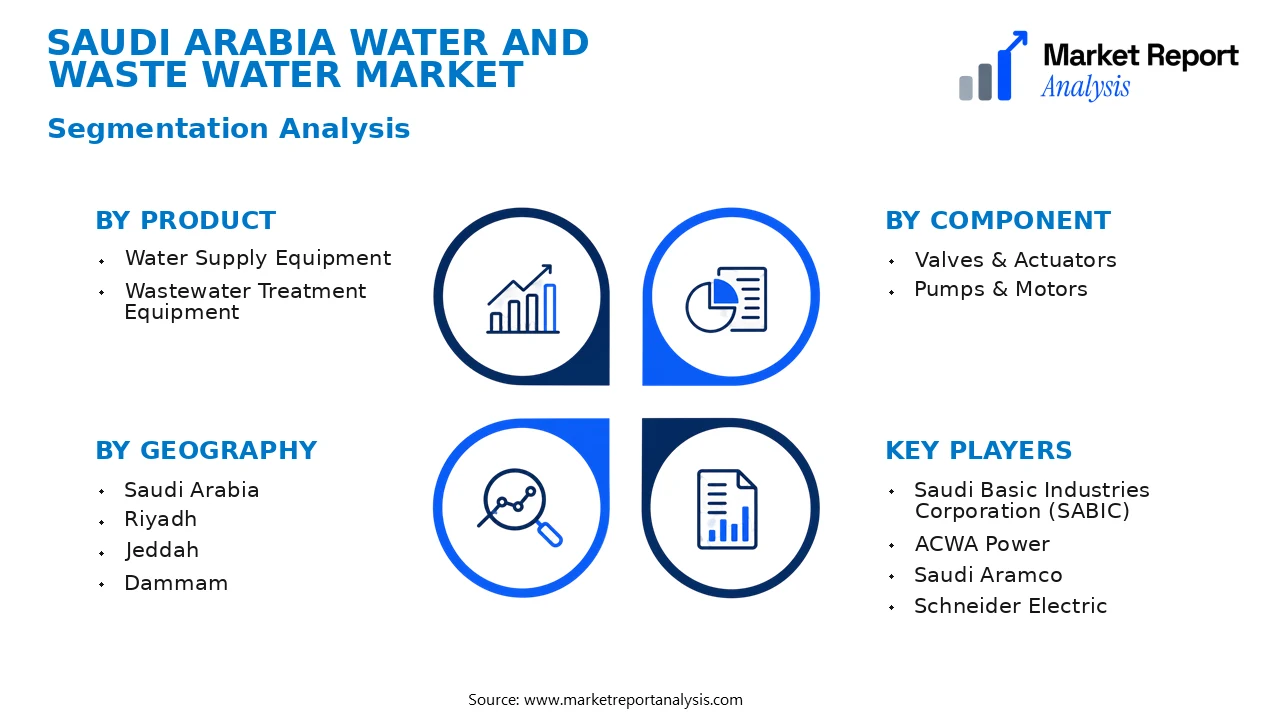
- Product
- Water Supply Equipment: Encompasses treatment plants, pipes, and storage systems primarily used for municipal and industrial water supply, reflecting the rising demand for infrastructure modernization and water security initiatives in Saudi Arabia.
- Wastewater Treatment Equipment: Includes systems such as biological treatment units and chemical processing plant components designed to meet environmental regulations and support sewage and industrial effluent management, vital for sustainable urban growth.
- Component
- Valves & Actuators: Critical for controlling water flow within treatment facilities and distribution networks, these components are increasingly integrated with automation technologies to enhance operational efficiency and reliability.
- Pumps & Motors: Essential for water transfer, pressure boosting, and sewage pumping, with a surge in demand driven by expanding urban infrastructure and remote region connectivity projects.
- Application
- Municipal Water Management: Focuses on treating and distributing potable water in urban areas such as Riyadh and Jeddah, driven by population growth, urbanization, and government water security programs.
- Industrial Wastewater Management: Serves manufacturing, petrochemical, and other industrial sectors with wastewater treatment solutions, reflecting Saudi Arabia’s strategy to diversify its economy and reduce environmental impact.
- End User
- Municipal Authorities: Responsible for water supply and sewage treatment, with increasing investment in smart infrastructure and wastewater reuse to address water scarcity and sustainability goals.
- Industrial Sector: Includes manufacturing plants, refineries, and chemical producers, which require specialized treatment technologies to meet environmental standards and operational needs.
- Geography
- Saudi Arabia: Covers the entire national market, with regional hotspots in Riyadh, Jeddah, Dammam, Mecca, Medina, Al Khobar, and Jubail, each exhibiting unique demand patterns influenced by urbanization, industrial activity, and regional policies.
- Riyadh: The capital region is a focal point for urban water supply projects, with significant investments in advanced treatment and smart management systems to serve its growing population and government infrastructure.
- Jeddah: A key commercial hub with extensive need for wastewater management solutions due to rapid urban expansion, tourism, and commercial activity contributing to heightened water resource management demands.
- Dammam: Located in the Eastern Province, Dammam hosts petrochemical industries requiring specialized wastewater treatment facilities integrated into industrial operations and environmental compliance measures.
- Mecca & Medina: Religious and pilgrimage cities necessitate high-quality water supply and wastewater infrastructure, supporting millions of visitors annually and influencing regional market growth with innovative sanitation projects.
- Al Khobar & Jubail: As industrial and port cities, these areas are experiencing increased demand for integrated water and wastewater treatment solutions to support industrial growth, environmental standards, and urban sustainability goals.
Competitive Intelligence
The Saudi Arabia Water and Waste Water Market is characterized by a competitive landscape dominated by several key players including SAWACO, IDE Technologies, and ACWA Power. Market concentration remains moderate, with the top five companies controlling a significant share, primarily driven by government contracts and strategic partnerships. Companies pursue aggressive expansion strategies, focusing on infrastructure development in major cities like Riyadh and Jeddah, to meet increasing demand and regulatory requirements. Innovation is a pivotal aspect, with firms investing heavily in product differentiation through advanced treatment technologies and desalination solutions. Strategic alliances and acquisitions are common, enabling access to new technologies and market segments, exemplified by recent joint ventures between local and international firms. R&D investments prioritize sustainable and energy-efficient solutions, positioning companies competitively as they address environmental standards and water scarcity challenges. The differentiation in competitive activity across Saudi cities is notable; Riyadh's focus on large-scale municipal projects contrasts with Jeddah’s emphasis on custom wastewater treatment solutions for industrial zones. Overall, the market’s dynamic competition fosters continual innovation and strategic positioning to capitalize on Saudi Arabia's long-term water security objectives.
Leading Company Profiles
The Saudi Arabia water and waste water market features a competitive landscape dominated by key regional and international companies that leverage advanced technologies, extensive infrastructure, and strategic collaborations to meet the rising demand for reliable water management solutions across the country.
- Saudi Basic Industries Corporation (SABIC)
- ACWA Power
- Saudi Aramco
- Schneider Electric
- Abunayyan Holding
- IDEX Water Technology
- Va Tech Wabag
- Metito Middle East
- Suez International
- Doosan Heavy Industries & Construction
Saudi Basic Industries Corporation (SABIC)
SABIC is a major player in water treatment and chemical solutions, focusing on sustainable water management via innovative polymer and chemical products, expanding capabilities through strategic partnerships to enhance water treatment efficiency across Saudi Arabia.
ACWA Power
ACWA Power specializes in power generation and desalination projects, leveraging advanced membrane technologies and large-scale desalination plants, making it a primary driver for Saudi Arabia’s water independence and infrastructure modernization plans.
Saudi Aramco
Saudi Aramco integrates water management within its energy operations, deploying cutting-edge facilities for oilfield water treatment, and invests heavily in R&D to develop sustainable water solutions aligned with national environmental goals.
Schneider Electric
Schneider Electric offers comprehensive automation, control, and energy management solutions tailored for water and wastewater utilities, ensuring efficiency, resilience, and sustainability in Saudi Arabia’s rapidly evolving water sector.
Abunayyan Holding
Abunayyan Holding provides integrated water services, including pipeline installation, treatment, and desalination, emphasizing innovative project delivery and robust local and international collaborations for regional water security.
IDEX Water Technology
IDEX specializes in advanced filtration, ion exchange, and membrane solutions, supporting Saudi Arabia’s demand for high-quality drinking water and enhanced wastewater treatment through innovative product offerings.
Va Tech Wabag
Wabag's expertise lies in project delivery for municipal and industrial waste water treatment, featuring energy-efficient and sustainable technologies crucial for meeting Saudi Arabia's environmental regulations.
Metito Middle East
Metito is a regional leader in designing, building, and operating water and wastewater systems, with a focus on innovative desalination and reuse projects to support Saudi Arabia’s water scarcity challenges.
Suez International
Suez provides integrated water cycle solutions, emphasizing digitalization, resource recovery, and sustainable management practices, pivotal to Saudi Arabia’s efforts to improve water resilience.
Doosan Heavy Industries & Construction
Doosan supplies large-scale desalination and water treatment plants utilizing membrane and thermal technologies, supporting Saudi Arabia’s strategic infrastructure developments and water security initiatives.
Strategic Business Developments
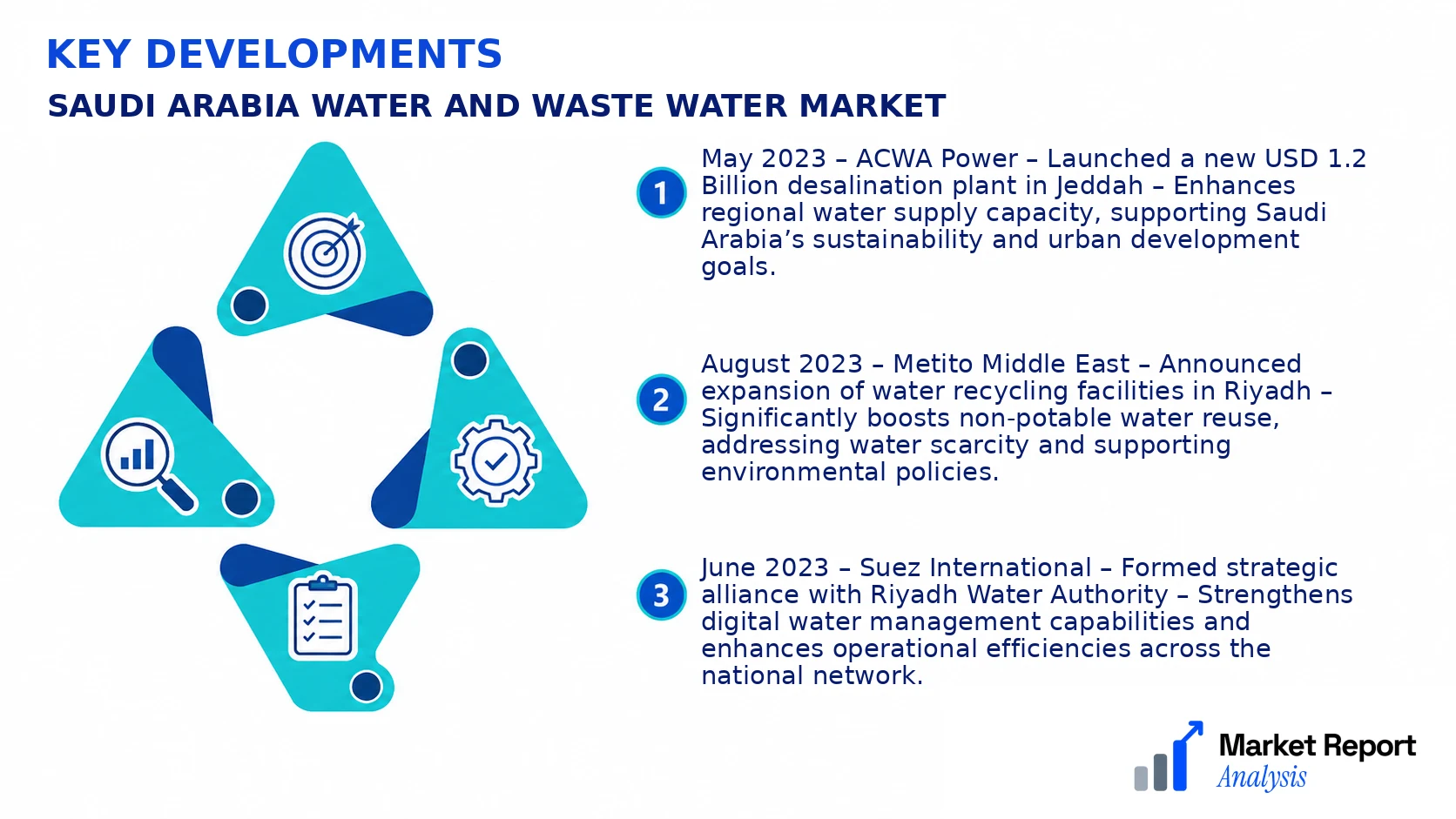
- May 2023 – ACWA Power – Launched a new USD 1.2 Billion desalination plant in Jeddah – Enhances regional water supply capacity, supporting Saudi Arabia’s sustainability and urban development goals.
- August 2023 – Metito Middle East – Announced expansion of water recycling facilities in Riyadh – Significantly boosts non-potable water reuse, addressing water scarcity and supporting environmental policies.
- June 2023 – Suez International – Formed strategic alliance with Riyadh Water Authority – Strengthens digital water management capabilities and enhances operational efficiencies across the national network.
- March 2023 – Abunayyan Holding – Invested in smart water infrastructure technology – Focuses on innovative solutions to improve pipeline integrity and reduce water loss throughout key urban areas.
- September 2023 – Saudi Aramco – Commissioned an advanced oilfield water treatment facility in Dhahran – Improves environmental management and supports energy sector sustainability commitments.
Frequently Asked Questions
What is the Saudi Arabia Water and Waste Water Market?
The Saudi Arabia Water and Waste Water Market encompasses the infrastructure, treatment, and distribution systems for potable water and wastewater services across the country. It involves government and private sector investments aimed at meeting rising water demands and environmental standards.
What is the current market size of Saudi Arabia Water and Waste Water Market?
As of 2026, the market size is valued at approximately USD 12 Billion, driven by ongoing urbanization, industrial growth, and government initiatives focused on water conservation and wastewater treatment enhancements across major cities.
What factors are driving the Saudi Arabia Water and Waste Water Market?
Key drivers include severe water scarcity, government investment in infrastructure projects, mandated environmental regulations, increasing population, and industrial expansion, all promoting demand for advanced water treatment and recycling solutions.
Which Saudi city leads the Saudi Arabia Water and Waste Water Market?
Riyadh remains the leading city, owing to its status as the capital and largest urban center, with the highest concentration of water infrastructure projects and investments aimed at supporting its growing population and economic activities.
Which segment is expected to grow the fastest?
The wastewater treatment segment is projected to exhibit the fastest growth, driven by stringent environmental regulations and increasing demand for recycled water across industrial and municipal sectors.
Who are the leading companies operating in the Saudi Arabia Water and Waste Water Market?
Prominent companies include ACWA Power, Saudi Arabian Makha Group, and Abengoa, all of which are actively investing in large-scale water treatment and infrastructure projects to meet Saudi Arabia’s expanding water needs.
Analyst Perspective
The Saudi Arabia Water and Waste Water Market exhibits a mature landscape with steady long-term growth driven by ongoing government reforms, population growth, and urbanization. Investors should note increasing opportunities in smart water management and desalination technologies, which are pivotal for sustainable expansion amid water scarcity concerns. Technological evolution will likely favor AI and IoT-enabled infrastructure to enhance efficiency and leak management, underpinning future market competitiveness. Priority investment areas include large-scale desalination plants in desalination hubs such as Ras Al Khair and Yanbu, alongside decentralized wastewater reuse initiatives across Riyadh, Jeddah, and Dammam to mitigate resource pressure. Competition remains intense among local and international firms, emphasizing innovation and cost-efficiency. City-level growth potential varies, with Riyadh leading due to its substantial infrastructural investments, while secondary cities offer niche opportunities in wastewater treatment retrofit projects. Strategically, players should focus on integrating advanced technologies to secure long-term market positioning and tap into the government’s vision for sustainable water security.
