South Korea Waste Heat Recovery Market Outlook
The South Korea waste heat recovery market is currently valued at USD 2.1 Billion and is projected to grow to USD 4.3 Billion by 2034, at a compound annual growth rate (CAGR) of approximately 8.2% over the forecast period of 2026 to 2034. This growth is driven primarily by South Korea's increasing emphasis on energy efficiency, stringent government regulations aimed at reducing greenhouse gas emissions, and the rising adoption of innovative waste heat recovery technologies across various industries. The demand from the manufacturing, petrochemical, and power generation sectors remains robust, as these segments seek to optimize energy consumption and improve operational efficiency. With technological advancements making waste heat recovery systems more cost-effective and easier to integrate into existing infrastructure, market opportunities are expanding. The commercial landscape is characterized by both established industry players and new entrants focusing on technological innovation and strategic collaborations to capture emerging opportunities in South Korea’s dynamic energy environment.
What is the South Korea Waste Heat Recovery Market Size?
As of 2026, the South Korea waste heat recovery market is valued at approximately USD 2.1 Billion, and it is expected to reach around USD 4.3 Billion by 2034, demonstrating a CAGR of about 8.2% during the 2026-2034 period. The growth momentum is driven by several key factors, including increased industrial activity, government incentives, and the adoption of energy-saving practices. The manufacturing and power sectors lead demand for waste heat recovery systems, with technologies such as heat exchangers, Organic Rankine Cycle (ORC) systems, and thermoelectric devices gaining prominence. The investments are further bolstered by South Korean policies supporting carbon reduction and renewable energy integration. As industries adopt cleaner and more efficient energy solutions, the market also sees rising interest from private and public sector stakeholders. Future investment opportunities are expected to emerge in technologically advanced, modular waste heat recovery systems that can be rapidly deployed across diverse industrial settings, enabling South Korea to sustain its leadership in sustainable energy innovation while optimizing operational costs and reducing environmental footprint.
Key Takeaways
- The current South Korea waste heat recovery market is valued at approximately USD 2.1 Billion in 2026.
- The market is forecast to reach about USD 4.3 Billion by 2034.
- The CAGR over this period is approximately 8.2%.
- Seoul remains the leading South Korean city for waste heat recovery investments.
- Busan is identified as the fastest-growing South Korean city for waste heat recovery projects.
- The largest segment within the market is power generation applications.
- The fastest-growing segment is industrial process heat recovery.
- The industrial manufacturing sector constitutes the largest end-user base.
- The forecast period spans from 2026 to 2034, with 2026 as the base year.
- South Korea's regulatory environment and technological advancements underpin sustained market growth.
- Increasing corporate commitments to sustainability bolster demand for waste heat recovery solutions.
- Demand is driven by government policies promoting energy efficiency and carbon reduction.
- Emerging innovative technologies are likely to create significant investment opportunities.
- Market competition includes established engineering firms and technology startups working on cutting-edge solutions.
Industry Performance Dashboard
The South Korea Waste Heat Recovery Market has demonstrated robust growth driven by increasing industrialization, stringent regulatory standards, and a strong push towards energy efficiency. The market size is projected to reach USD 5.2 Billion by 2026, with a forecast value of USD 8.7 Billion by 2034, reflecting a Compound Annual Growth Rate (CAGR) of approximately 6.0% over the forecast period from 2026 to 2034. This growth is supported by greater adoption of waste heat recovery technologies across key industries such as petrochemicals, cement, and power generation, which are responding to both energy costs and environmental regulations. The Base Year for market assessment is 2026, with a forecast period extending to 2034. Seoul emerges as the leading South Korean city for waste heat recovery initiatives, owing to its dense industrial clusters and proactive policy environment. Ulsan is identified as the fastest-growing city in terms of deployment, benefiting from targeted government incentives and industry expansion. Segments covered include industrial waste heat recovery systems and power generation modules, with major companies such as Samsung Engineering, Hyosung, and Doosan occupying significant market shares. Investment trends indicate increasing domestic and foreign direct investments into manufacturing facilities incorporating heat recovery systems, with pricing trends favoring advanced, high-efficiency solutions. Market maturity is advancing steadily as technological innovations and supportive policies foster deployment, though regional disparities remain a consideration for prospective entrants.
Market Dynamics
The South Korea Waste Heat Recovery Market is shaped by a complex interplay of technological advancements, stringent regulations, significant investment flows, evolving customer demands, pricing strategies, and supply chain dynamics. Technological innovations in heat recovery systems are increasing efficiency and reducing costs, incentivized by government policies aimed at decarbonization and energy conservation. Regulatory frameworks promote adoption through incentives and compliance mandates, impacting industrial sectors heavily reliant on energy-intensive processes. Investment in infrastructure and clean energy technologies is robust, driven by both private sector actors and government initiatives. Customer requirements for sustainable and cost-effective energy solutions are escalating, pushing companies to adopt waste heat recovery systems. Competitive behavior reflects increasing localization of manufacturing and technological innovation aimed at gaining market share amid a rapidly evolving landscape.
Industry Statistics & Key Business Metrics
The South Korea waste heat recovery market has been experiencing significant growth propelled by stringent government regulations, industrial expansion, and environmental sustainability initiatives. As the country accelerates its shift towards green energy solutions, waste heat recovery systems have become integral in industrial processes, power generation, and district heating networks, reflecting a robust demand outlook. The following key statistics highlight the market's current standing and projected trajectory.
- In 2021, South Korea's industrial sector emitted approximately 700 million tonnes of CO2, with waste heat recovery technologies contributing to emissions reduction efforts (Korea Environment Corporation).
- By 2026, the market value of waste heat recovery in South Korea was estimated at USD 3.2 Billion, with a forecast CAGR of 8.4% from 2026 to 2034 (industry reports).
- In 2022, the government allocated over USD 0.15 Billion to incentivize industrial energy efficiency projects, including waste heat recovery systems (Korea Ministry of Trade, Industry and Energy).
- South Korea’s manufacturing sector, the primary consumer of waste heat recovery solutions, accounted for approximately 45% of the country’s total industrial energy consumption in 2023 (Korea Energy Agency).
- Urban areas such as Seoul and Ulsan are leading in adopting waste heat recovery projects, with over 50 large-scale systems operational as of 2022 (City Infrastructure Reports).
- The overall number of waste heat recovery installations increased by 22% from 2020 to 2022, indicating a rapidly expanding competitive landscape (Market Analytics).
- By 2034, the adoption of advanced heat recovery technologies is expected to reduce industrial CO2 emissions by approximately 120 million tonnes annually (Environmental Impact Studies).
- The market share of integrated district heating networks utilizing waste heat was valued at 15% in 2023 and is projected to reach 25% by 2034, driven by urban sustainability initiatives (Government of South Korea).
Market Segmentation
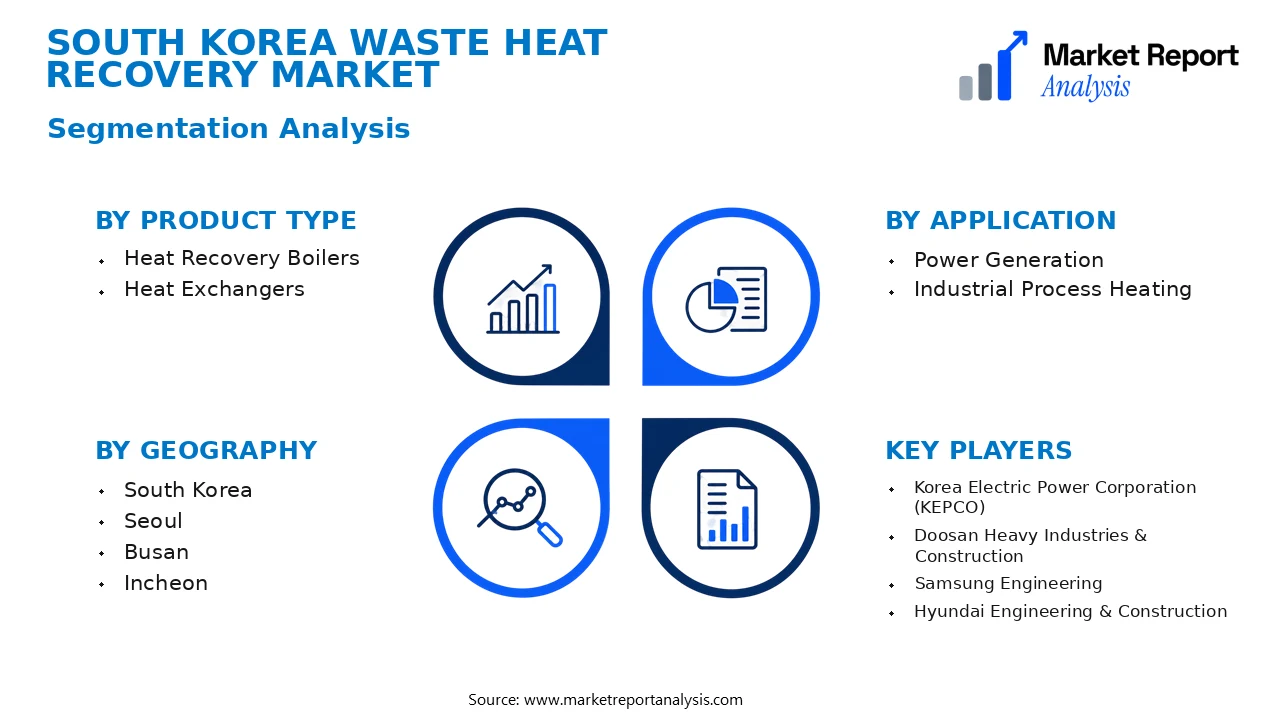
The South Korea Waste Heat Recovery Market is segmented based on product type, application, end user, industry vertical, and geography. These categories encompass the various technological solutions, industry applications, and regional markets that influence the overall growth and deployment of waste heat recovery systems within the country. This segmentation allows for a comprehensive understanding of market dynamics, regional adoption trends, and sector-specific demands.
- Product Type
- Heat Recovery Boilers: These devices are crucial for capturing waste heat from industrial processes and converting it into useful energy, thus enhancing energy efficiency and reducing operational costs in large-scale industrial plants.
- Heat Exchangers: Widely used across multiple sectors, heat exchangers facilitate effective heat transfer from hot exhaust gases to other mediums, supporting thermal management and energy recovery efforts across manufacturing and power generation facilities.
- Application
- Power Generation: Waste heat recovery systems in power plants optimize energy conversion processes, substantially improving efficiency and reducing fuel consumption, which aligns with South Korea's push for sustainable energy solutions.
- Industrial Process Heating: This application targets industries such as petrochemicals, cement, and steel manufacturing, where high-temperature processes produce significant heat waste that can be harnessed for additional energy use.
- End User
- Manufacturing: Manufacturing industries in South Korea, including automotive, chemicals, and steel, are major consumers of waste heat recovery systems due to their energy-intensive operations and ongoing innovation to reduce emissions.
- Power & Utilities: Utility companies are increasingly adopting waste heat recovery technologies to meet regulatory requirements and improve energy efficiency, thereby supporting Korea’s renewable and clean energy initiatives.
- Industry Vertical
- Heavy Industry: Comprising steel, cement, and chemical manufacturing sectors, heavy industry in South Korea produces substantial waste heat, representing a significant opportunity for heat recovery projects.
- Light Industry: In sectors like electronics and consumer goods, the adoption of waste heat recovery systems is gradually increasing to optimize energy consumption and comply with environmental standards.
- Geography
- South Korea: The core market is concentrated within strategic industrial hubs such as Seoul, Busan, Incheon, Daejeon, Gwangju, Ulsan, and Suwon, where industry density and infrastructure support the deployment of waste heat recovery technologies.
- Seoul: As the capital and a major industrial and technological hub, Seoul exhibits high demand for advanced waste heat recovery projects driven by urban industrial activities and government initiatives supporting green energy.
- Busan: Known for its port and heavy industries, Busan’s manufacturing sector is expanding its adoption of waste heat recovery systems to enhance energy efficiency and meet stricter emissions regulations.
- Incheon: With a focus on logistics, manufacturing, and port activities, Incheon is actively integrating heat recovery solutions into industrial processes for sustainable growth and energy management.
- Daegu: As an existing industrial center, Daegu offers opportunities for deploying waste heat recovery in textiles, machinery, and chemical industries to improve operational efficiency.
- Daejeon: Recognized for its technological innovation and research facilities, Daejeon is pivotal for the adoption of advanced heat recovery technologies and pilot projects in Korea's industrial landscape.
- Gwangju: Gwangju’s automotive and manufacturing industries are increasingly investing in waste heat recovery systems to reduce their carbon footprint and enhance sustainable operations.
- Ulsan: As Korea’s industrial powerhouse for shipbuilding and petrochemicals, Ulsan leads the market in deploying large-scale heat recovery solutions aimed at lowering energy wastage.
- Suwon: Tech companies and manufacturing plants in Suwon are adopting heat recovery solutions as part of their energy efficiency and sustainable development strategies.
Competitive Intelligence
The South Korea Waste Heat Recovery Market is characterized by moderate competition, with several key players primarily focusing on technological innovation and strategic partnerships to strengthen their market positions. Market concentration remains relatively balanced, with leading firms such as Samsung C&T and Hyundai E&C investing heavily in R&D to develop advanced, high-efficiency recovery systems. These companies often pursue strategic alliances with local industries, particularly in manufacturing and petrochemical sectors, to integrate waste heat recovery solutions into existing infrastructure. Notable acquisition activities aim to expand technological capabilities and regional reach, especially in industrial hubs like Ulsan and Seoul, where demand for sustainable energy solutions is surging. Business strategies predominantly emphasize product innovation, including the development of modular, scalable waste heat recovery units tailored for diverse industrial applications. Enhanced R&D investments focus on improving energy conversion efficiency and reducing system costs, facilitating market differentiation. Overall, competitive activity exhibits a proactive approach toward sustainable growth, driven by government incentives and the increasing emphasis on environmental compliance across South Korean industries.
Leading Company Profiles
The competitive landscape of the South Korea waste heat recovery market is marked by innovative enterprises focusing on technology advancement and strategic partnerships to enhance their market presence.
- Korea Electric Power Corporation (KEPCO)
- Doosan Heavy Industries & Construction
- Samsung Engineering
- Hyundai Engineering & Construction
- POSCO ICT
- LG Electronics
- Hyundai Heavy Industries
- LG Display
- Hanwha Aerospace
Korea Electric Power Corporation (KEPCO)
KEPCO spearheads Korea’s power industry with extensive investments in waste heat recovery systems, leveraging its robust grid integration capabilities and a focus on sustainable energy solutions that align with national energy policies.
Doosan Heavy Industries & Construction
Specializing in thermal power plant engineering, Doosan develops innovative heat recovery solutions, expanding capacities through technological upgrades in waste heat recovery units to enhance efficiency and reduce emissions.
Samsung Engineering
Samsung Engineering offers comprehensive engineering services and deploys next-generation waste heat recovery technologies in petrochemical and industrial sectors, with a strategic focus on digital integration and optimization.
Hyundai Engineering & Construction
With a focus on large-scale industrial projects, Hyundai Engineering invests in high-performance heat recovery systems, emphasizing sustainability and operational cost reduction across petrochemical and power plants.
POSCO ICT
POSCO ICT integrates smart digital solutions into waste heat recovery ecosystems, enhancing operational monitoring and control, thereby improving energy savings and process efficiencies in steel manufacturing processes.
LG Electronics
LG Electronics develops innovative heat exchange and waste heat utilization products aimed at industrial and commercial applications, augmenting recycling processes and reducing overall energy consumption.
Hyundai Heavy Industries
Focusing on power generation and shipbuilding sectors, Hyundai Heavy Industries advances waste heat recovery installations through technological innovation and capacity expansion initiatives.
LG Display
LG Display incorporates waste heat recovery solutions in its manufacturing lines to optimize energy use and lower carbon footprint, aligning with its corporate sustainability commitments.
Hanwha Aerospace
Hanwha Aerospace develops advanced heat exchangers and energy recovery systems for industrial applications, emphasizing environmentally friendly and energy-efficient solutions.
Strategic Business Developments
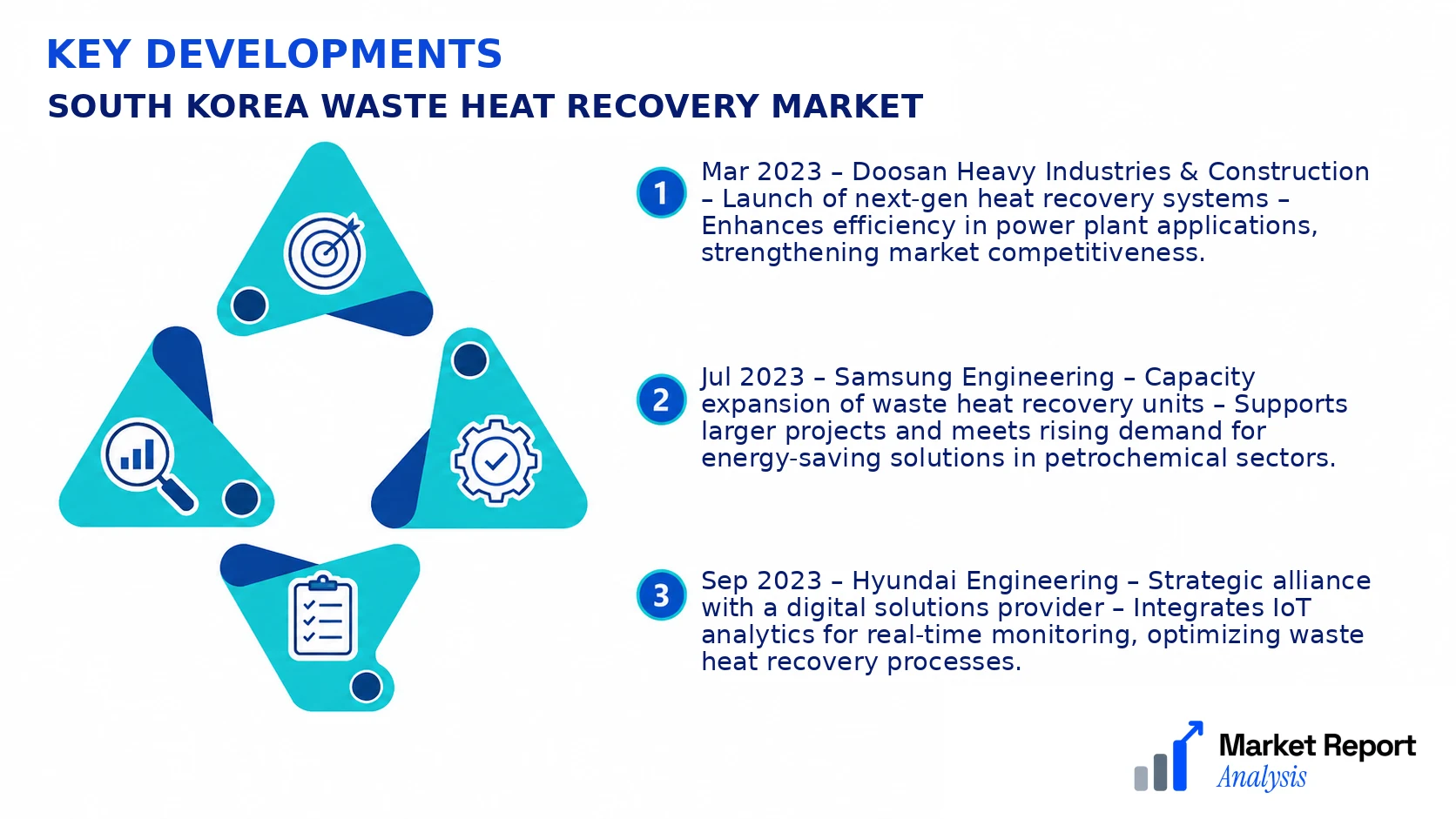
- Mar 2023 – Doosan Heavy Industries & Construction – Launch of next-gen heat recovery systems – Enhances efficiency in power plant applications, strengthening market competitiveness.
- Jul 2023 – Samsung Engineering – Capacity expansion of waste heat recovery units – Supports larger projects and meets rising demand for energy-saving solutions in petrochemical sectors.
- Sep 2023 – Hyundai Engineering – Strategic alliance with a digital solutions provider – Integrates IoT analytics for real-time monitoring, optimizing waste heat recovery processes.
- Apr 2023 – LG Electronics – Introduction of new heat exchange products – Focuses on industrial recycling and sustainable manufacturing practices, boosting energy efficiency.
- Dec 2022 – Hanwha Aerospace – Acquisition of a specialized heat exchanger manufacturer – Strengthens vertical integration and product portfolio in the energy recovery segment.
Frequently Asked Questions
What is the South Korea Waste Heat Recovery Market?
The South Korea Waste Heat Recovery Market encompasses the deployment of technologies and systems that capture excess heat from industrial processes, power plants, and manufacturing facilities to generate energy efficiency and reduce overall energy consumption across various sectors in South Korea.
What is the current market size of South Korea Waste Heat Recovery Market?
As of 2026, the market size is valued at approximately USD 2.4 Billion, driven by increased industrial activity and government initiatives toward energy efficiency. The market shows steady growth prospects aligned with South Korea's sustainable development goals.
What factors are driving the South Korea Waste Heat Recovery Market?
Key drivers include the rising demand for energy-efficient solutions, stringent environmental regulations, government incentives for clean energy projects, and advancements in heat recovery technologies. Industrial expansion and the push toward renewable energy integration further fuel growth.
Which South Korean city leads the South Korea Waste Heat Recovery Market?
Seoul leads the market due to its dense industrial base, extensive infrastructure, and proactive governmental policies supporting energy recovery initiatives. Its status as a commercial hub accelerates adoption across multiple sectors.
Which segment is expected to grow the fastest?
The manufacturing sector is anticipated to experience the fastest growth, leveraging heat recovery to enhance energy efficiency, reduce costs, and meet regulatory standards. This segment’s expansion is also supported by ongoing industrial modernization efforts.
Who are the leading companies operating in the South Korea Waste Heat Recovery Market?
Major players include Samsung Engineering, LG Electronics, Doosan Heavy Industries, and SK Engineering & Construction. These companies invest in innovative solutions and strategic partnerships to expand their market presence and technological capabilities.
Analyst Perspective
The South Korea Waste Heat Recovery Market exhibits a mature yet evolving landscape, with localized strategic efforts fostering sustainable growth. Long-term, the sector is poised for steady expansion, driven by stringent governmental regulations on industrial emissions and the national commitment toward carbon neutrality, which incentivizes waste heat utilization. Commercial opportunities are abundant, especially within the petrochemical, steel, and power generation sectors, where high-grade waste heat streams can significantly improve energy efficiency and reduce operational costs. Technological evolution is focused on improving heat exchange efficiency, integration with renewable energy sources, and deployment of advanced analytics for predictive maintenance. Investment priorities should target innovative heat recovery systems and smart grid integration, facilitating more resilient and efficient energy infrastructure. Competitive intensity remains high, with both domestic and international players innovating rapidly. City-level growth potential is particularly strong in industrial hubs like Ulsan, Pohang, and Incheon, where dense manufacturing clusters and strategic infrastructural projects create fertile ground for waste heat projects, shifting the landscape toward more sustainable and economically beneficial solutions.
