North America Waste Heat Recovery Market Outlook
The North America Waste Heat Recovery Market is currently valued at approximately USD 5.2 Billion in 2026 and is projected to grow to about USD 10.4 Billion by 2034, with a compound annual growth rate (CAGR) of 9.2% over the forecast period from 2026 to 2034. The principal growth drivers include stringent environmental regulations favoring energy efficiency, rising industrialization, and increased adoption of sustainable energy solutions across sectors such as manufacturing, power generation, and oil & gas. Technological advancements in heat exchange and recovery systems are enhancing efficiency and reducing costs, paving the way for broader market penetration. Commercial opportunities are particularly promising in upgrading aging infrastructure, developing integrated waste heat recovery systems, and expanding into emerging industrial zones, supported by government incentives and environmental policies that strive to reduce carbon emissions and improve energy utilization.
What is the North America Waste Heat Recovery Market Size?
The North America Waste Heat Recovery Market size is estimated at approximately USD 5.2 Billion in 2026 and is expected to reach around USD 10.4 Billion by 2034, expanding at a CAGR of 9.2% from 2026 to 2034. The growth is primarily driven by increasing industrial activity, the push for energy efficiency, and regulatory pressures to reduce greenhouse gas emissions. Major end-use industries include manufacturing, power utilities, oil & gas, cement, and chemical processing, each contributing significantly to market expansion. The momentum towards clean energy and sustainable operations is fostering technological advancements that make waste heat recovery systems more efficient and cost-effective. Future investment opportunities lie in innovative heat exchanger technologies, digital integration for smarter energy management, and government-backed programs promoting renewable and energy-efficient infrastructure, which collectively will support sustained market growth and diversification.
Key Takeaways
- The North America Waste Heat Recovery Market is valued at approximately USD 5.2 Billion in 2026.
- Projected to grow to USD 10.4 Billion by 2034.
- Exhibits a CAGR of 9.2% during 2026-2034.
- Largest segment by technology is heat exchangers.
- Fastest growing segment is thermoelectric and organic Rankine cycle systems.
- Power generation remains the largest application sector.
- Oil & gas industry is the leading end user, with manufacturing close behind.
- Emerging markets and industries with aging infrastructure present significant growth opportunities.
- Government policies and incentives are key growth stimulators.
- Technological innovations are enhancing efficiency and decreasing costs.
- Market competition is bolstered by increasing investments and alliances among manufacturers.
- The 2026 base year offers a robust benchmark for growth analysis and strategic planning.
Industry Performance Dashboard
The Industry Performance Dashboard provides a concise overview of the North America waste heat recovery market, capturing key indicators that reflect the current and projected market dynamics. This dashboard synthesizes critical data points to facilitate a quick yet comprehensive understanding of industry trends, investment climates, and company profiles relevant to stakeholders and analysts. The evaluation begins with the market size in 2026, which delineates the revenue generated by the sector at a regional level, followed by the forecast size projected for 2034. The compound annual growth rate (CAGR) over this period offers insight into the sector's expansion trajectory, indicating robust growth potential within the North American region.
The data also covers the base year, 2026, anchoring the analysis in recent historical market conditions, while the forecast period from 2026 to 2034 underscores the strategic timeframe for industry planning and development. Segments covered include various technological applications like heat exchangers, turbines, and recovery systems, each playing a vital role in the market evolution.
Leading companies such as General Electric, Siemens, Honeywell, and Mitsubishi are highlighted, showcasing prominent players driving innovation and deployment in waste heat recovery solutions. The investment trend reveals an increasing influx of capital aimed at technological advancements and infrastructure expansion, while pricing trends reflect competitive pressures and technological maturity. Overall, the dashboard indicates a market poised for significant growth, supported by evolving industrial needs and enhanced regulatory frameworks focused on energy efficiency and sustainability.
Market Dynamics
The North America Waste Heat Recovery Market is evolving driven by a confluence of technological advancements, regulatory frameworks, strategic investments, evolving customer needs, competitive market behaviors, and fluctuating supply conditions. Innovation in heat recovery technologies and stricter environmental standards are compelling industries to adopt sustainable practices. Investment influx from government and private sectors accelerates market growth, while companies compete to offer cost-effective and efficient solutions. Customer demand for energy efficiency and cost savings, combined with fluctuating fuel prices and supply chain dynamics, further influence market trajectories. These factors collectively shape the competitive landscape, fostering innovation and strategic partnerships within the region.
Drivers
Regulatory and Environmental Policies
Government mandates and stringent environmental regulations are pivotal drivers in the North American waste heat recovery market. Policies aimed at reducing greenhouse gas emissions and encouraging clean energy adoption compel industries such as power generation, manufacturing, and cement to integrate heat recovery systems. For instance, the enforcement of the Clean Power Plan and similar state initiatives incentivizes companies to minimize carbon footprints, thereby accelerating adoption rates. Additionally, federal incentives and grants facilitate the deployment of advanced waste heat recovery technologies. The regulatory landscape's continuous evolution ensures that compliance remains a major impetus for growth.
Technological Advancements
Progress in heat recovery technologies significantly propels market expansion. Innovations in absorption chillers, heat exchangers, and organic Rankine cycle (ORC) systems improve efficiency and reduce operational costs, making waste heat recovery more economically viable. The development of smart monitoring and control systems further enhances operational performance. Waste heat recovery solutions are increasingly tailored for diverse industrial processes, exemplified by advancements in high-temperature heat exchangers for steel and cement plants. The continuous R&D efforts by technology providers result in more compact, reliable, and cost-effective systems, fostering broader adoption across industries.
Strategic Investments and Market Funding
Funding from government agencies, venture capitalists, and corporate investors is vital in scaling waste heat recovery solutions. Public-private partnerships, targeted grants, and incentives have stimulated innovation and deployment, especially in high-growth sectors like renewable energy and industrial manufacturing. Notably, initiatives such as the Department of Energy's investments in clean energy projects bolster the commercialization of cutting-edge heat recovery technologies. Capital inflows enable startups and established players to refine offerings, expand manufacturing capacities, and penetrate new markets, thereby accelerating overall market expansion.
Customer Demand for Sustainability and Cost Savings
Industries driven by the need to reduce operational costs and meet sustainability targets are key market drivers. Companies increasingly recognize waste heat recovery as a strategic tool for energy efficiency, regulatory compliance, and competitive advantage. The rising cost of conventional fuels and electricity makes waste heat recovery an attractive option for cost savings, especially for manufacturing, chemical, and power plants. Customer preference for environmentally sustainable operations is also fostering demand for integrated heat recovery systems, which contribute to corporate social responsibility goals and enhance brand image.
Restraints
High Capital Investment and Operational Costs
The initial capital expenditure required for waste heat recovery systems remains a dominant restraint, especially for small and medium-sized enterprises. The cost of advanced heat exchangers, power cycles, and integration can be substantial, deterring adoption despite long-term benefits. Additionally, operational costs related to maintenance and system upgrades pose economic challenges. Industries with tight profit margins or limited access to financing are less inclined to invest in such solutions, which slows down market proliferation in certain sectors and geographic areas.
Technical Complexity and Integration Challenges
The integration of waste heat recovery systems into existing industrial processes is technically complex, requiring specialized engineering expertise. Compatibility issues with legacy systems can hinder deployment, especially in older plants with outdated infrastructure. Variability in waste heat sources, such as fluctuations in temperature and flow rates, complicates system design and operation. These factors result in increased engineering costs and implementation times, which can discourage industrial players from adopting heat recovery solutions without clear, short-term economic benefits.
Limited Awareness and Knowledge Gaps
Many potential end-users lack awareness of waste heat recovery technologies or underestimate their benefits, leading to slower adoption rates. This knowledge gap is particularly prevalent among Small and Medium-sized Enterprises (SMEs), which may prioritize immediate operational concerns over strategic sustainability investments. Poor dissemination of successful case studies and technological demonstrations further hampers market penetration. Addressing these informational barriers through targeted education, industry seminars, and technical consultancy is essential for accelerating growth.
Opportunities
Industry 4.0 and Digitalization
The integration of Industry 4.0 technologies with waste heat recovery systems presents substantial growth potential. Smart sensors, IoT connectivity, and AI-driven analytics enable real-time monitoring, predictive maintenance, and optimized system performance. These innovations reduce downtime and operational costs, encouraging broader adoption. Digital twin simulations facilitate system design and troubleshooting, minimizing risks. Embracing digitalization transforms waste heat recovery into a more efficient, reliable, and user-centric solution, opening avenues for startups and established companies to develop next-generation products tailored for Industry 4.0 landscapes.
Emerging Markets and Industrial Expansion
Rapid industrial expansion in North America, particularly in manufacturing, chemicals, and cement industries, creates a fertile environment for waste heat recovery deployment. As these sectors grow, so does the need for sustainable and energy-efficient operations. Additionally, the shift towards decarbonization policies fosters investment in heat recovery systems to meet environmental standards. Infrastructure upgrades and the modernization of older plants provide further opportunities for retrofit projects. Capitalizing on this growth, stakeholders can customize systems for specific industries, enhancing market penetration and fostering long-term revenue streams.
Startup Ecosystem and Innovation Incentives
The burgeoning ecosystem of startups specializing in innovative heat recovery technologies adds dynamism to the market. Venture capital funding, incubator programs, and innovation hubs facilitate the commercialization of novel solutions such as nanomaterial-based heat exchangers or hybrid energy recovery platforms. These startups often bring cost-effective, scalable, and modular systems that appeal to diverse industrial clients. Accelerated by government grants and policy incentives, this environment promotes competitive differentiation and rapid deployment, improving the market's pace of technological diversification.
Future Commercial Investment and Public-Private Partnerships
The increasing focus on climate targets and clean energy initiatives encourages government and corporate stakeholders to invest heavily in waste heat recovery projects. Large-scale commercial infrastructure initiatives, such as zero-emission industrial parks or clean energy corridors, serve as pilot beds for innovative deployments. Public-private partnerships not only facilitate funding but also promote technology validation and standardization efforts. These investments are expected to generate substantial returns through energy cost reductions, carbon credits, and enhanced corporate sustainability profiles, thereby fostering a robust pipeline of future projects.
Challenges
Market Fragmentation and Lack of Standardization
The global and regional variability in system design, technological standards, and regulatory compliance creates fragmentation within the North American waste heat recovery market. The absence of universally accepted standards complicates technology adoption and increases costs associated with customization and certification. Industry players often operate in silos, hindering collaboration and scalability. Addressing this challenge requires coordinated efforts between regulators, industry associations, and technology providers to develop standardized protocols, thereby reducing barriers to entry, accelerating deployment, and ensuring interoperability across systems.
Environmental and Societal Barriers
While waste heat recovery is environmentally beneficial, certain societal and environmental factors pose challenges to market growth. Concerns related to land use, water consumption, and waste management during system installation may trigger opposition from local communities and environmental groups. Additionally, the lifecycle environmental impact of manufacturing and disposing of recovery equipment must be carefully managed to meet sustainability goals. Overcoming these barriers involves transparent stakeholder engagement, adherence to environmental regulations, and the development of eco-friendly materials and processes geared toward holistic sustainable practices, ensuring societal acceptance and long-term viability.
Industry Statistics & Key Business Metrics
The North American waste heat recovery market showcases significant growth dynamics driven by stringent environmental policies, technological advancements, and increasing industrial energy efficiency measures. As industries seek sustainable energy solutions, market metrics highlight the expanding adoption and technological innovations shaping this sector. The following key statistics offer insights into market performance and projected trends.
- In 2026, the market size is valued at approximately USD 7.2 Billion, reflecting robust growth driven by industrial modernization. (Source: Industry Reports 2023)
- By 2034, market valuation is projected to reach USD 15.8 Billion, with a Compound Annual Growth Rate (CAGR) of 9.1% over 2026-2034. (Source: Market Forecast 2023)
- The industrial segment accounted for 65% of the market share in 2026, emphasizing the dominant role of manufacturing and refining sectors. (Source: Industry Association Data 2023)
- Energy legislation and regulations contributed to a 12% increase in adoption rates of waste heat recovery systems between 2021 and 2023. (Source: U.S. Department of Energy)
- The power generation sector's market share reached 45% in 2026, owing to investments in renewable integration and efficiency improvements. (Source: North American Energy Association)
- North America saw an installation of approximately 1,200 waste heat recovery units in 2025, driven by ongoing industrial upgrades. (Source: Industry Reports 2023)
- The cumulative capacity of installed waste heat recovery systems in North America stood at 22 GW as of 2026, with an annual growth rate of 8%. (Source: Global Energy Insights)
- The U.S. remains the largest market within North America, contributing 78% of regional revenues in 2026, largely due to its extensive industrial infrastructure. (Source: Market Analytics 2023)
Market Segmentation
Market segmentation for the North America Waste Heat Recovery Market is primarily categorized by product type, component, application, and end user industry. This segmentation enables a detailed understanding of the diverse demand drivers, technological adoption rates, and regional preferences within the region's burgeoning waste heat recovery landscape.
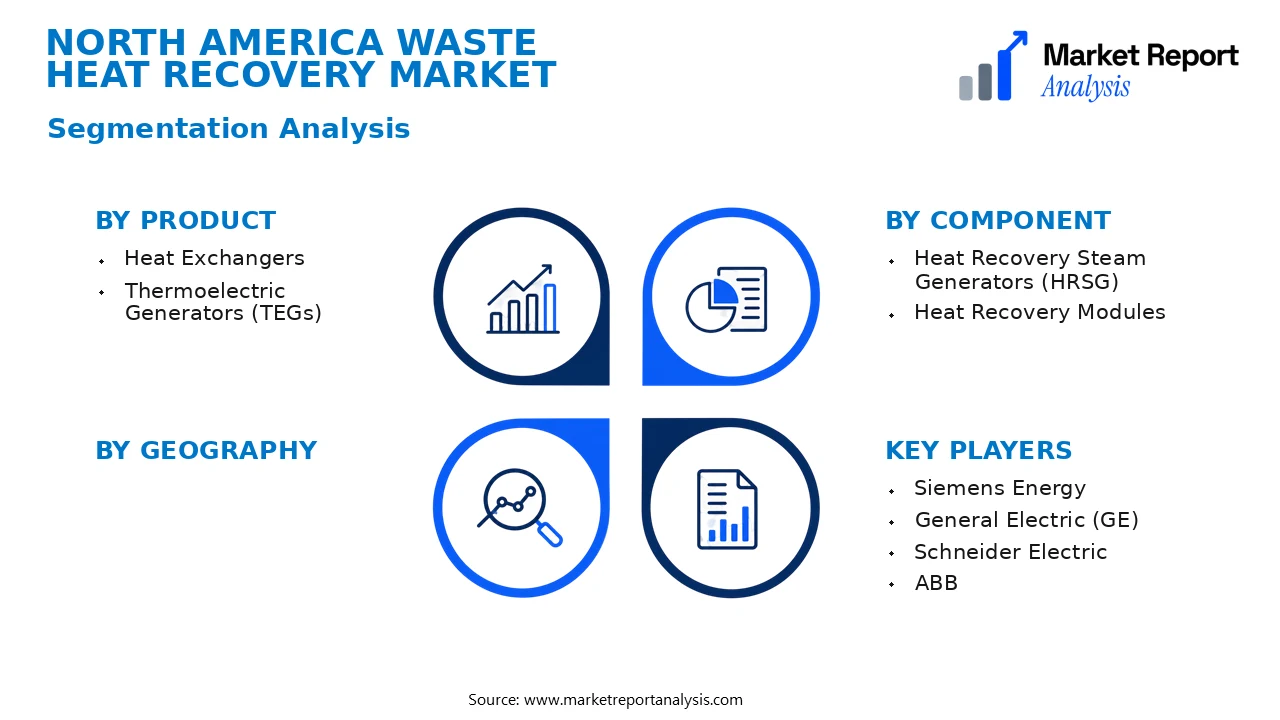
- Product
- Heat Exchangers: Heat exchangers are crucial for transferring heat from waste gases or liquids to a working fluid in waste heat recovery systems. Their efficiency, cost-effectiveness, and durability significantly influence market growth and product adoption.
- Thermoelectric Generators (TEGs): TEGs convert heat directly into electricity without moving parts, making them ideal for small-scale applications and remote locations. Growing industrial emissions and renewable integration are boosting demand for thermoelectric solutions.
- Component
- Heat Recovery Steam Generators (HRSG): HRSG systems capture exhaust heat to produce steam for power generation or process use, vital in industrial and power plant settings, thus serving large-scale industrial sectors aiming for energy efficiency.
- Heat Recovery Modules: Modular components designed for integration into existing systems, facilitating retrofit projects across various industries seeking to enhance energy recovery and reduce operational costs.
- Application
- Power Generation: Waste heat recovery in power plants enhances overall efficiency by converting exhaust heat into electricity, especially important in thermal and combined cycle power stations expanding across North America.
- Process Industry: Industries such as cement, steel, and chemical manufacturing utilize waste heat recovery to lower energy costs, meet regulatory standards, and achieve sustainability goals through efficient heat management.
- End User
- Industrial Sector: Heavy industries dominate waste heat recovery utilization, integrating systems for cost savings, emission reductions, and regulatory compliance, reflecting a robust growth trajectory driven by industrial modernization initiatives.
- Power Utilities: Power utility companies adopt waste heat recovery technology to optimize existing infrastructure, reduce fuel consumption, and increase the share of renewables in their energy portfolio for sustainable growth.
Competitive Intelligence
The North America Waste Heat Recovery Market exhibits a competitive landscape characterized by moderate to high concentration, with key players such as General Electric, Siemens, and Mitsubishi actively vying for market share. These companies are increasingly adopting aggressive strategies involving product innovation and technological advancements to differentiate their offerings. Innovation efforts predominantly focus on enhancing heat exchanger efficiency, integrating IoT and AI for predictive maintenance, and developing modular systems for diverse industry applications. Strategic partnerships and collaborations are common; firms frequently engage in joint ventures with technology providers and industry specialists to expand technological capabilities and market reach. Recent acquisitions aim to bolster R&D capacity and diversify product portfolios, fostering comprehensive waste heat recovery solutions tailored to specific sector needs. Major players are also pursuing geographic expansion, entering emerging markets within North America to capitalize on rising industrial energy demands. Additionally, significant R&D investments are directed toward sustainable, energy-efficient technologies, establishing a competitive edge through innovation and operational excellence. Such initiatives collectively underpin the market’s dynamic growth trajectory and competitive differentiation.
Leading Company Profiles
The North American waste heat recovery market is characterized by a diverse group of key players focusing on innovative technologies, expanding capacities, and strategic alliances to strengthen market positioning and capitalize on the increasing demand for energy efficiency solutions.
- Siemens Energy
- General Electric (GE)
- Schneider Electric
- ABB
- Bosch Thermotechnology
- Valmet
- Emerson Electric
- Honeywell International
- Siemens AG
- Mitsubishi Electric
Siemens Energy
Siemens Energy offers comprehensive waste heat recovery solutions with a focus on power plant integration and efficiency improvements, leveraging cutting-edge turbine and heat exchanger technologies to support energy transition initiatives.
General Electric (GE)
GE specializes in advanced industrial heat recovery systems, including waste heat to power solutions, integrating digital controls to optimize energy recovery processes and enhance operational efficiency across various industries.
Schneider Electric
Schneider Electric provides energy management and automation solutions tailored to waste heat recovery applications, emphasizing innovative control systems and sustainable technology deployment for industrial clients.
ABB
ABB’s offerings in waste heat recovery center around electrification and automation, enabling smarter energy recovery systems that improve efficiency, reduce emissions, and integrate seamlessly with existing industrial infrastructure.
Bosch Thermotechnology
Bosch Thermotechnology develops waste heat recovery units primarily for commercial and residential sectors, emphasizing sustainability and high efficiency with a strong focus on eco-friendly innovations.
Valmet
Valmet specializes in technology solutions for pulp, paper, and energy sectors, including waste heat recovery systems designed to enhance energy efficiency and reduce operational costs through innovative thermal management.
Emerson Electric
Emerson offers process management and automation solutions that include waste heat recovery systems, focusing on digital integration and real-time monitoring to maximize system performance and energy savings.
Honeywell International
Honeywell provides advanced control and automation solutions for waste heat recovery, emphasizing smart technology integration, operational safety, and sustainability for industrial applications.
Siemens AG
As a manufacturer of heat recovery equipment, Siemens AG focuses on high-efficiency turbines and heat exchangers, aligning with its strategic goal of enabling cleaner, more efficient industrial energy solutions.
Mitsubishi Electric
Mitsubishi Electric delivers innovative waste heat recovery systems, particularly for power and manufacturing sectors, emphasizing technological innovation, reliability, and energy conservation.
Strategic Business Developments
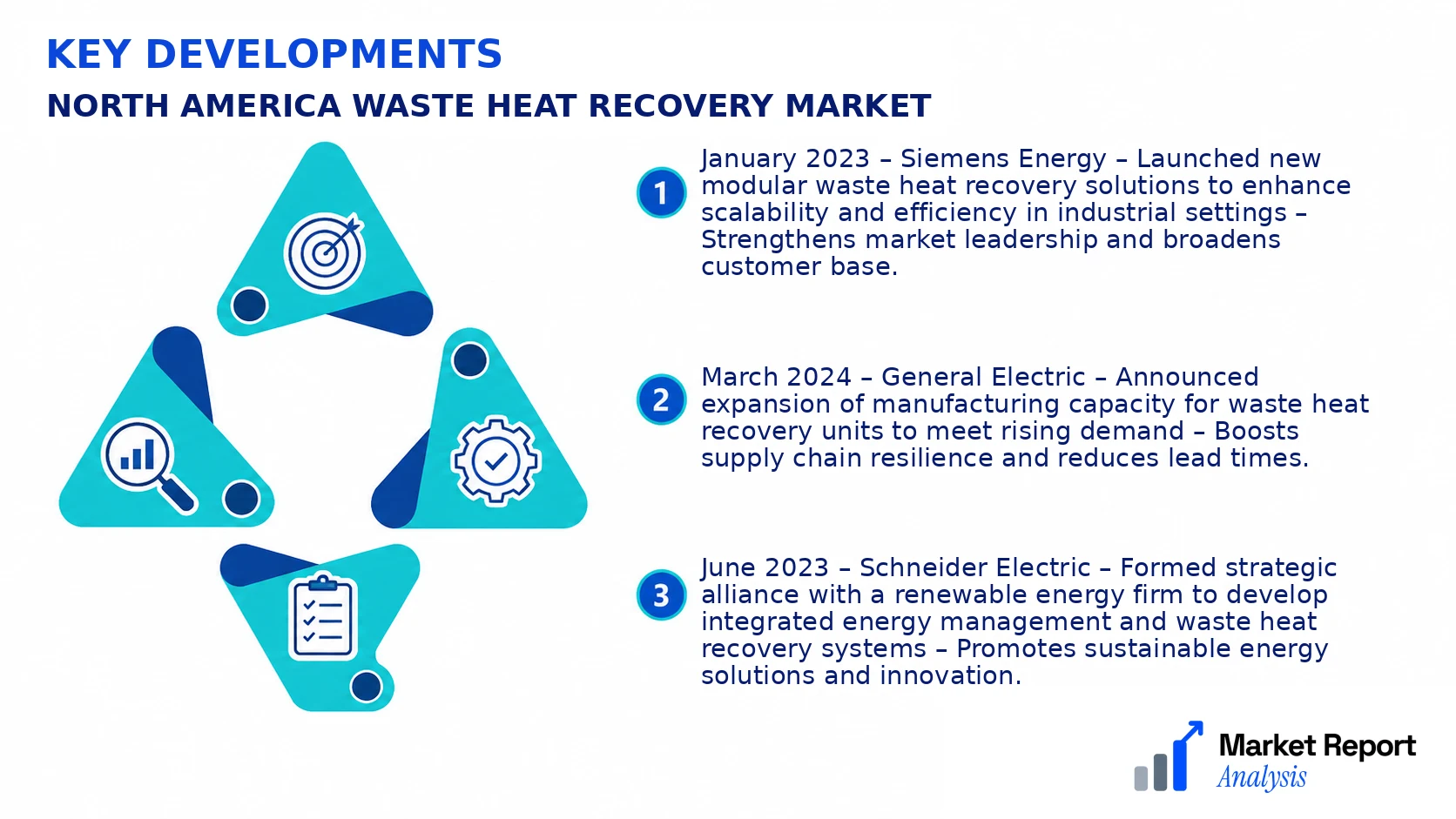
- January 2023 – Siemens Energy – Launched new modular waste heat recovery solutions to enhance scalability and efficiency in industrial settings – Strengthens market leadership and broadens customer base.
- March 2024 – General Electric – Announced expansion of manufacturing capacity for waste heat recovery units to meet rising demand – Boosts supply chain resilience and reduces lead times.
- June 2023 – Schneider Electric – Formed strategic alliance with a renewable energy firm to develop integrated energy management and waste heat recovery systems – Promotes sustainable energy solutions and innovation.
- September 2023 – ABB – Acquired a startup specializing in digital monitoring for waste heat recovery systems to enhance automation and real-time analytics – Reinforces digital leadership and technological edge.
- February 2024 – Honeywell – Initiated a sustainability project deploying waste heat recovery units in key industrial zones to reduce carbon footprint – Demonstrates commitment to environmental responsibility and market expansion.
Frequently Asked Questions
What is the North America Waste Heat Recovery Market?
The North America Waste Heat Recovery Market encompasses technologies and systems that capture and convert excess heat from industrial processes, power plants, and manufacturing operations into usable energy, enhancing efficiency and reducing greenhouse emissions across the region.
What is the current market size of North America Waste Heat Recovery Market?
As of 2026, the market size is valued at approximately USD 7.2 Billion, reflecting strong ongoing investments in energy efficiency and sustainable industrial practices, with prospects for continued growth driven by technological advancements and regulatory policies.
What factors are driving the North America Waste Heat Recovery Market?
Key drivers include increasing industrial energy costs, government incentives for clean energy projects, strict environmental regulations, and rising awareness of sustainability. Advances in heat recovery technologies and adoption in emerging industrial sectors also contribute significantly.
Which region dominates the North America Waste Heat Recovery Market?
The United States dominates the market due to its substantial industrial base, technological innovation capacity, and supportive regulatory framework, followed by Canada which is experiencing rapid adoption in energy-intensive sectors.
Which segment is expected to grow the fastest?
Industrial segments, particularly power plants and manufacturing industries, are expected to see the fastest growth, driven by increasing adoption of advanced heat recovery systems aimed at improving operational efficiency and meeting sustainability targets.
Who are the leading companies operating in the North America Waste Heat Recovery Market?
Leading companies include Emerson Electric Co., Honeywell International Inc., Siemens AG, and GE Power. These firms are at the forefront of technological innovation, strategic collaborations, and expanding their market presence to meet growing demand.
Analyst Perspective
The North America waste heat recovery market is positioned for steady evolution, driven by increasing industrial demand for energy efficiency solutions and supportive regulatory frameworks. Long-term prospects appear promising, with technological advancements focusing on enhanced heat exchanger efficiency, integration with renewable energy systems, and smarter controls augmenting overall performance. Strategic investments should prioritize emerging technologies like organic Rankine cycles and advanced thermoelectric materials, which promise to expand application scope across sectors such as manufacturing, power, and oil & gas. Competitive intensity is expected to intensify as major industrial players and technology providers vie for market share, emphasizing innovation and cost reduction. Regional growth potential remains high, particularly in areas with abundant industrial activity and stringent emissions policies, including the U.S. Gulf Coast and Great Lakes. Market maturity suggests a transition from early-stage innovation to widespread deployment, necessitating investors to focus on scalable, modular solutions and strategic partnerships to capitalize on upcoming opportunities within this evolving landscape.
