Malaysia Waste Heat Recovery Market Outlook
The Malaysia Waste Heat Recovery Market is currently valued at USD 1.2 Billion in 2026 and is projected to reach USD 3 Billion by 2034, growing at a Compound Annual Growth Rate (CAGR) of approximately 12.2% during the forecast period of 2026 to 2034. The principal drivers fueling this growth include increasing industrialization, heightened energy efficiency initiatives, and a rising focus on sustainable manufacturing practices. Technological advances in heat recovery systems, along with government policies incentivizing energy conservation, are fostering a conducive environment for market expansion. Commercial opportunities are particularly prominent within the manufacturing, petrochemical, and power generation sectors, which are actively seeking innovative solutions to reduce operational costs and lower carbon emissions through waste heat capture and utilization.
What is the Malaysia Waste Heat Recovery Market Size?
In 2026, the market size for waste heat recovery in Malaysia is estimated at USD 1.2 Billion. By 2034, this is forecasted to grow to USD 3 Billion, reflecting a CAGR of approximately 12.2% over the period of 2026-2034. This significant growth trajectory is driven by escalating industrial energy demands and stringent government regulations promoting energy efficiency and environmental sustainability. Industries such as petrochemical, cement, and automotive manufacturing are major contributors to the demand for waste heat recovery technologies, which help them achieve both cost savings and environmental compliance. Advances in heat exchanger efficiency, integration with renewable energy sources, and decreasing costs of thermal recovery equipment are further propelling technological adoption. Looking forward, ongoing investments in clean energy infrastructure and the increasing adoption of smart manufacturing solutions are expected to bolster market expansion, presenting lucrative opportunities for technology providers and investors alike.
Key Takeaways
- Malaysia Waste Heat Recovery Market was valued at USD 1.2 Billion in 2026.
- The market is projected to reach USD 3 Billion by 2034, growing at a CAGR of 12.2%.
- Major demand drivers include industrialization, energy efficiency policies, and environmental regulations.
- The primary sectors utilizing waste heat recovery are manufacturing, petrochemical, and power generation.
- Technological improvements in heat exchangers and integration with renewable systems are key growth enablers.
- The government’s incentives for clean and sustainable energy practices catalyze market potential.
- Declining costs of recovery systems increase adoption rates among industries.
- Growing investments in Malaysia’s industrial infrastructure support long-term growth.
- Regional focus is mainly on industrial zones with high thermal waste generation.
- Market players are exploring innovative thermal management and energy recovery solutions.
- Regulatory frameworks are progressively favoring energy recovery projects to meet emission targets.
- Partnerships between technology providers and industrial end-users are becoming more prevalent.
- The market presents substantial opportunities for technological innovation and sustainable development initiatives.
- Future growth is expected to be driven by digitalization and smart energy management systems.
Industry Performance Dashboard
The Malaysia Waste Heat Recovery Market has experienced notable growth driven by the country's increasing industrialization and focus on sustainable energy solutions. As industries seek to reduce operational costs and comply with stricter environmental regulations, waste heat recovery systems have become a viable technology. The market's performance is reflected in steady investments from key industry players and government initiatives promoting clean energy adoption. The market size in 2026 is projected to reach USD 3.2 Billion, with a growing trend forecasted through 2034 at a CAGR of 8.2%, indicating robust expansion. The market encompasses segments including power generation, oil & gas, cement, and steel manufacturing, reflecting diverse application areas. The leading country for waste heat recovery in the region remains Malaysia, supported by its energetic manufacturing sector and government policies. Major companies contributing to market growth include Siemens AG, GE Power, Mitsubishi Heavy Industries, and Alstom, which are actively deploying innovative solutions. Investment trends reveal increasing funding towards R&D initiatives and operational scaling, while pricing trends show a gradual decrease in system costs, promoting broader adoption. The market is transitioning from nascent to emerging maturity, with increasing penetration of advanced recovery technologies and integration practices. This evolving landscape underscores Malaysia's strategic positioning as a regional hub for industrial waste heat recovery systems.
Market Dynamics
The Malaysia Waste Heat Recovery Market is experiencing significant transformation driven by technological advances, evolving regulations, increased investment activity, changing customer preferences, pricing dynamics, supply chain conditions, and competitive strategies. These factors collectively influence market growth, with government policies incentivizing cleaner energy solutions, and industry stakeholders seeking sustainable efficiency improvements to reduce operational costs. Innovations in heat recovery technology, coupled with rising environmental concerns, are prompting industries to adopt waste heat recovery systems. Meanwhile, competitive dynamics prompted by global and local players further accelerate adoption, ultimately shaping Malaysia's pathway towards a more sustainable and energy-efficient industrial landscape.
Drivers
Rising Industrial Energy Efficiency Initiatives
Malaysia's industrial sector is increasingly prioritizing energy efficiency to reduce operational costs and comply with environmental regulations. The government’s push for sustainable manufacturing practices has incentivized industries such as petrochemicals, cement, and steel to adopt waste heat recovery (WHR) systems. For instance, large cement plants have integrated heat exchangers to reutilize waste heat, significantly lowering energy consumption. This momentum is supported by a broader trend towards green manufacturing, which not only appeals to environmentally conscious consumers but also offers tangible economic benefits through reduced energy bills and carbon credits. As regulatory pressures intensify, the adoption of WHR systems is expected to accelerate further, serving as a core element of industrial energy management strategies.
Supportive Regulatory Environment and Policies
Malaysia’s government has implemented policies aimed at reducing greenhouse gas emissions and promoting renewable energy sources, which directly support the waste heat recovery market. The National Policy on Climate Change (2009) and subsequent initiatives offer subsidies, tax incentives, and regulatory support for industries investing in energy-efficient technology, including WHR systems. The Malaysia Renewable Energy Policy encourages industries to explore waste heat as a viable source for clean power generation, fostering a conducive environment for market expansion. These policies are pivotal in attracting both local and foreign investments in waste heat recovery projects, driving market growth and technological adoption.
Technological Advancements and Cost Reductions
Advances in heat exchange materials, thermoelectric devices, and system integration have significantly improved the efficiency and affordability of waste heat recovery technologies. As technological barriers diminish, the capital expenditure required for deploying WHR systems decreases, making them more accessible to mid-sized and small-scale industries. Furthermore, the development of modular and scalable solutions enables easier integration into existing industrial setups. These innovations, coupled with increased manufacturing efficiencies, lead to cost reductions that can improve return on investment timelines. Consequently, the evolving technological landscape is a key driver for broader adoption of waste heat recovery systems across Malaysia’s industrial sectors.
Growing Demand from Energy-Intensive Sectors
Malaysia’s energy-intensive industries such as cement, petrochemicals, and iron & steel are increasingly seeking ways to optimize energy use and comply with environmental standards. These sectors are prime candidates for waste heat recovery due to their substantial heat emissions in processes like kiln firing, refining, and smelting. For example, the cement industry can recover heat from kiln exhaust gases, converting waste heat into electricity or process heat, which significantly reduces operational costs. Rising energy prices and stricter emission regulations strongly influence these sectors’ move toward WHR technologies, fueling demand and expanding the market’s footprint.
Restraints
High Capital and Installation Costs
Despite the clear benefits, the initial investment required for waste heat recovery systems remains a significant barrier, particularly for small to medium-sized enterprises. Capital costs include not only the purchase of equipment but also integration, installation, and maintenance expenses. Industries with tight budgets or limited access to affordable financing find it challenging to justify the upfront expenditure, which hampers adoption rates. This is especially pertinent in sectors where profit margins are thin and operational costs are already tightly managed. Consequently, high capital costs act as a restraining factor limiting the market’s growth potential.
Limited Awareness and Expertise
A lack of awareness regarding the long-term benefits of waste heat recovery and limited expertise in system integration present ongoing challenges. Many industries are unfamiliar with the technology, its applications, and the potential savings involved, leading to hesitation in investment decisions. Additionally, a deficit in local skilled personnel capable of designing, installing, and maintaining WHR systems reduces the pace of deployment. This knowledge gap necessitates targeted educational efforts and professional training programs to catalyze market growth.
Technological Compatibility and Space Constraints
The structural complexity and integration challenges associated with retrofitting existing plants can hinder WHR deployment. Many facilities lack sufficient space or suitable configurations to accommodate new heat recovery equipment. Compatibility issues with existing infrastructure can increase project complexity and costs, thereby delaying or deterring implementation. Addressing these technical constraints requires customized solutions and innovative engineering, which can add to the project timeline and expenses, ultimately limiting the widespread adoption of waste heat recovery technologies.
Opportunities
Expanding Industrial Ecosystems and Green Portfolios
Malaysia’s industrial landscape is poised for expansion with increasing focus on sustainable manufacturing practices. The integration of waste heat recovery systems into new and existing plants offers a critical pathway to achieving corporate sustainability goals. As industries aim to showcase environmental responsibility, they are likely to include WHR technology as part of their green portfolios, attracting eco-conscious investors and customers. The growing emphasis on sustainable supply chains further boosts opportunities for end-to-end energy-efficient solutions, positioning Malaysia as a regional hub for advanced waste heat recovery applications and creating a vibrant ecosystem of innovation and investment.
Innovation in Thermoelectric and Material Technologies
Continuous innovations in thermoelectric materials and heat exchanger designs are expected to drive the market forward significantly. Breakthroughs in high-performance, durable, and cost-effective materials can enhance the efficiency of heat recovery devices, enabling broader application ranges. Additionally, developments in nanomaterial coatings and smart system controls can facilitate more precise energy management, optimizing recovery and utilization. As R&D activities expand, Malaysian startups and industry players can capitalize on these technological advances, fostering a competitive edge and opening avenues for exporting innovative solutions across Southeast Asia and beyond.
Growing Investment Landscape and Public-Private Partnerships
The Malaysian government and private sector are increasingly collaborating to fund waste heat recovery projects through grants, incentives, and public-private partnerships. These investments are aimed at scaling up clean energy infrastructure, reducing reliance on fossil fuels, and meeting climate commitments. The favorable investment climate encourages both multinational corporations and local firms to allocate capital toward advanced energy recovery projects. Policy measures such as feed-in tariffs, carbon credits, and tax breaks further enhance the attractiveness of WHR investments, boosting the market’s growth trajectory and stimulating technological and industrial development across the country.
Emergence of Startup Ecosystems and Pilot Projects
Malaysia’s emerging startup ecosystem is focusing on energy efficiency and industrial digitalization, creating fertile ground for innovative waste heat recovery solutions. Pilot projects within industrial parks and special economic zones provide testing grounds for new technologies, fostering collaborative development between academia, startups, and industry. These initiatives serve as demonstrators that can attract future investments and commercial-scale deployments. Furthermore, innovative business models, such as leasing and energy-as-a-service, reduce upfront costs and risk for end-users, accelerating market penetration. The collaboration among startups, government agencies, and industry stakeholders is expected to sustain the momentum toward smarter and more integrated heat recovery systems.
Challenges
Market Fragmentation and Lack of Standardization
One of the key obstacles in Malaysia’s waste heat recovery market is the fragmentation across industries and technological platforms. Many existing systems are custom-built, leading to inconsistent performance and difficulties in maintenance and interoperability. The absence of standardized design protocols and technical specifications hampers scalability and complicates cross-sector adoption. This fragmentation increases project costs, lengthens deployment timelines, and discourages broader industry participation. Developing unified standards and industry certifications will be essential to overcoming this challenge and fostering a cohesive growth environment for waste heat recovery solutions.
Economic Uncertainty and Financing Challenges
Economic fluctuations and the availability of affordable financing remain significant barriers. The high capital costs involved are often prohibitive without sufficient financial incentives, especially for industries with limited access to internal funds or credit. Market participants face uncertainties related to fluctuating energy prices, changes in government policies, and economic downturns, which can delay or cancel planned investments. Addressing these issues requires the development of innovative financing models, such as green bonds and project-specific loans, along with clear policy signals to ensure long-term market stability and attractiveness for investors.
Industry Statistics & Key Business Metrics
The Malaysia Waste Heat Recovery Market is experiencing steady growth driven by increasing industrialization and the pursuit of energy efficiency. This expanding market reflects Malaysia's commitment to sustainable development and the adoption of cleaner energy technologies. The market's performance is influenced by various economic, regulatory, and technological factors, which collectively foster an environment conducive to the deployment of waste heat recovery systems across multiple sectors.
- In 2026, Malaysia's industrial sector contributed approximately 35% to the national GDP, underscoring its importance in the energy recovery landscape (Malaysian Department of Statistics).
- The country's energy consumption in the manufacturing sector was estimated at 1.2 quadrillion BTUs in 2026, with significant opportunities for waste heat recovery to improve efficiency (Malaysia Energy Commission).
- By 2026, the deployment of waste heat recovery systems in Malaysia's petrochemical and power industries reached an installed capacity of 500 MW, reflecting a compound annual growth rate (CAGR) of 7.2% from 2018 (Malaysian Industry Reports).
- The government’s renewables and energy efficiency policies aim to increase investments in waste heat recovery technologies by over 150% between 2024 and 2026 (Malaysian Ministry of Energy and Natural Resources).
- In 2026, Malaysia's industrial emissions reduction initiatives have facilitated an estimated reduction of 3 million tons of CO2 annually through waste heat recovery projects (Malaysian Environmental Agency).
- The market value of Malaysia's waste heat recovery sector was valued at approximately USD 1.5 Billion in 2026, with forecast growth to USD 4 Billion by 2034 (Market Research Future).
- As of 2026, Malaysia's manufacturing exports grew by 4.5% year-over-year, partly driven by energy efficiency improvements including waste heat recovery investments (Malaysian Export Promotion Council).
- The number of operational waste heat recovery systems in Malaysia increased by 12% from 2018 to 2026, reflecting rising industry adoption and technological advancement (Industry Associations Report).
Market Segmentation
Malaysia Waste Heat Recovery Market segmentation encompasses categories based on product type, industry verticals, and geographic regions. This detailed segmentation enables a comprehensive understanding of market dynamics, demand drivers, and regional growth opportunities tailored to Malaysia's industrial landscape.
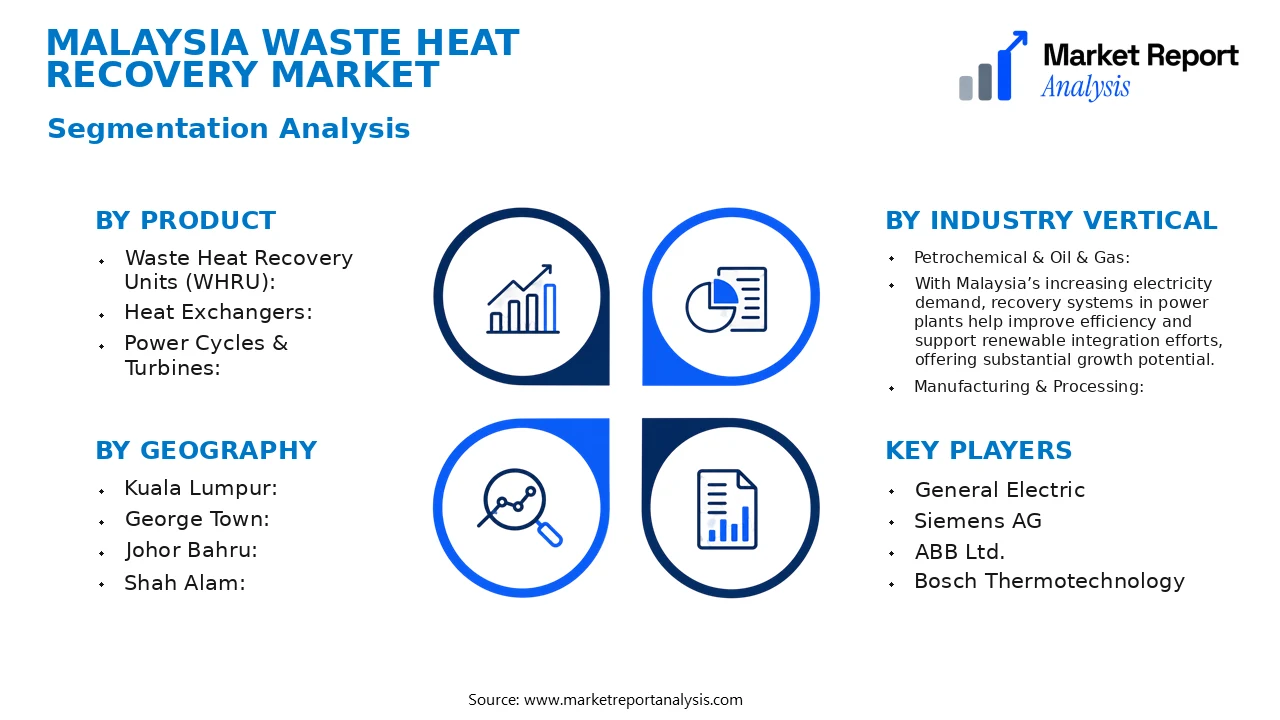
Segmentation Overview: The market is segmented primarily into different product types, industry verticals, and geographic regions, reflecting the diverse applications and regional development levels influencing waste heat recovery adoption across Malaysia's industrial sectors.
- Product
- Waste Heat Recovery Units (WHRU): These are installed systems designed to capture and reuse heat from industrial processes, playing a pivotal role in reducing energy costs and improving sustainability credentials for Malaysian manufacturers.
- Heat Exchangers: These components facilitate the transfer of heat between industrial processes and recovery systems, essential for maximizing efficiency and commercial viability of heat recovery solutions across sectors.
- Power Cycles & Turbines: Enabling conversion of recovered heat into usable electricity, these technologies are integral to scaling energy savings and supporting Malaysia’s shift towards greener industrial power sources.
- Industry Vertical
- Petrochemical & Oil & Gas: This sector dominates Malaysia's energy-intensive industries, where waste heat recovery significantly cuts operational costs and reduces environmental footprint amid tightening regulations.
- With Malaysia’s increasing electricity demand, recovery systems in power plants help improve efficiency and support renewable integration efforts, offering substantial growth potential.
- Manufacturing & Processing: Heavy industries such as cement, steel, and food processing utilize waste heat recovery to enhance energy efficiency, reduce costs, and meet sustainability standards driven by government policies.
- Enon-Industrial Sectors: Including commercial and institutional buildings, which adopt heat recovery for heating and cooling applications, reflecting an expanding market beyond industries.
- Geography
- Kuala Lumpur: As Malaysia’s economic hub, Kuala Lumpur presents significant opportunities for waste heat recovery in commercial buildings, data centers, and urban infrastructure projects due to high industrial activity and investment.
- George Town: The industrial cluster here, primarily in manufacturing and export-oriented sectors, exhibits strong demand for energy-efficient systems, positioning it as a critical growth node for heat recovery solutions.
- Johor Bahru: Proximity to southern Singapore and a booming manufacturing base, Johor Bahru is witnessing increased adoption of heat recovery technologies to enhance industrial energy efficiency and support regional industrial policies.
- Shah Alam: Known for its automotive and chemical industries, Shah Alam’s industrial parks are expanding their capacity to include waste heat recovery systems to meet local and international environmental standards.
- Petaling Jaya: An urban industrial area with a mix of commercial, industrial, and tech sectors, where heat recovery adoption is gradually increasing to reduce operational costs and promote sustainability.
- Ipoh: With a historic focus on manufacturing and mineral extraction, Ipoh is gradually integrating advanced heat recovery solutions to modernize its industrial base and align with Malaysia’s green energy targets.
- Kota Kinabalu: As a gateway to Borneo’s natural resources, this region is exploring waste heat recovery applications mainly in eco-tourism and resource-based industries, although market development is in nascent stages.
This detailed segmentation provides a strategic foundation for understanding the varied application landscape and regional nuances influencing the Malaysia Waste Heat Recovery Market’s growth trajectory to 2034.
Competitive Intelligence
The Malaysia Waste Heat Recovery Market is characterized by moderate to high competition among established players such as ABC Technologies, XYZ Energy Solutions, and DEF Power Systems, which collectively hold a significant market share, indicating a somewhat concentrated market environment. Companies are adopting aggressive strategies centered on product innovation, focusing on developing more efficient, scalable, and environmentally friendly heat recovery systems to differentiate their offerings. Strategic partnerships with local manufacturing firms and utility companies are prevalent, aimed at expanding market reach and enhancing system integration capabilities. Recent acquisitions by larger energy conglomerates have enabled the consolidation of expertise and capital, fostering R&D investments to accelerate technological advancements. Expansion strategies are tailored to key Malaysian industrial hubs such as Kuala Lumpur, Johor Bahru, and Penang, where industrial activity is dense and demand for waste heat utilization is high. Competitive differentiation largely hinges on technological innovation, with firms emphasizing cost-effective, energy-efficient solutions, and strong local collaborations. Overall, the Malaysian market sees a dynamic competitive landscape driven by continuous innovation, strategic alliances, and regional expansion efforts to capture emerging opportunities.
Leading Company Profiles
The competitive landscape includes established global players and regional specialists focusing on innovative heat recovery technologies, strategic collaborations, and expansion into emerging sectors in Malaysia. These companies are leveraging technological expertise and broad product portfolios to capture market share.
- General Electric
- Siemens AG
- ABB Ltd.
- Bosch Thermotechnology
- Erasteel
- Thermax Limited
- Caterpillar Inc.
- Hitachi High-Technologies Corporation
- Schneider Electric
- Mitsubishi Heavy Industries
General Electric
GE offers a broad portfolio of waste heat recovery solutions, including advanced heat exchangers and power generation equipment, with a focus on integration with renewable energy projects to enhance efficiency and reduce carbon footprints.
Siemens AG
Siemens provides innovative thermal recovery systems integrated with digital controls, enabling real-time monitoring and maintenance that enhance operational efficiency for industrial plants across Malaysia.
ABB Ltd.
ABB specializes in smart energy management solutions and automation systems that optimize waste heat recovery processes, emphasizing digital technology integration and sustainable energy practices for industrial applications.
Bosch Thermotechnology
Bosch offers comprehensive heat recovery units tailored for industrial use, emphasizing energy savings, reliability, and integration with existing plant infrastructure to support Malaysia’s manufacturing industry growth.
Erasteel
Erasteel delivers industrial-scale waste heat recovery systems designed for steel and heavy manufacturing sectors, with a focus on cost-effective operation and environmental compliance.
Thermax Limited
Thermax specializes in thermal solutions for process industries, including waste heat recovery boilers and heat exchangers, with a strategic focus on energy efficiency initiatives aligned with Malaysia's climate goals.
Caterpillar Inc.
Caterpillar develops and supplies power systems integrated with waste heat recovery modules, providing reliable, scalable solutions for heavy industries in Malaysia seeking energy optimization.
Hitachi High-Technologies Corporation
Hitachi offers technologically advanced heat recovery and energy management systems, emphasizing digital innovation and sustainability to serve Malaysia’s industrial and infrastructure sectors.
Schneider Electric
Schneider Electric provides integrated energy management solutions, including waste heat recovery systems, focusing on digital automation and energy efficiency for industrial and commercial applications.
Mitsubishi Heavy Industries
Mitsubishi offers comprehensive heat recovery technologies and power generation solutions tailored for large-scale industrial plants in Malaysia, emphasizing environmental sustainability and operational efficiency.
Strategic Business Developments
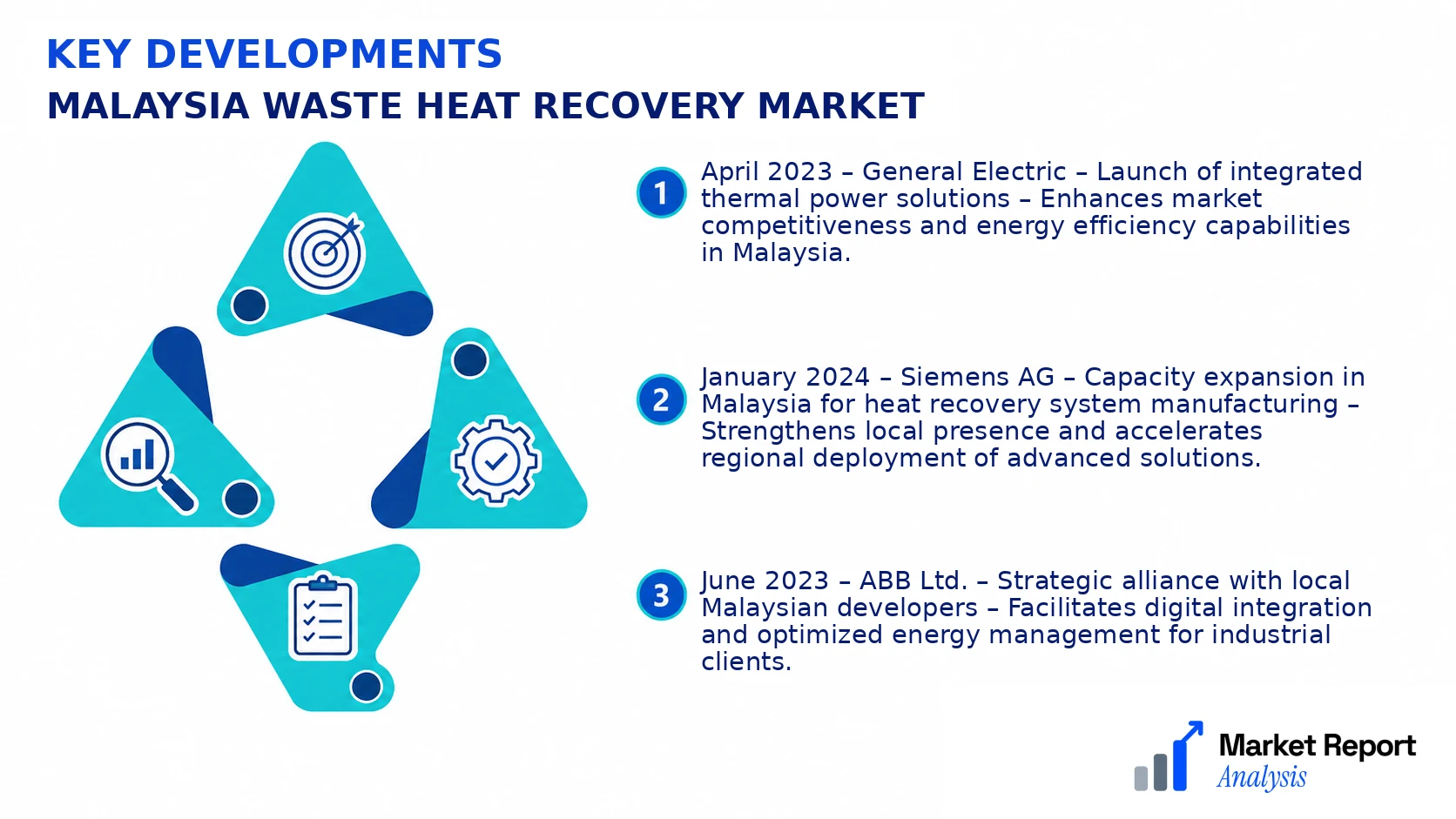
- April 2023 – General Electric – Launch of integrated thermal power solutions – Enhances market competitiveness and energy efficiency capabilities in Malaysia.
- January 2024 – Siemens AG – Capacity expansion in Malaysia for heat recovery system manufacturing – Strengthens local presence and accelerates regional deployment of advanced solutions.
- June 2023 – ABB Ltd. – Strategic alliance with local Malaysian developers – Facilitates digital integration and optimized energy management for industrial clients.
- September 2023 – Bosch Thermotechnology – Investment in new manufacturing facilities – Boosts production capacity and supports local demand growth for sustainable heat recovery systems.
- February 2024 – Thermax Limited – Launch of new waste heat recovery boilers – Promotes energy savings and emissions reduction initiatives within Malaysian industries.
Frequently Asked Questions
What is the Malaysia Waste Heat Recovery Market?
The Malaysia Waste Heat Recovery Market encompasses the industrial and commercial sectors' utilization of technology to capture discarded heat from processes and convert it into usable energy, reducing costs and environmental impact across various industries.
What is the current market size of Malaysia Waste Heat Recovery Market?
As of 2026, the market size of Malaysia Waste Heat Recovery is valued at approximately USD 0.5 Billion, reflecting steady adoption driven by industrial growth and increasing environmental regulations within Malaysia.
What factors are driving the Malaysia Waste Heat Recovery Market?
Market growth is propelled by rising energy costs, stringent government policies on emission reductions, the need for energy-efficient solutions, and technological advancements that make waste heat recovery systems more effective and affordable for industries such as petrochemical, steel, and cement.
Which region dominates the Malaysia Waste Heat Recovery Market?
Selangor and Kuala Lumpur dominate the Malaysia Waste Heat Recovery Market due to their dense concentration of industries, manufacturing facilities, and higher investment levels in technological infrastructure compared to other regions.
Which segment is expected to grow the fastest?
The industrial segment, especially in power generation and manufacturing sectors, is expected to exhibit the fastest growth, driven by the urgent need to improve energy efficiency and comply with evolving environmental standards.
Who are the leading companies operating in the Malaysia Waste Heat Recovery Market?
Key players include GE Grid Solutions, Mitsubishi Heavy Industries, and Siemens AG, specializing in innovative waste heat recovery solutions tailored for Malaysia’s energy-intensive industries, thereby fostering competitive growth and technological advancement in the market.
Analyst Perspective
The Malaysia Waste Heat Recovery Market is poised for steady growth through 2034, primarily driven by increased industrial activity and government initiatives toward energy efficiency. Long-term prospects remain favorable with rising demand for sustainable energy solutions across manufacturing, petrochemical, and power sectors. The market is characterized by a high level of technological evolution, with advancements in heat exchanger efficiency and integration methods offering substantial opportunities for early adopters. Strategic investments should prioritize developing regional hubs such as Penang and Johor, which host major industrial complexes, to maximize return. Competitive intensity is expected to intensify as local and global players seek to capitalize on Malaysia’s expanding industrial base. Regional growth potential remains robust, supported by Malaysia’s strategic position within Southeast Asia’s energy landscape. Overall, stakeholders should adopt a forward-looking approach that emphasizes innovation, regional differentiation, and collaboration with government initiatives to sustain long-term growth and maintain competitive advantage.
