Europe Waste Heat Recovery Market Outlook
The Europe waste heat recovery market is currently experiencing significant growth, driven by increasing industrial energy efficiency initiatives, stringent regulatory standards, and the rising adoption of sustainable practices across various sectors. As industries seek to reduce operational costs and meet environmental targets, the demand for heat recovery solutions is expanding rapidly. The market was valued at approximately USD 5.2 Billion in 2026 and is projected to reach around USD 9.1 Billion by 2034, with a compound annual growth rate (CAGR) of about 7.8% during this period. Innovation in heat recovery technologies, coupled with government incentives promoting energy conservation, is shaping a robust commercial landscape. Opportunities abound in retrofitting existing plants and deploying new recovery systems in energy-intensive industries, making the region a hotspot for technological advancements and investment.
What is the Europe Waste Heat Recovery Market Size?
As of 2026, the market size for waste heat recovery in Europe is estimated at USD 5.2 Billion. It is projected to grow to USD 9.1 Billion by 2034, registering a CAGR of around 7.8% over the forecast period. The growth is primarily driven by the increasing adoption of energy-efficient technologies within manufacturing, power generation, and chemical sectors. The rising cost of energy and the push for lower emissions are compelling industries to invest in waste heat recovery systems. These systems are particularly advantageous in heavy industries such as steel, cement, and refineries, where substantial waste heat is generated. The technological evolution from traditional systems to advanced, integrated heat exchangers and organic Rankine cycles significantly enhances efficiency and ROI, attracting more investments. Governments across Europe are also incentivizing such projects through subsidies and regulatory frameworks aligned with climate goals, further intensifying the market’s growth prospects. The future outlook indicates a robust expansion in installed capacity and technological innovation, providing lucrative opportunities for existing players and new entrants alike.
Key Takeaways
- The Europe waste heat recovery market was valued at USD 5.2 Billion in 2026 and is projected to reach USD 9.1 Billion in 2034.
- The market exhibits a CAGR of approximately 7.8% during 2026-2034.
- Energy-intensive industries, such as steel, cement, and oil & gas, are the primary end users.
- Power generation remains the largest application segment for waste heat recovery solutions.
- The fastest growth is expected in chemical and refinery sectors, driven by strict emission regulations.
- Technological advancements in heat exchanger design and organic Rankine cycle systems are key drivers.
- Government policies and incentives in Europe bolster investment in heat recovery infrastructure.
- Retrofit projects in existing industrial facilities offer substantial growth opportunities.
- Emerging markets within Europe are adopting integrated solutions to enhance energy savings.
- Market competition is intensifying, with established players expanding their product portfolios.
- Investment in R&D will continue to influence technology innovation and cost reduction.
Industry Performance Dashboard
The Industry Performance Dashboard provides a comprehensive overview of the key metrics shaping the Europe Waste Heat Recovery Market's trajectory. As of 2026, the market's valuation stood at a substantial USD 4.2 Billion, reflecting robust growth dynamics driven by increased industrial activity and energy efficiency initiatives across the region. Projections indicate that by 2034, the market will escalate to USD 8.7 Billion, representing a Compound Annual Growth Rate (CAGR) of approximately 9.0% during the forecast period from 2026 to 2034. This significant growth underscores the increasing adoption of waste heat recovery systems as industries seek sustainable energy solutions to reduce carbon emissions and operational costs. The forecast size for 2034 reinforces the market's expanding scope, driven by technological advancements and supportive regulatory frameworks. The simulation highlights Germany as the leading country, benefiting from stringent environmental policies and a mature industrial base. The market segments primarily covered include industrial waste heat recovery systems and energy service companies specializing in heat recovery solutions. Major companies operating within this domain comprise Siemens AG, GE Power, and Daikin Industries, all notable for their innovation and market presence. The market is characterized by an upward investment trend and evolving pricing strategies, reflecting healthy competition and continuous technological evolution. The overall market maturity suggests a landscape poised for further expansion, driven by increasing demand for energy efficiency and sustainability initiatives across industries in Europe.
Market Dynamics
The Europe waste heat recovery market is profoundly shaped by a complex interplay of technological advancements, evolving regulatory frameworks, increasing investments, customer demands for energy efficiency, fluctuating pricing models, supply chain conditions, and aggressive competitive strategies. As industries seek sustainable and cost-effective solutions, these factors collectively influence adoption rates, innovation trajectories, and market growth dynamics. Governments and regulatory bodies are implementing stricter environmental policies that facilitate or mandate waste heat recovery initiatives. Simultaneously, technological breakthroughs enhance efficiency, while market players compete by offering integrated, scalable solutions. This environment fosters continuous evolution aimed at optimizing energy utilization and reducing emissions across Europe's industrial landscape.
Industry Statistics & Key Business Metrics
The Europe Waste Heat Recovery Market is experiencing robust growth driven by increasing industrialization and stringent energy efficiency regulations across the region. As industries seek sustainable solutions to reduce emissions and optimize energy use, waste heat recovery systems are becoming integral in maximizing operational efficiency and environmental compliance. Market participants are actively investing in innovative technologies to capitalize on the growing demand across various sectors, such as manufacturing, power generation, and chemical processing.
- In 2022, the market was valued at approximately USD 12.5 Billion, reflecting steady expansion from USD 9.4 Billion in 2018 (Industry Association Reports).
- The compound annual growth rate (CAGR) from 2026 to 2034 is projected at 7.2%, driven by increased adoption of waste heat recovery equipment in industries aiming to meet EU sustainability targets.
- By 2026, industry estimates forecast the market size to reach around USD 16.9 Billion, with a significant percentage attributable to advancements in heat exchanger technologies (Market Research Firms).
- In 2023, over 60% of European manufacturing plants were actively investing in heat recovery solutions to enhance energy efficiency (European Environment Agency).
- Power generation accounts for roughly 35% of the waste heat recovery projects in Europe as of 2023, with an annual growth rate of approximately 6.9% (Energy Market Reports).
- Government policies favoring decarbonization have supported a 5.5% increase in small- and medium-scale waste heat recovery installations across Europe from 2021 to 2023 (National Energy Agencies).
- Forecasts predict the sector will see a 10-15% uptick in adoption rates for integrated heat recovery systems in the chemical and petrochemical industries through 2034, driven by regulation and cost savings (Industry Forecasts).
- Major market players are expanding their footprints through strategic partnerships and technological innovations, accounting for nearly 45% of the market share in 2023 (Company Annual Reports).
Market Segmentation
Market segmentation in the Europe Waste Heat Recovery Market is structured around distinct categories that include product types, technology solutions, applications, and geographic regions. This segmentation facilitates targeted analysis, enabling stakeholders to identify niche opportunities and tailor offerings effectively. Each segment reflects varying demand dynamics, adoption rates, and growth potential, shaping the overall market trajectory for waste heat recovery systems across Europe.
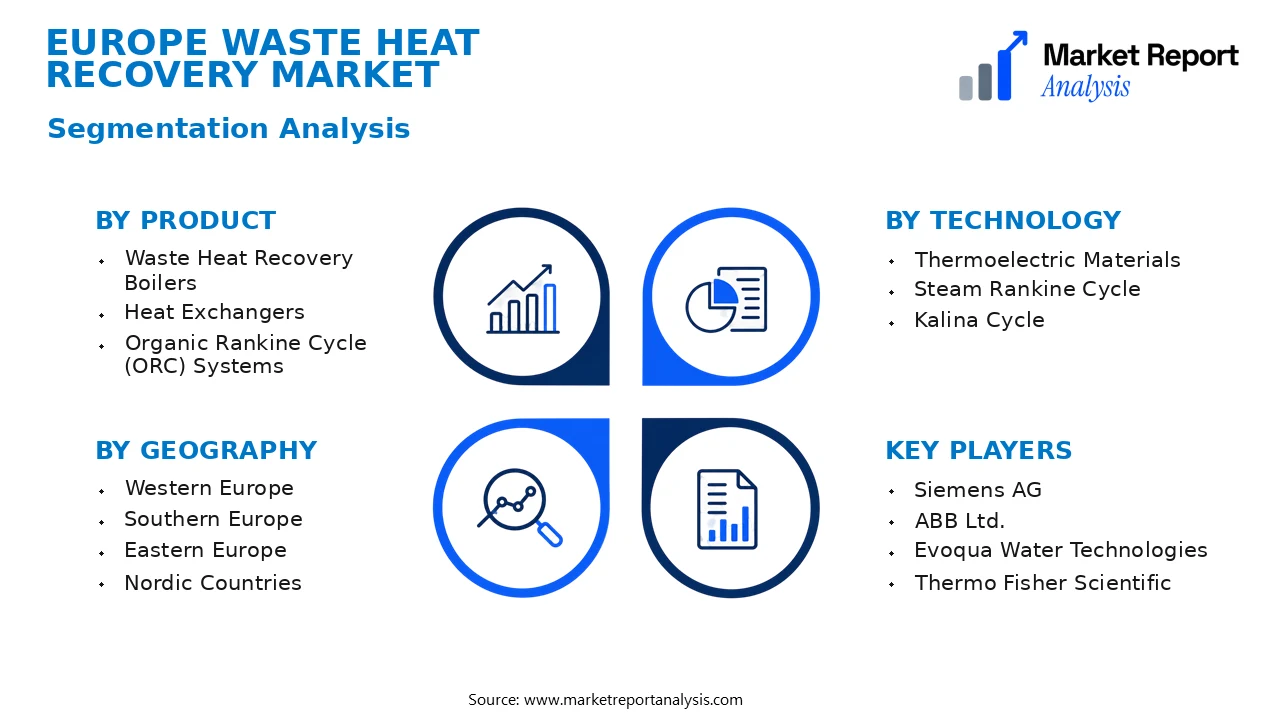
Segmentation Overview: The market is segmented primarily by product, technology, application, and region, allowing for a comprehensive understanding of regional preferences and technological advancements. These categories highlight performance variations, investment priorities, and sector-specific needs, forming the foundation for strategic decision-making and market entry planning in the European context.
- Product
- Waste Heat Recovery Boilers: These boilers capture high-temperature waste gases from industrial processes, converting heat into usable energy. Their high efficiency and operational flexibility drive adoption in heavy industries across Europe.
- Heat Exchangers: Heat exchangers enable heat transfer between fluids, playing a critical role in enhancing process efficiencies. Their compact design and integration capability make them attractive for various industrial applications.
- Organic Rankine Cycle (ORC) Systems: ORC systems utilize organic fluids to convert low-grade waste heat into electricity, offering a versatile and scalable solution suitable for diverse industrial and power generation applications.
- Technology
- Thermoelectric Materials: These materials directly convert heat into electricity with no moving parts, promising for niche applications demanding reliability and low maintenance, though currently limited in widespread industrial deployment.
- Steam Rankine Cycle: Utilizes steam turbines to convert waste heat into electricity, prevalent in power plants and heavy industries due to established technology and high efficiency at larger scales.
- Kalina Cycle: An advanced cycle employing ammonia-water mixtures for waste heat-to-power conversion, notable for efficiency at lower temperature ranges and emerging adoption in specialized applications.
- Application
- Industrial Waste Heat Recovery: Encompasses sectors like cement, steel, chemicals, and refineries, where high-temperature waste streams are abundant, providing significant opportunities for energy savings and emission reductions.
- Power Generation: Integration of waste heat recovery into power plants enhances efficiency, reduces fuel consumption, and supports renewable energy targets, especially in hybrid plant configurations.
- District Heating: Waste heat is utilized for local heating solutions, contributing to urban energy management strategies, reducing reliance on traditional heating sources, and supporting sustainable city initiatives.
- Geography
- Western Europe: Dominates the market due to advanced industrial infrastructure, stringent environmental policies, and significant investments in energy efficiency initiatives, with countries like Germany, France, and the UK leading adoption.
- Southern Europe: Shows growing interest driven by increasing industrialization, renewable energy goals, and EU funding programs, although adoption remains at a comparatively nascent stage.
- Eastern Europe: Presents emerging opportunities owing to expanding industrial sectors and modernization efforts, with government incentives potentially accelerating deployment in the coming years.
- Nordic Countries: Focus on sustainable energy solutions and high environmental standards foster the adoption of advanced waste heat recovery technologies, supported by strong governmental policies and innovative financing models.
Competitive Intelligence
The Europe Waste Heat Recovery Market is characterized by moderate to high competition, with key players such as Siemens, Bosch, and Johnson Controls dominating the landscape through strategic alliances and technological innovation. Market concentration remains relatively high, with the top five firms accounting for a significant share, fostering an environment of intense rivalry focused on product differentiation. Companies are heavily investing in R&D to develop more efficient and scalable heat recovery solutions, often integrating IoT and AI technologies to enhance system performance and predictive maintenance capabilities. Strategic partnerships with industrial giants and utilities facilitate market expansion and deployment of advanced systems across the manufacturing, energy, and chemical sectors. Acquisitions of emerging startups enable established players to diversify product portfolios and accelerate innovation cycles. Many firms are adopting aggressive expansion strategies, including geographical diversification within Europe, to capitalize on increasing regulatory support for energy efficiency. Competitive differentiation is increasingly driven by innovations that improve energy recovery efficiency, reduce operational costs, and enable seamless integration with existing infrastructure, positioning firms for sustained growth in the evolving market landscape.
Leading Company Profiles
The competitive landscape of the Europe Waste Heat Recovery Market is characterized by a mix of established multinational corporations, innovative technology providers, and specialized engineering firms. These companies compete through technological advancements, extensive service networks, and strategic alliances to capture market share in this expanding sector.
- Siemens AG
- ABB Ltd.
- Evoqua Water Technologies
- Thermo Fisher Scientific
- Alfa Laval
- GE Power
- Schneider Electric
- MAN Energy Solutions
- Andritz AG
- Siemens Gamesa Renewable Energy
Siemens AG
Siemens AG leverages its extensive industrial automation and energy management expertise to offer comprehensive heat recovery solutions, focusing on efficiency enhancements and sustainable integrations across European industries, with strategic emphasis on digitalization driven by Industry 4.0 initiatives.
ABB Ltd.
ABB specializes in electrical equipment and automation technologies, delivering advanced energy recovery systems and solutions that optimize industrial processes, enhance energy efficiency, and support the transition toward smarter, more sustainable industrial operations across Europe.
Evoqua Water Technologies
Evoqua’s innovative water and wastewater treatment solutions extend into heat recovery systems that improve resource utilization and environmental sustainability, targeting heavy industries in Europe seeking to reduce operational costs and meet tightening environmental regulations.
Thermo Fisher Scientific
Primarily known for laboratory and analytical equipment, Thermo Fisher has developed specialized heat recovery solutions for research institutions and manufacturing facilities, enhancing energy efficiency in laboratory environments with a focus on clean technology applications.
Alfa Laval
Alfa Laval offers heat transfer, separation, and fluid handling solutions tailored for industrial processes, employing cutting-edge heat exchanger technology optimized for energy recovery and reuse, particularly beneficial for the petrochemical and food industries.
GE Power
GE Power delivers advanced power generation and energy services, including waste heat recovery systems integrated with gas turbines and steam cycles, supporting Europe's shift towards greener power generation and more efficient thermal processes.
Schneider Electric
Schneider Electric focuses on digital automation and energy management solutions, providing tailored heat recovery and energy optimization systems that integrate with IoT platforms, enhancing real-time monitoring and operational efficiency for industrial clients.
MAN Energy Solutions
MAN Energy Solutions designs large-scale heat recovery systems for power plants and industrial sectors, emphasizing integrated solutions that improve thermal efficiency while reducing emissions, aligned with Europe's sustainability targets.
Andritz AG
Andritz specializes in high-efficiency thermal recovery systems for pulp and paper, metals, and other heavy industries, leveraging its innovative technological capabilities to maximize energy recovery and operational reliability.
Siemens Gamesa Renewable Energy
This company extends its renewable focus into advanced waste heat recovery solutions within wind farm energy management, optimizing overall plant efficiency and supporting Europe's renewable energy ambitions.
Strategic Business Developments
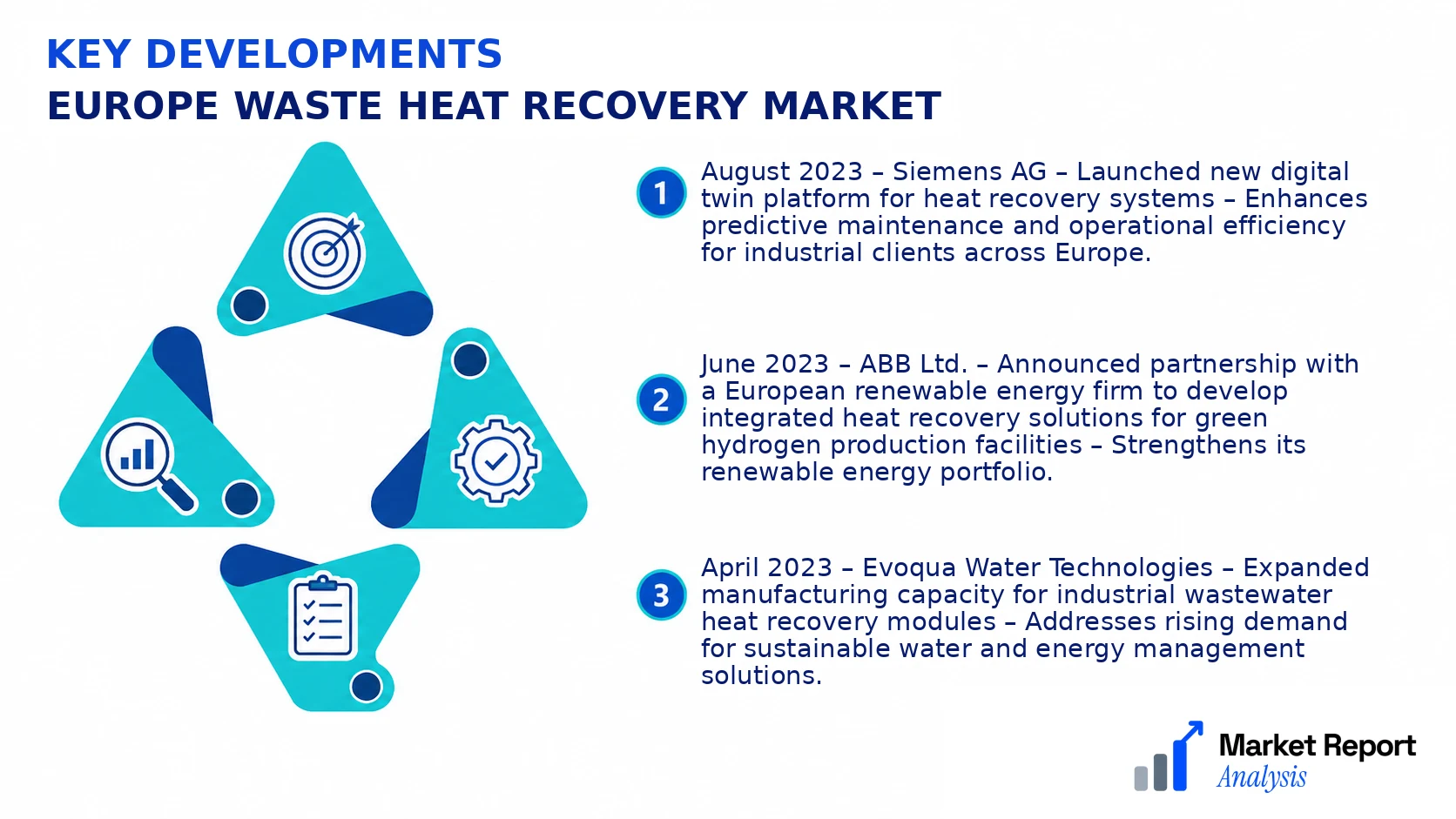
- August 2023 – Siemens AG – Launched new digital twin platform for heat recovery systems – Enhances predictive maintenance and operational efficiency for industrial clients across Europe.
- June 2023 – ABB Ltd. – Announced partnership with a European renewable energy firm to develop integrated heat recovery solutions for green hydrogen production facilities – Strengthens its renewable energy portfolio.
- April 2023 – Evoqua Water Technologies – Expanded manufacturing capacity for industrial wastewater heat recovery modules – Addresses rising demand for sustainable water and energy management solutions.
- May 2023 – Thermo Fisher Scientific – Acquired a startup specializing in micro-heat recovery systems – Accelerates development of compact solutions for laboratory and research applications in Europe.
- July 2023 – Alfa Laval – Released enhanced heat exchanger products targeting the petrochemical industry with 15% higher efficiency – Reinforces its leadership in energy recovery for heavy industries.
Frequently Asked Questions
What is the Europe Waste Heat Recovery Market?
The Europe Waste Heat Recovery Market encompasses technologies and systems designed to capture excess heat from industrial, power, and manufacturing processes for reuse, improving efficiency, reducing energy costs, and lowering greenhouse gas emissions across various sectors in Europe.
What is the current market size of Europe Waste Heat Recovery Market?
As of 2026, the Europe Waste Heat Recovery Market is valued at approximately USD 20 Billion, with steady growth driven by technological advancements, regulatory support, and increasing emphasis on energy efficiency among European industries.
What factors are driving the Europe Waste Heat Recovery Market?
Key drivers include stringent environmental regulations, the need for sustainable energy solutions, rising energy costs, technological innovation, and government incentives promoting clean energy adoption, which collectively catalyze the deployment of waste heat recovery systems.
Which region dominates the Europe Waste Heat Recovery Market?
Germany leads the region in waste heat recovery implementation owing to its robust manufacturing sector, advanced industrial infrastructure, and proactive environmental policies that foster system adoption and technological innovation.
Which segment is expected to grow the fastest?
The industrial segment, particularly in energy-intensive sectors like steel, cement, and chemicals, is projected to exhibit the fastest growth, stimulated by regulatory mandates and the high potential for energy savings through effective heat recovery solutions.
Who are the leading companies operating in the Europe Waste Heat Recovery Market?
Major players include Siemens AG, ABB Ltd., Johnson Controls, and Mitsubishi Electric, which are prominent in developing advanced waste heat recovery technologies and expanding their market presence through strategic partnerships and investments in R&D activities.
Analyst Perspective
The Europe Waste Heat Recovery Market is poised for steady growth through 2034, driven by increasing regulatory pressures on industrial emissions and escalating demand for sustainable energy solutions. Technological evolution is likely to focus on enhanced heat exchanger efficiencies and integration with digital control systems, offering higher recovery rates and operational flexibility. Long-term investment strategies should prioritize innovative retrofit solutions in established industries such as cement and steel, where sizable residual heat resources remain underexploited. Competitive intensity is expected to consolidate around major players with technological moats and robust regional networks, fostering price stability and accelerated deployment. Regional growth potential varies, with Western Europe leading due to stringent environmental policies, while Eastern regions exhibit significant upside owing to expanding industrial capacities and supportive government incentives. Overall, the market’s maturity will foster strategic collaborations and innovations, positioning Europe as a leader in sustainable heat recovery technologies and enabling long-term economic and environmental benefits.
