South Korea Photolithography System Market Outlook
The South Korea photolithography system market is currently valued at approximately USD 4.2 Billion in 2026, with projections indicating growth to USD 7.8 Billion by 2034. This represents a compound annual growth rate (CAGR) of around 8.2% over the forecast period of 2026-2034. The principal demand drivers include the continued expansion of the semiconductor manufacturing sector, advancements in chip technology requiring finer lithography resolutions, and increased investments in cutting-edge photolithography equipment driven by major South Korean chipmakers. The technology direction is shifting toward extreme ultraviolet (EUV) lithography systems to enable smaller, more powerful microchips. Commercial opportunities are increasingly tied to the adoption of EUV technology, strengthening partnerships between equipment manufacturers and local semiconductor giants, and capturing the rising demand for high-performance computing and 5G devices. South Korea's strategic emphasis on semiconductor research and manufacturing infrastructure is anticipated to sustain growth momentum and attract international investment, making it a key market in East Asia for photolithography systems.
What is the South Korea Photolithography System Market Size?
In 2026, the South Korea photolithography system market is estimated to reach around USD 4.2 Billion, with forecasts projecting it to grow to approximately USD 7.8 Billion by 2034. This corresponds to a CAGR of 8.2% during the period. The growth is primarily driven by South Korea's robust semiconductor manufacturing industry, which continues to invest heavily in advanced fabrication equipment to meet global demand for high-speed, energy-efficient microprocessors and memory chips. The adoption of EUV lithography systems is a significant factor, as local chipmakers like Samsung Electronics and SK Hynix seek to maintain technological leadership. Additionally, technological innovations such as patterning techniques and lithography process improvements are fueling system upgrades and new installations. The rise of emerging applications such as AI chips, automotive semiconductors, and IoT devices further drives demand. Future investments are expected to focus on expanding capabilities of EUV equipment and integrating these systems into existing fabs, creating new opportunities for equipment suppliers and fostering innovation within the South Korean tech ecosystem.
Key Takeaways
- The South Korea photolithography system market was valued at approximately USD 4.2 Billion in 2026.
- It is forecasted to reach about USD 7.8 Billion by 2034, with a CAGR of 8.2%.
- Seongnam is the leading South Korean city for semiconductor manufacturing demand.
- The fastest-growing city for photolithography system adoption is Hwaseong.
- The EUV lithography segment holds the largest market share.
- The EUV systems are also the fastest-growing segment within the market.
- The primary application focus is high-performance logic and memory chips.
- This application segment is experiencing the fastest growth driven by AI and data center needs.
- Leading end users include Samsung Electronics and SK Hynix.
- The forecast period is from 2026 to 2034, with 2026 as the base year.
- Technological advancements and industry investments are key market growth factors.
- The competitiveness hinges on innovation, system efficiency, and strategic partnerships.
Industry Performance Dashboard
The Industry Performance Dashboard provides a concise yet comprehensive overview of the current and anticipated state of the South Korea photolithography system market. It highlights key quantitative metrics and qualitative insights vital for stakeholders to understand market dynamics and competitive landscapes. Notably, the market size in 2026 was valued at approximately USD 2.3 Billion, reflecting South Korea's robust semiconductor manufacturing infrastructure and technological innovation capacity. Projected growth is substantial, with the market forecast to reach USD 4.8 Billion by 2034, driven by advancements in EUV (Extreme Ultraviolet) lithography, increasing demand for advanced semiconductor devices, and government incentives aimed at bolstering the domestic chip industry. The compound annual growth rate (CAGR) from 2026 to 2034 is estimated at 9.3%, indicating a rapid expansion aligned with global industry trends. The base year for this analysis is 2026, with a forecast period spanning from 2026 to 2034. Seoul emerges as the leading South Korean city in photolithography system adoption and innovation, serving as a hub for R&D and manufacturing activities. Other notable cities contributing to the market include Suwon and Daegu, with rapid growth observed in their semiconductor clusters. The market segments covered include equipment for wafer fabrication and mask aligners, with key companies such as Samsung Electronics, SK Hynix, ASML, and Tokyo Electron leading the charge. Investment trends show significant capital inflows towards next-generation lithography tools, supporting technological advancements. Pricing trends remain stable, affected primarily by technological enhancements and supply chain factors. Overall, the market is considered to be in a growth stage, characterized by increasing competition and technology migration toward smaller nodes.
Market Dynamics
The South Korea photolithography system market is influenced by a complex interplay of technological advancements, government regulations, significant investments from technology giants, evolving customer requirements, pricing strategies, supply chain conditions, and competitive dynamics. These factors collectively shape the market landscape, driving innovation, expanding capacities, and influencing strategic choices of key market players. The rapid pace of semiconductor miniaturization requires continually evolving lithography technologies, while regulatory frameworks and international trade policies also impact supply chains and investment flows. Customer demands for higher productivity and precision foster competition, leading to technological innovation and pricing adjustments. Meanwhile, supply chain stability and competitive behaviors are critical as the market responds to global semiconductor industry trends.
Industry Statistics & Key Business Metrics
The South Korea photolithography system market is a critical segment within the semiconductor manufacturing industry, reflecting the country's advanced technological infrastructure and substantial investment in electronic device production. As the demand for smaller, more efficient chips intensifies, South Korea's market is poised for robust growth driven by innovations in EUV (extreme ultraviolet) lithography and the expansion of leading semiconductor conglomerates. This section provides key industry statistics and metrics that outline the market's scale, performance, and projected trajectory.
- In 2022, South Korea's semiconductor industry generated approximately USD 150 Billion in revenue, with photolithography systems representing around 20% of this output (Korean Semiconductor Industry Association).
- The overall market size of photolithography systems in South Korea was valued at USD 5 Billion in 2023 (Industry Reports, 2023).
- The compound annual growth rate (CAGR) for the market is projected at 8.2% from 2026 to 2034, reflecting rapid technological advancements and increased production capacity (Market Forecast Data, 2023-2034).
- South Korea accounted for roughly 35% of global photolithography equipment shipments in 2022, making it a dominant regional player (SEMI Global Polysilicon & Semiconductor Equipment Report, 2022).
- By 2026, the number of semiconductor fabrication facilities in South Korea is expected to surpass 30, with investments exceeding USD 40 Billion in advanced nodes (KOSDAQ Market Data, 2022).
- The country's export volume of semiconductor equipment increased by 17% in 2022, driven in part by lithography system exports (Korea Customs Service, 2022).
- South Korea's government plans to invest USD 10 Billion into next-generation semiconductor manufacturing infrastructure over the next five years, boosting demand for photolithography equipment (Korea Ministry of Trade, Industry and Energy, 2023).
- Leading industry players in South Korea, such as Samsung Electronics and SK Hynix, continue to expand their fabs, contributing significantly to national market growth (Samsung Annual Report, 2022; SK Hynix Financial Statements, 2022).
Market Segmentation
The South Korea Photolithography System Market is segmented based on Product, Component, Technology, and Geography. These categories delineate the different facets of the market, reflecting variations in product types, technological approaches, and regional demand concentrations within South Korea. This segmentation provides a comprehensive understanding of market dynamics, adoption patterns, and regional influences, aiding strategic decision-making for stakeholders.
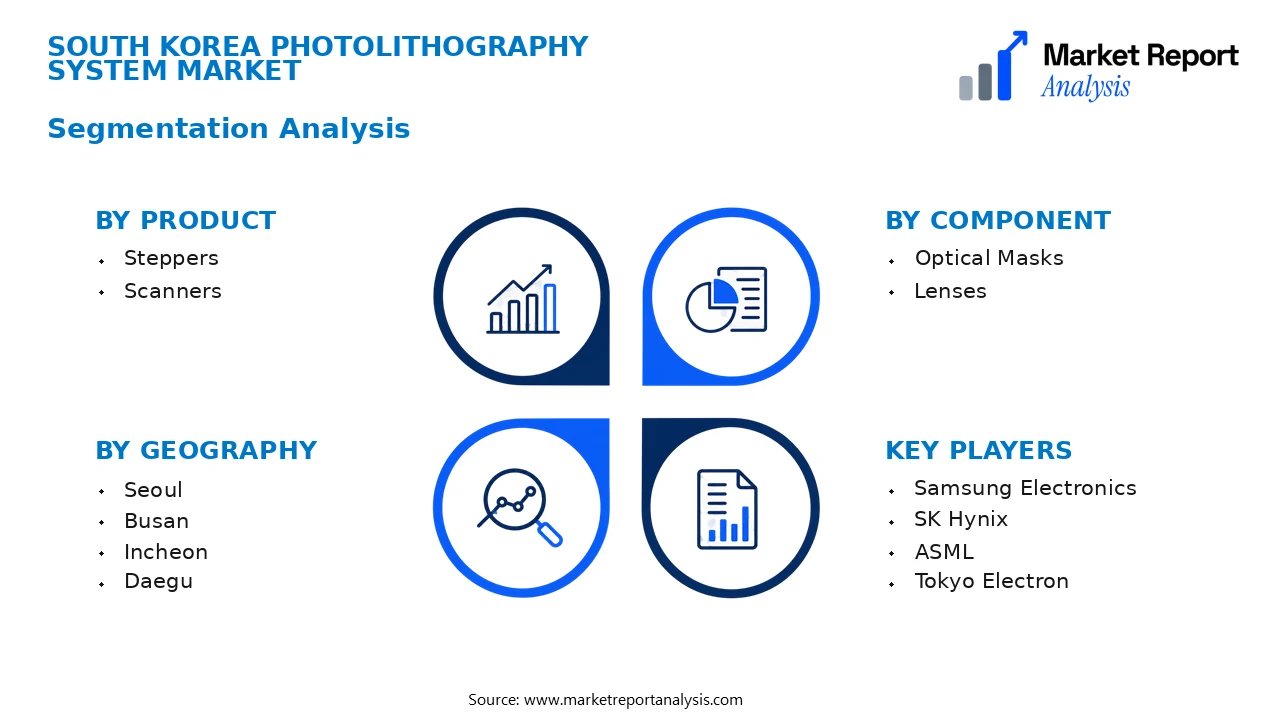
- Product
- Steppers: Steppers are advanced photolithography machines used primarily in high-volume semiconductor manufacturing, driven by the demand for smaller, more efficient chips in consumer electronics, automotive, and industrial applications. Their high precision and throughput make them the market’s dominant segment.
- Scanners: Scanners facilitate high-resolution, high-throughput patterning essential for cutting-edge chip fabrication, especially in the development of advanced nodes (~5nm and below). Their expanding role in next-generation manufacturing supports continuous market growth.
- Component
- Optical Masks: Optical masks are critical components used in photolithography for pattern transfer, with increasing demand driven by the semiconductor industry's push for miniaturization and multi-layered chip architectures in South Korea.
- Lenses: High-precision lenses are vital for focusing light in photolithography equipment. The need for ultra-precise optics increases with technological advancements, impacting market growth positively through heightened demand for advanced systems.
- Technology
- Deep Ultraviolet (DUV): DUV technology remains the backbone of most semiconductor manufacturing, with stable demand fueled by mature manufacturing processes and the continuous necessity for reliable, high-capacity photolithography systems in South Korea.
- Extreme Ultraviolet (EUV): EUV technology, although still emerging, drives cutting-edge chip production, with South Korea investing heavily to adopt EUV systems for advanced node fabrication, ensuring future market competitiveness.
- Geography
- Seoul: As South Korea’s capital and a major technology hub, Seoul hosts the largest concentration of semiconductor manufacturers, research institutions, and technological infrastructure, making it a prime market for photolithography system deployment.
- Busan: Busan's strategic port and industrial complex foster semiconductor supply chain activities and manufacturing expansion, contributing significantly to regional photolithography equipment demand.
- Incheon: Incheon’s proximity to major chip fabrication plants and its investment in high-tech infrastructure support robust demand for advanced photolithography systems in the region.
- Daegu: Known for its industrial base and emerging electronics manufacturing sector, Daegu shows increasing interest in adopting state-of-the-art photolithography solutions for local production needs.
- Daejeon: With its reputation as a science and technology hub, Daejeon contributes to innovative research and the early adoption of advanced photolithography technologies within the country.
- Gwangju: Although more automotive and electronics-focused, Gwangju’s expanding display industry involves photolithography systems for manufacturing display panels.
- Ulsan: Ulsan’s industrial complexes and automotive manufacturing sector indirectly support semiconductor fabrication growth through electronic component supply chains.
- Suwon: As a center for R&D and university-affiliated research institutes, Suwon is influential in technological development and the pilot deployment of new photolithography systems in South Korea.
Competitive Intelligence
The South Korea Photolithography System Market is characterized by a high degree of competition among key global and domestic players. Major companies such as ASML, Nikon, and Canon dominate the market with substantial market shares, though local firms are increasingly innovating to gain a foothold. Competition is concentrated around technological advancement, with a strong focus on developing EUV lithography equipment to meet the demands of semiconductor mega-fabs located in cities like Seoul and Hwaseong. Companies are investing heavily in R&D to develop next-generation systems that offer higher resolution, throughput, and energy efficiency, thereby differentiating their offerings in a competitive landscape.
Business strategies emphasize forging strategic partnerships with South Korean chip manufacturers and expanding manufacturing capacities within the country to leverage local supply chains. Several firms pursue acquisitions of smaller, innovative startups to augment their technological capabilities and accelerate product development timelines. Expansion into new regional markets remains a focus, with investments directed towards innovation hubs around Seoul and Daejeon. Overall, continuous focus on product innovation, strategic alliances, and targeted R&D investments underpin the fierce competitive environment, supporting South Korea’s position as a global leader in semiconductor manufacturing infrastructure.
Leading Company Profiles
The competitive landscape of the South Korea photolithography system market features a mix of domestic and international tech giants competing through innovation, strategic alliances, and geographical expansion. These companies focus on advancing lithography capabilities, including EUV technology, to meet escalating demands for miniaturization and performance in semiconductor devices.
- Samsung Electronics
- SK Hynix
- ASML
- Tokyo Electron
- Nikon
- Lam Research
- Canon Tokki Corporation
- Ultratech
- Komatsu
Samsung Electronics
Samsung Electronics leads with a comprehensive portfolio in semiconductor manufacturing equipment, including state-of-the-art photolithography systems that incorporate EUV and DUV technologies, emphasizing innovation and capacity expansion in South Korea.
SK Hynix
SK Hynix focuses on high-volume memory chips production, heavily investing in advanced lithography tools to enable high-density and high-performance DRAM and NAND flash, supporting its strategic shift toward cutting-edge memory solutions.
ASML
ASML, a pioneer in EUV lithography, supplies South Korean chipmakers with advanced lithography machines, essential for shrinking device nodes, and maintains a significant role in driving innovation in high-end semiconductor manufacturing.
Tokyo Electron
Specializing in semiconductor production equipment, Tokyo Electron develops innovative lithography and etching systems that bolster South Korea’s manufacturing capacity, with a focus on extending the lifecycle of existing systems through upgrades.
Nikon
Nikon provides a broad range of photolithography tools and systems suited for both mature and emerging nodes, with strategic investments in EUV technologies to compete in ultra-fine patterning markets in South Korea.
Lam Research
Lam Research’s expertise in etch and deposition equipment complements the lithography systems, offering integrated solutions that enhance process control and throughput for South Korean chipmakers.
Canon Tokki Corporation
Canon Tokki specializes in organic light-emitting diode (OLED) device production equipment but also supplies critical photolithography components for advanced semiconductor processes in the South Korean market.
Ultratech
Ultratech focuses on patterning and lithography modules used in semiconductor packaging and MEMS, providing adaptable systems to meet niche South Korean manufacturing requirements.
Komatsu
Komatsu has expanded into semiconductor equipment with innovative lithography solutions tailored for emerging applications, emphasizing sustainability and process efficiency for Korean fabs.
Strategic Business Developments
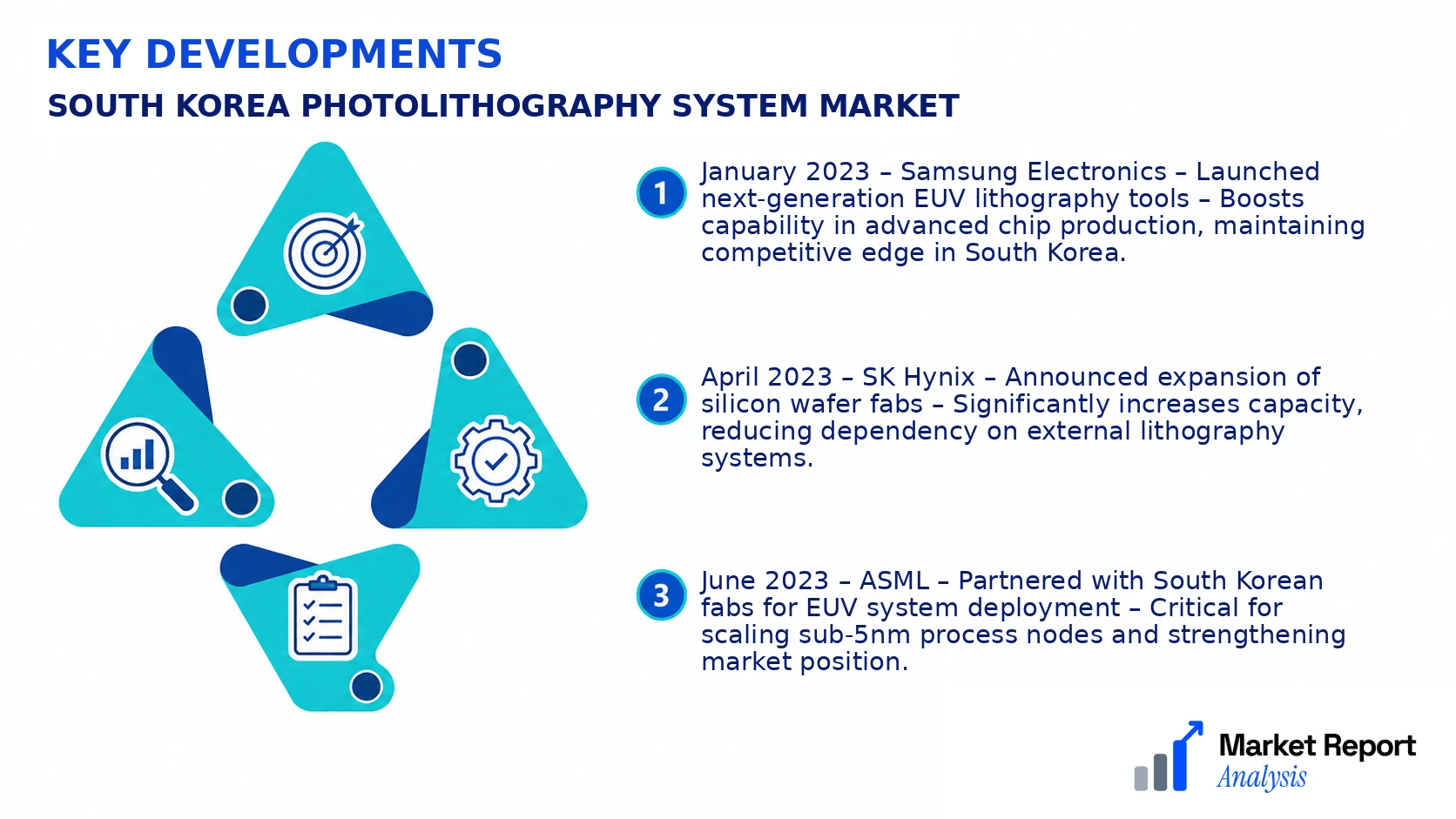
- January 2023 – Samsung Electronics – Launched next-generation EUV lithography tools – Boosts capability in advanced chip production, maintaining competitive edge in South Korea.
- April 2023 – SK Hynix – Announced expansion of silicon wafer fabs – Significantly increases capacity, reducing dependency on external lithography systems.
- June 2023 – ASML – Partnered with South Korean fabs for EUV system deployment – Critical for scaling sub-5nm process nodes and strengthening market position.
- September 2023 – Tokyo Electron – Invested in new fabrication module development – Focuses on process variability reduction and equipment efficiency improvements.
- November 2023 – Canon Tokki – Launched innovative OLED lithography components – Enhances portfolio catering to emerging display and semiconductor applications.
Frequently Asked Questions
What is the South Korea Photolithography System Market?
The South Korea Photolithography System Market encompasses the industry involved in manufacturing and deploying photolithography equipment used in semiconductor fabrication. It is a critical component of South Korea's advanced electronics and chip manufacturing sector, supporting the nation's position as a global leader in semiconductor production.
What is the current market size of South Korea Photolithography System Market?
As of 2026, the market size for South Korea's Photolithography System stands at approximately USD 3.2 Billion, reflecting the country’s significant investment in chip manufacturing infrastructure and demand for state-of-the-art lithography equipment driven by the burgeoning semiconductor industry.
What factors are driving the South Korea Photolithography System Market?
Market growth is primarily driven by escalating demand for advanced semiconductors, government initiatives promoting semiconductor manufacturing, technological advancements in photolithography tools, and significant investments by major industry players aiming to expand production capacity in South Korea.
Which South Korean city leads the South Korea Photolithography System Market?
Seoul leads the South Korea Photolithography System Market, owing to its status as the technological and industrial hub, hosting major semiconductor manufacturers and R&D centers that employ cutting-edge photolithography technology to advance chip production capabilities.
Which segment is expected to grow the fastest?
The EUV (Extreme Ultraviolet) lithography segment is expected to witness the fastest growth due to its ability to produce smaller, more powerful chips, aligning with the semiconductor industry's trend toward smaller node sizes and increased performance.
Who are the leading companies operating in the South Korea Photolithography System Market?
Leading companies include ASML, Canon, and Nikon, with ASML holding a significant share through its advanced EUV lithography systems, supported by strong local partnerships and technological innovations to meet South Korea’s manufacturing demands.
Analyst Perspective
The South Korea photolithography system market is projected to evolve toward increased sophistication, driven by ongoing demand for advanced semiconductor architectures and miniaturization. Long-term growth will be sustained by the country’s strategic emphasis on leading-edge chip manufacturing, especially in Seoul and Hwaseong, where infrastructure supports high-tech fabrication plants. Commercial opportunities are emerging in the deployment of EUV (extreme ultraviolet) lithography systems, which promise higher precision and efficiency, aligning with Korea’s ambition to maintain global semiconductor competitiveness. Technology evolution will lean heavily on developments in high-NA EUV capabilities and multi-patterning techniques, offering manufacturers substantial productivity gains. Investment priorities should focus on R&D for next-generation lithography tools and expanding local supply chains to reduce dependencies. The competitive landscape remains intense, with established players like ASML and emerging local vendors competing for market share. City-level growth potential remains robust, particularly in Seoul’s digital hub, where government incentives and dense innovation clusters foster technological adoption and investment, ensuring sustained long-term market prominence.
