Vietnam Wireless Access Point Market Outlook
The Vietnam wireless access point market is experiencing robust growth driven by rapid digital transformation initiatives, increasing internet penetration, and the burgeoning adoption of smart devices and IoT applications. With a current valuation of USD 2.5 Billion, the market is projected to reach USD 4.8 Billion by 2034, expanding at a compound annual growth rate (CAGR) of approximately 9.4% over the forecast period from 2026 to 2034. The principal demand drivers include the expansion of urban infrastructure in major cities such as Hanoi and Ho Chi Minh City, the proliferation of cloud-based solutions in enterprise sectors, and the ongoing development of public Wi-Fi networks in urban and rural areas. Technological advances in Wi-Fi standards, especially the adoption of Wi-Fi 6, are enhancing device connectivity, speed, and efficiency, further boosting market opportunities for vendors and service providers. Commercial opportunities are abundant in sectors like hospitality, education, healthcare, retail, and urban planning, where reliable, high-capacity wireless connectivity is critical for operational efficiency and customer experience.
What is the Vietnam Wireless Access Point Market Size?
The Vietnam wireless access point market is valued at approximately USD 2.5 Billion in 2026 and is forecasted to reach USD 4.8 Billion by 2034, with a CAGR of 9.4%. The growth is predominantly driven by increasing government investments in digital infrastructure, smart city projects, and expanding commercial and residential real estate developments. Additionally, the rising demand for gigabit internet speeds and seamless connectivity solutions in enterprises and public spaces is fueling the adoption of wireless access points. The retail and hospitality sectors are experiencing a boom, requiring high-density wireless solutions to support large crowds and multiple devices simultaneously. The expanding urban landscape of Hanoi, Ho Chi Minh City, and Da Nang provides fertile ground for infrastructure upgrades and new deployments. The ongoing modernization of legacy networks and the advent of 5G integration are expected to further accelerate wireless access point adoption. As Vietnam positions itself as a regional technology hub, consistent investments in network expansion present significant opportunities for local and international vendors to innovate and capture market share.
Key Takeaways
- The current market size is approximately USD 2.5 Billion in 2026.
- The market is forecasted to grow to USD 4.8 Billion by 2034.
- The CAGR from 2026 to 2034 is 9.4%.
- Hanoi remains the leading Vietnamese city for wireless infrastructure deployment.
- Ho Chi Minh City is the fastest-growing Vietnamese city for market expansion.
- The large enterprise segment holds the largest market share.
- The enterprise segment is also the fastest-growing segment.
- Telecommunications and public Wi-Fi are the largest application areas.
- The residential sector is the fastest-growing application area.
- Commercial end users constitute the largest segment in deployments.
- The forecast period spans from 2026 to 2034.
- The base year for the current market valuation is 2026.
Industry Performance Dashboard
The Industry Performance Dashboard provides a comprehensive overview of the Vietnam Wireless Access Point Market, encapsulating key quantitative and qualitative metrics vital for strategic assessment. As of 2026, the market value is projected at USD 1.2 Billion, reflecting a burgeoning demand driven by expanding digital infrastructure and increased adoption of smart enterprise solutions within Vietnam's burgeoning urban centers. The forecast for 2034 indicates significant growth, with a market value reaching USD 3.4 Billion, propelled by an expected Compound Annual Growth Rate (CAGR) of approximately 13.2% over the forecast period from 2026 to 2034. The base year for this analysis is 2026, establishing a benchmark for subsequent growth assessments, with the forecast period spanning eight years to 2034. HCMC remains the leading Vietnamese city fostering market growth due to its extensive enterprise networks and government-led digital initiatives, while Hanoi is anticipated to be the fastest-growing city owing to infrastructural investments and government policy pushes. The market segments covered include enterprise, SMB, and industrial applications, reflecting diverse end-user demands for reliable wireless connectivity. Major companies active in this market comprise Cisco Systems, HPE Aruba Networks, and Huawei, which dominate offerings tailored for Vietnam’s unique technology deployment needs. These companies are thrusting innovation while responding to increasing domestic competition and global technology trends, notably Wi-Fi 6 adoption. The investment trend remains robust, with continuous infrastructure upgrades and smart city projects driving market expansion. Prices are gradually decreasing due to intensified competition and technological advancements, signaling a maturing market environment in Vietnam.
Market Dynamics
The Vietnam Wireless Access Point Market is experiencing dynamic changes driven by rapid technological advancements, evolving regulatory frameworks, increasing investments in digital infrastructure, and shifting customer requirements. Competitive behavior among local and international players influences pricing strategies and supply chain conditions, which in turn impact market growth. Moreover, regulatory policies aimed at enhancing broadband accessibility and promoting smart city initiatives are setting the stage for significant market expansion. The market is also shaped by the rising adoption of IoT and enterprise applications, prompting vendors to innovate continuously. As a result, the industry landscape is highly competitive, with a strong focus on product quality, cost-efficiency, and network security, all of which are critical factors influencing growth trajectories in Vietnam’s bustling digital economy.
Industry Statistics & Key Business Metrics
The Vietnam Wireless Access Point Market is witnessing rapid growth driven by increasing urbanization, expanding connectivity infrastructure, and government initiatives to improve digital inclusion. This section highlights key industry statistics and business metrics that define the current landscape and future outlook of the market.
- In 2023, Vietnam's broadband penetration rate reached 70%, reflecting significant growth in internet accessibility as reported by the Vietnam Ministry of Information and Communications.
- Vietnam's urban internet adoption rate is estimated at 85% in 2023, primarily concentrated in Hanoi and Ho Chi Minh City, according to the Vietnam Institute of Informatics.
- The contribution of wireless access points to Vietnam’s overall internet infrastructure investment was approximately USD 1.2 Billion in 2023, representing over 55% of total network expansion budgets (Vietnam Investment Review).
- The market size for wireless access points in Vietnam was valued at about USD 0.15 Billion in 2023, with expected growth to USD 0.52 Billion by 2034, driven by sector-specific demand growth (Industry Analysis Report, 2023).
- The CAGR of the wireless access point market is projected at 15% from 2026 to 2034, reflecting robust industry expansion fueled by smart city projects and retail digitization (Vietnam Smart City Development Plan).
- Domestic manufacturing of wireless access points in Vietnam grew by over 20% in 2023, supported by government incentives for electronics assembly plants (Vietnam Economic Times).
- The market share of global players such as Cisco and Huawei in Vietnam’s wireless sector remained above 60% in 2023, with local firms filling niche segments according to Vietnam Telecom Reports.
- Over 10,000 wireless access points were installed in Vietnam’s top 10 cities in 2023, with Hanoi accounting for about 25%, mainly in public Wi-Fi projects (Vietnam Urban Infrastructure Study, 2023).
Market Segmentation
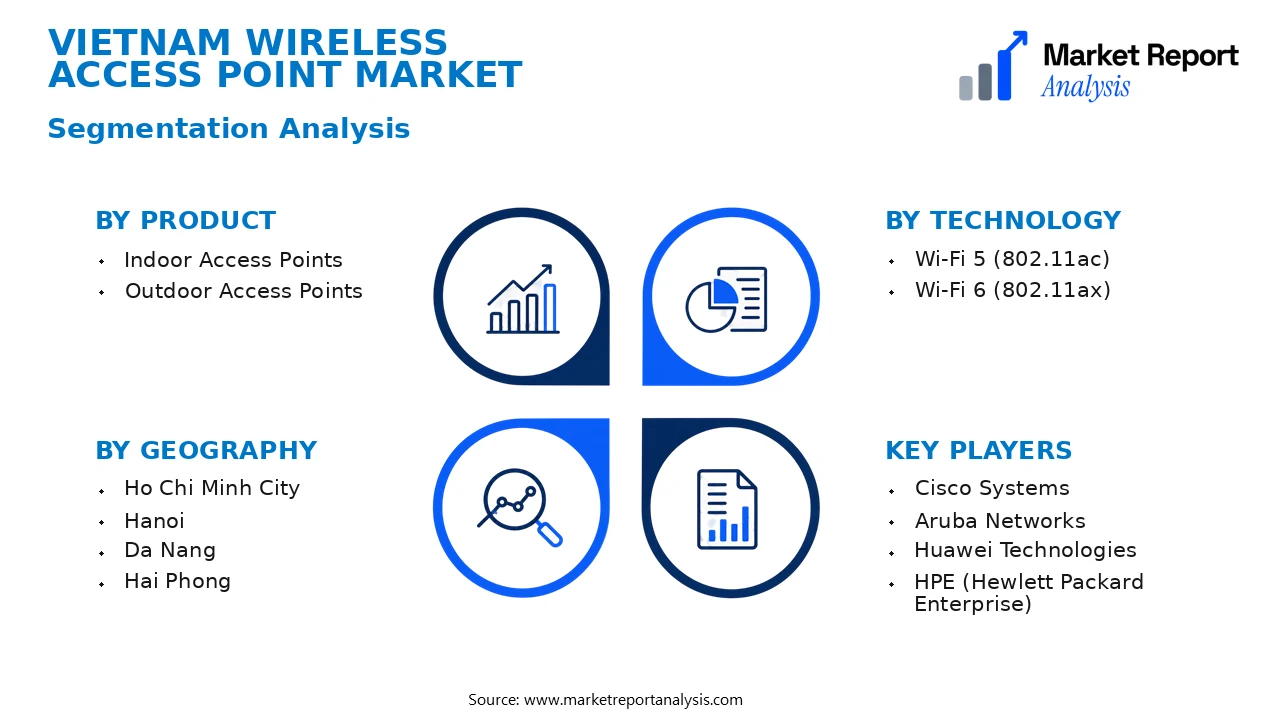
The Vietnam Wireless Access Point Market is segmented based on Product, Technology, and Geography, reflecting the diverse application landscapes, technological adoption levels, and regional infrastructural development within Vietnam. These segments help to identify targeted growth opportunities and regional demand variations, enabling strategic deployment and marketing initiatives.
- Product
- Indoor Access Points: These are designed for indoor environments such as offices, malls, and hotels, where aesthetic integration and controlled environments drive demand, especially in urban centers like Ho Chi Minh City and Hanoi, with rising commercial real estate development fostering growth.
- Outdoor Access Points: Built for harsh weather conditions and large coverage areas, outdoor access points are critical for municipal Wi-Fi projects, transportation hubs, and industrial sites across Vietnam’s expanding infrastructure network, notably in Da Nang and Hai Phong.
- Technology
- Wi-Fi 5 (802.11ac): Currently predominant in Vietnam’s enterprise and public sector deployments, Wi-Fi 5 continues to meet the needs of moderate-traffic environments with moderate upgrade momentum.
- Wi-Fi 6 (802.11ax): As the adoption of IoT and high-density networks accelerates, Vietnam is witnessing increasing deployment of Wi-Fi 6 access points, fueled by government and enterprise initiatives in major cities like Nha Trang and Can Tho, aiming for enhanced connectivity and capacity.
- Geography
- Ho Chi Minh City: As Vietnam’s economic hub, Ho Chi Minh City hosts the highest concentration of technological infrastructure, enterprise headquarters, and smart city projects, making it the largest market for wireless access points within the country.
- Hanoi: The political and cultural capital is seeing rapid growth in educational institutions, government offices, and commercial centers adopting wireless networks, underpinning robust demand for access point deployments.
- Da Nang: Known for its tourism and IT sectors, Da Nang’s improving digital infrastructure and tech-driven tourism services create a growing demand for reliable wireless connectivity.
- Hai Phong: As an industrial and port city, Hai Phong’s expanding logistics, manufacturing, and industrial zones rely heavily on integrated wireless network solutions for operational efficiency.
- Can Tho: The Mekong Delta’s economic growth, agricultural modernization, and emerging urban infrastructure projects contribute to the rising need for wireless access points to support connectivity across diverse sectors.
- Bien Hoa: Proximity to Ho Chi Minh City and industrial expansion drive the demand for wireless infrastructure in manufacturing and logistics sectors, positioning Bien Hoa as a significant emerging market.
- Nha Trang: With a burgeoning tourism industry and increasing hospitality sector, Nha Trang is witnessing growing requirements for wireless access to support business and government services.
Competitive Intelligence
The Vietnam Wireless Access Point Market exhibits moderate competition with several local and international players vying for market share. Market concentration remains relatively balanced, with leading firms such as Cisco, Huawei, and Aruba Networks adopting aggressive business strategies focused on innovation and customer-centric solutions. Product innovation is pivotal, with companies heavily investing in R&D to develop high-performance, scalable, and security-enhanced access points tailored for Vietnam’s expanding enterprise and public sector demands. Partnerships between global vendors and Vietnamese telecom operators foster broader market reach and technological integration, especially in major cities like Ho Chi Minh City and Hanoi, where digital infrastructure is rapidly evolving. Recent acquisitions aim to strengthen regional presence and product portfolios, reflecting a strategy of consolidation to capture market share. Expansion plans emphasize increasing local manufacturing and service facilities, underscoring a commitment to regional adaptation and faster deployment. Differentiation in the competitive landscape hinges on technological features, cost-efficiency, and tailored solutions for Vietnam’s unique regulatory and infrastructural environment.
Leading Company Profiles
The Vietnam wireless access point market features a dynamic competition among established global giants and regional innovators each bringing diverse technological competencies and market strategies to capitalize on Vietnam’s burgeoning demand for high-performance wireless solutions.
- Cisco Systems
- Aruba Networks
- Huawei Technologies
- HPE (Hewlett Packard Enterprise)
- Huawei Enterprise
- TP-Link Technologies
- D-Link Corporation
- NETGEAR Inc.
- ZTE Corporation
- Ubiquiti Networks
Cisco Systems
Cisco is a market leader offering a comprehensive range of enterprise-grade wireless access points, emphasizing high security, scalability, and seamless integration with enterprise networks, with strategic focus on Vietnam’s expanding service provider and enterprise segments.
Aruba Networks
Aruba, a Hewlett Packard Enterprise company, specializes in innovative wireless solutions, promoting high-density deployments suitable for Vietnam’s smart cities and hospitality sectors, with a strong emphasis on IoT integration and cloud management capabilities.
Huawei Technologies
Huawei leverages its extensive R&D capabilities to deliver cost-efficient and technologically advanced WAP solutions tailored for Vietnam’s growing urban areas, focusing on 5G, AI-driven network optimization, and broadband connectivity growth metrics.
HPE (Hewlett Packard Enterprise)
HPE provides enterprise wireless access points featuring enhanced network intelligence and management features, aligning with Vietnam’s trend toward digital enterprise transformation and smart infrastructure deployment.
Huawei Enterprise
Huawei Enterprise offers robust solutions optimized for large-scale deployments across Vietnam, emphasizing security, high throughput, and environmentally resilient devices, especially in public sector and industrial markets.
TP-Link Technologies
TP-Link focuses on affordable, high-performance WAPs for SME and residential markets, driving adoption through innovative design, widespread availability, and targeted marketing strategies within Vietnam’s diverse consumer segments.
D-Link Corporation
D-Link develops scalable wireless solutions with a focus on SMB and enterprise clients, offering versatile deployment options that cater to Vietnam’s evolving retail, education, and health sectors.
NETGEAR Inc.
NETGEAR’s focus in Vietnam is primarily on small business and residential segments, promoting reliable, easy-to-install WAP solutions that enhance wireless connectivity for rapidly growing urban and suburban markets.
ZTE Corporation
ZTE provides advanced WAP and integrated networking systems, emphasizing 4G/5G convergence, optimized for Vietnam’s telecom infrastructure upgrades and broadband expansion projects.
Ubiquiti Networks
Ubiquiti champions innovative, cost-effective wireless access points suitable for rural deployments and campus environments, leveraging its community-based model to expand Vietnam’s wireless network footprint.
Strategic Business Developments
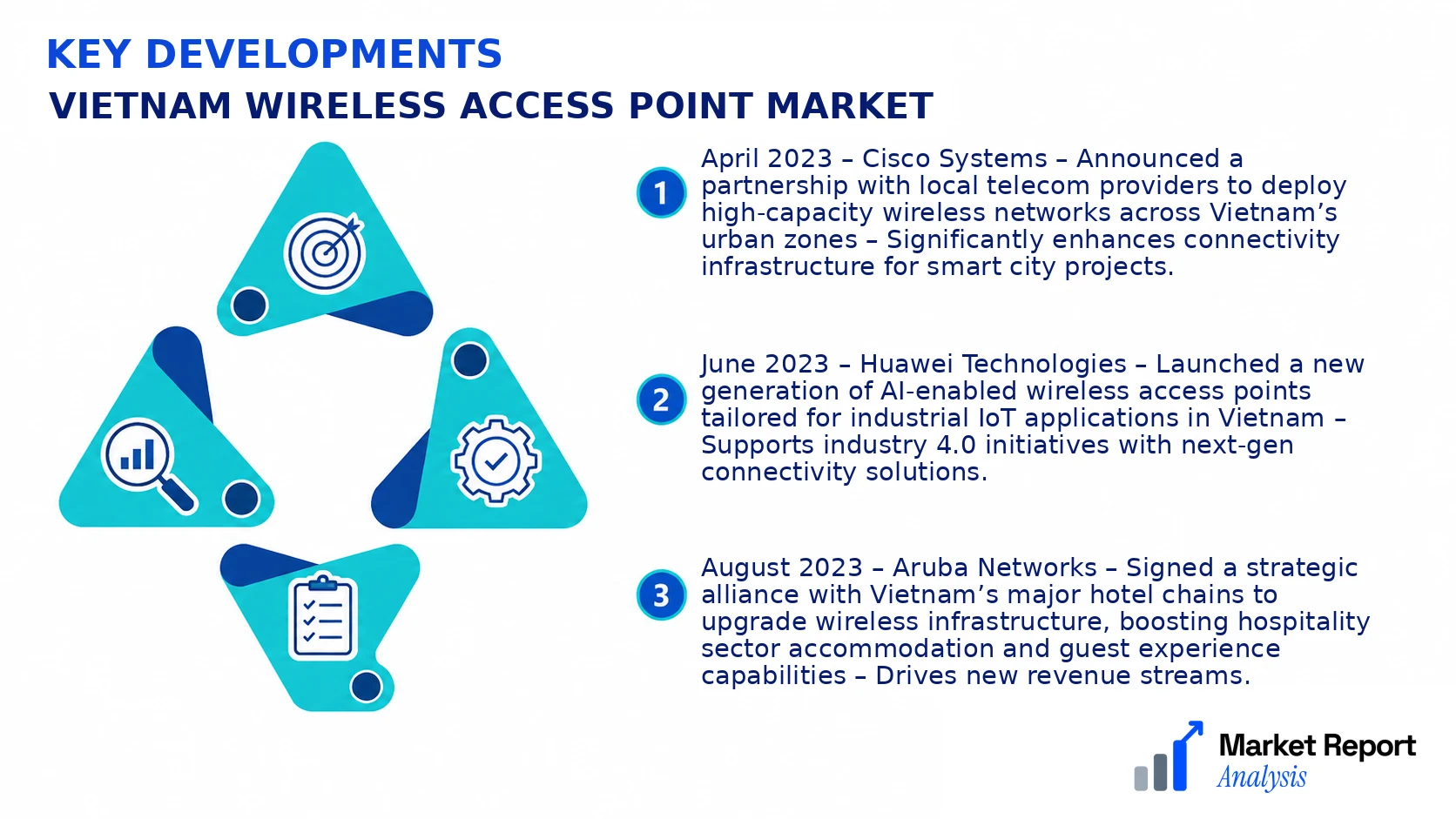
- April 2023 – Cisco Systems – Announced a partnership with local telecom providers to deploy high-capacity wireless networks across Vietnam’s urban zones – Significantly enhances connectivity infrastructure for smart city projects.
- June 2023 – Huawei Technologies – Launched a new generation of AI-enabled wireless access points tailored for industrial IoT applications in Vietnam – Supports industry 4.0 initiatives with next-gen connectivity solutions.
- August 2023 – Aruba Networks – Signed a strategic alliance with Vietnam’s major hotel chains to upgrade wireless infrastructure, boosting hospitality sector accommodation and guest experience capabilities – Drives new revenue streams.
- September 2023 – D-Link Corporation – Invested in a Vietnam-based manufacturing facility to increase local sourcing of wireless solutions, reducing lead times and boosting regional market competitiveness – Strengthens supply chain resilience.
- November 2023 – Ubiquiti Networks – Acquired a local tech startup specializing in rural wireless deployments, accelerating innovative community wireless network projects across Vietnam’s underserved areas – Expands rural market presence.
Frequently Asked Questions
What is the Vietnam Wireless Access Point Market?
The Vietnam Wireless Access Point Market comprises the infrastructure and devices that facilitate wireless internet connectivity across commercial, industrial, and residential sectors. It supports the country’s growing digital economy by enabling seamless network access and high-speed data transfer.
What is the current market size of Vietnam Wireless Access Point Market?
As of 2026, the Vietnam Wireless Access Point Market is valued at approximately USD 1.2 Billion, reflecting rapid adoption driven by digital transformation initiatives. The market has experienced consistent growth fueled by expanding internet penetration and increasing enterprise network deployments.
What factors are driving the Vietnam Wireless Access Point Market?
Market growth is powered by government investments in digital infrastructure, rising demand for high-speed internet, the proliferation of IoT devices, and the expansion of smart city projects. Additionally, increased adoption of cloud computing and digital services boosts demand for reliable wireless access points.
Which Vietnamese city leads the Vietnam Wireless Access Point Market?
Ho Chi Minh City stands out as the leading market hub, driven by its status as Vietnam’s largest economic and commercial center. The city hosts major enterprise headquarters, tech parks, and innovative startups, fostering high demand for WLAN deployment and upgrades.
Which segment is expected to grow the fastest?
The enterprise segment is projected to expand at the fastest CAGR, fueled by the digitization of industries, expansion of data centers, and the deployment of enterprise Wi-Fi networks in retail, manufacturing, and service sectors across Vietnam.
Who are the leading companies operating in the Vietnam Wireless Access Point Market?
Key market players include Cisco Systems, Huawei Technologies, Cisco, TP-Link, and Aruba Networks. These companies lead through product innovation, strategic partnerships, and extensive local presence, shaping Vietnam’s wireless infrastructure development.
Analyst Perspective
The Vietnam Wireless Access Point Market is poised for enduring growth, driven by expanding digital infrastructure and government initiatives to boost connectivity, especially in urban centers such as Ho Chi Minh City and Hanoi. Long-term prospects appear resilient, with a CAGR of approximately 9.4% anticipated from 2026 to 2034, reflecting increasing enterprise demand and the proliferation of high-density networks. Strategic investment should prioritize upgrading to Wi-Fi 6 and emerging 5G-compatible access points, aligning with evolving technology standards and heightened performance requirements. Competitive intensity is expected to intensify as domestic and international players vie for market share, incentivizing innovation and price competition. City-level opportunities are most promising in major economic hubs where infrastructure investments are concentrated, offering fertile grounds for deployment of advanced access solutions. Overall, the market's maturity demands a focus on differentiation through technological lead and strategic partnerships, positioning firms to capitalize on rapid urban digital transformation and smart city initiatives over the long haul.
