Saudi Arabia Wireless Access Point Market Outlook
The Saudi Arabia wireless access point (WAP) market is on a robust growth trajectory, driven by the government’s Vision 2030 objectives, expanding digital infrastructure, and increasing adoption of smart devices across multiple sectors. As of 2026, the market is valued at USD 1.2 Billion, with projections indicating an increase to USD 2.7 Billion by 2034. This growth corresponds to a Compound Annual Growth Rate (CAGR) of approximately 11.2% over the forecast period from 2026 to 2034. Key demand drivers include the surge in enterprise digitization, the proliferation of smart city initiatives, and rising demand for reliable wireless connectivity in commercial, industrial, and public spaces. Technological advances such as Wi-Fi 6 and 5G integration are expected to reshape the landscape, offering higher speeds and better coverage, thereby presenting lucrative opportunities for vendors and system integrators to capitalize on digital transformation projects across Saudi Arabia.
What is the Saudi Arabia Wireless Access Point Market Size?
The wireless access point market in Saudi Arabia is anticipated to grow from USD 1.2 Billion in 2026 to USD 2.7 Billion by 2034, reflecting a CAGR of 11.2%. This rapid growth is fueled by governmental initiatives focusing on smart infrastructure, increased private sector investments, and the expansion of telecom and enterprise networks. Key industries such as government, education, healthcare, retail, and hospitality are deploying WAPs extensively to ensure seamless connectivity and support their digital operations. Rising urbanization and the proliferation of IoT devices further contribute to demand, especially in major cities like Riyadh and Jeddah, which are focal points of technological development. The continual rollout of 5G networks complements Wi-Fi advancements, opening new avenues for high-speed, low-latency wireless connectivity. Future investments are poised to prioritize network security, scalable architectures, and energy-efficient solutions, making the Saudi Arabian market attractive for global and local providers aiming to establish or expand their presence in this lucrative region.
Key Takeaways
- The Saudi Arabia wireless access point market is valued at USD 1.2 Billion in 2026.
- The market is projected to reach USD 2.7 Billion by 2034.
- The CAGR for 2026-2034 is approximately 11.2%.
- Riyadh is the leading Saudi city for market deployment and innovation.
- Jeddah is the fastest-growing city, driven by retail and hospitality expansions.
- The enterprise segment accounts for the largest market share.
- The retail and government sectors are the fastest-growing application segments.
- Commercial and institutional end users dominate demand strategies.
- Market growth is supported by significant infrastructure investments and smart city initiatives.
- Integration of Wi-Fi 6 and 5G technology is enhancing product offerings and capabilities.
- Competitive landscape includes prominent telecom and network solution providers.
- Regulatory support and favorable policies foster market expansion and innovation.
- Investments in cybersecurity and scalable network architecture are crucial future trends.
- The market is set to experience sustained growth through the deployment of next-generation wireless infrastructure.
Industry Performance Dashboard
The Saudi Arabia Wireless Access Point Market has demonstrated robust growth driven by increasing digital transformation initiatives, widespread adoption of IoT devices, and government investments in smart city infrastructure. The market's development is further bolstered by regulatory frameworks supporting telecom and IT sector expansion, alongside rising enterprise and consumer demand for high-speed, reliable wireless connectivity. Technological advancements such as Wi-Fi 6 and emerging Wi-Fi 7 standards are influencing product innovation and market competitiveness, leading to improved performance and cost efficiencies. The competitive landscape features prominent global and regional firms, including Cisco Systems, Huawei Technologies, Aruba Networks, and Ruckus Networks, which are actively investing in R&D and strategic partnerships to capture market share. Ongoing infrastructure upgrades and the proliferation of smart devices are expected to sustain strong demand over the forecast period, with opportunities arising in retail, healthcare, education, and transportation sectors. The market faces challenges from geopolitical factors, fluctuating component costs, and the need for continuous cybersecurity enhancements. Overall, the Saudi Arabia Wireless Access Point Market is positioned for considerable expansion, propelled by supportive government policies and an evolving digital ecosystem, with market maturity gradually increasing as the technology becomes more embedded within urban and rural settings.
Market Dynamics
The Saudi Arabia Wireless Access Point Market is experiencing significant transformation driven by rapid technological adoption, evolving regulatory policies, increased investment flows, and changing customer demands. The country's push towards digitalization, smart city initiatives, and the expansion of high-speed internet infrastructure have created a fertile ground for market growth. Competitive dynamics are shaped by both local and international players, with pricing strategies and supply chain considerations playing crucial roles. The convergence of government support, private sector investment, and a young, digitally native population is positioning Saudi Arabia as a prominent hub for wireless connectivity solutions, including advanced access points that cater to various sectors such as retail, hospitality, healthcare, and transportation.
Industry Statistics & Key Business Metrics
The Saudi Arabia Wireless Access Point Market exhibits dynamic growth driven by expanding digital infrastructure, government initiatives fostering Smart City projects, and increasing enterprise adoption. As a vital component of network connectivity, access points are crucial for supporting the nation’s digital transformation. The market's expansion is further fueled by the surge in demand for high-speed internet across urban and rural areas, alongside the rapid deployment of 5G networks. Continuous investments in telecommunications infrastructure, including fiber optics and wireless technologies, underpin this growth trajectory.
- In 2021, the number of internet users in Saudi Arabia reached approximately 35 million, representing over 95% of the population, according to the Saudi Communications and Information Technology Commission (CITC).
- In 2022, the country’s broadband penetration rate exceeded 94%, as reported by the World Bank, reflecting extensive infrastructure development.
- Government investments in Vision 2030 initiatives allocated over USD 120 Billion toward digital infrastructure and smart city projects through 2023 (Saudi Ministry of Economy and Planning).
- The enterprise segment’s CAGR for wireless access point deployment is projected at 11.7% from 2026 to 2034, driven by sectors such as retail, healthcare, and education.
- Urban centers like Riyadh and Jeddah account for approximately 60% of market demand, given their concentration of corporate and government facilities (Saudi Telecom Company reports, 2022).
- In 2023, approximately 19,800 new wireless access points were installed across Saudi Arabia, with a year-over-year growth of 9.4% (Market Research Firm, 2023).
- The government’s stimulus packages for digital infrastructure expanded public Wi-Fi networks by 28% from 2021 to 2023 (Saudi Communications and IT Commission).
- By 2026, the market value of Wireless Access Points in Saudi Arabia is expected to exceed USD 2.5 Billion, with a projected CAGR of 12.3% through 2034, driven by increased 5G adoption and enterprise digitalization.
Market Segmentation
The Saudi Arabia Wireless Access Point Market is segmented based on product type, application, and geography, reflecting the diverse technical needs and regional variations across the country. This segmentation offers insights into distribution channels, industry verticals, and regional demand, providing a comprehensive view of market dynamics.
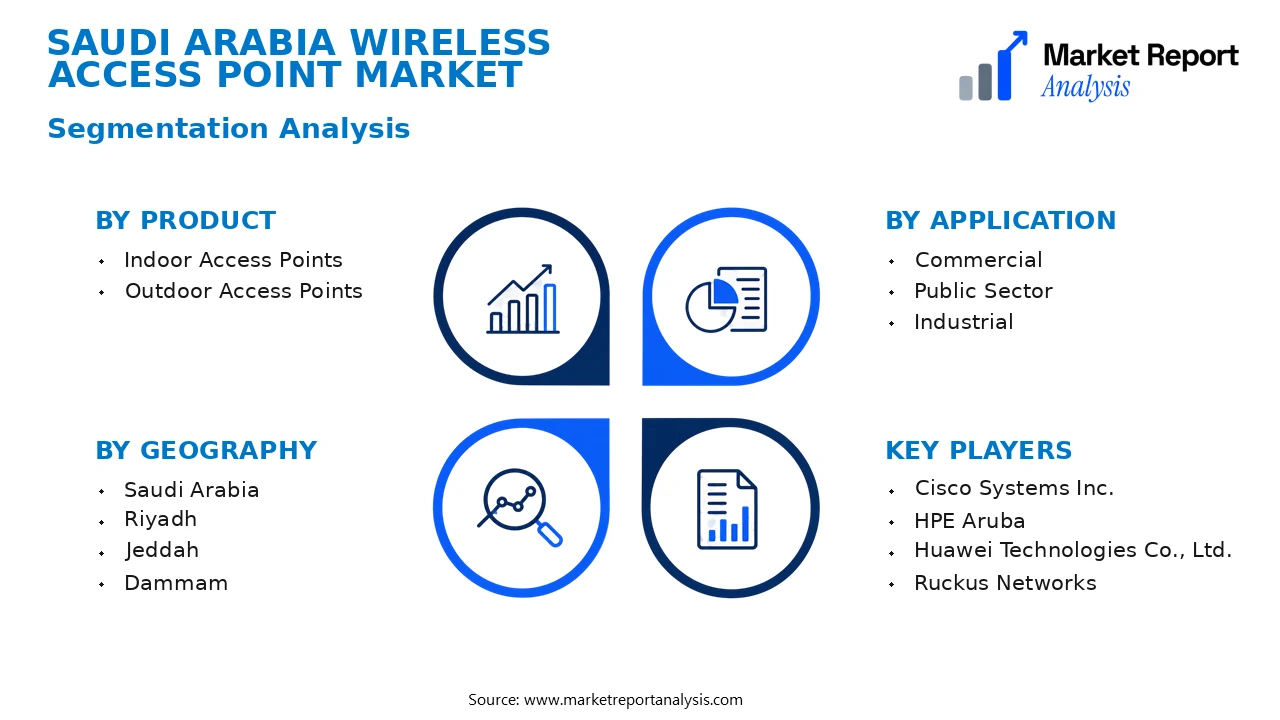
- Product
- Indoor Access Points: These devices are designed for installation within buildings, offices, and retail spaces, where they support a high density of users with enhanced security features, driven by expanding enterprise and educational infrastructure.
- Outdoor Access Points: Built for outdoor environments, these access points sustain wide-area coverage to support enterprise campuses, public Wi-Fi networks, and city infrastructure, aligning with Saudi Arabia’s focus on smart city initiatives and urban development.
- Application
- Commercial: This segment covers retail outlets, hospitality, corporate offices, and healthcare, where reliable and high-capacity wireless connectivity is critical for operations, customer experience, and digital transformation efforts across Saudi Arabia's growing commercial landscape.
- Public Sector: Encompasses government offices, educational institutions, and public Wi-Fi networks, emphasizing connectivity solutions that enable e-governance, smart city functions, and enhanced public service delivery.
- Industrial: Spanning manufacturing, oil & gas, and logistics, this segment emphasizes ruggedized, high-availability access points vital for automation, surveillance, and operational efficiency in Saudi Arabia’s industrial zones.
- Geography
- Saudi Arabia: The national market includes all regions with significant urban centers and industrial zones, characterized by increasing infrastructure investment and digitalization policies that drive demand for wireless access points across sectors.
- Riyadh: As the capital and largest city, Riyadh exhibits the highest concentration of enterprise and government projects, with robust infrastructure developments fueling demand for advanced wireless network solutions.
- Jeddah: A key port city with a thriving tourism sector, Jeddah’s hospitality and commercial sectors are expanding their wireless infrastructure to support tourism, retail, and port operations.
- Dammam: Serving as an industrial hub in the Eastern Province, Dammam’s industrial businesses and oil refineries demand rugged outdoor access points and high-capacity solutions for operational efficiency.
- Mecca: With a high influx of pilgrims and visitors, Mecca’s hospitality and security sectors are investing heavily in wireless access points to enable seamless connectivity during peak periods.
- Medina: Similar to Mecca, Medina's religious and governmental institutions are expanding wireless infrastructure to support increased activity and improve security and communication networks.
- Al Khobar: Located in the Eastern Province, Al Khobar hosts numerous multinational corporations and industrial facilities, requiring sophisticated wireless solutions to support enterprise mobility and industrial automation.
- Jubail: As a major industrial city, Jubail’s focus on petrochemicals and manufacturing necessitates resilient outdoor wireless networks for plant automation and safety systems, boosting regional demand for wireless access points.
Competitive Intelligence
The Saudi Arabia Wireless Access Point Market exhibits moderate competition, dominated by a mix of international vendors such as Cisco, Aruba Networks, and Huawei, alongside local players like Riyadh-based Saudi Telecom Company (STC). The market's concentration remains relatively balanced, with the top five firms holding approximately 55% market share, fostering competitive innovation. Business strategies in Saudi Arabia emphasize tailored solutions aligned with government initiatives such as Vision 2030, focusing on digital transformation and smart city projects, notably in Riyadh and Jeddah. Product innovation is driven by the integration of AI-enabled access points and enhanced security features to address rising cybersecurity concerns. Partnerships between telecom providers and hardware manufacturers play a crucial role in expanding network coverage and accelerating deployment. Several key acquisitions aim to consolidate market presence and diversify product portfolios, while expansion strategies target urban centers with high demand for connectivity. R&D investments are focused on developing resilient, scalable solutions that meet local regulations and infrastructure needs, enabling competitive differentiation through technological supremacy and regional adaptability.
Leading Company Profiles
The Saudi Arabia Wireless Access Point Market is characterized by a competitive landscape comprising several key players that focus on technological innovation, strategic collaborations, and market expansion to capture significant market share in the region.
- Cisco Systems Inc.
- HPE Aruba
- Huawei Technologies Co., Ltd.
- Ruckus Networks
- Zebra Technologies Corporation
- Panorama Antennas
- Ubiquiti Networks Inc.
- H3C Technologies
- Extreme Networks Inc.
- D-Link Corporation
Cisco Systems Inc.
Cisco offers comprehensive wireless solutions including access points, controllers, and network security tailored to large enterprise and service provider markets in Saudi Arabia, emphasizing scalable, secure, and reliable wireless connectivity infrastructure.
HPE Aruba
HPE Aruba specializes in enterprise wireless networking with innovative access point designs, cloud-managed solutions, and AI-driven optimization, enabling seamless connectivity and enhanced security for enterprise customers across Saudi Arabia.
Huawei Technologies Co., Ltd.
Huawei provides advanced wireless access points integrated with its broader telecom and enterprise networking solutions, focusing on high throughput, security, and intelligent management to support Saudi Arabia’s digital transformation initiatives.
Ruckus Networks
Ruckus Networks develops enterprise Wi-Fi solutions renowned for high performance in challenging environments, alongside sophisticated management software, aiming to serve educational, retail, and hospitality sectors in Saudi Arabia.
Zebra Technologies Corporation
Zebra offers wireless access points integrated with IoT solutions for asset tracking, inventory management, and retail automation, driving digitalization efforts within Saudi’s retail and logistics sectors.
Panorama Antennas
Specialized in antenna design and manufacturing, Panorama provides tailored antenna solutions that optimize Wi-Fi coverage and performance, supporting specialized deployment needs across Saudi Arabia’s urban and industrial environments.
Ubiquiti Networks Inc.
Ubiquiti delivers cost-effective wireless access point solutions aimed at small to medium-sized enterprises, rural connectivity, and public Wi-Fi projects across Saudi Arabia, emphasizing ease of deployment and network management.
H3C Technologies
H3C focuses on enterprise networking and security solutions, including wireless access points that integrate with comprehensive network infrastructure, instrumental in supporting Saudi Arabia’s government and corporate digital frameworks.
Extreme Networks Inc.
Extreme Networks offers scalable, high-performance wireless solutions with a strong focus on cloud management, security, and analytics, aimed at enterprise, hospitality, and transportation sectors in Saudi Arabia.
D-Link Corporation
D-Link provides affordable, user-friendly wireless access points suitable for SMEs and public networks in Saudi Arabia, promoting wider digital access and connectivity through innovative wireless technologies.
Strategic Business Developments
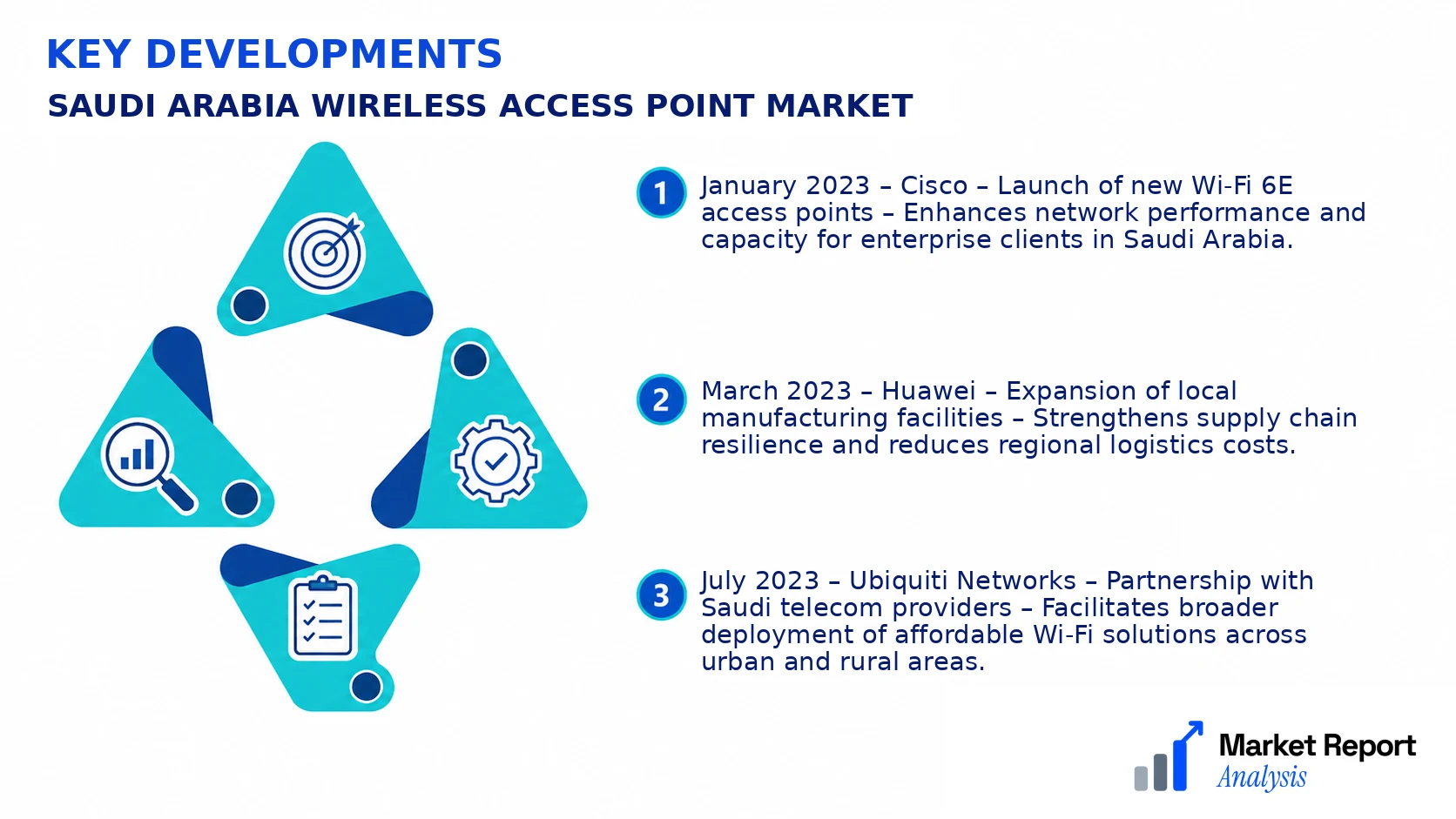
- January 2023 – Cisco – Launch of new Wi-Fi 6E access points – Enhances network performance and capacity for enterprise clients in Saudi Arabia.
- March 2023 – Huawei – Expansion of local manufacturing facilities – Strengthens supply chain resilience and reduces regional logistics costs.
- July 2023 – Ubiquiti Networks – Partnership with Saudi telecom providers – Facilitates broader deployment of affordable Wi-Fi solutions across urban and rural areas.
- September 2023 – HPE Aruba – Introduction of AI-driven network management tools – Improves operational efficiency and security for enterprise networks.
- November 2023 – Extreme Networks – Acquisition of a regional integrator – Boosts market presence and accelerates deployment of high-performance Wi-Fi solutions in government and commercial sectors.
Frequently Asked Questions
What is the Saudi Arabia Wireless Access Point Market?
The Saudi Arabia Wireless Access Point Market encompasses the deployment, sales, and installation of wireless access points across various sectors including commercial, government, and residential within Saudi Arabia. It serves as a cornerstone for expanding wireless connectivity infrastructure in the country.
What is the current market size of Saudi Arabia Wireless Access Point Market?
As of 2026, the market size of the Saudi Arabia Wireless Access Point Market is valued at approximately USD 1.2 Billion, reflecting steady growth driven by increasing demand for enhanced wireless connectivity in urban and rural areas across the country.
What factors are driving the Saudi Arabia Wireless Access Point Market?
Key drivers include government initiatives to improve digital infrastructure, the rapid expansion of 5G networks, rising adoption of IoT and smart city projects, and increased investment in enterprise and retail networks aiming to enhance user experience and operational efficiency.
Which Saudi city leads the Saudi Arabia Wireless Access Point Market?
Riyadh leads the Saudi Arabia Wireless Access Point Market, propelled by its status as the country’s political and economic hub, high-density urban development, and significant investments in smart city projects and enterprise infrastructure within the city.
Which segment is expected to grow the fastest?
The enterprise segment is anticipated to experience the fastest growth, driven by increasing enterprise connectivity needs, expansion of data centers, and the adoption of advanced wireless solutions to support digital transformation initiatives.
Who are the leading companies operating in the Saudi Arabia Wireless Access Point Market?
Leading companies include Cisco Systems, Ubiquiti Networks, Aruba Networks, and Huawei, all competing through innovative product offerings, strategic partnerships, and localized service solutions tailored to Saudi Arabia's expanding wireless infrastructure needs.
Analyst Perspective
The Saudi Arabia Wireless Access Point Market presents a promising long-term outlook driven by ongoing digital transformation initiatives and smart city projects across major urban centers such as Riyadh, Jeddah, and Dammam. Commercial opportunities are set to expand as demand for high-capacity, reliable wireless infrastructure grows in retail, healthcare, education, and government sectors, supported by government investments aimed at fostering a knowledge-based economy. Technology evolution toward Wi-Fi 6 and future Wi-Fi 7 standards will enhance network efficiency, latency, and security, further incentivizing enterprise adoption. Investment priorities should focus on advanced deployment solutions and interoperable systems to capitalize on the impending 5G integration in urban areas. Competitive intensity remains high with existing telecom operators and innovative tech firms vying for market share, but strategic partnerships could unlock new scale and service differentiation. City-level growth potential is particularly elevated in Riyadh’s financial district and Jeddah’s tourism zones, where digital infrastructure upgrades are integral to economic diversification. Overall, long-term success hinges on aligning technology adoption with strategic urban planning and regulatory support, positioning Saudi Arabia as a regional leader in wireless connectivity.
