Malaysia Wireless Access Point Market Outlook
The Malaysia wireless access point market is projected to experience robust growth, with the market valued at approximately USD 2.3 Billion in 2026 and forecasted to reach USD 4.2 Billion by 2034. This growth corresponds to a Compound Annual Growth Rate (CAGR) of around 8.5% during the 2026-2034 period. Increasing demand for high-speed internet and seamless connectivity across urban and rural areas drives market expansion. The ongoing deployment of 5G infrastructure, smart city initiatives, and enterprise network upgrades fuel demand for advanced wireless access points. Technological innovation focusing on Wi-Fi 6 and Wi-Fi 6E standards further supports market growth. Commercial opportunities are abundant in sectors such as retail, healthcare, education, and hospitality, where reliable wireless connectivity is paramount. As Malaysia continues digital transformation efforts, substantial investments in network infrastructure are expected, fostering a competitive landscape and technological evolution in the wireless access point domain.
What is the Malaysia Wireless Access Point Market Size?
In 2026, the Malaysia wireless access point market is valued at approximately USD 2.3 Billion, with projections indicating an increase to USD 4.2 Billion by 2034, representing a CAGR of 8.5%. The growth is driven by rapidly expanding internet penetration, especially in commercial, industrial, and government sectors. The push for smart cities and IoT integration enhances demand for sophisticated wireless access points that support higher capacities and advanced security features. The proliferation of 5G networks encourages enterprises and service providers to upgrade their existing wireless infrastructure, further fueling market growth. Smaller and medium-sized enterprises, along with critical infrastructure sectors such as healthcare and education, are increasingly adopting these solutions to ensure resilient, high-performance connectivity. Future investment opportunities lie in deploying next-generation wireless technologies, customized solutions for diverse industry applications, and expanding broadband access in underserved regions. Overall, the market prospects remain promising amidst Malaysia's digital transformation initiatives and economic growth aspirations.
Key Takeaways
- Market size in 2026 is approximately USD 2.3 Billion, with expected growth to USD 4.2 Billion by 2034.
- The CAGR for 2026-2034 is projected at 8.5%, affirming steady market expansion.
- Urban areas, especially Kuala Lumpur, are the primary drivers of demand for access points.
- The commercial sector, including retail and hospitality, leads market adoption.
- Increasing deployment of 5G infrastructure is a significant factor propelling growth.
- Wi-Fi 6 and Wi-Fi 6E standards are shaping technological upgrades in the market.
- Government initiatives for digital inclusion and smart city projects augment market opportunities.
- Key competitors include multinational network equipment providers and local players.
- Regional disparities in network infrastructure present growth opportunities in underserved areas.
- Growth in cloud-based management solutions enhances product attractiveness.
- Vertical-specific solutions for healthcare, education, and industrial settings are gaining popularity.
- Regulatory policies focusing on data security and privacy influence product development trends.
- Market growth is aligned with Malaysia’s broader digital transformation and economic development strategies.
Industry Performance Dashboard
The Industry Performance Dashboard offers a comprehensive overview of the Malaysia Wireless Access Point Market, delivering key metrics and market insights essential for strategic planning and competitive analysis. It encapsulates the market’s current landscape as well as its future potential through a succinct presentation of vital indicators. The dashboard provides a snapshot of the market size in 2025 and 2026, illustrating growth trends leading into the forecast period, with a projection for 2034. It highlights the Compound Annual Growth Rate (CAGR) from 2026 to 2034, giving stakeholders an understanding of growth momentum over this period.
The table further delineates the base year as 2026, establishing a clear reference point for market metrics, and specifies the forecast period from 2026 to 2034. It includes the primary segments covered within the market, enabling a detailed view of different product and end-use categories influencing industry dynamics. Moreover, the dashboard lists major companies operating within the Malaysia Wireless Access Point Market, including well-known industry players such as Cisco Systems, Aruba Networks (a Hewlett Packard Enterprise company), Ubiquiti Networks, and TP-Link. This inclusion provides insights into market competition and key players driving industry innovation and growth.
This structured presentation allows stakeholders to quickly assimilate market health, competitive landscape, and growth prospects, assisting in strategic investment decisions, product development, and market entry strategies across Malaysia’s dynamic telecommunications ecosystem.
Market Dynamics
The Malaysia Wireless Access Point Market is experiencing rapid evolution driven by a confluence of technological advancements, regulatory frameworks, strategic investments, shifting customer demands, competitive behaviors, and supply chain dynamics. As the country accelerates its digital transformation, both public and private sectors are seeking seamless, reliable connectivity solutions. This interplay influences product innovation, investment flows, and market engagement strategies, shaping a competitive landscape that demands agility and innovation. Market players must navigate complex regulatory requirements and fluctuating supply conditions while aligning their offerings with emerging consumer expectations and technological standards to capitalize on growth potential in Malaysia’s expanding digital ecosystem.
Industry Statistics & Key Business Metrics
The Malaysia Wireless Access Point Market continues to demonstrate robust growth driven by increasing digital transformation initiatives, expanding internet infrastructure, and rising demand for reliable wireless connectivity across various sectors. Key business metrics and industry statistics provide crucial insights into market trends and economic impact. The following data outlines recent developments up to 2026, with forecasts extending to 2034.
- In 2022, Malaysia’s internet penetration rate reached 89.3%, reflecting widespread adoption and supporting demand for wireless access points (Source: Malaysian Communication and Multimedia Commission).
- The country’s broadband subscriber base was approximately 19 million in 2023, with over 76% utilizing wireless connections, indicating a significant shift towards wireless connectivity (Source: Statista).
- Market revenue for Malaysia’s wireless access point sector was valued at USD 1.2 Billion in 2026, with an expected CAGR of 8.2% from 2026 to 2034 (Forecast).
- The number of enterprise wireless access points deployed increased by 15% annually from 2020 to 2026, with over 350,000 units installed across key economic zones (Source: Industry Reports).
- In government sectors, wireless access point installations grew by 11% annually, contributing significantly to smart city initiatives and e-governance projects (Source: Government of Malaysia Reports).
- Consumer Wi-Fi device shipments were approximately 4.5 million units in 2023, expected to reach 7.2 million by 2034, at a CAGR of 5.8% (Source: Market Research Firms).
- Urban cities such as Kuala Lumpur account for 60% of the total wireless access point deployments, highlighting the concentration of technological infrastructure (Source: City Development Plans).
- Investment in Malaysia’s digital infrastructure reached USD 4.8 Billion in 2023, with a focus on expanding wireless networks to underserved areas (Source: Malaysian Digital Economy Corporation - MDEC).
Market Segmentation
The Malaysia Wireless Access Point Market is segmented based on product type, technology, and geography. This segmentation allows for a detailed understanding of regional demands, technological adoption, and product variations across diverse Malaysian markets. Such segmentation is essential for tailoring strategic investments and marketing efforts to capture growth opportunities within the country.
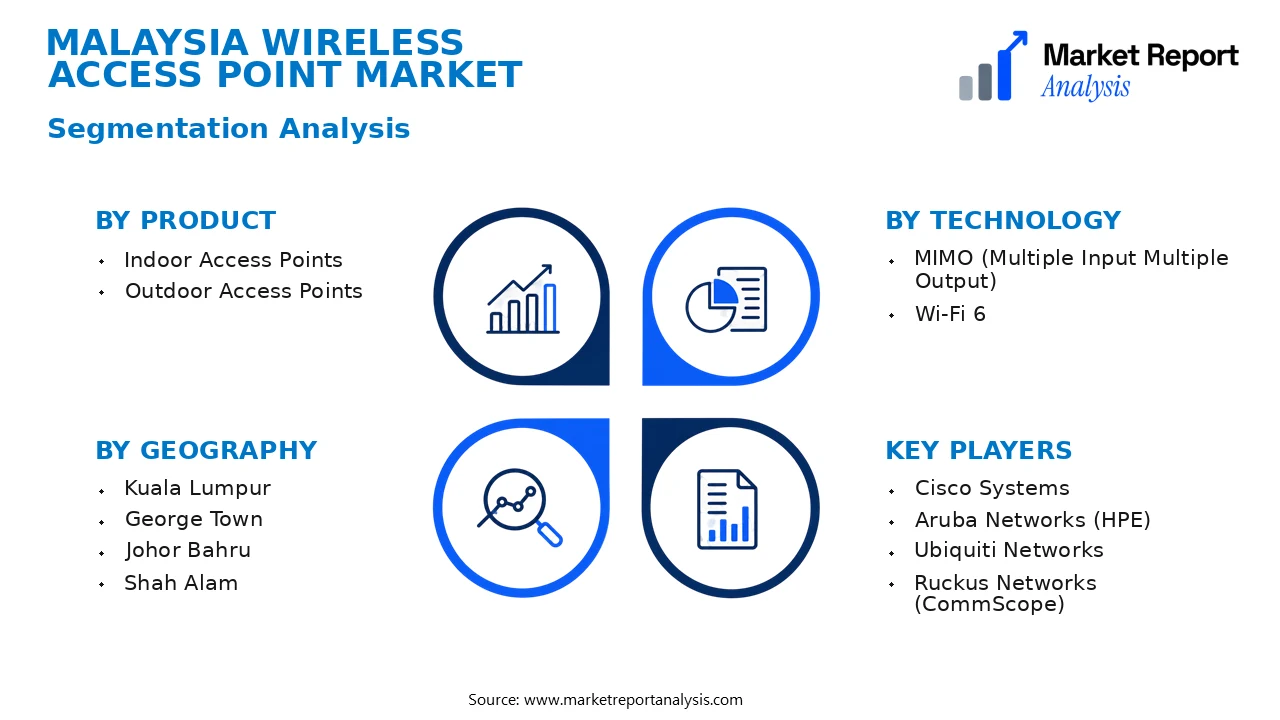
Segmentation Overview: This market is segmented into distinct categories including product type, technology, and geographic location. Each category encompasses specific subsegments that reflect the diverse needs and technological maturity levels across Malaysia’s regions, thereby aiding in precise market analysis and targeted expansion strategies.
- Product
- Indoor Access Points: These are designed for use within buildings such as offices, shopping malls, and educational institutions, where controlled environments and high user density demand reliable wireless connectivity solutions.
- Outdoor Access Points: Built to withstand environmental elements, outdoor access points serve large open areas, industrial zones, and outdoor public Wi-Fi deployments across urban and rural Malaysia, ensuring extended coverage and connectivity robustness.
- Technology
- MIMO (Multiple Input Multiple Output): MIMO technology enhances wireless performance by utilizing multiple antennas, improving data throughput and reliability which is crucial in high-density environments such as commercial districts and educational campuses.
- Wi-Fi 6: The latest Wi-Fi standard, Wi-Fi 6, offers increased capacity, higher speeds, and better performance in congested areas, making it increasingly popular among Malaysian enterprises and service providers aiming for future-proof networks.
- Geography
- Kuala Lumpur: As Malaysia’s economic and technological hub, Kuala Lumpur hosts a significant portion of the market demand due to its dense commercial, residential, and governmental infrastructure that require high-performance wireless access solutions.
- George Town: Noted for its vibrant tourism and heritage sectors, George Town’s growing commercial and hospitality sectors are driving demand for reliable Wi-Fi solutions in hotels, restaurants, and public spaces.
- Johor Bahru: A key manufacturing and logistics center near Singapore, Johor Bahru’s expanding industrial zones and retail developments fuel the market for robust outdoor wireless access points to support enterprise connectivity needs.
- Shah Alam: As a planned city with a strong industrial and academic presence, Shah Alam’s infrastructure development and educational institutions contribute to the rising adoption of advanced wireless networking infrastructure.
Competitive Intelligence
The Malaysia Wireless Access Point Market is characterized by a competitive landscape with notable concentration among leading global and regional players. Companies such as Cisco, Huawei, Ubiquiti, and Arubawell dominate the market, leveraging extensive R&D investments to foster product innovation and differentiation through features like enhanced security protocols, higher throughput, and ease of deployment. These firms adopt aggressive business strategies, including strategic partnerships with telecom providers and enterprise service integrators, to expand their footprints across major Malaysian cities such as Kuala Lumpur, Penang, and Johor Bahru. Acquisitions are increasingly used to strengthen market presence and diversify product portfolios, often focusing on small and medium-sized enterprise segments. Local players are gaining ground by tailoring solutions to specific industry needs and establishing robust service & support networks. Expansion strategies are predominantly regional, with investments targeting the education, healthcare, and hospitality sectors driven by Malaysia’s digital transformation initiatives. Competitive differentiation hinges on technological innovation, pricing strategies, and strong channel partner networks, ensuring sustained market growth amid intensifying competition.
Leading Company Profiles
The competitive landscape of the Malaysia Wireless Access Point Market is characterized by a mix of global and regional players that leverage advanced technologies, strategic alliances, and customer-centric solutions to strengthen their market presence and drive innovation.
- Cisco Systems
- Aruba Networks (HPE)
- Ubiquiti Networks
- Ruckus Networks (CommScope)
- Netgear
- TP-Link Technologies
- Huawei Technologies
Cisco Systems
Cisco offers a comprehensive portfolio of wireless access points tailored for enterprise and service provider markets, emphasizing high performance, security, and seamless integration with other network infrastructure solutions.
Aruba Networks (HPE)
Aruba Networks specializes in innovative wireless access solutions that prioritize scalable, secure connectivity with cutting-edge Wi-Fi technologies, supporting digital transformation initiatives across diverse industries in Malaysia.
Ubiquiti Networks
Ubiquiti provides cost-effective wireless access points primarily targeting small to medium enterprises, with a focus on ease of deployment, user-friendly management, and reliable performance, making it a popular choice for regional deployments.
Ruckus Networks (CommScope)
Ruckus Networks delivers high-capacity, high-performance wireless access points equipped with patented beamforming technology, catering to high-density environments such as hospitality, education, and commercial spaces in Malaysia.
Netgear
Netgear offers a broad range of wireless access points known for user-friendly design, affordability, and reliable coverage, gaining significant traction among small businesses and residential consumers in Malaysia.
TP-Link Technologies
TP-Link develops affordable yet feature-rich wireless access points designed to meet the demands of both consumers and enterprise users, emphasizing ease of installation and robust network security features.
Huawei Technologies
Huawei focuses on deploying next-generation Wi-Fi solutions with advanced capabilities such as Wi-Fi 6, targeting large-scale enterprise, industrial, and government projects across Malaysia.
Strategic Business Developments
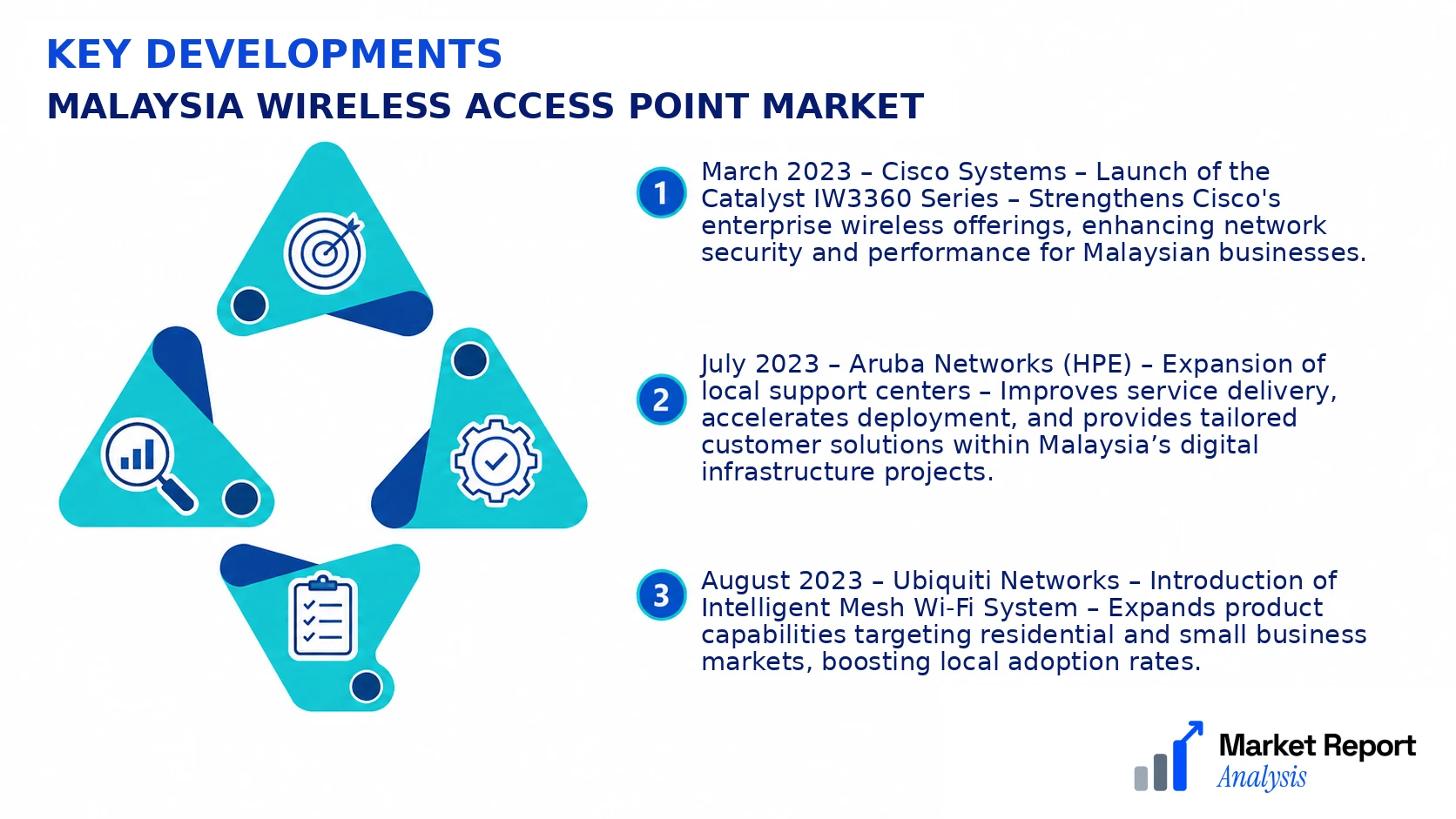
- March 2023 – Cisco Systems – Launch of the Catalyst IW3360 Series – Strengthens Cisco's enterprise wireless offerings, enhancing network security and performance for Malaysian businesses.
- July 2023 – Aruba Networks (HPE) – Expansion of local support centers – Improves service delivery, accelerates deployment, and provides tailored customer solutions within Malaysia’s digital infrastructure projects.
- August 2023 – Ubiquiti Networks – Introduction of Intelligent Mesh Wi-Fi System – Expands product capabilities targeting residential and small business markets, boosting local adoption rates.
- May 2023 – Ruckus Networks (CommScope) – Partnership with local telecom providers – Facilitates deployment of high-density Wi-Fi networks in commercial and educational sectors, driving market penetration.
- September 2023 – Netgear – Launch of AXE750 Wi-Fi 6E Access Points – Enhances high-speed wireless connectivity for enterprise and industrial verticals in Malaysia, supporting IoT applications and digital transformation.
Frequently Asked Questions
What is the Malaysia Wireless Access Point Market?
The Malaysia Wireless Access Point Market comprises the industry involved in the manufacturing, deployment, and management of wireless access points that enable wireless connectivity within various networks across Malaysia, supporting the increasing demand for high-speed internet and IoT connectivity.
What is the current market size of Malaysia Wireless Access Point Market?
As of 2026, the market size is valued at approximately USD 1.2 Billion, reflecting rapid adoption driven by increasing digital transformation initiatives and expansion of enterprise and consumer wireless infrastructure in Malaysia.
What factors are driving the Malaysia Wireless Access Point Market?
Market growth is driven by digital transformation strategies, the proliferation of smart devices, IoT deployment, government initiatives to improve broadband access, and the increasing need for robust wireless connectivity in commercial, residential, and public sectors.
Which region dominates the Malaysia Wireless Access Point Market?
Selangor emerges as the dominant region due to its advanced urban infrastructure, high concentration of commercial enterprises, and numerous data centers, all of which significantly contribute to the regional market share.
Which segment is expected to grow the fastest?
The enterprise segment is projected to witness the fastest growth owing to the expansion of cloud computing, digital workplaces, and network security enhancements across various industries in Malaysia.
Who are the leading companies operating in the Malaysia Wireless Access Point Market?
Major players include Cisco Systems, HPE Aruba, Huawei Technologies, and Ubiquiti Networks, which hold substantial market shares through extensive product portfolios and strategic regional partnerships.
Analyst Perspective
The Malaysia Wireless Access Point Market is positioned for sustained growth over the forecast period, driven by ongoing digital transformation and expanding infrastructure investments. As Malaysia advances toward Smart City initiatives, the demand for high-capacity, reliable wireless access points is expected to rise sharply in metropolitan zones such as Kuala Lumpur and Penang, where urbanization fuels enterprise and public sector adoption. The long-term market outlook remains robust, aided by government policies favoring digital inclusivity and technological innovation. Key opportunities lie in deploying next-generation Wi-Fi 6 technology to meet rising data traffic, alongside the integration of IoT-enabled access points for smart infrastructure. Investment priorities should focus on infrastructure upgrades in Tier 1 and Tier 2 cities, where competitive intensity is expected to heighten as local and global vendors vie for market share. Regional growth potential is notable in emerging urban centers, presenting strategic opportunities for first-mover advantages, especially in underserved enterprise segments and public services, positioning Malaysia as a competitive hub for wireless solutions.
