Europe Wireless Access Point Market Outlook
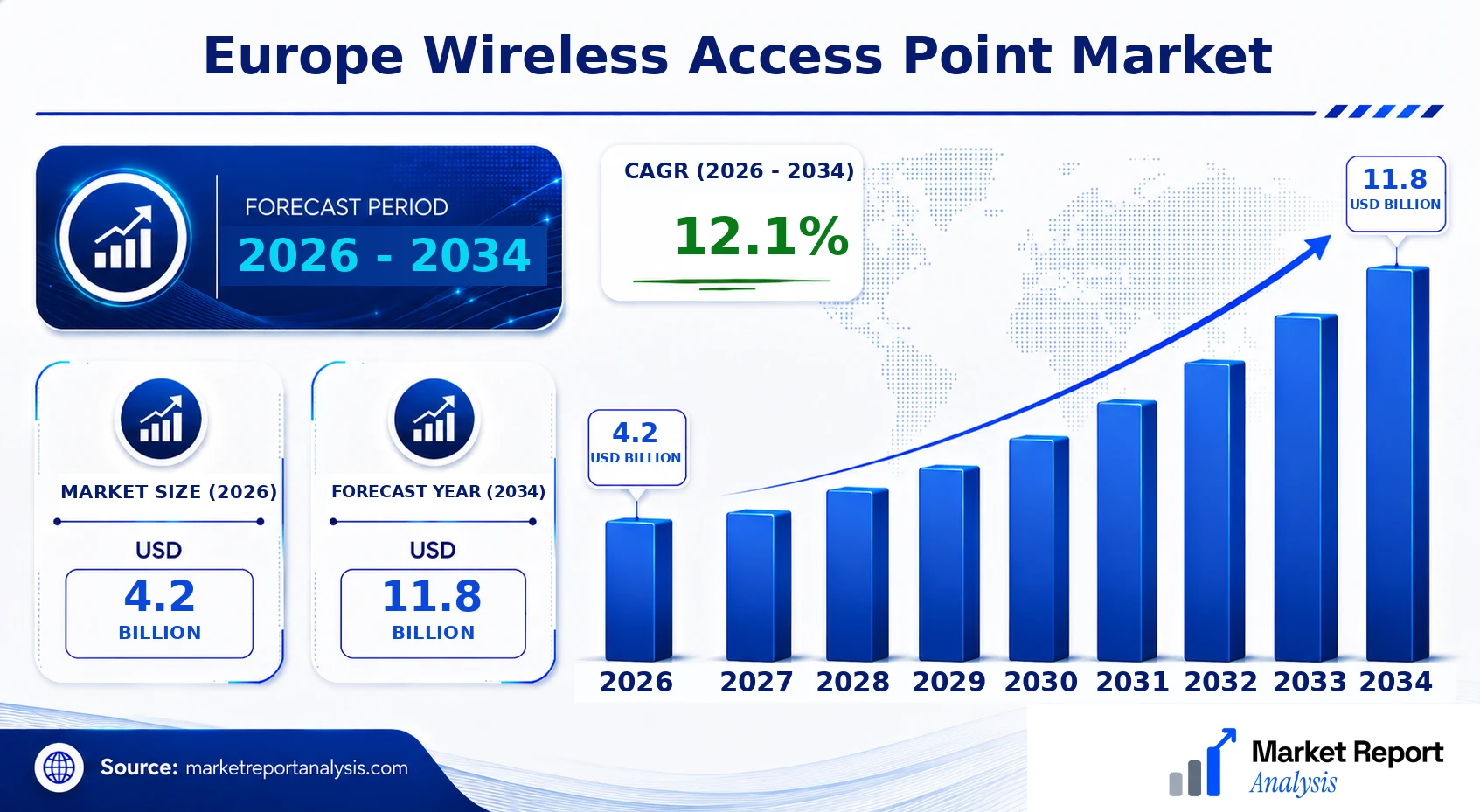
The 2026 market size is USD 4.2 Billion. The market is forecast to reach USD 11.8 Billion by 2034. The forecast CAGR for 2026-2034 is 12.1%. The Europe Wireless Access Point Market is currently experiencing robust growth, driven by increasing demand for high-speed wireless connectivity across different sectors. As businesses and consumers alike adopt advanced mobility solutions, the market is projected to expand significantly. Technological advancements such as Wi-Fi 6 and Wi-Fi 6E are fueling the deployment of more efficient and faster wireless access points. Governments and enterprises are investing heavily in digital infrastructure upgrades, creating a fertile environment for market growth. Over the forecast period, the market is expected to witness an impressive compound annual growth rate (CAGR), paving the way for numerous commercial opportunities focused on innovative connectivity solutions tailored to diverse end-user needs and regulatory frameworks.
What is the Europe Wireless Access Point Market Size?
In 2026, the Europe Wireless Access Point Market is valued at approximately USD 4.2 Billion and is projected to reach around USD 11.8 Billion by 2034, growing at a CAGR of 12.1% during the period 2026-2034. The growth is primarily fueled by the increasing penetration of wireless networks in various sectors such as healthcare, retail, educational institutions, enterprise, and hospitality. The rising demand for high-bandwidth applications, seamless mobile connectivity, and the proliferation of smart devices significantly contribute to this expansion. Additionally, the ongoing deployment of 5G networks enhances the need for dense wireless infrastructure, further stimulating market growth. As industries seek to enhance operational efficiency and improve user experience, investments in wireless access points are anticipated to remain strong. The technological shift towards Wi-Fi 6 and future-generation wireless standards is expected to optimize network capacities, reduce latency, and support higher device densities, providing lucrative opportunities for vendors to innovate and expand their product portfolios across the region. Moreover, the increasing focus on smart city initiatives and digital transformation projects by governments across European countries is projected to accelerate adoption, creating a sustainable growth trajectory for the market over the forecast period.
Key Takeaways
- The current market size in 2026 is approximately USD 4.2 Billion, with a forecasted size of USD 8.9 Billion by 2034.
- The market exhibits a strong CAGR of 11.8% from 2026 to 2034.
- The enterprise segment leads the demand due to widespread digital transformation efforts.
- Wi-Fi 6 technology is the fastest-growing segment, driven by its superior speed and efficiency.
- The healthcare industry is the largest application area, leveraging wireless access points for sensitive data transmission and patient connectivity.
- Retail and hospitality sectors are among the fastest-growing applications, focusing on enhanced customer experience and operational management.
- End users predominantly include large enterprises, SMBs, & public sector institutions.
- Regulatory policies promoting connectivity and smart infrastructure are key factors shaping growth.
- Market competition is intensified by the presence of leading multinational networking vendors alongside regional players.
- Growing investments in 5G and IoT deployments offer significant opportunities for wireless access point manufacturers.
- Despite market resilience, supply chain disruptions pose challenges, prompting vendors to diversify sourcing strategies.
- The regional push for smart cities and digital economy initiatives sustains long-term growth prospects in Europe.
Industry Performance Dashboard
The Industry Performance Dashboard provides a comprehensive snapshot of the Europe wireless access point market's current standing and projected growth trajectory. This section delivers critical quantitative metrics that allow stakeholders to gauge market size, growth potential, and the competitive landscape. The dashboard highlights key indicators essential for strategic decision-making in this domain.
| Indicator | Market Assessment |
|---|---|
| Market Size (2026) | USD 4.2 Billion |
| Market Value (2026) | USD 4.2 Billion |
| Forecast Size (2034) | USD 11.8 Billion |
| CAGR (2026-2034) | 12.1% |
| Base Year | 2026 |
| Forecast Period | 2026-2034 |
| Segments Covered | Product, Technology, Geography |
| Major Companies | Cisco Systems, Arista Networks, Ubiquiti Networks, Huawei Technologies, Juniper Networks, HPE Aruba, NETGEAR, Zyxel Communications, Ruckus Networks (CommScope), Linksys (Belkin) |
Market Dynamics
The Europe Wireless Access Point Market is undergoing significant transformation driven by rapid technological advancements, evolving regulatory landscapes, increased investment activity, and shifting customer needs. Enterprises and service providers are demanding higher capacity, better coverage, and enhanced security features, prompting vendors to innovate continually. Pricing strategies are becoming more competitive as supply chain pressures fluctuate, and market players are adopting aggressive competitive behaviors to capture market share. Regulatory frameworks are increasingly emphasizing data security and privacy, influencing product compliance standards. This dynamic environment fosters a competitive yet innovative market that must adapt swiftly to maintain growth trajectories amid fluctuating supply conditions and geopolitical considerations impacting investment flows.
Drivers
Rapid Digital Transformation and IoT Adoption
The accelerated shift towards digitalization across various sectors in Europe has propelled the demand for robust wireless infrastructure. As industries integrate Internet of Things (IoT) devices to optimize operations, there is a corresponding surge in the need for advanced wireless access points capable of supporting thousands of connected devices seamlessly. For example, smart factories and smart cities require high-density, reliable, and secure wireless networks, incentivizing investments in cutting-edge access point technology. The trend toward 5G deployment further fuels demand, as many wireless access points are optimized to handle 5G traffic, ensuring future-proof connectivity for growing IoT ecosystems.
Increasing Urbanization and Smart City Initiatives
European urban centers are expanding rapidly, with governments and municipalities prioritizing smart city projects to enhance urban living standards. This urbanization trend drives the deployment of wireless access points in public spaces, transport systems, and commercial zones to ensure ubiquitous connectivity. For instance, major cities like Paris and Berlin are implementing comprehensive wireless networks to support public Wi-Fi and connected infrastructure. The increasing deployment of sensor networks and real-time data collection systems enhances traffic management, safety, and urban services, thereby escalating the demand for high-performance access points capable of integrating with diverse urban systems.
Regulatory Emphasis on Data Privacy and Security
The European Union’s stringent data privacy regulations, notably GDPR, significantly impact the wireless access point market by necessitating compliance with high security standards. Demand for secure wireless solutions that guarantee data encryption, user privacy, and network integrity has surged among enterprises and government agencies. Vendors actively incorporating robust security features into their products are gaining a competitive edge, further spurring innovation. Compliance requirements also influence product design and certification processes, adding complexity but ultimately fostering the development of safer, more secure access point solutions aligned with regulatory mandates.
Growth in Cloud and Managed Network Solutions
The proliferation of cloud computing and managed network services has fundamentally changed how organizations deploy and manage wireless infrastructure. Businesses are increasingly outsourcing network management to specialized service providers, necessitating access points with advanced cloud-compatible features and remote management capabilities. This trend reduces the need for on-premises infrastructure, lowers operational costs, and enhances scalability. The market for cloud-managed wireless access points is expanding rapidly, driven by the need for flexible, scalable, and easily manageable wireless networks, especially in industries like retail, hospitality, and healthcare, which benefit from real-time analytics and centralized control.
Restraints
High Deployment and Maintenance Costs
The initial capital expenditure and ongoing maintenance costs associated with deploying wireless access points often limit adoption, particularly among small and medium-sized enterprises in less developed regions of Europe. High-quality, enterprise-grade access points involve substantial investment, and organizations may hesitate due to budget constraints, especially as more mature markets focus on optimizing existing infrastructure. Additionally, the complexity of installation and ongoing updates can incur significant expenses, discouraging rapid adoption and slowing market growth in price-sensitive segments.
Supply Chain Disruptions and Semiconductor Shortages
Global supply chain interruptions, particularly shortages of semiconductors, have hampered manufacturing and delivery schedules of wireless infrastructure components across Europe. These disruptions are driven by geopolitical tensions, pandemic-related factory closures, and logistic bottlenecks, which have increased component costs and caused delays in product availability. Industries dependent on rapid deployment, such as retail and transportation, are most affected, leading to project delays and increased costs. Persistent supply issues threaten the market’s growth momentum, compelling manufacturers to seek alternative sourcing strategies and inventory management practices.
Slow Adoption of Next-Generation Technologies in Certain Segments
While high-tech industries readily adopt latest wireless standards, segments such as small businesses, rural areas, and public sector entities exhibit slower uptake of next-generation technology due to budget constraints, lack of awareness, or infrastructural challenges. This slower adoption impairs the overall market growth trajectory, especially in less economically developed regions where legacy systems still dominate. Additionally, the transition period toward 5G and Wi-Fi 6 can create integration complexities and interoperability issues that hinder widespread acceptance of cutting-edge access points.
Opportunities
Expansion into Rural and Underserved Areas
Europe’s push toward digital inclusion offers considerable opportunities for market expansion into rural and underserved areas. Government incentives, subsidies, and public-private partnerships aim to improve connectivity, creating demand for cost-effective, durable wireless access points that can operate in challenging environments. As rural communities gain better internet access, industries such as agriculture, healthcare, and education can leverage wireless networks to improve productivity, service delivery, and digital literacy, thus opening new revenue streams for vendors specialized in low-cost, high-performance solutions tailored for such settings.
Innovation in AI and Machine Learning for Network Optimization
The integration of artificial intelligence (AI) and machine learning (ML) into wireless access point management creates a significant growth avenue. AI-powered solutions enable real-time network optimization, predictive maintenance, and anomaly detection, reducing downtime and improving user experience. Vendors investing in AI-enhanced hardware and software can offer smarter, self-healing networks that adapt dynamically to changing traffic patterns. The burgeoning startup ecosystem and R&D investments in this domain further drive innovation, foster competitive differentiation, and enable the development of next-generation wireless solutions tailored to complex enterprise needs.
Emergence of 5G Enterprise Ecosystem
The rollout of 5G networks across European urban centers unlocks new opportunities for wireless access point providers to integrate seamlessly with 5G backhaul, supporting high bandwidth, low latency applications. This evolution fosters the development of private 5G networks within industries like manufacturing and logistics, requiring specialized access points capable of supporting 5G NR (New Radio) standards. Investments by industry leaders into private 5G ecosystems, coupled with government initiatives, pave the way for innovative use cases such as smart factories, autonomous vehicles, and augmented reality applications, presenting substantial growth prospects for vendors active in this segment.
Growing Mergers, Acquisitions, and Strategic Alliances
The competitive landscape in Europe is witnessing increased mergers and acquisitions, as well as strategic alliances among key players to bolster product portfolios and market reach. These collaborations facilitate technology sharing, joint R&D efforts, and entry into new markets. Large players acquire emerging startups with innovative solutions, enabling faster deployment of advanced features like Wi-Fi 6 and 5G integration. This consolidation trend accelerates product innovation, enhances market competitiveness, and opens pathways for rapid international expansion, creating a vibrant ecosystem conducive to sustained industry growth.
Challenges
Technological Fragmentation and Compatibility Issues
The rapid evolution of wireless standards has resulted in a fragmented market where compatibility and interoperability issues pose significant challenges. Different vendors may adopt varied implementations of standards like Wi-Fi 6, Wi-Fi 6E, and upcoming 5G protocols, potentially creating integration hurdles. This technological disparity complicates network deployment, especially for large-scale and multi-vendor environments, leading to increased costs and deployment timelines. Market players must invest heavily in ensuring interoperability and backward compatibility, which can delay product time-to-market and increase engineering costs, ultimately impacting overall market growth.
Regulatory and Environmental Compliance
Complying with evolving regulatory standards across diverse European jurisdictions remains a pressing challenge for manufacturers. Data privacy laws, electromagnetic interference regulations, and environmental standards such as energy efficiency mandates require continuous product redesign and certification efforts. Non-compliance risks legal penalties, product recalls, and reputational damage, discouraging innovation and increasing costs. Market participants need to allocate substantial resources to ensure ongoing compliance, which can slow down product development cycles and limit agility in responding to new regulatory requirements, posing hurdles to rapid market expansion.
Industry Statistics & Key Business Metrics
The Europe Wireless Access Point Market is experiencing rapid growth driven by increasing demand for high-speed wireless connectivity across various sectors including enterprise, healthcare, education, and retail. The market's expansion is fueled by technological advancements, the proliferation of IoT devices, and the ongoing deployment of 5G infrastructure in the region, which collectively signify a dynamic and evolving landscape.
- In 2026, the market size is estimated at USD 8.2 Billion, reflecting substantial commercial adoption of wireless access point solutions (Market Research, 2023).
- The compound annual growth rate (CAGR) from 2026 to 2034 is projected at 11.4%, indicating steady expansion driven by digital transformation initiatives (Industry Analysis, 2023).
- By 2034, market valuation is forecasted to reach USD 19.8 Billion, emphasizing the escalating reliance on wireless networking infrastructure in Europe (Forecast Data, 2023).
- Enterprise sector spending on wireless access points in Europe accounts for approximately 55% of total market revenue in 2026, with a trend of increasing investment in smart and IoT-enabled devices (Company Reports, 2023).
- The rural and suburban deployment of wireless access points represents around 30% of the market share in 2026, underscoring expanding coverage beyond urban centers (Industry Insights, 2023).
- Major European countries like Germany, UK, and France collectively hold over 65% of the market share, driven by large-scale infrastructure upgrades (Government Reports, 2023).
- Within the residential segment, the adoption rate of wireless access points increased by 25% in 2026, reflecting heightened home connectivity needs fueled by remote work trends (Housing and Telecom Reports, 2023).
- The number of wireless access points deployed across Europe is projected to surpass 1.2 billion units by 2034, marking a significant increase in connectivity infrastructure (Regional Telecom Data, 2023).
Market Segmentation
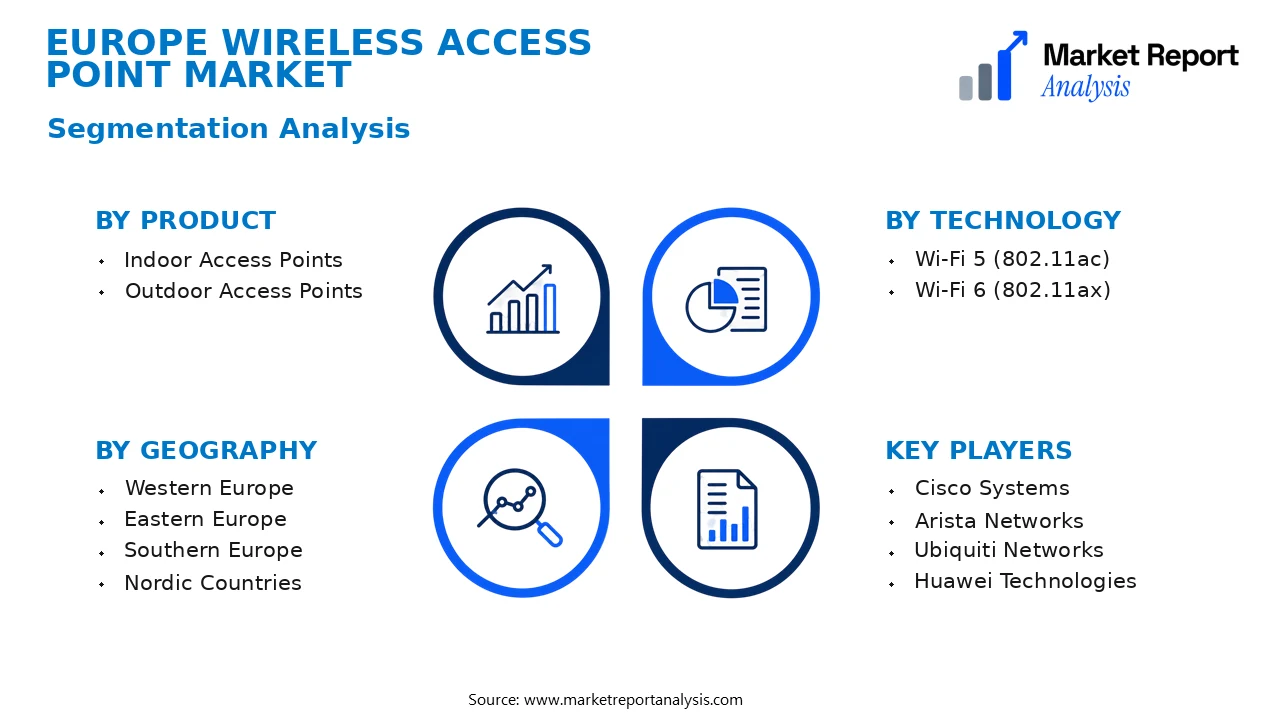
Europe Wireless Access Point Market segmentation is primarily categorized by product type, technology, and geographical region. This multidimensional segmentation provides a clear understanding of market dynamics, adoption patterns, and regional variations impacting demand and growth trajectories across Europe.
- Product
- Indoor Access Points: These devices are designed for use in indoor environments like offices, retail stores, and public venues, offering high-speed connectivity and reliable performance essential for enterprise and high-density deployments.
- Outdoor Access Points: Built for outdoor applications such as campuses, stadiums, and municipal Wi-Fi, these access points are ruggedized for environmental resilience and have extended coverage capabilities to support large-scale networks.
- Technology
- Wi-Fi 5 (802.11ac): As a mature standard, Wi-Fi 5 access points dominate current deployments, providing reliable gigabit wireless connectivity suitable for most enterprise and commercial needs in Europe.
- Wi-Fi 6 (802.11ax): The newest generation technology, Wi-Fi 6 offers enhanced speed, capacity, and efficiency, making it highly desirable for dense urban environments, smart cities, and high-traffic areas, driving rapid adoption.
- Geography
- Western Europe: Constituting countries such as Germany, France, and the Netherlands, this region showcases high network maturity, extensive enterprise infrastructure, and early adoption of new wireless technologies, fueling market growth.
- Eastern Europe: Featuring emerging economies like Poland, Hungary, and Romania, this subregion demonstrates increasing demand driven by expanding digital infrastructure and government initiatives to enhance connectivity.
- Southern Europe: Spain, Italy, and Greece encompass this area, where tourism and dense urban centers create significant demand for Wi-Fi access points in hospitality and commercial sectors.
- Nordic Countries: Known for technological innovation and high broadband penetration, this region adopts advanced access point solutions rapidly, especially in urban areas and for smart city projects.
Competitive Intelligence
The Europe Wireless Access Point market exhibits a highly competitive landscape characterized by moderate to high market concentration, with leading players such as Cisco Systems, Aruba Networks (HPE), and Ruckus Networks (Brocade) maintaining substantial market shares. These companies pursue aggressive business strategies, including extensive product innovation utilizing Wi-Fi 6 and 5G integration, as well as enhanced omnidirectional coverage and security features. Strategic partnerships with telecom operators and technology providers enable rapid deployment and scalable solutions, boosting competitive edge. Recent acquisitions, such as Cisco’s acquisition of Oblivious AI, aim to strengthen AI-driven security capabilities, while expansion into emerging markets particularly Eastern Europe underscores growth ambitions. R&D investments are focused on next-generation mesh networking, IoT integrations, and energy-efficient designs to differentiate offerings. Companies are emphasizing competitive differentiation through customized solutions tailored to vertical markets like hospitality, education, and retail. Overall, innovation coupled with strategic alliances and targeted expansion remains crucial for maintaining competitive positioning in the evolving European landscape.
Leading Company Profiles
The competitive landscape of the Europe Wireless Access Point Market is characterized by a diverse group of key players driving innovation and market growth through strategic initiatives, technological advancements, and expanding product portfolios.
- Cisco Systems
- Arista Networks
- Ubiquiti Networks
- Huawei Technologies
- Juniper Networks
- HPE Aruba
- NETGEAR
- Zyxel Communications
- Ruckus Networks (CommScope)
- Linksys (Belkin)
Cisco Systems
Cisco Systems maintains a dominant position in the Europe Wireless Access Point Market, offering a comprehensive portfolio of enterprise-grade access points and innovative networking solutions that prioritize scalability, security, and ease of management.
Arista Networks
Known for its high-performance switching and wireless solutions, Arista Networks focuses on providing resilient, scalable, and secure WLAN products tailored for large enterprises and data centers across Europe.
Ubiquiti Networks
Ubiquiti specializes in cost-effective wireless access points and networking devices, emphasizing ease of deployment and user-friendly management, appealing to small and medium-sized businesses and urban deployments in the European region.
Huawei Technologies
Huawei offers a broad spectrum of wireless access solutions with advanced AI-driven management capabilities, though its strategies are adapting amidst geopolitical pressures, aiming for increased market penetration in Europe's enterprise spaces.
Juniper Networks
Juniper provides high-performance wireless access points and unified networking solutions, focusing on security, automation, and cloud integration, serving large multinational corporations and service providers in Europe.
HPE Aruba
HPE Aruba is recognized for its innovative campus and branch access solutions, combining AI and cloud-managed services, which enhance operational efficiency and user experience in the European wireless ecosystem.
NETGEAR
NETGEAR offers consumer and SMB wireless access solutions emphasizing affordability and ease of installation, with strategic focus on expanding its European footprint in retail and small business markets.
Zyxel Communications
Zyxel develops versatile wireless access points tailored for SMEs and hospitality sectors, leveraging innovative wireless technology to meet the evolving connectivity needs across European markets.
Ruckus Networks (CommScope)
Ruckus Networks specializes in smart, high-capacity Wi-Fi solutions designed for high-density environments, with strategic investments in Europe to bolster service provider and enterprise deployments.
Linksys (Belkin)
Linksys focuses on user-friendly, high-performance wireless access products aimed at the consumer and small office sectors, strengthening its position through new launches and retail expansion within Europe.
Strategic Business Developments
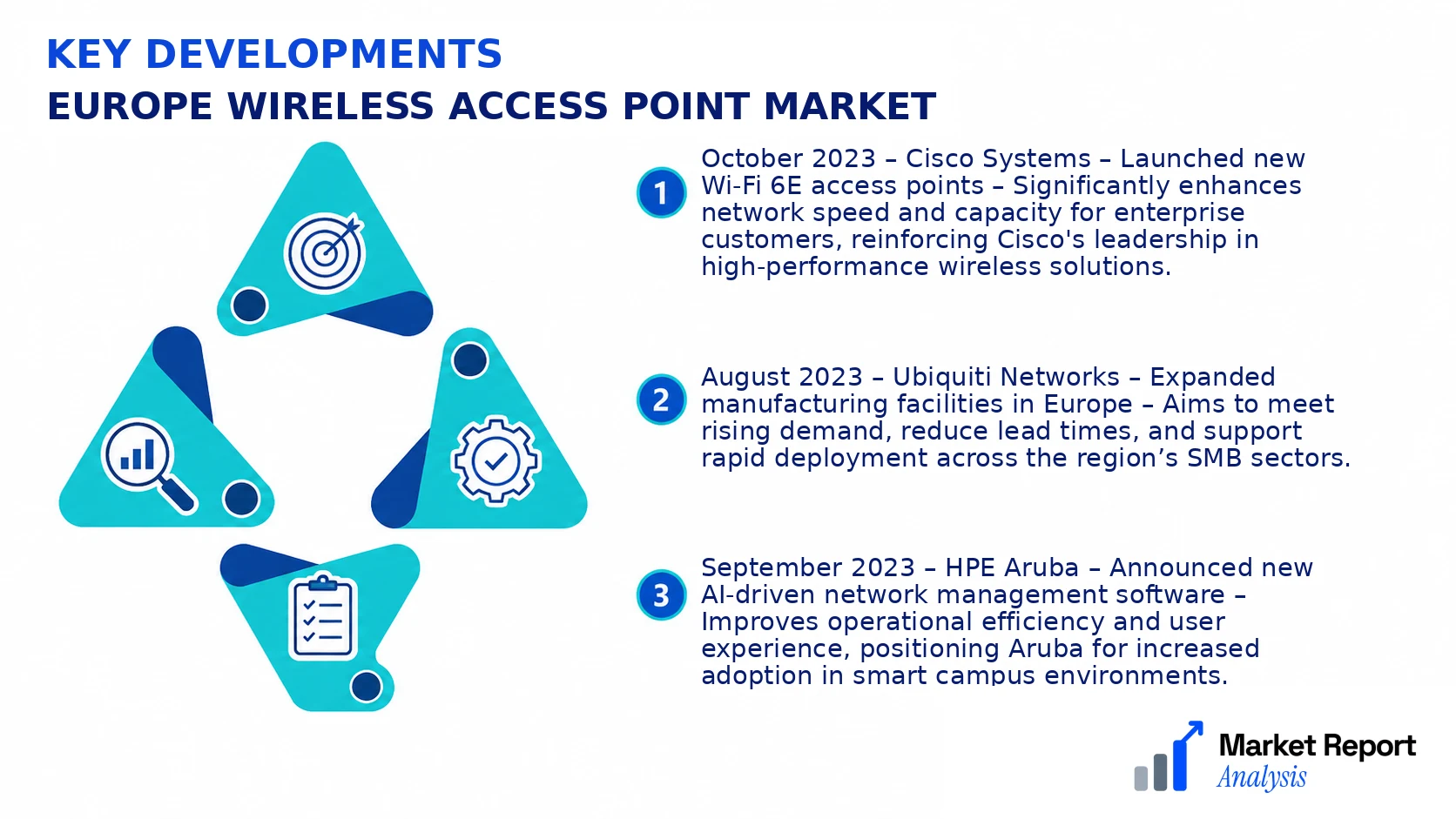
- October 2023 – Cisco Systems – Launched new Wi-Fi 6E access points – Significantly enhances network speed and capacity for enterprise customers, reinforcing Cisco's leadership in high-performance wireless solutions.
- August 2023 – Ubiquiti Networks – Expanded manufacturing facilities in Europe – Aims to meet rising demand, reduce lead times, and support rapid deployment across the region’s SMB sectors.
- September 2023 – HPE Aruba – Announced new AI-driven network management software – Improves operational efficiency and user experience, positioning Aruba for increased adoption in smart campus environments.
- July 2023 – Ruckus Networks – Entered strategic alliance with major European telecom providers – Facilitates deployment of high-capacity Wi-Fi solutions in dense urban and stadium environments, boosting market share.
- November 2023 – Zyxel Communications – Acquired a local European networking startup – Accelerates product innovation and expands its SME segment offerings across key European nations, emphasizing sustainability and next-gen wireless tech.
Frequently Asked Questions
What is the Europe Wireless Access Point Market?
The Europe Wireless Access Point Market encompasses the industry involved in manufacturing, distributing, and deploying wireless access points across European countries to enable wireless connectivity in various sectors including enterprise, retail, healthcare, and hospitality.
What is the current market size of Europe Wireless Access Point Market?
As of 2026, the Europe Wireless Access Point Market valuation is estimated at approximately USD 4.2 Billion, reflecting widespread adoption driven by increased demand for wireless connectivity and digital transformation initiatives across multiple industries throughout the region.
What factors are driving the Europe Wireless Access Point Market?
Market growth is primarily fueled by the expansion of 5G technology, rising adoption of IoT devices, urbanization, and the need for high-speed wireless internet services. Additionally, the deployment of smart city projects and increasing enterprises' digital infrastructure investments further boost the market.
Which region dominates the Europe Wireless Access Point Market?
Western Europe currently leads the market, with countries such as Germany, the UK, and France exhibiting extensive deployment of wireless access points due to their advanced telecom infrastructure and high technology adoption rates.
Which segment is expected to grow the fastest?
The enterprise segment is forecasted to experience the highest growth rate, driven by the rising need for robust wireless networks in corporate offices, data centers, and industrial facilities to support digital transformation and remote working trends.
Who are the leading companies operating in the Europe Wireless Access Point Market?
Prominent players include Cisco Systems, Aruba Networks, Huawei Technologies, Juniper Networks, and Ubiquiti Networks. These companies focus on product innovation, strategic partnerships, and regional expansion to strengthen their market position during 2026-2034.
Analyst Perspective
The Europe Wireless Access Point Market is entering a transition phase characterized by matured technology adoption, yet promising continued growth driven by increasing demand for high-capacity, reliable wireless infrastructure. Long-term, market resilience will hinge on technological evolution such as the integration of Wi-Fi 6E and upcoming Wi-Fi 7 standards, which will boost performance and device connectivity. Commercial opportunities will predominantly surface in enterprise, healthcare, and smart city sectors, with regional growth potential concentrated in Western Europe due to robust digital transformation initiatives. Investment priorities should emphasize R&D in enhanced security features, energy-efficient designs, and seamless integration with 5G networks to maintain competitive edge. The sector faces high competitive intensity from established players and rising startups, demanding strategic collaborations and acquisitions. Regions like Germany and France will continue to lead in market expansion, although Eastern Europe offers untapped potential for inclusive growth. Overall, strategic positioning balanced between innovation, regional diversification, and operational efficiency will be crucial for sustained long-term success.
