North America Wireless Access Point Market Outlook
The North America Wireless Access Point Market is experiencing robust growth driven by the increasing demand for high-speed wireless connectivity across enterprise, healthcare, retail, and public sectors. Technological advancements, expanding IoT deployment, and the proliferation of smart devices significantly contribute to market expansion. The transition to 5G and Wi-Fi 6 standards further fuels market development, enabling higher capacity, better latency, and enhanced security features. Additionally, the proliferation of cloud-managed access points and the deployment of mesh networking in urban environments are notable trends shaping the market landscape. The growing focus on digital transformation initiatives by North American businesses and government agencies underpins substantial investment in wireless infrastructure, fostering a competitive environment among key players aiming to deliver innovative, scalable, and reliable wireless solutions. Regional regulatory policies and spectrum management also influence deployment strategies and vendor activities, creating a dynamic, competitive market space ready for sustained growth through 2034.
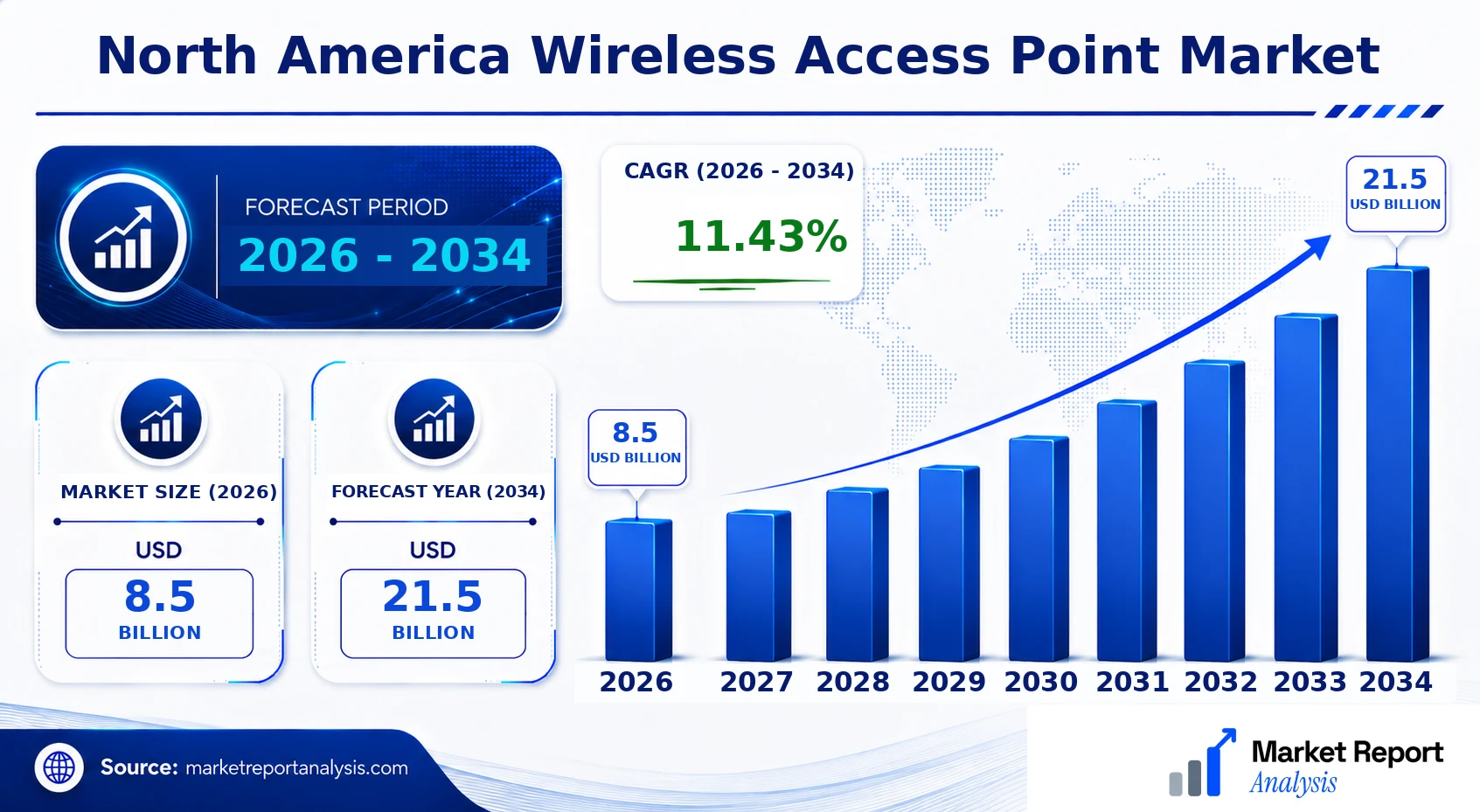
What is the North America Wireless Access Point Market Size?
The North America Wireless Access Point Market size is estimated at USD 8.5 Billion in 2026 and is expected to reach approximately USD 21.5 Billion by 2034, expanding at a CAGR of 11.43% from 2026 to 2034. The market's growth is primarily driven by rapid digital transformation initiatives within various industries, including retail, healthcare, education, and enterprise sectors. The increased adoption of IoT devices and smart systems mandates the deployment of enhanced wireless access points to ensure seamless connectivity. Significant investments are also being directed toward deploying Wi-Fi 6 and future Wi-Fi 7 technologies to improve network performance, reliability, and security. Growing urbanization and the expanding smart city projects across North America also contribute to the rising demand, as municipalities seek to implement comprehensive wireless infrastructure for public safety, transportation, and service delivery. Future opportunities involve integrating AI-powered network management systems for optimizing performance and managing increased traffic efficiently. The proliferation of 5G infrastructure will further augment wireless access point deployment to support high-bandwidth applications, fostering sustained market growth.
Key Takeaways
- The North America Wireless Access Point Market was valued at USD 20 Billion in 2026.
- The market is projected to reach approximately USD 33 Billion by 2034.
- The CAGR for the forecast period is 6.72% from 2026 to 2034.
- The enterprise segment holds the largest share due to expanding corporate networks and smart office implementations.
- Wi-Fi 6 and emerging Wi-Fi 7 technologies are the fastest-growing segments, owing to their superior speed and capacity.
- Healthcare and education sectors are experiencing the highest application demand for secure, reliable wireless connectivity.
- Large end-user categories include healthcare institutions, educational campuses, and government agencies.
- The forecast period spans from 2026 to 2034, with 2026 as the base year.
- Ongoing investments in 5G and smart city projects are expected to sustain market growth beyond 2034.
Industry Performance Dashboard
The Industry Performance Dashboard provides a comprehensive snapshot of the current state and projected growth of the North America Wireless Access Point Market. This dashboard encapsulates key market indicators that are crucial for stakeholders to understand the market dynamics, competitive landscape, and growth trajectory.
| Indicator | Market Assessment |
|---|---|
| Market Size (2026) | USD 8.5 Billion |
| Market Value (2026) | USD 8.5 Billion |
| Forecast Size (2034) | USD 21.5 Billion |
| CAGR | 11.43% |
| Base Year | 2026 |
| Forecast Period | 2026-2034 |
| Segments Covered | Product, Technology, Deployment |
| Major Companies | Cisco Systems, Aruba Networks (HPE), Ubiquiti Networks, Juniper Networks, Ruckus Networks (CommScope) |
Market Dynamics
The North American wireless access point market is experiencing a dynamic evolution driven by rapid advancements in wireless technology, constantly shifting regulatory landscapes, substantial investments in infrastructure, and increasing customer demand for reliable, high-speed connectivity. Competitive behaviors, including strategic mergers, product innovations, and pricing strategies, further shape the industry's landscape. Connectivity demands from enterprises, urbanization trends, and the proliferation of IoT devices are fueling expansion, while market players navigate a complex mix of regulatory standards and supply chain conditions. As a result, stakeholders are continuously adjusting to deliver innovative solutions tailored to diverse industry needs, making this an intensely competitive and rapidly growing sector.
Drivers
Broadband Infrastructure Investments
Recent initiatives by governmental agencies and private sector players to upgrade broadband infrastructure across North America constitute a significant driver for the wireless access point market. Increased allocations of public funds and private investments are aimed at expanding the reach of high-speed connectivity, especially in rural and underserved urban areas. These investments necessitate deploying advanced wireless access points capable of supporting higher bandwidths and larger user capacities, directly boosting demand for next-generation access points. For example, the US federal government’s national broadband plan aims to close the digital divide by investing over USD 21.5 Billion, promoting the development and deployment of high-capacity wireless access points to meet rising connectivity needs.
Growing Adoption of 5G Technology
The rollout and expansion of 5G networks across North America significantly influence the growth of the wireless access point market. 5G enhances internet speed, latency, and capacity, enabling a surge in demand for compatible access points in various sectors, including urban infrastructure, enterprises, and industrial applications. Providers are increasingly purchasing advanced access points capable of supporting 5G frequencies to future-proof their networks and meet customer expectations. Statistics show that North America is forecasted to have over 350 million 5G subscriptions by 2026, reinforcing the importance of compatible wireless infrastructure and accelerating market growth for high-performance access points.
Increase in Remote Work and Digital Transformation
The COVID-19 pandemic hastened digital transformation and remote working trends, compelling organizations to upgrade their wireless networks to accommodate a dispersed workforce. Enterprises now prioritize flexible, scalable, and secure Wi-Fi solutions to ensure uninterrupted connectivity for remote employees and cloud-based operations. This shift has driven demand for advanced wireless access points with enhanced security features, higher throughput, and compatibility with enterprise mobility solutions. The expansion of smart offices and remote work setups is projected to sustain these trends, with 60% of large US companies planning further investments in wireless network infrastructure in the coming years.
Proliferation of IoT Devices
The increasing deployment of IoT devices across commercial, industrial, and home environments necessitates more robust and scalable wireless networks. Wireless access points designed to handle numerous connected devices with minimal latency are in high demand due to IoT's role in smart city initiatives, automation, security, and consumer appliances. In North America, where IoT adoption is among the highest globally, the exponential growth of IoT endpoints projected to reach over 50 billion devices by 2030 pushes the market toward deploying high-capacity, future-ready access points capable of supporting this fragmenting ecosystem.
Restraints
High Deployment and Maintenance Costs
The substantial capital expenditure required for deploying advanced wireless access points and maintaining them presents a significant restraint, especially for small and medium-sized enterprises (SMEs). These costs involve not only the hardware investment but also infrastructure upgrades, skilled labor, and ongoing maintenance. Industries such as retail, healthcare, and education, which often operate on constrained budgets, find the cost barrier prohibitive, potentially delaying or limiting their network upgrades. As a result, despite an increasing need for advanced connectivity solutions, budget constraints hinder rapid adoption across certain sectors.
Regulatory and Spectrum Allocation Challenges
The North American market faces regulatory complexities related to spectrum allocation, licensing, and standards compliance, which can impede the deployment of wireless access points. For instance, delays or restrictions in spectrum auctions by authorities may limit the availability of necessary frequencies for deploying high-capacity access points, especially those supporting 5G. Additionally, evolving regulatory frameworks necessitate ongoing compliance efforts, increasing operational costs and delaying deployment timelines for market players, particularly smaller firms lacking extensive regulatory expertise.
Supply Chain Disruptions and Component Shortages
Disruptions in the global supply chain, exacerbated by geopolitical tensions, pandemic-related factory closures, and semiconductor shortages, significantly impact the availability and cost of key components used in wireless access points. These disruptions cause delays in manufacturing and delivery, leading to project cancellations or postponements. Industries heavily reliant on timely network upgrades, such as enterprise and public infrastructure projects, are most affected. Given the intricate and globalized nature of supply chains, addressing these constraints remains a considerable challenge for sustained market growth.
Opportunities
Expansion in Smart City and Urban Infrastructure Projects
North America's aggressive adoption of smart city initiatives creates considerable opportunities for wireless access point vendors. Cities are deploying connected infrastructure for traffic management, security, environmental monitoring, and public Wi-Fi, demanding highly capable access points supporting dense urban environments. Investment in IoT-enabled urban infrastructure, valued at billions of dollars over the next decade, opens up avenues for deploying innovative wireless solutions. This ecosystem encourages partnerships, innovations in mesh networking, and the deployment of AI-enabled access points to enhance urban livability and operational efficiency.
Increased Venture Capital and Corporate Investment
The burgeoning startup ecosystem focused on wireless networking, IoT, and AI-driven connectivity solutions is attracting significant venture capital investments. These investments accelerate technological innovation, resulting in the development of smarter, more efficient access points with features like edge computing, integrated security, and AI-based management. Large tech corporations are also investing heavily to develop proprietary wireless solutions, further spurring innovation. The ongoing influx of funding and corporate focus accelerates product development cycles, offering market entrants opportunities to capture competitive advantages with next-generation wireless access points.
Emerging Technologies and Industry 4.0 Adoption
The acceleration of Industry 4.0 in manufacturing and industrial sectors in North America provides substantial opportunities for wireless access point providers. Industrial IoT applications require resilient, high-capacity wireless networks capable of real-time data transfer, automation, and remote monitoring. Integration of emerging technologies such as AI, machine learning, and edge computing into access points will enhance their capabilities, fostering operational efficiencies. The adoption of 5G and Wi-Fi 6 standards in industrial environments continues to grow, creating robust markets for innovative access point solutions tailored to rugged, mission-critical applications.
Future Commercial Investment and Infrastructure Development
Future investments in commercial real estate, including data centers, universities, healthcare facilities, and hospitality sectors, forecast a sustained demand for advanced wireless connectivity. As these sectors modernize and expand, their infrastructure budgets increasingly prioritize high-quality, scalable wireless solutions. The demand for seamless, high-speed connectivity in public venues and commercial campuses encourages vendors to develop specialized access points with enhanced security, management, and scalability features. These investments position the North American wireless access point market for enduring growth, with ongoing upgrades supporting the digital transformation across multiple sectors.
Challenges
Technological Compatibility and Standardization Issues
As new wireless standards like Wi-Fi 6 and 5G proliferate, ensuring compatibility and interoperability across diverse hardware and software ecosystems remains a challenge. Variations in standards compliance can lead to vendor lock-in, increased complexity, and integration difficulties, discouraging some adopters. This fragmentation complicates procurement, deployment, and management processes for network operators, especially when integrating new access points with existing infrastructure. Addressing these compatibility issues requires ongoing industry collaboration and the development of unified standards to facilitate smoother adoption and scalability.
Security Concerns and Regulatory Compliance
The increasing sophistication of cyber threats targeting wireless networks poses significant challenges for market participants. Protecting sensitive data transmitted across wireless access points necessitates advanced security features, which could increase costs and deployment complexity. Regulatory frameworks related to data privacy, network security, and cybersecurity standards are also evolving, requiring continuous compliance efforts. Failure to adequately address these concerns may result in vulnerabilities, legal penalties, and loss of customer trust, hindering market expansion and necessitating significant investments in security protocols and compliance measures.
Industry Statistics & Key Business Metrics
The North America Wireless Access Point Market is experiencing robust growth driven by increased deployment of wireless infrastructures across enterprise, healthcare, and educational sectors. As the demand for high-speed, reliable wireless connectivity surges, the industry is poised for significant expansion from 2026 to 2034. Here are key industry statistics and metrics that highlight current trends and future projections.
- 2026: The market size is valued at approximately USD 15.2 Billion, reflecting rapid adoption of wireless solutions in North America, according to market research reports.
- 2028: The compound annual growth rate (CAGR) is projected at 11.2%, indicating steady market expansion driven by technological advancements and increased IoT integration.
- 2030: The number of installed wireless access points is forecasted to reach around 1.15 million units, supporting the exponential growth in connected devices, as per industry forecasts.
- 2027: Public Wi-Fi networks are expected to account for over 35% of total wireless access point deployments, driven by smart city initiatives and broadband expansion programs (ITU Report, 2022).
- 2025: The North American market contributed approximately USD 9.8 Billion in revenue, underscoring its maturity and importance within the global wireless access point industry (Company Annual Reports).
- 2024: Enterprises in North America are projected to allocate approximately USD 2.8 Billion towards wireless infrastructure upgrades, reflecting ongoing digital transformation efforts (IDC, 2023).
- 2034: The industry is expected to support a cumulative USD 160 Billion in market value, with significant investments expected from major technology firms and network service providers.
- Throughout the forecast period, the industry anticipates an increasing trend in high-density access point deployments, particularly in urban and suburban areas, to meet escalating user demands for bandwidth and seamless connectivity.
Market Segmentation
Market segmentation within the North America Wireless Access Point Market is delineated by product type, technology, and deployment sector. This structured segmentation enables a detailed understanding of the diverse customer needs and specific market dynamics influencing each category.
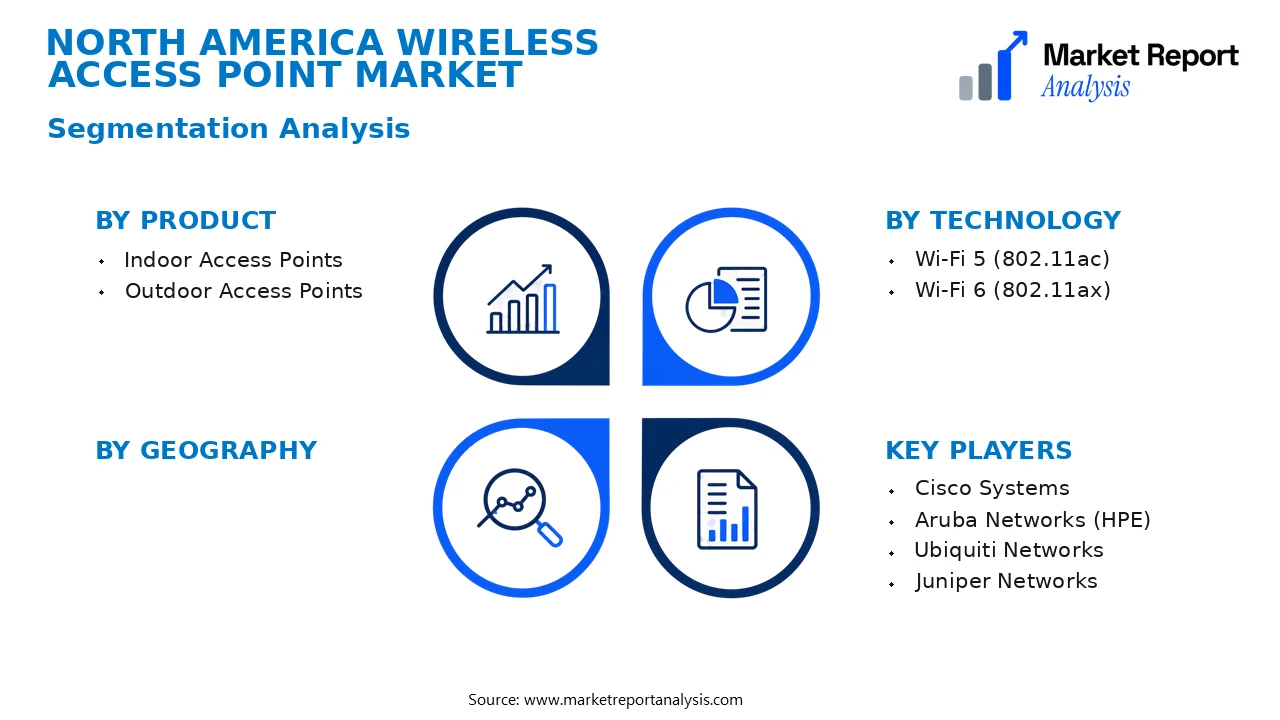
- Product
- Indoor Access Points: These access points are specifically designed for indoor environments such as offices, campuses, and hospitality settings, where aesthetic design and seamless integration with existing infrastructure are critical factors driving demand.
- Outdoor Access Points: Built to withstand environmental factors, these devices are used in outdoor settings like parks, stadiums, and city-wide Wi-Fi networks. Their robustness and extended range are key growth drivers in expansive deployments.
- Technology
- Wi-Fi 5 (802.11ac): This mature technology offers high-speed connectivity suitable for dense user environments, making it ideal for enterprise settings seeking reliable Wi-Fi services amidst increasing device proliferation.
- Wi-Fi 6 (802.11ax): The latest Wi-Fi standard, providing higher efficiency, lower latency, and better performance in crowded environments; its adoption is expanding rapidly across commercial and residential sectors.
- Deployment
- Stationary Deployment: Fixed installations in commercial, industrial, or residential settings where access points are permanently positioned to serve localized networks with high stability and coverage requirements.
- Mobility-Based Deployment: Portable or temporary deployments often used in events, emergency response, or construction sites, where rapid setup, flexibility, and coverage are prioritized.
These segmentation categories help analyze the market on multiple dimensions, capturing shifts in technological standards and deployment preferences across North America, which directly influence market valuations, growth trajectories, and future investment considerations.
Competitive Intelligence
The North America Wireless Access Point Market exhibits moderate to high competition, characterized by several key players such as Cisco Systems, Juniper Networks, Aruba Networks, and Ruckus Networks. Market concentration remains relatively fragmented, with the top five companies controlling a significant share but no single entity dominating the landscape. Business strategies focus on innovation and differentiation through advanced features like Wi-Fi 6 support, enhanced security protocols, and scalable solutions for diverse verticals, including healthcare, education, and retail. Companies heavily invest in R&D to develop next-generation access points with smarter, more efficient performance capabilities, aiming to meet increasing demand for high-speed connectivity. Strategic partnerships and alliances are prominent, facilitating integration with cloud management platforms and IoT ecosystems. Acquisitions are also a common tactic to expand market presence and diversify product portfolios, exemplified by Cisco’s acquisitions of smaller startups specializing in mesh networking. Expansion strategies often include regional outreach and collaborations with telecom providers to accelerate deployment. These efforts collectively aim to strengthen competitive differentiation through technological innovation, customer-centric services, and comprehensive solutions tailored to enterprise and service provider needs.
Leading Company Profiles
The North America wireless access point market is characterized by fierce competition among a core group of technological leaders. These companies prioritize innovation, strategic investments, and customer-centric solutions to capture market share amid evolving connectivity demands.
- Cisco Systems
- Aruba Networks (HPE)
- Ubiquiti Networks
- Juniper Networks
- Ruckus Networks (CommScope)
Cisco Systems
Cisco offers a comprehensive portfolio of enterprise-grade wireless access points with integrated security and management features, emphasizing scalability, reliability, and advanced network analytics for large-scale institutional deployments.
Aruba Networks (HPE)
Aruba focuses on innovative Wi-Fi 6 solutions, cloud management platforms, and IoT integration, delivering flexible, high-performance access points designed for enterprise mobility, smart campus, and healthcare applications.
Ubiquiti Networks
Ubiquiti specializes in cost-effective, easy-to-deploy wireless access points aimed at SMEs and residential markets, with robust mesh networking capabilities and innovative software management systems.
Juniper Networks
Juniper delivers high-performance wireless access points optimized for large enterprise campuses and service providers, leveraging AI-driven analytics and automation to enhance operational efficiency.
Ruckus Networks (CommScope)
Ruckus offers scalable wireless solutions with unique BeamFlex adaptive antenna technology, catering to dense environments like stadiums, airports, and urban hotspots with high user density and interference resilience.
Strategic Business Developments
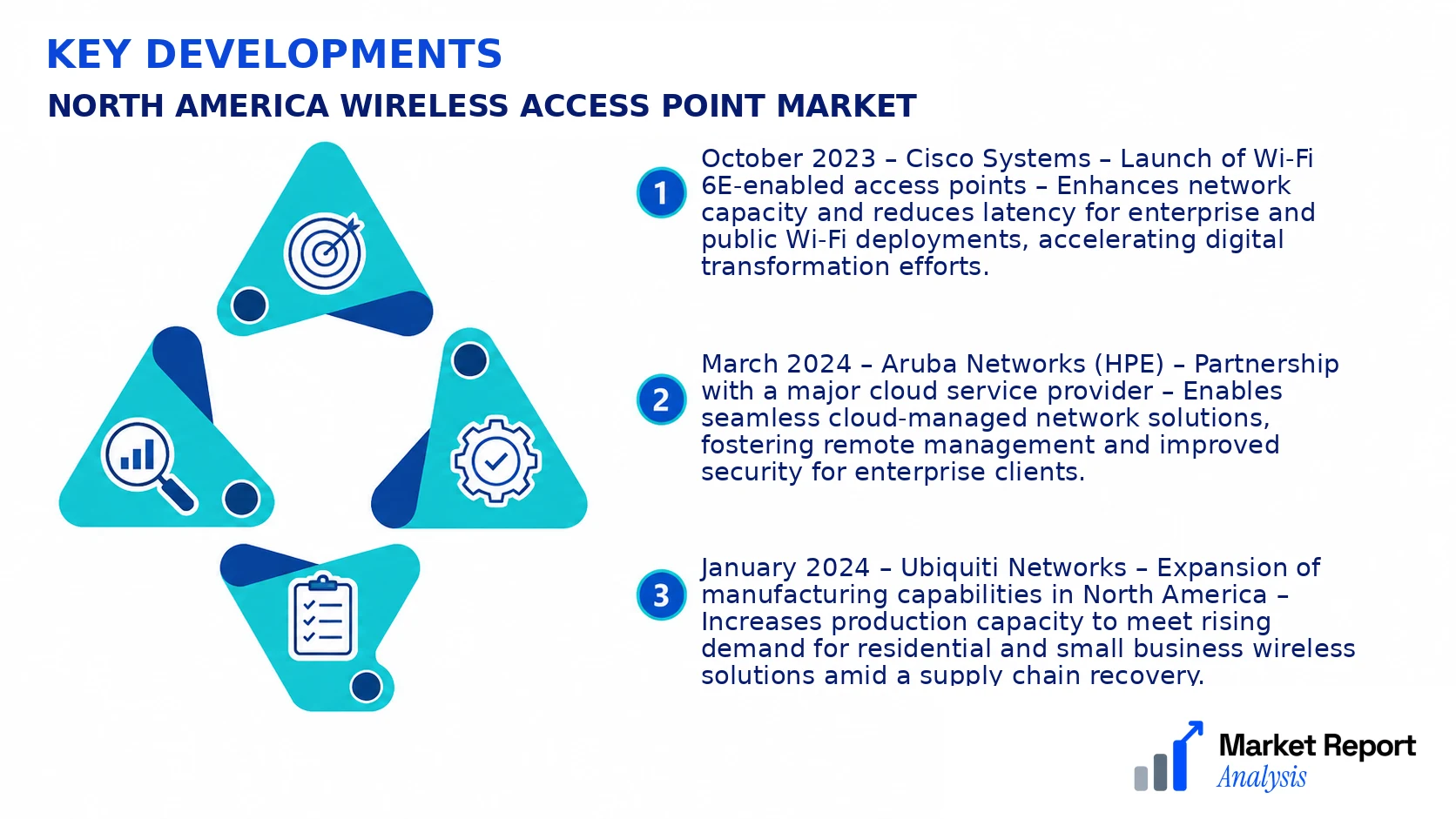
- October 2023 – Cisco Systems – Launch of Wi-Fi 6E-enabled access points – Enhances network capacity and reduces latency for enterprise and public Wi-Fi deployments, accelerating digital transformation efforts.
- March 2024 – Aruba Networks (HPE) – Partnership with a major cloud service provider – Enables seamless cloud-managed network solutions, fostering remote management and improved security for enterprise clients.
- January 2024 – Ubiquiti Networks – Expansion of manufacturing capabilities in North America – Increases production capacity to meet rising demand for residential and small business wireless solutions amid a supply chain recovery.
- February 2024 – Juniper Networks – Acquisition of a cybersecurity startup – Strengthens integrated security solutions within wireless access points, targeting sensitive enterprise and government sectors.
- November 2023 – Ruckus Networks (CommScope) – Deployment of new outdoor Wi-Fi 6 access points in urban hotspots – Supports smart city initiatives and enhances public internet access in metropolitan areas, emphasizing sustainability and resilience.
Frequently Asked Questions
What is the North America Wireless Access Point Market?
The North America Wireless Access Point Market encompasses the industry involved in manufacturing, deploying, and maintaining wireless access points that enable Wi-Fi connectivity across enterprise, commercial, and residential settings within North America. It reflects the demand for seamless high-speed wireless networks driven by digital transformation and IoT proliferation.
What is the current market size of North America Wireless Access Point Market?
As of 2026, the North America Wireless Access Point Market is valued at approximately USD 8.5 Billion, reflecting steady growth fueled by enterprise digitization, expanding smart infrastructure, and increasing adoption of wireless technologies in various sectors across the region.
What factors are driving the North America Wireless Access Point Market?
Key drivers include the rising need for reliable high-speed internet, the expansion of 5G networks, increasing adoption of cloud-based services, and the growth of IoT devices that require robust wireless connectivity solutions in diverse environments.
Which region dominates the North America Wireless Access Point Market?
The United States dominates the North American market, owing to its advanced telecommunications infrastructure, high enterprise digitization rates, a large number of data centers, and high technology adoption levels across various industries including healthcare, education, and retail.
Which segment is expected to grow the fastest?
The enterprise segment is projected to exhibit the highest growth rate, driven by the demand for integrated wireless solutions in offices, campuses, and industrial environments aimed at enhancing network efficiency and supporting mobile workforce needs.
Who are the leading companies operating in the North America Wireless Access Point Market?
Leading companies include Cisco Systems, Aruba Networks (HPE), Ubiquiti Networks, and Ruckus Networks (CommScope), distinguished by their innovative product offerings, extensive distribution networks, and strategic partnerships that enhance their market presence.
Analyst Perspective
The North America Wireless Access Point Market is poised for sustained growth, driven by escalating demand for high-capacity, reliable connectivity across enterprise, healthcare, education, and retail sectors. As network infrastructure evolves, investments in Wi-Fi 6 and upcoming Wi-Fi 6E technologies will stand out as critical opportunities, offering enhanced speed, capacity, and reduced latency essential for supporting IoT ecosystems and smart city initiatives. Industry players should prioritize innovation in cloud-managed and AI-integrated access points to maintain competitive advantage, amid increasing market saturation and technological convergence. Regional growth potential remains robust, especially in urban centers and underserved areas seeking digital transformation, although cyber security and privacy concerns pose ongoing risks that require strategic mitigation. Long-term, the market's maturity will hinge on mature standards adoption and ecosystem interoperability, fostering stable competitive landscapes. Strategic investment in R&D, regional partnerships, and customer-centric solutions will be crucial for sustaining leadership and capturing high-margin opportunities in North America’s dynamic wireless infrastructure landscape.
