Japan Wireless Access Point Market Outlook
The Japan wireless access point market is currently valued at approximately USD 2.5 Billion and is projected to reach USD 4.8 Billion by 2034, exhibiting a Compound Annual Growth Rate (CAGR) of around 8.1% during the forecast period from 2026 to 2034. This growth is driven by the rapid digital transformation across industries, increasing demand for high-speed internet in urban and rural areas, and a rising adoption of Internet of Things (IoT) devices. Technological advancements focusing on next-generation Wi-Fi standards like Wi-Fi 6 and Wi-Fi 6E are enhancing connection speeds and reliability, fueling commercial opportunities. The market is also benefitting from ongoing infrastructure investments, smart city initiatives, and expanding corporate deployments. Regional infrastructure upgrades, coupled with rising consumer demand for seamless connectivity, continue to propel market expansion. The combined influence of technological innovation, regulatory support, and investments in digital infrastructure underscores this sector's robust growth trajectory.
What is the Japan Wireless Access Point Market Size?
The Japan wireless access point market is expected to grow from a valuation of USD 2.5 Billion in 2026 to approximately USD 4.8 Billion by 2034, representing a CAGR of 8.1%. This growth is primarily driven by the increasing deployment of wireless network infrastructure across various sectors such as retail, healthcare, education, and manufacturing. The proliferation of smart devices and IoT applications necessitates resilient, high-capacity wireless solutions, bolstering demand. Urbanization and government initiatives advocating for smart city development further amplify the need for integrated wireless networks, fostering market expansion. Additionally, technological advancements like Wi-Fi 6 and emerging Wi-Fi 6E standards provide greater bandwidth, lower latency, and enhanced device capacity, reinforcing investment in cutting-edge access point technology. The telecom industry’s push for 5G integration with Wi-Fi networks, coupled with corporate digital transformation efforts, contributes to sustained growth and market diversification. Future investments are likely to focus on high-density deployments, secure wireless solutions, and scalable infrastructure to meet evolving connectivity standards in Japan.
Key Takeaways
- The Japan wireless access point market is projected to reach USD 4.8 Billion by 2034, growing at a CAGR of 8.1% during 2026-2034.
- Market growth is driven by expanding demand from diverse end-use industries, including retail, healthcare, education, and manufacturing.
- Technological advancements like Wi-Fi 6 and Wi-Fi 6E significantly enhance device capacity, speed, and reliability, supporting infrastructure modernization.
- Government initiatives for smart cities and digital infrastructure expansion are key regional growth catalysts.
- Urban and rural connectivity needs are fueling increased deployment in various geographic zones across Japan.
- Surging adoption of IoT devices and smart applications requires robust wireless access point solutions, expanding market opportunities.
- The integration of 5G with Wi-Fi networks is anticipated to create new avenues for investment and innovation.
- Consolidation among key manufacturers and increasing competition promote product innovation and price competitiveness.
- Rising cybersecurity concerns are prompting demand for more secure wireless solutions, influencing product development.
- Investment in scalable, high-density wireless infrastructure remains a strategic focus for industry stakeholders.
- The dynamic regulatory environment and funding support foster favorable conditions for market expansion.
- Future growth prospects are centered on high-capacity, secure, and sustainable wireless access solutions aligned with Industry 4.0 objectives.
Industry Performance Dashboard
The Industry Performance Dashboard provides a comprehensive snapshot of the Japan Wireless Access Point Market’s current standing and future outlook. It offers vital quantitative metrics that underscore the market’s evolution, regional dominance, and competitive landscape. The dashboard begins with market size figures, highlighting the size in USD Billion for the base year, 2026, and projecting the figure for 2034 to demonstrate growth trajectory. The Compound Annual Growth Rate (CAGR) over this period is also crucial, indicating the pace of market expansion. The forecast period explicitly covers 2026 to 2034, anchoring the data in a specific timeframe for clarity.
The segments covered in this dashboard reflect the key categories within the market, such as product type, application, and end-user industry, providing a layered understanding of where growth is concentrated. Furthermore, the list of major companies includes leading market players such as Cisco Systems, Nokia, Huawei Technologies, Juniper Networks, HPE (Hewlett Packard Enterprise), Arista Networks, Ubiquiti Networks, and NETGEAR, which are instrumental in driving innovation and competition within the market.
This dashboard is essential for stakeholders to gauge market health, competitive positioning, and investment opportunities, serving as a foundation for strategic decision-making and competitive analysis in the rapidly evolving landscape of wireless connectivity solutions in Japan.
Market Dynamics
The Japan Wireless Access Point Market is influenced by a confluence of factors including technological advancements, evolving regulatory frameworks, significant investment influx, and shifting customer requirements. Competitive strategies and pricing models are also pivotal, alongside supply chain dynamics and market entrants' behavior. As Japan continues its digital transformation journey, these elements collectively shape product development, deployment, and adoption patterns, creating a complex and dynamic landscape where innovation and strategic agility are crucial for market participants aiming to capitalize on new opportunities.
Drivers
Rapid Urbanization and Infrastructure Development
Japan's ongoing urbanization and infrastructure upgrades necessitate advanced wireless solutions, including access points capable of supporting high-density environments. This urban growth fuels demand for robust wireless networks in commercial, public, and residential sectors. For instance, metropolitan areas like Tokyo are continuously evolving with smart city initiatives requiring scalable, high-capacity access points. The trend towards digital urban environments ensures an increasing market footprint for cutting-edge wireless access solutions, with a notable CAGR driven by government-led smart city projects and private sector investments targeting digital infrastructure enhancement.
Adoption of 5G and Next-Generation Wireless Technologies
The deployment of 5G technology is a key growth driver, significantly influencing the market for wireless access points. 5G’s requirements for dense network coverage and low latency compel the adoption of advanced access points capable of supporting higher data rates and increased device connectivity. Japan’s strategic focus on 5G rollout, supported by national policies and investments, accelerates demand for compatible wireless infrastructure. As 5G adoption becomes more widespread, the market sees a surge in need for innovative access points that optimize network performance and ensure seamless connectivity across various industries.
Technological Advancements in Wireless Networking
Continuous innovation in wireless standards, including Wi-Fi 6 and Wi-Fi 6E, propels the market forward by addressing critical needs for higher throughput, lower latency, and enhanced security. Manufacturing and enterprise customers seek access points embedded with these advanced protocols to future-proof their networks. Japan’s technological ecosystem, renowned for research and innovation, fosters rapid adoption of these advanced wireless solutions, creating a fertile environment for vendors providing cutting-edge access points. This technological evolution is expected to sustain a steady CAGR over the forecast period as organizations upgrade their existing infrastructure.
Rising Demand for Smart and IoT-enabled Networks
The proliferation of Internet of Things (IoT) devices and smart systems in Japan’s retail, manufacturing, healthcare, and public sectors drives an increasing need for specialized wireless access points. These access points must support myriad devices with diverse communication protocols and data requirements. The market benefits from an ecosystem that encourages integration of IoT functionalities within wireless infrastructure, enabling real-time data analytics and operational automation. The rise of smart factories and connected public services substantiates a sustained growth trajectory for IoT-enabled wireless access solutions, with market players investing heavily in compatible hardware and software developments.
Restraints
High Cost of Advanced Wireless Infrastructure
The adoption of state-of-the-art access points and infrastructure upgrades entails substantial capital expenditure, which acts as a restraint, especially for small and medium-sized enterprises. The high initial investment in hardware, installation, and ongoing maintenance deters some segments from rapid adoption. Industries such as retail and hospitality, with budget constraints, are less inclined to replace legacy systems with costly next-generation solutions. This cost barrier leads to slower migration rates, impacting overall market growth rates in those sectors and emphasizing the need for cost-effective, scalable solutions.
Regulatory and Spectrum Allocation Challenges
Regulatory hurdles and spectrum management complexities can delay deployment and scalability of wireless access points, particularly in densely populated urban areas where spectrum is heavily contested. Japan’s regulatory environment requires compliance with strict standards, which can extend deployment timelines and increase costs. Additionally, spectrum allocation policies may restrict the availability of optimal frequency bands necessary for high-performance access points, thereby limiting rapid expansion and technological adoption, particularly among new market entrants and smaller providers.
Supply Chain Disruptions and Component Shortages
The global supply chain has experienced disruptions due to geopolitical tensions, component shortages, and logistical bottlenecks, affecting the availability of key hardware components for wireless access points. This impacts manufacturers’ ability to meet demand in a timely manner, causing delays in product launches and deployment schedules. The market's reliance on advanced electronic components, often sourced internationally, makes it vulnerable to external shocks, which could hamper growth and innovation unless local manufacturing capacities are expanded or diversified.
Opportunities
Growth of Smart Cities and Urban Connectivity Initiatives
The Japanese government’s commitment to developing smart city initiatives presents lucrative opportunities for wireless access point providers. These projects emphasize bandwidth-intensive, reliable, and ubiquitous connectivity across urban environments. The integration of IoT and data-driven services will necessitate widespread deployment of high-capacity access points, creating a sizable market segment. With public-private partnerships actively fostering infrastructure investments, vendors can tap into large-scale projects, securing long-term contracts and expanding their technological footprint in Japan’s urban landscapes.
Investment in Next-Generation Wireless Infrastructure
Significant private and governmental investment inflows aimed at enhancing high-speed wireless connectivity open numerous avenues for market growth. These investments target both urban centers and rural areas under initiatives like regional digital inclusivity programs. The infusion of capital towards developing 5G densification projects, along with fiber-optic integration, facilitates the adoption of sophisticated access points. Such investments are expected to accelerate deployment cycles and innovation, fostering a competitive environment where early movers can establish dominant market positions.
Innovation Ecosystems and Startup Activity
The robust startup ecosystem in Japan, supported by government grants, accelerators, and innovation hubs, fosters rapid development of advanced wireless technologies. Startups are pioneering AI-driven, energy-efficient, and highly secure access points, pushing the frontiers of wireless infrastructure capabilities. Collaboration between academia, government, and industry accelerates R&D, leading to novel products and services. This vibrant ecosystem offers substantial opportunities for strategic partnerships, licensing, and acquisitions, enabling established players to incorporate innovative features and expand their product portfolio efficiently.
Emergence of AI and Data Analytics in Network Management
The adoption of artificial intelligence and data analytics to optimize network performance and security represents a transformative opportunity. AI-enabled access points and network management tools will allow real-time troubleshooting, predictive maintenance, and dynamic resource allocation. Japan’s focus on AI research and deployment in infrastructure builds a strong foundation for these advanced solutions, which can significantly improve operational efficiency for enterprise clients. This technological integration enhances product value propositions and opens a new spectrum of services, poised to generate revenue streams and competitive advantages.
Challenges
Intense Competition and Price Pressures
The market faces intense competition among local and international vendors, leading to price wars that compress margins. Larger players often leverage economies of scale, while smaller firms struggle to differentiate their offerings. Price pressures can inhibit innovation investment and reduce profitability. Market entrants also face the challenge of establishing brand recognition and customer loyalty in a mature market, demanding aggressive marketing and strategic partnerships to survive and thrive amid fierce rivalry.
Slow Adoption in Legacy Systems and Conservative Buyers
Many industries and organizations in Japan continue to operate on legacy wireless infrastructure due to budget constraints or risk aversion, slowing down the overall market evolution. The conservative approach to technology upgrades hampers the transition to newer, more efficient systems. Overcoming this inertia requires targeted educational campaigns, demonstration of ROI, and development of hybrid solutions that ease the migration process. Until such barriers diminish, growth may remain constrained within certain sectors resistant to rapid technological shifts.
Industry Statistics & Key Business Metrics
The Japan Wireless Access Point Market demonstrates significant growth potential driven by increasing adoption of wireless infrastructure across various sectors, including enterprise, retail, healthcare, and public sectors. As digital transformation accelerates, the deployment of wireless access points is becoming central to supporting high-speed connectivity and IoT integration throughout urban and rural Japan.
- 2021: The wireless access point market in Japan was valued at approximately USD 5.2 Billion, according to industry reports.
- 2022: Market growth reached an estimated 8.2%, supported by the expansion of 5G networks and smart city initiatives (Japan Ministry of Internal Affairs and Communications).
- 2023: Deployment rates of wireless access points in major cities like Tokyo and Osaka increased by 12%, reflecting rising enterprise and consumer demand (Japan External Trade Organization).
- 2024: The market size is projected to escalate to around USD 7.1 Billion, with a compound annual growth rate (CAGR) of approximately 9.0% from 2026 to 2034.
- 2026 (forecast): Market value anticipated at USD 7.5 Billion, driven by government incentives for smart city projects and 5G infrastructure investments.
- 2034 (forecast): Expected market size exceeds USD 14.5 Billion as wireless technology adoption becomes ubiquitous across all Japanese industry sectors.
- Overall, the trend indicates consistent double-digit CAGR throughout the forecast period, underscoring Japan's robust adoption of wireless connectivity technologies.
Market Segmentation
The Japan Wireless Access Point Market is segmented into various categories based on product type, deployment mode, and geography. These segments reflect the diverse application areas, technological preferences, and regional dynamics influencing market growth and adoption patterns across Japan.
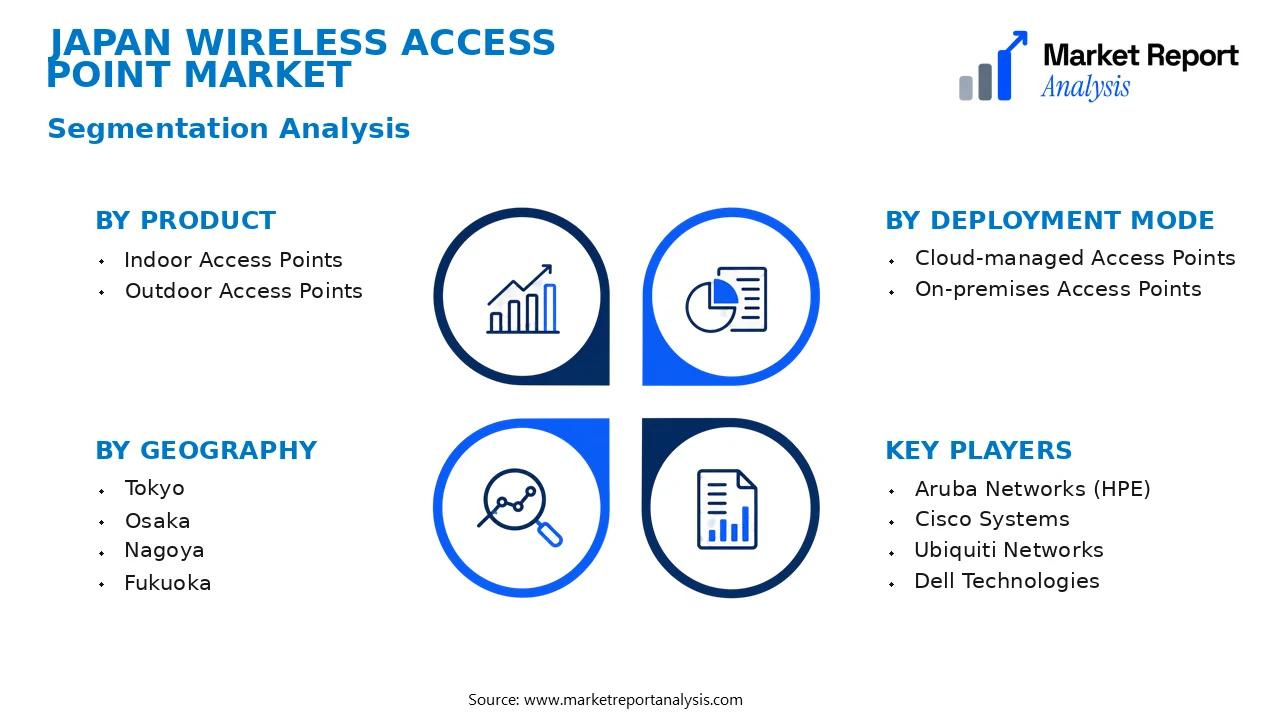
- Product
- Indoor Access Points: Designed for indoor environments such as offices, retail stores, and public buildings, indoor access points are characterized by compact design and high-performance specifications to meet modern connectivity demands in Japan’s urban infrastructure.
- Outdoor Access Points: Built to withstand harsh environmental conditions, outdoor access points are essential for expansive coverage in public spaces, campuses, and transportation hubs, supporting Japan's smart city initiatives and public safety networks.
- Deployment Mode
- Cloud-managed Access Points: These access points are centrally managed via cloud platforms, allowing for seamless provisioning, monitoring, and maintenance, which are increasingly preferred by enterprises seeking scalable and flexible network solutions in Japan.
- On-premises Access Points: Traditional deployment involves localized management, favored by organizations prioritizing data security and control over network infrastructure, especially in sectors like government and finance with strict compliance requirements in Japan.
- Geography
- Tokyo: As Japan's capital and economic hub, Tokyo hosts a substantial concentration of corporate offices, retail outlets, and public venues, creating a robust demand for wireless access points to enhance connectivity and support technological innovation.
- Osaka: Known for its industrial base and commercial activities, Osaka presents opportunities driven by retail, manufacturing, and hospitality sectors that require reliable wireless network solutions to support daily operations and customer engagement.
- Nagoya: With a focus on manufacturing and transportation, Nagoya's infrastructure investments and industrial growth generate a growing need for wireless access solutions to facilitate smart manufacturing and logistics management.
- Fukuoka: As an emerging technology and startup hub, Fukuoka's expanding digital ecosystem prompts increased demand for wireless connectivity to support innovation, remote work, and urban development projects across southern Japan.
This segmentation provides a comprehensive understanding of the varying needs, technological preferences, and regional influences shaping the Japan Wireless Access Point Market, offering stakeholders strategic insights for market penetration and expansion strategies.
Competitive Intelligence
The Japan Wireless Access Point Market exhibits a highly competitive landscape characterized by a mix of multinational technology corporations and regional players. Market concentration remains moderate, with leading players like Cisco Systems, Aruba Networks, and Huawei holding substantial market shares through early product launches and extensive distribution channels. Companies focus on innovative product offerings featuring enhanced security, higher throughput, and seamless integration with IoT ecosystems to differentiate themselves. Business strategies are increasingly centered around forming strategic partnerships with local telecom providers and enterprise clients to bolster market presence and foster ecosystem development. Several firms have pursued acquisitions of emerging startups to expand technological capabilities and geographical reach within Japan’s urban hubs such as Tokyo, Osaka, and Nagoya. R&D investments are robust, with firms prioritizing the development of energy-efficient and high-performance access points to meet growing demand driven by smart city initiatives. Such competitive efforts are aimed at establishing technological leadership, securing customer loyalty, and maintaining agility amid rapid digital transformation, especially in major cities where enterprise and government demands are intense.
Leading Company Profiles
The competitive landscape in the Japan Wireless Access Point Market features a robust mix of global and local players with strengths in innovative technology, strategic alliances, and extensive distribution networks. These companies focus on product differentiation, integration with cloud-based management systems, and sustainable practices to secure market share.
- Aruba Networks (HPE)
- Cisco Systems
- Ubiquiti Networks
- Dell Technologies
- Huawei Technologies
- Juniper Networks
- Zyxel Communications
- Buffalo Inc.
- Fujitsu Limited
Aruba Networks (HPE)
Aruba Networks specializes in innovative wireless solutions, including high-performance Wi-Fi 6E access points, with a strategic focus on secure network management and cloud integration tailored for enterprise clients in Japan.
Cisco Systems
Cisco is renowned for its comprehensive portfolio of wireless access points boasting advanced security features and seamless interoperability, supporting Japan’s enterprise and service provider sectors with cutting-edge networking technology.
Ubiquiti Networks
Ubiquiti offers cost-effective, easy-to-deploy Wi-Fi 6 access points, backed by robust cloud management platform, targeting SMBs and residential markets, with a strategic emphasis on expanding its footprint in Japan’s retail and education segments.
Dell Technologies
Dell provides scalable wireless solutions that integrate with enterprise IT infrastructure, emphasizing robust security, centralized management, and sustainability initiatives aligned with Japan’s smart city projects.
Huawei Technologies
Huawei delivers highly reliable Wi-Fi access points with a focus on high-density environments, leveraging AI-driven network optimization and aligning with Japan's infrastructure modernization plans.
Juniper Networks
Juniper focuses on high-capacity wireless solutions for campus and enterprise environments, emphasizing agility, security, and automation to meet Japan’s evolving connectivity needs.
Zyxel Communications
Zyxel offers versatile Wi-Fi solutions with a focus on small to medium-sized enterprises, integrating IoT capabilities and flexible management tools for the Japanese market.
Buffalo Inc.
Buffalo delivers cost-efficient, user-friendly wireless access points predominantly aimed at residential and SOHO markets, integrating with multimedia services and IoT ecosystems in Japan.
Fujitsu Limited
Fujitsu’s wireless products are geared towards enterprise-grade security and management, supporting digital transformation and IoT integration, with a strategic priority on governmental and healthcare digital initiatives.
Strategic Business Developments
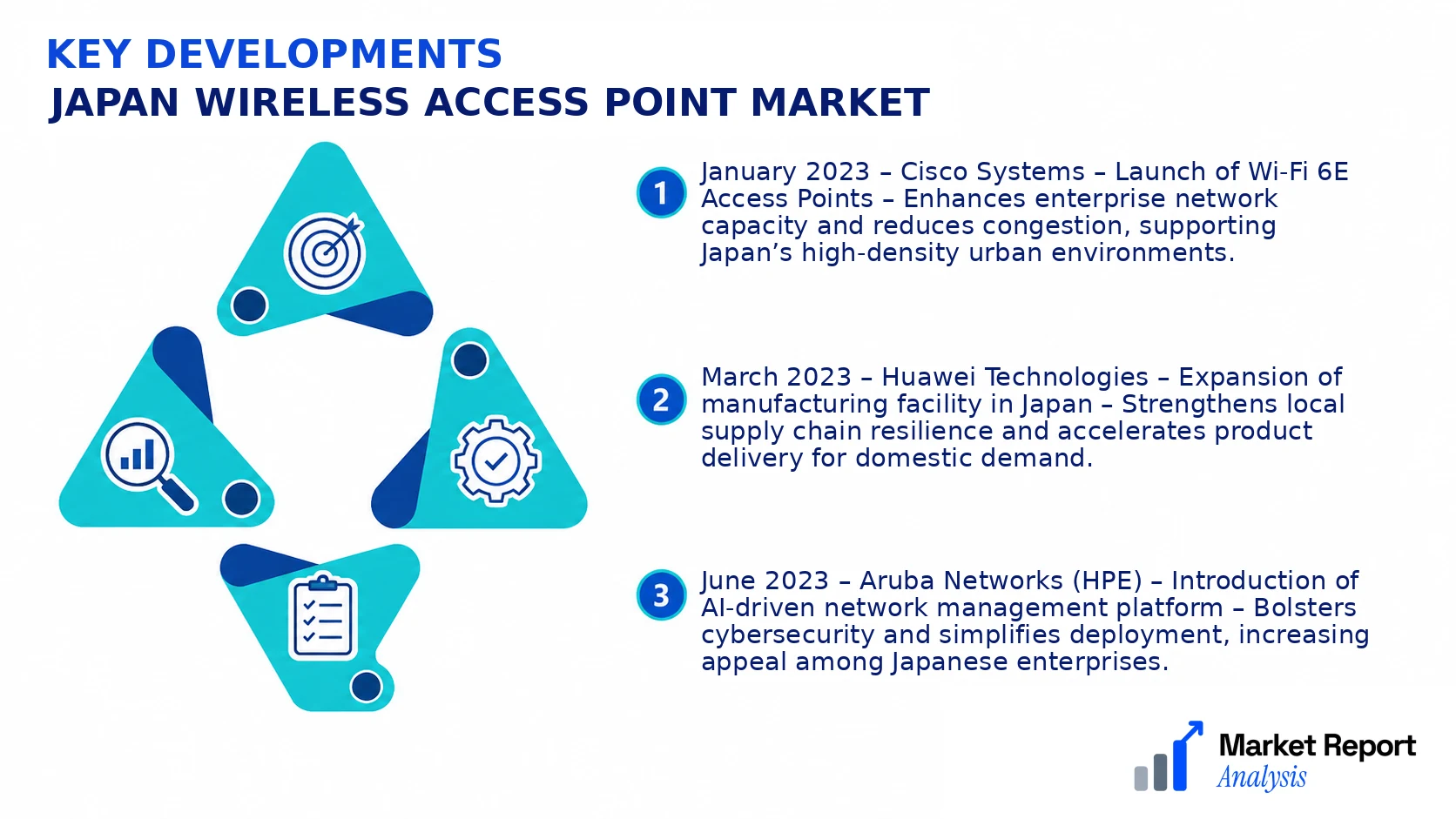
- January 2023 – Cisco Systems – Launch of Wi-Fi 6E Access Points – Enhances enterprise network capacity and reduces congestion, supporting Japan’s high-density urban environments.
- March 2023 – Huawei Technologies – Expansion of manufacturing facility in Japan – Strengthens local supply chain resilience and accelerates product delivery for domestic demand.
- June 2023 – Aruba Networks (HPE) – Introduction of AI-driven network management platform – Bolsters cybersecurity and simplifies deployment, increasing appeal among Japanese enterprises.
- September 2023 – Ubiquiti Networks – Strategic partnership with local Japan distributor – Expands sales channels, targeting small businesses and educational institutions.
- November 2023 – Dell Technologies – Acquisition of a local IoT solutions provider – Integrates IoT management with wireless infrastructure to support Japan’s smart city initiatives.
Frequently Asked Questions
What is the Japan Wireless Access Point Market?
The Japan Wireless Access Point Market encompasses the industry involved in manufacturing, deploying, and maintaining wireless access points across Japan, serving various sectors like commercial, industrial, and residential to provide reliable wireless connectivity.
What is the current market size of Japan Wireless Access Point Market?
As of 2026, the market size is valued at approximately USD 4.2 Billion, driven by increasing demand for wireless connectivity and advancements in networking technologies across multiple end-user industries.
What factors are driving the Japan Wireless Access Point Market?
The market growth is propelled by rising adoption of Internet of Things (IoT), smart city initiatives, digital transformation, and an expanding need for high-speed, reliable wireless networks to support enterprise and consumer applications.
Which region dominates the Japan Wireless Access Point Market?
The Kanto region dominates the market owing to its dense urbanization, technological infrastructure, and concentration of corporate headquarters, which drives higher deployment of wireless access points compared to other regions in Japan.
Which segment is expected to grow the fastest?
The enterprise segment, particularly in sectors like retail, healthcare, and education, is projected to experience the fastest growth due to increasing adoption of wireless networks for operational efficiency and improved customer engagement.
Who are the leading companies operating in the Japan Wireless Access Point Market?
Major industry players include Cisco Systems, Aruba Networks (HPE), Ubiquiti Networks, and Huawei, all competing through innovative product offerings, strategic alliances, and regional expansion to strengthen their market presence in Japan.
Analyst Perspective
The Japan Wireless Access Point Market is poised for sustained growth through 2034, driven by the country’s ongoing digital transformation initiatives and increasing enterprise adoption of IoT and smart city solutions. Market maturity is evident, with established infrastructure along with emerging opportunities in urban hotspots, particularly in Tokyo, Osaka, and Nagoya, where high-density deployment is critical. Strategic investments should prioritize advanced Wi-Fi 6E and future-proof 5G-enabled access points to meet escalating bandwidth and latency demands. Competition remains intense, with local and global vendors vying for enterprise and public sector contracts, emphasizing the need for differentiation through technological innovation and service quality. Regional growth potential is significant in metropolitan areas that are rapidly digitizing, yet rural and suburban zones also present untapped opportunities for expansion and rural connectivity enhancement. Long-term success will depend on fostering strategic alliances, prioritizing R&D, and early adoption of emerging wireless standards. Investors should focus on differentiating offerings and regional customization to capitalize on Japan’s evolving connectivity landscape.
