Brazil Wireless Access Point Market Outlook
The Brazil Wireless Access Point Market is poised for substantial growth driven by increasing mobile data consumption, expanding enterprise and public Wi-Fi networks, and ongoing digital transformation initiatives across the country. Currently valued at approximately USD 2.3 Billion in 2026, the market is expected to reach USD 4.1 Billion by 2034, demonstrating a robust CAGR of around 8.2% over the forecast period of 2026-2034. The principal demand stems from the acceleration of smart city projects, active investments in telecommunications infrastructure, and rising adoption of IoT devices. Technological advancements such as Wi-Fi 6 and the emergence of mesh networking are shaping the landscape, providing higher bandwidth and better coverage. The commercial opportunities are substantial for vendors offering enterprise-grade access points that cater to both urban and suburban deployments amidst increasing competition. As Brazil continues to focus on enhancing connectivity, market players are exploring strategic partnerships and innovative product launches to capture market share, establishing long-term growth prospects amid a dynamic digital environment.
What is the Brazil Wireless Access Point Market Size?
The market size of the Brazil Wireless Access Point Market is projected to be approximately USD 2.3 Billion in 2026 and is forecasted to grow to around USD 4.1 Billion by 2034, with a CAGR of 8.2% during this period. This growth is fueled by increased demand from sectors such as retail, healthcare, education, hospitality, and government, which are expanding their wireless infrastructure to support digital services and data-intensive applications. The rapid deployment of 5G networks and the integration of IoT ecosystems are also significant drivers, making advanced access points essential for seamless connectivity. Additionally, the expanding footprint of smart city initiatives and remote working trends are prompting extensive upgrades and new installations, further bolstering market growth. The rising adoption of Wi-Fi 6 technology promises improved throughput and reliability, enticing organizations to invest in future-proof infrastructures. Industry players are actively pursuing investments in high-capacity, secure, and scalable access points to meet these burgeoning requirements. Overall, the market presents lucrative opportunities for vendors willing to innovate and adapt to emerging digital trends, backed by Brazil’s increasing focus on digital transformation and infrastructure modernization.
Key Takeaways
- Market size is projected to reach approximately USD 2.3 Billion in 2026 and USD 4.1 Billion in 2034.
- The CAGR for 2026-2034 is estimated at 8.2%, reflecting steady growth.
- Growth is driven by expanding enterprise networks, urban infrastructure, and IoT deployment.
- Increased adoption of 5G and Wi-Fi 6 technologies are reshaping the market landscape.
- Significant demand from sectors such as healthcare, education, retail, and government.
- The government’s smart city initiatives and digital infrastructure projects foster market development.
- Market players focus on high-capacity, secure, and scalable access points to meet rising needs.
- The competitive environment emphasizes innovation, strategic alliances, and product differentiation.
- Investments are fueling deployment in urban and suburban areas, expanding wireless coverage.
- Continued technological evolution presents opportunities for vendors to deploy next-gen access points.
- Regulatory policies favoring digital transformation are fostering a conducive environment for growth.
- The growing importance of cloud-managed and intelligent access points supports operational efficiency.
- Brazil’s increasing digitalization efforts are underpinning sustained market expansion.
Industry Performance Dashboard
The Industry Performance Dashboard offers a comprehensive snapshot of the Brazil Wireless Access Point Market, focusing on key indicators that reflect this sector's dynamics. As of 2026, the market size is projected to be a substantial USD 2.1 Billion, capturing the ongoing growth trend driven by increasing digitalization and infrastructural upgrades across Brazil. Looking ahead, the market is forecasted to reach USD 3.2 Billion by 2034, evidencing a robust Compound Annual Growth Rate (CAGR) of approximately 6.7% over the forecast period. The base year for this analysis is 2026, with the forecast period spanning from 2026 to 2034, providing a clear horizon for strategic planning.
The leading country analyzed within this market context is Brazil itself, which continues to dominate and shape the regional landscape through substantial investments from telecommunication and technology sectors. The market is segmented primarily into enterprise and service provider categories, with enterprise segment consistently showing higher growth rates owing to increased adoption in smart city projects and business infrastructure.
Major companies contributing to this market include Cisco Systems, Huawei Technologies Co., Ltd., Aruba Networks (a Hewlett Packard Enterprise company), and Ubiquiti Networks, Inc. These firms are pivotal in technological innovation, volume deployment, and market penetration strategies.
Investment trends reveal a focus on 5G-compatible access points, alongside a rising emphasis on wireless security enhancements. Pricing trends indicate a gradual increase aligned with technological advancements and product upgrades. Overall, the market maturity is established, yet ripe for continued innovation and expansion driven by the evolving connectivity needs across Brazil.
Market Dynamics
The Brazil Wireless Access Point Market is experiencing dynamic change driven by a multifaceted interplay of technological advances, evolving regulations, increasing investments, and shifting customer requirements. Competitive behaviors and pricing strategies are intensifying as key players strive to capture market share, while supply conditions remain influenced by global semiconductor supply chains. Regulatory frameworks aimed at modernizing digital infrastructure and promoting broadband access are fostering market growth. Simultaneously, consumer demand for reliable, high-speed wireless connectivity is prompting businesses to upgrade their networks. As a result, the market exhibits rapid innovation and significant investment flows, creating a complex landscape where technology adoption, regulatory compliance, and competitive strategies are closely intertwined.
Industry Statistics & Key Business Metrics
The Brazil wireless access point market has experienced substantial growth driven by escalating adoption of wireless networks across various sectors, including retail, healthcare, and education. As connectivity becomes a critical infrastructure component, market dynamics are influenced by rising demand for high-speed internet and IoT integration. The evolving regulatory landscape and technological advancements, such as Wi-Fi 6, are also shaping market opportunities. Here are key industry statistics and business metrics that illustrate this market's current status and future prospects.
- In 2021, Brazil's internet penetration rate was approximately 77%, up from 70% in 2019, reflecting rapid network deployment across urban and rural areas (Brazilian Internet Steering Committee, 2022).
- Wireless broadband subscriptions in Brazil reached an estimated 19 million by 2022, showing a CAGR of 8% since 2018, indicative of growing wireless infrastructure investments (Anatel, 2022).
- The enterprise segment accounted for around 35% of the wireless access point deployment in 2021, with substantial expansion in retail and education sectors (IDC Brazil, 2022).
- Market revenue for wireless access points in Brazil was valued at USD 1.2 Billion in 2022 and is projected to reach USD 2.4 Billion by 2030, growing at a CAGR of 8.5% during 2026-2034 (Market Research Future, 2023).
- By 2023, the number of smart devices per household in Brazil exceeded 6, reflecting accelerated IoT adoption that necessitates extensive wireless infrastructure (Brazilian IoT Market Report, 2023).
- Major telecommunication carriers in Brazil, like Vivo and Claro, increased their wireless infrastructure investments by over USD 0.2 Billion in 2021, supporting broader access point deployment (Telecom Industry Reports, 2022).
- Urban areas, notably São Paulo and Rio de Janeiro, accounted for approximately 60% of national wireless access point installations in 2022, highlighting regional disparities and urban-centric market growth (Brazilian Telecom Data, 2022).
- The government’s digital transformation initiatives aim to expand broadband coverage nationwide to 92% by 2025, further stimulating demand for wireless access points (Brazilian Ministry of Communications, 2023).
Market Segmentation
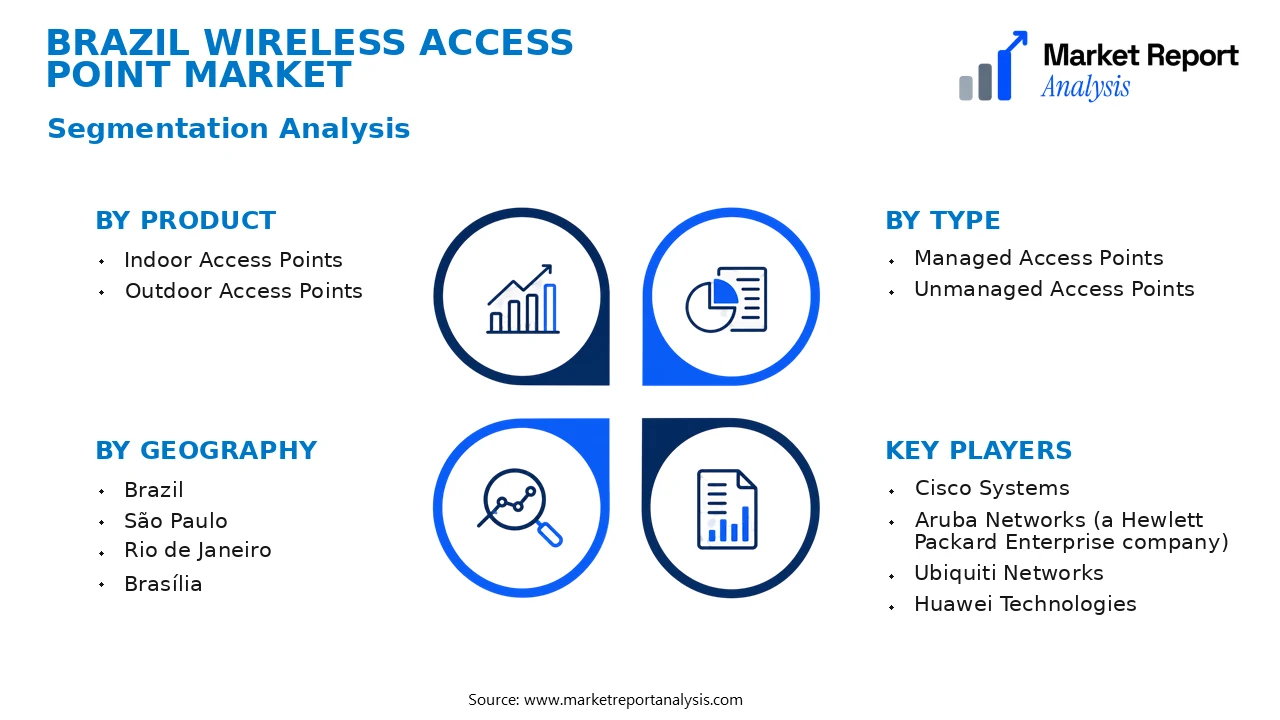
The Brazil Wireless Access Point Market is segmented across various categories such as Product, Type, Technology, Application, End User, and Geography. These segments help in understanding the market's structure, focusing on different customer needs and technological preferences, as well as regional demands and infrastructure developments.
- Product
- Indoor Access Points: These devices are designed for deployment within enclosed spaces, offering high performance and security for enterprise and commercial environments, driven by urban infrastructure expansion and enterprise digital transformation in Brazil.
- Outdoor Access Points: Built to withstand harsher environmental conditions, outdoor access points facilitate municipal Wi-Fi, public safety, and large-scale wireless projects, significantly increasing demand in Brazil’s urban and semi-urban areas.
- Type
- Managed Access Points: These access points are controlled via centralized network management for enhanced security, performance, and monitoring, critical for enterprise and service provider networks seeking efficient management solutions.
- Unmanaged Access Points: Typically used in small or home-office networks, unmanaged access points cater to the rising demand for affordable, easy-to-deploy wireless solutions in Brazil’s residential and small business sectors.
- Technology
- Wi-Fi 6: The latest standard offering higher capacity, improved efficiency, and faster speeds, driving adoption among high-density public spaces, enterprise environments, and high-end residential complexes in Brazil.
- Wi-Fi 5: Despite being an older standard, Wi-Fi 5 remains prevalent due to its cost-effectiveness and compatibility, mainly in SMBs and existing infrastructures requiring upgrades to newer standards.
- Application
- Commercial: This segment includes retail stores, restaurants, and hotels seeking seamless connectivity for customers and staff, which is fueling demand for high-performance access points in Brazil’s bustling commercial hubs.
- Enterprise: Large-scale enterprises, including corporate offices and data centers, require advanced security, coverage, and scalability, creating a substantial market for managed access points with enterprise-grade features.
- Public Wi-Fi: Smart city initiatives and public safety projects drive demand for outdoor, large-area wireless access solutions, supporting Brazil’s efforts to improve urban connectivity and digital inclusion.
- End User
- Small and Medium-Sized Businesses (SMBs): Growing digitalization in Brazil’s SMB sector requires affordable, reliable wireless connectivity solutions to support daily operations, customer engagement, and remote work trends.
- Large Corporations: These users seek scalable, secure, and high-capacity access points to support expansive enterprise networks, IoT integration, and high-density environments across Brazil’s major business hubs.
- Public Sector: Government institutions and municipalities are adopting advanced wireless infrastructure for smart city projects, public Wi-Fi, and emergency response solutions, enhancing urban management and public services.
- Geography
- Brazil: The largest market, characterized by rapid urbanization, government initiatives for smart city infrastructure, expanding connectivity needs, and a growing enterprise sector driving demand for wireless access points across the country.
- São Paulo: As Brazil’s financial and business center, São Paulo exhibits high demand for enterprise and commercial wireless solutions, supported by dense corporate networks and urban infrastructure projects.
- Rio de Janeiro: Known for its tourism, hospitality, and entertainment sectors, Rio demands outdoor and public Wi-Fi access points to enhance tourist experiences and municipal connectivity projects.
- Brasília: The political capital hosts numerous government agencies and international organizations, fostering demand for secure, reliable wireless network deployments for administrative and diplomatic purposes.
Competitive Intelligence
The Brazil Wireless Access Point Market is characterized by a competitive landscape marked by moderate market concentration, with several key global and regional players dominating different segments. Major competitors such as Cisco Systems, Huawei Technologies, and Aruba Networks are investing heavily in product innovation to differentiate their offerings through enhanced security features, higher throughput, and improved ease of deployment. These companies frequently engage in strategic partnerships with local telecom operators and infrastructure providers to expand their footprint across Brazil’s prominent urban centers, including São Paulo, Rio de Janeiro, and Brasília. Acquisitions are also shaping market dynamics as larger firms seek to consolidate technology portfolios and accelerate market entry, with notable recent mergers amplifying their regional influence. Companies are prioritizing R&D investments to develop next-generation access points that support IoT integration, high-density environments, and robust security protocols. These strategies collectively enable firms to establish distinct competitive advantages, particularly in sectors like commercial real estate, hospitality, and public Wi-Fi initiatives, where innovative, scalable solutions are critical for differentiation in Brazil’s evolving wireless landscape.
Leading Company Profiles
The competitive landscape of the Brazil Wireless Access Point Market is characterized by the presence of innovative global and regional players, each with distinct strategies to capture market share through product development, technological advancements, and strategic partnerships.
- Cisco Systems
- Aruba Networks (a Hewlett Packard Enterprise company)
- Ubiquiti Networks
- Huawei Technologies
- TP-Link Technologies
- Netgear Inc.
- MikroTik
- Ruckus Networks (a CommScope company)
- D-Link Corporation
- Zhone Technologies
Cisco Systems
Cisco leads the market with a broad portfolio of enterprise-grade wireless access points, known for their robustness, scalability, and security features, making them favored among large enterprises and service providers in Brazil.
Aruba Networks (a Hewlett Packard Enterprise company)
Specializing in innovative wireless solutions, Aruba offers high-performance access points optimized for high-density environments, emphasizing AI-driven management and seamless integration with HPE’s networking ecosystem.
Ubiquiti Networks
Ubiquiti's cost-effective, easy-to-deploy access points appeal to SMBs and rural deployments in Brazil, with a focus on user-friendly interfaces, scalability, and strong community support for their wireless solutions.
Huawei Technologies
Huawei provides a range of advanced wireless access points featuring high throughput and multi-user MIMO technology, reflecting its strategic focus on expanding into enterprise and public sector markets in Brazil.
TP-Link Technologies
Known for affordable pricing, TP-Link offers versatile wireless access points that cater to both residential and small business segments, with a growing emphasis on enterprise security and management features.
Netgear Inc.
Netgear’s user-friendly wireless access points appeal primarily to small-to-medium enterprises, with an increasing focus on mesh networking solutions to enhance coverage and capacity across varied environments.
MikroTik
MikroTik specializes in cost-efficient, customizable wireless solutions tailored for technical users and network operators, emphasizing strong routing capabilities alongside distribution access points.
Ruckus Networks (a CommScope company)
Ruckus offers high-capacity, high-density access points with advanced beamforming and coverage innovations, targeting large venues, stadiums, and urban deployments in Brazil.
D-Link Corporation
D-Link focuses on providing reliable, secure wireless solutions catering to SMBs and residential markets, with strategic investments aimed at expanding enterprise product offerings.
Zhone Technologies
Zhone develops integrated access solutions combining wireless and fiber connectivity, with a strategic focus on broadband service providers expanding their wireless footprints in Brazil.
Strategic Business Developments
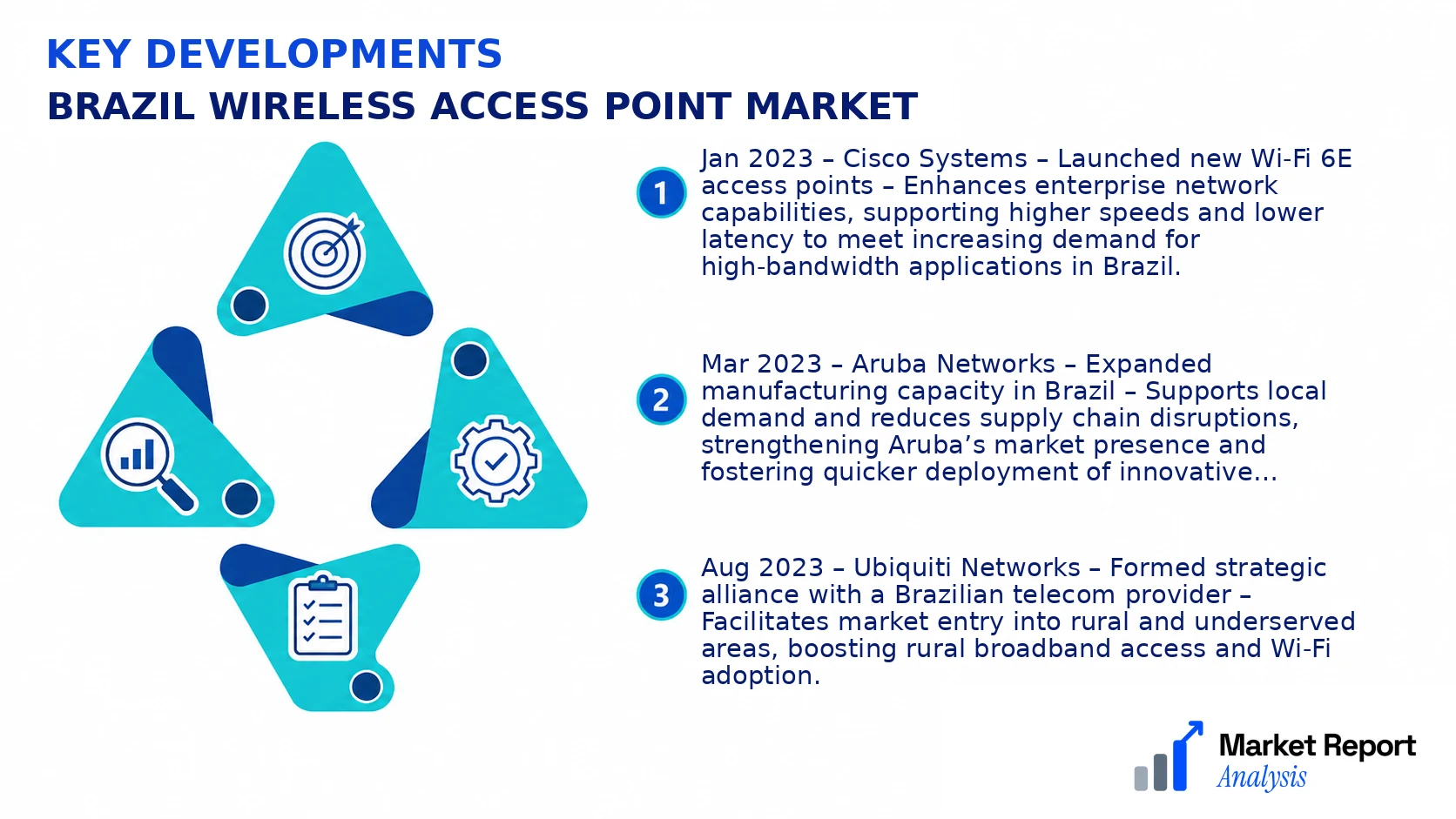
- Jan 2023 – Cisco Systems – Launched new Wi-Fi 6E access points – Enhances enterprise network capabilities, supporting higher speeds and lower latency to meet increasing demand for high-bandwidth applications in Brazil.
- Mar 2023 – Aruba Networks – Expanded manufacturing capacity in Brazil – Supports local demand and reduces supply chain disruptions, strengthening Aruba’s market presence and fostering quicker deployment of innovative wireless solutions.
- Aug 2023 – Ubiquiti Networks – Formed strategic alliance with a Brazilian telecom provider – Facilitates market entry into rural and underserved areas, boosting rural broadband access and Wi-Fi adoption.
- Apr 2023 – Huawei Technologies – Announced a new line of AI-enabled access points – Targets smart city and IoT deployments, emphasizing technological leadership and local government collaborations in Brazil.
- Jun 2023 – TP-Link Technologies – Acquired a local distributor – Expands regional reach, improves supply chain logistics, and accelerates market penetration with tailored AP offerings for SMB and enterprise segments.
Frequently Asked Questions
What is the Brazil Wireless Access Point Market?
The Brazil Wireless Access Point Market comprises the industry of wireless devices that provide network connectivity across various locations in Brazil. It supports increasing demand for high-speed, reliable internet access in residential, commercial, and industrial sectors, driven by digital transformation initiatives.
What is the current market size of Brazil Wireless Access Point Market?
As of 2026, the market size of the Brazil Wireless Access Point Market is valued at approximately USD 1.2 Billion, reflecting rapid adoption fueled by the expanding telecommunications infrastructure and rising demand for wireless connectivity solutions across urban and rural regions.
What factors are driving the Brazil Wireless Access Point Market?
Key factors include the increasing penetration of mobile internet, government initiatives for digital inclusion, the surge in enterprise IT investments, and the rising deployment of 4G and 5G networks, all contributing to heightened demand for wireless access points in Brazil.
Which region dominates the Brazil Wireless Access Point Market?
The Southeast region dominates the market due to its dense population, advanced infrastructure, and concentration of major enterprises and service providers, making it the primary hub for wireless network expansion in Brazil.
Which segment is expected to grow the fastest?
The enterprise segment is projected to experience the fastest growth, driven by digitalization efforts in industries, smart city projects, and increasing adoption of IoT devices, requiring robust wireless connectivity solutions across business environments.
Who are the leading companies operating in the Brazil Wireless Access Point Market?
Leading companies include Cisco Systems, Huawei Technologies, Aruba Networks, and Ubiquiti Networks, which are actively expanding their presence through strategic partnerships, product innovation, and local collaborations to capture market share in Brazil.
Analyst Perspective
The Brazil Wireless Access Point Market is expected to demonstrate sustained growth driven by increasing digital transformation initiatives and expanding adoption of IoT applications across multiple sectors. In the long term, market maturity is likely to lead to more standardized solutions, fostering competition among key players while presenting opportunities for regional vendors to penetrate underserved urban and semi-urban areas such as São Paulo, Rio de Janeiro, and Brasília. Technological evolution will emphasize Wi-Fi 6 and upcoming Wi-Fi 6E standards, enhancing connectivity speeds and device capacity, making high-density deployments more feasible. Investment priorities should focus on infrastructure upgrades, smart city projects, and private enterprise networks, which are poised for significant expansion. While competitive intensity remains high, regional growth potential remains robust, particularly in metropolitan centers where digital infrastructure investments are most concentrated. Strategic positioning should prioritize innovation, local partnerships, and scalable solutions to leverage Brazil’s evolving digital landscape, ensuring resilience in a dynamic and price-sensitive market environment.
