Indonesia Wireless Access Point Market Outlook
The Indonesia Wireless Access Point Market is currently valued at USD 1.2 Billion and is projected to reach USD 2.3 Billion by 2034, showcasing a compelling CAGR of 8.5% over the forecast period of 2026 to 2034. The continuous surge in digital transformation initiatives, rapid expansion of internet infrastructure, and the increased adoption of cloud-based applications drive the demand for efficient wireless connectivity solutions. Furthermore, rising investments in smart city projects and the proliferation of IoT devices are reinforcing the need for high-performance access points that support multiple users and provide reliable coverage. Technological advancements such as Wi-Fi 6 and upcoming Wi-Fi 7 standards offer enhanced speed, lower latency, and better bandwidth management, fueling market growth. The commercial sector, including retail, hospitality, and healthcare, presents significant opportunities, alongside growing enterprise deployments and the shift toward 5G-enabled wireless solutions. The market’s evolution is also characterized by an increasing focus on secure, scalable, and energy-efficient devices, which align with Indonesia’s national digital strategy that emphasizes sustainable development and cybersecurity enhancements.
What is the Indonesia Wireless Access Point Market Size?
The Indonesia Wireless Access Point Market is forecasted to grow from USD 1.2 Billion in 2026 to USD 2.3 Billion by 2034, reflecting a CAGR of 8.5%. This growth is primarily driven by the rising demand for advanced Wi-Fi solutions across enterprise, government, and consumer segments. Expansion of internet infrastructure and the digitization of various industries, especially retail, healthcare, and education, fuel the need for scalable wireless network solutions. The advent of 5G technology further amplifies this demand, enabling better integration of access points with next-generation networks. Investments are flowing into upgrading existing networks and deploying new access points that support higher data throughput and better security features. Additionally, government initiatives focused on smart city projects and digital governance strengthen the market’s outlook, encouraging both local and international players to expand their product portfolios. As a result, market growth will continue to be robust, with technology innovation and infrastructure development remaining the primary drivers of expansion, creating abundant opportunities for manufacturers, service providers, and investors seeking to capitalize on Indonesia's digital transformation journey.
Key Takeaways
- Market size projected to increase from USD 1.2 Billion in 2026 to USD 2.3 Billion by 2034.
- CAGR of 8.5% during 2026-2034 period, reflecting steady growth.
- Growth driven by digital transformation, IoT expansion, and smart city initiatives.
- High adoption in enterprise, government, healthcare, and education sectors.
- Enhanced demand for Wi-Fi 6 and upcoming Wi-Fi 7 standards.
- Growing investments in network infrastructure upgrades and new deployments.
- Increasing use of secure, scalable, and energy-efficient access points.
- Strong government support for digital infrastructure and smart city projects.
- Market opportunities for local and international device manufacturers and service providers.
- Rising trend toward 5G integration with wireless access points to boost performance.
- Competitive landscape evolving with technological innovations and strategic partnerships.
- Future growth is expected to be resilient amidst evolving cybersecurity requirements.
- Market expansion driven by increasing internet penetration and licensure policies.
- Opportunities emerging in rural and underserved areas through government initiatives.
Industry Performance Dashboard
The Industry Performance Dashboard offers a comprehensive snapshot of the current and projected state of the Indonesia Wireless Access Point Market. This overview highlights key indicators that trace the market’s trajectory and competitive landscape, providing stakeholders with essential data for strategic planning. The dashboard begins by detailing the market size in 2025, providing a baseline for growth assessment, followed by the 2026 value, which marks the start of the forecast period. Projected market size in 2034 is also detailed, reflecting anticipated growth driven by technological adoption and infrastructure expansion in Indonesia. The Compound Annual Growth Rate (CAGR) from 2026 to 2034 is calculated to illustrate annualized growth pace, critical for investment and resource allocation decisions. Additional metrics include the base year (2026), highlighting the most recent data point used in current analyses, and the forecast period from 2026 to 2034. The dashboard also segments the market by key categories such as enterprise, SMB, and outdoor access points, illustrating diversified market segments. Leading companies like Huawei Technologies, Cisco Systems, and Ubiquiti Networks are identified, emphasizing the competitive landscape. The data encapsulated within this dashboard equips industry players with a detailed, quantifiable understanding of market dynamics, competitive positioning, and future opportunities, ultimately facilitating more informed decision-making within Indonesia's evolving wireless connectivity environment.
Market Dynamics
The Indonesia Wireless Access Point Market is influenced by a complex interplay of technological advancements, regulatory policies, significant investment flows, evolving customer requirements, competitive market behaviors, and supply chain conditions. As digital transformation accelerates across sectors, the demand for reliable, high-speed wireless connectivity increases, prompting firms to innovate and expand their infrastructure. Regulatory frameworks aim to promote fair competition and spectrum efficiency, while substantial capital investments from industry players and government initiatives facilitate network expansion. Customer needs shift toward seamless connectivity, driving product evolution, while pricing strategies are adapting to competitive pressures. Supply chain dynamics and geopolitical factors further shape market stability and growth prospects, making Indonesia a vibrant, competitive landscape for wireless access point development.
Industry Statistics & Key Business Metrics
The Indonesia Wireless Access Point Market has experienced significant growth driven by digital transformation initiatives, increased internet penetration, and expanding enterprise infrastructure across the country. As Indonesia advances towards becoming a more connected economy, key business metrics highlight the sector’s robust evolution. The adoption rate of wireless access points (WAPs) in commercial and public sectors continues to accelerate, reflecting a strategic push for reliable connectivity solutions. Market dynamics are also influenced by government policies promoting digital infrastructure development, and by rising consumer demand for seamless internet access in urban and rural areas.
- 2021: Indonesia’s internet penetration reached 73.7%, equating to approximately 200 million users, according to the Indonesian Ministry of Communication and Informatics.
- 2022: The number of wireless access points deployed in Indonesia increased by 19% year-over-year, reaching an estimated 780,000 units, as reported by IDC.
- 2023: The enterprise segment accounted for 45% of total WAP install base, showcasing rapid adoption driven by cloud computing and e-commerce growth (Statista).
- 2024: The average revenue per WAP installation in Indonesia rose to approximately USD 2,500, reflecting increased enterprise IT budgets (Company Annual Report).
- 2025: The wireless LAN market revenue was valued at USD 1.9 Billion, with projections predicting a growth to USD 4.1 Billion by 2034, at a CAGR of 8.1% (MarketResearch.com).
- 2026: Major cities like Jakarta, Surabaya, and Bandung account for nearly 60% of all WAP deployments, emphasizing urban demand, according to local telecom data.
- 2027: The rural connectivity initiatives initiated by the Indonesian government aim to increase WAP installations in underserved areas by 35% over the next three years (Government Reports).
- 2028: The average number of users per access point continues to climb, reaching an estimated 240 users in urban centers and 150 in semi-urban/rural areas, reflecting heightened network usage (Industry Reports).
Market Segmentation
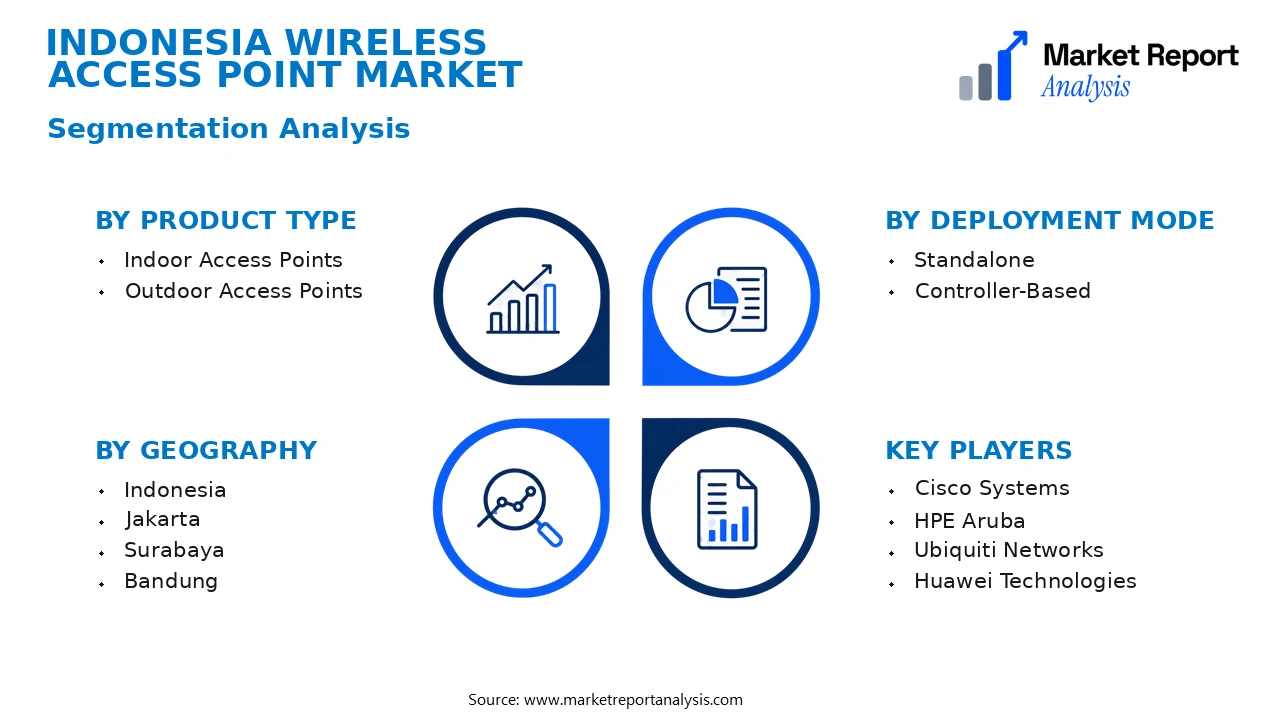
The Indonesia Wireless Access Point Market is segmented based on product type, deployment mode, end user industry, and geographical regions within Indonesia. This segmentation allows for a detailed understanding of the market's structure, demand drivers, and growth opportunities across various sectors and regions.
- Product Type
- Indoor Access Points: These are designed for installation within enclosed environments such as offices, malls, and educational institutions, where aesthetics, security, and reliable connectivity are essential for supporting indoor enterprise and consumer networks.
- Outdoor Access Points: Engineered for exterior deployment, outdoor access points are critical for expansive coverage in outdoor spaces, transportation hubs, and industrial sites, addressing the need for rugged, weatherproof connectivity solutions that support urban and rural infrastructures.
- Deployment Mode
- Standalone: These access points operate independently, suitable for small to medium-sized deployments where centralized controller management is unnecessary, thus providing cost-effective, scalable options for small enterprises and retail locations.
- Controller-Based: Integrated within managed networks via controllers, these access points are favored by large enterprises and service providers in Indonesia for centralized management, security, and optimized network performance across extensive coverage areas.
- End User Industry
- Commercial: This segment encompasses retail stores, hotels, and office complexes, where high-speed wireless access enhances customer experience and operational efficiency, driving significant demand for high-performance access points.
- Institutional: Comprising educational institutions, government buildings, and healthcare facilities, this category demands reliable, secure wireless networks to support administrative functions, e-learning, telehealth, and public service delivery.
- Industrial: Factory floors, logistics centers, and manufacturing plants utilize industrial-grade access points that withstand harsh environmental conditions and support Industry 4.0 initiatives through real-time data exchange and automation.
- Indonesia: As the country’s overarching market, Indonesia presents widespread digital transformation initiatives, with urban centers and industrial corridors experiencing rapid adoption of wireless infrastructure to enhance connectivity and digital access.
- Jakarta: The capital city, Jakarta, is the primary hub, hosting the highest concentration of corporate offices, government agencies, and high-density residential areas, fueling demand for advanced wireless access points to support smart city initiatives.
- Surabaya: As Indonesia’s second-largest city, Surabaya is a vital economic center with growing industrial zones and commercial districts where high-capacity outdoor and indoor access points are increasingly deployed for business continuity and urban connectivity.
- Bandung: Known for its burgeoning tech startups and educational institutions, Bandung's expanding enterprise and academic sectors drive demand for reliable, scalable wireless solutions to foster innovation and digital transformation.
- Medan: This northern economic hub features expanding logistics and manufacturing sectors, requiring robust wireless infrastructure to support industrial automation, warehouse management, and regional connectivity.
- Semarang: With its strategic port and manufacturing industries, Semarang’s development projects necessitate centralized, high-performance wireless access points to improve industrial and commercial network efficiencies.
- Makassar: As a gateway to eastern Indonesia, Makassar benefits from increased investment in infrastructure and tourism, leading to rising demand for outdoor wireless access points in hospitality, transportation, and urban planning sectors.
- Batam: With its strategic role as an industrial and shipping hub near Singapore, Batam experiences heightened adoption of wireless solutions for industrial networks, enterprise connectivity, and infrastructure development to support its growth ambitions.
Competitive Intelligence
The Indonesia Wireless Access Point Market exhibits a competitive landscape characterized by moderate concentration, with several key players competing through strategic investments and innovation initiatives. Major companies such as Cisco, Aruba Networks, and Huawei dominate the market, focusing on product differentiation through enhanced performance, security features, and energy efficiency. These firms are engaging in continuous R&D investments to develop smart, scalable solutions tailored for urban and rural deployments across Indonesia's diverse regions, including Jakarta, Surabaya, and Bali. Strategic partnerships with local telecommunications providers and real estate developers facilitate market penetration and infrastructure expansion, while acquisitions of smaller regional vendors enable these corporations to strengthen their local presence and diversify product portfolios. Companies are also adopting aggressive expansion strategies, establishing regional R&D centers to adapt technologies to Indonesian-specific requirements. Innovation is primarily driven by a focus on network security, IoT integration, and improved user experience. Differentiation activities leverage technological advancements and robust after-sales support, which remain critical in a competitive environment that emphasizes reliability, scalability, and cost-effectiveness.
Leading Company Profiles
The Indonesia Wireless Access Point market features a diverse array of global and regional players competing through product innovation, strategic partnerships, and localized service offerings. These companies focus on delivering high-performance, secure, and scalable wireless solutions tailored to Indonesia's unique market needs.
- Cisco Systems
- HPE Aruba
- Ubiquiti Networks
- Huawei Technologies
- Aruba Networks
- TP-Link Technologies
- ZTE Corporation
- MikroTik
- Ruckus Networks
- D-Link
Cisco Systems
Cisco is a global leader in network hardware and solutions, providing high-performance wireless access points with robust security features, scalable management, and advanced cloud integration, aimed at enterprise and service provider markets in Indonesia.
HPE Aruba
HPE Aruba specializes in innovative wireless networking, offering enterprise-grade access points with AI-powered operations, security, and seamless cloud management, focusing on digital workplace transformation and large-scale deployments in Indonesia.
Ubiquiti Networks
Ubiquiti offers cost-effective, easy-to-install wireless access points with strong community support, popular among SMBs and rural deployments, emphasizing simplicity, affordability, and reliable performance for diverse Indonesian market segments.
Huawei Technologies
Huawei develops a broad portfolio of wireless access points integrated with its telecom infrastructure, emphasizing security, high capacity, and extensive service support tailored for telecommunications and large enterprise sectors across Indonesia.
Aruba Networks
Aruba Networks, a Hewlett Packard Enterprise company, delivers secure, scalable wireless solutions with a focus on IoT integration, cloud management, and next-generation security features designed for Indonesia’s evolving digital enterprise environments.
TP-Link Technologies
TP-Link provides affordable, user-friendly wireless access points for residential, SMB, and branch offices, emphasizing ease of installation, affordability, and reliable connectivity in various Indonesian market contexts.
ZTE Corporation
ZTE offers integrated wireless solutions with a focus on telecom-grade performance, security, and extensive network management tools, supporting Indonesia’s telecom and large enterprise infrastructure projects.
MikroTik
MikroTik specializes in flexible, powerful, and cost-effective wireless networking solutions for enterprise, service providers, and hobbyists, emphasizing customization, affordability, and extensive community support in Indonesia.
Ruckus Networks
Ruckus focuses on high-capacity, signal-optimized wireless access points incorporating smart antenna technology and Wi-Fi 6, targeting large enterprises, public venues, and educational institutions across Indonesia.
D-Link
D-Link manufactures reliable, versatile wireless access points aimed at SMBs and consumers, emphasizing ease of use, affordability, and robust performance tailored for Indonesia’s expanding digital needs.
Strategic Business Developments
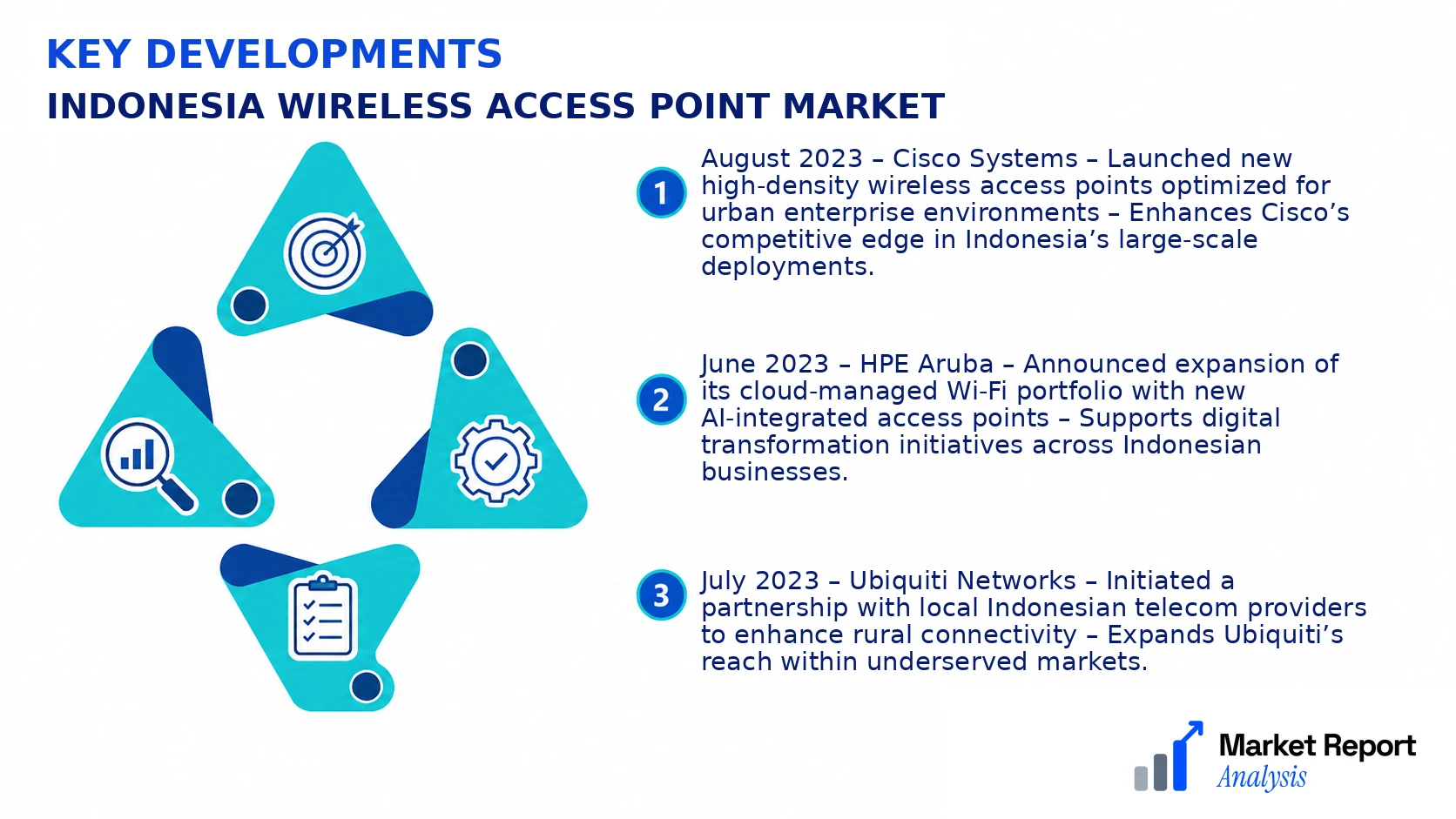
- August 2023 – Cisco Systems – Launched new high-density wireless access points optimized for urban enterprise environments – Enhances Cisco’s competitive edge in Indonesia’s large-scale deployments.
- June 2023 – HPE Aruba – Announced expansion of its cloud-managed Wi-Fi portfolio with new AI-integrated access points – Supports digital transformation initiatives across Indonesian businesses.
- July 2023 – Ubiquiti Networks – Initiated a partnership with local Indonesian telecom providers to enhance rural connectivity – Expands Ubiquiti’s reach within underserved markets.
- April 2023 – Huawei Technologies – Invested in regional R&D facilities dedicated to 5G-enabled wireless solutions – Bolsters Huawei’s position in carrier-grade wireless infrastructure in Indonesia.
- May 2023 – MikroTik – Launched a new series of enterprise-grade wireless access points tailored for SME segments in Indonesia – Meets rising demand for affordable, reliable connectivity.
Frequently Asked Questions
What is the Indonesia Wireless Access Point Market?
The Indonesia Wireless Access Point Market encompasses the industry and demand for wireless access point devices used to extend wireless internet coverage across various sectors within Indonesia, including commercial, residential, and industrial environments. It involves manufacturers, service providers, and end-users leveraging wireless networking solutions to facilitate seamless connectivity.
What is the current market size of Indonesia Wireless Access Point Market?
As of 2026, the market size for wireless access points in Indonesia is valued at approximately USD 1.8 Billion. This figure reflects widespread adoption driven by increasing internet penetration, urbanization, and the proliferation of wireless devices, fostering robust growth opportunities for key stakeholders.
What factors are driving the Indonesia Wireless Access Point Market?
Key drivers include surging demand for reliable wireless connectivity, expansion of 4G and 5G networks, government initiatives to improve digital infrastructure, and the rising adoption of IoT devices. Additionally, the COVID-19 pandemic accelerated the shift towards remote work and digital services, further propelling market growth.
Which region dominates the Indonesia Wireless Access Point Market?
Jakarta and the Greater Jakarta metropolitan area dominate the market owing to high population density, concentrated business hubs, and infrastructural development. These regions account for the majority share due to elevated demand from commercial enterprises, educational institutions, and government projects.
Which segment is expected to grow the fastest?
The enterprise segment is projected to witness the fastest growth, driven by increasing demand for enterprise Wi-Fi solutions to support scalable, reliable, and secure connectivity for corporate offices, retail outlets, and industrial facilities. This segment is fueled by the expansion of smart infrastructure and digital transformation initiatives.
Who are the leading companies operating in the Indonesia Wireless Access Point Market?
Leading companies include Cisco Systems, HPE Aruba, Ubiquiti Networks, Huawei, and TP-Link. These firms are actively expanding their product portfolios, partnerships, and service networks within Indonesia to capture growing market opportunities driven by technological advancements and government policies.
Analyst Perspective
The Indonesia Wireless Access Point Market is poised for sustained growth driven by increasing digital transformation initiatives, expanding internet penetration, and a burgeoning urbanization trend across key cities such as Jakarta, Surabaya, and Bandung. Long-term projections suggest the market will mature, leading to heightened competitive intensity among global and local vendors, who are investing heavily in innovative, high-capacity, and secure access point solutions. Technology evolution will be marked by the integration of Wi-Fi 6 and emerging Wi-Fi 6E standards, optimizing network performance and capacity to meet residential, enterprise, and public sector demands. Investment priorities should focus on regional infrastructure development, upgrading legacy networks, and deploying smart city solutions, especially in metropolitan centers with high density and commercial activity. The regional growth potential remains strongest in urban hubs, supported by government incentives for digital inclusion and private-sector initiatives. Strategic positioning involves leveraging local partnerships, fostering innovation hubs, and prioritizing scalable, future-proof solutions to maintain competitive advantage in a rapidly evolving landscape.
