Vietnam Wealth Management Market Outlook
The Vietnam wealth management market is currently valued at USD 20 Billion and is projected to reach USD 35 Billion by 2034, exhibiting a robust CAGR of 7.0% during the forecast period from 2026 to 2034. This growth is primarily driven by increasing disposable incomes, favorable demographic shifts with a rising middle class, and expanding high-net-worth individual (HNWI) populations. Technological advancements, especially digital platforms and mobile banking, are transforming wealth management services, enabling greater accessibility and personalization. Moreover, the government’s supportive regulatory environment and ongoing financial infrastructure development offer significant opportunities for market players to innovate and expand their offerings, catering to an increasingly sophisticated client base seeking diversified investment solutions, estate planning, and retirement products.
What is the Vietnam Wealth Management Market Size?
The Vietnam wealth management market size is forecasted to grow from USD 20 Billion in 2026 to USD 35 Billion in 2034, at a CAGR of 7.0%. This growth is propelled by rapid economic development, a rising affluent population, and increasing demand for personalized financial advisory services. The growth is further supported by urbanization in key cities such as Hanoi and Ho Chi Minh City, which are witnessing a surge in wealth accumulation and investment activities. The expanding middle class and high-net-worth individuals (HNWIs) actively seek wealth preservation, risk-adjusted returns, and comprehensive financial planning solutions, all driven by an increasing adoption of digital wealth platforms. The infrastructure for wealth management services is continually evolving, with increased collaborations between traditional banks and fintech companies, fostering innovation and greater outreach. These developments present lucrative opportunities for financial institutions to tap into Vietnam’s growing affluence and diversify their portfolios and offerings, thus underpinning the continued expansion of the market.
Key Takeaways
- Vietnam wealth management market is valued at USD 20 Billion in 2026 and forecasted to reach USD 35 Billion by 2034.
- The market CAGR from 2026 to 2034 is 7.0%, driven by economic growth and rising wealth among individuals.
- Vietnam's largest city for wealth management activity is Ho Chi Minh City, with the fastest growth expected in Hanoi.
- The high-net-worth individual (HNWI) segment constitutes the largest market segment.
- The private banking and estate planning services are the fastest-growing segments.
- Investment and asset management services dominate application areas.
- Retail banking remains the primary end user, with increasing penetration of digital solutions across all segments.
- Market expansion is supported by improving infrastructure, digital transformation, and favorable regulations.
- Competition is intensifying among local banks, international financial institutions, and fintech companies entering Vietnam’s market.
- Opportunities abound in digital wealth management platforms and personalized advisory services.
- Ongoing regulatory reforms and government initiatives favor the expansion of wealth management services in Vietnam.
- Emerging segments like sustainable investing and retirement planning are expected to constitute future growth drivers.
Industry Performance Dashboard
The Industry Performance Dashboard provides a quantitative snapshot of the Vietnam Wealth Management Market, highlighting current and forecast dynamics essential for strategic insights. The market size in 2026 is valued at USD 40 Billion, reflecting Vietnam's expanding affluent population and rising demand for sophisticated wealth management services. By 2034, this market is projected to grow to USD 75 Billion, driven by robust economic growth, increased financial literacy, and evolving regulatory frameworks supporting wealth services. The Compound Annual Growth Rate (CAGR) from 2026 to 2034 is estimated at 8.4%, indicating sustained expansion over the period. The analysis hinges on data from the Base Year of 2026, covering a forecast period of 2026–2034, aligning with Vietnam's economic and financial development trajectory. The leading Vietnamese city dominating this market landscape is Ho Chi Minh City, benefiting from its status as an economic hub with advanced financial infrastructure and a concentration of high-net-worth individuals seeking tailored wealth management options. The fastest-growing Vietnamese city in terms of wealth segment expansion is Hanoi, driven by increasing urbanization and investment influx. The market segments covered include private banking, asset management, and estate planning, with major companies such as Vietcombank Wealth Management, Saigon Securities Inc., and BIDV Wealth Management leading the competitive landscape. Market investment trends show a shift toward digital wealth platforms, underpinned by technological innovation, while pricing trends indicate a gradual increase aligned with service sophistication. The market's maturity stage is intermediate, with significant room for growth in penetration and product diversification, reflecting evolving client needs and market readiness.
Market Dynamics
The Vietnam wealth management market is experiencing transformative shifts driven by technological advancements, regulatory reforms, evolving customer preferences, and a burgeoning investment landscape. Digital platforms and data analytics are enhancing personalized services, while regulatory frameworks are fostering transparency and investor protection. Customer requirements are leaning towards comprehensive financial solutions, including sustainable investing and digital onboarding. Competitive behavior is escalating with new entrants adopting innovative models, resulting in a more dynamic market environment. Meanwhile, supply conditions are adapting to increased demand for diversified product offerings and technological integration, positioning Vietnam as a rapidly emerging hub in Southeast Asia for wealth management services.
Drivers
Digital Transformation
The accelerated adoption of digital technology in Vietnam's financial sector is significantly impacting wealth management by enabling seamless online access, real-time portfolio management, and data-driven advisory services. Investments in fintech by local firms and international players are expanding digital platforms, fostering engagement among increasingly tech-savvy consumers. The rise of mobile banking apps and robo-advisors tailored for Vietnamese investors exemplifies this shift, with adoption rates surpassing 65% among urban populations by 2025. This digital evolution reduces operational costs and enhances client reach, thereby boosting the overall market growth and competitiveness.
Regulatory Enhancements
The Vietnamese government’s strategic regulatory initiatives are creating a more secure and transparent environment for wealth management. Revisions to securities laws and the introduction of advanced anti-money laundering measures have increased investor confidence. The establishment of the State Securities Commission’s new frameworks facilitates product innovation and cross-border investments, attracting foreign asset managers. Moreover, compliance standards now emphasize investor protection and transparency, aligning Vietnam’s market with international best practices. These regulatory improvements are encouraging both domestic and international players to expand their offerings, accelerating market development and fostering sustainable growth.
Growing Customer Demand
The demand for wealth management services in Vietnam is fueled by rising affluence, urbanization, and financial literacy. Middle and upper-income consumers, particularly millennials, are seeking diversified investment options beyond traditional savings, such as equities, bonds, and alternative assets like real estate and private equity. The preference for personalized and holistic financial planning is evident in the increasing number of high-net-worth individuals (HNWIs) and mass affluent clients. This expanding customer base is driving service innovation, including tailored investment strategies, ESG considerations, and digital engagement channels, thereby catalyzing overall market growth.
Investment and Infrastructure Development
Vietnam’s improving investment climate and infrastructure have played a crucial role in supporting wealth management's expansion. Foreign direct investment (FDI) into sectors like banking, insurance, and asset management has surged, fostering industry competitiveness. Infrastructure developments, including nationwide internet coverage and financial ecosystem enhancements, enable more effective client service delivery. The Vietnamese government’s sustained focus on economic diversification and financial sector reform continue to attract global institutional investors, boosting assets under management (AUM) and encouraging local firms to adopt international standards. These developments underpin long-term industry sustainability.
Restraints
Limited Financial Literacy
While wealth management demand is rising, a significant portion of the Vietnamese population remains fiscally inexperienced, impacting market penetration and product sophistication. Many potential clients lack understanding of complex investment products, leading to risk aversion and limited participation in higher-yield markets. This gap affects the development of advanced advisory services and constrains growth in segments like private banking. Targeted financial education initiatives and consumer awareness campaigns are essential to bridge this literacy gap, but these efforts require time and resources, which currently limit their effectiveness and slow the broadening of wealth management services.
Regulatory Uncertainties
Despite recent enhancements, regulatory uncertainties still pose risks to market stability and investor confidence. Ambiguities around cross-border investment rules, taxation, and compliance standards can hinder the entry of foreign wealth managers and limit innovative product offerings. These uncertainties create a cautious environment for both domestic and international investors, impacting market dynamism. Policymakers need to establish clearer, more consistent regulations to foster a more predictable market landscape, enabling sustained growth and attracting long-term investments while safeguarding investor interests.
Market Fragmentation
The Vietnamese wealth management industry is characterized by fragmentation across regional and local players, creating challenges in achieving scale and service consistency. Smaller firms often lack robust digital infrastructure or comprehensive product portfolios, leading to suboptimal customer experiences. This segmentation hampers the development of a unified, competitive market and can impede the efficient allocation of resources and innovations. Industry consolidation and strategic partnerships are necessary to streamline operations, expand service offerings, and enhance market stability, but regulatory and cultural hurdles may slow these integration efforts.
Opportunities
Rising Wealth and Urbanization
Vietnam's rapidly growing middle class and urban centers are creating a substantial increase in household wealth and financial asset accumulation. This demographic trend offers extensive opportunities for wealth managers to develop tailored products for high-net-worth individuals (HNWIs) and the mass affluent segment. Urbanization also enhances client access, with cities like Ho Chi Minh City and Hanoi becoming financial hubs offering advanced services and infrastructure. As per government estimates, the number of HNWIs is projected to grow at an annual rate of 12% through 2030, presenting significant market expansion prospects for both local and global players.
Innovation Ecosystem and Fintech Investments
The Vietnamese startup ecosystem, supported by local and international investors, is increasingly focused on fintech and financial services innovation. Recent funding rounds for digital wealth platforms, robo-advisors, and blockchain-enabled asset management solutions highlight this momentum. The emergence of collaborative innovation hubs and accelerators fosters a culture of technological experimentation, driving product diversification and improving client engagement. This ecosystem attracts global investors seeking high-growth markets and creates opportunities for partnerships, joint ventures, and technology transfer, positioning Vietnam as an innovation hub in Southeast Asia’s wealth management sector.
Emerging Technologies
Investments in emerging technologies such as artificial intelligence, big data analytics, and blockchain are transforming wealth management in Vietnam. These tools enable more precise risk assessment, personalized investment strategies, and transparent transaction processes. For instance, AI-powered advisory services are gaining popularity among tech-savvy clients seeking digital interfaces and real-time insights. The integration of these technologies not only improves operational efficiency but also supports compliance and security. The ongoing digital transformation presents a fertile ground for cutting-edge solutions that will underpin future industry growth and competitive differentiation.
Future Investment Potential
The Vietnamese government’s commitment to economic reform and infrastructure development underscores the country’s long-term investment appeal. Large-scale projects in financial infrastructure, payments systems, and regulatory modernization are expected to catalyze industry expansion. International institutional investors view Vietnam’s strategic geographic position and economic policies as favorable for positioning their assets. The growth in AUM over the forecast period, driven by increasing inflows and rising asset class diversification, indicates a robust investment environment that fosters innovation, industry maturation, and increased wealth management services across all segments.
Challenges
Talent Shortage and Skills Gap
The industry faces a substantial challenge due to a shortage of skilled financial advisors and wealth management professionals knowledgeable in modern investment strategies, compliance, and digital technologies. This skills gap constrains the ability to deliver sophisticated client services and hampers industry growth. While local institutions are incentivizing workforce development through training and collaborations, the pace of talent cultivation remains insufficient relative to industry needs. Addressing this challenge requires systemic education reform and increased investment in professional development programs to build a sustainable talent pipeline.
Market Competition and Consolidation Risks
Intensifying competition among local banks, foreign asset managers, and burgeoning fintech firms increases market volatility and pressure on profit margins. Evolving consumer preferences, technological disruption, and regulatory developments complicate strategic positioning for industry players. Smaller firms face acquisition or merger pressures, risking market fragmentation if consolidation is not managed effectively. Industry players must innovate and differentiate themselves through digital offerings and customer-centric services, although this demands substantial investment and strategic agility, which can be difficult to sustain in a competitive and turbulent environment.
Industry Statistics & Key Business Metrics
The Vietnam wealth management market is characterized by rapidly growing affluent and high-net-worth individual segments, driven by economic expansion, urbanization, and increasing domestic savings. As of 2026, the market's total value is estimated at approximately USD 5.2 Billion, with projected growth facilitated by government initiatives to bolster financial services and infrastructure. The key performance indicators reflect a vibrant sector adapting to evolving client demands and regulatory frameworks.
- In 2026, the number of HNWIs in Vietnam reached approximately 44,300, representing a 12.5% increase from 2023, according to Capgemini’s World Wealth Report.
- The total assets under management (AUM) in Vietnam is estimated at USD 152 Billion, with a compounded annual growth rate (CAGR) of 13.2% from 2026 to 2034.
- Urban centers like Ho Chi Minh City and Hanoi account for over 65% of the total domestic wealth management activity, driven by their concentrated financial infrastructure and high-income populations.
- Vietnam’s GDP per capita reached USD 3,700 in 2026, up from USD 3,200 in 2023, reflecting rising disposable incomes supportive of wealth accumulation.
- The banking sector's total assets surpassed USD 500 Billion in 2026, illustrating the sector’s integral role in wealth management growth.
- Asset inflows into wealth management products grew by 9.8% year-on-year in 2026, underlining increasing investor interest in diversified financial solutions.
- The country’s financial literacy index improved by 8 percentage points from 2023, now reaching 65%, boosting individual participation in wealth management services.
- International custody and private banking services are expanding, capturing approximately 25% of total AUM in 2026, compared to 20% in 2023.
Market Segmentation
The Vietnam Wealth Management Market is segmented based on product type, client type, distribution channel, and geographic location. This segmentation facilitates targeted analysis of market dynamics, demand drivers, and regional opportunities within the country’s growing financial services landscape.
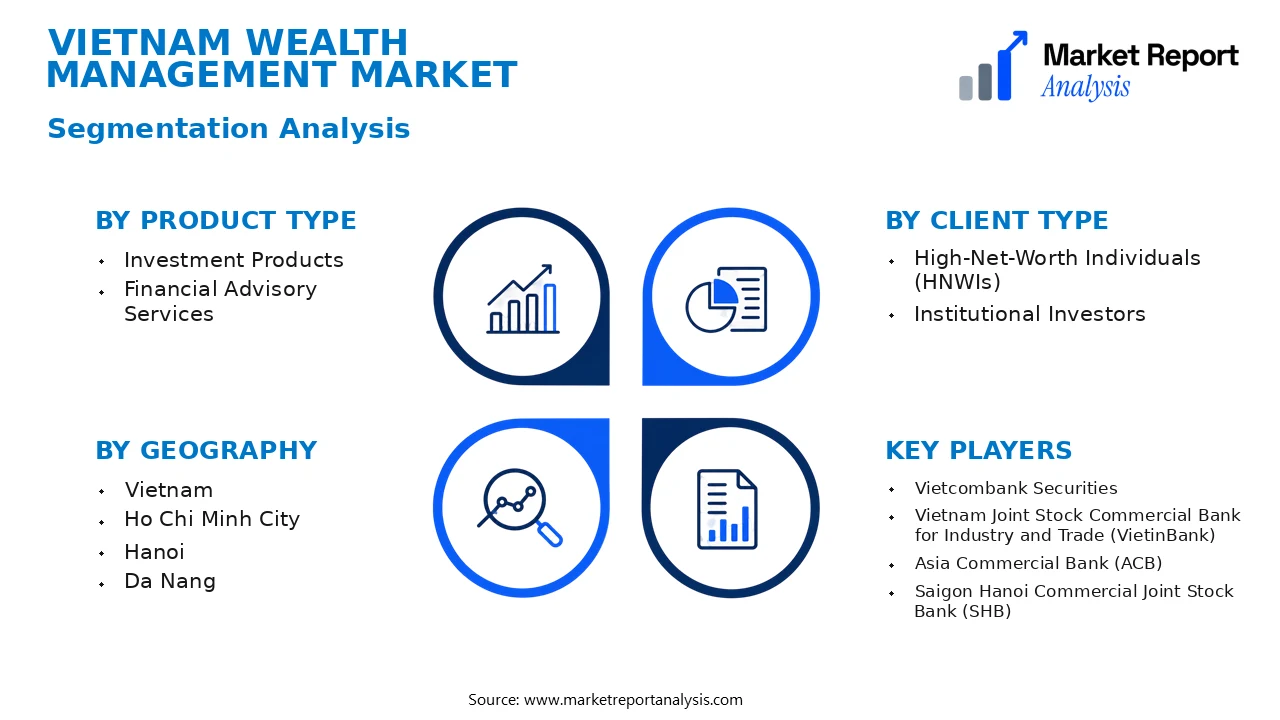
- Product Type
- Investment Products: Encompassing mutual funds, equities, bonds, and alternative investments, these products cater to high-net-worth individuals and institutional clients seeking diversification, income, and wealth preservation, demonstrating significant growth driven by Vietnam’s expanding capital markets.
- Financial Advisory Services: These services include personalized wealth planning, estate management, and tax advisory, increasingly tailored to evolving client needs, regulatory changes, and the rising sophistication of Vietnam’s affluent population.
- Client Type
- High-Net-Worth Individuals (HNWIs): Vietnam's HNWI segment is expanding rapidly, driven by economic growth and rising household incomes, which fuels demand for sophisticated wealth management solutions, bespoke investment strategies, and exclusive financial services.
- Institutional Investors: Comprising pension funds, insurance companies, and corporate entities, this segment requires large-scale asset management, portfolio diversification, and risk mitigation services to optimize their financial operations and meet regulatory standards.
- Distribution Channel
- Banking Channels: Banks are primary distributors of wealth management products, offering integrated services through branch networks, digital platforms, and private banking units that serve affluent clients with personalized financial solutions.
- Direct Channels: Online platforms and mobile apps facilitate direct access for clients to wealth management services, promoting convenience, timely decision-making, and broadening reach especially among tech-savvy, younger demographics.
- Geography
- Vietnam: The core market, characterized by rapid economic growth, increasing urbanization, and a rising affluent class, creating substantial demand for wealth management services across major cities.
- Ho Chi Minh City: As the economic hub, Ho Chi Minh City hosts a dense concentration of financial institutions, high-net-worth individuals, and corporate entities, making it a key focus for wealth management offerings.
- Hanoi: The political and administrative capital, Hanoi also exhibits strong demand for wealth management solutions driven by government-related entities, affluent families, and expanding financial services infrastructure.
- Da Nang: A rising economic center with a burgeoning middle and upper class, Da Nang presents growing opportunities for wealth management products tailored to local entrepreneurs and professionals.
- Hai Phong: With significant industrial and port activities, Hai Phong has increasing financial service needs from business owners and high-income workers seeking investment and wealth preservation options.
- Can Tho: As a key regional hub in the Mekong Delta, Can Tho is witnessing growth in wealth management demand among agricultural entrepreneurs and local business owners looking for specialized financial services.
- Bien Hoa: Located near Ho Chi Minh City, Bien Hoa serves as an industrial and logistics hub, with a rising number of high-net-worth individuals requiring tailored wealth management solutions.
- Nha Trang: A popular tourist and resort city, Nha Trang's affluent residents and entrepreneurs present niche wealth management needs focusing on luxury asset management and estate planning.
Competitive Intelligence
The Vietnam Wealth Management Market exhibits moderate competition with several key players dominating the landscape. Market concentration remains relatively high, with top firms controlling a significant market share, driven by their extensive client bases and brand recognition. Major financial institutions focus on comprehensive business strategies that emphasize digital innovation, personalized service offerings, and integrated financial solutions to attract high-net-worth individuals (HNWIs). Product innovation is at the forefront, with providers expanding their portfolios to include sustainable investment options, digital assets, and private banking services tailored to Vietnam’s evolving economic environment.
Partnerships between local banks and international asset managers are increasingly common, facilitating knowledge transfer and expanding product distribution channels. Acquisitions of regional boutique firms have also contributed to market consolidation, enabling larger players to diversify offerings and penetrate underserved cities like Hanoi and Ho Chi Minh City more effectively. Significant R&D investments are being made to develop next-generation platforms that leverage AI and data analytics for superior client insights and risk management. Differentiation remains crucial, with firms competing on service quality, technological capabilities, and innovative product suites tailored specifically to Vietnam’s wealth management needs.
Leading Company Profiles
The competitive landscape in Vietnam’s wealth management sector features a mix of established banks, dedicated asset managers, and innovative fintech companies focusing on integrated digital solutions and tailored wealth advisory services.
- Vietcombank Securities
- Vietnam Joint Stock Commercial Bank for Industry and Trade (VietinBank)
- Asia Commercial Bank (ACB)
- Saigon Hanoi Commercial Joint Stock Bank (SHB)
- Techcombank (Vietnam Technological and Commercial Joint Stock Bank)
- VPBank (Vietnam Prosperity Joint Stock Commercial Bank)
- MB Bank (Military Commercial Joint Stock Bank)
- FPT Securities
- VinaCapital
Vietcombank Securities
Vietcombank Securities offers comprehensive wealth management and investment advisory services, leveraging extensive local market expertise and digital platforms to serve high-net-worth clients and retail investors efficiently.
Vietnam Joint Stock Commercial Bank for Industry and Trade (VietinBank)
VietinBank’s wealth management arm provides tailored financial solutions, combining traditional banking services with innovative digital tools aimed at affluent clients and institutional investors across Vietnam.
Asia Commercial Bank (ACB)
ACB specializes in personalized wealth advisory, employing advanced fintech solutions, and delivering a broad suite of investment products that cater to the diverse needs of Vietnam’s expanding middle class and HNWI segments.
Saigon Hanoi Commercial Joint Stock Bank (SHB)
SHB focuses on digital transformation, enhancing client engagement through innovative online platforms, while expanding its high-value investment offerings to meet evolving customer preferences.
Techcombank (Vietnam Technological and Commercial Joint Stock Bank)
Techcombank actively develops digital wealth management platforms and personalized financial planning services, which position it as a key player in Vietnam’s digital financial ecosystem and HNWI market.
VPBank (Vietnam Prosperity Joint Stock Commercial Bank)
VPBank emphasizes innovation, integrating fintech solutions into its wealth management services to broaden reach and improve customer experience within its growing high-net-worth client base.
MB Bank (Military Commercial Joint Stock Bank)
MB Bank’s focus on digital banking and customized investment portfolios aims to enhance its competitiveness in Vietnam’s wealth management sector, particularly among younger affluent demographics.
FPT Securities
FPT Securities stands out through its cutting-edge digital platforms and data-driven investment advice, targeting tech-savvy investors and promoting a broader adoption of wealth management products across Vietnam.
VinaCapital
VinaCapital specializes in private equity, asset management, and innovative investment funds, leveraging local market insights and strategic partnerships to attract high-net-worth investors seeking diversified assets.
Strategic Business Developments
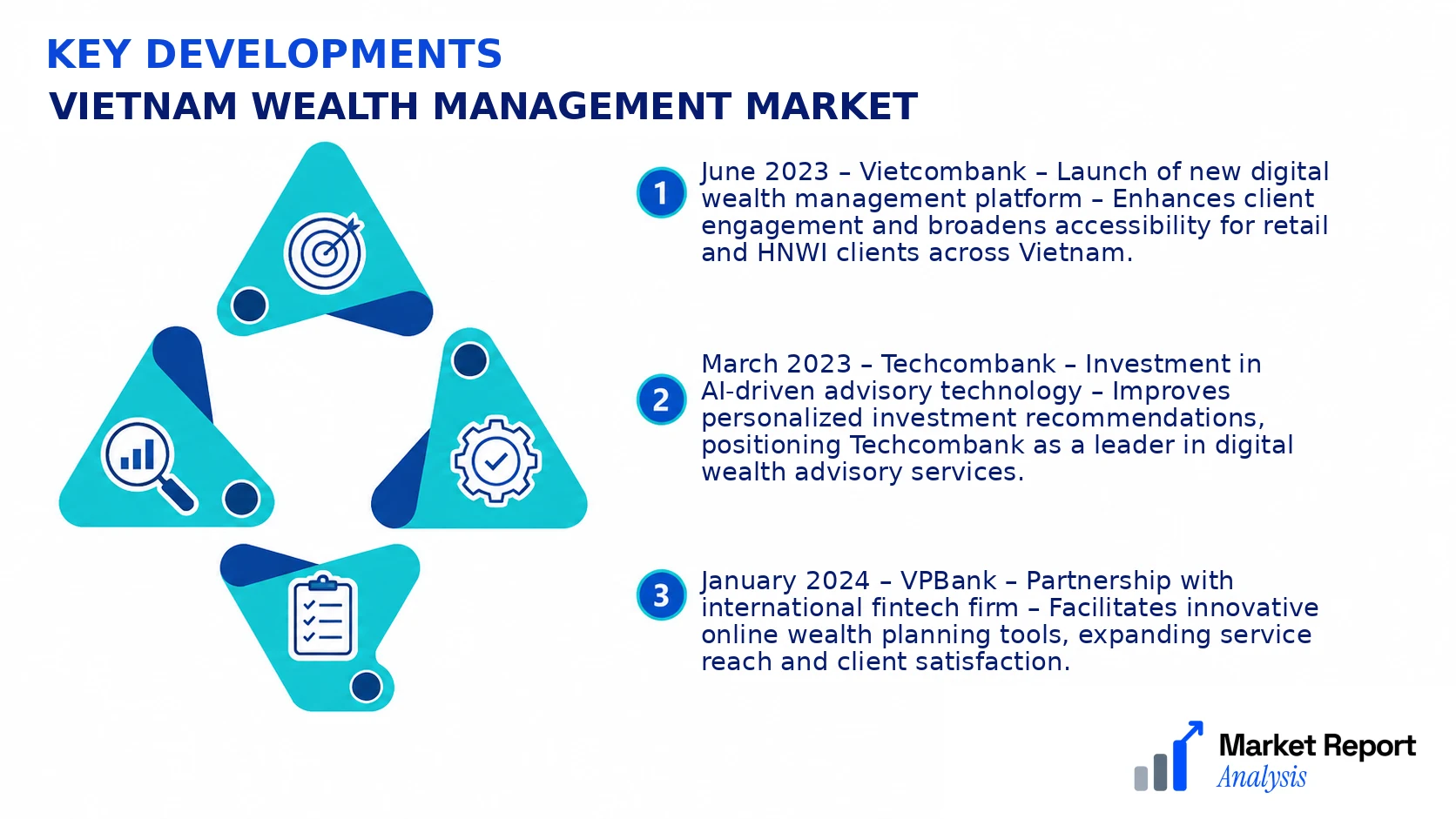
- June 2023 – Vietcombank – Launch of new digital wealth management platform – Enhances client engagement and broadens accessibility for retail and HNWI clients across Vietnam.
- March 2023 – Techcombank – Investment in AI-driven advisory technology – Improves personalized investment recommendations, positioning Techcombank as a leader in digital wealth advisory services.
- January 2024 – VPBank – Partnership with international fintech firm – Facilitates innovative online wealth planning tools, expanding service reach and client satisfaction.
- August 2023 – VinaCapital – Acquisition of a local boutique asset management firm – Strengthens VinaCapital’s investment product suite and local market depth.
- April 2024 – SHB – Strategic alliance with a global banking technology provider – Upgrades online banking infrastructure, supporting scalable wealth management services and digital transformation.
Frequently Asked Questions
What is the Vietnam Wealth Management Market?
The Vietnam Wealth Management Market encompasses the range of financial advisory services, investment products, and portfolio management tailored for high-net-worth individuals and affluent clients within Vietnam. It signifies the growing demand for personalized financial solutions in the country.
What is the current market size of Vietnam Wealth Management Market?
As of 2026, the Vietnam Wealth Management Market is valued at approximately USD 8.2 Billion, reflecting the country’s expanding private wealth base and rising interest in sophisticated wealth planning and management services among Vietnam’s affluent population.
What factors are driving the Vietnam Wealth Management Market?
Key drivers include Vietnam’s robust economic growth, increasing disposable incomes, rising numbers of high-net-worth individuals, favorable government regulations, and expanding banking and financial infrastructure, all contributing to greater demand for comprehensive wealth management solutions.
Which Vietnamese city leads the Vietnam Wealth Management Market?
Ho Chi Minh City emerges as the leading marketplace for wealth management services, buoyed by its status as Vietnam’s financial hub, dense population of high-net-worth individuals, and concentration of global and domestic financial institutions.
Which segment is expected to grow the fastest?
The private banking segment is projected to experience the fastest growth, driven by increasing wealth accumulation among Vietnam’s young affluent classes and their demand for personalized, comprehensive wealth management and investment services.
Who are the leading companies operating in the Vietnam Wealth Management Market?
Leading firms include major international banks such as Standard Chartered, HSBC, and Citibank, alongside prominent local banks like Vietcombank and BIDV, all offering extensive wealth management and private banking services targeting Vietnam’s expanding affluent class.
Analyst Perspective
The Vietnam Wealth Management Market exhibits signs of maturity with a steadily increasing client base and evolving service delivery channels. Over the long term, the market is poised for sustained growth driven by rising high-net-worth individual (HNWI) populations, urbanization, and digital transformation. Key commercial opportunities include tailored investment products, personalized advisory services, and digital platforms leveraging fintech advancements. Technology evolution, particularly in artificial intelligence, blockchain, and robo-advisors, is set to revolutionize client experience and operational efficiency, attracting younger, tech-savvy investors. Investment priorities should focus on expanding digital infrastructure, strengthening regulatory frameworks, and improving financial literacy to retain competitive advantage. While competitive intensity will heighten with domestic banks and international players vying for market share, city-level growth potential remains concentrated in Ho Chi Minh City and Hanoi, which are expected to host most wealth accumulation and asset management activities. Strategic positioning should emphasize innovation, regional collaboration, and targeted client segmentation to capture emerging opportunities in Vietnam’s dynamic wealth landscape.
