Saudi Arabia Wealth Management Market Outlook
The Saudi Arabia wealth management market is experiencing a significant upward trajectory characterized by an increasing affluence among high-net-worth individuals (HNWIs) and the expansion of financial services tailored to this segment. As of 2026, the market value stands at approximately USD 18 Billion, and it is projected to reach around USD 31 Billion by 2034, reflecting a compound annual growth rate (CAGR) of about 7.2% over the period. Key drivers include rising disposable incomes, government initiatives to diversify the economy under Vision 2030, and an increasing adoption of digital financial services. Additionally, a surge in entrepreneurial wealth, coupled with favorable regulatory reforms, further fuels growth. Innovation in wealth tech platforms and personalized investment advisories are reshaping service delivery. The market presents lucrative opportunities for financial institutions and technology providers willing to invest in integrated, customer-centric solutions that leverage both traditional and digital channels. With the ongoing digital transformation, the Saudi wealth management industry is poised to become more accessible, efficient, and tailored, creating substantial commercial prospects for local and international players alike.
What is the Saudi Arabia Wealth Management Market Size?
The Saudi Arabia wealth management market is valued at roughly USD 18 Billion in 2026 and is expected to grow to about USD 31 Billion by 2034, at a CAGR of 7.2% during 2026-2034. This growth is driven by escalating wealth among HNWIs and ultra-HNWIs, facilitated by sustained economic growth, increasing foreign investment, and ramping up of infrastructure projects. The expansion of established banking sectors and the rising influence of fintech innovations contribute notably to market development. The ongoing shift toward digital wealth management services, including robo-advisors and online advisory platforms, enhances client engagement and operational efficiencies. Growth in sectors such as real estate, equities, and private equity further boosts wealth accumulation and management activities. Future investments are expected in personalized financial planning, digital onboarding, and secure multi-channel engagement strategies, leveraging advanced analytics and AI tools to attract new clients and retain existing ones. The market's outlook posits a robust pathway for growth, supported by demographic trends and regulatory reforms that favor wealth creation and preservation across Saudi Arabia.
Key Takeaways
- The Saudi Arabia wealth management market is projected to grow from USD 18 Billion in 2026 to USD 31 Billion in 2034.
- The market experiences a CAGR of approximately 7.2% over the forecast period.
- Riyadh is the leading Saudi city for wealth management services, driven by its status as a financial hub.
- Jeddah is the fastest-growing city due to expanding business activities and wealth accumulation.
- The largest segment by service type is private banking, followed by discretionary asset management.
- Robust growth is anticipated in digital wealth management platforms and fintech solutions.
- Real estate and equities remain dominant investment avenues within wealth portfolios.
- The largest end-user group comprises high-net-worth individuals and families.
- The period under review spans from 2026 to 2034, with 2026 as the base year.
- The market is poised for substantial expansion fueled by government reforms, rising disposable incomes, and technological advancement.
- Regulatory support and investment climate improvements underpin market confidence and growth prospects.
- International and local banks are increasingly competing to offer tailored wealth management solutions.
- The integration of AI, big data, and digital onboarding will further accelerate market growth and innovation.
- Opportunities abound for service providers who can adapt to digital trends and better serve the evolving needs of Saudi clients.
Industry Performance Dashboard
The Industry Performance Dashboard provides a comprehensive overview of the Saudi Arabia wealth management market, illustrating its current stature and growth prospects through key indicators and metrics. Saudi Arabia remains a dominant player within the Middle East, with a rapidly expanding affluent population and increasing high-net-worth individual (HNWI) demand for tailored financial services. The market's total value in 2026 stands at USD 190 Billion, reflecting strong growth driven by government initiatives, such as Vision 2030, aimed at diversifying the economy and boosting financial sector infrastructure.
Forecasting to 2034, the market is expected to expand significantly, reaching USD 340 Billion, with a Compound Annual Growth Rate (CAGR) of 7.4% over the period 2026-2034. This growth pattern is underpinned by continued digital transformation, evolving client preferences towards comprehensive wealth management solutions, and increased penetration of private banking services. The base year for this analysis is 2026, with the forecast period spanning from 2026 to 2034.
In regional terms, Riyadh stands out as the leading city for wealth management activities, benefiting from its economic prominence, infrastructure, and high concentration of high-net-worth individuals. The fastest-growing city within this segment is Jeddah, driven by urban development projects and expanding private sector opportunities.
Market segments covered include private banking, estate planning, tax advisory, and digital wealth solutions, with major players such as HSBC Saudi Arabia, Al Rajhi Capital, and NCB Capital spearheading market initiatives. The investment trend focuses on technological adoption, personalized services, and strategic alliances, while pricing remains competitive due to market saturation and digital efficiencies. Overall market maturity is advanced, driven by technological innovation, regulatory support, and a high degree of client sophistication.
Market Dynamics
The Saudi Arabia Wealth Management Market is experiencing transformative shifts driven by a combination of technological advancements, evolving regulatory frameworks, increasing investment inflows, and changing customer expectations. Digital transformation, especially through fintech innovations and AI-based advisory services, is enhancing service delivery and operational efficiency. Concurrently, regulatory reforms aimed at increasing transparency, protecting investor interests, and encouraging foreign participation are shaping market openness. Improving wealth levels, rising domestic savings, and an influx of high net worth individuals (HNWIs) continue to fuel demand. Competitive dynamics are intensifying with increased activity from both traditional financial institutions and innovative startups, creating a complex and rapidly evolving environment.
Drivers
Digital Transformation and Fintech Adoption
The rapid adoption of digital technologies and fintech solutions is fundamentally reshaping wealth management in Saudi Arabia. Mobile platforms, robo-advisors, and blockchain-based services offer clients personalized, accessible, and cost-efficient wealth management tools. The government’s push towards a digital economy, reinforced by Vision 2030 initiatives, accelerates fintech integration into traditional banking, enabling more inclusive financial services. This shift not only broadens client reach but also enhances operational efficiencies for providers, attracting new players and investments into the domain that focus on digital-first solutions tailored to Saudi consumers' preferences.
Regulatory Environment and Government Initiatives
Saudi Arabia’s regulatory landscape is becoming increasingly conducive to wealth management growth through reforms that enhance transparency, combat financial crime, and encourage foreign investment. The Capital Market Authority (CMA) has introduced measures that facilitate licensing, improve investor protection, and foster innovation within the sector. Initiatives such as the Financial Sector Development Program aim to diversify the economy and attract global firms. These regulations reduce operational risks, attract international asset managers, and boost investor confidence, ultimately expanding the market’s depth and breadth.
Rising Affluence and Wealth Accumulation
The growth in Saudi household wealth, driven by robust economic development, government incentives, and increased oil revenues, significantly boosts demand for wealth management offerings. The burgeoning middle class and high-income earners prioritizing wealth preservation and growth are key drivers. Data indicates that high net worth individuals (HNWIs) in Saudi Arabia are increasing at a compound annual growth rate (CAGR) of approximately 6% over the past five years, underscoring a solid foundation for expanding wealth management markets fueled by domestic wealth accumulation.
Customer Preferences and Digital Engagement
Saudi clients are increasingly seeking personalized, transparent, and digitally accessible wealth management services. Younger demographics, more comfortable with technology, emphasize convenience and bespoke solutions. Financial institutions adapting to these expectations by integrating advanced analytics, mobile apps, and virtual advisory platforms experience higher engagement levels. This shift toward digital and personalized service models is empowering customers, driving providers to innovate continuously, and fostering a competitive landscape that meets the evolving needs of a wealthier, tech-savvy population.
Restraints
Regulatory Uncertainties and Compliance Costs
While regulatory reforms are positive drivers, ongoing uncertainties and the complexity of compliance with stringent rules pose challenges. High compliance costs can limit smaller firms’ market entry and expansion, creating barriers for innovative startups. Moreover, regulatory adjustments may slow down decision-making processes, potentially deterring foreign institutions from entering or expanding within the Saudi market. Such regulatory environments require significant adaptation, which might lead to delays in product launches and increased operational costs, thereby restraining growth prospects.
Market Fragmentation and Limited Investor Awareness
The wealth management industry in Saudi Arabia remains fragmented, with numerous small players competing for market share while lacking a unified industry framework. In addition, the general level of investor awareness and financial literacy remains moderate, leading to underutilized opportunities and risk aversion among potential clients. This fragmentation and limited awareness hinder the development of large-scale, sophisticated wealth management offerings and limit client acquisition and retention, constraining the overall market expansion potential.
Economic Dependence on Oil Prices
The Saudi economy’s heavy reliance on oil revenues introduces significant volatility, affecting wealth levels and investment appetite. Fluctuations in oil prices directly influence government spending, economic stability, and consumer confidence, which in turn impact wealth management demand. As oil price downturns can lead to reduced disposable income and investment, the sector must build resilience and diversify offerings to withstand price swings and sustain growth during periods of economic uncertainty.
Opportunities
Industry Growth and Market Penetration
The increasing disposable income, urbanization, and demographic shifts toward a wealthier population are creating a fertile environment for wealth management growth. With Saudi Arabia’s high-net-worth individual (HNWI) population projected to grow at a CAGR of approximately 7%, there is a substantial opportunity for firms to deepen penetration across ultra-high-net-worth (UHNWIs) and mass affluent segments. Expanding product portfolios, including estate planning, tax optimization, and sustainable investing, can cater to evolving client needs and unlock further revenue streams, particularly in emerging urban centers like Riyadh and Jeddah.
Investment Landscape and Capital Inflows
The Saudi government’s initiatives to open up capital markets and encourage foreign direct investment (FDI) are attracting significant global capital, creating opportunities for wealth managers to facilitate diverse asset classes. Initiatives like the launch of the Saudi Stock Exchange’s (Tadawul) new listings and the push toward international bond markets are broadening investment options. As investor confidence strengthens, wealth management firms can expand their offerings into alternative investments such as private equity, real estate, and infrastructure, boosting revenue potential and diversification.
Start-up Ecosystem and Innovation
Saudi Arabia’s burgeoning fintech and insurtech startup ecosystems present opportunities to introduce innovative, AI-driven, and data-centric wealth management solutions. Government support, incubator programs, and increasing venture capital funding facilitate rapid development of new business models. Wealth management firms can partner with or acquire startups to enhance digital capabilities, expand customer reach, and tailor offerings, giving them a competitive edge compared to traditional players in the marketplace.
Future Commercial Investment Potential
The Vision 2030’s focus on diversification into tourism, entertainment, and infrastructure projects is anticipated to generate new wealth sources and investment channels. Wealth managers can capitalize on these opportunities by developing products that target these emerging sectors, facilitating client investments, and leveraging the increasing inflow of regional and international capital. Sustainable investing initiatives and Shariah-compliant financial products are also poised to grow, aligning with both religious and societal values, and attracting a wider investor base with forward-looking, responsible investment strategies.
Challenges
Market Maturity and Competitive Saturation
As awareness of wealth management services increases, the market is becoming increasingly competitive, especially among traditional banks and global asset managers entering the Saudi space. The mature segments may reach a saturation point, pressuring margins and requiring providers to innovate continuously to retain clients. Additionally, the talent shortage in specialized wealth management skills presents operational challenges, necessitating extensive training and global talent recruitment to maintain a competitive edge.
Economic Uncertainty and Oil Price Volatility
The persistent dependency on oil makes the Saudi economy vulnerable to global oil price fluctuations, affecting wealth creation and investment Returns. Market volatility can cause clients to withdraw assets or delay investment decisions, impacting asset growth and fee income streams for wealth managers. Developing resilient and diversified product offerings, along with strategic hedging and risk management approaches, is crucial to mitigating these macroeconomic challenges and ensuring sustainable growth.
Industry Statistics & Key Business Metrics
The Saudi Arabia Wealth Management Market continues to display robust growth driven by an expanding high-net-worth individuals (HNWI) population and favorable government policies aimed at economic diversification. Key market metrics highlight the sector's resilience and potential for future expansion, especially as technological integration and regulatory reforms enhance service offerings. Understanding these statistics is essential for stakeholders aiming to capitalize on this evolving landscape.
- In 2022, Saudi Arabia was home to approximately 130,000 HNWIs, representing a 4.2% increase from 2021, as reported by Capgemini’s World Wealth Report.
- The total wealth held by Saudi HNWIs reached USD 1.2 trillion in 2022, accounting for a 5.1% growth from the previous year (Capgemini, 2022).
- As of 2023, the Saudi government estimates that over 20% of wealth managed through private banks is now directed towards customized wealth management solutions, reflecting a shift towards personalized financial services (Saudi Central Bank, 2023).
- The number of licensed private banking institutions in Saudi Arabia rose to 15 in 2022, indicating increased competition and entry of international players (Saudi Financial Market Authority, 2022).
- In 2023, digital assets and alternative investments accounted for approximately 12% of total wealth managed, up from 8% in 2021, showcasing growing diversification (Al Rajhi Bank, 2023).
- The compound annual growth rate (CAGR) of the Saudi wealth management market is projected to reach 9.1% from 2026 to 2034, driven by rising disposable incomes and innovative financial products (Market Research Future, 2023).
- According to the World Bank, Saudi Arabia's GDP per capita increased to USD 25,974 in 2022, spurring the wealth creation necessary for market expansion (World Bank, 2022).
- In Riyadh, the capital city, the wealth management sector is particularly active, with an estimated 35% of national wealth management assets located there as of 2023 (Riyadh Chamber of Commerce, 2023).
Market Segmentation
The Saudi Arabia Wealth Management Market is segmented based on product, component, and geography. This segmentation allows for a comprehensive understanding of the diverse offerings, regional distributions, and varying client needs across the nation, facilitating targeted growth strategies.
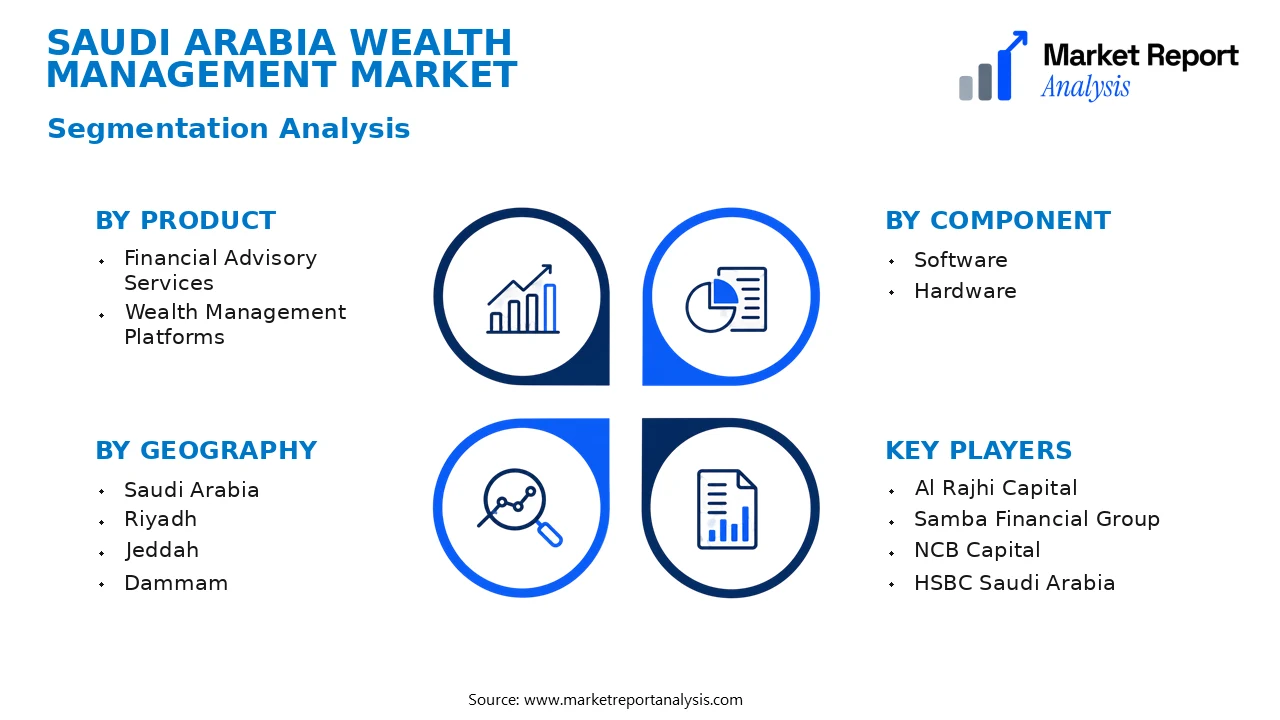
- Product
- Financial Advisory Services: These services encompass personalized investment advice, estate planning, and portfolio management, addressing the high-net-worth individuals' demand for customized wealth preservation and growth solutions in Saudi Arabia.
- Wealth Management Platforms: Software solutions that integrate client data, automate reporting, and streamline portfolio management processes, significantly enhancing operational efficiencies for financial institutions and catering to digitally savvy clients.
- Component
- Software: Critical for managing customer accounts, executing transactions, and providing analytical insights, the software component is increasingly integrated with AI and data analytics for better decision-making.
- Hardware: Comprising servers, networking equipment, and other infrastructure necessary for supporting sophisticated software solutions and ensuring secure, reliable service delivery to wealth management clients.
- Geography
- Saudi Arabia: The primary market encompasses the entire nation, driven by substantial government investments, policy reforms favoring private wealth growth, and expanding financial services infrastructure.
- Riyadh: As the capital and financial hub, Riyadh hosts most of the country's wealth management firms, private banks, and high-net-worth individual (HNWI) population, making it the most vibrant regional market.
- Jeddah: A key port city with a rapidly growing affluent population, Jeddah is witnessing increased demand for sophisticated wealth management services, particularly in real estate and commercial investments.
- Dammam: The economic center of the Eastern Province, Dammam benefits from oil industry influence and industrial investments, fostering a niche market for specialized wealth management offerings focused on energy sector clients.
- Mecca: Known for religious tourism, Mecca's wealth management market is developing as wealthy pilgrims and business owners seek financial services that cater to hospitality, property, and charitable foundations.
- Medina: Similar to Mecca, Medina’s wealth management growth is influenced by religious tourism and associated commercial activities, with increasing demand for investment advisory and estate planning services.
- Al Khobar: As part of the Dammam metropolitan area, Al Khobar possesses a burgeoning corporate sector and affluent residential zones, driving demand for comprehensive wealth management solutions.
- Jubail: An industrial city with significant petrochemical undertakings, Jubail’s wealth management services are tailored towards corporate executives and high-net-worth industrialists seeking specialized financial planning.
Competitive Intelligence
The Saudi Arabia wealth management market is characterized by a competitive landscape dominated by a handful of influential financial institutions, including local banks such as National Commercial Bank and Al Rajhi Bank, alongside global players like HSBC and Citibank. Market concentration remains high, with the top five firms controlling a significant portion of assets under management, fostering a duopolistic environment. These institutions employ aggressive expansion strategies, including leveraging technological advancements to enhance personalized services and operational efficiency. Product innovation centers on digital wealth solutions, sustainable investment funds, and Sharia-compliant offerings tailored to the Saudi market. Strategic partnerships between local banks and international fintech firms accelerate digital transformation and broaden client reach. Recent acquisitions aim to consolidate market share and expand service portfolios, particularly in affluent cities such as Riyadh and Jeddah. Robust R&D investments focus on AI-driven advisory platforms and cybersecurity, enabling differentiation through superior service agility and security. Overall, competition is driven by a blend of technological innovation, strategic alliances, and a focus on customized, compliance-driven investment solutions.
Leading Company Profiles
The wealth management landscape in Saudi Arabia is characterized by a competitive group of prominent financial firms that focus on high-net-worth individuals through innovative products, personalized services, and strategic expansion plans across the region.
- Al Rajhi Capital
- Samba Financial Group
- NCB Capital
- HSBC Saudi Arabia
- JP Morgan Saudi Arabia
- Barclays Bank Saudi Arabia
- Deutsche Bank Saudi Arabia
- Bank of America Merrill Lynch Saudi Arabia
- Goldman Sachs Saudi Arabia
- Citibank Saudi Arabia
Al Rajhi Capital
Al Rajhi Capital is a leading financial services provider offering tailored wealth management solutions, leveraging its extensive local market expertise to serve high-net-worth clients with innovative investment strategies and digital platforms.
Samba Financial Group
Samba Financial Group specializes in bespoke wealth advisory, asset management, and investment banking, focusing on integrating technological advancements and sustainable investing to meet the evolving needs of Saudi high-net-worth individuals.
NCB Capital
As a pioneer in the Saudi wealth management sector, NCB Capital provides comprehensive private banking, asset management, and investment solutions, emphasizing digital transformation and client-centric advisories to sustain long-term growth.
HSBC Saudi Arabia
HSBC offers premium wealth management services including personalized investment portfolios, estate planning, and comprehensive banking solutions, capitalizing on its global network and local market insights for high-net-worth clients.
JP Morgan Saudi Arabia
JP Morgan’s Saudi operations emphasize sophisticated wealth management, leveraging its global expertise, cutting-edge technology, and strategic alliances to deliver tailored financial solutions to Saudi HNWIs.
Barclays Bank Saudi Arabia
Barclays focuses on wealth planning, investment advisory, and asset management services, integrating innovative digital solutions to enhance client experience and maintain competitive strength within the Saudi market.
Deutsche Bank Saudi Arabia
Deutsche Bank offers wealth advisory, estate planning, and investment management, leveraging advanced analytics and technology to serve ultra-high-net-worth clients and expand its regional footprint.
Bank of America Merrill Lynch Saudi Arabia
Bank of America provides extensive wealth management services including tailored investment strategies, trust services, and financial planning, supported by a robust digital platform and strategic alliances.
Goldman Sachs Saudi Arabia
Goldman Sachs leverages its global investment banking expertise to offer exclusive wealth management and private banking services, emphasizing sustainability and innovative product offerings for affluent clients.
Citibank Saudi Arabia
Citibank provides comprehensive wealth and investment management solutions, utilizing its international network and technology-driven platforms to cater to the sophisticated needs of high-net-worth individuals in Saudi Arabia.
Strategic Business Developments
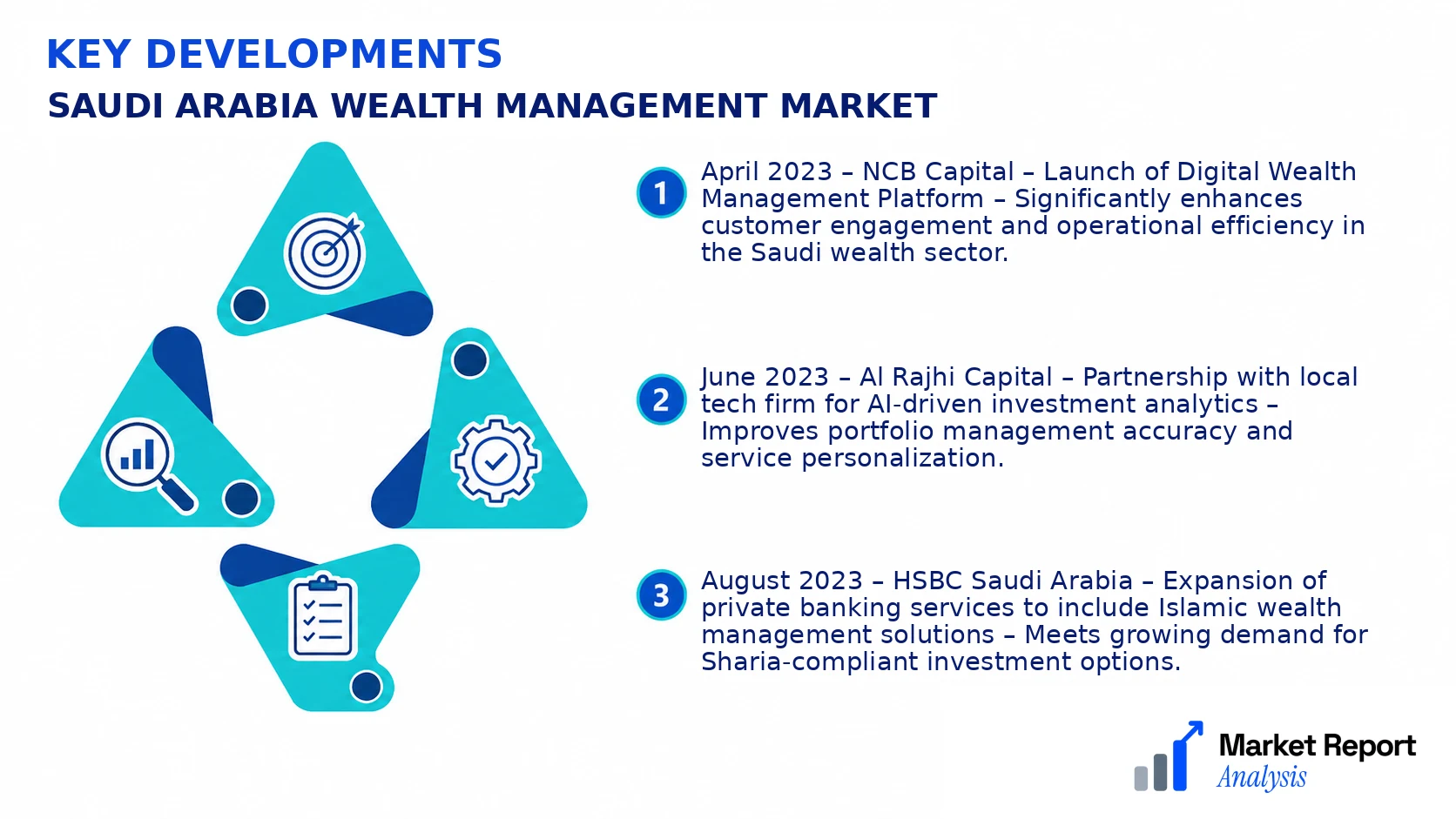
- April 2023 – NCB Capital – Launch of Digital Wealth Management Platform – Significantly enhances customer engagement and operational efficiency in the Saudi wealth sector.
- June 2023 – Al Rajhi Capital – Partnership with local tech firm for AI-driven investment analytics – Improves portfolio management accuracy and service personalization.
- August 2023 – HSBC Saudi Arabia – Expansion of private banking services to include Islamic wealth management solutions – Meets growing demand for Sharia-compliant investment options.
- October 2023 – Deutsche Bank Saudi Arabia – Acquisition of regional boutique asset manager – Strengthens market position and broadens product offerings to high-net-worth clients.
- December 2023 – JP Morgan Saudi Arabia – Launch of sustainable investing advisory – Aligns with regional trends towards ESG and responsible investing practices, catering to affluent clients’ preferences.
Frequently Asked Questions
What is the Saudi Arabia Wealth Management Market?
The Saudi Arabia Wealth Management Market encompasses financial services tailored to high-net-worth individuals (HNWIs), including investment advisory, asset management, estate planning, and private banking. It reflects the country’s growing affluent population and expanding financial sector.
What is the current market size of Saudi Arabia Wealth Management Market?
As of 2026, the Saudi Arabia Wealth Management Market is valued at approximately USD 25 Billion, driven by increasing wealth accumulation among high-net-worth individuals and a shift towards diversified investment portfolios facilitated by regulatory reforms.
What factors are driving the Saudi Arabia Wealth Management Market?
Key drivers include rising oil revenues, government initiatives for economic diversification such as Vision 2030, increasing domestic wealth, favorable regulatory reforms, and growing awareness of wealth management solutions among the Saudi population.
Which Saudi city leads the Saudi Arabia Wealth Management Market?
Riyadh emerges as the leading city, owing to its status as the political and economic capital, hosting the majority of private banks, wealth management firms, and high-net-worth individuals engaging in diverse investment activities.
Which segment is expected to grow the fastest?
The private banking segment is projected to witness the fastest growth, driven by rising affluent wealth, strategic partnerships, and technological advancements in personalized financial services tailored to HNWIs.
Who are the leading companies operating in the Saudi Arabia Wealth Management Market?
Major players include Saudi British Bank, Banque Saudi Fransi, J.P. Morgan, and Citi Private Bank, distinguished by their extensive local presence, innovative product offerings, and partnerships tailored to Saudi high-net-worth clients.
Analyst Perspective
The Saudi Arabia Wealth Management Market exhibits a maturity driven by increasing domestic wealth, government initiatives supporting financial sectors, and rising demand for personalized investment solutions. Long-term prospects remain robust, propelled by ongoing economic diversification under Vision 2030, which opens diverse sectors for wealth management services. Commercial opportunities lie in digital platform integration, ESG-focused products, and tailored solutions for high-net-worth individuals, especially in Riyadh and Jeddah, where urban wealth accumulation is concentrated. Technological evolution, notably fintech advancements and AI-driven advisory services, will contest traditional players and reshape client engagement. Investment priorities should focus on infrastructure for digital transformation, strategic alliances, and expanding private banking networks to capture emerging affluent segments. Competition is intensifying, with both traditional banks and new entrants vying for market share. City-level growth is most promising in Riyadh’s evolving financial hub and Jeddah’s entrepreneurial scene, suggesting these cities will drive industry expansion. Strategic positioning must emphasize innovation, regulatory agility, and targeted client outreach to sustain long-term growth.
