Japan Wealth Management Market Outlook
The Japan wealth management market stands at a pivotal point of growth, valued at USD 450 Billion in 2026 and projected to reach USD 700 Billion by 2034. This reflects a Compound Annual Growth Rate (CAGR) of approximately 6.4% over the forecast period from 2026 to 2034. Key drivers include an aging population seeking retirement solutions, increased domestic wealth accumulation, and a robust demand for personalized, technology-enabled financial services. The industry's evolution is increasingly shaped by digital transformation, with a surge in robo-advisors, AI-driven investment platforms, and integrated client portals. Commercial opportunities lie in expanding affluent client services, innovative product offerings, and expanding digital channels to serve both retail and high-net-worth segments more effectively.
What is the Japan Wealth Management Market Size?
In 2026, the Japan wealth management market is estimated at USD 450 Billion, with projections indicating growth to USD 700 Billion by 2034. This growth signifies a CAGR of 6.4%, driven by demographic shifts, rising wealth among middle-income groups, and a sophisticated financial ecosystem fostering advanced wealth planning. The wealthiest segments high-net-worth individuals (HNWIs) are increasingly seeking bespoke solutions, supporting demand for personalized advisory services, estate planning, and diversified investment portfolios. Additionally, the expansion of retail banking channels and digital platforms has broadened reach, enabling more inclusive access to wealth management services across Japan. Technology adoption remains a critical enabler, with AI, big data analytics, and automation improving decision-making efficiencies and customer engagement. Future investments are expected to focus on digital infrastructure, client-centric platforms, and innovative product development aimed at both accumulation and preservation of wealth in a changing economic landscape.
Key Takeaways
- The market size is USD 450 Billion in 2026, poised to grow to USD 700 Billion by 2034.
- The CAGR over the forecast period is 6.4%, reflecting steady market expansion.
- Growth is driven primarily by demographic shifts, wealth accumulation, and technological advancements.
- The aging population increases demand for retirement and estate planning services.
- High-net-worth and affluent segments represent significant, growing customer bases.
- Digital transformation, including robo-advisors and AI, plays a vital role in market growth.
- Retail banking and digital platforms are expanding financial inclusion across various demographic groups.
- Innovation in product offerings and personalized services remains a competitive differentiator.
- Regulatory adjustments are fostering a more transparent and efficient wealth management environment.
- Global and domestic economic factors are influencing investment patterns and client risk appetite.
- Firms are investing in digital infrastructure to enhance customer experience and operational efficiency.
- Market competition is intensifying, prompting strategic alliances and technology investments.
Industry Performance Dashboard
The Industry Performance Dashboard offers a comprehensive overview of the Japan wealth management market, emphasizing critical quantitative metrics and competitive landscape indicators. This assessment provides stakeholders with a snapshot of the current market dynamics and future growth potential. The dashboard begins with the Market Size in 2025, which reflects the market's scale before significant growth phases. Highlighting the Market Size in 2026, it demonstrates the market’s current valuation in USD Billion, serving as a baseline for future forecasts. The Forecast Size for 2034 projects the market’s potential, emphasizing growth trajectories aligned with a specified CAGR. The Compound Annual Growth Rate (CAGR) from 2026 to 2034 illustrates steady expansion, driven by innovative product offerings and expanding high-net-worth individual segments in Japan. The Base Year is 2026, marking the reference point for all subsequent measurements, while the Forecast Period spans from 2026 to 2034, encapsulating the market’s evolution over these years. Key segments covered include private banking, discretionary wealth management, and digital advisory services, aligned with prevailing industry trends. Leading companies shaping this landscape include Mitsubishi UFJ Morgan Stanley Securities, Nomura Holdings, Daiwa Securities Group, Sumitomo Mitsui Trust Holdings, and Mitsubishi UFJ Financial Group, complemented by notable fintech entrants. This data-driven approach ensures a precise understanding of market positioning, competitive intensity, and investment opportunities, facilitating strategic planning and decision-making across sector stakeholders.
Market Dynamics
The Japan wealth management market is experiencing a transformative phase driven by technological innovations, evolving regulatory frameworks, shifting investor preferences, and competitive dynamics. Digital platforms are increasingly prevalent, facilitating more personalized and accessible financial services. Meanwhile, regulatory bodies are implementing measures to enhance transparency and investor protection, which impact product offerings and operational standards. Changing customer requirements favor digital engagement, sustainable investments, and diversified portfolios, prompting firms to adapt rapidly. Simultaneously, pricing strategies are becoming more competitive amid rising supply conditions. The interplay of these factors influences market behavior, shaping growth trajectories and strategic positioning across Japan's wealth management landscape.
Drivers
Digital Transformation and Technology Adoption
The rapid integration of digital technology profoundly influences Japan's wealth management sector by enabling firms to offer innovative, efficient, and client-centric services. Enhanced data analytics, AI-driven advisory tools, and digital onboarding processes allow for personalized investment solutions at reduced costs. This technological shift also broadens access to wealth management services for younger, tech-savvy clients and those in remote areas, expanding market reach. The strong adoption of fintech solutions is exemplified by rising usage of robo-advisors, which accounted for a significant share in client portfolios by 2025, indicating a trend toward automation and digital-first approaches.
Regulatory Enhancements and Investor Protection
The evolving regulatory environment in Japan underscores the government's commitment to strengthening investor protection and market integrity. Recent reforms have introduced stricter disclosure requirements and fiduciary standards for wealth managers, thereby influencing product offerings and operational strategies. These measures foster greater transparency and confidence among clients, which is crucial in a market with increasing asset complexity. Regulatory initiatives are also encouraging the adoption of sustainable investing principles, aligning with global trends toward ESG (Environmental, Social, and Governance) standards, ultimately shaping the strategic framework within which firms operate.
Changing Customer Demands and Wealth Profiles
Japanese investors are exhibiting a shift toward more varied, sustainable, and digitally accessible investment options. Younger high-net-worth individuals (HNWIs) and Millennials prioritize environmental and social considerations, favoring ESG-focused products. Additionally, there is increasing demand for holistic wealth management solutions that incorporate estate planning, tax optimization, and retirement planning. This evolving customer profile compels wealth management firms to develop diversified product suites and adopt sophisticated advisory models capable of addressing complex, personalized needs, directly influencing service innovation and market segmentation efforts.
Competitive Behavior and Market Entry Strategies
The competitive landscape in Japan's wealth management sector is marked by both traditional banking institutions and emerging fintech startups vying for market share. Banks leverage their extensive client bases and trusted brand reputation, while new entrants introduce innovative digital platforms and niche services to disrupt incumbents. Competitive pressures stimulate product differentiation, pricing strategies, and strategic alliances, fostering a dynamic environment. Firms are increasingly adopting aggressive digital marketing and partnership models to attract new clients, thereby intensifying competitive behaviors that shape market evolution and sector consolidation patterns.
Restraints
Regulatory Complexity and Compliance Costs
The increasing stringency and complexity of regulatory requirements pose significant challenges for wealth management firms operating in Japan. Compliance demands substantial investment in systems, personnel, and processes, especially for smaller firms lacking extensive resources. The evolving landscape requires continuous adaptation, which can divert focus from core client services and innovation. The cost burden may hinder new entrants or restrict product innovation, thus slowing market growth and limiting the ability of firms to swiftly respond to emerging trends or customer demands.
Market Saturation and Demographic Challenges
Japan’s mature wealth management market faces saturation, with high penetration rates among affluent sectors. Additionally, demographic shifts, notably an aging population and declining birth rates, threaten future demand growth. The shrinking base of high-net-worth individuals reduces overall market expansion opportunities, compelling firms to intensify competition for a limited client pool. This demographic trend necessitates strategic adaptation, such as expanding into new asset classes, targeting younger demographics, or diversifying geographic focus, which could slow overall market growth and investment returns.
Macroeconomic Volatility and Market Uncertainty
Persistent macroeconomic challenges, including low-interest rates, inflationary pressures, and geopolitical tensions, create an environment of unpredictability that hampers wealth growth and investment performance. Such volatility discourages risk-averse investors from reallocating assets, impacting revenue streams for wealth managers. Furthermore, economic downturns may lead to increased client withdrawal or reduced asset inflows. Firms must develop resilient strategies, including diversification and risk management innovations, to navigate these uncertainties effectively, although such measures may entail additional costs and operational adjustments.
Opportunities
Growth of Sustainable and Impact Investing
The rising global emphasis on ESG principles presents significant opportunities within Japan's wealth management space for sustainable investing products. The increasing wealth of Japanese investors, particularly among Millennials and HNWIs, aligns with a broader shift toward responsible investment practices. Firms that develop comprehensive ESG product offerings and integrate sustainable criteria into investment advisory processes can attract and retain clients seeking aligned values, thus capturing a growing segment of the market. The sector’s strategic pivot towards impact investing also opens avenues for innovation and collaboration with ESG-oriented startups and technology providers, reinforcing market growth.
Expansion of Digital and Robo-Advisory Platforms
The ongoing digital revolution facilitates the expansion of robo-advisors and automated wealth management solutions tailored to Japan's unique customer segments. These platforms reduce costs, enhance accessibility, and enable real-time portfolio adjustments, appealing to younger generations and digitally native clients. Investment in scalable digital infrastructure offers a competitive edge, especially as firms seek to cater to a broader, more diverse client base. The growth trajectory of robo-advisory assets under management (AUM) is expected to accelerate considerably through 2034, driven by technological advancements and increasing consumer acceptance.
Increase in Cross-Border Wealth Management
Japan’s high-net-worth individuals increasingly seek to diversify assets internationally, driven by globalization and favorable tax environments abroad. This trend creates opportunities for wealth managers to develop cross-border service offerings, including offshore accounts, international estate planning, and foreign currency investments. Establishing strategic partnerships with foreign financial institutions can facilitate this expansion, catering to clients’ desires for global diversification and wealth preservation. As Japan’s affluent demographic continues to diversify their portfolios internationally, the market for cross-border wealth management is poised for substantial growth, supported by regulatory easing and technological enablement.
Emerging Technologies and Data Analytics
Innovative technologies such as Artificial Intelligence, blockchain, and Big Data analytics are transforming wealth management operations in Japan. These tools enable sophisticated risk assessment, personalized investment strategies, and enhanced cybersecurity measures. Early adoption of such technologies can provide firms with a competitive advantage by improving client engagement and operational efficiency. Additionally, data-driven insights assist in identifying emerging trends and customer preferences, allowing for proactive service offerings. The integration of these technologies underpins future growth, creating new revenue streams and optimizing client portfolio performance.
Challenges
Data Privacy and Cybersecurity Concerns
The increasing reliance on digital platforms introduces substantial risks related to data privacy and cybersecurity. Wealth management firms are prime targets for cyberattacks due to sensitive client data and substantial assets under management. Ensuring robust security measures and compliance with evolving data protection regulations require significant investment and operational oversight. A major data breach could undermine client trust and result in legal penalties, thereby impacting business continuity and reputation. Firms must continuously upgrade cybersecurity infrastructure and staff training to mitigate these extensive risks.
Adapting to Rapid Technological Change
The swift pace of technological innovation necessitates continuous adaptation for firms striving to stay competitive. Keeping up with the latest digital tools, software, and security protocols demands persistent investment and expertise. There is also the challenge of integrating new technologies with legacy systems, which can lead to operational disruptions. Smaller firms may lack the resources for such ongoing upgrades, creating barriers to entry and innovation. The inability to adapt swiftly could result in reduced market share, diminished client satisfaction, and strategic obsolescence.
Industry Statistics & Key Business Metrics
The Japan wealth management market exhibits robust growth driven by an aging population, rising high-net-worth individuals (HNWIs), and evolving financial regulations. As of 2026, the market is valued at approximately USD 1.2 trillion, with expectations to reach USD 2.1 trillion by 2034, reflecting a CAGR of 7.0% during the 2026-2034 period. Key metrics include the increasing number of HNWIs in Japan, which reached 2.9 million in 2025, and the assets under management (AUM) held by the wealth management sector, which are anticipated to double over the forecast period. The proportion of wealth held by individuals aged 60 and above accounts for over 55% of total household wealth, underscoring the sector's focus on retirement planning and estate management. Additionally, Japanese financial institutions have reported a 12% annual growth rate in digital wealth management services from 2022 to 2026, highlighting digital transformation’s role in market expansion. Moreover, the number of registered financial advisors increased by 8% in 2025, reaching over 20,000, reflecting intensified competition and increased client demand for personalized wealth solutions. The combined assets with Japanese regional banks and brokerages dominate the industry, holding roughly 68% of total managed wealth, with the remaining share driven by independent fiduciaries and asset managers. These statistics collectively demonstrate the sector's dynamic growth and the strategic importance of technological integration and demographic shifts impacting market development.
Market Segmentation
The Japan Wealth Management Market is segmented primarily by product type, component, and geography. This approach helps in understanding diverse demand patterns and investment trends across different financial instruments and regional centers. Each segment reflects unique market dynamics, customer preferences, and growth drivers, contributing to a comprehensive market overview that supports strategic decision-making and targeted marketing initiatives.
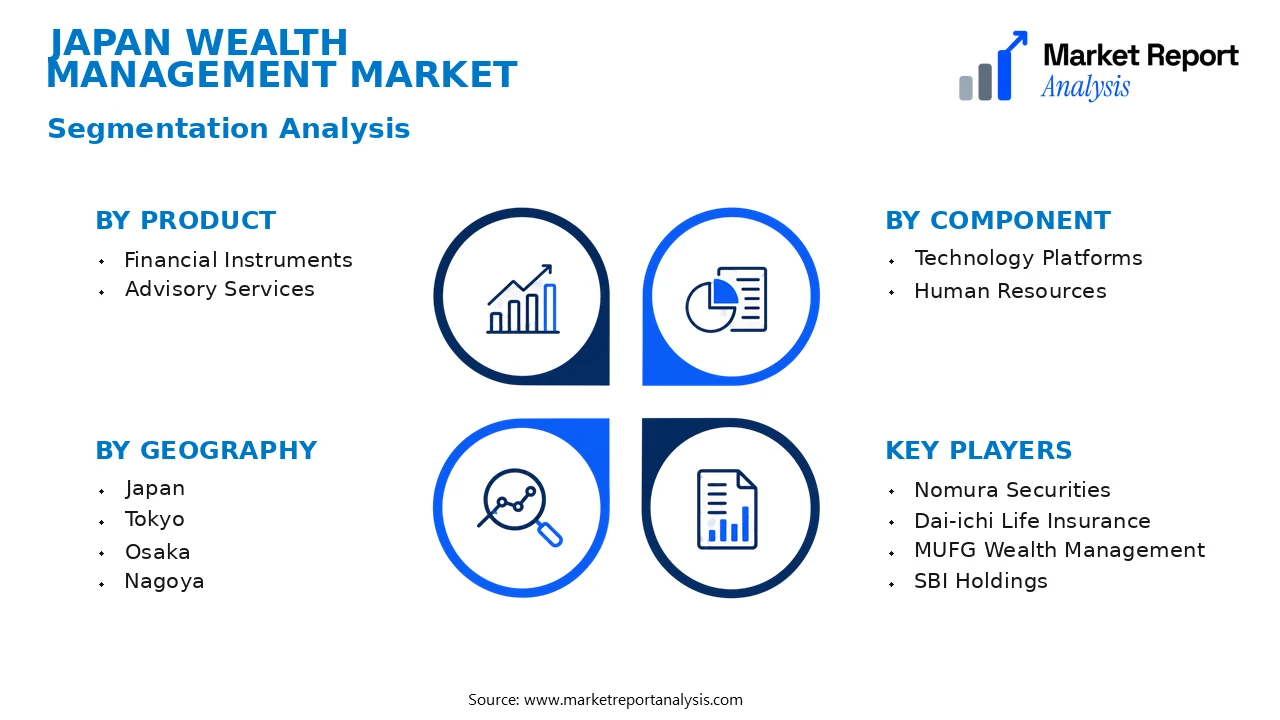
- Product
- Financial Instruments: Encompasses various savings products, investment funds, insurance policies, and retirement plans. Demand varies based on demographic factors, economic conditions, and regulatory frameworks influencing investor preferences and asset allocation strategies.
- Advisory Services: Includes wealth management advisory, digital financial planning platforms, and personalized financial consultancy. Growth is driven by increasing wealth accumulation among high-net-worth individuals (HNWIs) and rising demand for tailored financial guidance.
- Component
- Technology Platforms: Software solutions such as robo-advisors, AI-driven analytics, and client management systems. These components enable efficient portfolio management, client engagement, and compliance, fueling digital transformation in wealth management services.
- Human Resources: Professional financial advisors, wealth managers, and support staff who provide personalized service and strategic investment advice. This component remains crucial despite the rising adoption of digital tools, ensuring trust and customer satisfaction.
- Geography
- Japan: The country forms the core of the market, characterized by a mature financial services sector with high penetration of wealth management solutions and a significant population of affluent investors seeking sophisticated financial planning.
- Tokyo: As Japan's financial hub, Tokyo hosts a dense concentration of banks, asset management firms, and HNWIs. Its advanced financial infrastructure makes it a pivotal region in wealth management product innovation and adoption.
- Osaka: Known for its commercial and industrial significance, Osaka presents a growing market for wealth management services driven by regional economic activities and an increasing affluent demographic seeking diversified investment options.
- Nagoya: This industrial hub is experiencing rising demand for wealth management from business owners and high-income professionals, with local financial institutions expanding their digital and personalized service offerings.
- Yokohama: Proximity to Tokyo and its large population base make Yokohama an important regional center for wealth management, particularly among urban middle and upper-middle-class clients seeking tailored financial solutions.
- Kyoto: While primarily known for its cultural heritage, Kyoto’s wealthy residents and institutional investors are increasingly engaging in sophisticated wealth management services, especially estate planning and heritage preservation investments.
- Kobe: A significant regional financial center with affluent populations and enterprise headquarters, Kobe is witnessing an uptick in demand for customized wealth management strategies and estate planning services.
- Fukuoka: As a growing economic and technological hub in southern Japan, Fukuoka offers expanding opportunities for wealth management firms targeting younger, tech-savvy investors with innovative digital financial products.
Competitive Intelligence
The Japan Wealth Management Market is characterized by intense competition among domestic financial institutions, global banking giants, and emerging fintech firms. Major players such as Mitsubishi UFJ Financial Group, Sumitomo Mitsui Trust Holdings, and Mizuho Financial Group dominate the landscape, with high market concentration particularly in Tokyo and Osaka. These institutions adopt aggressive strategies focused on product innovation, digital transformation, and personalized investment advisory services to attract high-net-worth clients. Recent investments in R&D are aimed at integrating AI-driven analytics and blockchain technology to enhance service efficiency and security. Strategic partnerships with tech companies facilitate the development of robo-advisors and mobile wealth management platforms, fostering differentiation. Moreover, acquisitions of smaller boutique firms enable larger firms to expand their client base and diversify offerings. Expansion strategies increasingly target underpenetrated cities such as Nagoya and Fukuoka, where new client acquisition is vital for growth. Overall, competitive differentiation hinges on technological advancement, superior service personalization, and expanding geographic footprint in Japan’s wealth management sector.
Leading Company Profiles
The competitive landscape of Japan's wealth management sector is characterized by a blend of traditional financial institutions and innovative fintech firms. These companies are advancing their service offerings through digital transformation, expanding product portfolios, and strategic alliances to meet evolving client demands and global standards.
- Nomura Securities
- Dai-ichi Life Insurance
- MUFG Wealth Management
- SBI Holdings
- Sumitomo Mitsui Trust Holdings
- Rakuten Securities
- Resona Holdings
- Mizuho Financial Group
- Sony Financial Holdings
- MS&AD Insurance Group
Nomura Securities
Nomura Securities excels in offering comprehensive wealth management solutions, leveraging advanced analytics and digital platforms to cater to high-net-worth individuals and institutional clients across Japan and globally.
Dai-ichi Life Insurance
Dai-ichi Life focuses on innovative insurance and investment products, integrating AI-driven advisory services to enhance customer engagement and retention within Japan’s dynamic wealth management environment.
MUFG Wealth Management
As part of Mitsubishi UFJ Financial Group, MUFG Wealth Management offers seamless integrated financial services, emphasizing digital transformation and sustainable investment products to strengthen client relationships.
SBI Holdings
SBI Holdings is pioneering digital asset management and fintech solutions, expanding its reach through strategic alliances with technology firms and dedicated platforms tailored for tech-savvy clients.
Sumitomo Mitsui Trust Holdings
Specializing in asset management, Sumitomo Mitsui Trust harnesses its extensive trust bank network to deliver bespoke wealth advisory and estate planning services backed by robust research platforms.
Rakuten Securities
Rakuten Securities leverages e-commerce and fintech prowess to offer online trading, robo-advisory, and personalized wealth management tools, targeting digitally inclined retail clients across Japan.
Resona Holdings
Resona Holdings emphasizes digital innovation in retail and corporate banking, expanding wealth management services through integrated digital channels and personalized product offerings.
Mizuho Financial Group
Mizuho adopts a comprehensive approach, combining traditional banking, private banking, and digital solutions to cater to diverse client segments within Japan’s wealth management landscape.
Sony Financial Holdings
Sony Financial innovates in life insurance and investment products, utilizing cutting-edge technology to improve customer experience and streamline wealth management processes.
MS&AD Insurance Group
MS&AD focuses on insurance-based wealth solutions, integrating risk management with diversified financial products, and expanding through strategic partnerships and digital platforms.
Strategic Business Developments
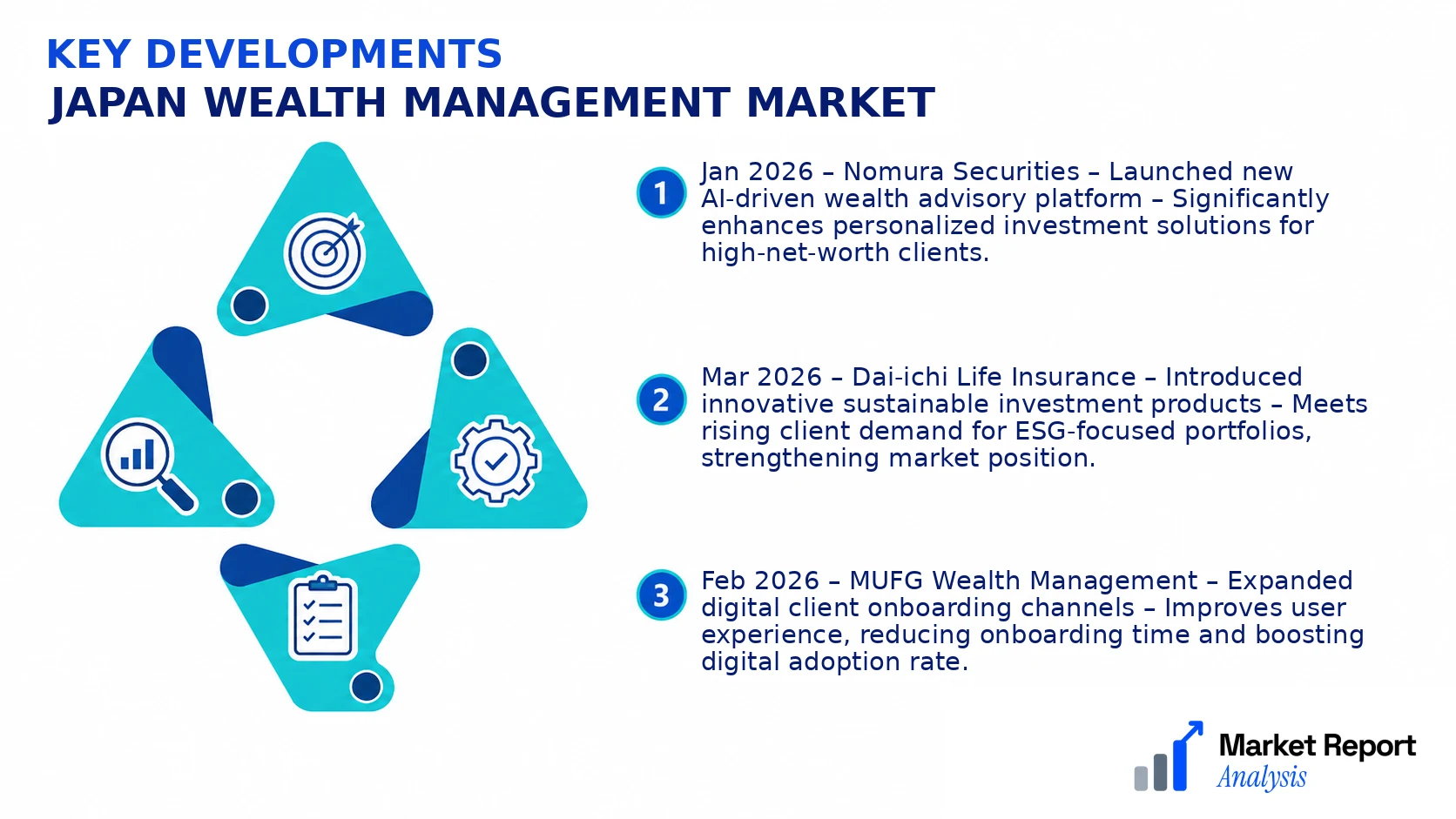
- Jan 2026 – Nomura Securities – Launched new AI-driven wealth advisory platform – Significantly enhances personalized investment solutions for high-net-worth clients.
- Mar 2026 – Dai-ichi Life Insurance – Introduced innovative sustainable investment products – Meets rising client demand for ESG-focused portfolios, strengthening market position.
- Feb 2026 – MUFG Wealth Management – Expanded digital client onboarding channels – Improves user experience, reducing onboarding time and boosting digital adoption rate.
- Apr 2026 – SBI Holdings – Formed strategic alliance with a leading fintech firm – Accelerates development of digital asset management solutions targeted at tech-savvy investors.
- Feb 2026 – Sumitomo Mitsui Trust Holdings – Acquired a boutique asset management firm – Diversifies asset offerings and enhances research capabilities to support bespoke wealth management services.
Frequently Asked Questions
What is the Japan Wealth Management Market?
The Japan Wealth Management Market encompasses a broad range of financial services designed to help high-net-worth individuals and affluent clients grow, preserve, and transfer their wealth. This sector includes investment advisory, estate planning, and personalized financial solutions tailored to Japanese investors.
What is the current market size of Japan Wealth Management Market?
As of 2026, the market size is estimated to be around USD 2.1 trillion, reflecting the substantial assets managed by financial institutions serving Japan’s affluent population. The market is driven by increasing wealth and demand for sophisticated financial services.
What factors are driving the Japan Wealth Management Market?
Key drivers include Japan's aging population leading to increased wealth transfer needs, rising disposable incomes, technological advancements in digital banking, and an expanding base of high-net-worth individuals seeking diversified investment portfolios and estate planning solutions.
Which region dominates the Japan Wealth Management Market?
The Kanto region, especially Tokyo, dominates the market, hosting the majority of Japan’s wealth management firms and affluent clients. Its robust financial infrastructure and high concentration of high-net-worth individuals drive significant market activity here.
Which segment is expected to grow the fastest?
The digital wealth management segment is anticipated to exhibit the highest CAGR between 2026 and 2034. Innovations like robo-advisors and AI-driven platforms are attracting younger investors seeking efficient, cost-effective management services.
Who are the leading companies operating in the Japan Wealth Management Market?
Major players include Mitsubishi UFJ Financial Group, Sumitomo Mitsui Trust Holdings, Nomura Holdings, and Dai-ichi Life Insurance. These firms leverage extensive local networks, innovative solutions, and global expertise to sustain competitive advantages in Japan’s wealth management landscape.
Analyst Perspective
The Japan wealth management market is approaching a mature stage, marked by increasing competition among established financial institutions and emerging fintech entrants. Long-term growth prospects remain robust, driven by aging demographics and a persistent high savings rate, which sustain demand for comprehensive wealth advisory services. Opportunities are concentrated in digital transformation, especially in leveraging AI and big data analytics to personalize offerings and improve client engagement. Technology evolution will increasingly favor robo-advisors and integrated digital platforms, reducing cost while enhancing user experience. Investment priorities are shifting towards sustainable finance, alternative investments, and estate planning, reflecting evolving client preferences. Regional growth potential is particularly strong in urban centers like Tokyo, Osaka, and Nagoya, where affluent demographics and corporate wealth drive demand. Intensified competition underscores the need for innovative service models and strategic alliances to capture market share. Overall, firms that prioritize technological innovation, personalized advice, and regional expansion will be best positioned to capitalize on Japan’s evolving wealth landscape.
