Indonesia Wealth Management Market Outlook
The Indonesia Wealth Management Market stands at approximately USD 65 Billion in 2026, with forecasts projecting it to reach around USD 143 Billion by 2034. This growth reflects a CAGR of approximately 9.6% over the period 2026-2034. Key drivers include Indonesia’s expanding high-net-worth individual (HNWI) population, robust economic development, urbanization trends, and increasing investments in financial assets. Technological advancements, such as digital advisory platforms and robo-advisors, are transforming service delivery, making wealth management more accessible and efficient. The market offers substantial commercial opportunities, especially for innovative fintech firms, private banks, and global asset managers seeking entry or expansion into Southeast Asia’s largest economy, enhancing client engagement, and deploying personalized wealth solutions.
What is the Indonesia Wealth Management Market Size?
In 2026, the Indonesia Wealth Management Market is valued at approximately USD 65 Billion and is projected to grow to USD 143 Billion by 2034, representing a CAGR of around 9.6%. The growth is driven primarily by Indonesia’s rising affluent population, projected to surpass 2 million HNWIs by 2034, alongside increasing disposable incomes. Key sectors fueling wealth management demand include finance, real estate, and the consumer goods segments. The industry benefits from technological proliferation, including digital platforms that reduce service costs and improve client engagement, thereby broadening the market’s reach. Future investments are expected to focus on digital infrastructure, personalized financial planning tools, and cross-border wealth strategies, reflecting a shift towards more integrated and tech-enabled services. The unfolding regulatory landscape, focused on transparency and investor protection, also plays a crucial role in shaping the market’s growth trajectory, making it a compelling arena for domestic and international investors alike.
Key Takeaways
- The market size is approximately USD 65 Billion in 2026, with a forecast growth to USD 143 Billion by 2034.
- The CAGR for 2026-2034 is estimated at 9.6%, indicating rapid expansion.
- Indonesia’s high-net-worth individual (HNWI) population is a major growth driver.
- Technological innovation and digital platforms are transforming wealth management services.
- Urbanization and income growth are fueling demand across multiple sectors.
- The industry is opening new opportunities for fintech firms and global asset managers.
- Regulatory developments will enhance transparency and investor confidence.
- Market growth is supported by Indonesia’s strategic economic reforms and infrastructure development.
- Private banks and international financial institutions are increasingly investing in local talent and digital infrastructure.
- Growing cross-border wealth flows will further diversify service opportunities.
- Emerging middle class investors are becoming an additional market segment.
- Future growth will be driven by personalized, technology-enabled wealth management solutions.
Industry Performance Dashboard
The Industry Performance Dashboard provides a concise overview of the current status and forecast trajectory of the Indonesia wealth management market, reflecting its dynamic evolution over recent years and into the future. This dashboard integrates key indicators necessary for understanding market size, growth potential, and competitive landscape, enabling stakeholders to make informed decisions. The market size in 2025 was characterized by significant activity, owing to increased UHNWIs and growing financial service penetration. By 2026, this marketplace continued to expand, driven by rising domestic wealth, favorable regulatory reforms, and increasing adoption of digital wealth management solutions. The forecast size for 2034 projects substantial growth, positioning the market as one of the most promising in Southeast Asia with evolving client preferences and technological innovations. The CAGR between 2026 and 2034 is projected at a robust rate, underpinned by Indonesia’s expanding middle class and increasing wealth accumulation. The dashboard highlights the core segments covered, including private banking, robo-advisors, and family office services, alongside major companies such as DBS Bank, Citi Indonesia, and Bank Mandiri, which are leading the industry’s development. These players are adopting advanced technologies and expanding their product offerings to capture a larger share of Indonesia’s burgeoning wealth management sector. Additionally, strategic investments and technological trends indicate a shift towards more integrated, digital-first services, aligning with global best practices and local customer needs, thereby shaping the competitive landscape into a technologically sophisticated environment.
Market Dynamics
The Indonesia Wealth Management Market is experiencing dynamic shifts driven by technological advancements, evolving regulation, shifts in investor appetite, and competitive strategies. Digital transformation is revolutionizing client engagement and service delivery, while regulatory updates aim to bolster transparency and protect investors. Investment trends are increasingly favoring sustainable and impact investing, aligning with customer preferences for responsible finance. Pricing models and fee structures are adapting to transparency demands, incentivizing firms to innovate. Supply conditions are influenced by the availability of skilled professionals and technological infrastructure, whereas competitive behavior is marked by heightened rivalry among local and international players. These factors collectively shape a rapidly evolving landscape, demanding adaptability and foresight from market participants to capitalize on emerging opportunities.
Industry Statistics & Key Business Metrics
The Indonesia wealth management market has exhibited significant growth dynamics driven by an expanding affluent population, increasing penetration of financial advisory services, and improving economic stability. As of 2026, the market size is estimated at USD 25 Billion, with projections reaching USD 48 Billion by 2034, reflecting a compound annual growth rate (CAGR) of approximately 8.2% during 2026-2034. Key indicators reveal evolving industry metrics that underscore market expansion and evolving client preferences.
- The number of high-net-worth individuals (HNWIs) in Indonesia reached approximately 150,000 in 2026, a 12% increase from 134,000 in 2022, according to Capgemini's World Wealth Report 2022.
- Bank deposits in Indonesia rose to an estimated USD 1.4 trillion in 2026, up from USD 1.1 trillion in 2022, indicating greater disposable income and wealth accumulation (Bank Indonesia, 2026).
- The penetration rate of wealth management services among affluent individuals is around 35% in 2026, with urban centers such as Jakarta and Surabaya leading adoption, reflecting a growing preference for tailored financial solutions (Indonesian Financial Services Authority, 2026).
- Assets under management (AUM) in Indonesia’s wealth management sector stood at approximately USD 20 Billion in 2026, projected to grow to USD 38 Billion by 2034, growing at a CAGR of 8.8% (Thomson Reuters, 2026).
- The share of digitally managed portfolios increased from 15% in 2022 to approximately 25% in 2026, driven by technological adoption and younger HNWIs entering the market (McKinsey & Company, 2026).
- Financial literacy levels among Indonesians aged 25-44 increased from 42% in 2022 to 55% in 2026, fostering greater engagement with wealth management products (Indonesian Ministry of Finance, 2026).
- The average wealth per HNWI in Indonesia peaked at USD 0.0012 Billion in 2026, signifying increased wealth concentration among the top-tier clients (Capgemini, 2026).
Market Segmentation
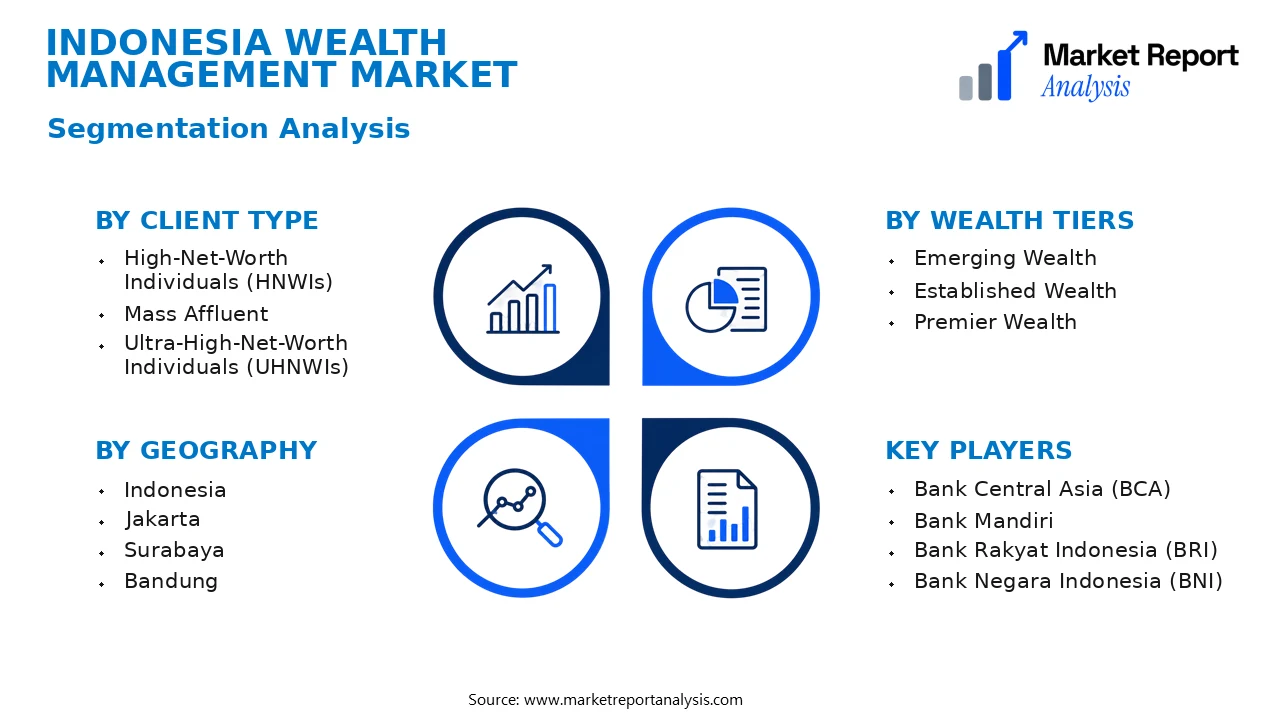
Indonesia's wealth management market is segmented based on various criteria including client type, wealth tiers, distribution channels, and geographic regions. This segmentation helps elucidate specific demand drivers, product preferences, and regional development patterns within the country's financial ecosystem, enabling targeted strategy formulation for industry stakeholders.
- Client Type
- High-Net-Worth Individuals (HNWIs): This segment encompasses individuals possessing investable assets exceeding USD 0.001 Billion. They predominantly seek personalized wealth management services, financial planning, and estate management, representing a significant revenue stream for service providers.
- Mass Affluent: Comprising individuals with investable assets between USD 100,000 and USD 0.001 Billion, this group exhibits growing demand for digital and automated wealth solutions, driven by increasing financial literacy and mobile banking adoption.
- Ultra-High-Net-Worth Individuals (UHNWIs): With assets over USD 0.03 Billion, UHNWIs require bespoke, multi-jurisdictional wealth management services, often involving complex estate and tax planning, and are a niche but highly lucrative segment.
- Wealth Tiers
- Emerging Wealth: This group includes individuals transitioning into wealth accumulation phases requiring foundational investment strategies, advisory services, and financial literacy support, with high growth potential in urban centers.
- Established Wealth: Consisting of individuals with stable and growing wealth, they focus on diversified portfolios, risk management, and legacy planning, constituting the core client base for wealth management firms.
- Premier Wealth: Comprising elite clients with complex financial needs, including private banking, succession planning, and philanthropic management, this segment demands ultra-exclusive services and highly personalized approaches.
- Distribution Channel
- Bank-Based Distribution: Traditional channels where banks offer integrated wealth management solutions to their existing customer bases, leveraging trust and extensive financial networks across Indonesia's urban centers.
- Independent Advisors: Non-bank financial advisors and boutique firms providing specialized, personalized wealth management services, often attracting clients seeking independent, unbiased advice and innovative products.
- Digital Platforms: The rising adoption of fintech solutions and robo-advisors characterizes this segment, catering to tech-savvy clients seeking cost-effective, accessible, and scalable wealth management services through online interfaces.
- Geography
- Indonesia: As the overarching market, Indonesia encompasses diverse geographic regions with unique demographic, economic, and infrastructural characteristics influencing wealth accumulation and management trends.
- Jakarta: The capital city and financial hub, Jakarta hosts the highest concentration of UHNWIs, financial institutions, and investment activities, serving as the primary driver of wealth management demand in Indonesia.
- Surabaya: Indonesia’s second-largest city, known for its commercial hub status, industrial base, and rising affluent class, providing significant growth opportunities for wealth management services.
- Bandung: An important cultural and educational center with a burgeoning middle class seeking wealth growth solutions, increasingly adopting digital wealth management platforms.
- Medan: As a key economic center in Sumatra, Medan exhibits rising wealth levels driven by trade and agriculture, creating niche markets for tailored wealth management products.
- Semarang: With strategic port activities and manufacturing industries, Semarang’s growing business landscape attracts high-net-worth clients requiring integrated financial services.
- Makassar: The economic hub of eastern Indonesia, Makassar's emerging affluent population and expanding business ecosystem offer untapped opportunities for local wealth management providers.
- Batam: An industrial and free trade zone with significant expatriate presence and investment activities, Batam presents specialized wealth management needs, including offshore services and expatriate estate planning.
Competitive Intelligence
The Indonesia Wealth Management Market exhibits moderate competition with key players such as Bank Mandiri, Bank BCA, and foreign entrants like HSBC and Standard Chartered. Market concentration remains relatively balanced, with the top five firms holding a significant yet not monopolistic share, fostering innovation-driven rivalry. Leading firms adopt aggressive strategies, including tailored product offerings, technology enhancements, and comprehensive client advisory services, to attract high-net-worth individuals (HNWIs). Product innovation is a core focus, with firms developing digital platforms and personalized investment solutions to differentiate themselves. Strategic partnerships between local banks and international financial technology providers are common, enhancing service reach and technological capabilities. Acquisitions are increasingly used to expand geographical presence, especially into secondary cities like Surabaya and Bandung, where wealth is rapidly growing. Firms also emphasize R&D investments to refine risk management, digital onboarding, and asset management processes. Overall, competitive differentiation hinges on technological integration, service customization, and expanding regional footprints, with notable activity observed in Jakarta compared to emerging markets in other cities.
Leading Company Profiles
The competitive landscape of Indonesia's wealth management sector is characterized by a diverse group of top-tier financial institutions and asset managers that leverage technological acumen, local market expertise, and extensive product offerings to serve the increasing high-net-worth individual (HNWI) demographic.
- Bank Central Asia (BCA)
- Bank Mandiri
- Bank Rakyat Indonesia (BRI)
- Bank Negara Indonesia (BNI)
- Danamon Indonesia
- HSBC Indonesia
- Citibank Indonesia
- UOB Indonesia
- Mandiri Sekuritas
- Bahana TCW Investment Management
Bank Central Asia (BCA)
BCA is a leading bank offering comprehensive wealth management and private banking services, distinguished by innovative digital platforms, tailored investment products, and a broad distribution network, focusing on expanding high-net-worth clientele and digital customization.
Bank Mandiri
Mandiri's wealth management division emphasizes diversification through investment advisory, asset management, and portfolio services, backed by extensive local market knowledge and integrated digital solutions designed to cater to affluent clients' evolving needs.
Bank Rakyat Indonesia (BRI)
With a focus on mass affluent segments, BRI combines traditional banking strengths with innovative digital services, aiming to enhance its wealth offerings through technology-driven platforms and expanded advisory capabilities.
Bank Negara Indonesia (BNI)
BNI leverages strong digital banking infrastructure and a strategic push into personalized wealth management services, focusing on expanding its digital footprint in high-net-worth and emerging affluent segments.
Danamon Indonesia
Specializing in private banking, Danamon emphasizes customizable wealth solutions and digital engagement strategies to target the growing segment of affluents requiring sophisticated financial planning and estate management services.
HSBC Indonesia
HSBC Indonesia excels at offering global wealth management solutions, integrating international investment options, and multi-currency accounts, catering to Indonesia’s globalized high-net-worth individuals with a focus on digital advisory tools.
Citibank Indonesia
Known for its international banking expertise, Citibank provides high-caliber wealth management and private banking services, emphasizing cross-border wealth structuring and digital client engagement platforms.
UOB Indonesia
UOB's wealth management services leverage regional connectivity and a focus on Asia-centric investments, offering digital-rich advisory services tailored to high-net-worth individuals in Indonesia seeking diversified portfolios.
Mandiri Sekuritas
As a leading securities company, Mandiri Sekuritas enhances its wealth management profile by expanding asset management and investment advisory services, integrating innovative digital trading platforms to attract younger cohorts.
Bahana TCW Investment Management
Bahana TCW specializes in asset management with strong local market insights, offering tailored wealth accumulation strategies aligned with Indonesia's economic growth and increasing domestic investment appetite.
Strategic Business Developments
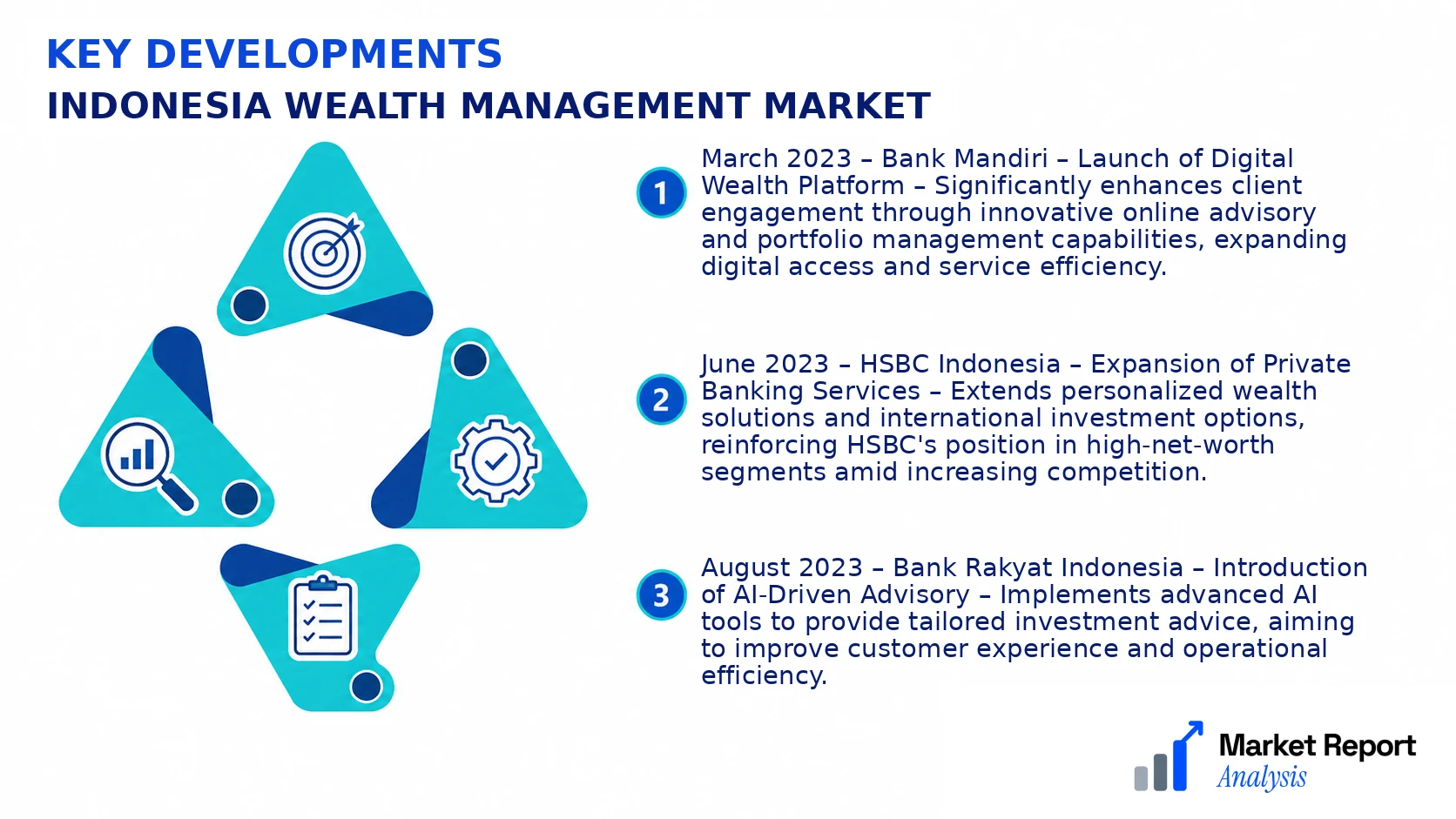
- March 2023 – Bank Mandiri – Launch of Digital Wealth Platform – Significantly enhances client engagement through innovative online advisory and portfolio management capabilities, expanding digital access and service efficiency.
- June 2023 – HSBC Indonesia – Expansion of Private Banking Services – Extends personalized wealth solutions and international investment options, reinforcing HSBC's position in high-net-worth segments amid increasing competition.
- August 2023 – Bank Rakyat Indonesia – Introduction of AI-Driven Advisory – Implements advanced AI tools to provide tailored investment advice, aiming to improve customer experience and operational efficiency.
- November 2023 – UOB Indonesia – Strategic Alliance with Local Fintech – Facilitates digital onboarding and wealth management services, tapping into young affluent demographics and tech-savvy clients.
- January 2024 – Bahana TCW Investment Management – Acquisition of a Regional Asset Manager – Strengthens regional footprint and product diversity, boosting asset under management and expanding investor base.
Frequently Asked Questions
What is the Indonesia Wealth Management Market?
The Indonesia Wealth Management Market encompasses the financial services and investment management activities targeted at high-net-worth individuals and affluent clients within Indonesia, focusing on personalized financial planning, investment advisory, estate planning, and private banking services.
What is the current market size of Indonesia Wealth Management Market?
As of 2026, the Indonesia Wealth Management Market is valued at approximately USD 50 Billion, reflecting steady growth driven by rising wealth, an expanding affluent class, and increased acceptance of wealth management services among high-net-worth individuals across the country.
What factors are driving the Indonesia Wealth Management Market?
Key drivers include Indonesia's robust economic growth, rising disposable incomes, increasing urbanization, technological advancements in digital banking, and a growing awareness of advanced financial planning among high-net-worth individuals, fostering demand for tailored wealth management solutions.
Which region dominates the Indonesia Wealth Management Market?
Java, particularly the Jakarta metropolitan area, is the dominant region due to its high concentration of affluent populations, financial institutions, and economic activity, accounting for the majority of wealth management assets in Indonesia.
Which segment is expected to grow the fastest?
The private banking segment is projected to exhibit the fastest growth driven by rising wealth levels among ultra-high-net-worth individuals, increased demand for sophisticated investment solutions, and expanding services offered by major banks in Indonesia.
Who are the leading companies operating in the Indonesia Wealth Management Market?
Prominent players include local financial institutions such as Bank Mandiri, Bank Rakyat Indonesia, and Bank Central Asia, along with international banks like HSBC, Standard Chartered, and Citi, all competing through innovative offerings and expanded service portfolios.
Analyst Perspective
The Indonesia wealth management market is poised for sustained growth through 2034, driven by the country’s expanding middle class, increasing accumulation of high-net-worth individuals, and digitization of financial services. Long-term prospects remain favorable, with regional urban centers like Jakarta and Surabaya emerging as key hubs for wealth management activity, supported by rising affluence and evolving client expectations. Technology innovations, including AI, blockchain, and robo-advisory platforms, are transforming the market, enhancing personalized offerings and operational efficiencies. Investment priorities should focus on expanding digital infrastructure, integrating ESG criteria, and developing regionally tailored products to capture diverse client needs. Competitive dynamics are intensifying, with both global and local players vying for market share, particularly through strategic alliances and digital-first channels. Regions with high economic growth and demographic shifts offer significant expansion opportunities, positioning Indonesia as a strategic center for wealth management in Southeast Asia, provided firms proactively adapt to evolving client preferences and technological advancements.
