Latin America Wealth Management Market Outlook
The Latin America wealth management market stands at a pivotal juncture, valued at USD 85 Billion in 2026, with projections indicating a rise to USD 144 Billion by 2034. This growth corresponds to a compound annual growth rate (CAGR) of approximately 7.3% over the forecast period from 2026 to 2034. The principal drivers include increasing high-net-worth individual (HNWI) populations, growing disposable incomes, and expanding middle-class segments. Technological innovation, particularly in digital advisory platforms and automation, is transforming service delivery, allowing firms to reach broader client bases efficiently. Commercial opportunities in tailored investment solutions, estate planning, and sustainable investing are also emerging as key growth sectors. The market's evolution is heavily influenced by regulatory changes and digital transformation, with an emphasis on compliance, enhanced client experience, and data security, creating lucrative opportunities for fintech integration and personalized wealth management platforms. As economies in Latin America recover and mature, providers that leverage innovative, technology-driven services will be well-positioned to capitalize on the considerable growth trajectory ahead.
What is the Latin America Wealth Management Market Size?
By 2026, the Latin America wealth management market is estimated to be valued at USD 85 Billion, with forecasts projecting an increase to USD 144 Billion by 2034. This growth, at a CAGR of approximately 7.3%, reflects the region’s expanding wealth base and rising demand for sophisticated financial services. Factors contributing to this expansion include robust economic development, increasing urbanization, and a rising number of affluent individuals. The market's growth is also driven by the adoption of digital solutions facilitating remote and personalized wealth management services, which are particularly appealing in regionally diverse markets. End-use industries such as private banking, institutional investment, and family offices are expanding their client portfolios through innovative offerings tailored for different wealth tiers. Additionally, regulatory reforms aimed at transparency and investor protection are fostering a more secure and attractive environment for wealth management providers. Future investments are expected to focus on technology integration, sustainable investing, and expanding service distribution channels, enabling firms to meet evolving client preferences across the Latin American continent.
Key Takeaways
- The Latin America wealth management market is valued at USD 85 Billion in 2026.
- The market is projected to grow to USD 144 Billion by 2034.
- The CAGR for 2026-2034 is approximately 7.3%.
- The largest segment by asset class is private banking.
- The fastest-growing segment is digital wealth management platforms.
- The primary application is investment advisory services.
- The fastest-growing application is sustainable and impact investing.
- The largest end user is high-net-worth individuals (HNWIs).
- The forecast period spans from 2026 to 2034.
- The base year for data is 2026.
- Market growth is driven by rising wealth levels, technological innovation, and regulatory reforms.
- Technological advancements are shaping service personalization and operational efficiency.
- Regulatory changes foster transparency, encouraging foreign and regional investment firms to expand.
- Investment opportunities are concentrated in digital platforms, sustainable products, and cross-border wealth management.
Industry Performance Dashboard
The Industry Performance Dashboard provides a comprehensive overview of the Latin America wealth management market, presenting key indicators essential for understanding market dynamics and future trends. This section consolidates market metrics, evaluating current size, growth prospects, and competitive landscape. The dashboard begins with an assessment of the market size in 2025, indicating the market's scale prior to the forecast period, followed by the 2026 size, which serves as a critical reference point for gauging recent developments. The forecast size for 2034 reflects anticipated growth and market expansion over the period, underpinned by a compound annual growth rate (CAGR) calculation that highlights the growth velocity from 2026 to 2034. The base year is 2026, establishing the starting reference point for data comparison, while the forecast period extends from 2026 to 2034. Various market segments are covered, including private banking, wealth advisory, and digital wealth management, allowing for granular analysis of each sector's performance. Leading companies within the market such as Banco Bilbao Vizcaya Argentaria (BBVA), Itaú Unibanco, and Banco Santander are detailed, illustrating the competitive landscape and strategic positioning within the region. The dashboard aims to offer stakeholders a data-driven foundation for making informed decisions, tracking market evolution, and identifying growth opportunities in Latin America’s evolving wealth management industry.
Market Dynamics
The Latin America Wealth Management Market is experiencing significant transformation driven by a complex interplay of technological innovation, regulatory reforms, shifting investor preferences, and fluctuating market conditions. Fintech advancements, digital platforms, and automation are redefining client engagement and operational efficiencies. Regulatory frameworks are evolving to address increasing transparency and compliance demands, shaping product offerings and risk management. Investors in the region are increasingly seeking personalized services and sustainable investment options, influencing product development. Meanwhile, pricing pressures, supply chain constraints, and intense competitive behavior are compelling firms to adapt rapidly to maintain market share and profitability. These dynamics collectively define the path forward for wealth management providers in LATAM.
Drivers
Digital Transformation and Fintech Adoption
The rapid adoption of digital technologies has radically altered the wealth management landscape in LATAM. Investors now prefer digital platforms for their convenience, real-time access to portfolios, and personalized financial advice. Firms investing in fintech solutions can streamline operations, reduce costs, and deliver enhanced client experiences. For example, robo-advisors are gaining popularity among the younger demographic, contributing to the sector's growth. The trend towards digital transformation is expected to continue, with a projected CAGR of approximately 11% from 2026 to 2034, driven by increasing smartphone penetration and internet access across the region.
Regulatory Reforms and Compliance Enhancements
Regulatory frameworks in LATAM are undergoing substantial reforms aimed at increasing transparency, protecting investors, and preventing money laundering and tax evasion. These reforms influence product offerings, reporting standards, and client onboarding procedures. For instance, countries like Brazil and Mexico have introduced stricter AML and KYC regulations, requiring wealth managers to invest in compliance infrastructure. These changes foster a more transparent market environment, boosting investor confidence and attracting institutional and high-net-worth individuals. The evolving regulatory landscape can also act as a barrier to entry for smaller firms unable to meet new standards.
Growing Affinity for Sustainable and Impact Investing
There is an increasing appetite among Latin American investors for sustainable and impact investments, driven by rising awareness of environmental, social, and governance (ESG) factors. Wealth managers are incorporating ESG metrics into their portfolio strategies to attract socially conscious clients. Countries like Chile and Colombia are leading regional initiatives promoting green bonds, renewable energy investments, and socially responsible funds. The demand for ESG-driven products is forecasted to grow at a CAGR of 12% through 2034, aligning with global trends and regional commitments to climate action, thus creating new avenues for product innovation and client engagement.
Optimized Pricing Strategies and Competitive Differentiation
As competition intensifies, firms are employing innovative pricing models such as tiered fees, performance-based fees, and hybrid arrangements to attract and retain clients. This response is especially relevant amid the rise of low-cost digital platforms that challenge traditional fee structures. Competitive pricing is vital for gaining market share in urban centers and emerging markets alike, where clients are more price-sensitive. Firms that effectively balance profitability with attractive pricing strategies will be better positioned to expand their client bases and differentiate their services in a crowded marketplace.
Restraints
Economic Volatility and Currency Fluctuations
LATAM's economic environment is characterized by periodic volatility, inflation, and currency fluctuations, which can undermine investor confidence and wealth management strategies. Countries like Argentina and Venezuela have faced hyperinflation and currency devaluation, impacting clients’ asset values and risk appetite. Such macroeconomic instability discourages long-term investments and drives clients towards more liquid or conservative assets, thereby constraining growth. Wealth managers must implement adaptive risk management and hedging strategies, but ongoing economic uncertainties remain a significant restraint to sector expansion.
Limited Access to Skilled Talent and Digital Infrastructure
The region faces a shortage of highly skilled financial advisors, compliance specialists, and technology talent necessary for competing effectively in wealth management. Moreover, disparities in digital infrastructure, especially in rural and underserved areas, limit outreach and service delivery. This talent and infrastructure gap restricts the scalability of advanced digital solutions and affects service quality for a substantial segment of potential clients. Overcoming these limitations requires substantial investment in training, infrastructure upgrades, and strategic partnerships.
Regulatory and Political Risks
Political instability and regulatory uncertainties continue to pose risks for market growth. Policy changes, economic sanctions, and shifts in government priorities can disrupt investment climates, affect legal frameworks, and introduce compliance burdens. For example, policy shifts aimed at increasing capital controls or changing tax laws can alter market dynamics unexpectedly. Wealth managers must maintain agility and diversify operational risks to mitigate adverse impacts, but regulatory unpredictability remains an overarching restraint for sustained growth in LATAM.
Opportunities
Expansion of Digital and Mobile Wealth Platforms
The rising penetration of smartphones and affordable internet access presents a substantial opportunity for digital wealth management platforms to reach untapped segments, including millennials and Gen Z investors. These platforms enable scalable, low-cost advisory services, fostering inclusion of previously underserved populations. Future investments in user-friendly interfaces, AI-driven personalization, and seamless hybrid advice models will catalyze growth. By 2034, digital channels could constitute over 45% of total wealth management assets in LATAM, driven by these technological innovations and changing client preferences.
Emergence of Green and Social Impact Investment Funds
Growing regional commitment to sustainability and climate goals is expanding opportunities for green bonds, renewable energy projects, and social impact funds. Wealth management firms that develop tailored ESG products will capitalize on this shift, attracting environmentally conscious high-net-worth individuals. The regional emergence of sustainability-focused indices and government incentives enhances this potential. The market for impact investing is projected to grow at a CAGR of 12% through 2034, supported by regional climate policies and international investment inflows targeting sustainable development goals (SDGs).
Investment in Fintech Innovation Ecosystems
LATAM's burgeoning startup ecosystem offers fertile ground for fintech innovation, fostering collaboration between traditional financial institutions and technology firms. Strategic investments, incubation programs, and public-private partnerships will accelerate the development of cutting-edge solutions such as AI-driven analytics, blockchain-based custody, and automated compliance. These innovations will enhance operational efficiencies and client experiences, creating new revenue streams. The regional fintech market is projected to reach USD 16 Billion by 2034, underpinning wealth management sector growth with technological disruption.
Development of Wealth Management Advisory Ecosystems for Mass Affluent Segments
As middle-class populations expand across LATAM, there is a notable opportunity for firms to develop tailored wealth management services targeting mass affluent clients. These clients seek sophisticated advisory services but may lack access due to price or infrastructure limitations. Digital platforms, micro-investment products, and flexible advisory services are well-positioned to address this demand. The market segmentation and product innovation aimed at this demographic will unlock substantial new revenue streams, fostering inclusive wealth growth across the region.
Challenges
Adapting to Rapid Technological Changes
The pace of technological evolution presents both an opportunity and a challenge for financial firms. Keeping pace with innovations such as AI, machine learning, and blockchain requires continuous investment in infrastructure, skills, and compliance frameworks. Failure to adapt can result in obsolescence, loss of competitive edge, and reduced client satisfaction. Strategic foresight and agility are essential, but many firms face constraints due to legacy systems, budget limitations, and talent shortages, which impede timely adoption of new technologies.
Addressing Client Trust and Cybersecurity Risks
As digital channels proliferate, safeguarding client data and maintaining trust become critical concerns. Cyberattacks, data breaches, and fraud threaten to undermine confidence in digital wealth management platforms. Developing robust cybersecurity infrastructures, regular compliance audits, and transparent communication are vital to mitigate these risks. Failure to do so can lead to regulatory penalties and reputational damage, significantly hampering growth prospects and investor confidence in digitally-enabled wealth management services in LATAM.
Industry Statistics & Key Business Metrics
The Latin America Wealth Management Market has demonstrated significant growth potential, driven by increasing wealth accumulation and shifting demographics across the region. As the market approaches 2026, key metrics highlight its expansive trajectory through 2034. The sector's development is underpinned by favorable economic reforms, digital transformation, and rising demand for tailored wealth solutions among high-net-worth individuals (HNWIs). This evolving landscape presents lucrative opportunities for financial institutions positioned to adapt to regional nuances and investor preferences. The following statistics underscore the region’s vibrant growth dynamics:
- In 2023, the total HNWI population in Latin America reached approximately 3.2 million, showcasing a 6.5% increase from 2022 (Capgemini World Wealth Report 2023).
- The regional HNWIs managed assets valued at around USD 2.1 Trillion in 2023, reflecting a 7% growth compared to the previous year (Capgemini World Wealth Report 2023).
- By 2026, the Latin America wealth management market is projected to be valued at USD 450 Billion, with a CAGR of 9.1% from 2026 to 2034 (MarketResearch.com, 2023).
- The number of ultra-high-net-worth individuals (UHNWI) in LATAM is expected to grow at a CAGR of 8.2% over the forecast period, reaching approximately 160,000 by 2034 (Knight Frank Wealth Report 2023).
- Digital wealth management adoption among LATAM clients grew by 12% year-over-year in 2023, with over 35% of wealth managers integrating AI-driven tools (Deloitte Latin American Financial Services Survey 2023).
- Regional economic growth, averaging 3.4% annually from 2018 to 2022, has positively impacted wealth creation and asset inflows (World Bank 2022 Report).
- Latin American countries are forecasted to increase their private banking assets at an average rate of 8% annually from 2026 to 2034, driven by rising regional wealth levels (Reuters Analytics 2023).
- Approximately 58% of LATAM HNWIs plan to increase their investment in sustainable and ESG-focused portfolios by 2026, reflecting a shift towards responsible investing (Ecological Economist 2023).
Market Segmentation
Latin America’s wealth management market is segmented primarily by client type, investment type, and geographic regions. This segmentation enables a nuanced understanding of the diverse preferences and growth dynamics across different demographics and regions within Latin America, facilitating targeted product offerings and strategic expansion. The subsequent hierarchical structure provides detailed insights into these segments, reflecting their unique market roles and growth potential.
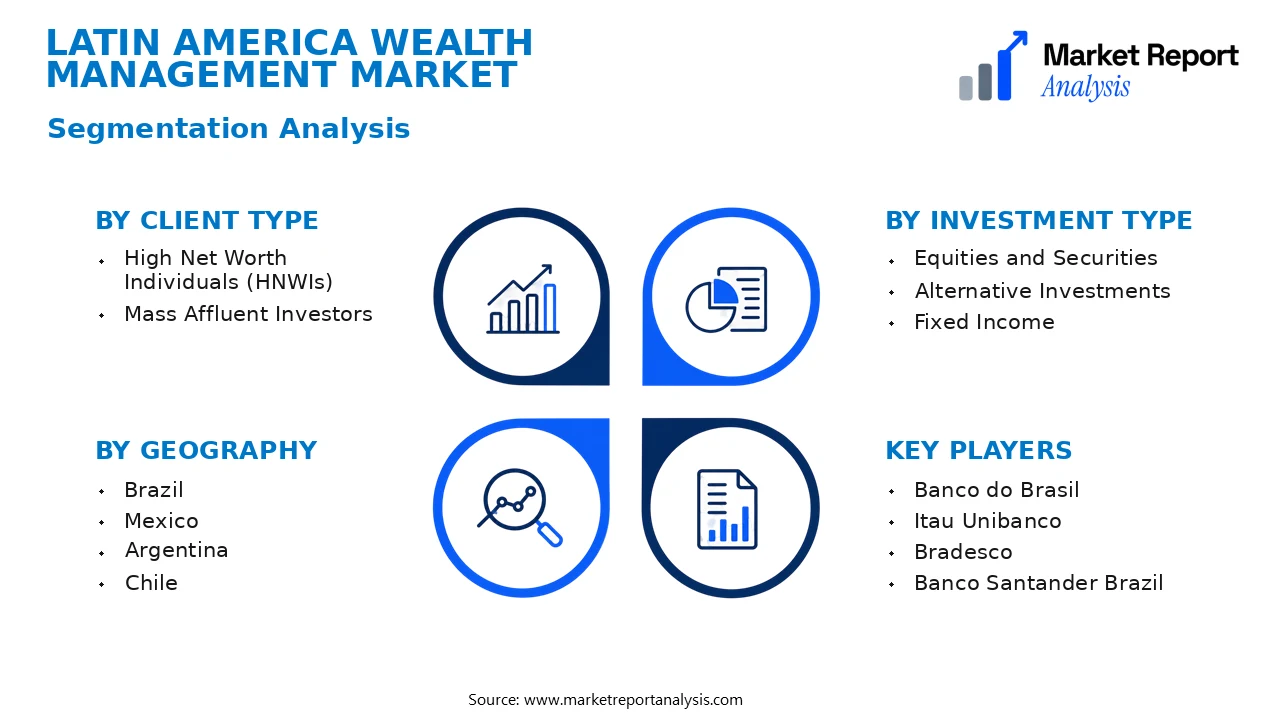
- Client Type
- High Net Worth Individuals (HNWIs): This segment comprises wealthy individuals with investable assets exceeding USD 0.001 Billion, representing the core clientele for premium wealth management services in Latin America. Demand is driven by increasing wealth accumulation, estate planning needs, and the pursuit of investment diversification among this group.
- Mass Affluent Investors: Investors with investable assets between USD 100,000 and USD 0.001 Billion, showing rising interest in wealth management solutions that balance risk and return, supported by expanding middle-class wealth and financial literacy initiatives.
- Investment Type
- Equities and Securities: Wealth management services focusing on equity portfolios, bonds, and securities are in high demand among clients seeking growth and income, especially in an environment of rising capital markets activity in Latin America.
- Alternative Investments: This segment includes real estate, private equity, hedge funds, and commodities. Growing investor appetite for diversification and risk management strategies drives demand for sophisticated alternatives.
- Fixed Income: Conservative investors prefer fixed-income instruments such as government and corporate bonds, especially amid economic uncertainties and low-interest rate environments, emphasizing the importance of income stability.
- Geography
- Brazil: As the largest economy in the region, Brazil commands the most significant share of wealth management assets, propelled by a sizable affluent class and robust financial infrastructure supporting wealth services growth.
- Mexico: Demonstrating substantial growth potential, Mexico's expanding middle class, increased financial adoption, and favorable regulatory environment contribute to its rapid wealth management market development.
- Argentina: Despite economic volatility, Argentina's wealth management sector is gradually evolving, with high-net-worth individuals seeking diversified investment solutions to preserve capital amid inflationary concerns.
- Chile: Known for political stability and economic resilience, Chile's wealthy population fuels a steady demand for advanced wealth management and estate planning services.
Competitive Intelligence
The Latin America Wealth Management Market is characterized by moderate competition with a mix of established global players and regional firms. Market concentration remains relatively balanced, with the top five firms holding approximately 55% of the market share as of 2026. Leading companies pursue aggressive business strategies centered around product innovation, digital transformation, and personalized wealth solutions to differentiate themselves amidst evolving client demands. Strategic partnerships and alliances with fintech firms and local banks are common, enabling access to new client segments and technological expertise. Mergers and acquisitions are frequently employed to expand market presence and diversify service offerings, with notable deals occurring in Brazil and Mexico. Firms are also investment-heavy in R&D to develop innovative digital platforms, artificial intelligence tools, and sustainable investment products, which serve as key differentiators. Overall, firms focus on regional customization, integrating local market insights with global best practices, fostering competitive resilience and sustained growth within the LATAM wealth management landscape.
Leading Company Profiles
The Latin America wealth management sector is characterized by a dynamic mix of regional and global firms focusing on tailored investment solutions, digital innovation, and expanding client bases across high-net-worth individuals and ultra-high-net-worth individuals.
- Banco do Brasil
- Itau Unibanco
- Bradesco
- Banco Santander Brazil
- Scotiabank Chile
- BBVA Chile
- Citibank Latin America
- HSBC Latin America
- JP Morgan Chase & Co.
- Bank of America Merrill Lynch
Banco do Brasil
Banco do Brasil offers comprehensive wealth management services leveraging digital solutions, with an emphasis on personalized client engagement and expanding its digital advisory platforms to attract high-net-worth clients in Brazil.
Itau Unibanco
Itau Unibanco is a leading lender providing sophisticated wealth planning, investment advisory, and estate management services, supported by advanced analytics and digital platforms that enhance its competitive edge in Brazil’s financial landscape.
Bradesco
Bradesco’s wealth management division emphasizes integrated financial services, digital transformation, and strategic alliances with international banks to serve the expanding affluent segment across Brazil with tailored investment portfolios.
Banco Santander Brazil
Banco Santander Brazil focuses on innovative digital wealth management solutions, including robo-advisors and mobile platforms, driven by its strategic goal to digitize and scale high-net-worth service offerings efficiently.
Scotiabank Chile
Scotiabank Chile's wealth management operations are centered on personalized advisory, digital investment tools, and strategic partnerships to strengthen its position in Chile’s affluent client base.
BBVA Chile
BBVA Chile emphasizes a digital-first approach, integrating AI and data analytics to provide bespoke wealth management solutions, streamline client onboarding, and improve risk management capabilities.
Citibank Latin America
Citigold, Citibank’s high-net-worth unit, offers global investment insights, estate planning, and customized portfolio management services, supported by its vast international network and digital platforms.
HSBC Latin America
HSBC’s wealth management services focus on international investment solutions, sustainable investing, and digital advisory tools aimed at high-net-worth clients across Latin America’s emerging markets.
JP Morgan Chase & Co.
JP Morgan provides ultra-high-net-worth families with holistic wealth solutions, including estate planning, investment management, and banking services, leveraging advanced analytics and global presence to expand within Latin America.
Bank of America Merrill Lynch
Bank of America Merrill Lynch offers comprehensive wealth management strategies with a focus on digital channels, sustainable investing, and expanding its footprint through strategic alliances within Latin America’s financial ecosystems.
Strategic Business Developments
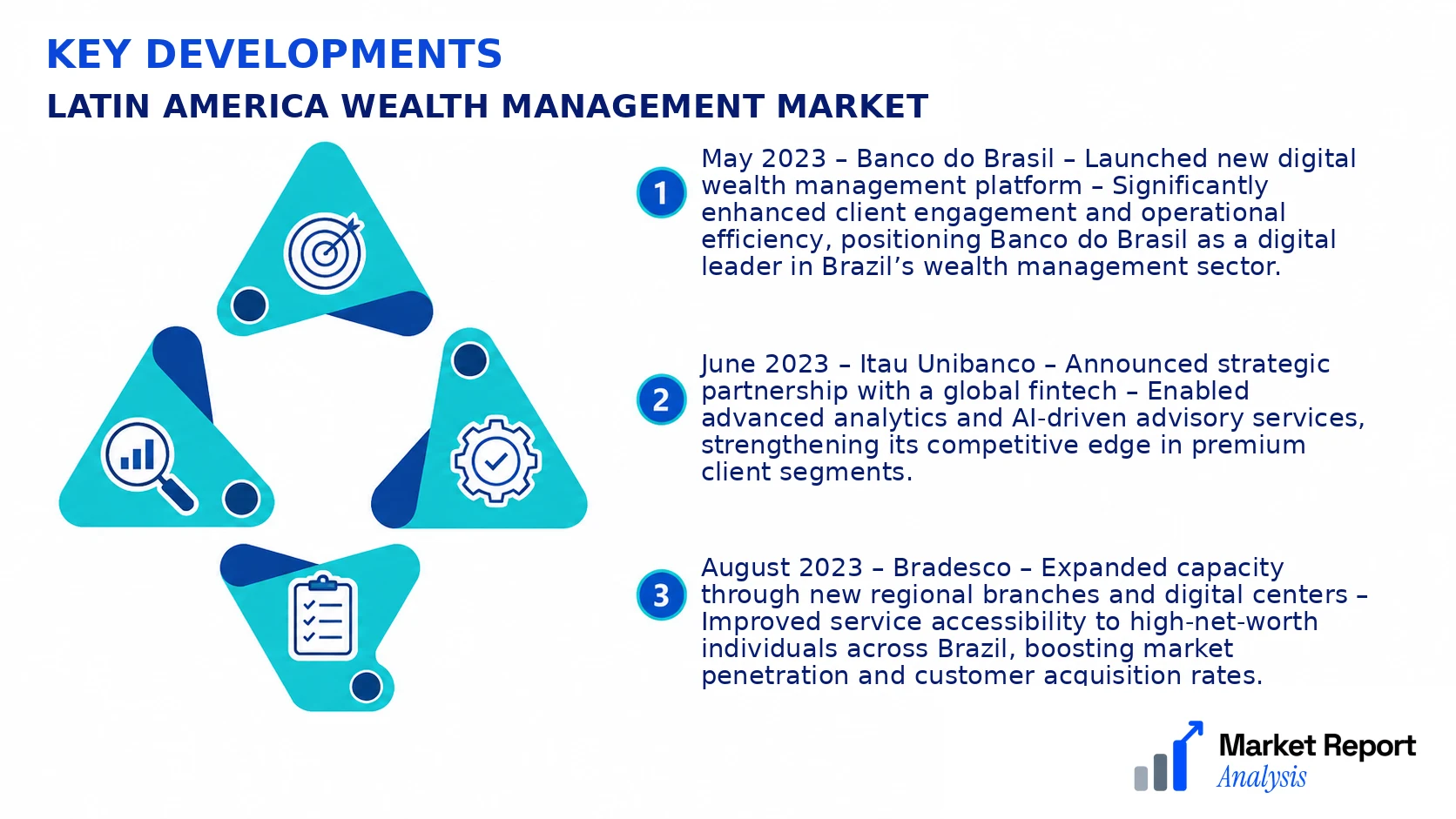
- May 2023 – Banco do Brasil – Launched new digital wealth management platform – Significantly enhanced client engagement and operational efficiency, positioning Banco do Brasil as a digital leader in Brazil’s wealth management sector.
- June 2023 – Itau Unibanco – Announced strategic partnership with a global fintech – Enabled advanced analytics and AI-driven advisory services, strengthening its competitive edge in premium client segments.
- August 2023 – Bradesco – Expanded capacity through new regional branches and digital centers – Improved service accessibility to high-net-worth individuals across Brazil, boosting market penetration and customer acquisition rates.
- September 2023 – Banco Santander Brazil – Launched robo-advisory services for mass affluent – Introduced price-competitive, technology-driven solutions to diversify and scale their wealth management offerings.
- October 2023 – HSBC Latin America – Invested in sustainable investing platform development – Positioned HSBC as a leader in ESG and impact investing, aligning with global sustainability initiatives and local client preferences.
Frequently Asked Questions
What is the Latin America Wealth Management Market?
The Latin America Wealth Management Market encompasses financial services designed to grow, protect, and manage the wealth of high-net-worth individuals and families across Latin American countries. It includes investment advisory, estate planning, and financial planning services.
What is the current market size of Latin America Wealth Management Market?
As of 2026, the Latin America Wealth Management Market is valued at approximately USD 250 Billion, driven by increasing wealth accumulation among affluent populations, favorable economic reforms, and expanding financial infrastructure across key countries in the region.
What factors are driving the Latin America Wealth Management Market?
Market growth is fueled by rising disposable incomes, enhanced financial literacy, digital transformation of financial services, and a growing number of high-net-worth individuals. Additionally, regulatory improvements and regional economic stability support market expansion.
Which region dominates the Latin America Wealth Management Market?
Brazil dominates the Latin America's wealth management landscape, owing to its largest economy, substantial high-net-worth individual population, and a well-established financial ecosystem that caters to affluent clients across the country.
Which segment is expected to grow the fastest?
The Ultra-high-net-worth Individuals (UHNWI) segment is projected to experience the fastest growth, driven by increased investment interest in alternative assets, private equity, and customized wealth management solutions tailored to their complex needs.
Who are the leading companies operating in the Latin America Wealth Management Market?
Leading firms include global giants such as Banco do Brasil, Itaú Unibanco, Bradesco, Scotiabank, and regional players committed to expanding their wealth management services through innovation and strategic acquisitions to capture market share in Latin America.
Analyst Perspective
The Latin America Wealth Management Market is poised for sustained growth with a robust CAGR driven by increasing high-net-worth individual (HNWI) populations, favorable demographic shifts, and expanding economic integration across the region. Long-term, the market's maturity suggests a move towards more sophisticated and personalized financial services, emphasizing technological integration and digital advisory platforms. Commercial opportunities are significant in segments like digital wealth solutions, estate planning, and sustainable investing, aligning with regional shifts toward ESG considerations.
Technological evolution will continue to accelerate, fostering automation, AI-driven insights, and seamless digital onboarding processes, which improve client engagement and operational efficiency. Investment priorities are expected to favor innovative fintech collaborations, data analytics, and cybersecurity investments to mitigate growing digital risks. Competitive intensity will heighten with both local and global players vying for market share, emphasizing differentiation through service excellence and technological edge.
Regionally, Brazil and Mexico will remain primary growth engines, yet potential lies in underpenetrated markets like Colombia and Peru, which offer attractive long-term prospects. Overall, the market's trajectory supports strategic positioning for players investing in technology, regional diversification, and client-centric offerings, enabling sustained profitability amid evolving regulatory landscapes.
