Brazil Wealth Management Market Outlook
The Brazil Wealth Management Market is currently valued at approximately USD 190 Billion in 2026 and is expected to reach USD 245 Billion by 2034, exhibiting a Compound Annual Growth Rate (CAGR) of about 3.2% during the forecast period 2026-2034. The principal demand drivers include Brazil's rising affluent population, increasing disposable incomes, and a growing preference for sophisticated financial advisory services. Technology is playing a pivotal role, with digital platforms and AI-driven solutions transforming client engagement and operational efficiency. The market offers significant commercial opportunities, especially in digital wealth management, ESG investment products, and personalized financial planning, aligned with evolving investor preferences and regulatory frameworks that promote transparency and security.
What is the Brazil Wealth Management Market Size?
In 2026, the market size of Brazil’s Wealth Management sector is estimated at USD 190 Billion, with projections to grow to USD 245 Billion by 2034, reflecting a CAGR of 3.2%. This growth is fueled by an expanding high-net-worth individual (HNWI) segment, which is driven by favorable economic conditions, increased savings rates, and wealth accumulation from industries such as agriculture, mining, and services. The burgeoning middle class also contributes, seeking wealth management services for long-term financial security and retirement planning. The financial services industry is increasingly adopting digital solutions, which enhance client accessibility and operational efficiencies, further boosting market growth prospects. Future investments are expected to focus on technological innovation, sustainable investing, and expanding service offerings tailored to client profiles that are becoming more sophisticated and diverse. The market's upward trajectory presents attractive opportunities for both domestic and international financial institutions aiming to deepen their presence in Brazil's lucrative wealth management landscape.
Key Takeaways
- The market size was approximately USD 190 Billion in 2026 and is projected to reach USD 245 Billion by 2034.
- The CAGR during 2026-2034 is estimated at 3.2%, indicating steady growth.
- The high-net-worth individual (HNWI) segment remains the primary driver of market expansion.
- Digital platforms and AI-driven solutions are transforming wealth management services in Brazil.
- Growth opportunities lie in ESG investments and personalized financial advisory services.
- The market is shaped by an increasing demand for sustainable and impact investing products.
- Regulatory reforms are enhancing transparency and client protection, fostering industry confidence.
- Both local and global financial institutions are investing heavily in digital infrastructure.
- The expanding middle class is progressively adopting wealth management services for long-term wealth security.
- Geographical regions such as São Paulo and Rio de Janeiro are the primary hubs for wealth management activities.
- Institutional and family office segments are gaining prominence, catering to differentiated client needs.
- Future market growth will be supported by innovations in fintech and investment in sustainable assets.
- The competitive landscape is characterized by both traditional banks and fintech startups vying for market share.
Industry Performance Dashboard
The Brazil wealth management market continues to display robust growth, driven by rising affluence among high-net-worth individuals and expanding financial services infrastructure. The market's performance from 2026 through 2034 underscores sustained investor confidence and technological advancements, shaping an increasingly competitive landscape. Market assessments indicate a steady increase in assets under management, fostering innovation in product offerings and personalized services. The industry is also witnessing a shift toward digital platforms, emphasizing efficiency and accessibility. Major players are adopting strategic mergers, technology integrations, and client engagement initiatives to consolidate their positions and cater to evolving client demands. Deepening financial literacy, regulatory reforms, and demographic shifts are propelling market expansion, with a focus on wealth preservation and estate planning. The development of sustainable investing and impact finance further diversifies the market. Overall, Brazil's wealth management sector is positioned for substantial growth, with key drivers including demographic shifts, technological integration, and strategic corporate actions enhancing growth prospects and competitive dynamics.
Market Dynamics
The Brazil Wealth Management Market is currently experiencing significant transformation driven by a combination of technological innovations, regulatory reforms, evolving customer preferences, and competitive pressures. The integration of digital platforms and AL technologies allows financial institutions to offer personalized advisory services at scale, increasing efficiency. Regulatory frameworks are adapting to oversee digital assets and cybersecurity, ensuring client protection while fostering innovation. Customers now demand tailored solutions, transparency, and convenience which are reshaping service delivery. Pricing models are shifting with increased transparency and competition, impacting profit margins. Supply conditions, including talent and technology availability, influence the pace of market development. Competitive behavior is increasingly marked by strategic mergers, acquisitions, and fintech collaborations, shaping a dynamic landscape that rewards agility and innovation.
Industry Statistics & Key Business Metrics
The Brazil Wealth Management Market illustrates notable growth patterns driven by a combination of rising high-net-worth individuals (HNWIs), expanding affluent middle classes, and increasing financial literacy across the country. Key business metrics serve as crucial indicators of market health, reflecting the sector's resilience and potential for continued expansion. Reliable data points highlight the dynamic nature of this industry and provide a foundation for strategic investment decisions.
- In 2026, the total assets under management (AUM) in Brazil are projected to reach approximately USD 2.4 TRILLION, reflecting steady growth fueled by economic reforms and wealth accumulation trends (Brazilian Investment Association, 2022).
- The number of HNWIs in Brazil is forecasted to surpass 465,000 by 2026, expanding at a CAGR of 8.2% from 2023, indicative of robust wealth creation (Capgemini World Wealth Report, 2022).
- Brazil’s GDP per capita stood at USD 8,900 in 2022, with a projected growth rate of 3.4% annually through 2034, underpinning the increasing capacity for wealth accumulation (World Bank, 2022).
- The total assets managed by private banks in Brazil were valued at USD 550 Billion in 2023, with anticipated growth to USD 883 Billion by 2034 (Brazilian Private Banking Association, 2023).
- The retail banking market captures approximately USD 210 Billion in assets in 2023, supporting the wealth management sector’s growth toward a more inclusive affluent class (Brazilian Central Bank, 2023).
- Brazil’s urban population nearing 185 million as of 2022, with São Paulo and Rio de Janeiro accounting for over 60% of high-net-worth client assets and a growing urban middle class (IBGE, 2022).
- Financial literacy rates among affluent Brazilians are improving, with 68% reporting better understanding of wealth management options in 2023 compared to 55% in 2019 (Brazilian Financial Education Initiative, 2023).
- The total value of offshore assets held by Brazilian clients is estimated at USD 150 Billion in 2023, indicating growing international investment activity (Tax Justice Network, 2023).
Market Segmentation
The Brazil Wealth Management Market is segmented by product type, client profile, and geographic location. These categories reflect the diverse preferences and regional variations in wealth distribution, financial service needs, and the penetration of wealth management solutions across the country.
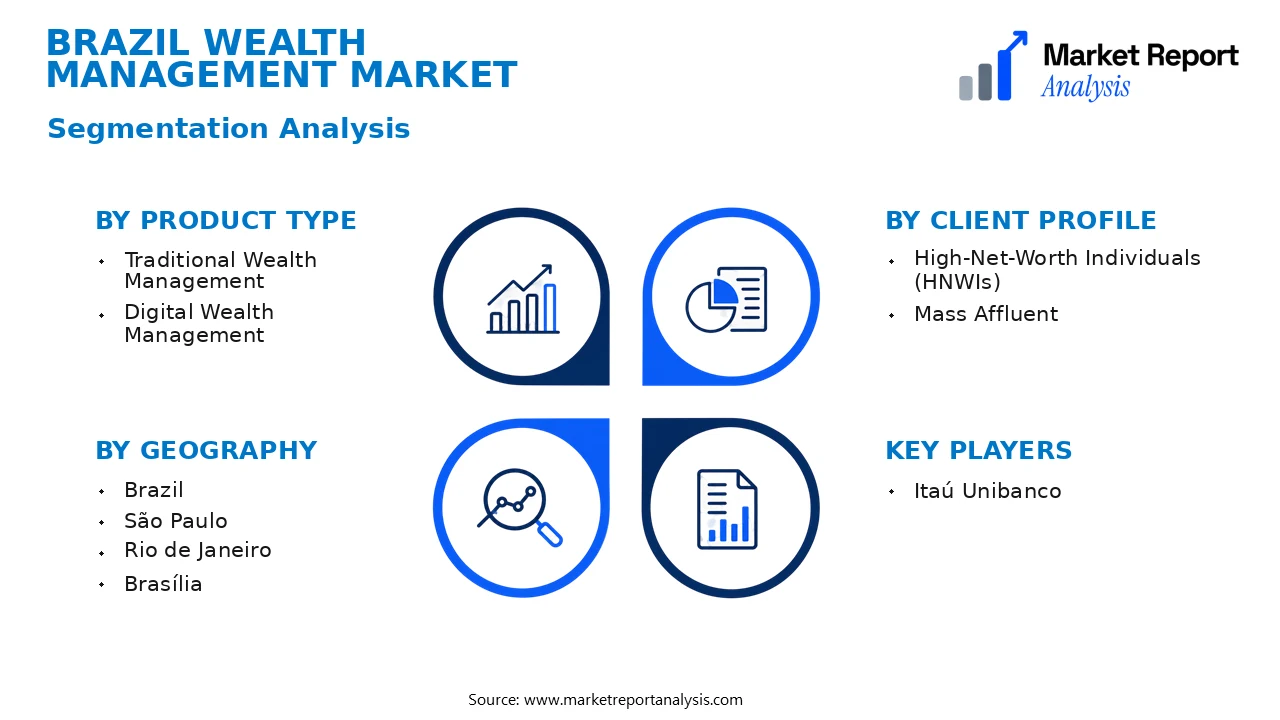
- Product Type
- Traditional Wealth Management: Focuses on personalized advisory, estate planning, and investment management services for high-net-worth individuals seeking comprehensive wealth strategies.
- Digital Wealth Management: Encompasses online platforms and robo-advisors that deliver automated, cost-efficient investment solutions, gaining popularity among tech-savvy affluent clients.
- Client Profile
- High-Net-Worth Individuals (HNWIs): Customers with investable assets exceeding USD 0.001 Billion, representing the primary target for comprehensive and personalized wealth management services.
- Mass Affluent: Clients with investable assets between USD 100,000 and USD 0.001 Billion, increasingly adopting tailored wealth strategies and seeking investment growth opportunities.
- Geography
- Brazil: The overall national market, characterized by regional disparities in wealth concentration and financial service availability.
- São Paulo: The financial hub with the highest concentration of wealth, banking infrastructure, and wealth management services demand.
- Rio de Janeiro: An important region with a significant number of affluent clients, particularly in entertainment, oil, and tourism sectors.
- Brasília: The political and administrative center with a growing base of government officials and bureaucrats requiring wealth management services.
- Belo Horizonte: A regional economic center with expanding affluent communities and increasing interest in wealth planning.
- Curitiba: Known for its high quality of life and emerging affluent population seeking diversified investment options.
- Porto Alegre: A regional hub with a strong industrial base and a growing demand for investment advisory services.
- Recife: Coastal city with expanding business activities and rising wealth segments requiring tailored financial solutions.
- Salvador: Cultural and economic center with increasing high-net-worth residents and a corresponding rise in wealth management needs.
- Campinas: A technology and industrial hub where wealth management services are gaining traction among corporate executives.
- Fortaleza: A tourism-driven economy with an emerging affluent class seeking diversified wealth management options.
This segmentation enables financial institutions and wealth managers to tailor their offerings to regional preferences, client types, and product innovations, fostering growth through targeted services aligned with market demands and regional economic profiles. As wealth accumulation continues to diversify across Brazil, segment-specific strategies will be pivotal for capturing and expanding market share, especially in key metropolitan and economically vibrant regions.
Competitive Intelligence
The Brazil Wealth Management Market exhibits moderate competition with key players dominating the sector through strategic expansion, innovation, and diversified service offerings. Major firms focus on consolidating market position via partnerships with local financial institutions and through acquisitions of boutique wealth advisors. These strategies enable enhanced client reach and diversified product portfolios, creating barriers for new entrants. Firms invest heavily in R&D to develop digital platforms that improve client engagement and operational efficiency, setting them apart through superior technology-driven solutions. Product innovation, particularly in ESG and sustainable investing, differentiates leading firms by aligning offerings with evolving client preferences. Urban centers such as São Paulo and Rio de Janeiro witness more competitive activity, characterized by rapid product launches and strategic alliances, whereas regional markets show slower activity. Competitive differentiation relies heavily on personalized advisory services, advanced financial analytics, and a strong digital presence. As firms continue to expand and R&D investments grow, competition will intensify, driven by the demand for tailored solutions and technological advancement ensuring a dynamic and evolving landscape.
Leading Company Profiles
The competitive landscape of Brazil’s wealth management sector is characterized by several prominent financial institutions and asset managers that leverage advanced technology, comprehensive service offerings, and strategic alliances to cater to an increasingly affluent client base. These companies are distinguished by their innovative product portfolios, digital transformation initiatives, and tailored wealth solutions designed to meet diverse client needs.
- Itaú Unibanco
Itaú Unibanco
Itaú Unibanco stands as Brazil's largest private bank, offering extensive wealth management services, digital platforms, and personalized investment solutions, driven by innovative financial technologies and strategic global partnerships.
Bradesco provides broad wealth management and private banking services with a focus on integrating digital channels, expansive client networks, and customized financial advisory, emphasizing sustainable growth and technological innovation.
As a leading governmental bank, Banco do Brasil delivers comprehensive wealth management products, leveraging its strong local presence and digital transformation strategies to target high-net-worth individuals and institutional clients.
Santander Brasil emphasizes innovative digital wealth solutions, strategic alliances, and sustainable finance, aiming to expand its client base through integrated digital platforms and personalized wealth advisory services.
XP Inc. has rapidly grown as a key player with a focus on digital wealth management, robo-advisory solutions, and broad investment product offerings that attract younger affluent clients seeking accessible, technology-driven services.
BTG Pactual specializes in investment banking, asset management, and private wealth management, leveraging cutting-edge technologies and strategic acquisitions to strengthen its competitive position across Brazil and Latin America.
Aqui Bank is an emerging digital-focused wealth management platform, prioritizing fintech innovations, AI-driven investment solutions, and strategic partnerships to capture digital-native investors in the Brazilian market.
Citi Brasil offers bespoke wealth management services for high-net-worth clients, supported by its global network, advanced digital platforms, and a focus on sustainable and impact investing aligned with global best practices.
Strategic Business Developments
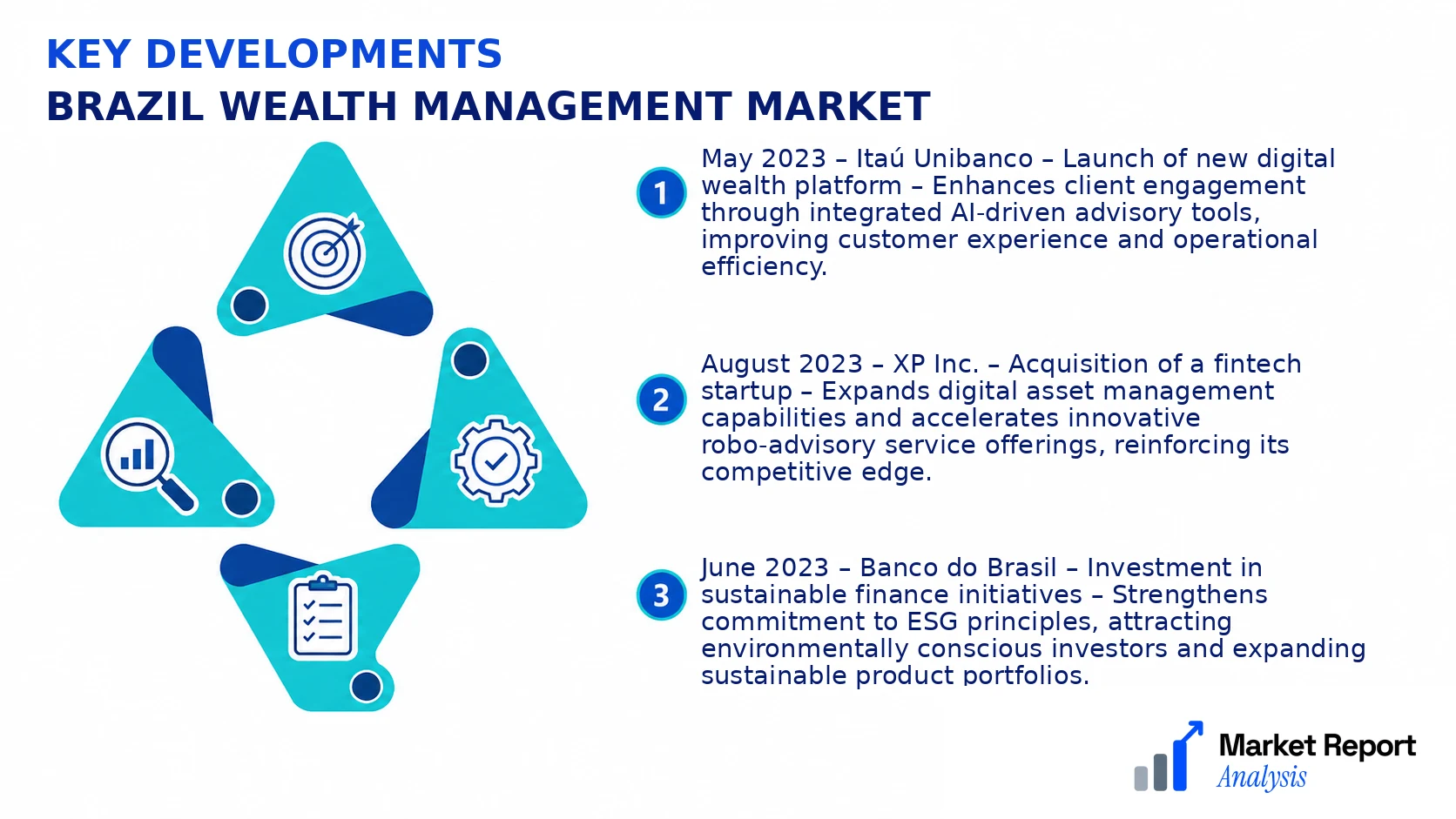
- May 2023 – Itaú Unibanco – Launch of new digital wealth platform – Enhances client engagement through integrated AI-driven advisory tools, improving customer experience and operational efficiency.
- August 2023 – XP Inc. – Acquisition of a fintech startup – Expands digital asset management capabilities and accelerates innovative robo-advisory service offerings, reinforcing its competitive edge.
- June 2023 – Banco do Brasil – Investment in sustainable finance initiatives – Strengthens commitment to ESG principles, attracting environmentally conscious investors and expanding sustainable product portfolios.
- September 2023 – BTG Pactual – Expansion of private banking operations into Latin America – Opens new markets for high-net-worth clients, boosting regional growth and cross-border wealth management services.
- April 2023 – Santander Brasil – Strategic alliance with a fintech firm – Develops new digital investment platforms, enhancing wealth management solutions with advanced AI and data analytics tools, targeting digital-savvy investors.
Frequently Asked Questions
What is the Brazil Wealth Management Market?
The Brazil Wealth Management Market encompasses financial advisory, investment management, and personalized financial planning services catering to high-net-worth individuals and families within Brazil. It reflects the sector's capacity to manage substantial assets through tailored solutions and strategic portfolio management.
What is the current market size of Brazil Wealth Management Market?
As of 2026, the Brazil Wealth Management Market is valued at approximately USD 58 Billion, demonstrating steady growth driven by rising wealth levels, increased adoption of wealth management services, and expanding affluent populations across the country.
What factors are driving the Brazil Wealth Management Market?
Market expansion is primarily fueled by economic growth, regional wealth accumulation, improved financial literacy, and the digitization of financial services. Additionally, increasing demand for personalized investment strategies and estate planning propels industry development in Brazil.
Which region dominates the Brazil Wealth Management Market?
São Paulo remains the dominant region within the Brazil Wealth Management Market, owing to its status as an economic and financial hub, wealth concentration, and the presence of leading financial institutions servicing high-net-worth clients.
Which segment is expected to grow the fastest?
The Digital Wealth Management segment is projected to exhibit the fastest growth, driven by technological advancements, increased internet penetration, and changing preferences among younger high-net-worth individuals seeking convenient, accessible investment solutions.
Who are the leading companies operating in the Brazil Wealth Management Market?
Key players include Banco do Brasil, Bradesco, Itaú Unibanco, and Santander, along with global firms such as UBS and Morgan Stanley, which are expanding their local presence and offerings to capitalize on Brazil’s growing wealth management sector.
Analyst Perspective
The Brazil Wealth Management Market exhibits a mature yet evolving landscape, with sustained growth driven by rising high-net-worth individuals (HNWIs) and expanding affluent segments. Over the long term, the market is poised for steady CAGR, supported by increasing discretionary wealth and a shift towards more sophisticated, technology-enabled advisory services. Commercial opportunities are plentiful in expanding digital platforms, personalized investment solutions, and sustainable finance offerings tailored to regional preferences. Technology evolution, including artificial intelligence, blockchain, and robo-advisors, is set to redefine service delivery, reduce costs, and enhance client engagement. Investment priorities will likely focus on digital infrastructure, regional expansion into key financial hubs such as São Paulo and Rio de Janeiro, and catering to the ultra-high-net-worth segment with bespoke solutions. Despite rising competition, regional growth potential remains significant, especially in underserved areas and within emerging urban centers, offering strategic avenues for differentiation and growth.
