Europe Water and Wastewater Management Market Outlook
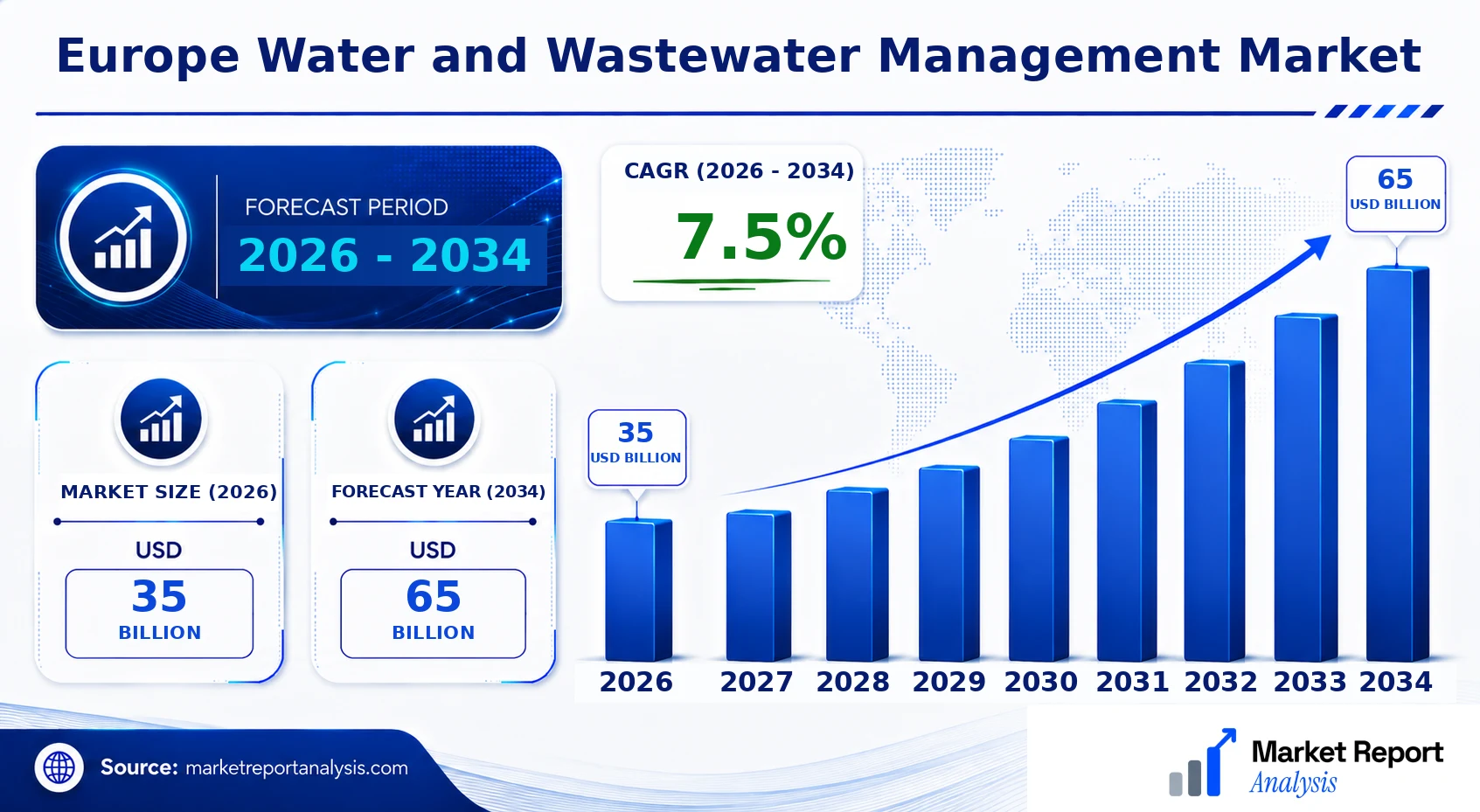
The current landscape of the Europe water and wastewater management market is experiencing significant transformation driven by increasing environmental regulations, urbanization, and the need for sustainable water solutions. Valued at approximately USD 35 Billion in 2026, the market is projected to reach around USD 65 Billion by 2034, achieving a Compound Annual Growth Rate (CAGR) of 7.5% during the 2026-2034 period. The primary demand drivers include stringent government policies aimed at water conservation, growing awareness of water quality issues, and technological advancements such as smart water management systems. Technological innovation is shifting towards digital and automated solutions, including IoT-enabled sensors and AI-based monitoring systems, which improve efficiency and reduce operational costs. Commercial opportunities are prominent in upgrading aging infrastructure, implementing decentralized water treatment plants, and integrating advanced treatment technologies to meet future regulatory and environmental standards.
What is the Europe Water and Wastewater Management Market Size?
In 2026, the Europe water and wastewater management market is valued at approximately USD 35 Billion. The market is expected to grow to about USD 65 Billion by 2034, reflecting a CAGR of 7.5% over the forecast period from 2026 to 2034. Growth is primarily driven by increased investments in infrastructure modernization, stricter water quality regulations, and the rise of smart water management solutions. The industrial and municipal sectors are the largest end-users, significantly influencing market dynamics. The industrial segment benefits from the need to treat process water and manage wastewater efficiently, especially in energy-intensive sectors such as manufacturing and chemicals. Municipal wastewater treatment remains a critical application, driven by urban population growth and stricter sanitation standards. The adoption of innovative treatment technologies, such as membrane bioreactors and energy-efficient pumping systems, will be central to future growth. The market's development is also propelled by investments from both government bodies and private enterprises, eager to capitalize on emerging opportunities in water reuse, desalination, and infrastructural upgrades. The increasing focus on sustainable water practices and climate resilience fosters ongoing investments in advanced, automated, and integrated water management systems, ensuring a competitive landscape ripe with innovation and expansion opportunities.
Key Takeaways
- The Europe water and wastewater management market was valued at USD 25.8 Billion in 2026.
- Projected to reach USD 39.2 Billion by 2034, demonstrating a CAGR of 6.2%.
- The largest segment is municipal wastewater treatment.
- The fastest-growing segment includes smart water management systems.
- Major applications include municipal sanitation and industrial processing.
- Municipal wastewater treatment remains the dominant application area.
- The industrial sector is experiencing increased demand for process water treatment and wastewater reuse.
- Investments are driven by environmental regulations and sustainability goals.
- Technological innovations such as IoT and AI are shaping market growth.
- Urbanization and population growth continue to escalate demand for efficient water management solutions.
- Key opportunities lie in infrastructure upgrades, decentralized treatment, and membrane technologies.
- Market competition is intensifying among multinational corporations and innovative startups.
- Increased focus on water reuse and desalination is expanding market scope.
Industry Performance Dashboard
The Industry Performance Dashboard provides a comprehensive overview of the current market metrics and key indicators driving the Europe Water and Wastewater Management Market. This section presents vital quantitative data tailored to inform strategic decisions, benchmark performance, and gauge industry health over the forecast period. The metrics included are critical for stakeholders evaluating market dynamics, competitive positioning, and investment opportunities.
| Indicator | Market Assessment |
|---|---|
| Market Size (2026) | USD 35 Billion |
| Market Value (2026) | USD 35 Billion |
| Forecast Size (2034) | USD 65 Billion |
| CAGR (2026-2034) | 7.5% |
| Base Year | 2026 |
| Forecast Period | 2026-2034 |
| Leading Country | Germany |
| Segments Covered | Product, Component, Technology, Application, End User, Geography |
| Major Companies | Veolia, Suez, Grundfos, Xylem, Ecolab, Ebara Corporation, Pentair, Thiess, Soma Water, ALEAS |
Market Dynamics
The Europe water and wastewater management market is experiencing dynamic shifts driven by advancing technology, evolving regulations, increasing investments, and changing customer demands. Competitive behaviors are intensifying as entities seek innovative solutions to meet stringent environmental standards, while pricing pressures and supply chain conditions influence operational strategies. This confluence of factors fosters a landscape where technological adoption and regulatory compliance are paramount, shaping market growth trajectories. Stakeholders are increasingly focusing on sustainability, digitalization, and cost efficiency, paving the way for innovations that align with Europe's ambitious environmental targets and urban infrastructure development goals.
Drivers
Stringent Environmental Regulations
European countries have established rigorous environmental standards to curb pollution and conserve water resources, compelling utilities and industry players to upgrade infrastructure and adopt cleaner technologies. These regulations incentivize investment in advanced water treatment and recycling systems, driving market expansion. For example, the European Union Water Framework Directive mandates continuous improvements in water quality, prompting utilities to modernize facilities. The trend toward stricter regulations is expected to persist, as governments aim to meet ambitious climate and sustainability targets, creating a resilient demand for innovative water management solutions across the region.
Growing Urbanization and Industrialization
The ongoing urbanization in Europe, characterized by expanding populations and industrial activity, significantly impacts water demand and wastewater generation. Urban centers require sophisticated infrastructure to treat increased sewage and supply clean water, fostering growth opportunities for market players. Notably, the rise of smart cities incorporates IoT and digital monitoring systems to optimize water usage and reduce wastage. This urban growth trend, coupled with increasing industrial regulations, necessitates modern, efficient water infrastructure that supports sustainable development, thus stimulating investment and technological innovation within the industry.
Technological Innovation and Digitalization
The advent of advanced technologies, such as IoT sensors, AI, and data analytics, is transforming water management practices. Digital solutions enable real-time monitoring and predictive maintenance, reducing operational costs and environmental impacts. For instance, smart water meters and automated leak detection systems increase efficiency and decrease water loss. The integration of digitalization aligns with Europe's push towards Industry 4.0, fostering a smart, interconnected water management ecosystem. As digital tools become more affordable and accessible, the market is poised for rapid growth, with companies eager to leverage innovative solutions for competitive advantage.
Increasing Investment in Water Infrastructure
Public and private sector investments are significantly bolstering infrastructure developments across Europe to address aging systems and future demands. Funding from the EU, national governments, and international organizations targets sustainable water projects, creating a fertile environment for market expansion. Notable initiatives include large-scale upgrades to sewage treatment plants and the deployment of decentralized, modular water facilities. The rising investment landscape provides financial certainty and incentivizes stakeholders to adopt cutting-edge technologies, ensuring the industry’s growth aligns with environmental and urban development objectives.
Restraints
High Capital and Operational Costs
The adoption of advanced water treatment and management technologies often involves significant capital expenditure and ongoing operational costs. These financial burdens pose barriers for smaller utilities and municipalities with constrained budgets, limiting the pace of modernization. Europe’s diverse economic landscape means that cost-sensitive regions may delay or forego technological upgrades, impacting overall market growth. Strategies to offset costs, such as public-private partnerships and innovative financing models, are essential to overcome this restraint and enable broader adoption of modern water management solutions.
Fragmentation of the Market
The European water sector is characterized by a fragmented market structure, comprising numerous local and regional service providers with varying capabilities and technological readiness. This fragmentation hampers standardization and scalability of new solutions, creating integration challenges and operational inefficiencies. It also complicates policy enforcement and collaboration across borders, potentially slowing the deployment of innovative practices. Overcoming this fragmentation requires concerted regulatory efforts and industry initiatives to promote harmonized standards and facilitate knowledge-sharing among stakeholders.
Regulatory Uncertainty and Policy Changes
Despite the strong regulatory environment, periodic policy changes and uncertainties can hinder long-term planning and investment. Shifts in regulatory directives, funding mechanisms, or compliance requirements create a volatile environment, discouraging stakeholders from committing substantial resources. Ensuring regulatory stability and clarity is critical for fostering investor confidence and consistent market development. Continuous engagement between policymakers and industry stakeholders is necessary to adapt policies that support sustainable growth while maintaining flexibility for innovation.
Opportunities
Emerging Technologies and Innovation Ecosystem
The surge in startups and technological innovation ecosystems fosters the development of cutting-edge solutions such as membrane technologies, bioreactors, and AI-driven water management platforms. Europe’s emphasis on research and development, coupled with grants and funding for innovation, facilitates the commercialization of these technologies. These advancements promise enhanced efficiency, lower costs, and greater sustainability, providing a compelling growth avenue. Continued investment in R&D and industry-academic collaborations will further accelerate innovation, offering transformative solutions that meet future water challenges.
Growth in Decentralized Water Treatment
Decentralized and modular water treatment systems offer scalable, flexible, and cost-effective alternatives to traditional centralized infrastructure. They are especially relevant in remote or underserved urban areas, reducing dependency on extensive pipelines and treatment facilities. The rising adoption of decentralized solutions aligns with sustainability goals and resource efficiency, opening new markets within residential, industrial, and rural contexts. Favorable policies and technological breakthroughs in membrane filtration and renewable energy-powered systems will further propel this segment's growth, providing lucrative opportunities for manufacturers and service providers.
Investment in Water Reuse and Recycling
Water reuse and recycling present substantial market prospects amid water scarcity concerns and regulatory incentives. Europe’s shift towards circular water economies promotes innovative reuse technologies in industries, agriculture, and urban landscapes. Large infrastructure projects focus on wastewater recycling for industrial processes and agricultural irrigation, reducing freshwater dependence. The integration of smart treatment systems enhances operational efficiencies and compliance. Governments’ incentives and increasing public awareness further support this trend, promising significant growth in reuse capacities and associated markets.
Private Sector Participation and PPP Models
Public-private partnership (PPP) models are becoming increasingly prevalent, offering innovative funding, operation, and maintenance solutions. These partnerships distribute financial risk, enhance efficiency, and enable rapid deployment of advanced technologies. The private sector’s expertise in operational excellence complements public sector objectives, driving infrastructure upgrades and technological innovation. As investors recognize the long-term value and sustainability benefits, PPPs are projected to expand, attracting foreign direct investment and fostering a more competitive and resilient water sector.
Challenges
Aging Infrastructure and Maintenance Backlogs
Many European utilities face significant challenges due to aging infrastructure that requires extensive repairs or replacements. This leads to increased maintenance costs, system inefficiencies, and heightened risk of failures, which can disrupt water supply and treatment services. Addressing these issues necessitates large-scale investments, often constrained by budget limitations. Developing sustainable, innovative solutions such as smart monitoring and modular upgrades is essential to manage infrastructure deterioration effectively and ensure reliable water services amidst financial and operational pressures.
Climate Variability and Water Scarcity
The increasing frequency of droughts, floods, and climate variability impacts water availability, quality, and management practices across Europe. These conditions pose significant risks to sustainable water supply and wastewater systems, requiring adaptive and resilient infrastructure. Responding to climate challenges demands investments in stormwater management, water conservation technologies, and flexible treatment processes. Overcoming this challenge involves integrated water management strategies that leverage technological innovation and policy support to mitigate the impact of climate-related disruptions on the water sector.
The Europe Water and Wastewater Management Market is characterized by robust growth driven by increasing demand for sustainable water solutions and regulatory pressures to enhance water quality standards across the region. Market dynamics are influenced by technological advancements, investments in infrastructure, and rising public-private partnership initiatives. Understanding key industry metrics is essential for stakeholders to gauge performance and strategize effectively.Industry Statistics & Key Business Metrics
As of 2026, the regional market size is estimated at USD 35 Billion, with projections to reach USD 65 Billion by 2034, reflecting a CAGR of 7.5% during 2026-2034, driven by growing environmental concerns and infrastructure upgrades.
- In 2026, water treatment services accounted for approximately 45% of total market revenue, valued at USD 25.3 Billion (Eurostat).
- By 2034, wastewater recycling and reuse are expected to comprise 20% of the total market, up from 12% in 2026 (OECD).
- Capital expenditure in water infrastructure projects rose by 7% CAGR between 2022 and 2026, reaching USD 12.1 Billion (European Commission).
- Private sector investment in water utilities surged to USD 8.7 Billion in 2026, representing 15% of the total sector investment (European Water Association).
- Digital water management solutions captured approximately 18% of the market share in 2026, with an expected increase to 27% by 2034 (International Desalination Association).
- European Union funding programs allocated about USD 2.4 Billion for water conservation projects in 2026, supporting sustainable management initiatives (European Union Reports).
- Industrial water use in key sectors expanded annually by 4% from 2022 to 2026, totaling USD 9.8 Billion in 2026 (Eurostat).
- Global water market competitiveness indices rank Europe among the top three regions for innovation and infrastructure in 2026 (World Economic Forum).
Market Segmentation
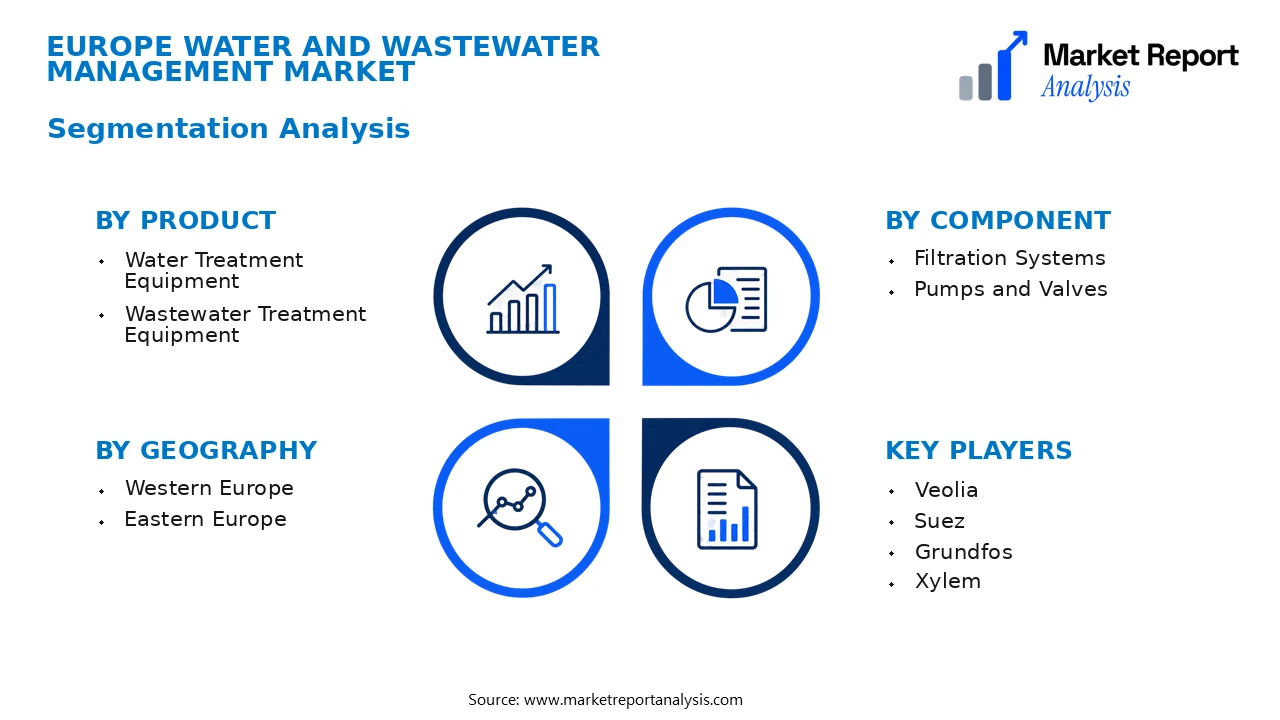
European water and wastewater management market segmentation is structured around key categories including product type, component, technology, application, end user, and geographic regions. This segmentation facilitates comprehensive market analysis by identifying specific areas of demand, technological adoption, and regional growth dynamics, ultimately supporting strategic decision-making and investment planning across the sector.
- Product
- Water Treatment Equipment: This subsegment includes all machinery and systems designed for filtering, purifying, and treating raw water sources to meet regulatory standards and consumer needs, representing the largest share due to rising demand for clean water.
- Wastewater Treatment Equipment: Encompasses systems for sewage and industrial effluent treatment, critical for pollution control, environmental compliance, and urbanization, with increasing adoption across municipalities and industries.
- Component
- Filtration Systems: These components remove particles and contaminants, playing a pivotal role in ensuring water purity and safety, particularly in municipal water supplies and industrial processes.
- Pumps and Valves: Integral to the movement and regulation of water and wastewater, these components are essential for efficient plant operations and infrastructure scalability.
- Technology
- Membrane Technologies: This innovative technology uses semi-permeable membranes for efficient desalination and purification, gaining prominence due to its high efficiency and decreasing operational costs.
- Biological Treatment: Using microbial processes to degrade organic pollutants, this sustainable technology aligns with environmental policies and offers cost-effective wastewater treatment solutions.
- Application
- Municipal Water Supply: Focuses on supplying clean drinking water to urban and rural populations, driven by increasing urbanization and regulatory standards for public health.
- Industrial Wastewater: Includes treatment tailored to meet the specific needs of sectors like pharmaceuticals, textiles, and chemicals, which have high pollution load and regulatory requirements.
- End User
- Municipal Sector: Comprising city and regional authorities, this sector is primarily responsible for urban water supply and sewage management, constituting a major market share given Europe's dense population hubs.
- Industrial Sector: Encompasses manufacturing, chemical, and energy industries that require wastewater treatment for operational compliance and sustainability commitments, showing steady growth due to stricter regulations.
- Geography
- Western Europe: Including countries like Germany, France, and Benelux, this region is characterized by advanced infrastructure, high technology adoption, and robust regulatory frameworks promoting water management innovations.
- Eastern Europe: Comprising Poland, Hungary, and surrounding nations, this area exhibits rising investments in water infrastructure with significant opportunities for modernization and capacity expansion alongside economic growth.
Competitive Intelligence
The Europe Water and Wastewater Management Market is characterized by moderate competition, with several key players dominating the landscape. Market concentration remains relatively high, as leading firms such as Veolia, Suez, and Xylem hold significant market shares through aggressive expansion and innovation initiatives. Companies are adopting diverse strategies such as strategic partnerships and joint ventures to enhance technological capabilities and broaden regional presence. Product innovation continues to be a key focus, with emphasis on smart sensors, automation, and sustainable treatment solutions that reduce environmental impact. Acquisitions are increasingly common, enabling firms to diversify portfolios and accelerate market penetration; for instance, recent acquisitions have facilitated entry into emerging markets within Europe. Expansion strategies often involve establishing regional R&D centers and upgrading existing infrastructure with cutting-edge technology to stay competitive. Significant R&D investments are directed toward developing eco-friendly, cost-efficient solutions that meet stringent EU regulatory standards. Differentiation is achieved through innovation, comprehensive service offerings, and strategic alliances, positioning leading players uniquely in a competitive landscape driven by technological advancement and sustainable development priorities.
Leading Company Profiles
The competitive landscape of the Europe water and wastewater management market is composed of global and regional players with diverse capabilities in water treatment, infrastructure development, and innovative technological solutions.
- Veolia
- Suez
- Grundfos
- Xylem
- Ecolab
- Ebara Corporation
- Pentair
- Thiess
- Soma Water
- ALEAS
Veolia
Veolia leads Europe's water and wastewater management sector with comprehensive solutions spanning treatment plants, smart water networks, and recycling initiatives backed by innovative technologies aimed at sustainability and efficiency.
Suez
Suez specializes in integrated water management solutions, emphasizing digital water systems, pollution control, and infrastructure modernization, aligning with Europe's regulatory focus on environmental stewardship and resource efficiency.
Grundfos
Grundfos is a global pump manufacturer with advanced pumping technologies focusing on energy-efficient solutions for water distribution, sewage pumping, and wastewater treatment, supporting Europe's demand for sustainable infrastructure development.
Xylem
Xylem offers a wide range of water technology products including smart sensors, treatment solutions, and digital solutions that enhance operational efficiency and water quality management across urban and industrial sectors.
Ecolab
Ecolab provides water, hygiene, and infection control solutions, emphasizing sustainable treatment chemicals and digital monitoring services that aid European industries in complying with stringent water quality standards.
Ebara Corporation
Ebara supplies innovative pump systems and water treatment solutions, driven by a focus on eco-friendly technologies and strategic investments in smart water management infrastructure.
Pentair
Pentair is known for its water quality systems, including filtration, disinfection, and automation technologies, targeting domestic, municipal, and industrial users across Europe.
Thiess
Thiess focuses on large-scale infrastructure projects, offering integrated water management services, including construction, operation, and maintenance of water treatment facilities, aligned with sustainability goals.
Soma Water
Soma Water innovates in decentralized water treatment with smart, chemical-free solutions suitable for urban and industrial applications, supporting Europe's move toward resilient and sustainable water systems.
ALEAS
ALEAS specializes in digital water management platforms, enhancing real-time monitoring, data analytics, and predictive maintenance to optimize European water infrastructure operations and resource management.
Strategic Business Developments
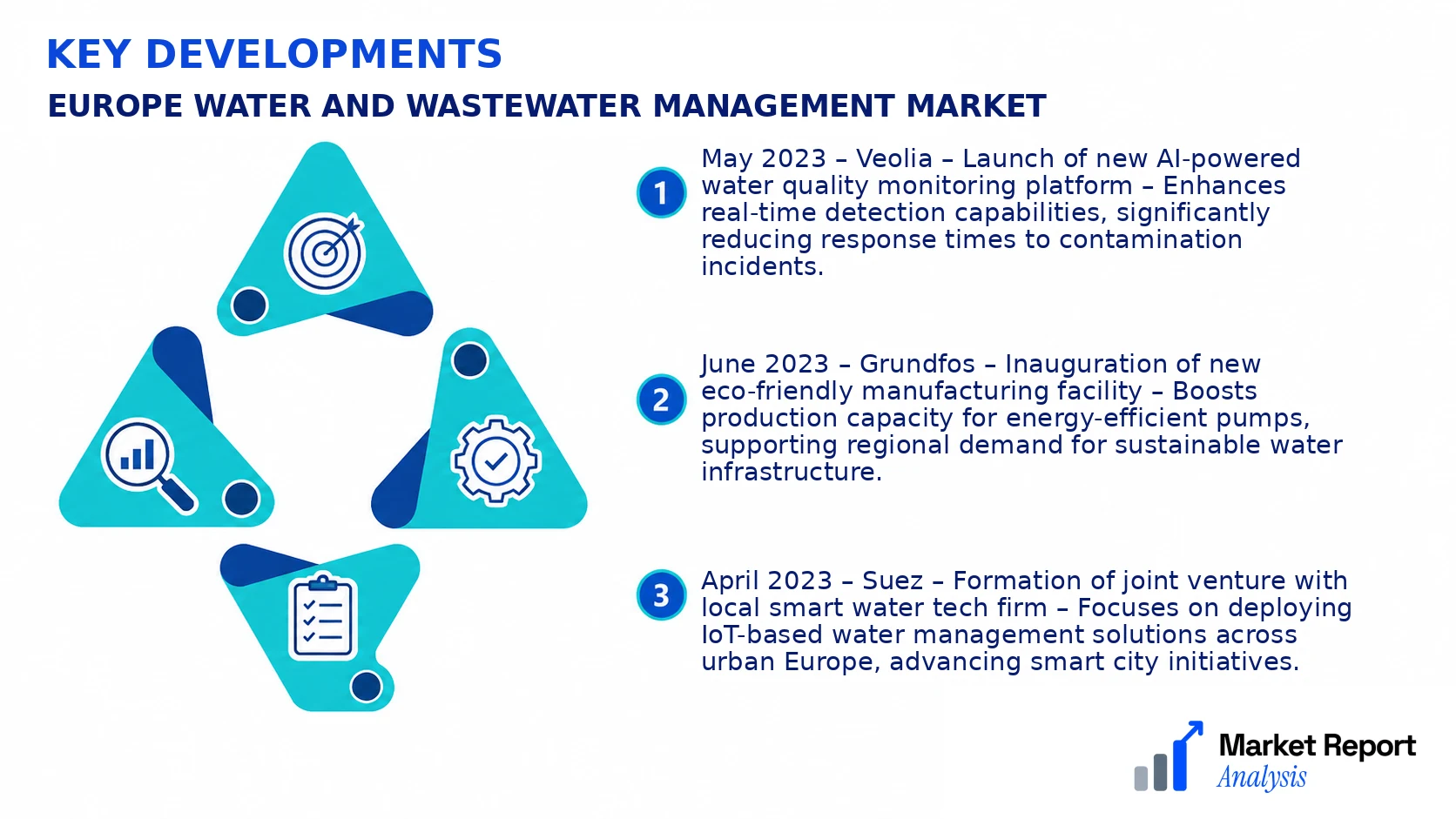
- May 2023 – Veolia – Launch of new AI-powered water quality monitoring platform – Enhances real-time detection capabilities, significantly reducing response times to contamination incidents.
- June 2023 – Grundfos – Inauguration of new eco-friendly manufacturing facility – Boosts production capacity for energy-efficient pumps, supporting regional demand for sustainable water infrastructure.
- April 2023 – Suez – Formation of joint venture with local smart water tech firm – Focuses on deploying IoT-based water management solutions across urban Europe, advancing smart city initiatives.
- August 2023 – Xylem – Acquisition of innovative sensors technology startup – Accelerates expansion of digital water management solutions and enhances product portfolio for industrial clients.
- July 2023 – Ecolab – Launch of chemical-free water treatment system for industrial use – Promotes chemical reduction and eco-compatible treatment options, aligning with environmental regulations.
Frequently Asked Questions
What is the Europe Water and Wastewater Management Market?
The Europe Water and Wastewater Management Market encompasses the infrastructure, technology, and services used for water supply, treatment, and wastewater management across European countries. It plays a vital role in ensuring clean water and environmental sustainability.
What is the current market size of Europe Water and Wastewater Management Market?
As of 2026, the market is valued at approximately USD 35 Billion, reflecting ongoing investments in infrastructure, regulatory compliance, and technological innovation across the region to address rising water quality and resource scarcity challenges.
What factors are driving the Europe Water and Wastewater Management Market?
Key drivers include stringent environmental regulations, increasing urbanization, technological advancements, and rising awareness about water conservation. Additionally, infrastructure upgrades and government funding initiatives significantly propel market growth.
Which region dominates the Europe Water and Wastewater Management Market?
Western Europe leads the market due to its advanced infrastructure, robust regulatory environment, and higher investment levels. Countries like Germany, France, and the UK are major contributors to regional market dominance.
Which segment is expected to grow the fastest?
The wastewater treatment segment is projected to experience the fastest growth, driven by environmental regulations, urban population expansion, and technological innovations that improve treatment efficiency and sustainability.
Who are the leading companies operating in the Europe Water and Wastewater Management Market?
Leading companies include Veolia Environnement, Suez, and Xylem Inc., distinguished by their extensive regional presence, innovative solutions, and strategic collaborations to address evolving water management needs across Europe.
Analyst Perspective
The Europe Water and Wastewater Management Market exhibits mature characteristics, yet ongoing technological advancements and regulatory reforms foster continuous growth opportunities. The long-term outlook remains positive, driven by increasing urbanization, stricter environmental standards, and aging infrastructure requiring modernization. Commercial opportunities are abundant in smart water management systems, including IoT-enabled sensors and AI-driven analytics, which enhance efficiency and compliance. Investment priorities should focus on innovative treatment technologies, digital transformation, and resilient infrastructure to mitigate climate change impacts. Despite heightened competitive intensity among established multinationals and local players, regional growth potential remains high, especially in Eastern Europe, where investment in urban water systems is accelerating. Overall, strategic positioning should emphasize sustainable technologies, regional diversification, and strengthening local partnerships to leverage evolving market dynamics and maintain competitive edge over the forecast period.
