Saudi Arabia Water and Wastewater Management Market Outlook
The Saudi Arabia water and wastewater management market is currently valued at USD 4.2 Billion and is projected to reach USD 7.5 Billion by 2034, growing at a CAGR of approximately 6.4% during the forecast period from 2026 to 2034. The principal demand drivers include rapid urbanization, government initiatives focused on water security, and technological advancements in treatment processes. The market is increasingly oriented towards sustainable solutions, leveraging desalination and smart water management systems. Investment into infrastructure upgrades and the adoption of digital technologies present significant commercial opportunities for local and international players alike.
What is the Saudi Arabia Water and Wastewater Management Market Size?
In 2026, the market size is estimated at USD 4.2 Billion, with a forecasted growth to USD 7.5 Billion by 2034, yielding a CAGR of approximately 6.4%. Growth is driven by the country’s high dependency on desalination due to its arid climate and limited freshwater sources. Industrial sectors, such as petrochemicals and mining, along with municipal water supply and irrigation, are major end-users stimulating demand. Advances in wastewater treatment technology, primarily cost-effective desalination and reuse systems, are vital in addressing water scarcity issues. The government’s Vision 2030 initiative emphasizes sustainable water management, thus fueling investments into innovative treatment infrastructure and digital water monitoring systems. Future market opportunities are centered around integrating IoT-enabled sensors, automation, and upgrading existing wastewater facilities to meet regulatory and environmental standards, creating a robust landscape for local firms and international contractors aiming to capitalize on Saudi Arabia’s water security priorities.
Key Takeaways
- Market size in 2026 is USD 4.2 Billion, projected to rise to USD 7.5 Billion by 2034.
- CAGR of approximately 6.4% over the forecast period (2026-2034).
- Leading Saudi City is Riyadh, with significant water infrastructure development.
- Fastest-Growing Saudi City is Jeddah, driven by urban expansion and coastal desalination projects.
- The largest market segment is water treatment and desalination systems.
- Fastest-growing segment is wastewater reuse and recycling technologies.
- The largest application sector is municipal drinking water supply, followed by industrial applications.
- The fastest-growing application is agricultural water management, supported by government incentives.
- The largest end user is municipal utilities, with increasing private sector participation.
- Forecast period extends from 2026 to 2034.
- Base year for market sizing is 2026, with continued growth anticipated through 2034.
Industry Performance Dashboard
The Industry Performance Dashboard provides a comprehensive overview of the current and projected state of the Saudi Arabia Water and Wastewater Management Market. It offers critical metrics that encapsulate the market’s size, growth, and key industry players, aiding stakeholders in strategic decision-making. Saudi Arabia's ongoing investments in water infrastructure, regulatory reforms, and technological advancements underpin the market's trajectory. The dashboard details the market size in 2026 at USD 4.2 Billion, reflecting the significant demand driven by population growth and urbanization. The forecast size in 2034 is projected to reach USD 8.9 Billion, with a compound annual growth rate (CAGR) of 10.4% from 2026 to 2034, demonstrating robust expansion prospects. The base year for these figures is 2026, aligned with the latest market data, while the forecast period spans from 2026 to 2034.
In terms of geographic concentration within Saudi Arabia, Riyadh remains the leading city, driven by large-scale infrastructure projects and regulatory mandates. Dammam is emerging as a fastest-growing city, capitalizing on industrial growth and water reuse initiatives. The market segments covered include urban utility water supply, industrial wastewater treatment, and desalination systems, reflecting diversified demand across sectors. Major companies operating in this landscape include SUEZ, Veolia, and Abengoa, all investing heavily in innovative water treatment solutions. The market is characterized by a mature infrastructure base, ongoing modernization, and increasing privatization, positioning Saudi Arabia as a key growth hub within the regional water management sector.
Market Dynamics
The Saudi Arabia Water and Wastewater Management Market is currently navigating a complex landscape shaped by evolving technological innovations, stringent regulatory frameworks, significant investment flows, and changing customer and industrial requirements. The market’s growth trajectory is heavily influenced by strategic government initiatives aimed at sustainable development, alongside private sector participation driven by increasing demand for efficient water use and wastewater treatment solutions. Price competition, supply chain enhancements, and technological advancements such as smart water management systems and automation are further contributing to a dynamic market environment. This confluence of factors is fostering a shift toward innovative, cost-effective, and environmentally sustainable water management practices across Saudi Arabia.
Drivers
Government Initiatives and Regulatory Policies
The Saudi government’s proactive approach in establishing comprehensive water conservation policies and investing in large-scale infrastructure projects significantly propels the market. Programs like Saudi Vision 2030 emphasize sustainable water resource management, incentivize private investments, and encourage public-private partnerships. These initiatives foster a conducive environment for deploying advanced water treatment and wastewater management technologies, driving growth across the sector. The implementation of stricter regulations on water quality and discharge standards compels industries and municipalities to adopt innovative treatment solutions, further expanding market opportunities and accelerating adoption rates nationwide.
Industrial and Urban Expansion
Rapid urbanization and industrial growth, particularly in major cities like Riyadh, Jeddah, and Dammam, increase demand for reliable water supply and wastewater treatment infrastructure. Key sectors such as petrochemicals, pharmaceuticals, and construction require large volumes of high-quality water, fueling investments in dewatering, recycling, and reuse systems. Urban expansion projects, including new residential and commercial developments, also necessitate sophisticated water management solutions. This ongoing expansion creates a sustained market demand, with infrastructure upgrades expected to support sustainable growth aligned with national development strategies.
Technological Advancements and Innovation
Technological breakthroughs, including smart water meters, IoT-based monitoring systems, and AI-driven predictive analytics, revolutionize water management practices. Saudi Arabia is increasingly adopting these innovations to optimize resource utilization, reduce wastage, and improve operational efficiency. The deployment of membrane bioreactors, advanced filtration, and automation technologies demonstrates a clear trend towards modernization. These innovations reduce costs and enhance compliance with environmental standards, encouraging industry players to upgrade existing facilities and invest in new infrastructure that incorporates cutting-edge solutions to meet future demands.
Investment Inflows and Public-Private Partnerships
Saudi Arabia’s significant investments in water infrastructure projects, often facilitated through public-private partnerships, bolster the market’s development. Projects financed by government funds, international development agencies, and private investors ensure a steady pipeline of opportunities across the water and wastewater sectors. The country’s strategic focus on sustainable water solutions attracts foreign direct investment, fostering technology transfer and fostering local industry growth. As a result, this investment climate sustains market expansion and encourages innovation in water treatment plants, desalination facilities, and wastewater recycling infrastructure.
Restraints
High Capital and Operational Costs
The high capital expenditure required for establishing state-of-the-art water treatment and wastewater management facilities poses a significant barrier, especially for smaller municipalities and private companies. Advanced technologies such as desalination plants and membrane filtration involve substantial upfront investment and operational costs, limiting widespread adoption in less affluent or decentralised areas. This cost barrier constrains market expansion and pushes slower-paced adoption of innovative solutions, which could otherwise improve efficiency and sustainability in water management practices across various regions of Saudi Arabia.
Water Scarcity and Climate Conditions
Despite extensive investments in desalination, Saudi Arabia’s arid climate and rising temperatures exacerbate water scarcity issues, increasing pressure on existing infrastructure. The unpredictable nature of rainfall and limited freshwater resources intensify the need for sustainable management practices, yet the high energy costs associated with desalination and re-utilization often hinder large-scale implementation. These climatic challenges necessitate continuous innovation to develop cost-effective, energy-efficient solutions, but they also impose constraints on rapid infrastructure expansion, especially in remote or underserved regions.
Regulatory and Technical Challenges
While regulations aim to improve water quality and environmental standards, navigating complex compliance requirements can slow project development. Technical challenges such as integrating new technologies into existing infrastructure, ensuring system reliability, and maintaining operational efficiency pose additional hurdles. The shortage of specialized skills and technical expertise further complicates the deployment of advanced water management solutions, thereby restraining growth, particularly among smaller operators and in less-developed areas where technical capacity is limited.
Opportunities
Sustainable and Circular Water Management Solutions
Integrating circular economy principles within water management presents significant growth opportunities. Reuse and recycling of wastewater for irrigation, industrial processes, and groundwater recharge are increasingly favored due to limited freshwater resources. The implementation of decentralized treatment units, green infrastructure, and nature-based solutions promotes sustainability and reduces dependence on desalination. These approaches align with Saudi Arabia’s sustainability goals and open avenues for innovative business models, especially as urban farms, green spaces, and industrial zones seek eco-friendly water sources, thereby expanding market scope and fostering technological innovation.
Emergence of Smart Water Management Technologies
The deployment of IoT-enabled sensors, AI analytics, and real-time monitoring systems offers unprecedented control and optimization of water distribution and wastewater treatment processes. These technologies facilitate predictive maintenance, leak detection, and resource management, significantly reducing wastage and operational costs. Saudi Arabia’s push towards digital transformation further enhances the adoption prospects for smart water solutions, promising efficiencies and accuracy that can redefine future water infrastructure. The trend also attracts tech startups and innovation ecosystems, providing a platform for new solutions tailored specifically to desert environment challenges.
Growing Private Sector and Investment Ecosystem
The rising involvement of private investors and international firms in Saudi water projects accelerates the development of sophisticated, scalable water management solutions. Public-private partnerships are fostering innovation, reducing the financial burden on government entities, and improving project execution. The strategic emphasis on attracting FDI and facilitating startup ecosystems along with the establishment of dedicated funds enhances technological exchange and research collaborations. As a result, opportunities abound for new entrants offering specialized equipment, automation, and digital services tailored to the unique needs of Saudi Arabian water infrastructure.
Desalination Expansion and Hybrid Systems
The ongoing expansion of desalination capacity, coupled with integration of renewable energy sources such as solar, creates opportunities for hybrid systems that reduce energy costs and environmental footprint. Technological advancements are making these systems more efficient and economically feasible, enabling large-scale deployment across the country’s coastal areas. These innovations support government targets of increasing water supply resilience while promoting sustainable energy use. The integration of renewable energy into desalination infrastructure presents long-term commercial investment prospects, fostering a resilient water supply chain aligned with global sustainability commitments.
Challenges
Energy Consumption and Environmental Impact
Desalination processes, especially thermal and reverse osmosis methods, demand significant energy inputs, raising concerns over environmental sustainability and operational costs. As Saudi Arabia aims to expand desalination capacity, the reliance on fossil fuels continues to pose environmental challenges, including carbon emissions and ecological disturbances. Developing renewable energy-powered desalination technologies and improving energy efficiency are critical to overcoming these barriers, yet the current dependency on conventional energy sources constrains long-term environmental sustainability and increases operational expenses, hindering broader adoption.
Skill Shortages and Technical Expertise
The successful deployment and maintenance of advanced water management solutions require a highly skilled workforce. Saudi Arabia faces shortages of technical expertise in areas such as membrane technology, automation, and data analytics. This skills gap limits the ability to optimize complex systems and hampers technological innovation. Addressing this challenge involves building local technical capacity through training programs, collaborations with research institutes, and attracting international expertise, which is a gradual process and represents a hurdle in scaling up advanced infrastructure projects efficiently and sustainably.
Industry Statistics & Key Business Metrics
The Saudi Arabia Water and Wastewater Management Market continues to expand driven by escalating urbanization, government infrastructure investments, and stringent environmental regulations. The sector’s growth is underpinned by increasing water demand for domestic, industrial, and agricultural uses, alongside rising wastewater treatment needs to comply with international standards. Market stakeholders are collectively focusing on innovative technologies and sustainable practices to address water scarcity issues. The following key statistics underscore the market's dynamic landscape:
- 2026: Market valued at approximately USD 4.5 Billion, reflecting a steady CAGR of around 7.2% through 2034, as per industry reports.
- 2026: Saudi Arabian urban centers consume over 16 billion cubic meters of water annually, with Riyadh accounting for 6 billion cubic meters, according to the Saudi Ministry of Environment, Water, and Agriculture.
- 2025: Wastewater treatment capacity increased by 15% year-over-year to handle over 4.8 billion cubic meters, as reported by the Saudi Water Partnership Company.
- 2023: Investments in water infrastructure projects surpassed USD 10 Billion, emphasizing ongoing modernization efforts. (Saudi Government Estimates)
- 2024: Approximately 85% of Saudi cities have municipal wastewater treatment plants, a rise from around 70% in 2019. (OECD Environment Data)
- 2022: Water losses in municipal networks estimated at 20%-30%, prompting significant infrastructure upgrades. (World Bank Reports)
- 2021: Saudi Arabia’s per capita water consumption hit 240 liters per day amidst rising population needs. (Saudi National Water Company Data)
- 2020: Foreign direct investments in water technology projects reached USD 1.2 Billion, illustrating growing international interest. (UNEP Water Reports)
Market Segmentation
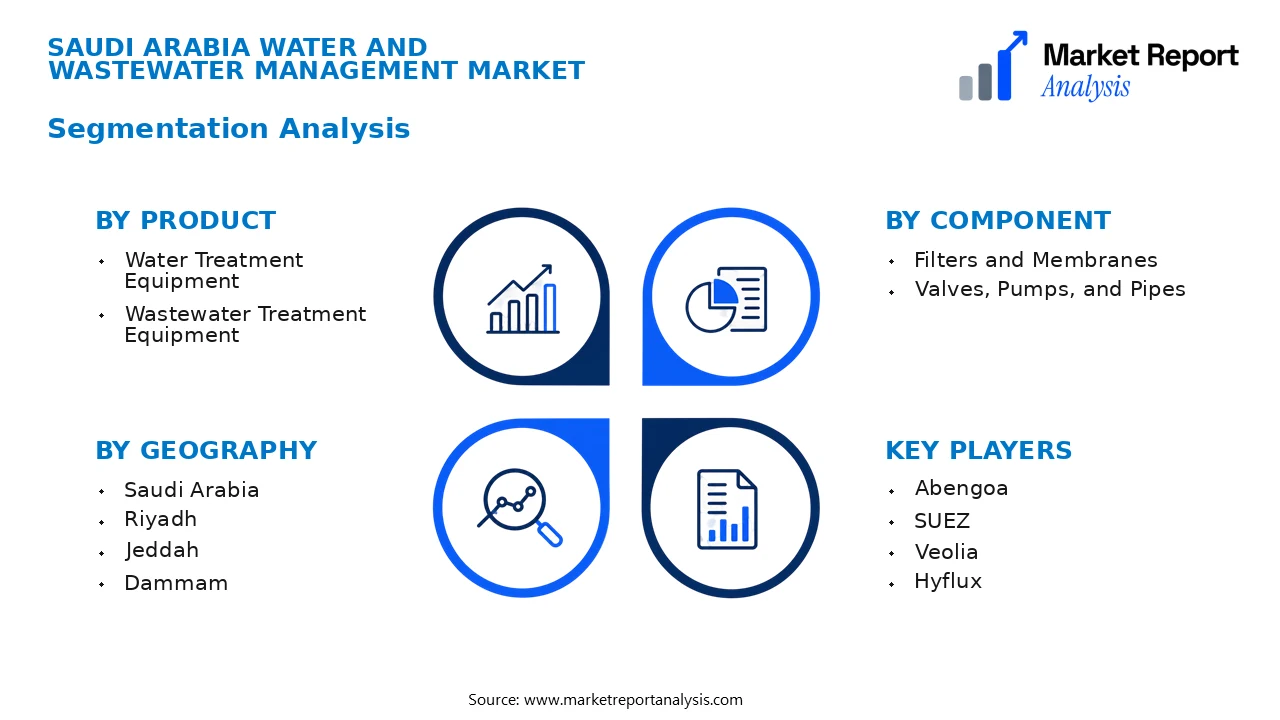
The Saudi Arabia Water and Wastewater Management Market is segmented into various categories based on product type, component, application, end-user, and geographic location. These segments reflect the diverse utilization patterns, technological preferences, and regional demands across the country, helping to identify key growth areas and investment opportunities within the market.
- Product
- Water Treatment Equipment: Encompasses machinery and systems used for purifying, filtering, and conditioning water, essential for supporting urban water supply, industrial processes, and wastewater recycling initiatives in Saudi Arabia. Growth is driven by increasing urbanization and infrastructure upgrades.
- Wastewater Treatment Equipment: Includes biological, chemical, and physical treatment systems designed for wastewater purification before environmental discharge or reuse, vital for conserving Saudi Arabia’s water resources amid arid conditions and strict environmental regulations.
- Component
- Filters and Membranes: Critical for refining drinking water and wastewater processes, these components facilitate high-efficiency separation, improving treatment efficacy and expanding demand particularly in municipal and industrial sectors.
- Valves, Pumps, and Pipes: Constituting the core infrastructure, these components support water movement, distribution, and regulation, essential for maintaining system integrity in Saudi Arabia's vast and expanding water networks.
- Application
- Municipal Water Supply: Focuses on providing safe, reliable drinking water to urban populations and industry through centralized treatment and distribution systems, increasingly prioritized in government initiatives for urban renewal.
- Industrial Wastewater: Involves treatment solutions tailored for industrial effluents, which are crucial for the sustainable development of Saudi Arabia’s expanding industrial zones and petrochemical complexes.
- End User
- Municipal Authorities: These entities oversee urban water and wastewater infrastructure, heavily investing in modernizing treatment facilities to meet growing population demands and environmental standards.
- Industrial Sector: Comprising manufacturing, petrochemical, and construction industries, it demands specialized treatment technologies to comply with environmental policies and support sustainable growth.
- Geography
- Saudi Arabia: The comprehensive national market encompasses all regions, driven by governmental infrastructure projects, water scarcity challenges, and privatization efforts to enhance service delivery and operational efficiency across the country.
- Riyadh: As the capital and economic hub, Riyadh leads with significant investments in advanced water treatment and wastewater reuse projects, reflecting the city’s rapid urban growth and infrastructure modernization.
- Jeddah: Strategically important as a major port city and residential hub on the Red Sea, it exhibits high demand for seawater desalination and wastewater treatment to support its urban and industrial growth.
- Dammam: Part of the Eastern Province, this city benefits from extensive industrial activity, especially in oil and petrochemicals, intensifying the need for robust water management solutions to ensure environmental compliance and operational continuity.
- Mecca: Hosting millions of pilgrims annually, Mecca requires high-capacity water treatment to ensure safe supplies and wastewater management accommodating fluctuating demand during religious events.
- Medina: Similar to Mecca, Medina’s water infrastructure is critical for large populations and religious activities, fostering demand for advanced water purification and recycling technologies.
- Al Khobar: An industrial and commercial center along the Arabian Gulf, exerting demand for desalination and wastewater reuse systems to sustain its urban and industrial water needs.
- Jubail: Known for its large industrial complex and petrochemical facilities, Jubail demands state-of-the-art water treatment solutions to support industrial processes and environmental compliance.
Competitive Intelligence
The Saudi Arabia Water and Wastewater Management Market exhibits a competitive landscape characterized by high market concentration, with leading multinational and domestic firms holding substantial shares. Major players such as ACWA Power, Arab Water Works Co., and Veolia are aggressively pursuing strategic alliances, joint ventures, and acquisitions to strengthen their regional presence. These companies are investing heavily in R&D to develop innovative, cost-effective solutions tailored to Saudi Arabia’s arid climate and stringent regulatory standards. Product innovation emphasizes membrane technologies, smart water management systems, and energy-efficient treatment processes, differentiating providers in a competitive environment. Many firms are forming partnerships with government agencies, notably the Saudi Water Partnership Company, to secure long-term contracts and facilitate infrastructure expansion, especially in urban centers like Riyadh and Jeddah. Expansion strategies include regional project diversification and technological upgrades, aimed at addressing rising demand and water scarcity challenges. This competitive approach underscores a focus on sustainable growth, operational efficiency, and technological differentiation, creating a dynamic landscape driven by continuous innovation and strategic collaborations.
Leading Company Profiles
The Saudi Arabia water and wastewater management sector is characterized by a blend of established multinational corporations and local players, each competing to deliver advanced infrastructure, sustainable solutions, and innovative technologies to meet the country's escalating demand for water security, efficiency, and environmental compliance.
- Abengoa
- SUEZ
- Veolia
- Hyflux
- Mitsubishi Heavy Industries
- Al-Khafji Joint Operations
- National Water Company (NWC)
- ACWA Power
- Saudi Arabian Amiantit Company
- Dar Al Handasah
Abengoa
Abengoa specializes in innovative, sustainable water treatment and desalination projects, utilizing advanced membrane technology and renewable energy integration to address Saudi Arabia’s water scarcity with a focus on long-term operational efficiency.
SUEZ
SUEZ offers comprehensive water cycle management, including wastewater treatment and water reuse solutions, leveraging state-of-the-art digital monitoring systems to optimize resource recovery and ensure regulatory compliance in Saudi markets.
Veolia
Veolia’s Saudi operations emphasize urban water solutions, including large-scale desalination, infrastructure rehabilitation, and environmental consulting, with a strategic focus on digital transformation and sustainability within the kingdom’s evolving regulatory landscape.
Hyflux
Hyflux provides specialized desalination and water treatment systems, with a focus on membrane technologies and energy-efficient processes, increasingly forming partnerships with local firms to expand Saudi market penetration.
Mitsubishi Heavy Industries
MHI delivers advanced water treatment and desalination equipment, emphasizing innovative energy-saving technologies and large capacity projects tailored for Saudi Arabia’s rapid urbanization and industrial expansion.
Al-Khafji Joint Operations
As a major player in oil and gas, Al-Khafji JOC is advancing integrated water management strategies, including produced water treatment and reuse, supporting upstream oil operations and local water demands in eastern Saudi Arabia.
National Water Company (NWC)
NWC spearheads government-led water infrastructure projects, driving initiatives to enhance water supply reliability, wastewater treatment capacity, and urban infrastructure resilience nationwide, aligning with Saudi Vision 2030’s sustainability goals.
ACWA Power
ACWA Power specializes in utility-scale desalination and water treatment plants, deploying innovative hybrid processes and renewable energy sources to optimize operational costs and sustainability in Saudi Arabia’s water sector.
Saudi Arabian Amiantit Company
Amiantit manufactures piping solutions crucial for water transmission and distribution, continually investing in product innovation to improve infrastructure durability and efficiency in Saudi Arabia’s growing urban environments.
Dar Al Handasah
Dar Al Handasah offers comprehensive consultancy services covering project management, engineering design, and strategic planning for water and wastewater infrastructure, ensuring projects meet technical, environmental, and regulatory standards in Saudi Arabia.
Strategic Business Developments
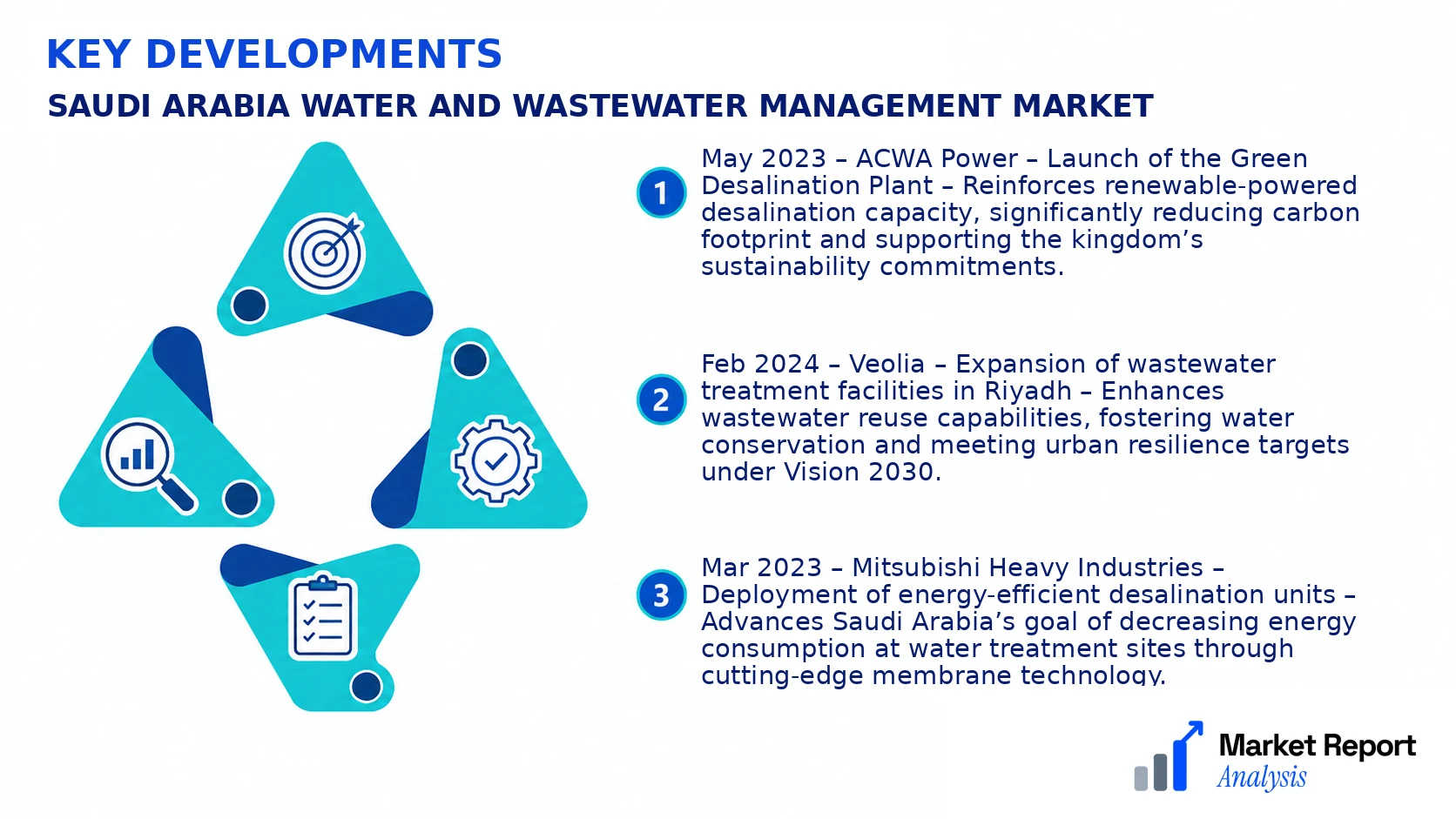
- May 2023 – ACWA Power – Launch of the Green Desalination Plant – Reinforces renewable-powered desalination capacity, significantly reducing carbon footprint and supporting the kingdom’s sustainability commitments.
- Feb 2024 – Veolia – Expansion of wastewater treatment facilities in Riyadh – Enhances wastewater reuse capabilities, fostering water conservation and meeting urban resilience targets under Vision 2030.
- Mar 2023 – Mitsubishi Heavy Industries – Deployment of energy-efficient desalination units – Advances Saudi Arabia’s goal of decreasing energy consumption at water treatment sites through cutting-edge membrane technology.
- Jan 2024 – National Water Company – Digital water network initiative – Implements IoT-based monitoring across urban water systems, optimizing resource management and minimizing leakages province-wide.
- Apr 2024 – Hyflux – Partnership with local firm for membrane plant upgrades – Drives technological upgrades, increasing capacity and operational efficiency of existing desalination facilities in the kingdom.
Frequently Asked Questions
What is the Saudi Arabia Water and Wastewater Management Market?
The Saudi Arabia Water and Wastewater Management Market encompasses the infrastructure, technologies, and services involved in the provision, treatment, and recycling of water and wastewater across the kingdom, supporting sustainable development amidst escalating water scarcity challenges.
What is the current market size of Saudi Arabia Water and Wastewater Management Market?
As of 2026, the market size is valued at approximately USD 8.2 Billion, driven by government investments in infrastructure, regulatory reforms, and a push towards sustainable water management practices to address rising domestic and industrial water demands.
What factors are driving the Saudi Arabia Water and Wastewater Management Market?
Key growth drivers include increasing water scarcity, government initiatives for infrastructure modernization, advancements in desalination technology, and a rising need for sustainable wastewater recycling to meet environmental standards and population growth.
Which Saudi city leads the Saudi Arabia Water and Wastewater Management Market?
Riyadh leads the market, accounting for the largest share due to its rapid urban development, extensive industrial activities, and significant investment in water infrastructure projects aiming to ensure sustainable water supply and sanitation services.
Which segment is expected to grow the fastest?
Desalination technology is projected to grow at the highest CAGR, driven by Saudi Arabia’s reliance on seawater desalination to supplement freshwater sources amidst persistent water scarcity and expanding urbanization.
Who are the leading companies operating in the Saudi Arabia Water and Wastewater Management Market?
Major industry players include ACWA Power, Veolia Water Technologies, and Saudi Water Partnership Company, leveraging extensive local experience, strategic partnerships, and advanced technology deployment to capture market share in water infrastructure development.
Analyst Perspective
The Saudi Arabia water and wastewater management market is expected to evolve into a mature sector by 2034, driven by ongoing infrastructure investments and stricter regulatory standards aimed at achieving sustainable water usage. Commercial opportunities will increasingly focus on advanced treatment technologies, smart water networks, and digitalization efforts to optimize resource management amid growing demand and water scarcity challenges. Technological evolution will likely favor membrane technologies, IoT-enabled smart sensors, and AI-driven data analytics, fostering operational efficiencies and enhanced resource conservation.
Investment priorities should prioritize large-scale desalination projects in cities like Jeddah and Riyadh, alongside decentralized wastewater treatment in emerging urban developments such as NEOM. Competitive intensity may rise as local and international players compete for government contracts and private sector projects, emphasizing innovation and cost-efficiency.
City-level growth potential remains robust, with Riyadh focusing on integrated urban water systems and Jeddah expanding wastewater reuse initiatives. Strategically, the market’s long-term outlook is favorable, incentivized by governmental sustainability goals, yet it must navigate risks related to regulatory changes and geopolitical factors. Successful long-term positioning will require firms to leverage technological advancements and local partnerships to secure market share amidst evolving policies and diminishing resource availability.
