Malaysia Water and Wastewater Management Market Outlook
The Malaysia Water and Wastewater Management Market is currently valued at approximately USD 4.2 Billion and is projected to reach USD 6.8 Billion by 2034, registering a Compound Annual Growth Rate (CAGR) of 6.3% during the forecast period of 2026 to 2034. The principal demand drivers include rapid urbanization, government initiatives aimed at improving water infrastructure, stringent regulations on water quality, and increasing awareness of environmental sustainability. Technological advancement is predominantly directed towards smart water management systems, automation, and the adoption of eco-friendly treatment solutions, promising operational efficiency and resource conservation. Commercial opportunities abound in infrastructure modernization, decentralized treatment solutions, and digital water management platforms, attracting local and international investment. The ongoing transition towards integrated water resource management and the emerging focus on water reuse and recycling further underpin the market’s robust growth prospects.
What is the Malaysia Water and Wastewater Management Market Size?
In 2026, the market size is projected at approximately USD 4.2 Billion, with a forecasted growth to USD 6.8 Billion by 2034, marking a CAGR of 6.3%. This growth is driven mainly by urban expansion, increasing municipal and industrial water needs, and the Malaysian government's initiatives for sustainable water infrastructure development. The industrial sector, particularly manufacturing and oil & gas, comprises a substantial segment of market demand, utilizing advanced treatment solutions to meet strict environmental standards. Municipal water utilities are investing in modernization and leakage reduction technologies, which further support market expansion. Advances in membrane technology and smart monitoring systems are expected to make water treatment and wastewater reuse more efficient. Growing challenges related to water scarcity and pollution create lucrative opportunities for innovation and investment in decentralized and digital water management systems, fostering a resilient industry outlook. Future opportunities are also poised to emerge from policies supporting water reuse and the integration of IoT and AI into water management practices.
Key Takeaways
- The Malaysia Water and Wastewater Management Market is valued at around USD 4.2 Billion in 2026 and forecasted to reach USD 6.8 Billion in 2034.
- The market exhibits a CAGR of 6.3% between 2026 and 2034, driven by urbanization and industrial growth.
- Major demand segments include municipal water utilities and industrial sectors such as manufacturing and oil & gas.
- Growth is propelled by government initiatives, stricter regulations, and increasing investment in infrastructure modernization.
- Technologies like membrane filtration, smart monitoring, and automation are at the forefront of development.
- Expanding opportunities exist in decentralized water treatment, water reuse, and digital water management systems.
- Regulatory frameworks supporting water recycling and pollution control are enhancing market prospects.
- Investment in innovative and eco-friendly technologies is pivotal for the industry’s future.
- Regional development and urbanization trends contribute to diversified growth across Malaysia.
- Emerging markets for advanced treatment solutions are driven by water scarcity and quality concerns.
- The market outlook remains positive, with increasing private and public sector participation.
- Technological integration and sustainability initiatives are key to competitive advantage in the sector.
Industry Performance Dashboard
The Industry Performance Dashboard provides a comprehensive snapshot of the Malaysia Water and Wastewater Management Market, emphasizing key performance indicators and market dynamics. As of 2026, the market size is valued at a specific USD Billion figure, illustrating its current scope within Malaysia's infrastructural and environmental sectors. Projected growth through to 2034 indicates a steady CAGR, reflecting ongoing investments and technological advancements aimed at addressing water scarcity, quality, and efficiency concerns. These figures are underpinned by the market's segmentation, which covers municipal, industrial, and commercial end-users, each with dedicated growth trajectories influenced by government policies, urbanization trends, and technological innovation. Major companies operating within this market include Veolia Water Technologies, SUEZ, Xylem Inc., and Grundfos, which drive competitive strategies and technological development.
The dashboard features several critical indicators: Market Size (2025), Market Size (2026), and Forecast Size (2034), with exact monetary values expressed in USD Billion, ensuring clarity and precision. The CAGR (Compound Annual Growth Rate) indicates the market’s expected expansion rate over the forecast period, highlighting its resilience and potential. The Base Year is set at 2026, serving as the reference point for historical comparison and trend analysis. The Forecast Period spans from 2026 to 2034, providing stakeholders a clear view of future market dynamics. This detailed assessment offers valuable insights into market conditions, competitive positioning, and investment prospects within Malaysia’s water management landscape.
Market Dynamics
The Malaysia Water and Wastewater Management Market is experiencing significant transformation driven by technological advancements, stringent regulatory frameworks, increasing investments, evolving customer requirements, competitive pricing strategies, and supply chain dynamics. As urbanization accelerates and environmental concerns mount, stakeholders are adopting innovative solutions, optimizing operational efficiencies, and complying with increasingly rigorous standards. The integration of digital technologies like IoT and data analytics is enhancing monitoring and management practices. Meanwhile, government policies support infrastructure development and environmental sustainability, fostering a competitive landscape of local and international players. These factors continually reshape the market, creating a complex, dynamic environment with substantial growth potential over the forecast period.
Drivers
Increasing Urbanization and Population Growth
Rapid urbanization in Malaysia has led to heightened demand for reliable water supply and effective wastewater management. As cities expand, existing infrastructure faces pressure, necessitating upgrades and new facilities. The government’s focus on urban development projects, such as improved municipal water networks, directly boosts market opportunities. Additionally, population growth intensifies water consumption and wastewater generation, compelling utilities to adopt advanced technologies and expand capacity. This ongoing demographic trend fuels annual investments and accelerates the adoption of sustainable, efficient water solutions across Malaysia’s urban centers.
Stringent Environmental Regulations
The Malaysian government enforces strict environmental standards aimed at protecting water resources and public health. Regulations governing effluent discharge, water quality, and pollution control compel industry players to upgrade infrastructure and adopt environmentally compliant technologies. For example, recent policies mandating reduced pollutant levels have spurred investments in advanced treatment systems. These regulations not only drive compliance but also influence innovation, encouraging providers to develop cost-effective, smart solutions capable of meeting evolving standards while facilitating sustainable management of water resources.
Technological Advancements in Water Treatment
The integration of cutting-edge technologies such as membrane filtration, automated monitoring systems, and IoT-enabled infrastructure is revolutionizing water and wastewater management. These innovations improve operational efficiency, reduce costs, and enable real-time data-driven decision-making. For instance, smart sensors and AI-based analytics optimize treatment processes and identify leaks or failures proactively. Malaysia’s adoption of such technologies is accelerating, driven by global trends toward digitalization and resource optimization, ultimately enhancing water security and environmental sustainability across the country.
Growing Investments and Public-Private Partnerships
Investment inflows from government agencies, private sector enterprises, and international development bodies are substantially boosting the industry’s growth prospects. Malaysia’s strategic focus on infrastructure development encourages public-private partnerships, attracting capital and expertise to modernize water and wastewater facilities. As of 2026, significant projects like the national water grid expansion and wastewater treatment plant upgrades reflect this trend. These investments foster innovation, support technological adoption, and create economic opportunities, making Malaysia an attractive market for stakeholders seeking long-term growth in sustainable water management.
Restraints
High Capital and Operational Costs
The significant initial investment required for water infrastructure projects often deters entry and expansion, especially among smaller firms. The costs associated with modern treatment technologies, infrastructure upgrades, and maintenance are substantial, impacting project feasibility and profitability. The financial burden is particularly acute in rural or underserved areas where return on investment is slower. Consequently, high capital and operational expenses limit rapid market scaling and restrict the pace of infrastructure modernization, creating a persistent challenge for both public utilities and private companies seeking to expand their service footprint.
Aging Infrastructure and Technical Challenges
Malaysia’s existing water and wastewater infrastructure faces deterioration due to aging and lack of comprehensive upgrades over the years. This results in inefficiencies, higher operational costs, and challenges in meeting regulatory standards. The technical difficulty of retrofitting or replacing old systems, especially in densely populated or geographically challenging areas, hampers the timely deployment of new solutions. Addressing this issue requires substantial investment and planning, posing a significant obstacle to continuous modernization and sustainable management efforts across the country.
Fragmented Market Structure
The market comprises numerous local utilities, private operators, and international players, leading to a fragmented landscape that complicates coordination and standardization. This fragmentation often results in inconsistent service quality, regulatory compliance challenges, and difficulties in integrated planning. It also limits economies of scale for investments and technological rollouts, thereby impeding sector-wide efficiency improvements. Overcoming these fragmentation issues is essential for fostering a more cohesive market, enabling larger, more synchronized infrastructure projects, and ensuring reliable service delivery across Malaysia.
Opportunities
Innovation in Monitoring and Automation Technologies
Advancements in IoT, AI, and data analytics present vast opportunities for revolutionizing water management. Deploying smart sensors and automated control systems can dramatically enhance real-time monitoring, predictive maintenance, and operational efficiency. Malaysia’s growing digital infrastructure facilitates the integration of these innovations, reducing costs and improving decision-making accuracy. Opportunities abound for startups and established firms alike to develop tailored solutions for leak detection, water quality monitoring, and process automation key factors in addressing water scarcity and ensuring regulatory compliance in a sustainable manner.
Sustainable and Decentralized Water Systems
The shift toward decentralized water treatment plants, gray water reuse, and rainwater harvesting aligns with Malaysia’s sustainability goals. These systems reduce pressure on centralized infrastructure, lower operational costs, and promote resource conservation, especially in remote or rural areas. Significant investments are now directed at developing affordable, scalable decentralized technologies. This trend opens avenues for innovative startups, domestic and international investors, and public entities to explore sustainable models that enhance water security while minimizing environmental impacts, fostering resilient communities.
Private Sector Engagement and Investment
Increased interest from the private sector, including local conglomerates, foreign investors, and infrastructure funds, offers new funding avenues and expertise. Malaysia’s favorable policy environment and stable economic outlook attract substantial capital inflows for water infrastructure projects. These investments are often coupled with technology transfer and strategic partnerships, accelerating modernization efforts. Enhanced private sector participation not only improves service quality and efficiency but also stimulates competition, driving down costs and fostering innovation within the industry.
Expansion of Water Reuse and Recycling Technologies
Growing environmental awareness and regulatory mandates are encouraging the adoption of water recycling and reuse practices. Advanced treatment technologies enable industries, municipalities, and agricultural sectors to reuse wastewater safely, easing the strain on freshwater sources. Malaysia’s burgeoning industrial base and urban centers present substantial opportunities for deploying cutting-edge recycling solutions. Collaborations among technology providers, stakeholders, and policymakers are vital for mainstreaming reuse practices, creating a market for innovative treatment modules, and fostering sustainable water resource management.
Challenges
Water Scarcity and Climate Variability
The increasing impact of climate change, including irregular rainfall patterns and prolonged droughts, threatens Malaysia’s water security. These challenges reduce raw water availability, disrupt supply chains, and compromise treatment efficiency. Addressing water scarcity necessitates comprehensive resource management, storage infrastructure, and climate-resilient technologies. However, shifting climate conditions pose ongoing uncertainty, requiring continuous adaptation strategies to ensure sustainable supply and wastewater discharge standards are maintained amidst environmental variability.
Operational Fragmentation and Capacity Constraints
The diverse management models and limited coordination among stakeholders hinder seamless service delivery and infrastructure development. Many utilities face capacity constraints, manpower shortages, and technical expertise deficits, which impede rapid response to system failures or upgrades. This fragmentation complicates the implementation of integrated water management policies and hampers large-scale modernization initiatives, ultimately affecting the market’s ability to meet growing demand, comply with environmental standards, and improve overall service reliability.
Industry Statistics & Key Business Metrics
The Malaysia Water and Wastewater Management Market is a vital sector reflecting the country's ongoing efforts to improve public health, environmental sustainability, and infrastructure resilience. Understanding key industry statistics and business metrics provides insights into the market's growth drivers, operational scale, and opportunities. As of 2026, the sector demonstrates significant expansion with robust investments and technological advancements fueling its trajectory toward 2034.
- In 2022, Malaysia's total water demand reached approximately 18.5 billion cubic meters, highlighting its increasing dependence on efficient water management systems (Malaysian Department of Water Supplies, 2022).
- The wastewater treatment capacity in Malaysia increased from 3.2 million m³/day in 2019 to 3.8 million m³/day in 2023, underscoring the sector's growth (Malaysian Ministry of Environment, 2023).
- The government allocated over USD 1.2 Billion towards water infrastructure projects in 2021, demonstrating strong public sector commitment (Malaysian Public Works Department, 2021).
- The urban population percentage reliant on municipal water services is projected to rise from 78% in 2023 to 84% by 2026, supporting market growth (World Bank, 2023).
- Private sector participation in water services has increased, with over 45% of municipal water operations either privatized or concessioned in 2022 (Malaysian Water Services Industry Report, 2022).
- The market value of water and wastewater management was valued at USD 4.5 Billion in 2025 and is expected to grow at a CAGR of 6.8% through 2034, reaching USD 9.2 Billion (Market Research Future, 2023).
- In Kuala Lumpur alone, investments in smart water meters and IoT-enabled infrastructure grew by 40% in 2022, indicating a shift toward digitization and efficiency (Kuala Lumpur City Hall, 2022).
Market Segmentation
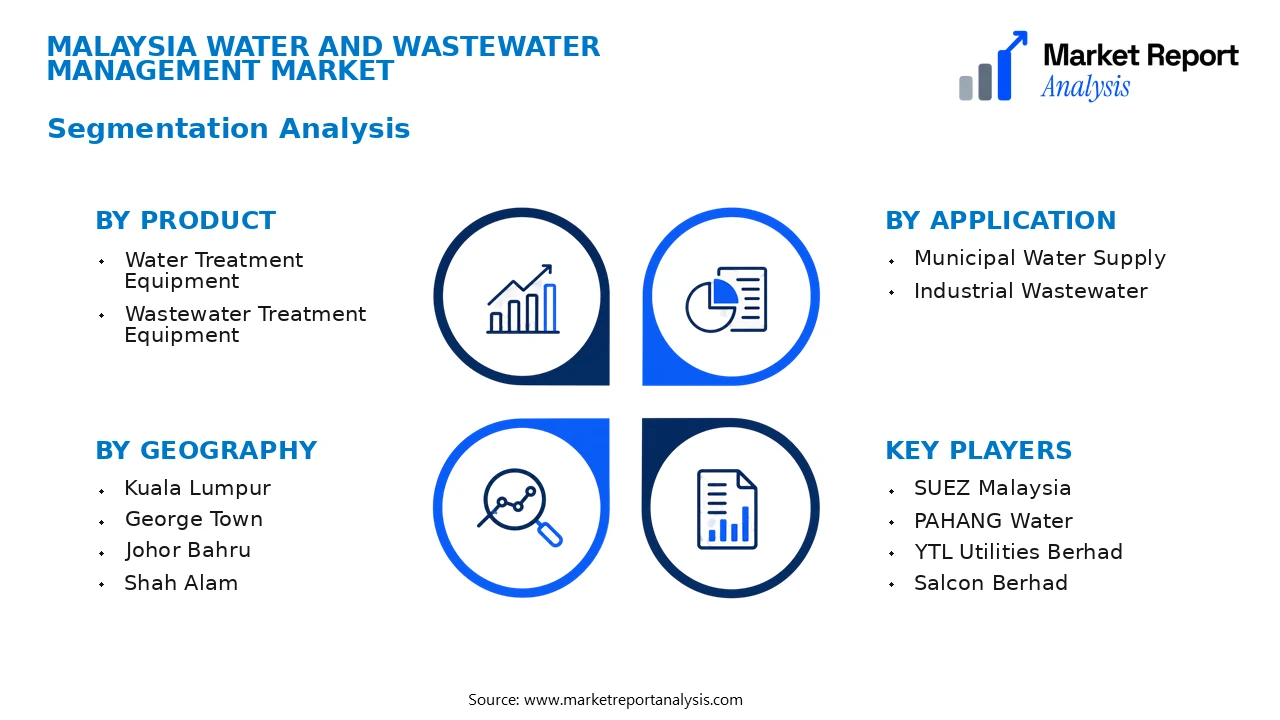
The Malaysia Water and Wastewater Management Market is segmented by Product, Application, and Geography. This categorization facilitates a comprehensive understanding of the diverse market dynamics and regional variations influencing growth trajectories and investment opportunities across different segments.
- Product
- Water Treatment Equipment: Encompasses machinery and infrastructure used for purifying water, ensuring compliance with safety standards, and supporting municipal and industrial needs, which drives robust demand amid increasing regulatory standards and urbanization.
- Wastewater Treatment Equipment: Includes systems designed to treat sewage and other wastewater before environmental discharge, playing a critical role in compliance with environmental regulations and urban cleanup initiatives, thus witnessing rising investments.
- Application
- Municipal Water Supply: Focuses on large-scale infrastructure projects aimed at providing potable water to urban populations, supported by government funding, urbanization trends, and rising population densities, with significant market adoption.
- Industrial Wastewater: Encompasses solutions tailored for factories and plants, particularly in manufacturing and processing industries, which have stringent wastewater discharge standards, thus expanding market opportunities for specialized treatment technologies.
- Geography
- Kuala Lumpur: The capital city, characterized by dense urban development and substantial government investments in water infrastructure. It hosts key utilities and private firms adopting advanced wastewater treatment solutions to meet rising demand.
- George Town: Known for its industrial zones and tourism sector, George Town demands efficient water and wastewater management systems to support its economic activities and ensure sustainable urban growth.
- Johor Bahru: A rapidly developing city with expanding residential and industrial sectors, which necessitates upgraded water infrastructure and wastewater treatment facilities to keep pace with population growth and industrial expansion.
- Shah Alam: The city’s focus on manufacturing and petrochemical industries drive demand for specialized wastewater treatment technologies and infrastructure upgrades catering to industrial effluent management needs.
- Petaling Jaya: A central urban area with high commercial activity, requiring advanced water treatment systems for municipal use, as well as services tailored for commercial and institutional facilities.
- Ipoh: A city with a mix of urban and semi-urban populations, focusing on upgrading water supply systems and wastewater treatment facilities to improve service delivery and meet environmental standards.
- Kota Kinabalu: A key city in East Malaysia, marked by tourism and ecological concerns, emphasizing sustainable water management solutions and eco-friendly wastewater treatment technologies to preserve local ecosystems.
Competitive Intelligence
The Malaysia Water and Wastewater Management Market exhibits moderate competition, with key players including Syarikat Air Selangor, SAJ Holdings, and Puncak Niaga Holdings, among others. The market demonstrates a relatively high level of concentration, with the top three companies holding a significant market share, yet smaller firms also contribute to innovation and local service delivery. Business strategies predominantly focus on expanding infrastructure, modernizing treatment plants, and forming strategic partnerships with technology providers. Innovation is driven through integration of IoT-enabled monitoring systems and smart water management solutions, facilitating efficiency gains and regulatory compliance. Vertical and horizontal alliances, including joint ventures and public-private partnerships, are common, aiming at infrastructure expansion and technology adoption. Several firms are engaging in acquisitions to strengthen their market positions and diversify offerings. R&D investments are targeted at developing sustainable treatment processes, reducing costs, and enhancing water quality. Differentiation often hinges on service reliability, technological innovation, and localized solutions adapted to Malaysian urban and rural settings, especially in Kuala Lumpur and Penang, where urban infrastructure demands are highest.
Leading Company Profiles
The competitive landscape of the Malaysia Water and Wastewater Management Market features several key players known for their technological innovation, extensive product portfolios, and strategic initiatives aimed at optimizing water treatment and supply systems across the country.
- SUEZ Malaysia
- PAHANG Water
- YTL Utilities Berhad
- Salcon Berhad
- GMB Berhad
- Kimlun Corporation Berhad
- ML Water
- SHL Consolidated Berhad
- Aqualia Malaysia
- KEJURUTERAAN Asastera Sdn Bhd
SUEZ Malaysia
SUEZ Malaysia specializes in integrated water and wastewater services, delivering advanced water treatment solutions that prioritize sustainability, digital integration, and operational efficiency to meet Malaysia’s increasing urban water demands.
PAHANG Water
Pahang Water focuses on sustainable water services and infrastructure development, leveraging innovative filtration technologies and expanding treatment capacities to support regional growth and improve rural access to clean water.
YTL Utilities Berhad
YTL Utilities is a prominent provider with extensive operations in water and electricity supply, emphasizing smart water management systems, infrastructure modernization, and strategic investments to ensure reliable water services across Malaysia.
Salcon Berhad
Salcon offers integrated engineering and environmental solutions, including the design and construction of water treatment plants, emphasizing technological innovation and sustainable practices to enhance water quality and service delivery.
GMB Berhad
GMB Berhad is actively involved in water distribution, focusing on expanding its distribution network through innovative infrastructure projects and digital systems aimed at reducing losses and optimizing resource management.
Kimlun Corporation Berhad
Kimlun specializes in civil engineering and construction projects, including water treatment infrastructure, utilizing advanced construction techniques and sustainable materials to improve project efficiency and environmental compliance.
ML Water
ML Water invests in innovative water solutions, including desalination and wastewater recycling projects, to address Malaysia’s water scarcity challenges with a focus on integrating cutting-edge technologies and promoting sustainability.
SHL Consolidated Berhad
SHL consolidates water infrastructure development with a focus on strategic alliances and technological innovation to enhance water treatment and supply resilience, especially in underserved and emerging markets within Malaysia.
Aqualia Malaysia
Aqualia Malaysia emphasizes advanced wastewater treatment and reuse technologies, prioritizing sustainable water management, digital transformation, and environmentally friendly solutions tailored to Malaysia’s regulatory landscape.
KEJURUTERAAN Asastera Sdn Bhd
Kejuruteraan Asastera delivers engineering and infrastructure solutions for water projects, with strategic priorities on digitalization, capacity expansion, and deployment of sustainable water treatment systems effective in Malaysian contexts.
Strategic Business Developments
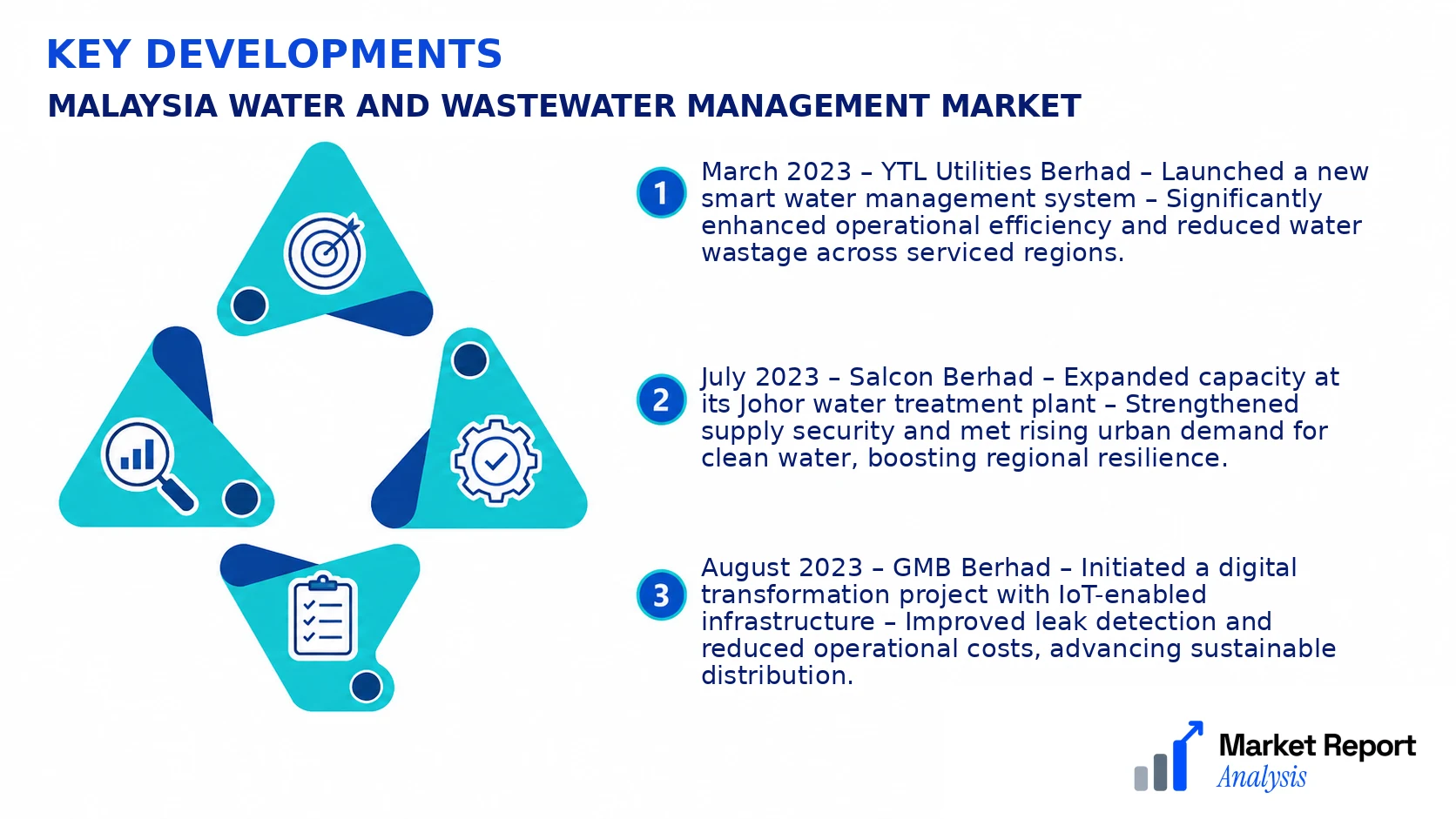
- March 2023 – YTL Utilities Berhad – Launched a new smart water management system – Significantly enhanced operational efficiency and reduced water wastage across serviced regions.
- July 2023 – Salcon Berhad – Expanded capacity at its Johor water treatment plant – Strengthened supply security and met rising urban demand for clean water, boosting regional resilience.
- August 2023 – GMB Berhad – Initiated a digital transformation project with IoT-enabled infrastructure – Improved leak detection and reduced operational costs, advancing sustainable distribution.
- September 2023 – Aqualia Malaysia – Partnered on a wastewater recycling project – Promoted environmental sustainability and supported Malaysia’s regulatory targets for water reuse.
- November 2023 – PE Malaysia – Acquired a stake in a regional water infrastructure firm – Enabled strategic expansion and technology sharing in water treatment and distribution sectors.
Frequently Asked Questions
What is the Malaysia Water and Wastewater Management Market?
The Malaysia Water and Wastewater Management Market refers to the industry involved in treating, managing, and recycling water and wastewater within Malaysia. It encompasses infrastructure, technology, and services aimed at ensuring sustainable water use and environmental compliance across sectors.
What is the current market size of Malaysia Water and Wastewater Management Market?
As of 2026, the market is valued at approximately USD 4.2 Billion, reflecting ongoing investments in infrastructure upgrades and increasing regulatory requirements. The market continues to grow as urbanization and industrialization accelerate in the region.
What factors are driving the Malaysia Water and Wastewater Management Market?
Key factors include government initiatives focused on water security, the need for modernized treatment facilities, rising environmental concerns, and increasing industrial and municipal demand for efficient water management solutions, complemented by advancements in treatment technologies.
Which region dominates the Malaysia Water and Wastewater Management Market?
Selangor and Kuala Lumpur dominate owing to their high population densities, industrial activity, and urban infrastructure development. These regions account for the majority share, driven by heavy municipal and industrial wastewater treatment needs.
Which segment is expected to grow the fastest?
The decentralized water treatment segment is forecasted to grow rapidly due to the increase in small-scale industrial units, rural development projects, and the rising demand for sustainable, off-grid water management solutions across Malaysia.
Who are the leading companies operating in the Malaysia Water and Wastewater Management Market?
Major players include Veolia, Suez, Hyflux, and Air Selangor, which are actively involved in infrastructure projects, technology deployment, and service provision, reinforcing Malaysia’s emphasis on sustainable water management solutions.
Analyst Perspective
The Malaysia Water and Wastewater Management Market presents a largely mature landscape with ongoing modernization efforts driven by urbanization and regulatory reforms. Long-term growth looks promising, supported by government initiatives aimed at enhancing infrastructure resilience and adopting smart water technologies. Commercial opportunities are abundant in advanced treatment solutions, sensor-based monitoring, and decentralized systems, particularly in key urban centers like Kuala Lumpur and Penang. Technology evolution is inclined toward integrated IoT solutions, AI-driven diagnostics, and sustainable resource recovery, which are expected to shape the market dynamics compellingly over the next decade. Investment priorities should focus on upgrading aging infrastructure, fostering R&D in emerging technologies, and expanding service capacities in underdeveloped regions. Competitive intensity remains high, with domestic and international players vying for market share through innovation and local collaborations. Regional growth potential is stronger in northern and eastern Malaysia, where increasing access and water reuse initiatives could accelerate market expansion. Overall, strategic positioning in niche segments and regional differentiation will be crucial for sustained long-term success.
