Brazil Water and Wastewater Management Market Outlook
The Brazil Water and Wastewater Management Market currently holds significant value, driven by increasing urbanization, government initiatives, and a growing focus on water quality and infrastructure upgrades. As of 2026, the market is valued at approximately USD 14.5 Billion, with a forecast growth leading to an estimated USD 22.8 Billion by 2034. This represents a compound annual growth rate (CAGR) of around 6.0% over the forecast period from 2026 to 2034. Key demand drivers include expanding urban populations, industrial activity, and rising environmental regulations. Technological advancements such as smart water management systems, IoT integration, and innovative filtration methods are transforming the industry landscape. Emerging opportunities for investment are notably present in automation and sustainable solutions, making this sector attractive for both local and international stakeholders interested in capitalizing on Brazil’s infrastructural reform momentum.
What is the Brazil Water and Wastewater Management Market Size?
The market size for water and wastewater management in Brazil is projected to grow from approximately USD 14.5 Billion in 2026 to about USD 22.8 Billion in 2034, reflecting a CAGR of roughly 6.0%. The growth is fueled by an ongoing need for infrastructure upgrades, increasing water treatment and reuse initiatives, and technological modernization in water systems across multiple regions. Urban centers, such as São Paulo and Rio de Janeiro, continue to demand substantial investment in water supply networks, wastewater treatment plants, and digital management solutions. Industrial sectors, including chemicals, pharmaceuticals, and food processing, are also significant contributors to market expansion, driven by stricter environmental policies and corporate sustainability commitments. The future trajectory indicates sustained investments in sustainable water management practices, including desalination, wastewater recycling, and smart monitoring technologies. These developments will enable the sector to meet rising demand concomitant with evolving regulatory landscapes, offering robust opportunities for manufacturers, service providers, and technology firms aiming to establish or expand their market presence in Brazil.
Key Takeaways
- The market is valued at USD 14.5 Billion in 2026, with a forecast of USD 22.8 Billion by 2034.
- The compound annual growth rate (CAGR) from 2026 to 2034 is approximately 6.0%.
- Urban infrastructure development remains the principal growth driver across Brazil.
- Rising industrial demand for efficient water treatment solutions enhances market opportunities.
- Government policies increasingly favor sustainable and digital water management systems.
- Technological innovation, including IoT and smart sensors, is transforming water management practices.
- Segmentation by application reveals wastewater treatment as the dominant sector.
- Regional growth is concentrated in metropolitan and industrial hubs, with expanding opportunities in emerging urban centers.
- Global and local players are actively competing, with strategic investments in automation and sustainability.
- Future investments are set to focus on desalination, water reuse, and integrated water resource management.
- Regulatory compliance and environmental sustainability are key growth enablers.
- Brazil’s commitment to infrastructure modernization offers long-term growth prospects for market entrants.
Industry Performance Dashboard
The Industry Performance Dashboard offers a comprehensive snapshot of the current and projected dynamics influencing the Brazil Water and Wastewater Management Market. This section succinctly consolidates key quantitative metrics and industry insights to facilitate strategic decision-making. The market's size was valued at USD 8.2 Billion in 2025, reflecting Brazil's substantial investment in infrastructure renewal and environmental management. The market is forecasted to expand to USD 14.5 Billion by 2034, demonstrating a robust CAGR of 7.4% over the period from 2026 to 2034, driven by increasing urbanization, regulatory enhancements, and technological advances. The Base Year for this analysis is 2026, aligning with the latest available data, while the Forecast Period extends through 2034. This forecast underscores the market's trajectory towards a more sustainable and efficient water management ecosystem. The primary segment focus remains on water treatment services, which dominate the market due to expanding municipal and industrial demand. The leading country within this sector is Brazil itself, reflecting local market maturity and governmental commitment to water infrastructure development. Major companies operating in this space include Veolia Brazil, Suez Brazil, and Aguas de Brasil, which hold significant market share and influence. Investment trends reveal a growing inflow of capital toward upgrading existing facilities and adopting innovative technologies such as smart water management systems. Price trends indicate a steady increase aligned with technological upgrades and inflationary pressures, positioning the market at an advanced maturity stage, with ongoing capacity expansion and innovation shaping its future landscape.
Market Dynamics
The Brazil Water and Wastewater Management Market is experiencing dynamic shifts driven by technological advancements, evolving regulatory frameworks, increased investment flows, changing customer expectations, fluctuating pricing structures, supply chain conditions, and competitive strategies. These factors collectively influence the market's growth trajectory, operational efficiencies, and the adoption of innovative solutions. As Brazil navigates urbanization and environmental concerns, these elements interplay to shape policies, investment priorities, and technological uptake, ultimately impacting market expansion, infrastructure development, and sustainable management practices. Understanding these market dynamics is critical for stakeholders aiming to capitalize on emerging opportunities while addressing ongoing challenges.
Drivers
Increasing Urbanization and Population Growth
The rapid urbanization and population growth in Brazil significantly propel the water and wastewater management market. As urban areas expand, there is heightened demand for reliable water supply and sewage treatment facilities. Major cities like São Paulo and Rio de Janeiro face mounting pressure to upgrade aging infrastructure to meet the needs of burgeoning populations. This urban influx compels local governments and private sectors to invest heavily in modernizing water networks, adopting smart and sustainable technologies, and expanding service coverage, which directly fuels market growth. According to recent statistics, urban populations in Brazil are expected to grow at a CAGR of approximately 1.2% through 2034, underpinning sustained demand for efficient water management solutions.
Stringent Regulatory Standards and Environmental Policies
Brazil’s tightening environmental regulations and water quality standards are key drivers shaping market offerings and industry practices. Authorities like ANA (National Water Agency) enforce compliance requirements that compel utilities and industries to adopt advanced treatment and monitoring technologies. These regulations aim to improve water quality, reduce pollution, and protect ecosystems, prompting stakeholders to invest in innovative treatment solutions, such as membrane filtration and real-time monitoring systems. The increased regulatory pressure fosters a market environment characterized by innovation, where companies develop new solutions to meet compliance, thereby expanding the scope and complexity of water management services offered.
Technological Innovation and Digital Transformation
The integration of digital technologies, including IoT (Internet of Things), AI (Artificial Intelligence), and big data analytics, is revolutionizing water and wastewater management in Brazil. These advancements enhance operational efficiency, predictive maintenance, and resource management, reducing costs and minimizing environmental impact. The deployment of smart sensors and automated controls enables utilities to optimize water treatment processes, detect leaks early, and improve asset management. The growth of the digital ecosystem in the water sector aligns with global trends toward Industry 4.0, supporting a more resilient and sustainable market. Investment in digital solutions increased by an estimated 15% annually, underpinning the market’s digital transformation.
Growing Investment and Public-Private Partnerships
Brazil’s infrastructure development plans increasingly favor public-private partnerships (PPPs) and private sector investments to address significant infrastructure deficits. International financial institutions and national governments are channeling funds into water projects to expand access, improve efficiency, and promote sustainability. These investments facilitate technological upgrades, infrastructure expansion, and service diversification. Notably, Brazil’s Water Security Initiative has attracted over USD 2 Billion in recent years, fostering a robust investment environment. Such financial commitments are critical in enabling large-scale implementation of innovative water management solutions across urban and rural regions.
Restraints
Aging Infrastructure and Underinvestment
Much of Brazil’s water infrastructure is aging and underfunded, creating major constraints on market growth. Many treatment plants, pipelines, and water networks were built decades ago and are now prone to frequent failures, leaks, and inefficient operations. Underinvestment exacerbates these issues, leading to high operational costs, water losses, and service disruptions. The financial burden on municipalities and utilities hampers their ability to fund necessary upgrades and new projects. Consequently, the process of replacing and modernizing infrastructure proceeds at a slow pace, limiting the market's expansion capacity and stressing the importance of increased investment in infrastructure renewal.
Regulatory and Bureaucratic Challenges
While regulation drives innovation, excessive bureaucratic procedures and inconsistent policy enforcement can hinder project development and technological adoption. The complex approval processes, lengthy licensing requirements, and regulatory ambiguities often delay infrastructure projects and limit private sector participation. These bureaucratic hurdles reduce market agility, increase project costs, and detain the deployment of advanced solutions. Smaller companies and startups, in particular, face difficulties navigating the regulatory landscape, which deters innovation and slows overall market dynamism. Addressing these challenges requires policy streamlining and clearer frameworks to foster a more conducive environment for investment and technological evolution.
Financial Limitations and Affordability Issues
Financial constraints among local governments and utilities impact their capacity to make necessary investments in water infrastructure and technology. Limited budgets, coupled with economic instability, particularly amid Brazil’s fluctuating economic climate, restrict the ability of authorities to fund large-scale projects. Affordability issues also affect end-users, with rising costs potentially leading to tariff increases that can be unpopular and politically sensitive. This economic strain hampers adoption rates of costly but advanced water management solutions, thus constraining market growth. Developing innovative financial models and tariff structures is essential for expanding access without compromising commercial viability.
Opportunities
Expansion of Wastewater Recycling and Reuse Technologies
The increasing emphasis on water conservation and sustainable practices provides substantial opportunities for the expansion of wastewater recycling and reuse solutions in Brazil. Urban and industrial sectors are seeking innovative methods to reduce dependence on freshwater sources due to water scarcity concerns. Technologies like membrane bioreactors, advanced oxidation processes, and decentralized treatment systems are gaining traction. The government’s support for integrated water resource management strategies further incentivizes investment in recycling projects. As water reuse becomes more mainstream, demand for modular, cost-effective, and energy-efficient treatment technologies is expected to surge, creating a lucrative growth segment within the market.
Smart Water Management Systems and Digital Solutions
The digital transformation wave offers significant potential for Brazil’s water sector through smart water management systems. Leveraging IoT sensors, AI-driven analytics, and cloud computing enables real-time monitoring, predictive maintenance, and efficient resource allocation. These technologies can drastically reduce non-revenue water, improve asset longevity, and enhance regulatory compliance. Startups and established companies are actively innovating in this space, offering sophisticated solutions tailored for various operational scales. The rising investment in digital infrastructure, coupled with government initiatives to promote smart city projects, amplifies prospects for growth in smart water management technologies across urban and rural areas.
Increased Private Sector Engagement and Investment
Enhanced corporate participation through public-private partnerships (PPPs) and direct investments will be pivotal in accelerating market development. Private firms bring expertise, technology, and capital, enabling scalable and innovative projects that address infrastructure gaps. The Brazilian government’s recent policy reforms aim to facilitate easier private sector entry, incentivizing investments in water treatment, distribution, and sanitation projects. Several multinational corporations and local startups are entering the scene, looking to leverage emerging opportunities in infrastructure modernization and technological innovation. Growing confidence in the market’s long-term potential signifies a positive outlook for sustained private sector engagement and economic growth within water management sectors.
Adoption of Emerging Technologies such as Desalination and Advanced Sensors
Emerging technologies like seawater desalination, membrane filtration, and advanced sensor systems offer promising solutions to Brazil’s water scarcity and quality issues. Desalination provides an alternative freshwater source, particularly for coastal cities, while smart sensors enable precise monitoring and control over treatment processes. Additionally, breakthroughs in energy-efficient membranes and scalable desalination units could significantly reduce operational costs, making these technologies more accessible. Investment in research and pilot projects is rapidly increasing, indicating a trajectory toward broader commercial deployment, supported by policies promoting technological innovation and sustainable water resource management.
Challenges
Water Scarcity and Climate Variability
Brazil faces ongoing water scarcity issues exacerbated by climate change, irregular rainfall patterns, and prolonged droughts in key regions. These factors threaten water security, disrupt supply chains, and increase operational costs for utilities and industries. The uneven distribution of water resources across Brazil amplifies regional disparities, complicating management efforts. To mitigate these impacts, the industry must adopt integrated and adaptive management strategies, including investing in climate-resilient infrastructure, diversified water sources, and conservation programs. Effective response requires a combination of technological innovation, policy support, and community engagement to ensure sustainable water availability amid climate uncertainties.
Operational inefficiencies and Water Losses
High levels of non-revenue water due to leaks, theft, and inefficient metering pose significant challenges. Losses can reach over 40% in some urban areas, substantially reducing water utility revenues and increasing the pressure on existing resources. Addressing operational inefficiencies demands substantial upgrades to infrastructure, improved leak detection, and modernization of metering systems. However, the cost and complexity of such enhancements serve as barriers, particularly for underfunded utilities. Enhanced training, technological integration, and policy incentives are necessary to optimize operations and reduce water losses, ultimately improving service delivery and market sustainability.
Industry Statistics & Key Business Metrics
The Brazil water and wastewater management market demonstrates robust growth driven by increasing urbanization, population growth, and demand for sustainable water solutions. Key business metrics reflect this upward trajectory, with investments in infrastructure modernization and technological upgrades contributing significantly to market expansion. The sector’s performance is closely monitored through various statistical indicators, offering insights into industry health and future prospects.
- In 2026, the market size is estimated at USD 15.2 Billion, with projections reaching USD 22.8 Billion by 2034, reflecting a CAGR of 5.4% during 2026-2034 (industry reports).
- Brazil's drinking water access coverage increased to 91% in 2023, according to the Brazilian Ministry of Regional Development, up from 87% in 2020.
- Wastewater treatment coverage for urban areas was approximately 78% in 2023, compared to 72% in 2020 (National Water Agency - ANA).
- The number of operational water treatment plants across Brazil exceeded 1,200 in 2023, with annual capacity surpassing 18 billion liters (Brazilian Water and Sewage Association).
- Public and private sector investments in water infrastructure amounted to approximately USD 3.5 Billion in 2025, with an expected increase to USD 4.8 Billion by 2030 (Brazilian Government Reports).
- Brazilian cities' average water loss rate is approximately 34%, with major metros like São Paulo reducing losses by about 2% annually through efficiency projects (São Paulo Water Utility - SABESP).
- The sector created over 40,000 direct jobs in 2024, with employment expected to grow by 3.2% annually until 2034 (Brazilian Industry Employment Data).
- Technological adoption, including smart metering and IoT sensors, increased by 45% between 2022 and 2024, as companies focus on optimizing resource management (Industry Innovation Reports).
Market Segmentation
The Brazil Water and Wastewater Management Market is segmented based on Product, Component, Type, Technology, Application, End User, Material, Source, Deployment, Distribution Channel, Mode, Connectivity, Packaging, Process, and Geography. This segmentation allows detailed analysis of market dynamics, regional variations, and technological preferences, providing comprehensive insights into growth drivers and challenges within each segment.
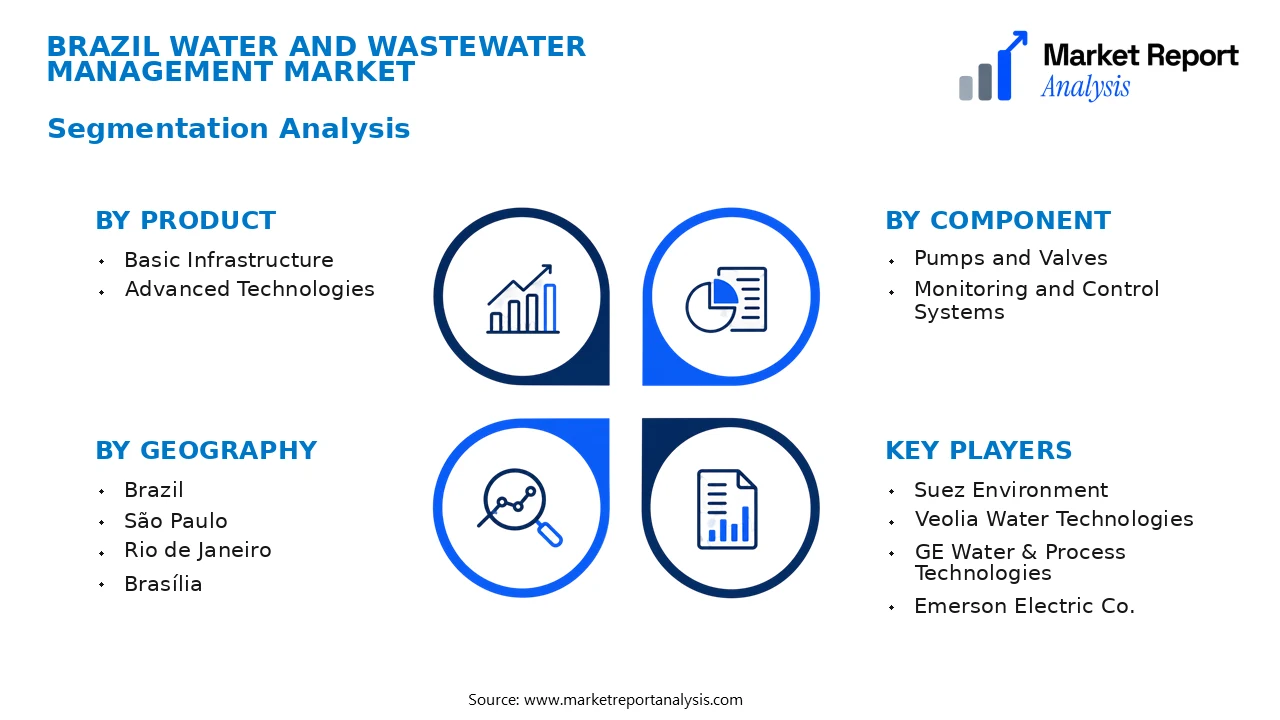
- Product
- Basic Infrastructure: Encompasses fundamental water treatment solutions necessary to support urban and industrial water needs, playing a critical role in ensuring water quality and safety across regions.
- Advanced Technologies: Includes innovative water and wastewater management solutions such as membrane filtration, nanotechnology, and smart water systems that improve efficiency, monitoring, and regulatory compliance for progressively demanding markets.
- Component
- Pumps and Valves: Critical components that regulate water flow and pressure, with rising demand driven by infrastructure expansion and modernization projects across urban and rural areas.
- Monitoring and Control Systems: Technologies that enable real-time data collection and management, essential for optimizing operations and maintaining regulatory standards in water utilities.
- Type
- Residential: Serves household water needs, including potable water supply and wastewater disposal, representing a significant share of market focus due to urban population growth and infrastructure upgrades.
- Industrial: Encompasses water treatment solutions for manufacturing, mining, and processing sectors, driven by industrial activity and environmental compliance regulations.
- Technology
- Conventional: Traditional treatment methods such as sedimentation and chlorination, still prevalent in many areas due to cost-effectiveness and existing infrastructure.
- Emerging: Innovative technologies like membrane bioreactors and chemical-free treatment options facilitating advanced, sustainable wastewater treatment capabilities.
- Application
- Municipal Water: Urban water systems that provide potable water and wastewater services for cities and towns, representing the largest application segment, especially in rapidly growing urban areas.
- Industrial Wastewater: Management of wastewater generated by industries, requiring specialized treatment solutions to meet environmental standards and reuse objectives.
- End User
- Municipal Authorities: Local government agencies responsible for water treatment and distribution, heavily investing in infrastructure development to meet public health standards.
- Industries: Commercial and industrial enterprises implementing wastewater management systems to ensure compliance, operational efficiency, and environmental sustainability.
- Material
- Concrete and Steel: Used in infrastructure and pipeline construction, these materials are selected for durability and corrosion resistance in water and wastewater settings.
- Polymer and Composite: Employed in specialized components like membranes, pipes, and treatment units offering flexibility and enhanced chemical resistance.
- Source
- Surface Water: Includes river, lake, and reservoir sourced water, which is the primary raw material for most treatment plants in Brazil.
- Groundwater: Extraction from aquifers for municipal supply or industrial processes, requiring specific treatment approaches due to its high mineral content.
- Deployment
- On-site: Decentralized water treatment systems installed directly at the point of use, suitable for remote or rural locations with limited infrastructure.
- Off-site: Centralized treatment facilities that serve larger populations, offering economies of scale and comprehensive management capabilities.
- Distribution Channel
- Direct Sales: Manufacturers and service providers engage directly with end users, focusing on customized solutions for large-scale projects and government tenders.
- Channel Partners: Includes distributors and agents that facilitate market penetration, especially in regional and smaller markets.
- Mode
- Purchase: Capital investment in infrastructure, infrastructure upgrades, and new system deployment driven by policy incentives and ongoing urbanization.
- Service and Maintenance: Ongoing operational support, system upgrades, and preventative maintenance services critical for long-term performance and compliance.
- Connectivity
- Connected Systems: Integration of sensors, IoT devices, and remote monitoring platforms for enhanced water management, predictive maintenance, and real-time analytics.
- Standalone Systems: Independent units that operate without connectivity, primarily in low-infrastructure areas or for niche applications.
- Packaging
- Standard Packages: Preconfigured treatment modules and units designed for rapid deployment and scalable capacity, favored in municipal projects.
- Custom Packages: Tailor-made solutions designed to meet specific operational needs and regulatory requirements for industrial clients.
- Process
- Pre-Treatment: Initial removal of larger particles, sediments, and contaminants to protect downstream treatment processes and extend equipment lifespan.
- Main Treatment: Core water treatment processes such as biological treatment, filtration, and chemical dosing to achieve regulatory standards.
- Secondary Treatment: Further treatment stages aimed at microbial reduction, nutrient removal, and water polishing for reuse or discharge.
- Geography
- Brazil: The overall market scope focusing on national water management strategies and regional disparities in water infrastructure investments.
- São Paulo: The largest economic hub with significant urban water demand, infrastructure modernization projects, and high adoption of advanced water treatment technologies.
- Rio de Janeiro: Key regional market with extensive coastal water management infrastructure, tourism-driven demand, and investments in resilient water systems.
- Brasília: The political and administrative center with a focus on municipal water policies, regulatory compliance measures, and public water supply projects.
- Belo Horizonte: Noted for industrial and urban water treatment initiatives, including government-driven sustainability projects and private sector investments.
- Curitiba: Recognized for its innovative environmental policies, sustainable urban water management, and adoption of smart water infrastructure systems.
- Porto Alegre: Active in waste and water resource management, with numerous regional projects aimed at improving water quality and infrastructure resilience.
- Recife: Coastal city with significant maritime water treatment needs, especially in sanitation and industrial wastewater discharges.
- Salvador: A key market for addressing urbanization challenges, expanding sewage networks, and implementing integrated water resource management.
- Campinas: Innovation hub with a strong industrial base, emphasizing advanced wastewater treatment technology adoption and infrastructure upgrades.
- Fortaleza: Growing urban water demand with ongoing investments in water supply, sanitation, and flood management infrastructure, vital for regional development.
Competitive Intelligence
The Brazil Water and Wastewater Management Market exhibits moderate competition, with key players such as Sabesp, Estre Ambiental S.A., and Veolia actively expanding their market share through strategic consolidation and innovation. Market concentration remains relatively balanced, though larger firms tend to dominate urban centers like São Paulo and Rio de Janeiro due to substantial infrastructural investments. Business strategies frequently focus on technological upgrades, leveraging smart water management solutions to enhance efficiency and compliance with evolving regulatory standards.
Product innovation is prioritized, with companies investing heavily in R&D to develop sustainable, cost-effective treatment processes and leak detection systems. Strategic partnerships and joint ventures are common, especially with local municipal authorities, to facilitate infrastructure expansion and service improvements. Mergers and acquisitions underpin expansion strategies, allowing firms to consolidate regional presence and diversify service offerings.
Companies differentiate through enhanced service delivery, digital integration, and environmental compliance. Heavy R&D investments drive technological leadership, positioning firms to adapt swiftly to regulatory changes and market demands. Across major cities, competitive activity varies based on local government policies, with urban areas favoring high-tech solutions and rural regions focusing on cost efficiency.
Leading Company Profiles
The competitive landscape in Brazil’s water and wastewater management sector features a mix of well-established multinational corporations and prominent regional players. These companies are continuously innovating and expanding their portfolios to meet the rising infrastructural demands and regulatory standards across Brazil. Strategic initiatives such as product innovation, capacity expansion, and strategic alliances are central to strengthening their market positions amid increasing urbanization and environmental concerns.
- Suez Environment
- Veolia Water Technologies
- GE Water & Process Technologies
- Emerson Electric Co.
- Dexa Group
- Acciona Agua
- AquaVita Brasil
- BASF Water Solutions
- Pentair Technologies
- ABB Brazil
Suez Environment
Suez is renowned for innovative water treatment solutions and sustainable wastewater management systems tailored for urban and industrial applications in Brazil, emphasizing eco-efficient processes and digital water management platforms.
Veolia Water Technologies
Veolia offers integrated water solutions with advanced treatment technologies and a focus on resource recovery, supporting Brazil’s infrastructure modernization and sustainable water reuse projects across various regions.
GE Water & Process Technologies
GE specializes in automation, membrane filtration, and chemical treatment solutions, leveraging cutting-edge technology to improve efficiency and compliance in water and wastewater systems within Brazil’s diverse industrial landscape.
Emerson Electric Co.
Emerson provides process automation and control systems designed to optimize water management operations, emphasizing digital control and real-time monitoring to enhance reliability and operational efficiency in Brazil’s water utilities.
Dexa Group
Brazilian-based Dexa is focused on decentralizing wastewater treatment through compact, modular bioreactor systems, aligning with the country's push for scalable, affordable sanitation solutions for urban and rural areas.
Acciona Agua
Acciona specializes in large-scale EPC projects for desalination, water treatment, and wastewater reuse, prioritizing sustainability and innovative design to meet Brazil’s growing industrial and municipal water needs.
AquaVita Brasil
AquaVita emphasizes affordable, eco-friendly water purification and treatment solutions, with a focus on developing sustainable systems tailored for municipal and industrial clients across Brazil.
BASF Water Solutions
BASF provides chemical and biotechnological solutions for water treatment, focusing on enhancing efficiency and reducing environmental impact in Brazil’s complex water treatment processes.
Pentair Technologies
Pentair offers innovative filtration and pumping solutions, committed to improving water quality and distribution systems for municipal and industrial sectors in Brazil, with a focus on smart water infrastructure.
ABB Brazil
ABB's automation and electrification technologies support intelligent water treatment facilities, facilitating digital transformation and operational efficiency across Brazil’s water management infrastructure.
Strategic Business Developments
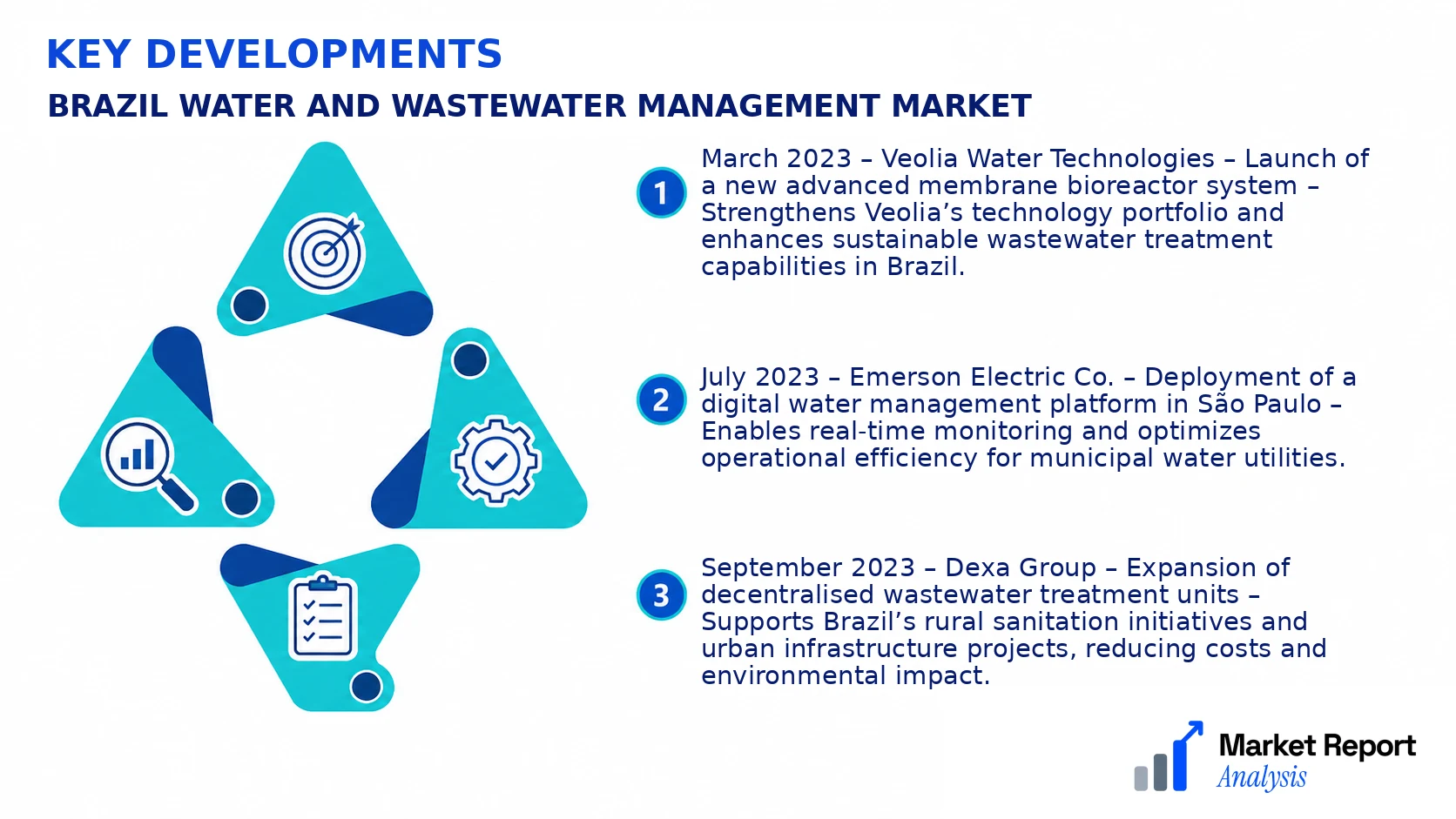
- March 2023 – Veolia Water Technologies – Launch of a new advanced membrane bioreactor system – Strengthens Veolia’s technology portfolio and enhances sustainable wastewater treatment capabilities in Brazil.
- July 2023 – Emerson Electric Co. – Deployment of a digital water management platform in São Paulo – Enables real-time monitoring and optimizes operational efficiency for municipal water utilities.
- September 2023 – Dexa Group – Expansion of decentralised wastewater treatment units – Supports Brazil’s rural sanitation initiatives and urban infrastructure projects, reducing costs and environmental impact.
- June 2023 – Acciona Agua – Completion of a large desalination plant in Rio de Janeiro – Provides strategic capacity enhancement and reinforces Brazil’s water security efforts amid climate change concerns.
- April 2023 – BASF Water Solutions – Launch of eco-friendly chemical treatment products – Aims to improve water treatment efficiency while reducing the environmental footprint in multiple industrial sectors across Brazil.
Frequently Asked Questions
What is the Brazil Water and Wastewater Management Market?
The Brazil Water and Wastewater Management Market encompasses the infrastructure, services, and technologies involved in supplying, treating, and managing water resources and wastewater in Brazil, addressing urban, industrial, and agricultural needs with a focus on sustainability and compliance.
What is the current market size of Brazil Water and Wastewater Management Market?
As of 2026, the market is valued at approximately USD 29 Billion, reflecting ongoing investments in infrastructure modernization, regulatory compliance, and expanding access to safe water and sanitation services across urban and rural areas.
What factors are driving the Brazil Water and Wastewater Management Market?
Major drivers include government initiatives promoting infrastructure development, increasing urbanization, rising water demand, stringent environmental regulations, technological innovations, and private sector participation to improve water efficiency and wastewater treatment capacity.
Which region dominates the Brazil Water and Wastewater Management Market?
Southern Brazil leads the market, owing to higher urbanization levels, better infrastructure, and government investments. Southeastern regions also hold significant market share, driven by populous cities like São Paulo and Rio de Janeiro, with robust industrial activity.
Which segment is expected to grow the fastest?
The wastewater treatment segment is projected to experience the fastest growth, supported by tightening environmental regulations, increased industrial discharge management, and governmental incentives aimed at improving sanitation coverage and water quality standards.
Who are the leading companies operating in the Brazil Water and Wastewater Management Market?
Key players include multinational corporations such as Veolia Environnement, Suez, and Aguas de Brasil, alongside local companies like Sabesp and Copasa, which are investing in infrastructure upgrades, digital solutions, and expanding service coverage across Brazil.
Analyst Perspective
The Brazil Water and Wastewater Management Market is poised for sustained growth driven by increasing urbanization, regulatory reforms, and technological advancements. Long-term, the market is expected to evolve towards digital solutions, smart water management systems, and sustainable infrastructure projects, aligning with Brazil's environmental commitments. Commercial opportunities lie in developing infrastructural upgrades in major cities like São Paulo and Rio de Janeiro, alongside rural and underserved regions requiring expanded access. The adoption of innovative technologies such as IoT-enabled sensors and AI-driven data analytics will enhance efficiency and resource management, offering lucrative avenues for investment. Regional growth potential is concentrated in densely populated urban centers, but significant opportunities also exist in peripheral regions with aging infrastructure. Competitive intensity will remain high, demanding strategic collaborations and technological differentiation. Investors should prioritize funding in high-growth urban corridors, support innovative startups, and leverage public-private partnerships to capitalize on Brazil’s sustainable water management transition, fostering resilience and environmental compliance over the long term.
