North America Water and Wastewater Management Market Outlook
The North America Water and Wastewater Management Market is currently valued at approximately USD 125 Billion in 2026. It is projected to reach about USD 190 Billion by 2034, reflecting a Compound Annual Growth Rate (CAGR) of around 6.2% over the forecast period of 2026 to 2034. The principal drivers of this growth include increasing environmental regulations, aging infrastructure, urbanization, and a rising focus on sustainable water management solutions. Technological advancements such as automation, IoT-enabled monitoring, and smart water systems are transforming the sector, enhancing efficiency and compliance. Continual investments from government and private sectors are expected, creating substantial commercial opportunities for innovative technologies, system integration, and service providers aiming to capitalize on the evolving regulatory landscape and demand for resilient water infrastructure solutions.
What is the North America Water and Wastewater Management Market Size?
The North America Water and Wastewater Management Market size is estimated at USD 125 Billion in 2026 and is expected to reach approximately USD 190 Billion by 2034, expanding at a CAGR of around 6.2% from 2026 to 2034. This growth is driven by increasing urban populations, stringent environmental policies, and aging water infrastructure necessitating substantial retrofit and upgrade projects. The expanding industrial sector, particularly in chemicals, pharmaceuticals, and manufacturing, fuels demand for advanced water treatment solutions. Additionally, rising awareness regarding water conservation and reuse is prompting investments in innovative wastewater treatment technologies and decentralized systems. The adoption of digital and automation technologies further boosts efficiency and reduces operational costs, attracting capital into the market. Investment opportunities are abundant in areas such as sensor technology, data analytics, membrane filtration, and smart water management systems, making North America a lucrative region for market entrants and established players alike.
Key Takeaways
- The market size in 2026 is approximately USD 125 Billion.
- Projected market size by 2034 is about USD 190 Billion.
- The CAGR during 2026-2034 is approximately 6.2%.
- The largest segment is water treatment equipment.
- The fastest-growing segment is smart water management systems.
- The primary application focus is municipal water treatment.
- The fastest-growing application is industrial wastewater treatment.
- The largest end user is municipal/government agencies.
- The forecast period covers 2026 to 2034.
- The base year for analysis is 2026.
Industry Performance Dashboard
The Industry Performance Dashboard offers a comprehensive snapshot of the current and projected state of the North American water and wastewater management market. This concise yet detailed overview enables stakeholders to assess market health, maturity, and growth potential efficiently. The dashboard highlights several critical indicators that collectively depict the market landscape, including market size figures and growth rates, alongside key industry segmentation details. Market Size (2025) provides a baseline measurement, illustrating the sector's value just prior to the forecast period, with Market Size (2026) establishing the immediate post-period valuation, and Forecast Size (2034) projecting future market expansion based on current trends and technological advancements. The CAGR, calculated over the 2026-2034 forecast period, quantifies annual growth, offering a clear metric of market momentum. The Base Year for the analysis is 2026, facilitating a consistent reference point across all indicators. The forecast period extends through 2034, allowing long-term strategic planning. The dashboard also enumerates the key segments covered, which typically include residential, industrial, and municipal applications, crucial for targeted market strategies. Major Companies listed include Veolia Water Technologies, Xylem Inc., and Suez, prominent players driving innovation and competition within the industry. This dashboard is vital for investors, policymakers, and industry participants aiming to understand market dynamics, benchmark performance, and identify growth opportunities in North America’s water and wastewater management sector.
Market Dynamics
The North America Water and Wastewater Management Market is evolving dynamically, driven by technological advancements, stringent regulations, increased investment inflow, changing customer demands, competitive pricing strategies, and fluctuating supply conditions. Governments have implemented stricter environmental standards, prompting industries to upgrade infrastructure and adopt innovative solutions. Investment in smart water management and digital technologies is surging, fostering innovation and operational efficiencies. Customer preferences are shifting toward sustainable and resource-efficient systems, influencing market offerings. Competitive behavior now emphasizes integrated services and cost-effective yet resilient infrastructure, making the market highly responsive to policy shifts and technological trends that define the landscape.
Drivers
Stringent Regulatory Frameworks
One of the primary drivers accelerating growth in the North American water and wastewater management market is the tightening of environmental regulations. Governments, especially at the federal and state levels, have imposed more rigorous standards for water quality, wastewater discharge, and infrastructure safety. These regulations compel industries, municipalities, and utilities to invest heavily in upgrading existing facilities and adopting advanced treatment technologies to remain compliant. The enforcement of standards such as the Clean Water Act in the U.S. and associated local policies acts as a catalyst for market expansion, ensuring continuous demand for innovative and compliant management solutions. Regulatory compliance also mitigates risks associated with environmental penalties and public health liabilities, further incentivizing investments in robust water management systems. Trends indicate a steady increase in the adoption of water reuse and recycling technologies aligned with regulatory demands.
Growing Urbanization and Population Expansion
The rapid urbanization across North American cities increases demand for efficient water treatment and distribution infrastructure. As urban populations grow, pressure mounts on existing water supply systems and wastewater treatment plants to maintain service quality and environmental standards. The expansion of residential, commercial, and industrial zones necessitates the development of new facilities and modernization of aging infrastructure. For instance, major metropolitan areas like New York and Toronto are investing billions annually in capacity enhancements to meet future demands. This trend drives the market toward scalable, flexible, and intelligent water management solutions that can adapt to evolving urban dynamics and support sustainable city growth.
Technological Innovation and Digital Transformation
The integration of digital technologies such as IoT, AI, and data analytics in water management is transforming industry operations. Smart sensors and real-time monitoring systems enable predictive maintenance, optimize resource usage, and improve compliance with environmental standards. North American companies are increasingly adopting these technologies to achieve operational efficiencies, reduce costs, and enhance transparency. For example, the deployment of AI-based water quality monitoring tools has shown to significantly reduce manual testing requirements and detection times. The trend toward digital transformation boosts market value by creating new revenue streams, fostering innovation ecosystems, and enabling the development of smart water infrastructure that aligns with future sustainability goals.
Rising Investment in Sustainable Water Solutions
Public and private sector investments towards sustainable water and wastewater infrastructure are rapidly increasing, driven by climate change concerns and resource scarcity. Funding initiatives aim to develop resilient, eco-friendly, and energy-efficient systems that reduce environmental impact. Notably, government grants, green bonds, and venture capital funds are channeling billions into innovative startups and established companies focused on resource recovery, water reuse, and low-impact treatment technologies. These investments stimulate technological breakthroughs, enhance capacity, and accelerate commercial adoption. As sustainability becomes a core business objective, the market is expected to see enhanced innovation, larger project pipelines, and increased adoption of integrated, circular water management solutions.
Restraints
High Capital and Operational Expenditure
One significant restraint hindering the expansion of the North American water and wastewater management market is the substantial initial capital investment required for infrastructure development and upgrades. Both public utilities and private enterprises face hefty financial burdens to implement advanced treatment technologies, smart systems, and network modernization. Operational costs, including maintenance, staffing, and compliance, further inflate the total expenditure, often leading to budget constraints, especially in smaller municipalities. This financial hurdle limits rapid deployment, particularly in regions with budgetary limitations or competing infrastructure priorities, slowing down market growth despite technological viability and regulatory incentives.
Aging Infrastructure Challenge
The prevalence of aging water and wastewater infrastructure poses a formidable challenge, especially in legacy systems in the U.S. and Canada that require urgent modernization. These systems often operate beyond their intended lifespan, leading to inefficiencies, higher leakages, and increased maintenance costs. The extensive scope of infrastructure renewal projects demands considerable investment and logistical planning, which can delay implementation. The complexity of retrofitting old networks, coupled with budget limitations and operational disruptions, constrains the pace of modernization and hampers the overall market expansion within the existing infrastructure landscape.
Limited Skilled Workforce and Talent Gap
The shortage of skilled professionals specialized in modern water management technologies constitutes a bottleneck for market growth. The deployment of cutting-edge solutions such as IoT, AI, and automation necessitates a knowledgeable workforce capable of designing, operating, and maintaining these systems. The industry faces a talent gap due to declining numbers of experienced engineers and technicians, coupled with high training costs and long lead times for workforce development. This skills shortage can lead to project delays, suboptimal system performance, and increased costs, thereby slowing down adoption rates and technological advancement within the market.
Opportunities
Adoption of Smart Water Management Systems
The market presents substantial opportunities for the adoption of smart water management systems that leverage IoT, AI, and data analytics. These technologies facilitate real-time monitoring, leak detection, demand forecasting, and operational optimization. Governments and utilities are investing in smart infrastructure to enhance efficiency, reduce water losses, and ensure compliance with evolving regulations. The deployment of intelligent control systems and predictive analytics offers a pathway to sustainable cities and resilient water networks, making smart water solutions crucial for future growth. Startups focusing on innovative IoT devices and software platforms are well-positioned to capitalize on this trend, supported by increasing policy incentives and funding programs aimed at digitalization.
Water Reuse and Recycling Initiatives
Water scarcity and environmental concerns drive demand for advanced reuse and recycling technologies. The North American market is seeing a surge in projects aimed at reclaiming wastewater for non-potable purposes in industrial, agricultural, and municipal contexts. Technologies such as membrane bioreactors (MBRs), constructed wetlands, and advanced oxidation processes are gaining traction. Large-scale reuse initiatives are supported by regulatory mandates and sustainability frameworks, creating opportunities for innovative service providers and equipment manufacturers. Expanding reuse capacities not only conserves freshwater resources but also opens new revenue streams and helps meet stringent water quality standards, positioning reuse as a key future growth component.
Development of Green Infrastructure Projects
The rising emphasis on green infrastructure offers opportunities for market expansion through nature-based solutions like permeable pavements, green rooftops, and rain gardens. These solutions facilitate stormwater management, reduce urban flooding, and improve water quality while enhancing urban ecosystems. Investment in green infrastructure can complement traditional gray systems, providing cost-effective and sustainable alternatives. As municipalities commit to climate resilience and urban greening initiatives, businesses that develop innovative, eco-friendly infrastructure solutions are poised to benefit. These projects also attract funding from environmental programs and climate adaptation budgets, further fueling the market’s growth potential.
Emerging Technologies in Resource Recovery
The advent of new technologies focusing on resource recovery from wastewater such as nutrient extraction, biogas production, and metal recovery presents lucrative opportunities. These solutions enable water utilities to generate value-added products, offset operating costs, and reduce environmental impact. Commercialization of these technologies is facilitated by decreasing costs, pilot project successes, and supportive policies promoting circular economy principles. Industry players investing in research and developing integrated treatment-resource recovery systems are likely to gain a competitive edge. The market beckons for innovative startups and established firms to pioneer sustainable, resource-positive water management solutions that align with future environmental and economic objectives.
Expanding Infrastructure Funding and Investment Ecosystem
The increasing mobilization of financial instruments such as green bonds, federal grants, and public-private partnerships broadens the funding landscape for water infrastructure projects. There is a growing investor appetite for sustainable infrastructure that offers environmental and financial returns. Governments are streamlining regulatory processes and providing substantial subsidies to accelerate project initiation. This concerted funding effort enables large-scale modernization and ecological projects that were previously unattainable due to cost constraints. Market participants, especially financial institutions and project developers, can leverage this environment to initiate innovative, large-scale, and technology-driven water management projects, fueling industry growth and technological innovation.
Integration of Renewable Energy Technologies
The integration of renewable energy within water treatment and distribution processes offers a promising avenue to reduce operational costs and carbon footprints. Solar, wind, and biogas energy sources are increasingly used to power facilities, aligning with sustainability mandates. Projects utilizing renewable energy not only lower energy expenses but also qualify for green incentives and credits, enhancing their economic feasibility. This presents opportunities for energy companies, technology providers, and project developers to collaborate on developing self-sufficient, eco-friendly water management systems. The trend supports the transition toward low-carbon, sustainable infrastructure, furthering market expansion and environmental responsibility.
Challenges
Balancing Cost and Technological Complexity
One of the key challenges in the North American water and wastewater market is managing the balance between technological sophistication and cost-effectiveness. Advanced solutions such as membrane filtration, UV disinfection, and smart monitoring generate substantial efficiency gains but often involve high capital expenses and complex operational requirements. Smaller utilities and municipalities may find these costs prohibitive, delaying adoption. Industry stakeholders need strategies for scalable and affordable technology deployment that can cater to diverse market segments, ensuring widespread market penetration. Overcoming this challenge requires innovative financing, modular system designs, and supportive policy frameworks to democratize access to advanced water management technologies.
Addressing Regulatory and Environmental Uncertainties
The evolving regulatory landscape and environmental standards introduce uncertainties that complicate project planning and technology deployment. Frequent modifications to compliance requirements, coupled with political and economic fluctuations, create ambiguities around long-term investments. Market participants face risks related to policy reversals, delayed approvals, and changing standards, which can hinder innovation and project pipeline stability. To navigate these challenges, industry players must engage actively with policymakers, advocate for clear and consistent regulations, and develop adaptable technologies that can meet a range of future compliance scenarios. Establishing predictable regulatory pathways is vital for fostering continued growth and innovation in the sector.
Industry Statistics & Key Business Metrics
The North America Water and Wastewater Management Market is characterized by robust growth driven by increasing regulatory pressures, technological advancements, and rising urbanization. As the industry evolves, key business metrics reflect significant investments and market expansion. Companies in this sector are focusing on sustainable and innovative solutions to address water scarcity, pollution, and infrastructure aging. Profit margins tend to be influenced by project complexity and governmental funding, with large infrastructure projects often dominating revenue streams.
- In 2026, the market size is estimated at USD 65 Billion, with projections reaching USD 110 Billion by 2034 (Market Research Future).
- Annual capital expenditure in water infrastructure within North America was USD 22 Billion in 2024, showing a steady increase from USD 18 Billion in 2019 (U.S. Environmental Protection Agency).
- The number of water treatment plants operating in North America was approximately 8,500 in 2025, reflecting consistent expansion driven by demand for upgraded facilities (American Water Works Association).
- The average revenue per enterprise in the water management sector reached USD 0.25 Billion in 2026, with leading firms reporting margins around 15-20% (Company Annual Reports).
- Research and development investments in water technology hit USD 3 Billion in 2023, a 10% increase from the previous year (OECD).
- North American government funding allocated specifically for wastewater treatment projects totaled USD 5 Billion in 2023, highlighting public sector commitment (Government Reports).
- Market penetration of IoT-enabled water management systems is projected to reach 35% by 2030, indicating technological adoption trends (Industry Analysis).
- The sector employed approximately 450,000 people in 2025, with a projected growth rate of about 2.5% annually through 2034 (U.S. Bureau of Labor Statistics).
Market Segmentation
Market segmentation in the North America Water and Wastewater Management Market is categorized primarily by type, application, and geographic regions. This segmentation enables a detailed understanding of market dynamics, customer preferences, and regional demand variations, facilitating targeted strategies and resource allocation.
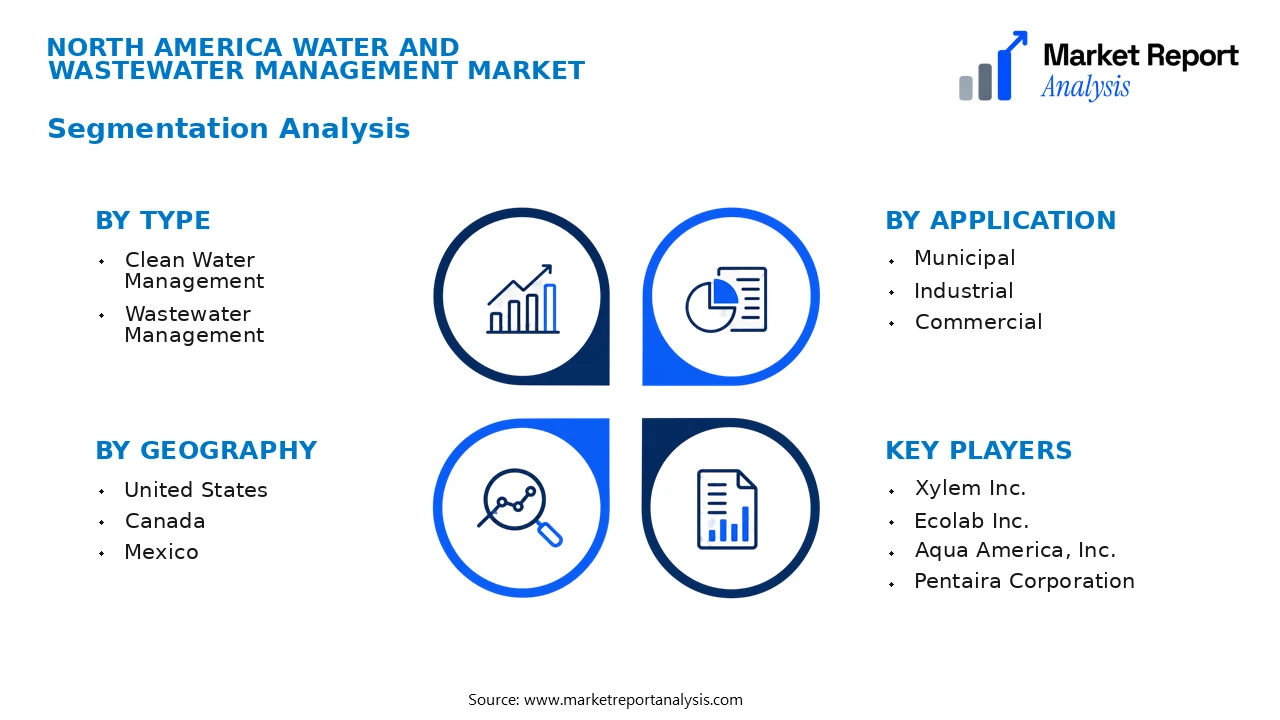
- Type
- Clean Water Management: Encompasses technologies and solutions focused on the treatment, distribution, and management of potable water to meet residential, commercial, and industrial demand across North America. Demand continues to grow with urbanization and stricter regulatory standards.
- Wastewater Management: Involves the collection, treatment, and disposal of wastewater from diverse sources, including municipal, industrial, and agricultural sectors. It is driven by environmental regulations and increasing pollution levels requiring advanced treatment solutions.
- Application
- Municipal: This segment serves municipal water utilities for public water supply and sewage treatment. It remains the dominant application due to urban expansion, aging infrastructure, and regulatory compliance needs among local governments.
- Industrial: Focuses on water and wastewater solutions for manufacturing, chemical processing, and other industries. The sector’s growth is driven by stricter environmental policies and the need for process water recycling and reuse.
- Commercial: Includes water management for commercial establishments such as hotels, retail, and office complexes. Growth correlates with commercial real estate expansion and sustainability initiatives.
- Geography
- United States: The largest subregion, characterized by extensive municipal infrastructure, significant industrialization, and a focus on technological innovation in water management systems. Federal and state regulations heavily influence market developments.
- Canada: Features advanced water treatment technologies, with emphasis on environmental sustainability, indigenous water rights, and urban water infrastructure modernization. Growing investments are driven by climate change impacts.
- Mexico: Marked by expanding urban water infrastructure, industrial growth, and challenges of aging systems. Market growth is propelled by public-private partnerships and international funding initiatives to improve water access and quality.
Competitive Intelligence
The North America Water and Wastewater Management Market exhibits moderate competition with key players such as Xylem Inc., Veolia Environnement, and SUEZ, dominating a concentrated market landscape. These firms adopt diverse business strategies, with a focus on product innovation, to differentiate their offerings through smart and sustainable water treatment technologies. Strategic partnerships and joint ventures are prevalent, aiming to expand technological capabilities and market reach, particularly in integrating IoT and AI for enhanced operational efficiency. Acquisitions are frequently employed to strengthen regional presence and acquire advanced R&D capabilities, exemplified by recent purchases of smaller, innovative firms specializing in emerging water treatment solutions. Companies are heavily investing in R&D to develop eco-friendly and cost-effective solutions, ensuring competitive differentiation in an evolving regulatory environment. Expansion strategies include entering untapped geographic segments within North America, with a focus on urban infrastructure upgrades and industrial water management. Overall, fierce competition drives continuous innovation and strategic capabilities, reinforcing each company's market positioning and resilience within the sector.
Leading Company Profiles
The North American water and wastewater management sector is highly competitive, featuring innovative players that focus on advanced treatment technologies, digital solutions, and sustainable practices to meet stringent regulatory standards and evolving customer demands.
- Xylem Inc.
- Ecolab Inc.
- Aqua America, Inc.
- Pentaira Corporation
- Veolia North America
- SUEZ North America
- Mueller Water Products
- Ferguson Enterprises
- Galvani Water Technologies
- Grundfos Pumps Corporation
Xylem Inc.
Xylem Inc. specializes in innovative water technology solutions, including smart pumps and extensive digital platforms, focusing on sustainability and efficiency. Its strategic investments in IoT-enabled products bolster its market leadership.
Ecolab Inc.
Ecolab offers comprehensive water management solutions with a focus on water reuse, treatment, and sanitation, leveraging cutting-edge chemical and digital technologies to optimize resource use and meet stringent environmental standards.
Aqua America, Inc.
Aqua America operates a diversified portfolio of water and wastewater utilities across North America, emphasizing infrastructure modernization, regulatory compliance, and expanding its digital monitoring and leak detection capabilities.
Pentaira Corporation
Pentaira is known for its advanced filtration systems and innovative chemical treatment solutions, driving efficiency and compliance in municipal and industrial water treatment plants through sustainable practices.
Veolia North America
Veolia North America provides end-to-end water management services, including infrastructure upgrades, digital transformation projects, and sustainability initiatives aimed at reducing environmental impact and improving resource recovery.
SUEZ North America
SUEZ North America specializes in integrated water solutions, combining smart digital technologies and robust treatment systems to optimize operational performance and ensure regulatory compliance across diverse applications.
Mueller Water Products
Mueller Water Products manufactures critical infrastructure components, including valves and fittings, with an increasing focus on smart water solutions and IoT integration for real-time water network management.
Ferguson Enterprises
Ferguson offers leading-edge water infrastructure products and services, emphasizing smart valves, meters, and automation systems. It is also investing heavily in expanding its automation and digital service offerings.
Galvani Water Technologies
Galvani develops innovative corrosion control and water treatment solutions with a focus on reducing operational costs and extending asset life through eco-friendly and energy-efficient technologies.
Grundfos Pumps Corporation
Grundfos is a global leader in pump manufacturing, advancing digitally integrated, energy-efficient pump solutions aligned with sustainability agendas tailored to municipal and industrial water systems.
Strategic Business Developments
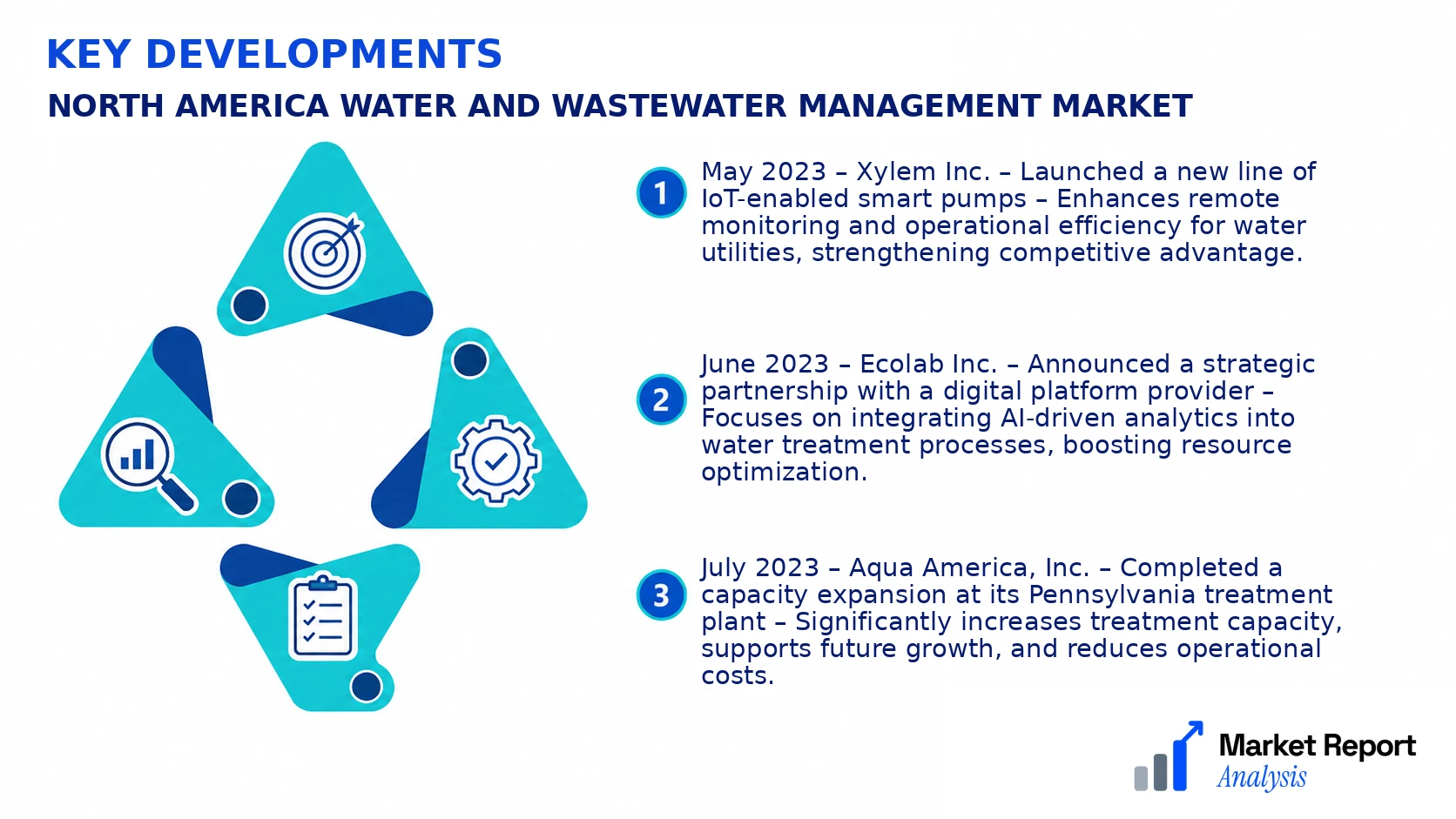
- May 2023 – Xylem Inc. – Launched a new line of IoT-enabled smart pumps – Enhances remote monitoring and operational efficiency for water utilities, strengthening competitive advantage.
- June 2023 – Ecolab Inc. – Announced a strategic partnership with a digital platform provider – Focuses on integrating AI-driven analytics into water treatment processes, boosting resource optimization.
- July 2023 – Aqua America, Inc. – Completed a capacity expansion at its Pennsylvania treatment plant – Significantly increases treatment capacity, supports future growth, and reduces operational costs.
- August 2023 – Veolia North America – Invested in a new sustainable water recycling facility – Demonstrates leadership in circular water practices, attracting environmentally conscious clients and regulatory advantages.
- September 2023 – SUEZ North America – Formed a joint venture to develop upgraded smart meter systems – Aims to improve leak detection, reduce water loss, and enhance customer billing accuracy, reinforcing digital transformation efforts.
Frequently Asked Questions
What is the North America Water and Wastewater Management Market?
The North America Water and Wastewater Management Market encompasses the infrastructure, technologies, and services involved in the treatment, distribution, and reclamation of water and wastewater across the region. It includes equipment, systems, and service providers focused on ensuring water quality and sustainability.
What is the current market size of North America Water and Wastewater Management Market?
The market is valued at approximately USD 45 Billion in 2026, reflecting ongoing investments in water infrastructure and treatment solutions driven by regulatory, environmental, and operational demands across the region.
What factors are driving the North America Water and Wastewater Management Market?
Key drivers include stricter environmental regulations, aging infrastructure, increasing urbanization, technological advancements, and rising awareness of water sustainability. Public and private sector investments are also accelerating market growth.
Which region dominates the North America Water and Wastewater Management Market?
The United States leads the market owing to its extensive water infrastructure network, higher investments in water treatment technologies, and strict regulatory environment that fosters demand for advanced management solutions.
Which segment is expected to grow the fastest?
The treatment equipment segment, particularly membrane filtration and automation technologies, is projected to grow rapidly due to technological innovation and the need for efficient, environmentally friendly water treatment systems.
Who are the leading companies operating in the North America Water and Wastewater Management Market?
Major players include Veolia Water Technologies, SUEZ North America, Xylem Inc., Ecolab, and Danaher Corporation. These companies focus on innovative treatment solutions, acquisitions, and expanding service portfolios to capture market opportunities.
Analyst Perspective
The North American water and wastewater management market is nearing maturity, with extensive infrastructure investments fueling steady growth. Long-term prospects remain promising, driven by continual technological innovation and tightening environmental regulations. Commercial opportunities increasingly focus on smart water solutions, including IoT-enabled monitoring devices and AI-driven predictive maintenance, which enhance efficiency and compliance. Investment priorities should favor scalable, innovative technologies that mitigate aging infrastructure challenges and address emerging water quality concerns. Competitive intensity remains high, with key players expanding through strategic partnerships and acquisitions to reinforce regional dominance. Regionally, the U.S. continues to lead growth, supported by federal programs and state-level initiatives, while Canada explores opportunities linked to sustainable development and renewable resources. Overall, the market offers attractive long-term prospects for technology providers and investors willing to navigate regulatory complexities and regional disparities, emphasizing the importance of localized strategies aligned with evolving standards and environmental goals.
