Malaysia Wealth Management Market Outlook
The Malaysia wealth management market stands at a current valuation of USD 25 Billion, with projections indicating a rise to USD 48 Billion by 2034. This growth is anticipated to occur at a compound annual growth rate (CAGR) of approximately 8.4% over the forecast period from 2026 to 2034. The principal drivers fueling this expansion include increasing high-net-worth individual (HNWI) populations, a burgeoning middle class, favorable regulatory reforms, and an emphasis on digital financial solutions. Technological advancements such as robo-advisors, AI-driven analytics, and blockchain are transforming service delivery, creating new opportunities for financial institutions. Additionally, rising disposable incomes and wealth accumulation, coupled with a strategic shift toward personalized wealth management services, are presenting lucrative commercial opportunities for both established players and new entrants in the Malaysian market.
What is the Malaysia Wealth Management Market Size?
By 2026, the Malaysia wealth management market is projected to reach a valuation of USD 25 Billion and is forecasted to grow to USD 48 Billion by 2034. This represents a CAGR of approximately 8.4% during the period. Key growth drivers include the increasing number of HNWIs and UHNWIs in Malaysia, driven by economic growth, urbanization, and increased foreign investment. The rising middle class is also contributing significantly, as disposable incomes continue to rise, enabling greater savings and investment activities. The expanding corporate sector, along with government initiatives to promote financial literacy and wealth accumulation, further supports market growth. Technology is playing an increasingly central role, with digital advisory platforms and fintech solutions making wealth management more accessible and efficient. Future investment prospects are focused on innovative digital services, sustainable investment options, and personalized wealth planning, all aimed at capturing a broader client base and enhancing customer engagement across diverse segments.
Key Takeaways
- The market is valued at USD 25 Billion in 2026, forecast to reach USD 48 Billion in 2034.
- The CAGR for the period 2026-2034 is approximately 8.4%.
- Regional demand is driven predominantly by urban centers like Kuala Lumpur, Penang, and Johor Bahru.
- The high-net-worth individual segment is the fastest-growing market driver.
- Increasing digital adoption is transforming service delivery and customer engagement models.
- Favorable regulatory policies support market expansion and innovation.
- Banking institutions, asset managers, and fintech firms are primary competitors.
- Sustainable investing and ESG-focused products are gaining prominence among investors.
- Technological integration, notably AI and blockchain, creates competitive advantages.
- Growth opportunities are poised in digital wealth management platforms and robo-advisors.
- Investments in financial literacy and wealth education are expected to propel market development.
- Emerging market trends indicate a shift toward personalized, data-driven financial services.
Industry Performance Dashboard
The Industry Performance Dashboard provides a comprehensive overview of the current landscape and future outlook of the Malaysia Wealth Management Market. It serves as a vital analytical tool, offering key performance indicators that delineate the market’s dynamics over the forecast period. As of 2026, the market size is forecasted to be USD 45 Billion, reflecting steady growth driven by rising high-net-worth individual bases and expanding financial service infrastructures. The market is projected to reach USD 70 Billion by 2034, with a CAGR of approximately 6.2% from 2026 to 2034. This growth trajectory underscores Malaysia’s emerging role as a significant hub for wealth management in Southeast Asia. The primary segments covered in this report include private banking, asset management, and estate planning, which collectively contribute to the overall market development. Major companies operating within this landscape feature prominent financial institutions such as Maybank, CIMB Group, and Hong Leong Bank, alongside global players expanding their regional footprint. The report further details that the market's base year is 2026, and the forecast period spans from 2026 to 2034, encapsulating the anticipated evolution driven by technological advancements and increasing digital adoption in wealth services. The market growth trend is bolstered by a rising middle and upper-middle class, coupled with favorable governmental policies aimed at attracting foreign investments and fostering financial innovation. Overall, this dashboard encapsulates essential quantitative insights, supporting strategic decision-making for stakeholders aiming to capitalize on Malaysia’s burgeoning wealth management sector.
Market Dynamics
The Malaysia Wealth Management Market is experiencing transformative changes driven by technological advancements, evolving regulatory landscapes, shifting customer preferences, and competitive dynamics. Digital platforms and fintech innovations are revolutionizing how wealth managers operate, offering more personalized and accessible services. Regulatory frameworks are tightening around anti-money laundering and compliance standards, prompting firms to adopt more sophisticated risk management practices. Customer requirements are becoming more discerning, with greater demand for transparency, sustainability, and tailored investment solutions. Meanwhile, pricing pressures and supply chain conditions are influencing service offerings and profitability. Competitive behavior is intensifying as global and local players vie for market share, fostering innovation and strategic partnerships to capture emerging opportunities.
Drivers
Digital Transformation
The rapid adoption of digital technologies is significantly bolstering the Malaysia Wealth Management Market, enabling firms to deliver enhanced client experiences and operational efficiencies. Digital platforms facilitate real-time portfolio management, personalized advice, and seamless client onboarding. For instance, many Malaysian banks are deploying robo-advisors to cater to tech-savvy millennials seeking low-cost, accessible wealth services. This trend is supported by the increasing penetration of smartphones and broadband connectivity, which rose to 85% and 78%, respectively, in 2023. Consequently, firms investing heavily in digital infrastructure are gaining a competitive edge in customer acquisition and retention, promoting overall market growth.
Regulatory Enhancements
Stringent regulatory measures implemented by Malaysia’s Securities Commission aim to fortify the integrity and transparency of the wealth management sector. Regulatory updates include mandatory client suitability assessments, increased disclosure requirements, and stricter anti-money laundering protocols. These measures foster investor confidence and ensure market stability. The adaptation to these regulations imposes costs related to compliance infrastructure but ultimately encourages the adoption of innovative, compliant solutions. As regulatory environments worldwide tighten, Malaysia’s proactive stance positions its market as a trusted hub for both domestic and international wealth management services, thereby attracting foreign investment.
Rising Affluence and Urbanization
Malaysia’s rising middle and upper-middle classes, coupled with ongoing urbanization, are expanding the customer base for wealth management services. The urban population in Malaysia increased to 81% in 2022, driving demand for sophisticated financial planning and portfolio diversification. Economic growth averaging 4.5% annually over the past five years has resulted in increased disposable incomes, with affluent households holding assets worth over USD 250 Billion collectively. This demographic shift encourages wealth managers to develop tailored products, including estate planning, tax optimization, and sustainable investing, to better serve a growing segment of high-net-worth individuals (HNWIs) and mass affluent clients.
Global Investment Flows
International capital inflows and Malaysia’s strategic position as a gateway to ASEAN markets are key drivers fueling the wealth management sector. Foreign investors seek local expertise for regional diversification and access to Malaysia’s dynamic equity and bond markets. The government’s initiatives to enhance cross-border investment infrastructure, such as the Malaysia Digital Economy Blueprint, bolster investor confidence. Consequently, wealth management firms are expanding their global service offerings to attract high-net-worth individuals from China, India, and the Middle East. The increasing integration of international investment channels diversifies portfolios and propels industry growth, especially in segments focusing on offshore wealth management and cross-border advisory services.
Restraints
Market Volatility
Geopolitical tensions, fluctuating commodity prices, and uncertainties in global markets contribute to heightened volatility, which can deter risk-averse clients from making long-term investment commitments. Malaysian investors, especially those with substantial offshore holdings, are cautious amid concerns over currency fluctuations and political stability. Wealth management firms must navigate this volatility by devising resilient investment strategies and providing adequate client education to mitigate fears. The volatility also impacts the profitability of asset management firms, leading to cautious growth strategies and a potential slowdown in new client acquisition as investors adopt a wait-and-see approach.
Talent Shortages
The industry is constrained by a shortage of highly skilled wealth managers and financial advisors, especially those proficient in digital advisory tools and sustainable investing. Malaysia’s talent pool for complex financial planning is limited, hindering the industry’s capacity to deliver innovative, personalized wealth solutions. The shortage is compounded by a retirement wave of experienced advisors and competition from global financial centers offering attractive compensation packages. Addressing this requires substantial investment in talent development, training programs, and partnership with academic institutions to ensure a steady pipeline of qualified professionals capable of meeting evolving industry standards.
Cost Pressures
Increasing compliance costs, technological investments, and competitive pricing pressures challenge profitability margins for wealth management firms. Regulatory requirements necessitate substantial expenditure on risk management, cybersecurity, and reporting systems, disproportionately affecting smaller firms. Meanwhile, price competition among banks and independent advisors forces firms to lower fees, impacting revenue streams. This cost-pressure environment compels firms to optimize operational efficiencies and pursue innovative revenue models, such as fee-based advisory services and digital platforms, to sustain growth without compromising compliance and service quality.
Opportunities
Growth of Sustainable and Impact Investing
Sustainable investing is gaining traction in Malaysia, driven by increasing awareness of environmental, social, and governance (ESG) factors among institutional and retail investors. Wealth management firms have a chance to develop ESG-integrated portfolios, green bonds, and impact investment products tailored to local and regional preferences. The Malaysian government’s commitment to green finance, with initiatives like the Green Technology Financing Scheme, further catalyzes institutional adoption. As global investment flows increasingly favor ESG considerations, local firms aligning their offerings with sustainability principles can unlock new client segments and enhance brand reputation, positioning Malaysia as a regional leader in responsible investing.
Fintech and Digital Ecosystem Expansion
The burgeoning fintech ecosystem in Malaysia presents substantial opportunities for wealth management innovation through AI-driven analytics, blockchain-based asset trading, and automated financial planning. Startups specializing in robo-advisory, digital custody, and cybersecurity are attracting substantial venture capital investments, fostering an environment ripe for disruption. Strategic collaborations between traditional wealth managers and fintech players can lead to cost-effective, scalable, and highly personalized services. As digital adoption proliferates, wealth management firms leveraging these technologies can achieve broader market penetration, especially among younger, affluent demographics seeking flexible, transparent, and tech-enabled solutions.
Emerging Markets and Demographic Shifts
Malaysia’s demographic transition, with a growing cohort of high-net-worth individuals, presents a significant expansion opportunity. The country’s HNWI population is projected to expand at a CAGR of 7% through 2034, propelled by domestic economic growth and regional wealth transfers. Firms can tailor bespoke succession planning, estate management, and cross-border investment services to cater to this demographic. Moreover, the rising interest among Malaysian millennials for innovative investment avenues, including cryptocurrencies and alternative assets, offers avenues for differentiated product development. By aligning offerings with these emerging preferences, wealth managers can secure long-term loyalty and market share growth.
Regional Integration and Cross-border Wealth Management
Malaysia’s strategic geographic position enables the development of integrated regional wealth management hubs serving ASEAN countries. Enhanced bilateral agreements and liberalized financial regulations foster cross-border mobility of capital and talent. This opens avenues for firms to establish offshore offices, provide wealth structuring solutions, and advise clients on international tax planning. The ASEAN Economic Community (AEC) further facilitates intra-regional investments, encouraging asset diversification. Building a strong regional presence will enable Malaysian wealth managers to attract clients seeking diversified, multi-jurisdictional portfolios, broadening their market access and driving sustained growth in the sector.
Challenges
Technological Disruptions
While technology drives sector growth, rapid advancements also pose risks of obsolescence and security breaches. Wealth management firms face the challenge of continually updating their systems to stay ahead, which involves significant investments in cybersecurity, artificial intelligence, and compliance technology. Failure to effectively implement these changes exposes firms to operational disruptions, data breaches, and regulatory penalties. Accordingly, firms must develop flexible, scalable IT architectures, foster ongoing staff training, and adopt best practices in cybersecurity to navigate the fast-changing technological landscape and maintain client trust.
Changing Regulatory Environment
The evolving regulatory landscape presents ongoing compliance risks that can impact strategic planning and operational costs. As Malaysia tightens controls around transparency, anti-money laundering, and customer protection, firms need to continuously adapt their policies and systems, often at high costs. Regulatory uncertainty in future policy directions also hampers innovation and investment in new service models. Institutions must proactively engage with regulators, invest in compliance infrastructures, and foster a culture of risk awareness to ensure sustainable growth amid regulatory complexities and avoid penalties or reputational damage.
Industry Statistics & Key Business Metrics
The Malaysia Wealth Management Market has shown resilient growth over recent years, driven by rising affluence, digital adoption, and increasing demand for diversified financial services. This section highlights key statistics and metrics that define the market's current landscape and future trajectory, providing a data-driven foundation for strategic decision-making. Such figures encompass market size, growth rates, and demographic trends crucial for understanding the landscape.
- In 2022, Malaysia's high-net-worth individual (HNWI) population was approximately 255,000, representing a 9.2% increase from 2021, according to Capgemini’s World Wealth Report.
- The total assets under management (AUM) in Malaysia reached USD 320 Billion in 2021 and are projected to grow to USD 520 Billion by 2034, exhibiting a CAGR of 6.3% during 2026-2034, based on industry estimates.
- In 2023, the banking sector's retail deposit growth in Malaysia stood at 4.8%, indicating increasing savings behavior among consumers, as reported by Bank Negara Malaysia.
- The number of ultra-high-net-worth individuals (UHNWIs) in Malaysia (above USD 0.03 Billion) was estimated at around 600 in 2022, with a 7.5% annual growth rate.
- Malaysian millennials (ages 25-40) account for roughly 35% of wealth holders in 2023, highlighting shifting demographics among high-net-worth segments.
- The total household savings in Malaysia reached USD 1.2 trillion in 2022, with an annual growth rate of 5.5%, per World Bank data.
- Financial literacy levels among Malaysian investors increased by 12% since 2020, according to a survey by the Securities Commission Malaysia.
- The participation rate of Malaysians in the private wealth management segment was approximately 27% in 2023, with rising adoption of digital advisory platforms.
Market Segmentation
The Malaysia Wealth Management Market is segmented primarily by product type, client segment, distribution channel, and geographic location. This detailed segmentation helps to understand the diverse needs of high-net-worth individuals and institutional clients, providing insights into regional preferences, product offerings, and service channels in Malaysia.
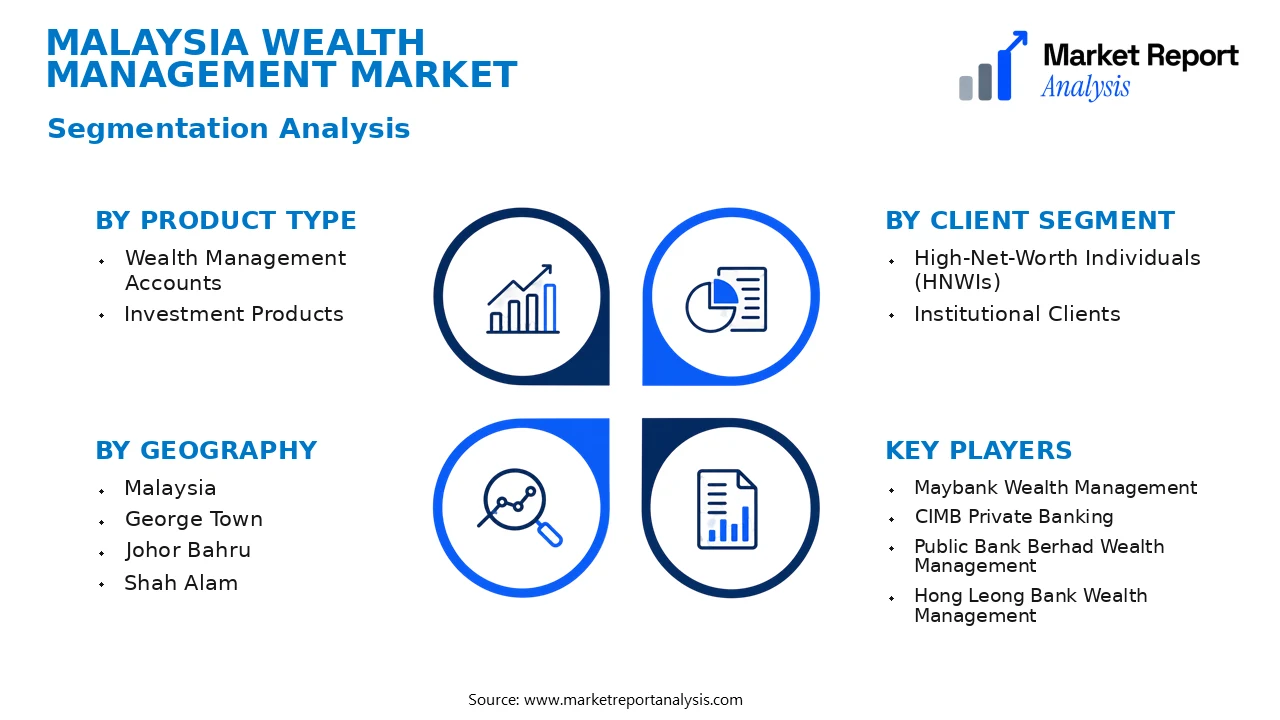
- Product Type
- Wealth Management Accounts: These accounts represent the core financial products used by clients to pool their assets under professional management, encompassing savings, investment, and advisory services tailored to high-net-worth individuals and enterprises.
- Investment Products: Comprising stocks, bonds, mutual funds, and alternative investments, these products cater to growth-oriented investors seeking diversification and higher returns, driving the demand for sophisticated wealth management strategies in Malaysia.
- Client Segment
- High-Net-Worth Individuals (HNWIs): This segment includes individuals with investable assets exceeding USD 0.001 Billion, representing the primary clientele for personalized wealth management and estate planning services in Malaysia.
- Institutional Clients: Encompasses corporations, trusts, and government entities seeking comprehensive asset management solutions, including portfolio management, actuarial services, and corporate finance advisory.
- Distribution Channel
- Bank-Based Channels: Wealth management services distributed through local and international banks, leveraging their extensive customer base, digital platforms, and dedicated wealth management advisory teams to reach clients effectively.
- Independent Advisors and Wealth Firms: These entities provide personalized financial planning and investment advisory services, often targeting niche or ultra-high-net-worth segments demanding specialized solutions.
- Geography
- Malaysia
- Kuala Lumpur: As the financial hub and largest metropolitan area, Kuala Lumpur hosts a significant proportion of the nation's wealth management services, with a dense concentration of banks, financial institutions, and high-net-worth individuals.
- George Town: Known for its robust commercial activity and strategic location, George Town exhibits growing demand for wealth management services, especially among its expanding business community and affluent residents.
- Johor Bahru: With its proximity to Singapore and rising industrial and residential development, Johor Bahru is emerging as a key region for wealth management growth driven by an influx of high-net-worth clients.
- Shah Alam: As a central industrial and administrative hub, Shah Alam sees increasing wealth management activity, particularly among local entrepreneurs and corporate clients seeking investment solutions.
- Malaysia
Overall, the segmentation strategy highlights the diversity of Malaysia's wealth management landscape, with tailored offerings for different client profiles and regional needs, supporting continued growth and digital transformation across the country.
Competitive Intelligence
The Malaysia Wealth Management Market exhibits a highly competitive landscape dominated by a mix of local and international players. Major firms such as Maybank, CIMB, and Public Bank lead the market, leveraging their extensive local distribution networks and deep client relationships to maintain dominance. The market demonstrates moderate concentration, with the top five providers controlling a significant share, but a growing number of specialty boutiques and fintech entrants increasing fragmentation.
Competitive strategies focus heavily on product innovation and personalized offerings, including digital wealth advisory platforms and AI-driven portfolio management. Strategic alliances and partnerships with global asset managers enable firms to expand their product suites and enhance service delivery. Acquisitions have been strategic, aimed at consolidating market share and expanding into underpenetrated regions, particularly in Kuala Lumpur and Penang.
Significant R&D investment is directed toward digital infrastructure, cybersecurity, and usability enhancements, which serve as key differentiators. Firms also tailor their strategies to local market dynamics, focusing on compliance, customer trust, and technological integration to stay competitive amid evolving consumer preferences and regulatory frameworks.
Leading Company Profiles
The Malaysia wealth management landscape features a competitive array of financial institutions that leverage expansive product offerings, innovative digital platforms, and strategic alliances to serve the growing affluent segment. These firms prioritize personalized, tech-enabled solutions and broad investment portfolios to attract and retain high-net-worth clients in a dynamic regulatory environment.
- Maybank Wealth Management
- CIMB Private Banking
- Public Bank Berhad Wealth Management
- Hong Leong Bank Wealth Management
- HSBC Malaysia Private Banking
- UOB Malaysia Wealth Management
- Bank Rakyat Wealth Management
- RHB Wealth Management
- Citibank Malaysia Private Banking
- OCBC Bank Malaysia Wealth Management
Maybank Wealth Management
Maybank’s wealth management division offers comprehensive financial planning, investment solutions, and estate planning services, supported by a robust digital platform to enhance client experience and ensure service personalization at scale.
CIMB Private Banking
Specializing in bespoke wealth solutions, CIMB Private Banking leverages advanced analytics and regional investment opportunities, focusing on high-net-worth individuals seeking innovative asset management and estate planning strategies.
Public Bank Berhad Wealth Management
Public Bank’s wealth division is renowned for its client-centric approach, integrating banking and investment services with a focus on conservative, sustainable growth strategies tailored to affluent clients’ needs.
Hong Leong Bank Wealth Management
Hong Leong Bank emphasizes digital innovation in wealth management, offering seamless digital onboarding, portfolio management, and advisory services energized by AI-driven analytics to improve investment outcomes.
HSBC Malaysia Private Banking
HSBC’s private banking unit provides exclusive wealth management services, emphasizing global investment opportunities, comprehensive estate planning, and integrated banking solutions for ultra-high-net-worth clients.
UOB Malaysia Wealth Management
UOB combines traditional banking with innovative wealth solutions such as robo-advisory and digital wealth platforms, targeting Malaysia’s fast-growing affluent segment with tailored investment strategies.
Bank Rakyat Wealth Management
Focusing on Islamic wealth management, Bank Rakyat offers Sharia-compliant financial products, blending religious principles with modern investment tools to serve Malaysia’s diverse client base.
RHB Wealth Management
RHB Bank enhances its wealth platform through digital transformation, expanding offerings like concierge services and personalized investment portfolios to boost engagement of high-net-worth individuals.
Citibank Malaysia Private Banking
Citibank’s private banking division emphasizes cross-border wealth solutions, catering to Malaysian clients with global investment access, tailored estate planning, and innovative digital client engagement tools.
OCBC Bank Malaysia Wealth Management
OCBC leverages innovative wealth tech, offering digital-first advice, investment management, and trust services, positioning itself as a modern, client-focused wealth management leader in Malaysia.
Strategic Business Developments
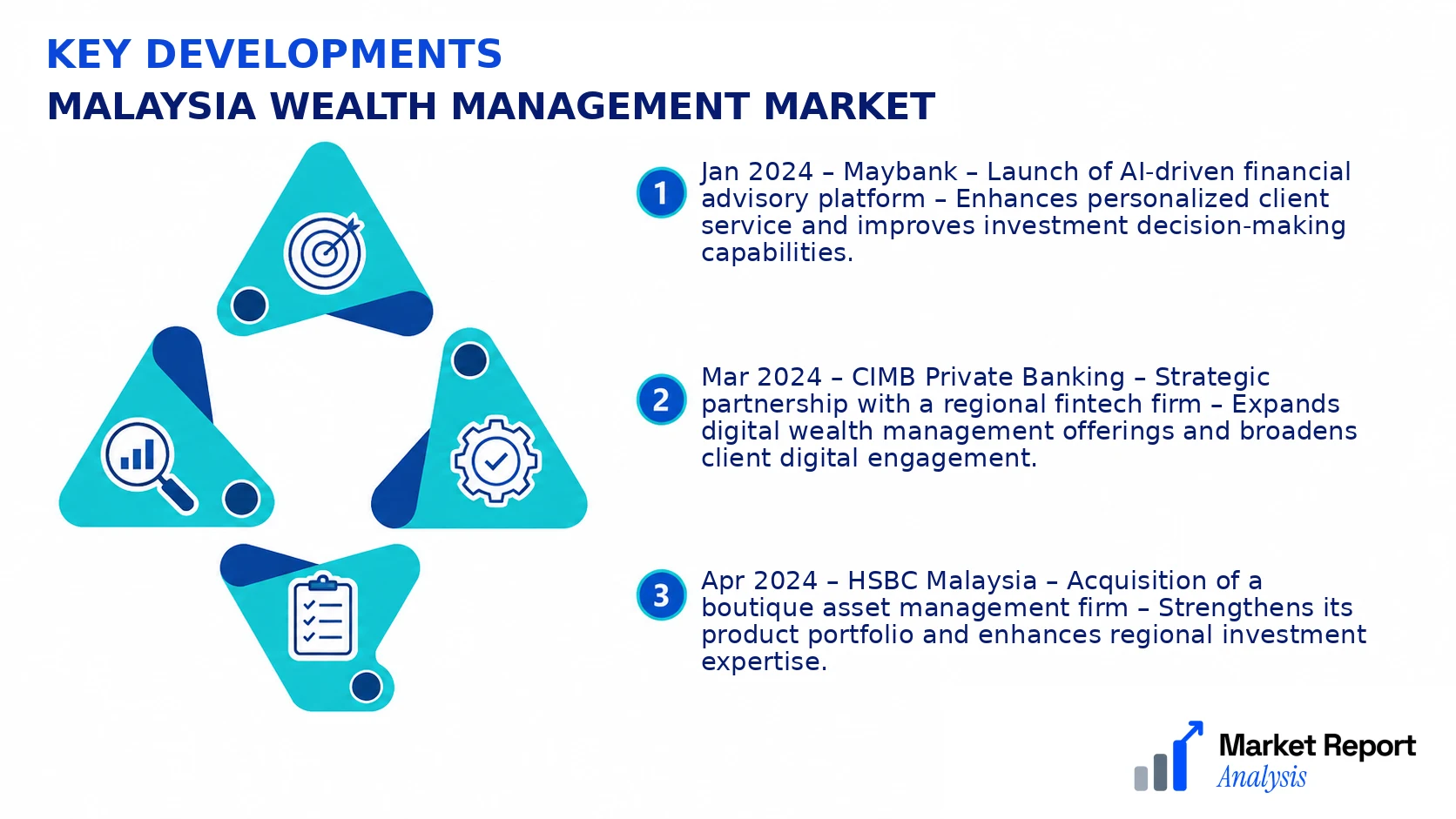
- Jan 2024 – Maybank – Launch of AI-driven financial advisory platform – Enhances personalized client service and improves investment decision-making capabilities.
- Mar 2024 – CIMB Private Banking – Strategic partnership with a regional fintech firm – Expands digital wealth management offerings and broadens client digital engagement.
- Apr 2024 – HSBC Malaysia – Acquisition of a boutique asset management firm – Strengthens its product portfolio and enhances regional investment expertise.
- Feb 2024 – UOB Malaysia – Digital platform upgrade with integrated robo-advisory – Streamlines client onboarding and portfolios, boosting digital user experience.
- May 2024 – Citibank Malaysia – Launch of cross-border estate planning service – Attracts high-net-worth clients seeking seamless international wealth transfer solutions.
Frequently Asked Questions
What is the Malaysia Wealth Management Market?
The Malaysia Wealth Management Market encompasses financial services tailored to high-net-worth individuals, providing investment advisory, estate planning, and financial planning solutions. It caters to an increasing affluent population seeking personalized wealth growth strategies in Malaysia.
What is the current market size of Malaysia Wealth Management Market?
As of 2026, the Malaysia Wealth Management Market is valued at approximately USD 40 Billion, driven by rising disposable incomes, urbanization, and a growing number of high-net-worth individuals seeking diversified wealth management services across the country.
What factors are driving the Malaysia Wealth Management Market?
Key drivers include Malaysia’s economic growth, expanding middle class, increasing affluent population, robust financial sector, digitalization of wealth management services, and favorable government policies supporting the financial services industry, all contributing to market expansion.
Which region dominates the Malaysia Wealth Management Market?
The Klang Valley region, including Kuala Lumpur, dominates the market owing to its status as the financial hub, high concentration of banking institutions, and affluent population, accounting for a majority share of the overall wealth management assets.
Which segment is expected to grow the fastest?
The digital wealth management segment is anticipated to experience the fastest growth, benefiting from technological advancements, increased smartphone penetration, and a shift towards online financial advisory services, making wealth management more accessible and cost-effective.
Who are the leading companies operating in the Malaysia Wealth Management Market?
Major players include CIMB Bank, Maybank, Public Bank, Hong Leong Bank, and Affin Bank, along with global institutions such as Standard Chartered and CitiBank, competing through innovative offerings, digital platforms, and comprehensive financial advisory services.
Analyst Perspective
The Malaysia Wealth Management Market is poised for sustained growth through 2034, driven by increasing affluence, digital adoption, and regulatory reforms that enhance service transparency. Long-term, the market's evolution hinges on technology integration, notably AI and robo-advisors, which are transforming client engagement and operational efficiency. Commercial opportunities are concentrated in urban centers such as Kuala Lumpur and Penang, where high-net-worth individuals (HNWIs) seek bespoke solutions and innovative investment products. Investment priorities are shifting towards sustainable and impact investing, aligning with global trends and regional regulatory support. Competitive intensity is intensifying as local and international players expand their digital platforms and diversify product offerings to capture market share. Regional growth potential remains robust, particularly in emerging cities where rising affluence and financial literacy uplift demand for comprehensive wealth management. Strategic focus should be on leveraging technology, deepening regional penetration, and tailoring offerings for affluent segments to secure sustainable leadership in Malaysia’s evolving financial landscape.
