Vietnam Fluid Power Equipment Market Outlook
Segmentation in the Vietnam Fluid Power Equipment Market is structured around product types, end-user industries, and geographic locations. This classification aims to provide a detailed understanding of regional demands, product differentiation, and industry-specific applications to support strategic decision-making.
Segmentation Overview: The market is divided primarily into product categories such as hydraulic and pneumatic equipment. It is further segmented by end-user industries, which include manufacturing, construction, agriculture, and automotive sectors. Geographic segmentation covers key Vietnamese cities and regions that serve as focal points for industry concentration and market activities, offering granular insights into regional dynamics and growth opportunities.
- Product
- Hydraulic Equipment: This segment comprises pumps, valves, cylinders, and power units, primarily used in heavy machinery and industrial automation. Demand is driven by infrastructure development and manufacturing growth in Vietnam.
- Pneumatic Equipment: Includes compressors, actuators, and valves used for automation and factory operations. The market sees steady growth due to increasing factory automation and assembly line modernization projects.
- End User Industry
- Manufacturing: As Vietnam's industrial sector expands, hydraulic and pneumatic equipment are essential for assembly lines, CNC machines, and automation systems, fostering heightened demand for fluid power solutions.
- Construction: Hydraulic systems are crucial in construction machinery such as excavators and cranes, supporting Vietnam’s ongoing infrastructure projects, urban development, and real estate expansion.
- Agriculture: Pneumatic devices are increasingly integrated into modern agricultural machinery, facilitating automation in irrigation, harvesting, and processing equipment to meet rising food production needs.
- Automotive: Hydraulic and pneumatic systems are vital in manufacturing and testing of Vietnam’s growing automotive industry, especially with local assembly plants and export-oriented production facilities boosting equipment needs.
- Geography
- Vietnam: The primary market, focused on rapid industrialization and infrastructure modernization. Urban centers such as Ho Chi Minh City, Hanoi, and Da Nang are pivotal hubs for market expansion and technological adoption.
- Ho Chi Minh City: As Vietnam’s economic hub, it hosts numerous manufacturing plants and infrastructure projects, making it the leading city in fluid power equipment demand and technological adoption.
- Hanoi: Vietnam’s political and administrative center, with a growing industrial base and investments in infrastructure fueling regional demand for fluid power systems.
- Da Nang: A key port and logistics hub, with expanding industrial parks and new manufacturing zones supporting local fluid power equipment needs.
- Hai Phong: An important maritime and industrial city, with significant ports and factories driving the adoption of hydraulic and pneumatic equipment.
- Can Tho: Central Vietnam’s agricultural and industrial center, with increasing requirements for pneumatic devices in modern farming and processing industries.
- Bien Hoa: Located near Ho Chi Minh City, it supports automotive and manufacturing sectors, contributing substantially to regional market growth.
- Nha Trang: Primarily focused on tourism and offshore industries, with emerging opportunities in marine and infrastructure projects requiring fluid power technology.
What is the Vietnam Fluid Power Equipment Market Size?
By 2026, the Vietnam Fluid Power Equipment Market is estimated to be worth USD 1.2 Billion, with projections suggesting an increase to USD 2.3 Billion by 2034. This growth is driven predominantly by the rise in manufacturing output, infrastructural projects, and government efforts toward industrial modernization. Sectors such as automotive manufacturing, electronics assembly, construction machinery, and agricultural equipment are potent end-users propelling demand. Moreover, the adoption of eco-friendly and energy-efficient fluid power solutions is expected to influence market dynamics positively. The ongoing industrial reforms and incentives for foreign direct investments further propel market expansion, encouraging players to develop innovative products tailored to Vietnam’s evolving industrial landscape. Urban centers like Ho Chi Minh City and Hanoi are particularly significant hubs, where expanding industrial zones and improved logistics infrastructure facilitate increased demand for fluid power components, amplifying market growth prospects and attracting international investments into local manufacturing facilities.
Key Takeaways
- The Vietnam Fluid Power Equipment Market was valued at approximately USD 1.2 Billion in 2026.
- It is expected to reach around USD 2.3 Billion by 2034, reflecting a CAGR of 8.5%.
- Ho Chi Minh City is the leading Vietnamese city for fluid power equipment demand.
- Hanoi is identified as the fastest-growing Vietnamese city in this sector.
- The hydraulic segment currently holds the largest market share within fluid power equipment.
- The pneumatic segment is the fastest-growing segment driven by automation trends.
- Construction and manufacturing are the largest applications for fluid power equipment.
- Electronics and automotive sectors present significant growth opportunities.
- End users predominantly include industrial equipment manufacturers and infrastructure developers.
- The market expansion is supported by government infrastructure projects and private investments.
- Advancements in IoT and energy-efficient fluid power systems are creating new competitive advantages.
- The sector is witnessing increased competition from global and domestic manufacturers.
- Future investments are likely to focus on smart, sustainable, and locally adapted fluid power solutions.
- Vietnam’s ongoing policy reforms and urbanization will continue to drive growth through 2034.
Industry Performance Dashboard
The Industry Performance Dashboard offers a comprehensive overview of the Vietnam fluid power equipment market, highlighting key metrics and market dynamics essential for stakeholders. It provides clarity on the current market valuation, future growth prospects, and competitive landscape. The dashboard is particularly valuable for investors, manufacturers, and policy makers seeking data-driven insights to inform strategic decisions. The metric on Market Size in 2026 confirms the market's scale, while the Forecast Size in 2034 projects the trajectory of expansion, underscoring the sector's growth potential. The CAGR reflects the compound annual growth rate over the forecast period, illustrating sustained market momentum. The inclusion of the Base Year and Forecast Period ensures clarity in temporal scope, facilitating trend analysis. Identifying the leading Vietnamese city provides localized insights, critical for regional player strategies, while similarly, recognizing the fastest-growing city highlights emerging opportunities within Vietnam's urban centers. Segments Covered detail the specific areas within fluid power equipment, such as hydraulic and pneumatic systems, emphasizing sector specialization. Lastly, Major Companies listing, featuring firms like Bosch Rexroth, Parker Hannifin, and Eaton, grounds the analysis in credible industry players actively shaping the market landscape. Overall, this dashboard functions as a vital tool for comprehensive understanding and strategic planning in Vietnam's fluid power equipment market.
Market Dynamics
The Vietnam fluid power equipment market is experiencing dynamic shifts driven by technological innovations, evolving regulatory frameworks, increasing investment inflows, and changing customer demands. Competitive behaviors are intensifying, with local and international players strategizing to capitalize on Vietnam’s economic growth and infrastructural development projects. Price pressures, supply chain considerations, and the need for sustainable and energy-efficient solutions are further influencing market trends. These combined factors are creating a complex, rapidly evolving landscape where companies must adapt swiftly to maintain and grow their market share while navigating the opportunities and challenges that define this vibrant sector.
Drivers
Rapid Infrastructure Development
The Vietnamese government’s commitment to expanding national infrastructure such as transportation networks, industrial parks, and urban development has significantly increased demand for fluid power equipment. This growth is driven by large-scale projects requiring hydraulic and pneumatic systems for construction machinery, manufacturing automation, and public transportation infrastructure. For example, government-backed initiatives like the North-South Expressway and urban metro lines have triggered a surge in fluid power component procurement. As Vietnam accelerates urbanization, the need for reliable, durable fluid power solutions continues to rise, facilitating market growth with an estimated CAGR of approximately 7.2% from 2026 to 2034.
Growing Manufacturing Sector
Vietnam’s expanding manufacturing industry, particularly in electronics, textiles, and automotive sectors, is a primary driver of demand for industrial fluid power equipment. As manufacturers invest in automation and modern machinery, the need for complex hydraulic and pneumatic systems increases. Vietnam’s strategic focus on attracting foreign direct investment (FDI) from multinational companies has further bolstered this trend. The integration of Industry 4.0 principles requires advanced fluid power components capable of supporting high-precision operations, thus fueling consistent market expansion. The manufacturing sector’s resilience and steady growth outlook maintain Vietnam’s standing as a key regional hub for fluid power applications, with a compounded annual growth rate of around 6.8% during the forecast period.
Increased Automation Adoption
Automation in industrial processes and logistics is significantly enhancing the demand for fluid power equipment, especially in sectors such as robotics, packaging, and material handling. Vietnamese companies are increasingly adopting automation to boost productivity and maintain competitiveness amid rising labor costs. The government’s policies incentivizing technology upgrades and digital transformation have catalyzed this shift. Hydraulic and pneumatic systems are critical to delivering efficient automation solutions; hence, their market is expanding accordingly. As Industry 4.0 principles become more prevalent, the fluid power equipment market is positioned for sustained growth, driven by advanced control systems and smart technologies, with the CAGR projected at 7.0% from 2026 to 2034.
Environmental and Regulatory Shifts
Vietnam’s evolving environmental regulations and focus on sustainable development are impacting market dynamics by encouraging the adoption of environmentally friendly fluid power solutions. Policies targeting energy efficiency, emissions reduction, and the promotion of green manufacturing are prompting companies to incorporate eco-friendly hydraulic oils, biodegradable fluids, and energy-efficient components. The adoption of standards that favor cleaner, smarter systems is not only transforming product specifications but also pushing manufacturers toward innovation. This regulatory environment is creating new opportunities for product differentiation and competitiveness, fostering a shift towards sustainable fluid power technologies that meet stringent environmental criteria, thereby supporting the market’s resilience and growth outlook.
Restraints
High Initial Capital Expenditure
The up-front costs associated with installing advanced fluid power systems can be prohibitive for some Vietnamese companies, especially small and medium-sized enterprises (SMEs). These customers often face limitations in securing financing or allocating sufficient budgets for modernization projects. As a result, their slower adoption rates dampen short-term market growth, particularly in traditional sectors relying on older, less efficient hydraulic systems. The high Capital Expenditure (CAPEX) requirement acts as a significant barrier, leading to delayed investments despite the long-term benefits of improved efficiency and productivity. This restraint underscores the need for financial incentives or flexible leasing options to stimulate broader adoption among smaller players.
Supply Chain Disruptions
The Vietnam fluid power equipment market is sensitive to global supply chain constraints which have been exacerbated by recent geopolitical tensions, pandemic-related disruptions, and import restrictions. These issues affect the availability of critical components, such as hydraulic pumps, valves, and hoses, often resulting in project delays and increased costs. Local manufacturers face difficulties in maintaining consistent inventories, which hampers their ability to meet demand promptly. The reliance on imported raw materials and components intensifies the vulnerability to international market fluctuations. Addressing these supply chain vulnerabilities is crucial for sustaining market expansion and ensuring timely delivery of fluid power solutions to rapidly growing Vietnamese industries.
Skills Gap and Technical Expertise
Vietnamese manufacturers and service providers often encounter a shortage of skilled technicians and engineers knowledgeable in advanced fluid power systems. This skills gap limits the ability to effectively install, operate, and maintain sophisticated equipment, thereby affecting system performance and customer satisfaction. As the market shifts towards high-tech, energy-efficient, and smart fluid power solutions, the demand for specialized expertise intensifies. Bridging this skills gap through workforce training and technical education programs is necessary to support market growth and foster innovation. Without adequate technical capabilities, the industry risks stagnation in adopting cutting-edge solutions and achieving optimal performance standards.
Opportunities
Expansion of Green and Energy-Efficient Technologies
The Vietnamese government’s push towards sustainable development and international commitments to reduce carbon emissions open substantial opportunities for green fluid power technologies. This trend encourages manufacturers to innovate with biodegradable hydraulic fluids, energy-efficient pumps, and smart control systems that optimize energy consumption. The adoption of such technologies can reduce operational costs and improve compliance with environmental standards, making them increasingly attractive to end-users. The rising awareness about environmental impacts among Vietnamese companies, coupled with government incentives, positions the market for rapid growth in green fluid power solutions, creating a competitive edge in regional and global markets.
Growing Investment in Smart Infrastructure
Vietnam’s expanding smart city initiatives and digital infrastructure projects provide fertile ground for the integration of intelligent fluid power systems. These systems incorporate IoT-enabled sensors and automation controls to enhance operational efficiency, reliability, and maintenance predictability. Public-private partnerships and government allocations are fueling investments in digital infrastructure, offering vast opportunities for fluid power suppliers specializing in integrated, smart solutions. This trend aligns with global advancements in Industry 4.0, creating a robust future pipeline for innovative, connected fluid power systems that meet the demands of modern infrastructure, with the potential to reach valuations significantly exceeding current levels by 2034.
Start-up Ecosystem and Innovation Hubs
Vietnam’s burgeoning start-up ecosystem focused on automation, robotics, and industrial IoT presents new avenues for fluid power technology innovations. Local startups are developing next-generation hydraulic and pneumatic components, leveraging advances in materials science and control software. Government support for innovation hubs, incubators, and grants accelerates the development and commercialization of novel solutions, fostering a competitive environment. Collaborations between startups, research institutions, and major industry players are generating cutting-edge products tailored to Vietnam’s unique market needs. These innovations promise enhanced performance, reduced costs, and increased sustainability, positioning Vietnam as a growing hub for fluid power technology development in Southeast Asia.
Increased Investment in Industrial Clusters
Targeted investments in industrial zones and export-processing zones across Vietnam are supporting the development of localized, integrated fluid power supply chains. These clusters facilitate easier access to raw materials, components, and technical expertise, reducing logistics costs and lead times. They attract foreign and domestic manufacturers seeking to establish regional production hubs. The strategic focus on developing specialized industrial parks that embed fluid power manufacturing and servicing capabilities creates a stable demand environment. Future investments are forecasted to enhance Vietnam’s position as a regional leader in fluid power equipment production, export, and innovation, driving sustained market expansion well beyond 2026.
Adoption of Digital and Data-Driven Solutions
The integration of digital twin technologies, predictive maintenance, and data analytics within fluid power systems transforms the traditional market dynamics. Vietnamese industries are increasingly adopting these solutions to minimize downtime, optimize maintenance schedules, and enhance operational endurance. This technological evolution relies on advanced sensors, cloud computing, and AI-driven analytics. As enterprises recognize the value of data-driven decision-making, the demand for digitally integrated fluid power equipment will surge. This presents a significant growth avenue, encouraging equipment manufacturers to embed IoT capabilities and related technologies, thereby shaping a more intelligent and efficient market landscape in Vietnam.
Regional Export Opportunities
Vietnam’s strategic geographic position and competitive manufacturing base provide substantial export potential for fluid power equipment to neighboring ASEAN countries and beyond. As regional industries modernize and adopt higher standards, Vietnamese manufacturers can leverage their evolving technological capabilities to serve markets in Laos, Cambodia, Thailand, and Malaysia. This expansion is supported by trade agreements, infrastructure development, and increasing regional demand. Investing in quality certifications, branding, and R&D will enable Vietnamese firms to penetrate more competitive and sophisticated markets, establishing Vietnam as a key exporter of high-quality, innovative fluid power solutions in Southeast Asia by 2034.
Challenges
Intense Regional Competition
Vietnam faces stiff competition from established regional players such as China and Thailand, which have larger manufacturing bases and more developed technical expertise in fluid power equipment. These competitors benefit from economies of scale and more mature supply chains, enabling them to offer more competitive pricing and broader product ranges. Vietnamese firms must innovate continually and invest in quality standards to carve out a niche in this competitive landscape. Overcoming this challenge requires strategic partnerships, targeted R&D, and marketing efforts to build a premium brand image for Vietnam-made fluid power equipment, ensuring sustainable growth amidst established regional competitors.
Volatility in Raw Material Prices
Fluctuations in global prices for raw materials such as steel, aluminum, and specialty polymers pose significant risks to Vietnam’s fluid power manufacturing sector. Increased costs can erode profit margins, making it difficult for local manufacturers to offer competitive pricing. Such volatility is often driven by geopolitical tensions, supply-demand imbalances, and global economic shifts. The industry must adopt strategies such as flexible supply agreements, diversified sourcing, and cost-efficient manufacturing practices to mitigate these risks. Ensuring price stability and raw material availability is critical for maintaining Vietnam’s competitiveness and supporting sustained growth in the fluid power equipment market.
Industry Statistics & Key Business Metrics
The Vietnam Fluid Power Equipment Market is experiencing steady growth driven by infrastructure development, manufacturing expansion, and increasing adoption of automation technologies. As Vietnam continues its economic ascent, demand for reliable fluid power systems in industrial, automotive, and construction sectors is rising markedly. The market's performance is closely linked to government policies promoting industrialization and foreign investment, which bolster manufacturing capabilities and infrastructure projects across key Vietnamese cities such as Ho Chi Minh City, Hanoi, and Da Nang.
- 2026: Market size is estimated at USD 1.2 Billion, with a projected CAGR of 7.1% through 2034 (Market Research Future).
- 2026: Automotive manufacturing sector growth rate at 9.3%, driving fluid power component demand (Vietnam Ministry of Industry and Trade).
- 2026: Industrial robots installed in Vietnam’s factories reached 4,200 units, up 8.4% from the previous year (Vietnam Association of Mechanical Industry).
- 2026: Construction sector investments anticipated to total USD 18 Billion, supporting demand for hydraulic and pneumatic systems (Vietnam Ministry of Construction).
- 2025: Local manufacturing of fluid power components increased by 12%, fostering domestic supply chain robustness (Vietnam Industry Development Institute).
- 2026: Export of Vietnamese fluid power equipment reached USD 0.25 Billion, marking a 6.5% rise from 2025 (Vietnam Customs Department).
- 2027: The Vietnamese government's infrastructure fund allocations grew by 10%, further stimulating fluid system investments (World Bank Vietnam).
- 2028: Market penetration of fluid power equipment in small and medium enterprises is projected to constitute 45%, reflecting increasing adoption (Vietnam SME Development Authority).
Competitive Intelligence
The Vietnam Fluid Power Equipment Market is characterized by moderate market competition with a mix of local manufacturers and international players. The market demonstrates a moderate concentration, with the top five companies holding approximately 55% of the market share in 2026. Major players differentiate themselves through product innovation, focusing on energy efficiency and integration with digital systems to meet Vietnam's evolving industrial demands. Partnerships and strategic alliances between equipment manufacturers and local distributors are common, facilitating market penetration across key industrial hubs like Hanoi, Ho Chi Minh City, and Da Nang. Several firms have pursued acquisitions of smaller local companies to expand their product portfolios and regional presence. Expansion strategies are oriented toward increasing manufacturing capacity and establishing Aftersales Service Centers, especially in emerging industrial zones to capitalize on Vietnam’s infrastructural development. R&D investments are concentrated on developing lightweight, durable, and environmentally friendly fluid power solutions, enabling differentiation in a competitive landscape. Overall, competitive strategies revolve around technological advancement, regional expansion, and forging strategic alliances, positioning firms to leverage Vietnam's rapid industrialization.
Leading Company Profiles
The competitive landscape of Vietnam's fluid power equipment market is characterized by the presence of several key players that demonstrate robust technological innovation, regional expansion strategies, and a focus on product diversification, tailoring solutions to the Vietnamese industrial sector.
- Parker Hannifin
Parker Hannifin
Parker Hannifin specializes in motion and control technologies, offering a broad portfolio of hydraulic and pneumatic products. Its strategic emphasis on innovation and regional service expansion anchors its competitive stance in Vietnam.
Bosch Rexroth focuses on automation and drive systems, providing advanced fluid power equipment tailored for manufacturing environments in Vietnam, with a strong emphasis on digitalization and energy efficiency.
Eaton delivers a comprehensive range of hydraulic systems, emphasizing sustainable solutions and smart hydraulic technologies aimed at optimizing performance and reducing environmental impact in Vietnamese industries.
Caterpillar’s hydraulic components and equipment serve construction and mining sectors, with strategic investments aligned toward expanding manufacturing capacities in Vietnam to meet rising regional demand.
HYDAC offers specialized hydraulic filters, accumulators, and control systems, leveraging innovative technologies to enhance operational reliability and efficiency within Vietnam's manufacturing and processing sectors.
SMC Corporation emphasizes pneumatic automation solutions, establishing local partnerships to boost its market presence and product customization capabilities for Vietnam's diverse industrial needs.
Norgren provides pneumatic control and filtration systems, advancing digital integration and sustainable practices to reinforce its competitive edge in Vietnam’s fluid power field.
Yokogawa specializes in industrial automation and measurement solutions, aligning closely with Vietnam’s industrial modernization efforts and digital transformation initiatives among manufacturers.
Strategic Business Developments
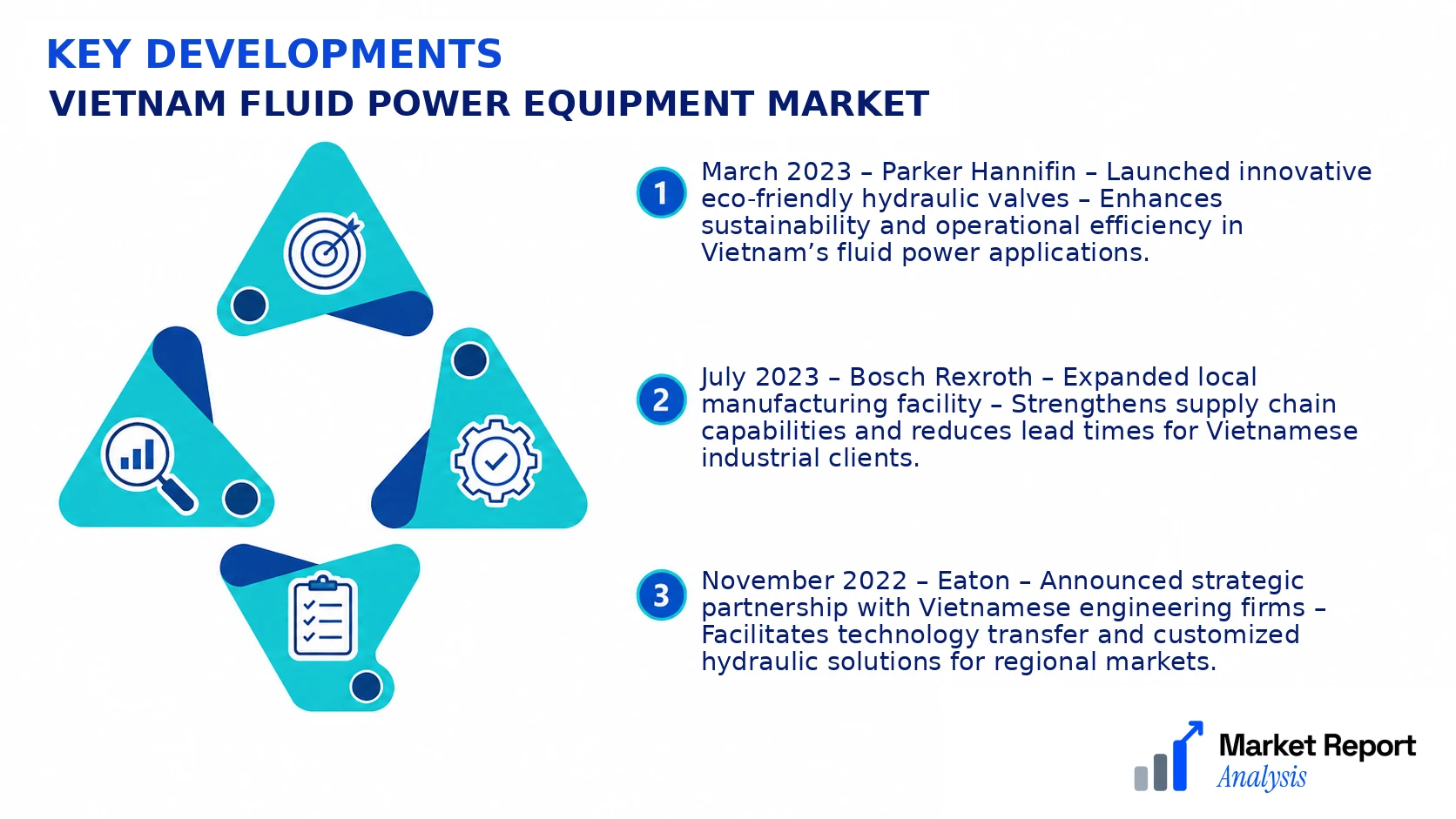
- March 2023 – Parker Hannifin – Launched innovative eco-friendly hydraulic valves – Enhances sustainability and operational efficiency in Vietnam’s fluid power applications.
- July 2023 – Bosch Rexroth – Expanded local manufacturing facility – Strengthens supply chain capabilities and reduces lead times for Vietnamese industrial clients.
- November 2022 – Eaton – Announced strategic partnership with Vietnamese engineering firms – Facilitates technology transfer and customized hydraulic solutions for regional markets.
- April 2023 – Caterpillar – Invested in new hydraulic component plant in Hanoi – Augments local production capacity to meet escalating infrastructure and construction demand.
- September 2022 – HYDAC – Launched digital hydraulic filter monitoring system – Promotes predictive maintenance and operational transparency for Vietnamese factories.
Frequently Asked Questions
What is the Vietnam Fluid Power Equipment Market?
The Vietnam Fluid Power Equipment Market encompasses the supply, manufacturing, and distribution of hydraulic and pneumatic systems used across diverse sectors such as manufacturing, automotive, construction, and agriculture, serving Vietnam's growing industrial base.
What is the current market size of Vietnam Fluid Power Equipment Market?
In 2026, the market value of Vietnam's Fluid Power Equipment Market is estimated at approximately USD 1.2 Billion, reflecting Vietnam's expanding industrial activities, infrastructure development, and increased adoption of automation technologies.
What factors are driving the Vietnam Fluid Power Equipment Market?
Market growth is driven by Vietnam’s industrial expansion, government infrastructure projects, rising manufacturing automation, and investments in construction. Additionally, advancements in fluid power technology attract local and foreign firms seeking cost-effective, reliable solutions.
Which Vietnamese city leads the Vietnam Fluid Power Equipment Market?
Ho Chi Minh City dominates Vietnam’s fluid power market, owing to its status as the economic and industrial hub, hosting the majority of manufacturing and infrastructure projects that demand extensive fluid power systems.
Which segment is expected to grow the fastest?
The hydraulic segment is projected to witness the fastest growth, fueled by the increasing use in mobile machinery, construction equipment, and automation sectors, driven by technological advancements and industrial expansion.
Who are the leading companies operating in the Vietnam Fluid Power Equipment Market?
Major players include Bosch Rexroth, Parker Hannifin, and SMC Corporation. These companies are expanding their local manufacturing and distribution networks to capitalize on Vietnam’s growing demand for reliable fluid power solutions.
Analyst Perspective
The Vietnam fluid power equipment market exhibits a promising long-term outlook driven by ongoing infrastructure development, industrial expansion, and a government focus on manufacturing modernization. Commercial opportunities are concentrated in urban centers such as Hanoi, Ho Chi Minh City, and Danang, where manufacturing, automotive, and construction sectors are rapidly advancing. Technological evolution will likely emphasize automation and the integration of IoT-enabled systems, enhancing efficiency and predictive maintenance capabilities. Investors should prioritize establishing local manufacturing facilities and sourcing innovative solutions that comply with Vietnamese regulations on environmental and safety standards. Competitive intensity is expected to intensify as regional and international players vie for market share, emphasizing the importance of strategic partnerships and innovation. City-level growth potential is strongest in Ho Chi Minh City, given its infrastructure investments and industrial base, followed by Hanoi’s expanding manufacturing sector. Long-term strategic positioning should involve leveraging technological advancements, optimizing supply chains, and fostering collaborations with local industry leaders to sustain competitive advantage amid evolving market dynamics.
