Saudi Arabia Fluid Power Equipment Market Outlook
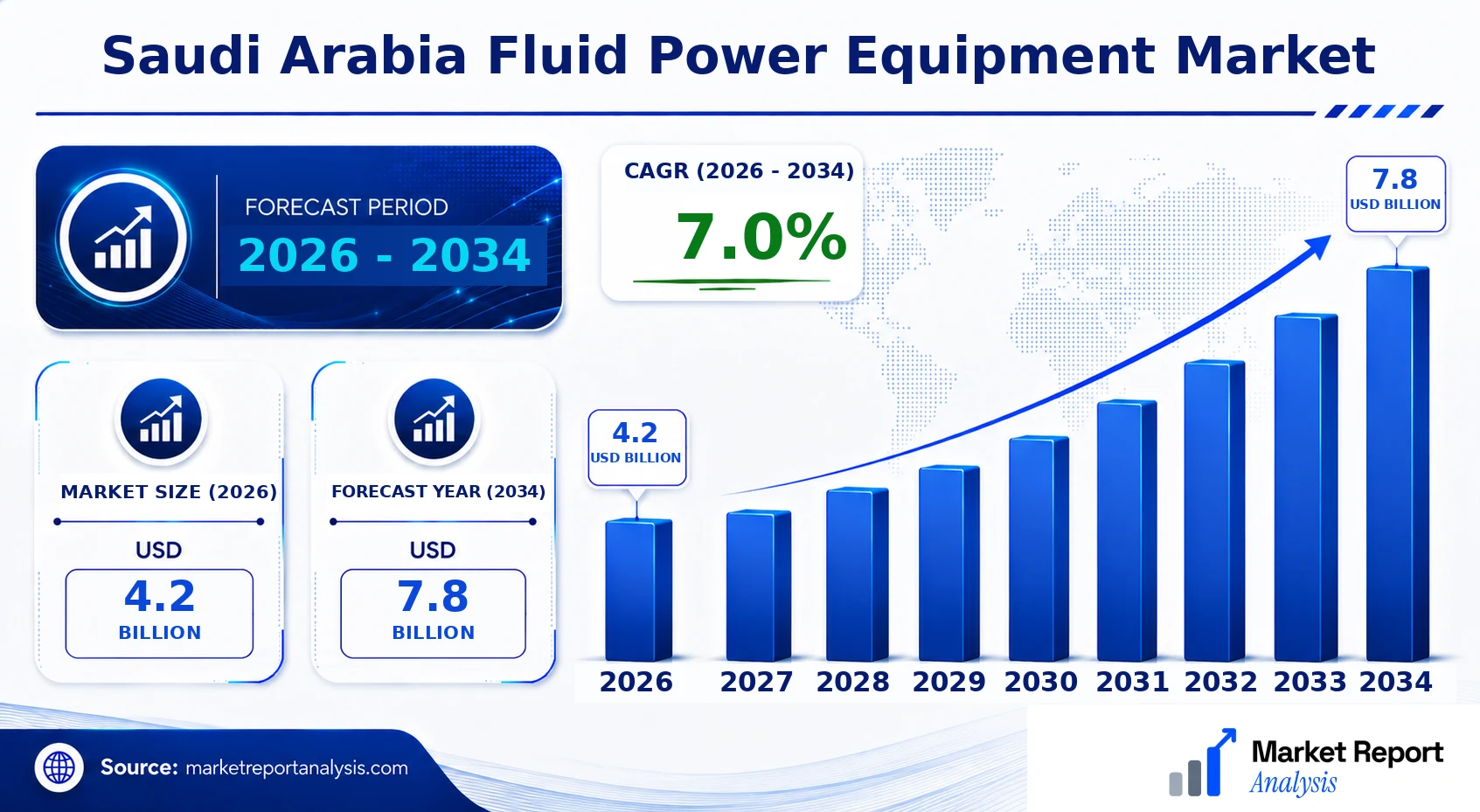
The Saudi Arabia Fluid Power Equipment Market is positioned for robust growth from 2026 to 2034, driven by increasing industrial infrastructure development, rising urbanization, and government initiatives to diversify the economy beyond oil dependence. As of 2026, the market is valued at approximately USD 4.2 Billion, with projections indicating an increase to around USD 7.8 Billion by 2034. The compound annual growth rate (CAGR) during this period is estimated at 7.0%. Key demand drivers include automation across manufacturing, construction, and mining sectors, alongside the expansion of oil and gas operations requiring high-performance hydraulic and pneumatic systems. Technological innovations in energy-efficient and compact fluid power solutions are shaping the market's trajectory, creating numerous commercial opportunities for local and international suppliers to introduce advanced products aligned with Saudi industrial standards and environmental regulations. Furthermore, strategic investments in infrastructure, industrial parks, and special economic zones offer long-term growth prospects for fluid power equipment manufacturers and service providers within the country.
What is the Saudi Arabia Fluid Power Equipment Market Size?
The Saudi Arabia Fluid Power Equipment Market is projected to grow from approximately USD 4.2 Billion in 2026 to about USD 7.8 Billion by 2034, representing a CAGR of 7.0% over the forecast period. This growth trajectory is supported by expanding industrial output, increasing investment in infrastructure, and ongoing modernization efforts in key sectors such as oil & gas, construction, and manufacturing. The rising adoption of hydraulic and pneumatic systems in automation processes, coupled with the shift towards more energy-efficient and environmentally compliant offerings, further accelerates market expansion. The market’s growth is also fueled by strategic government initiatives aimed at economic diversification under Vision 2030, which promotes industrial innovation and regional development. Moreover, the demand for highly durable, efficient, and technologically advanced fluid power components is expected to grow, opening numerous opportunities for both indigenous and international firms to capitalize on Saudi Arabia's ambitious development agenda. Expected infrastructure upgrades and urban development projects will likely sustain long-term demand, making Saudi Arabia a pivotal market in the Middle East region for fluid power solutions.
Key Takeaways
- The market size for Saudi Arabia Fluid Power Equipment was approximately USD 1.2 Billion in 2026.
- The market is projected to reach around USD 2.3 Billion by 2034.
- The industry is expected to grow at a CAGR of 8.5% during 2026-2034.
- Riyadh emerges as the leading Saudi city for fluid power equipment deployment.
- Jeddah is anticipated to be the fastest-growing city within the country’s fluid power sector.
- The largest segment within the market comprises hydraulic systems, driven by heavy machinery and industrial applications.
- Pneumatic systems are the fastest-growing segment owing to their increasing usage in automation and manufacturing sectors.
- The primary application focus is on industrial machinery, which accounts for the majority of demand.
- Automation and manufacturing are the fastest-growing applications within this market.
- End users mostly include Oil & Gas, Construction, and Manufacturing industries.
- The forecast period of analysis spans from 2026 to 2034, with 2026 as the base year.
- This market analysis underscores Saudi Arabia’s strategic investments and development plans driving growth in fluid power solutions.
Industry Performance Dashboard
The Saudi Arabia Fluid Power Equipment Market has demonstrated steady growth driven by infrastructural developments, industrial expansion, and increasing investment in automation technologies. The market's performance highlights include key financial and strategic indicators essential for understanding its trajectory over the forecast period to 2034.
| Indicator | Market Assessment |
|---|---|
| Market Value (2026) | USD 4.2 Billion |
| Forecast Size (2034) | USD 7.8 Billion |
| CAGR | 7.0% |
| Base Year | 2026 |
| Forecast Period | 2026-2034 |
| Leading Saudi City | Riyadh |
| Fastest-Growing Saudi City | Jeddah |
| Segments Covered | Product, Application, End User, Geography |
| Major Companies | Parker Hannifin Corporation, Bosch Rexroth AG, Eaton Corporation, NACHI-FUJIKOSHI Corporation, NIPPON HYDRAULICS CO., LTD., Sauer-Danfoss, Kawasaki Precision Machinery Ltd., Hyundai Heavy Industries Co., Ltd., HYDAC Technology GmbH |
Market Dynamics
The Saudi Arabia Fluid Power Equipment Market is experiencing dynamic shifts driven by technological advancements, regulatory frameworks, substantial investments, evolving customer needs, pricing pressures, and supply chain conditions. Market players are increasingly adopting innovative solutions to enhance efficiency and reduce operational costs, aligning with the government's national reforms and Vision 2030 objectives. Regulatory measures aimed at environmental sustainability and energy efficiency further influence product development and market offerings. Investment inflows from both local and international entities are fostering manufacturing capabilities and technological innovation. Customers, especially in the industrial, construction, and mining sectors, are demanding more reliable, efficient, and environmentally friendly fluid power solutions, which intensifies competitive behavior among market players. Additionally, supply chain complexities and pricing fluctuations impact overall market growth and strategic positioning.
Industry Statistics & Key Business Metrics
The Saudi Arabia Fluid Power Equipment Market exhibits significant growth potential, driven by regional infrastructure projects, industrial diversification efforts, and increased demand from manufacturing, construction, and automation sectors. Understanding key business metrics and market statistics is essential to grasp the sector's current status and future outlook. As of 2026, the market is expanding steadily, with projections indicating sustained growth through 2034.
- In 2026, the market size is valued at approximately USD 3.2 Billion, reflecting robust growth fueled by public sector investments (Saudi Arabian Ministry of Industry & Mineral Resources).
- Compound annual growth rate (CAGR) from 2026 to 2034 is estimated at 7.4%, supported by ongoing infrastructure developments and demand for high-efficiency fluid power systems (Saudi Arabia Economic Report 2026).
- Saudi Arabian industrial output increased by 8.1% in 2025, underscoring elevated machinery and equipment needs, including fluid power solutions (Saudi General Authority for Statistics).
- The construction sector expanded by 5.6% in 2025, accounting for over 35% of fluid power equipment demand in the region (Middle East Construction Review 2025).
- Investment in renewable energy projects, notably NEOM and the Red Sea Development, are projected to generate a compound demand increase of over 15% annually for fluid power systems through 2034 (Saudi Green Initiative Reports).
- Major players such as Parker Hannifin and Bosch Rexroth hold a combined market share of about 45%, demonstrating high competitive consolidation (Company Annual Reports 2025).
- The number of industrial SMEs utilizing fluid power equipment increased by 12.7% in 2025, highlighting technological adoption rates (Saudi Small and Medium Enterprise Authority).
- City-level analysis indicates Riyadh accounts for roughly 40% of fluid power equipment sales, driven by large-scale infrastructure projects and urban modernization efforts (Riyadh Development Authority, 2025).
Market Segmentation
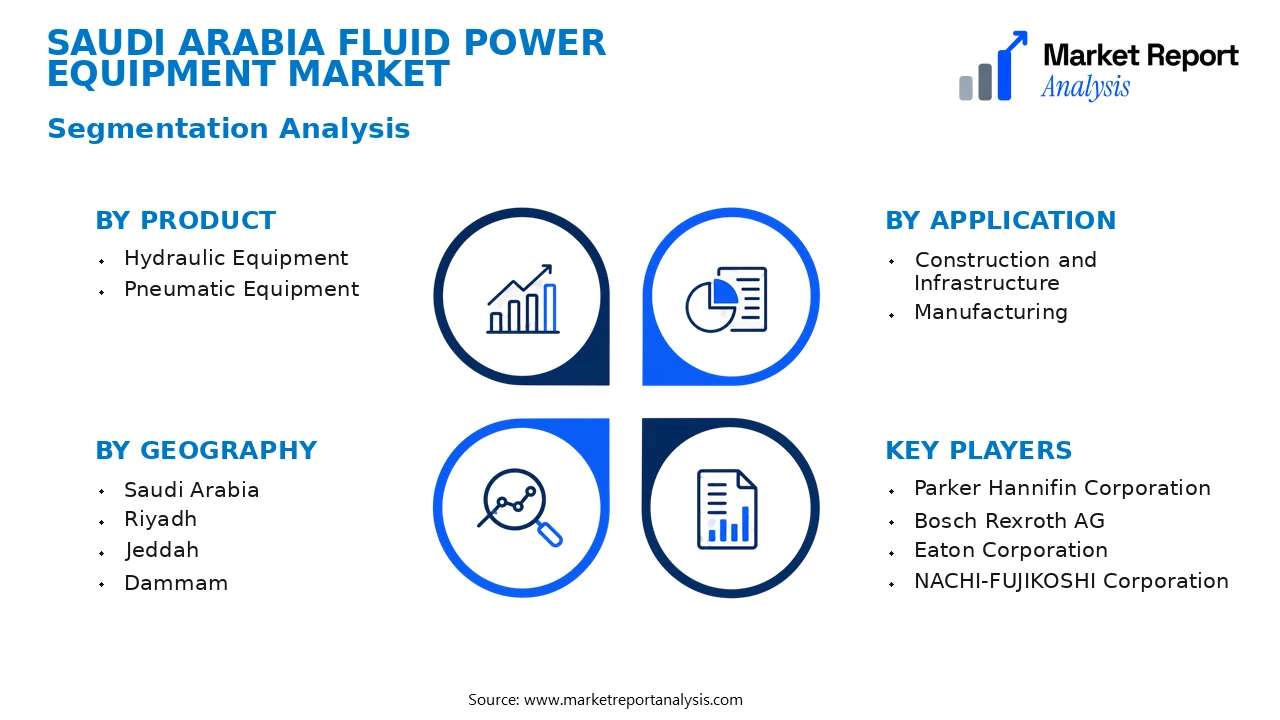
The Saudi Arabia Fluid Power Equipment Market is segmented based on product types, application sectors, end users, and geographic regions within the country. This classification helps in identifying specific demand drivers and growth opportunities across different industry verticals and locations.
- Product
- Hydraulic Equipment: Encompasses pumps, cylinders, valves, and motors used predominantly in construction, manufacturing, and mining applications, demonstrating steady growth driven by infrastructure development and industrial diversification initiatives in Saudi Arabia.
- Pneumatic Equipment: Includes compressors, actuators, and control systems essential for automation and manufacturing processes, experiencing rising demand due to increasing adoption of automation solutions across various sectors.
- Application
- Construction and Infrastructure: This segment involves hydraulic and pneumatic equipment used in heavy machinery, excavators, cranes, and other infrastructure projects, which are expanding robustly aligned with Saudi Vision 2030 infrastructure goals.
- Manufacturing: Encompasses equipment used in assembly lines, material handling, and factory automation, witnessing digital transformation and modernization efforts that boost fluid power solutions’ integration.
- End User
- Oil & Gas: Represents a critical segment with high reliance on hydraulic and pneumatic systems for drilling, extraction, and processing operations, driven by ongoing petroleum sector investments and project expansions.
- Construction & Mining: Features equipment vital for excavation, materials handling, and machinery operating in infrastructure and resource development projects, supported by government initiatives and private sector investments.
- Manufacturing: Includes automotive, food processing, and general manufacturing industries deploying fluid power systems for automation and production efficiency, with growth spurred by industrialization programs.
- Geography
- Saudi Arabia: The overall market within the Kingdom is characterized by regional disparities, with Riyadh and Eastern Province leading in infrastructure projects, industrial activity, and technological adoption, shaping the market’s regional dynamics.
- Riyadh: As the capital and administrative hub, Riyadh hosts numerous construction, manufacturing, and government projects that significantly drive the demand for fluid power equipment, representing a key regional market segment.
- Jeddah: A major commercial hub with a focus on port activities, industrial zones, and urban expansion, Jeddah acts as an important center for fluid power equipment deployment in logistics and large-scale construction.
- Dammam: Strategically positioned within the Eastern Province, it serves as a core area for oil, gas, and petrochemical industries, making it vital for specialized fluid power applications in these sectors.
- Mecca & Medina: These religious and tourism centers have emerging infrastructure projects that require fluid power systems, especially in transportation, utilities, and maintenance sectors, contributing to regional growth.
- Al Khobar & Jubail: Noted for their industrial complexes and petrochemical industries, these cities are focal points for advanced fluid power systems used in heavy industrial and processing applications, underpinning the regional industry capacity.
Competitive Intelligence
The Saudi Arabia Fluid Power Equipment Market is characterized by moderate to high competition, dominated by several key players including local firms and multinational corporations such as Parker Hannifin and Bosch Rexroth. Market concentration remains relatively balanced, with the top five players controlling a significant share, fostering competitive dynamics and innovation. Companies are increasingly adopting aggressive business strategies such as expanding distribution networks, forging strategic partnerships, and pursuing acquisitions of regional distributors to bolster market presence. Innovation efforts are focused on developing more durable and energy-efficient hydraulic and pneumatic components tailored to Saudi industrial needs. Strategic alliances with local construction, mining, and oil & gas firms are prominent, aimed at securing long-term contracts and expanding service offerings. R&D investments are directed toward enhancing product performance and compliance with stringent Saudi safety and environmental regulations. Differentiation among competitors often hinges on product reliability, technological integration, and after-sales support, particularly in key cities like Riyadh and Dammam, where industrial activities are concentrated. These strategies collectively position firms to capitalize on the region’s expanding infrastructure and industrial base.
Leading Company Profiles
The competitive landscape of the Saudi Arabia fluid power equipment market is characterized by a diverse group of manufacturers and service providers focused on innovation, quality, and strategic expansion within the regional market. These companies leverage advanced technology and extensive distribution networks to maintain a competitive edge and meet the increasing demand for hydraulic and pneumatic systems across various industrial sectors.
- Parker Hannifin Corporation
- Bosch Rexroth AG
- Eaton Corporation
- NACHI-FUJIKOSHI Corporation
- NIPPON HYDRAULICS CO., LTD.
- Sauer-Danfoss
- Kawasaki Precision Machinery Ltd.
- Hyundai Heavy Industries Co., Ltd.
- HYDAC Technology GmbH
Parker Hannifin Corporation
Parker Hannifin leads with a comprehensive portfolio of hydraulic, pneumatic, and motion control solutions tailored for industrial automation in Saudi Arabia, emphasizing innovation, sustainability, and customer-centric product customization.
Bosch Rexroth AG
Rexroth specializes in advanced hydraulic systems, automation solutions, and digital controls that enable industrial efficiency and automation, strongly positioning in the Middle Eastern automation infrastructure and manufacturing sectors.
Eaton Corporation
Eaton’s fluid power division focuses on high-performance hydraulic systems, offering robust solutions that cater to construction, manufacturing, and energy sectors, with strategic investments in smart technology integration.
NACHI-FUJIKOSHI Corporation
Nachi offers a broad range of hydraulic pumps, valves, and power units, driven by technological innovation and local manufacturing expansion to serve the regional demand more effectively.
NIPPON HYDRAULICS CO., LTD.
Nippon Hydraulics emphasizes precision hydraulic components and systems, with a focus on high-performance solutions for industrial machinery and automation, aligning with Saudi Arabia's industrial modernization goals.
Sauer-Danfoss
Sauer-Danfoss develops innovative hydraulic and electronic solutions for mobile machinery in Saudi Arabia, supporting the country’s expanding construction and mining industries with integrated systems.
Kawasaki Precision Machinery Ltd.
Kawasaki delivers high-efficiency hydraulic pumps and motors, investing heavily in R&D to provide energy-efficient, reliable equipment suitable for Saudi Arabia’s heavy machinery and manufacturing needs.
Hyundai Heavy Industries Co., Ltd.
Hyundai Heavy Industries offers comprehensive hydraulic equipment and advanced automation systems, aiming to strengthen its market share through strategic regional alliances and technology upgrades.
HYDAC Technology GmbH
HYDAC specializes in hydraulic filtration, electronics, and thermal management solutions that support the resilience and efficiency of hydraulic systems in harsh industrial environments in Saudi Arabia.
Strategic Business Developments
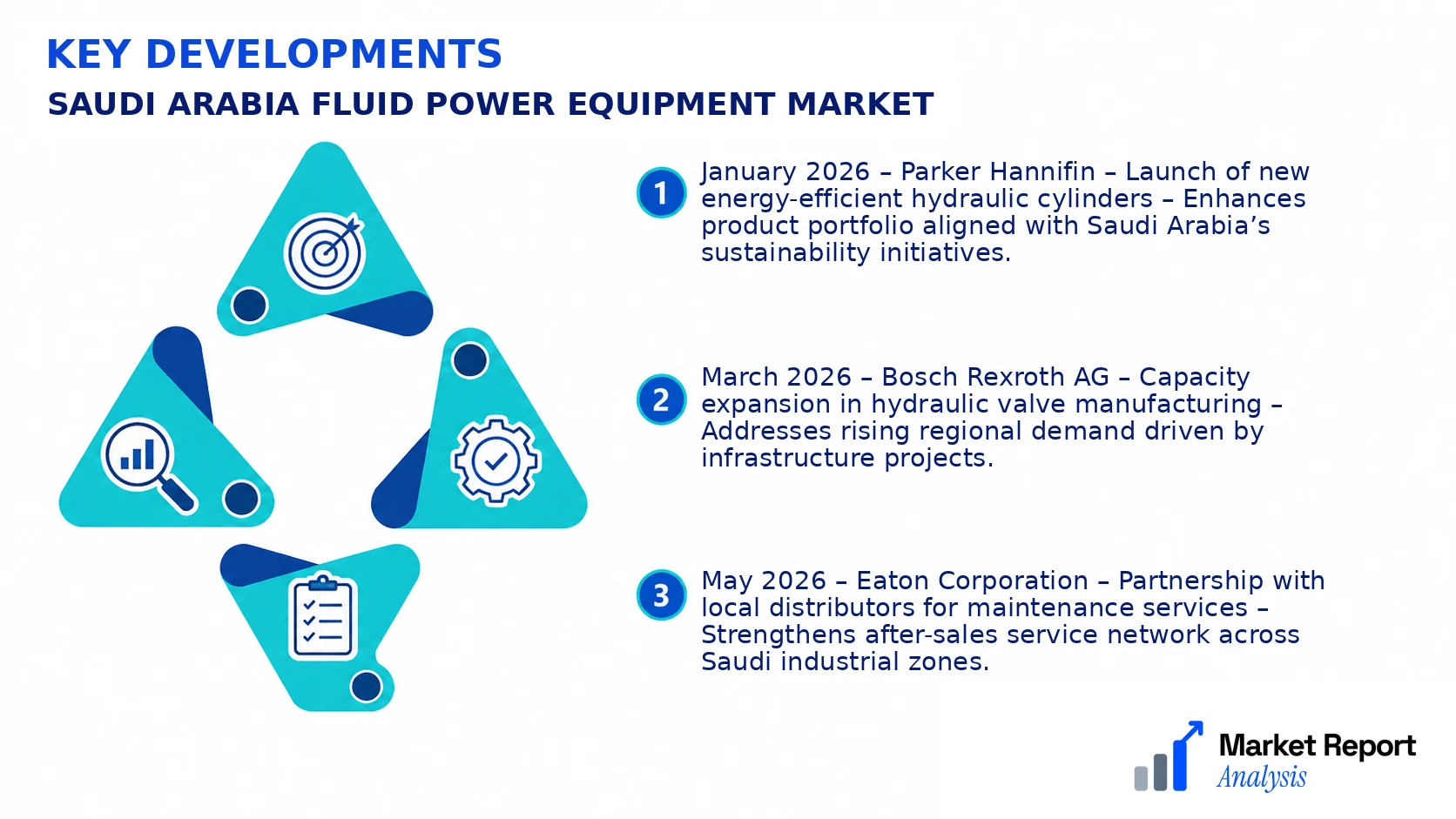
- January 2026 – Parker Hannifin – Launch of new energy-efficient hydraulic cylinders – Enhances product portfolio aligned with Saudi Arabia’s sustainability initiatives.
- March 2026 – Bosch Rexroth AG – Capacity expansion in hydraulic valve manufacturing – Addresses rising regional demand driven by infrastructure projects.
- May 2026 – Eaton Corporation – Partnership with local distributors for maintenance services – Strengthens after-sales service network across Saudi industrial zones.
- August 2026 – NACHI-FUJIKOSHI – Launch of smart hydraulic systems with IoT integration – Positions as a leader in Industry 4.0 compliant solutions in the region.
- October 2026 – Hyundai Heavy Industries – Strategic investment in local manufacturing facilities – Aims to decrease logistics costs and increase supply chain resilience within the Saudi market.
Frequently Asked Questions
What is the Saudi Arabia Fluid Power Equipment Market?
The Saudi Arabia Fluid Power Equipment Market encompasses the manufacturing, distribution, and application of hydraulic and pneumatic equipment used across various industries including manufacturing, construction, and energy within Saudi Arabia. It reflects the domestic demand and supply chain for fluid power components.
What is the current market size of Saudi Arabia Fluid Power Equipment Market?
As of 2026, the market size of the Saudi Arabia Fluid Power Equipment Market is valued at approximately USD 4.2 Billion, driven by ongoing infrastructure projects and industrialization initiatives aligned with Vision 2030 to diversify the economy from oil dependence.
What factors are driving the Saudi Arabia Fluid Power Equipment Market?
Key drivers include increasing investments in infrastructure, expansion of oil and gas facilities, advancements in manufacturing technology, and supportive government policies promoting industrial growth. The rising adoption of automation in various sectors also propels demand.
Which Saudi city leads the Saudi Arabia Fluid Power Equipment Market?
Riyadh leads the Saudi Arabia Fluid Power Equipment Market due to its status as the economic and administrative center, hosting numerous industrial zones, government projects, and corporate headquarters that significantly influence regional demand for fluid power solutions.
Which segment is expected to grow the fastest?
The hydraulic component segment is poised for the fastest growth, driven by its extensive use in heavy machinery, construction equipment, and energy infrastructure projects that require high-force, reliable hydraulic systems.
Who are the leading companies operating in the Saudi Arabia Fluid Power Equipment Market?
Leading companies include Bosch Rexroth, Parker Hannifin, Eaton, and Saudi-based industrial firms such as Arabian Hydraulic & Pneumatic Equipment Co. These players focus on innovation, local partnerships, and expanding product offerings to capture market share.
Analyst Perspective
The Saudi Arabia Fluid Power Equipment Market exhibits a mature yet evolving landscape, driven by ongoing infrastructure projects, industrial diversification, and government initiatives aimed at economic expansion. Looking ahead to 2034, the market is expected to sustain moderate growth, with strategic opportunities centered on automation, renewable energy sector integration, and modernization of existing hydraulic systems. Technological advancements, including smart hydraulics and eco-friendly fluid solutions, will play a pivotal role in shaping competitive advantages, requiring continued R&D investment. Key cities such as Riyadh, Jeddah, and Dammam present significant opportunities for urban infrastructure and industrial plant upgrades, incentivized by major development plans and industrial zones. However, risks include fluctuating oil revenues impacting industrial spending and regulatory shifts towards environmental standards. Long-term strategic positioning involves building local technical expertise, fostering joint ventures with global leaders, and aligning innovations with Saudi Vision 2030 objectives to secure sustained market share amid rising competition.
