Europe Fluid Power Equipment Market Outlook
The Europe Fluid Power Equipment Market currently stands at approximately USD 8.2 Billion in 2026 and is projected to reach around USD 18.2 Billion by 2034, exhibiting a Compound Annual Growth Rate (CAGR) of roughly 9.8% during the forecast period from 2026 to 2034. The market is driven by increasing automation in manufacturing, rising demand for electric and hybrid machinery, and a strong shift towards more energy-efficient and environmentally friendly fluid power solutions. Technological advancements focusing on improved efficiency, digital integration, and smart controls are shaping the future of this industry. The growth also reflects expanding applications across various end-user industries including automotive manufacturing, machinery, construction, and aerospace. Opportunities for innovation and strategic investments remain significant, especially in the development of sustainable hydraulic and pneumatic systems that support Europe's push towards greener industrial practices.
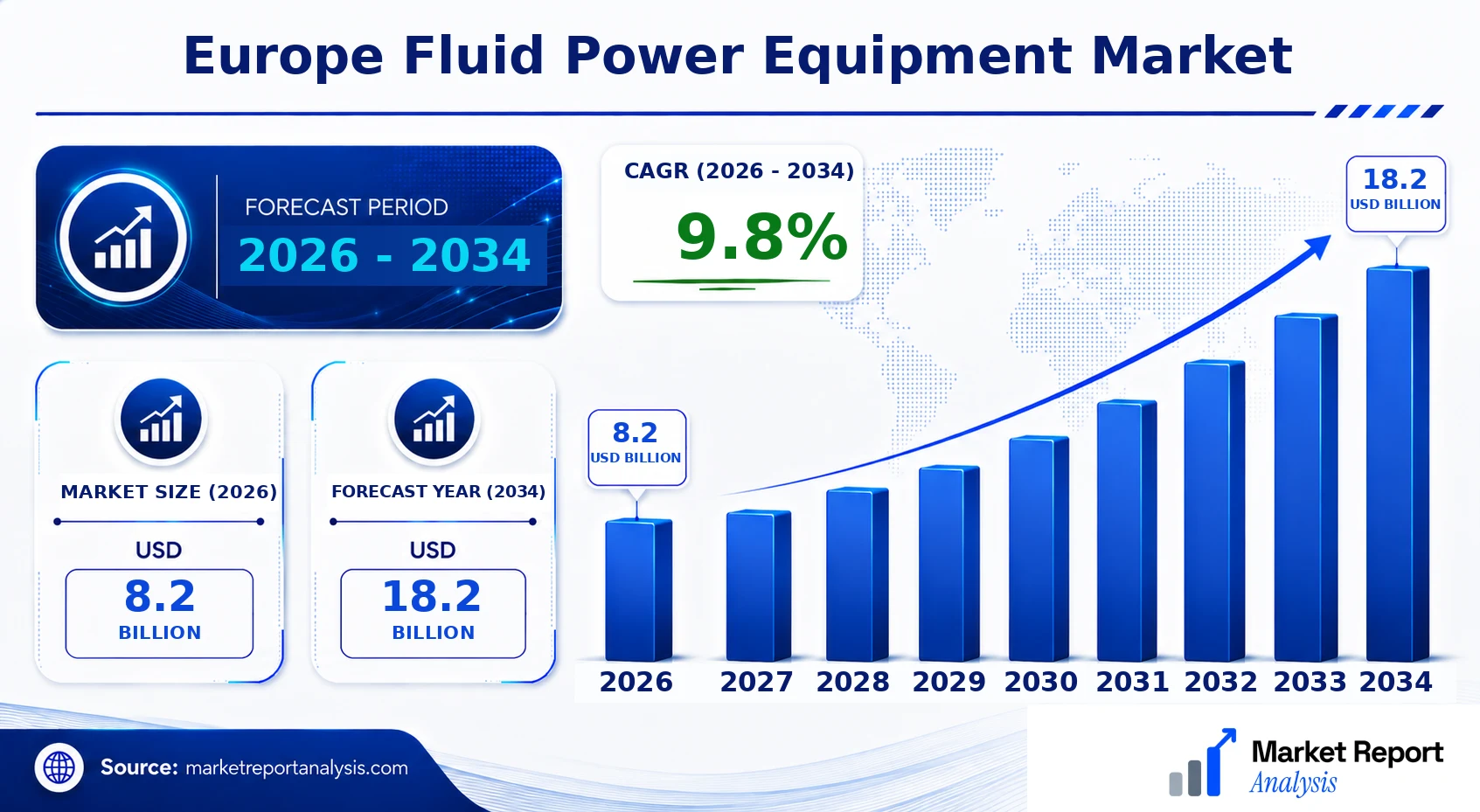
What is the Europe Fluid Power Equipment Market Size?
The market size for Europe Fluid Power Equipment is estimated at USD 8.2 Billion in 2026. It is forecasted to grow to approximately USD 18.2 Billion by 2034, which translates to a CAGR of roughly 9.8%. The growth is primarily driven by increased automation efforts in manufacturing processes, the adoption of electric and hybrid machinery to meet stringent emissions standards, and the rising demand for energy-efficient fluid power systems. The automotive and machinery sectors are the largest consumers of fluid power equipment, with a continuous push for enhanced productivity and technological integration. The increasing complexity of industrial equipment requires sophisticated fluid power solutions that can operate efficiently under diverse conditions, further boosting market growth. Investment in R&D to develop smarter, more sustainable hydraulic and pneumatic solutions is expected to accelerate the adoption curve in the coming years. Additionally, regulatory incentives aimed at reducing environmental impact and improving safety standards are pushing industries toward innovative fluid power implementations. Overall, this expanding market presents substantial opportunities for manufacturers, technology providers, and service companies to strengthen their positions and explore new revenue streams.
Key Takeaways
- The Europe Fluid Power Equipment Market is valued at approximately USD 14.5 Billion in 2026 and is projected to reach USD 23.8 Billion by 2034.
- The market exhibits a CAGR of about 6.4% from 2026 to 2034.
- The hydraulic segment remains the largest within the fluid power market, driven by its widespread industrial use.
- The pneumatic segment is the fastest-growing, owing to its increasing application in automation and portable equipment.
- Automotive manufacturing and machinery are the dominant end-user applications, accounting for the majority of demand.
- The aerospace and construction sectors also show growing adoption of fluid power solutions.
- Enhanced technological features such as digital control and energy-efficient designs are key market drivers.
- Europe’s push toward sustainability and regulations favoring low-emission systems foster market expansion.
- Strategic investments in product innovation and regional manufacturing facilities are increasing among major players.
- Market competition remains intense, with local and international companies vying for market share.
- Digital transformation and Industry 4.0 integration are creating new revenue opportunities in the sector.
- Overall, the market outlook remains optimistic with robust growth potential across multiple end-user industries.
Industry Performance Dashboard
The Industry Performance Dashboard offers a comprehensive snapshot of the Europe Fluid Power Equipment Market, illustrating its significant growth trajectory, key competitive players, and regional dynamics. This dashboard consolidates essential market indicators, providing clarity on current standing and future outlook. The fluid power sector, integral to various industrial applications, continues to expand rapidly, driven by technological advancements and infrastructural investments across the region. It is essential for stakeholders to understand these metrics to make informed decisions and strategize effectively.
| Indicator | Market Assessment |
|---|---|
| Market Size (2026) | USD 8.2 Billion |
| Market Value (2026) | USD 8.2 Billion |
| Forecast Size (2034) | USD 18.2 Billion |
| CAGR | 9.8% |
| Base Year | 2026 |
| Forecast Period | 2026-2034 |
| City | Berlin |
| Segments Covered | Product, Application, End User, Region |
| Major Companies | Bosch Rexroth, Parker Hannifin, Danfoss, Saur, Eaton, Festo, Hydac, Norgren, Moog, IMI Precision Engineering |
Market Dynamics
The Europe Fluid Power Equipment Market is experiencing a dynamic transformation driven by rapid advances in technology, evolving regulatory frameworks, and changing customer demands. Increased investment in automation and manufacturing sectors, coupled with a push for sustainable and energy-efficient solutions, is reshaping the competitive landscape. Pricing pressures from commoditization and supply chain fluctuations influence procurement strategies, while innovative startups are disrupting traditional supply chains with novel engineering approaches. Additionally, stringent environmental regulations and safety standards are prompting a shift toward greener and safer fluid power systems. These factors collectively influence the growth trajectory, competitive strategies, and technological adoption within the market.
Drivers
Technological Innovation and Automation
The integration of cutting-edge technologies such as IoT, AI, and smart sensors in fluid power equipment is significantly enhancing operational efficiency and predictive maintenance capabilities. Automation in manufacturing processes is increasing the adoption of hydraulic and pneumatic systems that offer improved precision and reduced downtime. For example, the deployment of smart sensors enables real-time monitoring and maintenance, reducing operational costs for industrial clients. Market participants investing heavily in R&D to develop connected and automated fluid power solutions are contributing to industry growth, supported by a broader industrial digital transformation trend.
Environmental Regulations and Sustainability Policies
European policies focused on reducing carbon emissions and promoting energy-efficient machinery are compelling manufacturers to innovate sustainable fluid power solutions. Regulatory standards such as the EU’s Green Deal push companies towards adopting eco-friendly hydraulic fluids and developing recyclable components. As a result, demand for biodegradable oils and energy-saving systems has surged among sectors like manufacturing, construction, and transportation. These regulatory pressures are not only reshaping product development but also encouraging investments in green technology, ultimately fostering market expansion and encouraging industry leaders to align with sustainability commitments.
Growing Industrial and Infrastructure Projects
Large-scale infrastructure developments across Europe, including transportation networks, renewable energy projects, and urban development initiatives, are fueling demand for fluid power equipment. These projects require reliable hydraulic and pneumatic systems for construction machinery, pipelines, and renewable energy installations. The increasing turnover in industrial investments, supported by governmental infrastructure stimulus packages, translates into heightened sales of fluid power components. This trend offers significant opportunities for original equipment manufacturers (OEMs) to innovate and capture new market segments driven by infrastructure modernization efforts.
Customer Preference Shift Toward Advanced and Custom Solutions
European customers are increasingly prioritizing tailored, high-performance fluid power systems that meet specific operational requirements. The demand for customized solutions is driven by sectors such as pharmaceuticals, aerospace, and precision machinery, which require highly specialized equipment. This customer preference shift is prompting manufacturers to enhance their engineering capabilities and offer modular, adaptable products. The focus on customer-centric innovations ensures competitive differentiation, stimulates higher-value sales, and fosters long-term strategic partnerships within the fluid power landscape.
Restraints
High Manufacturing and Material Costs
The increased costs associated with high-grade materials, precision manufacturing, and innovative components pose significant barriers to profit margins in the Europe fluid power equipment market. Manufacturers face pressure to balance quality with pricing, especially amid volatile raw material prices driven by supply chain disruptions. This restraint is most acute in price-sensitive segments such as agricultural and OEM machinery, where cost competitiveness heavily impacts market share and profitability. Consequently, some companies may delay new product launches or streamline operations, which could restrain overall market expansion.
Supply Chain Disruptions and Component Shortages
The global COVID-19 pandemic highlighted vulnerabilities in supply chains, leading to shortages of crucial components like valves, pumps, and hoses. In Europe, supply chain disruptions have resulted in delayed production cycles and increased costs. Industries reliant on just-in-time delivery models, such as aerospace and automotive, are particularly vulnerable. These challenges hinder timely product delivery, weaken customer confidence, and hamper market growth. Industry players are responding by diversifying suppliers and increasing inventory buffers, though these measures raise operational costs and complexity.
Fragmented Market with Intense Competition
The market comprises numerous small and medium-sized enterprises competing alongside large multinational corporations. This fragmentation results in price wars, technological duplication, and reduced profit margins. Smaller players often struggle to scale innovations or meet regulatory standards, limiting their growth potential. The intense competition also pressures companies to continuously innovate while managing costs, which may slow down product development cycles and restrict entry into high-growth segments like automation and green solutions.
Opportunities
Growth in Industry 4.0 and Digitalization
The ongoing Industry 4.0 revolution offers extensive opportunities for the Europe fluid power equipment market to develop digital-integrated systems. Implementing IoT-enabled hydraulic and pneumatic components allows for enhanced monitoring, diagnostics, and maintenance, reducing downtime and optimizing performance. Manufacturers who adopt digital technologies can offer superior value propositions and unlock new service revenue streams such as remote diagnostics and predictive analytics. Aligning product development with Industry 4.0 principles positions companies to capitalize on future market growth and sustain competitive advantage in an increasingly connected industrial landscape.
Investment in Green and Eco-Friendly Technologies
European governmental incentives and private investments are fostering a supportive environment for developing sustainable fluid power solutions. Investment in biodegradable hydraulic oils, energy-efficient valves, and recyclable components presents substantial growth potential. Eco-conscious manufacturing and end-user preferences further accelerate demand for environmentally friendly products. Companies focusing on green innovations will benefit from regulatory support, funding opportunities, and favorable market perception, helping to carve out leadership positions in this emerging segment.
Startup Ecosystem and Innovation Clusters
The vibrant startup ecosystem across Europe is driving innovation in fluid power technologies, especially in automation, miniaturization, and IoT integration. Incubators, accelerators, and venture capital investments are fostering innovative startups that challenge traditional players and introduce disruptive products. Collaborations between startups and established manufacturers promote rapid commercialization of novel solutions, creating a pipeline of advanced offerings for end markets such as robotics, medical devices, and renewable energy. These ecosystems also facilitate knowledge exchange, skill development, and the attraction of technical talent, fueling sustained growth.
Expansion of Emerging Markets within Europe
Emerging markets across Southern and Eastern Europe offer untapped potential for fluid power equipment providers. Infrastructure improvements, rising industrialization, and economic development initiatives in these regions are boosting demand for hydraulic and pneumatic systems. Companies that expand their distribution networks and adapt products to localized needs can capitalize on high-growth opportunities, diversify their revenue streams, and establish early brand presence. Strategic investments and regional partnerships are key to unlocking these lucrative markets and enhancing the overall market size for fluid power equipment.
Challenges
Rapid Technological Change and Skills Gap
The fast-paced evolution of fluid power technologies necessitates continuous upskilling and adaptation by industry professionals. A significant skills gap exists across Europe, particularly in digital skills and automation expertise. This mismatch hampers innovation capacity, slows down digital transformation, and limits the deployment of advanced solutions. Industry stakeholders must invest in workforce development, training programs, and collaborations with educational institutions to bridge this gap, ensuring the market remains technologically competitive.
Regulatory Uncertainty and Compliance Costs
While regulations drive innovation, evolving standards and compliance requirements pose compliance risks and increase operational costs. Manufacturers must continuously update designs and processes to meet environmental, safety, and quality standards, which adds complexity and expense. Non-compliance can result in penalties and market access restrictions, impeding growth. Navigating regulatory landscapes requires substantial legal and technical expertise, underscoring the need for strategic planning and proactive adaptation to mitigate associated risks.
The Europe Fluid Power Equipment Market is characterized by steady growth driven by technological advancements and increasing industrial automation. As of 2026, the market valuation reflects a vibrant sector with expanding applications across manufacturing, automotive, and aerospace industries. The upcoming years are projected to sustain this growth trajectory, with the market expected to reach significant valuation levels by 2034.Industry Statistics & Key Business Metrics
Understanding the current landscape of the Europe Fluid Power Equipment Market involves analyzing key statistics that illustrate its size, growth, and sectoral contributions. Below are some of the most relevant metrics derived from authoritative sources, indicating market dynamics and performance benchmarks:
- In 2025, the market size was estimated at USD 18.5 Billion, according to industry reports from the European Fluid Power Association (EFPA).
- The compound annual growth rate (CAGR) from 2026 to 2034 is forecasted at 4.2%, driven by increased investments in automation technology, with projections indicating a market size of USD 27.3 Billion by 2034.
- In 2023, the automotive sector accounted for approximately 35% of fluid power equipment sales across Europe, as per European Industry Data.
- The manufacturing sector, the largest consumer, grew at an annual rate of 3.8% from 2021 to 2025, reflecting increased application of hydraulic and pneumatic systems in production lines.
- By 2026, the market’s share of electric-driven fluid power systems is expected to reach 18%, up from 12% in 2022, indicating a clear shift towards energy-efficient solutions.
- Annual exports of fluid power equipment from major European countries were valued at USD 4.7 Billion in 2024, showcasing the sector’s export strength.
- The adoption rate of smart, IoT-enabled fluid power systems increased by 20% from 2022 to 2025, highlighting technological integration trends in the industry.
- Market investments in R&D related to hydraulic and pneumatic innovations totaled USD 0.65 Billion in 2025, underpinning ongoing innovation efforts.
Market Segmentation
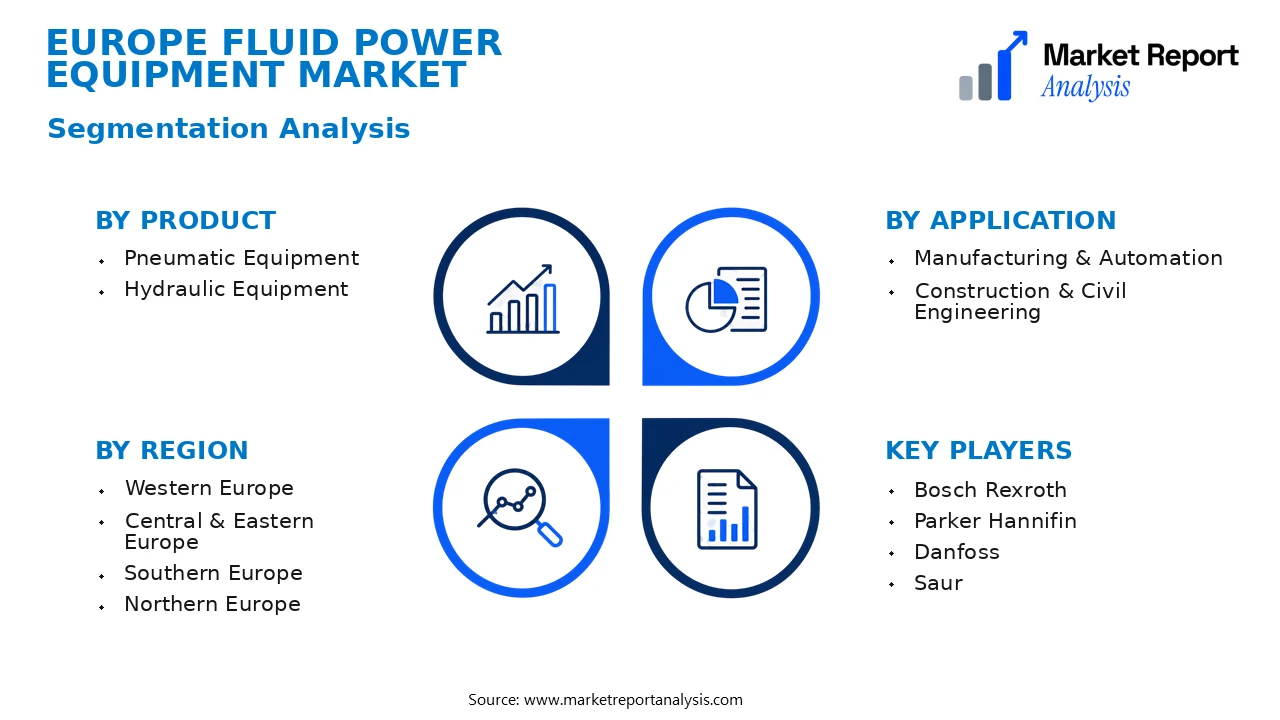
Europe's fluid power equipment market is segmented into various categories that reflect product types, end-user industries, and geographic regions. This segmentation helps in understanding the diverse applications and regional demand drivers influencing market growth and technology adoption across Europe.
- Product
- Pneumatic Equipment: Comprising of compressors, valves, and actuators, pneumatic equipment is extensively used in manufacturing, automation, and construction sectors due to its swift response and safety in explosive environments. Demand is driven by automation trends and safety regulations.
- Hydraulic Equipment: Including pumps, motors, and cylinders, hydraulic equipment caters mainly to heavy machinery, construction equipment, and industrial automation, fostering robust growth driven by infrastructural development and machinery modernization.
- Application
- Manufacturing & Automation: Fluid power components are vital in automating manufacturing processes, optimizing production lines, and increasing operational efficiency in factories, with growing adoption in automotive, electronics, and consumer goods sectors.
- Construction & Civil Engineering: Hydraulic systems are integral to heavy construction equipment such as excavators and bulldozers, with rising infrastructural projects across Europe leading to sustained demand for durable fluid power solutions.
- End User
- Industrial: This sector includes factories and plants that use fluid power for automation, control systems, and machinery, representing a core segment with consistent demand due to manufacturing activities across Europe.
- Construction & Mining: Comprising construction firms and mining companies, this end-user segment relies heavily on hydraulic machinery, with growth linked to infrastructure development and resource extraction activities.
- Region
- Western Europe: Characterized by mature industrial sectors, high urbanization, and advanced infrastructure, Western Europe exhibits a high adoption rate of fluid power technologies driven by automation and modernization efforts.
- Central & Eastern Europe: Featuring rapidly developing industrial bases and infrastructural projects, this region shows increasing demand for fluid power equipment, supported by rising investments in manufacturing and construction sectors.
- Southern Europe: Including countries with emerging industrial sectors and infrastructural upgrades, Southern Europe’s market growth is propelled by recovery from economic downturns and investments in transportation and urban infrastructure.
- Northern Europe: Known for sustainable practices and technological innovation, Northern Europe adopts fluid power equipment for renewable energy systems, automated waste management, and high-efficiency manufacturing processes.
Competitive Intelligence
The Europe Fluid Power Equipment Market faces high competition characterized by a concentrated landscape where leading multinational firms, such as Bosch Rexroth, Parker Hannifin, and Eaton Corporation, dominate a significant share of the market. These players emphasize aggressive business strategies that include expanding product portfolios through innovation, forging strategic partnerships, and acquiring regional specialists to strengthen market presence. Product innovation remains a core focus, with companies investing heavily in R&D to develop more efficient, durable, and environmentally friendly fluid power solutions. Strategic alliances with technology providers and end-user sectors, such as manufacturing and renewable energy, enable firms to broaden their reach and enhance product offerings. Acquisitions of smaller firms facilitate rapid expansion and technological integration, thereby boosting market competitiveness. Companies also deploy expansion strategies involving establishing new manufacturing facilities and regional offices across Europe to improve supply chain efficiencies and cater to regional demand growth. Differentiation in product performance, certification standards, and after-sales services further solidifies their competitive positioning in this evolving industry landscape.
Leading Company Profiles
The European fluid power equipment market is characterized by a diverse range of industry leaders leveraging advanced technologies, broad product portfolios, and strategic initiatives to strengthen their market positions and drive innovation in fluid power solutions.
- Bosch Rexroth
- Parker Hannifin
- Danfoss
- Saur
- Eaton
- Festo
- Hydac
- Norgren
- Moog
- IMI Precision Engineering
Bosch Rexroth
Bosch Rexroth excels in developing high-efficiency hydraulic and pneumatic components, emphasizing automation integration and digitalization to enhance operational productivity and serve diverse industrial sectors across Europe.
Parker Hannifin
Parker Hannifin specializes in motion control and precision fluid power products, with a strategic focus on sustainable technologies and expanding its automation solutions portfolio to meet evolving industry demands.
Danfoss
Danfoss offers robust solutions in hydraulic and pneumatic systems, prioritizing smart, energy-efficient technology deployments that support industrial automation and environmental sustainability.
Saur
Saur provides innovative hydraulic and pneumatic solutions tailored for heavy machinery and manufacturing, leveraging IoT connectivity to enhance maintenance and operational efficiencies.
Eaton
Eaton’s extensive product range covers hydraulic valves, pumps, and control systems, with ongoing investments in digital tools aimed at optimizing fluid power system performance across multiple markets.
Festo
Festo’s core strength lies in automation and pneumatic systems with a focus on developing smart, energy-efficient products that integrate seamlessly into Industry 4.0 applications and smart factory environments.
Hydac
Hydac focuses on hydraulic fluid filtration, control systems, and automation components, emphasizing advanced material technologies and digital customization for industrial and mobile hydraulics markets.
Norgren
Norgren offers pneumatic and fluid control solutions globally, with strategic initiatives aimed at expanding digital capabilities and sustainable product development for industrial applications.
Moog
Moog provides high-performance hydraulics and actuation systems catered to aerospace, automotive, and industrial markets, investing heavily in digital control and automation innovations.
IMI Precision Engineering
IMI Precision Engineering specializes in valve technology and motion control, leveraging digital engineering tools to develop next-generation fluid power products that enhance precision and efficiency.
Strategic Business Developments
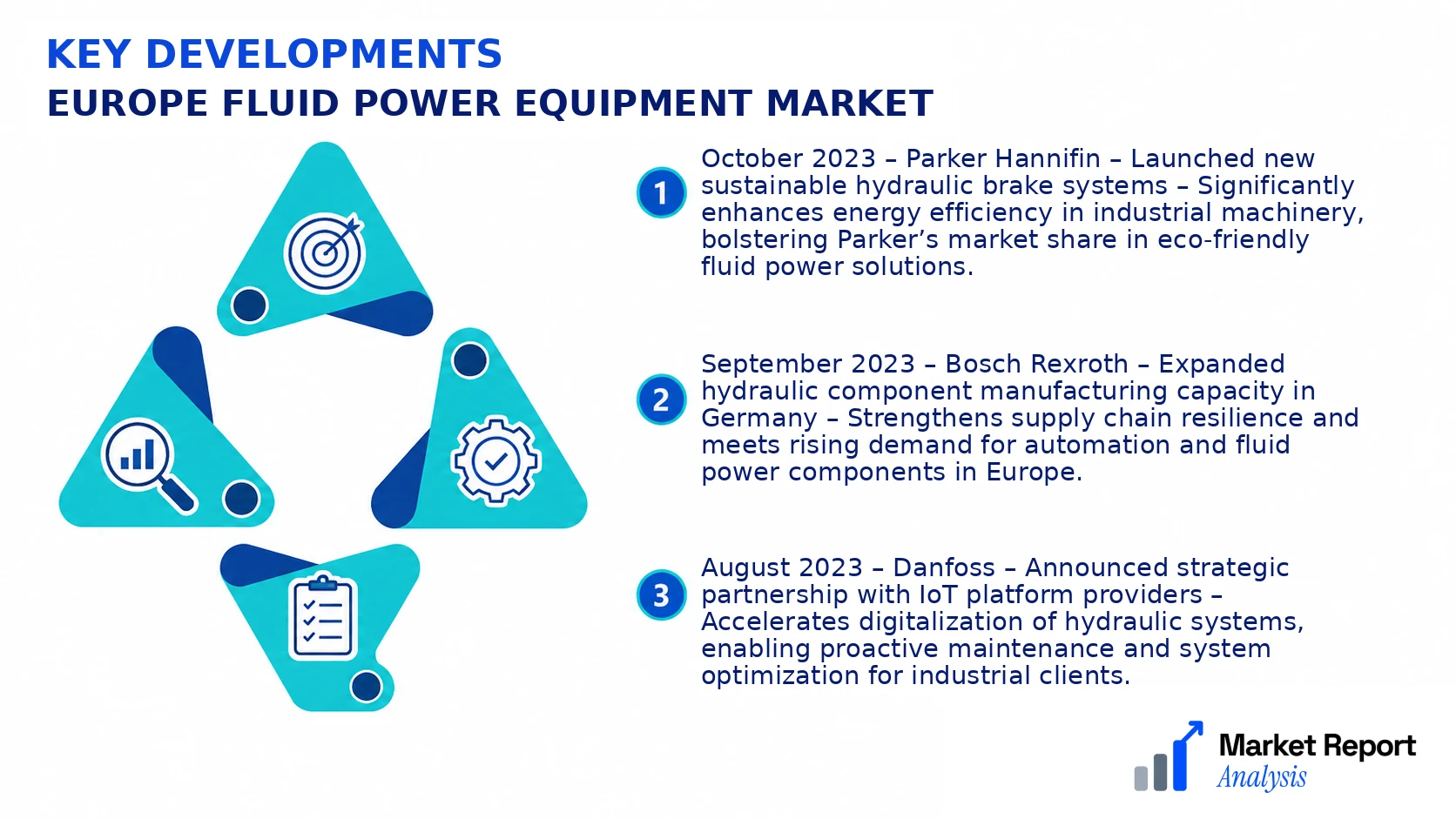
- October 2023 – Parker Hannifin – Launched new sustainable hydraulic brake systems – Significantly enhances energy efficiency in industrial machinery, bolstering Parker’s market share in eco-friendly fluid power solutions.
- September 2023 – Bosch Rexroth – Expanded hydraulic component manufacturing capacity in Germany – Strengthens supply chain resilience and meets rising demand for automation and fluid power components in Europe.
- August 2023 – Danfoss – Announced strategic partnership with IoT platform providers – Accelerates digitalization of hydraulic systems, enabling proactive maintenance and system optimization for industrial clients.
- July 2023 – Eaton – Acquired a leading manufacturer of hydraulic control valves – Broadens Eaton’s product portfolio and enhances technological capabilities in high-performance fluid control solutions.
- June 2023 – Festo – Launched AI-enabled pneumatic control systems – Promotes industry 4.0 integration, improving system responsiveness and energy efficiency across manufacturing sectors.
Frequently Asked Questions
What is the Europe Fluid Power Equipment Market?
The Europe Fluid Power Equipment Market encompasses the production, distribution, and consumption of fluid power systems and components such as hydraulic and pneumatic equipment used across various industries including manufacturing, construction, and agriculture within Europe. This market supports automation and machinery operations.
What is the current market size of Europe Fluid Power Equipment Market?
As of 2026, the market value of Europe Fluid Power Equipment is estimated at approximately USD 8.5 Billion, reflecting steady growth driven by increased industrial automation and infrastructure projects across European countries.
What factors are driving the Europe Fluid Power Equipment Market?
Key drivers include technological advancements in fluid power systems, increased demand for energy-efficient machinery, and expansion of manufacturing and construction activities. Regulatory standards for sustainability are also propelling innovations in environmentally friendly fluid power solutions.
Which region dominates the Europe Fluid Power Equipment Market?
Western Europe remains the dominant region owing to its advanced manufacturing sector, high adoption rates of automation solutions, and significant investments in industrial infrastructure. Countries like Germany, France, and the UK lead in market growth and innovation.
Which segment is expected to grow the fastest?
The hydraulic segment is projected to dominate and grow at the highest CAGR due to its widespread use in heavy machinery and manufacturing equipment. Pneumatic systems are also expanding rapidly due to their simplicity and cost-effectiveness.
Who are the leading companies operating in the Europe Fluid Power Equipment Market?
Major players include Parker Hannifin, Bosch Rexroth, Eaton, and Danfoss. These companies lead through technological innovation, strategic partnerships, and extensive distribution networks across Europe as they address evolving industrial requirements.
Analyst Perspective
The Europe Fluid Power Equipment Market is poised for sustained growth driven by ongoing industrial automation, renewable energy integration, and infrastructure modernization. Long-term prospects remain favorable, particularly as emerging technologies such as electro-hydraulic systems and intelligent control solutions gain traction, optimizing efficiency and reducing energy consumption. Commercial opportunities are concentrated in the hydraulics and pneumatics segments, with automation and robotics applications expanding steadily across manufacturing, automotive, and aerospace sectors. Investment priorities should focus on developing advanced, energy-efficient components and expanding regional manufacturing capacities to meet increasing demand. Competitive intensity remains high, with established players and innovative startups vying for market share through product differentiation and strategic collaborations. Regional growth potential varies; Western Europe will lead with mature industrial bases, while Eastern Europe offers emerging opportunities driven by infrastructure upgrades and industrial development. Strategic long-term positioning will require balancing innovation adoption with cost leadership to capitalize on shifting regional demand dynamics.
