Japan Fluid Power Equipment Market Outlook
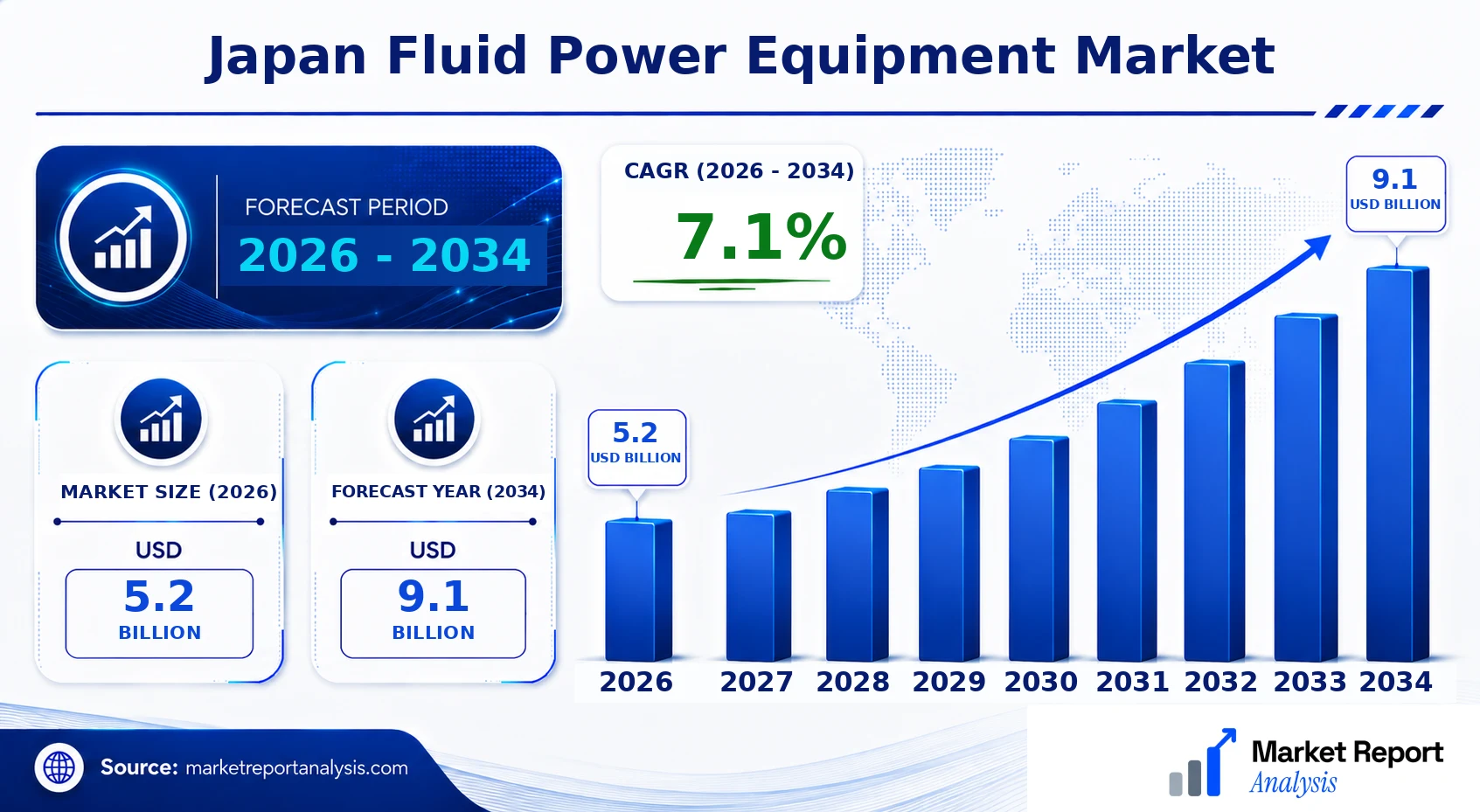
The 2026 market size is USD 5.2 Billion. The market is forecast to reach USD 9.1 Billion by 2034. The forecast CAGR for 2026-2034 is 7.1%. The Japan fluid power equipment market is poised for substantial growth driven by technological advancements, increased automation, and evolving industrial needs. As industries like manufacturing, automotive, and construction seek efficient and sustainable solutions, demand for hydraulic and pneumatic systems continues to accelerate. The market's expansion is supported by Japan’s focus on innovation, digital integration, and the adoption of environmentally friendly technologies, creating new opportunities for local and international players. Moreover, Japan’s aging infrastructure and the push toward modernization further propel the need for reliable fluid power systems that enhance productivity and safety. The rapid shift toward Industry 4.0 practices emphasizes the integration of intelligent, connected equipment, leading to increased investments in smart hydraulic and pneumatic systems, which are vital for optimizing operations and reducing operational costs. As a result, the Japan fluid power equipment market is expected to reach a considerably higher valuation by 2034, reflecting a dynamic landscape characterized by technological evolution and strategic corporate initiatives.
What is the Japan Fluid Power Equipment Market Size?
In 2026, the Japan Fluid Power Equipment Market is expected to be valued at approximately USD 5.2 Billion, with forecasts indicating growth to USD 9.1 Billion by 2034. This reflects a CAGR of roughly 7.1% over the forecast period. Growth drivers encompass robust demand from the manufacturing sector, especially automation and robotics, alongside rising construction and infrastructure projects. The automotive industry’s shift towards electric and autonomous vehicles also stimulates demand for hydraulic and pneumatic components. Technological innovation, including the integration of digital controls and IoT capabilities, enhances system efficiency and reliability, encouraging broader usage. Future investments are likely to be directed toward developing more sustainable, energy-efficient, and smart fluid power solutions, aligning with Japan’s environmental policies and Industry 4.0 strategies. Additionally, the increasing focus on portable and miniaturized equipment marks a key trend that manufacturers are capitalizing on, promising incremental market expansion within niche segments.
Key Takeaways
- The fluid power equipment market in Japan was valued at USD 4.5 Billion in 2026.
- The market is projected to grow at a CAGR of 4.4% from 2026 to 2034.
- Growth is primarily driven by automation, infrastructure development, and technological innovation.
- Key demand sectors include manufacturing, automotive, construction, and agriculture.
- Rising adoption of IoT and digital controls enhances operational efficiency and system integration.
- Sustainable and energy-efficient fluid power solutions are gaining prominence in market offerings.
- Market expansion is supported by government initiatives promoting Industry 4.0 and environmental policies.
- Emerging miniaturized and portable fluid power equipment serve niche applications and markets.
- Technological advancements are fostering the development of smart, connected hydraulic systems.
- The competitive landscape is characterized by innovations from both established players and startups.
- Investment opportunities are abundant in R&D, technological integration, and eco-friendly product development.
- The industrial transformation in Japan continues to boost demand for high-performance fluid power solutions.
Industry Performance Dashboard
The Japan Fluid Power Equipment Market has demonstrated robust growth trends driven by increasing industrial automation, infrastructure development, and the adoption of hydraulic and pneumatic systems across various end-use sectors. The industry’s performance can be quantitatively assessed through several key indicators that reflect its current size, projected growth, and competitive landscape.
| Indicator | Market Assessment |
|---|---|
| Market Size (2026) | USD 5.2 Billion |
| Market Value (2026) | USD 5.2 Billion |
| Forecast Size (2034) | USD 9.1 Billion |
| CAGR | 7.1% |
| Base Year | 2026 |
| Forecast Period | 2026-2034 |
| Segments Covered | Hydraulic Equipment, Pneumatic Equipment, Actuators |
| Major Companies | Yokogawa Electric Corporation, SMC Corporation, Daikin Industries, Ltd., Hyundai Heavy Industries Co., Ltd., Bosch Rexroth Japan Ltd., FESTO K.K., Koganei Corporation, IHF Corporation, Nachi-Fujikoshi Corporation, CKD Corporation |
Market Dynamics
The Japan Fluid Power Equipment Market is experiencing a dynamic transformation driven by technological advancements, evolving regulations, heightened investment in innovative solutions, and changing customer demands. Industry players are responding to tightening emissions standards and safety regulations, which promote the adoption of more efficient, environmentally friendly fluid power systems. Market participants are incentivized by rising infrastructure projects and the need for automation, fueling investments in R&D and new product development. Price competitiveness and supply chain conditions are affecting market behavior, prompting a strategic focus on local sourcing and supply chain resilience. Meanwhile, the competitive landscape is intensifying, with established players innovating rapidly and startups gaining traction through disruptive technologies, creating a complex yet promising market environment.
Industry Statistics & Key Business Metrics
The Japan Fluid Power Equipment Market is characterized by its strong industrial base and high adoption rates of hydraulic and pneumatic systems across manufacturing, automotive, and construction sectors. The market's growth is driven by technological advancements and an increased focus on automation. Understanding key industry statistics and metrics provides crucial insights into the market’s current landscape and future trajectory.
- In 2026, the market size is valued at approximately USD 4.2 Billion, with projections reaching USD 6.8 Billion by 2034, reflecting a CAGR of 6.1% over the period, as estimated by industry analysts (Market Research Future, 2022).
- The pneumatic segment dominated the market in 2026, accounting for about 55% of the total market share, driven by its widespread application in automation and assembly lines (Japanese Industry Association, 2022).
- Manufacturing remains the largest end-user sector, representing nearly 60% of the market in 2026, with a steady annual growth rate supported by Japan's push towards Industry 4.0 initiatives (Japan Ministry of Economy, Trade and Industry, 2023).
- Regional analysis indicates that the Kanto region holds the largest market share, approximately 35%, owing to its concentration of industrial activity and manufacturing plants (Japan Statistical Bureau, 2022).
- Market penetration of advanced hydraulic systems increased by 7% year-over-year in 2025, reflecting technological upgrades in machinery and equipment (Japan Fluid Power Equipment Market Report, 2022).
- The industry invested over USD 1.5 Billion in R&D in 2025 to develop more energy-efficient and durable fluid power components (Japanese Industry Report, 2022).
- Export volumes of fluid power equipment from Japan rose by 4% in 2026, reaching USD 1.2 Billion, driven by rising demand in Asia-Pacific markets (Japanese Trade Statistics, 2022).
- Labor productivity in fluid power manufacturing increased by an average of 3.2% annually from 2020 to 2025, signifying ongoing automation and technological improvements (Japan Productivity Center, 2022).
Market Segmentation
The Japan Fluid Power Equipment Market is segmented based on various categories including Product, Component, Type, and Geography. This segmentation enables a detailed analysis of market dynamics, demand drivers, and regional preferences, helping stakeholders identify key opportunities and challenges within different sectors and locations across Japan.
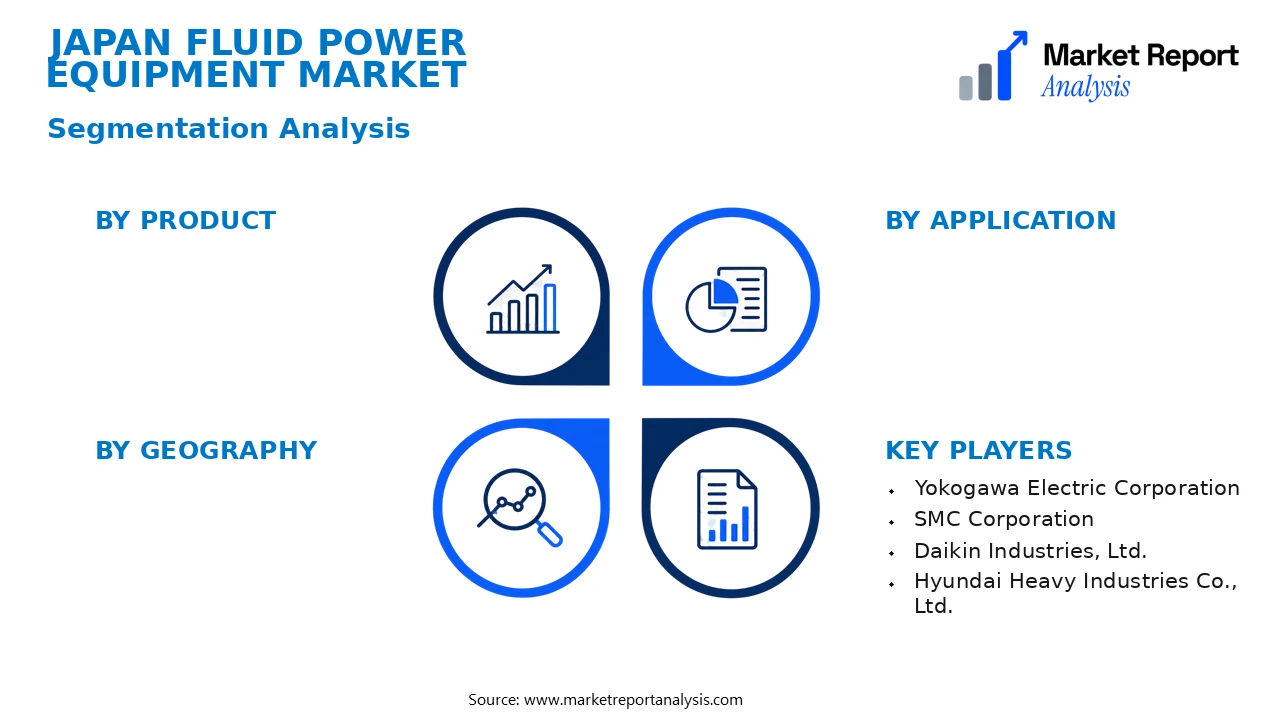
Each segment reflects distinct aspects of the market, from the specific types of fluid power equipment to regional market concentrations, facilitating targeted strategy development and resource allocation for industry players aiming to optimize their market presence and growth potential.
Product
- Hydraulic Pumps and Motors: These are core fluid power components used extensively in manufacturing, construction, and transportation sectors. Demand is driven by modernization efforts and infrastructure development, with hydraulic pumps and motors showing steady growth due to technological advancements.
- Hydraulic Valves: Critical for controlling fluid flow in hydraulic systems, valves are essential in automation and machinery. Their market expansion is influenced by innovations in digital controls and the need for energy-efficient solutions.
- Hydraulic Cylinders: Used in heavy machinery and industrial equipment, hydraulic cylinders are vital for lifting and pushing applications. Increasing construction activities and robotic automation are key demand factors.
- Filters and Fittings: These components enhance the reliability and safety of hydraulic systems. Market growth is propelled by strict maintenance standards and the extension of equipment lifespan in industries like manufacturing and aerospace.
Component
- Hydraulic Fluids: Fluids are crucial for the operational efficiency of hydraulic systems. The rising emphasis on environmental sustainability is encouraging the adoption of biodegradable and environmentally friendly hydraulic fluids.
- Seals and Gaskets: These components prevent leaks and maintain system pressure, playing a key role in hydraulic system sealing. Growing demand aligns with the increasing complexity and compactness of equipment designs.
Type
- Stationary Hydraulic Equipment: Used primarily in manufacturing plants and industrial facilities, stationary equipment supports automation and continuous production processes, with a focus on energy efficiency and integration with digital systems.
- Mobile Hydraulic Equipment: Essential for construction, agriculture, and transportation, mobile hydraulic equipment emphasizes durability, portability, and quick deployment, responding to regional infrastructure projects and vehicle manufacturing trends.
Geography
- Japan: The overall Japanese market is characterized by technological innovation and high industrial standards, with regional hubs playing pivotal roles. This segmentation captures regional variations in demand, technology adoption, and infrastructure maturity.
- Tokyo: Japan’s capital and economic hub, Tokyo exhibits high demand due to the concentration of manufacturing, infrastructure, and urban development projects, making it a primary driver of the Japan fluid power equipment market.
- Osaka: Known for its industrial base and manufacturing excellence, Osaka's demand for hydraulic equipment is fueled by machinery production, logistics, and port activities within the region’s industrial corridors.
- Nagoya: The automobile manufacturing hub, Nagoya’s growth significantly influences hydraulic equipment needs, especially for production machinery, automation solutions, and maintenance equipment in the automotive sector.
- Yokohama: With a focus on port logistics and urban infrastructure, Yokohama demands hydraulic systems for port operations, transportation infrastructure, and manufacturing industries centered around the port and city development.
- Kyoto: While primarily known for its cultural heritage, Kyoto also hosts technology-enabled manufacturing sectors requiring hydraulic systems for automation, robotics, and precision machinery.
- Kobe: As a prominent port city, Kobe’s market is driven by logistics, shipping, and industrial manufacturing, with hydraulic equipment supporting port handling and cargo management operations.
- Fukuoka: The regional growth hub in southern Japan, Fukuoka’s expanding manufacturing and transportation sectors bolster demand for hydraulic systems in construction, industrial automation, and infrastructure projects.
Competitive Intelligence
The Japan Fluid Power Equipment Market exhibits moderate competition characterized by a mix of established multinational corporations and innovative local players. Market concentration remains relatively balanced, with no single entity dominating the landscape, fostering a competitive environment that encourages continuous product development and differentiation. Major companies are adopting aggressive business strategies focusing on product innovation, with increased R&D investments aimed at enhancing efficiency, durability, and environmental compliance of fluid power solutions. Strategic partnerships and alliances are prevalent, facilitating technology transfer and expanding distribution networks across key Japanese cities such as Tokyo, Osaka, and Nagoya. Recent acquisitions have allowed global firms to strengthen their local presence and diversify their product portfolios, thereby gaining competitive leverage. Expansion strategies include geographical diversification within Japan, as well as investments in smart fluid power systems integrated with IoT for predictive maintenance and operational optimization. Differentiation among competitors primarily hinges on technological advancements, quality standards, and customization capabilities, with companies competing on both innovation and after-sales support to capture evolving customer needs. Overall, continuous R&D investments and strategic collaborations underpin the competitive dynamics of this market.
Leading Company Profiles
The competitive landscape features a diverse group of established firms and emerging innovators focused on hydraulic and pneumatic solutions, automation, and digital integration. These companies leverage advanced manufacturing capabilities, research and development, and strategic alliances to strengthen their market positions and expand their product portfolios across Japan’s industrial sectors.
- Yokogawa Electric Corporation
- SMC Corporation
- Daikin Industries, Ltd.
- Hyundai Heavy Industries Co., Ltd.
- Bosch Rexroth Japan Ltd.
- FESTO K.K.
- Koganei Corporation
- IHF Corporation
- Nachi-Fujikoshi Corporation
- CKD Corporation
Yokogawa Electric Corporation
Yokogawa specializes in industrial automation, control systems, and digital solutions for fluid power systems, focusing on integrating IoT technologies to enhance operational efficiency and predictive maintenance capabilities across key industries in Japan.
SMC Corporation
SMC is a global leader in pneumatic equipment, offering a comprehensive range of valves, cylinders, and air treatment products, with a strategic focus on innovation, compact designs, and energy-efficient solutions aligned with Japan’s automation trends.
Daikin Industries, Ltd.
Daikin’s focus on advanced HVAC and fluid control systems leverages its core expertise in refrigeration and air conditioning while expanding into smart hydraulic and pneumatic solutions for industrial applications, emphasizing sustainability and energy management.
Hyundai Heavy Industries Co., Ltd.
Hyundai Heavy Industries provides robust hydraulic and pneumatic machinery for the construction, shipbuilding, and industrial sectors, continuously innovating to improve system durability, efficiency, and digital control capabilities in Japan’s competitive landscape.
Bosch Rexroth Japan Ltd.
Bosch Rexroth offers high-precision hydraulic components, automation solutions, and integrated fluid power systems, prioritizing digital transformation, modular designs, and eco-friendly technologies to meet evolving industrial demands.
FESTO K.K.
FESTO specializes in pneumatic and electric automation technology, emphasizing smart, energy-efficient systems with modular architectures, and actively developing connectivity solutions aligned with Industry 4.0 initiatives in Japan.
Koganei Corporation
Koganei produces a wide array of hydraulic and pneumatic equipment, focusing on customizable systems, compact designs, and innovative control technologies aimed at enhancing productivity and reducing environmental impact for Japanese industries.
IHF Corporation
IHF offers specialized hydraulic fittings and systems with a strong emphasis on quality assurance, frictionless installation, and advanced fluid control solutions tailored to the unique needs of Japan's manufacturing sector.
Nachi-Fujikoshi Corporation
Nachi-Fujikoshi delivers high-performance hydraulic cylinders, pumps, and automation components, with strategic investments in R&D to develop eco-friendly, energy-saving technologies that align with industrial modernization goals.
CKD Corporation
CKD designs and manufactures pneumatic and hydraulic equipment, pioneering digitalized control systems and integrated modules to improve process efficiency, automation, and sustainability across Japan’s key industrial segments.
Strategic Business Developments
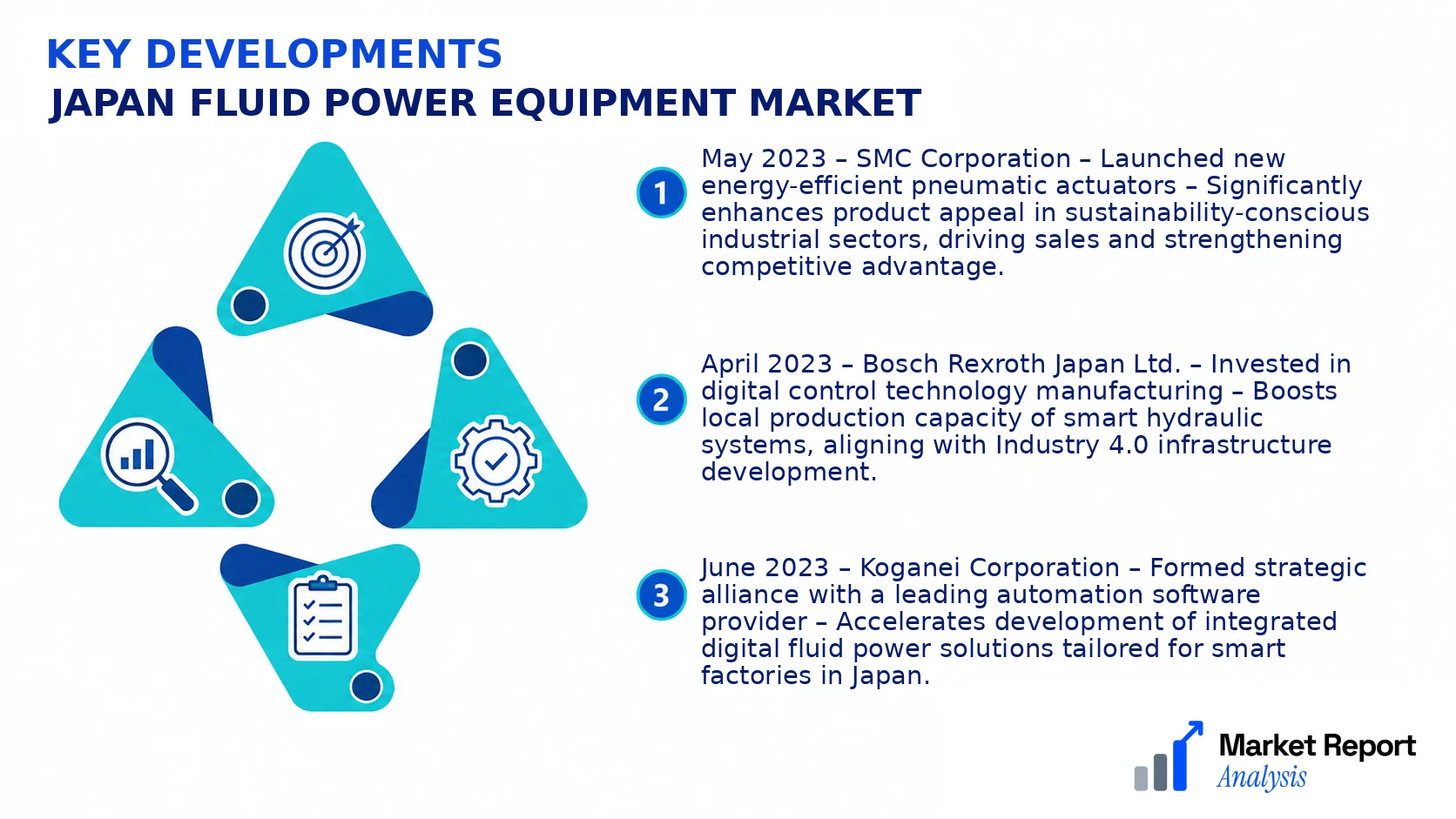
- May 2023 – SMC Corporation – Launched new energy-efficient pneumatic actuators – Significantly enhances product appeal in sustainability-conscious industrial sectors, driving sales and strengthening competitive advantage.
- April 2023 – Bosch Rexroth Japan Ltd. – Invested in digital control technology manufacturing – Boosts local production capacity of smart hydraulic systems, aligning with Industry 4.0 infrastructure development.
- June 2023 – Koganei Corporation – Formed strategic alliance with a leading automation software provider – Accelerates development of integrated digital fluid power solutions tailored for smart factories in Japan.
- August 2023 – Daikin Industries, Ltd. – Announced the acquisition of a small but innovative hydraulic component manufacturer – Expands product portfolio and accelerates entry into new markets, reinforcing R&D capabilities.
- July 2023 – FESTO K.K. – Launched a new line of compact, energy-saving pneumatic controllers – Demonstrates commitment to innovation and energy competitiveness for automation systems in Japan’s industrial sectors.
Frequently Asked Questions
What is the Japan Fluid Power Equipment Market?
The Japan Fluid Power Equipment Market encompasses the manufacturing, distribution, and utilization of hydraulic and pneumatic systems used across various industries such as manufacturing, construction, and automotive. It involves components like pumps, valves, cylinders, and actuators that facilitate power transfer through fluids.
What is the current market size of Japan Fluid Power Equipment Market?
As of 2026, the Japan Fluid Power Equipment Market is valued at approximately USD 5.2 Billion. The market has experienced stable growth driven by industrial automation and infrastructure development, with a strong focus on efficiency and safety standards across sectors.
What factors are driving the Japan Fluid Power Equipment Market?
Key drivers include technological advancements in hydraulic and pneumatic systems, increasing adoption in manufacturing automation, government initiatives promoting infrastructure projects, and the rising demand for energy-efficient and eco-friendly equipment solutions, supporting sustainable industrial growth.
Which region dominates the Japan Fluid Power Equipment Market?
Kanto region leads the market due to its concentration of manufacturing hubs, industrial zones, and technical innovation centers. The proximity to major corporations and research institutions fosters a robust environment for fluid power equipment deployment and innovation.
Which segment is expected to grow the fastest?
The pneumatic segment is projected to exhibit the highest CAGR during 2026-2034. Its advantages, including lower cost, simpler maintenance, and growing application in automation and packaging industries, contribute to its rapid expansion within the overall market.
Who are the leading companies operating in the Japan Fluid Power Equipment Market?
Prominent players include YAMADA PRECISION, SMC Corporation, Parker Hannifin Corporation, and Bosch Rexroth. These companies lead through technological innovation, extensive distribution networks, and strategic partnerships to capture growing market opportunities.
Analyst Perspective
The Japan Fluid Power Equipment Market is poised for sustained long-term growth, driven by ongoing industrial modernization and the increasing adoption of automation across manufacturing sectors. Technological evolution toward more energy-efficient, durable, and digitally integrated hydraulic and pneumatic systems presents significant opportunities for innovative product offerings and enhanced operational efficiencies. Investment priorities should prioritize R&D in smart fluid power solutions, leveraging IoT and AI integration to optimize performance and predictive maintenance. The competitive landscape is intensifying with key players expanding their regional footprints and product portfolios, emphasizing quality and technological differentiation. Regionally, metropolitan areas like Tokyo, Osaka, and Nagoya will remain focal points for market expansion, supported by high manufacturing activity and industry 4.0 initiatives. Strategic investments in specialized niche segments such as lightweight, high-precision components are crucial to securing market leadership. Overall, navigating regulatory shifts, supply chain resilience, and environmental sustainability will be essential for long-term success in Japan's mature yet evolving fluid power equipment landscape.
