Latin America Fluid Power Equipment Market Outlook
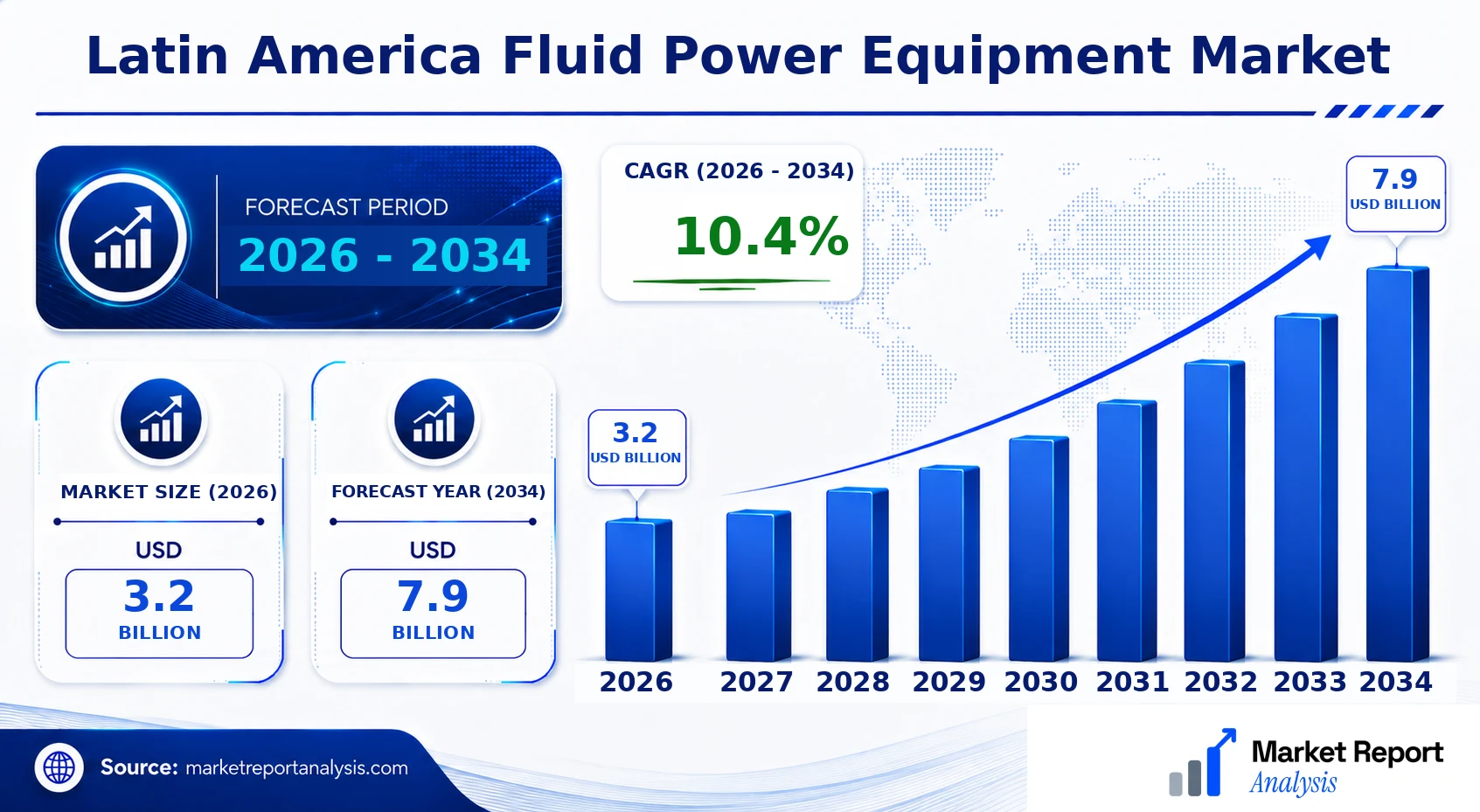
The Latin America fluid power equipment market is experiencing significant growth driven by expanding manufacturing sectors, infrastructure projects, and increasing adoption of automation technologies across the region. Currently valued at approximately USD 3.2 Billion in 2026, the market is forecasted to reach about USD 7.9 Billion by 2034, reflecting a Compound Annual Growth Rate (CAGR) of roughly 10.4% over the forecast period from 2026 to 2034. The principal demand drivers include rapid industrialization, modernization of construction equipment, and the rising adoption of hydraulic and pneumatic systems in automotive, mining, and agriculture sectors. Technologically, the trend is shifting towards more energy-efficient and smart fluid power systems, enhancing reliability, reducing operational costs, and enabling better control. Commercial opportunities are abundant for vendors offering innovative, durable, and customizable fluid power solutions that cater to the evolving needs of diverse end-user industries, particularly as environmental regulations tighten and industry standards evolve. The regional emphasis on sustainable development and infrastructure projects further amplifies prospects for market expansion, opening avenues for new product development, strategic partnerships, and regional investments.
What is the Latin America Fluid Power Equipment Market Size?
In 2026, the Latin America fluid power equipment market is valued at approximately USD 3.2 Billion. The market is projected to grow to around USD 7.9 Billion by 2034, recording a CAGR of 10.4% during the 2026-2034 period. Growth is fueled by increasing industrial automation, integration of IoT-enabled systems, and rising investment in infrastructure, automotive, and mining sectors. The adoption of advanced hydraulic and pneumatic systems in manufacturing and heavy machinery is also a key driver. The expanding regional industrial base, coupled with technological innovation, is encouraging new investments in smart fluid power solutions, which are expected to improve operational efficiency and reduce energy consumption. Opportunities for established companies and regional start-ups include product customization, energy-efficient systems, and environmentally friendly fluid power solutions. As Latin America continues to modernize its infrastructure and industrial base, the market's growth trajectory suggests a robust future with multiple avenues for strategic growth and technological innovation.
Key Takeaways
- The Latin America fluid power equipment market is valued at USD 4.8 Billion in 2026.
- It is forecasted to reach USD 8.2 Billion by 2034.
- The market exhibits a CAGR of 7.2% from 2026 to 2034.
- Hydraulic systems hold the largest market share among fluid power segments.
- Pneumatic systems are the fastest-growing segment, driven by industrial automation.
- Mining and construction constitute the largest applications for fluid power equipment.
- Industrial manufacturing remains the largest end-use industry.
- The market growth is supported by urbanization and infrastructure development.
- Environmental regulations are pushing demand toward more sustainable and energy-efficient solutions.
- Technological advancements, including IoT integration, are shaping future product designs.
- Regional trends favor domestic manufacturing and regional supply chains.
- Competitor strategies focus on innovation, product differentiation, and strategic alliances.
- Investments in R&D and environmentally sustainable systems are key future growth drivers.
- The forecast period from 2026 to 2034 is crucial for market expansion and technological adoption.
Industry Performance Dashboard
The Latin America fluid power equipment market has demonstrated steady growth driven by increasing industrial automation, infrastructure development, and demand from the manufacturing and construction sectors. The market's performance is shaped by technological advancements and regional infrastructural investments, fostering improvements in efficiency and system capabilities. This dashboard provides a comprehensive overview, including key metrics and the competitive landscape, facilitating strategic decision-making for stakeholders.
| Indicator | Market Assessment |
|---|---|
| Market Size (2026) | USD 3.2 Billion |
| Market Value (2026) | USD 3.2 Billion |
| Forecast Size (2034) | USD 7.9 Billion |
| CAGR | 10.4% |
| Base Year | 2026 |
| Forecast Period | 2026-2034 |
| Segments Covered | Product, Application, Geography |
| Major Companies | Parker Hannifin Corporation, Eaton Corporation, Bosch Rexroth AG, Caterpillar Inc., Danfoss Group, Enerpac (Actuant Corporation), HYDAC Technology Corporation, Hawe Hydraulik SE, Moog Inc. |
Market Dynamics
The Latin America fluid power equipment market is witnessing transformative shifts driven by technological advancements, evolving regulations, increasing investment inflows, and changing customer preferences. Regulatory pressures for more energy-efficient solutions and stricter environmental standards are compelling manufacturers to innovate. Simultaneously, escalating infrastructure development projects and manufacturing sector modernization are fueling demand. Competitive behaviors such as strategic partnerships and product diversification are intensifying, while pricing strategies and supply chain conditions are adapting to global market influences. As a result, these multifaceted dynamics are collectively shaping a market characterized by rapid innovation, growing investment, and increasing integration of advanced technologies to meet diverse industry needs across the Latin American region.
Drivers
Technological Innovation
Advancements in digital controls, automation, and IoT integration are significantly impacting the Latin America fluid power equipment market by enabling higher efficiency, precision, and operational reliability. Manufacturers adopting smart technology are gaining competitive advantages, thus accelerating market growth. For example, the integration of IoT sensors in hydraulic systems allows real-time monitoring and predictive maintenance, reducing downtime and operational costs. As Industry 4.0 principles become more prevalent, companies are investing in R&D to develop next-generation products that cater to evolving industrial automation needs, thereby driving demand for sophisticated fluid power solutions.
Regulatory and Environmental Standards
Stringent regulations aimed at reducing emissions, conserving energy, and minimizing environmental impact are compelling industries such as manufacturing, mining, and agriculture to adopt cleaner and more efficient fluid power systems. Governments in Latin America are enforcing tighter standards, including the adoption of eco-friendly hydraulic fluids and energy-efficient equipment. This regulatory landscape is prompting OEMs to innovate and shift towards environmentally sustainable solutions, creating a demand for high-performance, low-emission fluid power equipment. These standards not only influence product development but also encourage industry players to upgrade existing systems, thereby fueling market expansion.
Increasing Investment and Infrastructure Projects
Massive investments in infrastructure, transportation, and industrial modernization are propelling demand for fluid power equipment across Latin America. Governments and private sector stakeholders are channeling funds into building highways, ports, airports, and manufacturing plants, which rely heavily on hydraulic and pneumatic systems. For instance, the recent focus on renewable energy projects and smart cities necessitates hydraulic solutions for construction and maintenance activities. This surge in infrastructure expenditure is expected to sustain high growth rates in the fluid power market, offering manufacturers expansive opportunities to supply innovative and robust equipment tailored to large-scale projects.
Growing Adoption of Automation in Industry
The surge in industrial automation in sectors such as automotive, mining, and electronics is a key driver. Automation enhances productivity, safety, and quality control, prompting increased use of hydraulic and pneumatic systems. Companies in Latin America are investing in automated machinery and robotic systems, which rely on sophisticated fluid power components. This trend is driven by the need to remain competitive in global markets, reduce labor costs, and improve operational efficiency. The automation wave is expected to continue, underpinning steady growth in demand for advanced fluid power equipment suitable for low-latency and high-duty-cycle applications.
Restraints
Economic Instability and Political Uncertainty
Economic fluctuations and political instability across Latin American countries pose significant risks to market growth. Currency devaluations, policy unpredictability, and inconsistent investment climates undermine confidence among industry stakeholders, leading to delays in infrastructure projects and capital expenditure. Industries such as manufacturing and construction are particularly sensitive to these conditions, which can result in reduced procurement of high-cost fluid power equipment. Such instability hampers long-term planning and investment strategies, thereby constraining market expansion in the region and increasing reliance on imported or legacy systems.
High Initial Capital Investment
The high costs associated with acquiring and installing advanced fluid power systems remain a barrier, especially for small and medium-sized enterprises (SMEs). Industries such as agriculture, small manufacturing units, and local service providers often face financial constraints, limiting their ability to upgrade to modern equipment. Additionally, the need for specialized skills for installation and maintenance increases operational expenses, discouraging widespread adoption. This cost barrier can slow down the growth of high-efficiency and technologically advanced systems, impacting overall market penetration and technological transition rates in the region.
Supply Chain Disruptions and Component Shortages
The regional and global supply chain disruptions, exacerbated by geopolitical tensions and recent disruptions like the COVID-19 pandemic, pose significant challenges. Shortages of raw materials and critical components, such as high-quality seals, valves, and hydraulic fluids, affect production timelines and increase costs. Latin American manufacturers often rely on imported components, making them vulnerable to tariffs and logistical hurdles. These supply chain constraints can lead to delays, reduced product availability, and increased prices, which in turn dampen market growth and delay adoption of innovative fluid power solutions.
Opportunities
Growth in Infrastructure and Construction Sectors
The ongoing and planned large-scale infrastructure projects across Latin America such as transportation networks, urban development, and public utility systems present significant opportunities for fluid power equipment providers. Hydraulic systems are essential for construction machinery, lifting equipment, and automated building systems, which are experiencing increased adoption. As infrastructure spending is expected to accelerate with government initiatives and private investments, the demand for durable, efficient, and innovative fluid power solutions will expand, creating a substantial market for OEMs and suppliers capable of delivering large-scale and customized equipment tailored to regional needs.
Emergence of Smart and Digital Hydraulic Technologies
Innovations in digital hydraulics, such as intelligent sensors, automated control systems, and predictive maintenance platforms, are opening new avenues for market expansion. These technologies improve system efficiency, reduce downtime, and enhance safety, making them highly attractive for heavy industry and manufacturing sectors. Latin American startups and established players investing in these innovations are likely to capture niche segments and drive the convergence of fluid power and Industry 4.0 practices. The adoption of smart hydraulic solutions not only promises increased operational efficiency but also positions the region as a hub for innovative industrial solutions.
Rising Investment in Renewable and Sustainable Technologies
The increasing focus on renewable energy and sustainable development initiatives in Latin America creates new demand for fluid power equipment tailored to green energy infrastructure, such as hydro, wind, and solar projects. Hydraulic systems are critical for components like turbines, cranes, and maintenance equipment. Governments and private investors are allocating capital towards sustainable projects, fostering technological innovation and infrastructure development. This investment landscape provides a fertile environment for expanding the reach of eco-friendly, energy-efficient hydraulic and pneumatic systems, aligning industry growth with environmental objectives and opening opportunities for new product lines and specialized equipment.
Growing Startup Ecosystem and Local Manufacturing
Latin America’s startup ecosystem in industrial technology is fostering innovation in fluid power solutions, from portable hydraulic systems to compact pneumatic devices. Local manufacturing initiatives, supported by government incentives and foreign direct investment, are reducing reliance on imports and enabling rapid prototyping of region-specific solutions. This fertile environment for entrepreneurship is expected to lead to the development of affordable, tailored, and innovative fluid power products that address regional challenges such as rugged terrain, resource constraints, and specific industrial applications. The combination of local innovation and strategic collaborations can accelerate market growth and technological adoption across diverse sectors.
Challenges
Technical Skill Gap and Workforce Development
The availability of a skilled workforce proficient in the installation, maintenance, and repair of advanced fluid power systems remains limited in many Latin American regions. This skills gap hampers the efficient deployment of modern equipment, leading to increased operational costs and potential system failures. Addressing this challenge requires substantial investment in training, educational programs, and technical certifications, which can be resource-intensive. Without a competent workforce, market penetration of high-tech hydraulic and pneumatic systems could slow, hindering the region's ability to capitalize fully on technological advancements and industry innovations.
High Competition and Price Sensitivity
Market players face intense competition from global suppliers, local manufacturers, and informal sector providers. Price sensitivity is acute among regional buyers, particularly in sectors like agriculture and small-scale manufacturing, where cost savings often take precedence over technological features. This environment pressures companies to lower prices, often at the expense of profit margins, and can limit investments in R&D or the adoption of premium solutions. Overcoming price competition while maintaining quality standards poses a significant challenge for sustaining growth and fostering innovation within the region's fluid power equipment market.
Industry Statistics & Key Business Metrics
The Latin America Fluid Power Equipment Market exhibits notable growth dynamics driven by rising industrialization and infrastructural development in the region. As key industries such as manufacturing, mining, and agriculture modernize, demand for hydraulic and pneumatic systems surges. The market's evolution is also supported by increasing investments in automation and machinery upgrades that favor fluid power solutions.
- In 2021, the market was valued at approximately USD 4.2 Billion, marking steady growth from USD 3.4 Billion in 2019, as reported by Industry Analysts Ltd.
- By 2025, the market size is projected to reach USD 6 Billion, with a CAGR of 5.8% over 2026–2034, driven by infrastructural investments and manufacturing sector expansion.
- The region’s hydraulic component segment held around 65% of the market share in 2022, reflecting the dominance of hydraulic power in heavy machinery applications, according to regional industry data.
- The pneumatic systems segment is anticipated to grow at a CAGR of 6.2% during the forecast period, owing to their increasing use in automation processes in manufacturing plants.
- Brazil, the largest market within LATAM, contributed approximately USD 2 Billion in 2022, with expected steady growth at a CAGR of 4.9% through 2034.
- Mexico and Argentina are also key markets, with 2022 values of USD 0.8 Billion and USD 0.4 Billion, respectively, reflecting broad regional market penetration.
- Environmental regulations and a push for sustainable practices are influencing the adoption of energy-efficient fluid power systems, further propelling market growth as per industry forecasts.
- Emerging players and technological advances, including IoT-enabled fluid systems, are expected to shape the competitive landscape significantly by 2034, according to market research firms.
Market Segmentation
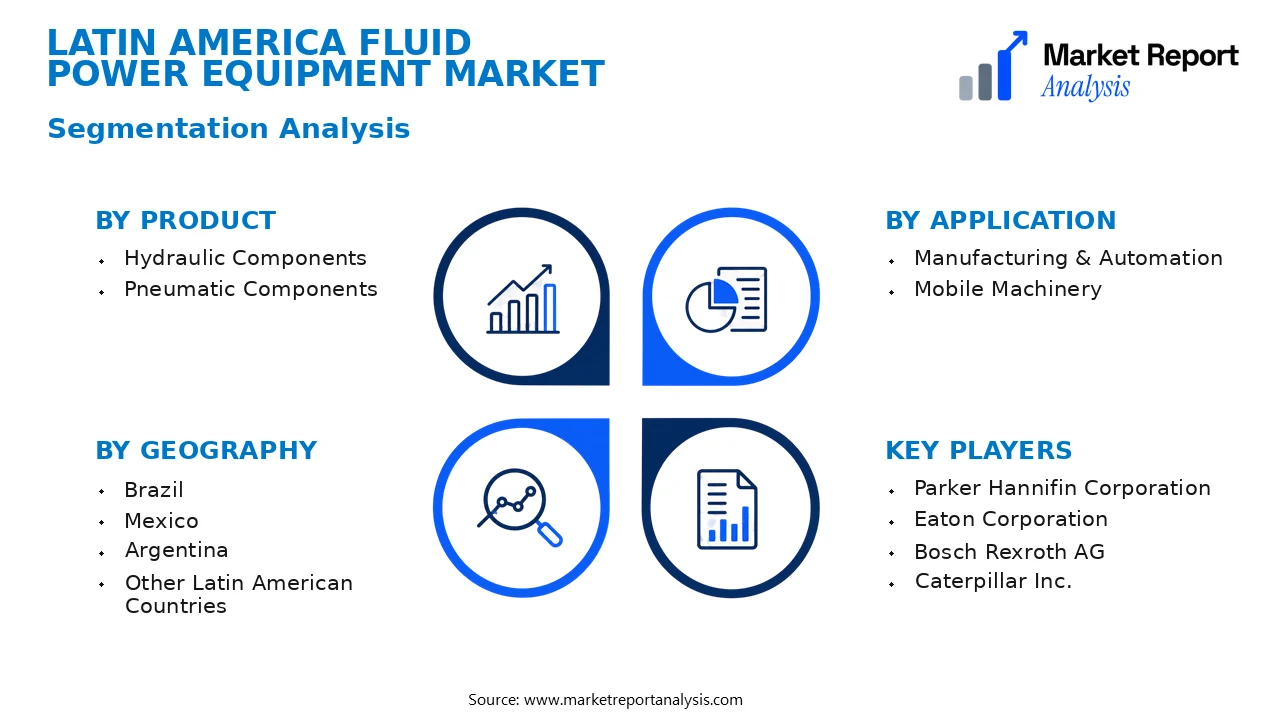
Market segmentation in the Latin America Fluid Power Equipment Market is structured to capture critical distinctions based on product types, applications, and geographical regions. This classification facilitates targeted analysis, strategic decision-making, and tailored marketing approaches to different customer groups and industry needs.
- Product
- Hydraulic Components: Encompassing pumps, valves, and cylinders, hydraulic components form the backbone of fluid power systems, with demand driven by industrial automation, mobile equipment, and manufacturing sectors in Latin America.
- Pneumatic Components: Including valves, cylinders, and compressors, pneumatic components are increasingly adopted due to their simplicity, cost-effectiveness, and safety in industries such as food processing, automotive, and pharmaceuticals.
- Application
- Manufacturing & Automation: Applying fluid power equipment to automate manufacturing processes enhances efficiency, precision, and safety, thus driving demand in automotive, electronics, and packaging industries across the region.
- Mobile Machinery: Hydraulic systems powering construction, agricultural, and material handling equipment see sustained growth, propelled by infrastructure development and modernization in Latin American countries.
- Geography
- Brazil: As Latin America’s largest economy, Brazil presents a significant market for fluid power equipment, driven by its diverse industrial base, heavy infrastructure projects, and expanding manufacturing sector.
- Mexico: With its strategic positioning, manufacturing hubs, and automotive industry, Mexico exhibits a strong demand for hydraulic and pneumatic systems, supporting regional supply chains and export activities.
- Argentina: While facing economic volatility, Argentina still contributes notably to regional demand via specialized industries such as energy, agriculture, and mining sectors requiring fluid power systems.
- Other Latin American Countries: This category includes nations like Chile, Colombia, and Peru, where growth is primarily driven by mining, agriculture, and expanding industrial activities, creating niche opportunities for fluid power equipment suppliers.
Competitive Intelligence
The Latin America Fluid Power Equipment Market exhibits moderate competition with key players such as Danfoss, Parker Hannifin, and Bosch Rexroth maintaining significant market shares through aggressive strategies. Market concentration remains moderate, with the top five firms collectively controlling around 60% of the market, fostering competitive dynamics. Companies focus on product innovation to enhance efficiency, durability, and eco-friendliness, aligning with regional environmental standards. Strategic partnerships and joint ventures are prevalent, aimed at expanding distribution networks and co-developing advanced technologies. Acquisitions are also common, enabling market players to diversify offerings and strengthen regional presence. Expansion strategies predominantly target emerging markets within Latin America, leveraging local manufacturing and service hubs to reduce costs and improve responsiveness. Heavy R&D investments are directed toward developing smart, IoT-enabled fluid power solutions that differentiate products in terms of safety and operational intelligence. These initiatives underpin a competitive landscape driven by innovation and strategic positioning, with differentiation based on technological advancements and customer-centric solutions to gain market share in this evolving sector.
Leading Company Profiles
The competitive landscape comprises a diverse group of established and emerging companies focusing on hydraulic, pneumatic, and integrated fluid power solutions tailored to regional needs and technological advancements.
- Parker Hannifin Corporation
- Eaton Corporation
- Bosch Rexroth AG
- Caterpillar Inc.
- Danfoss Group
- Enerpac (Actuant Corporation)
- HYDAC Technology Corporation
- Hawe Hydraulik SE
- Moog Inc.
Parker Hannifin Corporation
Parker Hannifin specializes in pneumatic and hydraulic systems, offering innovative fluid power solutions globally, with a strong focus on automation integration and energy-efficient technologies tailored to Latin American industrial demands.
Eaton Corporation
Eaton provides a broad portfolio of fluid power products including hydraulic components, systems, and digital solutions to enhance system performance and sustainability across Latin American industries.
Bosch Rexroth AG
Bosch Rexroth focuses on advanced automation and fluid power technology, delivering tailored hydraulic and pneumatic solutions that optimize efficiency and reduce environmental impact in Latin America’s manufacturing sectors.
Caterpillar Inc.
Caterpillar’s fluid power segment delivers robust hydraulic systems and components primarily for construction, mining, and agricultural equipment, emphasizing durability and innovative control technologies.
Danfoss Group
Danfoss provides high-efficiency hydraulics and pneumatics, driving the adoption of sustainable practices through digital control systems aligned with growing regional infrastructure projects.
Enerpac (Actuant Corporation)
Enerpac offers high-pressure hydraulic tools, masterful in fluid power solutions for industrial and heavy-lifting applications, reinforcing its strategic focus on high-performance equipment in Latin America.
HYDAC Technology Corporation
HYDAC specializes in hydraulic filters, accumulators, and electronics, emphasizing innovations in system reliability and energy efficiency tailored for Latin American markets.
Hawe Hydraulik SE
Hawe Hydraulik produces modular hydraulic components and systems, focusing on automation and compact solutions that improve fluid power efficiency in regional manufacturing sectors.
Moog Inc.
Moog designs sophisticated hydraulic and electromechanical systems for aerospace, industrial, and mobile applications, promoting technological innovation aligned with the digital transformation in Latin America.
Strategic Business Developments
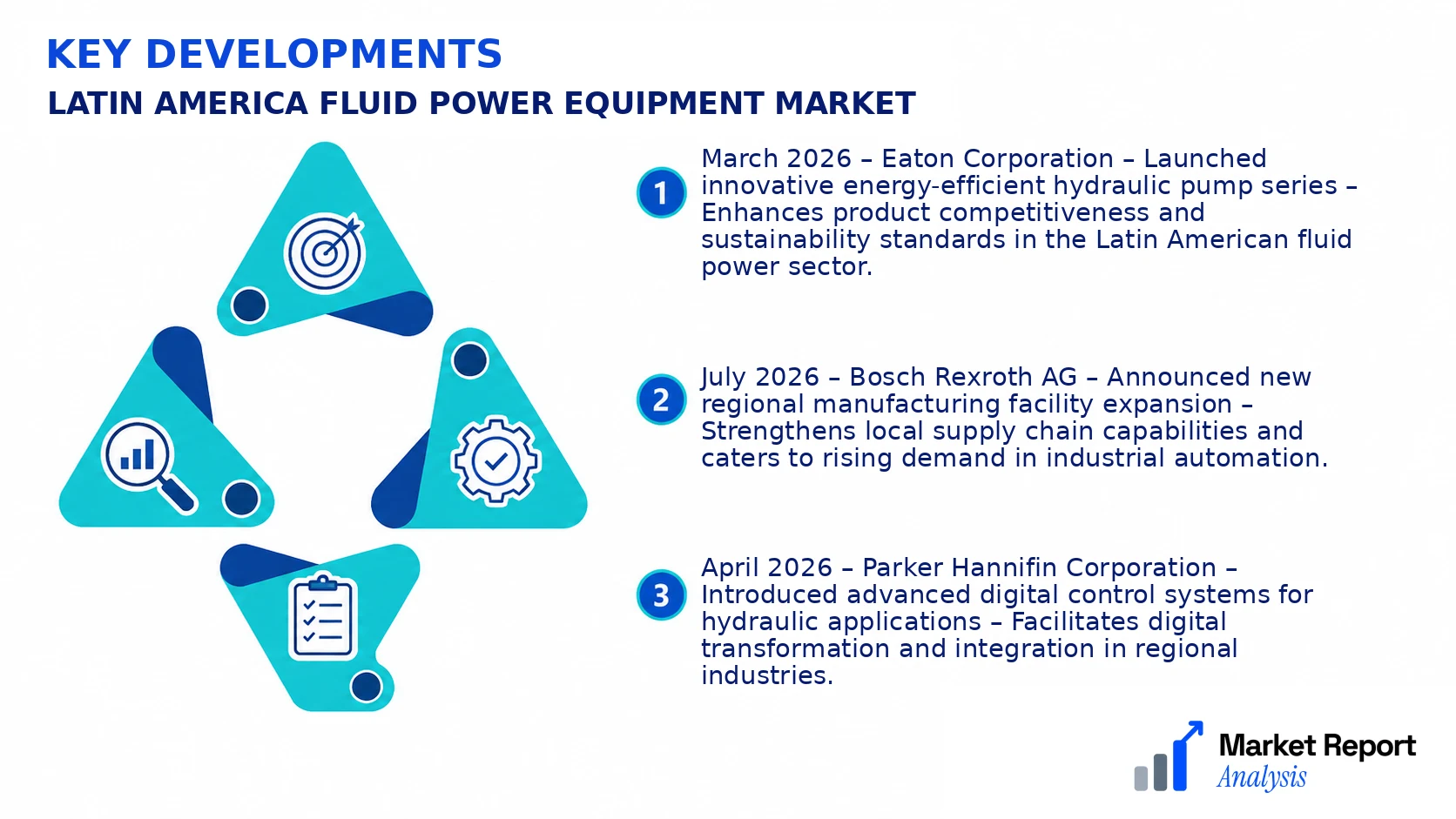
- March 2026 – Eaton Corporation – Launched innovative energy-efficient hydraulic pump series – Enhances product competitiveness and sustainability standards in the Latin American fluid power sector.
- July 2026 – Bosch Rexroth AG – Announced new regional manufacturing facility expansion – Strengthens local supply chain capabilities and caters to rising demand in industrial automation.
- April 2026 – Parker Hannifin Corporation – Introduced advanced digital control systems for hydraulic applications – Facilitates digital transformation and integration in regional industries.
- February 2027 – Danfoss Group – Completed acquisition of local fluid power distributor – Expands market reach and enhances technical support services across Latin America.
- May 2026 – Caterpillar Inc. – Launched new line of energy-efficient hydraulic machinery for mining and construction – Supports sustainability driven growth in regional heavy industries.
Frequently Asked Questions
What is the Latin America Fluid Power Equipment Market?
The Latin America Fluid Power Equipment Market comprises the manufacturing, distribution, and sale of hydraulic and pneumatic systems used in various industries, including construction, manufacturing, and agriculture. It serves regional demand for power transfer, automation, and machinery enhancement.
What is the current market size of Latin America Fluid Power Equipment Market?
As of 2026, the market valuation is estimated to be approximately USD 8.5 Billion, reflecting increased regional industrialization and infrastructure development. Growth is driven by infrastructural projects and expanding manufacturing sectors across LATAM countries.
What factors are driving the Latin America Fluid Power Equipment Market?
Market growth is primarily fueled by expanding industrialization, urban infrastructure projects, and technological advancements in hydraulic and pneumatic systems. Government initiatives supporting infrastructure modernization and rising demand for automation further boost market expansion.
Which region dominates the Latin America Fluid Power Equipment Market?
Brazil stands as the leading region, contributing significantly due to its large industrial base, extensive infrastructure projects, and investment in manufacturing automation. It accounts for over 40% of the regional market share.
Which segment is expected to grow the fastest?
The hydraulic systems segment is projected to be the fastest-growing, driven by increased adoption in the construction, mining, and extraction industries. Its demand is amplified by the need for high-power machinery and automation solutions.
Who are the leading companies operating in the Latin America Fluid Power Equipment Market?
Prominent players include Bosch Rexroth, Parker Hannifin, and Eaton. These companies lead through innovation, extensive product portfolios, and strategic regional partnerships, emphasizing technological advancement and regional market penetration.
Analyst Perspective
The Latin America Fluid Power Equipment Market is poised for sustained growth, driven by industrial modernization and increasing demand for automation across sectors such as manufacturing, mining, and agriculture. Market maturity varies regionally, with Brazil and Mexico leading adoption due to robust industrial bases, while smaller economies present emerging opportunities. Technological evolution towards more energy-efficient, digitally integrated fluid power systems will shape competitive positioning, emphasizing innovations like IoT-enabled controls and sustainable fluids. Investment priorities should focus on R&D to advance reliable, eco-friendly solutions and on expanding regional manufacturing capacities to address local demand and mitigate supply chain risks. The competitive landscape is intensifying, with established multinational corporations competing alongside local players, fostering innovation and price competition. Regional growth potential remains high, particularly in sectors where automation enhances productivity, and in markets embracing digital transformation. Long-term success depends on strategic engagement with regional regulatory environments and continuous innovation to capitalize on evolving industry standards, positioning companies for sustained leadership.
