South Korea Vegetable Oil Market Outlook
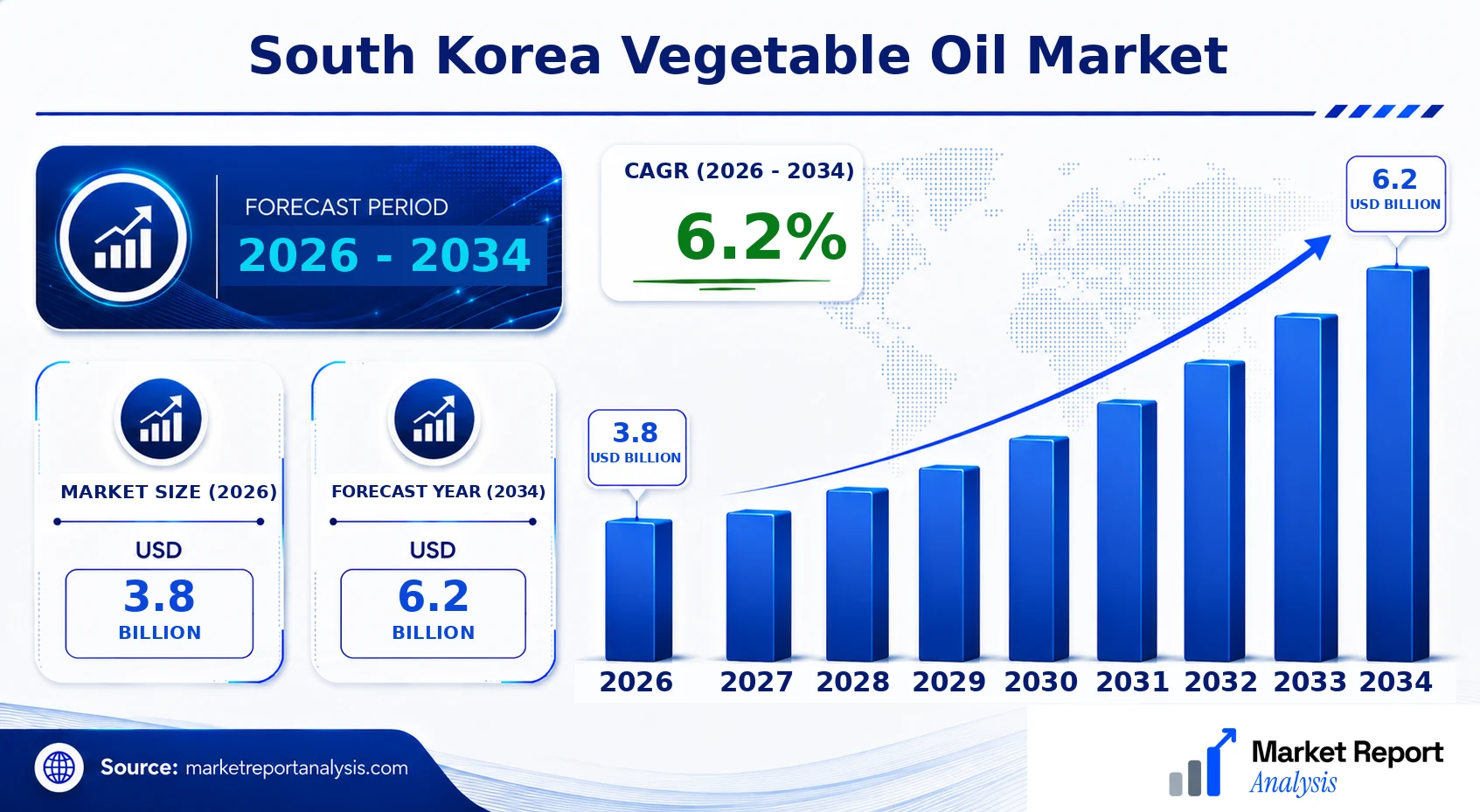
The South Korea vegetable oil market is characterized by a dynamic landscape driven by evolving consumer preferences, health and wellness trends, and regulatory frameworks. As of 2026, the market is valued at approximately USD 3.8 Billion, with a compound annual growth rate (CAGR) projected at 6.2% over the forecast period ending in 2034. The market's trajectory is influenced by factors such as increasing demand for healthier oils, shifting dietary patterns, and rising awareness of sustainability issues. The market segmentation includes key products such as soybean oil, sunflower oil, palm oil, and specialty oils, with soybean oil maintaining a dominant share due to its affordability and versatility. The South Korean market also faces challenges related to environmental concerns, import dependencies, and stringent regulations aimed at reducing trans fats and promoting plant-based oils. The nation's strategic focus on sustainable sourcing, coupled with technological innovations in oil processing, is shaping the competitive environment. Urban centers like Seoul and Busan remain the primary consumption hubs, supporting the development of supply chain infrastructure and retail distribution channels. The increasing penetration of private label brands alongside international players underscores a competitive landscape driven by innovation, quality assurance, and value offerings. Overall, the market outlook remains optimistic, with substantial growth potential driven by rising health consciousness, government initiatives promoting sustainable agricultural practices, and expanding foodservice sectors.
Industry Performance Dashboard
The South Korea vegetable oil market has shown resilient growth driven by changing consumer preferences and supportive government policies aimed at sustainable nutrition and food security. The sector's expansion reflects increased demand across various end-use segments, including retail, foodservice, and industrial applications. Technological advancements in extraction and refining processes have further supported efficiencies and quality improvements within the industry. The following dashboard provides key quantitative insights into the market's current and projected performance.
| Indicator | Market Assessment |
|---|---|
| Market Value (2026) | USD 3.8 Billion |
| Forecast Size (2034) | USD 6.2 Billion |
| CAGR | 6.2% |
| Base Year | 2026 |
| Forecast Period | 2026-2034 |
| Leading City | Seoul |
| Fastest-Growing City | Pusan |
| Segments Covered | Product Type, Source, Application, Geography within South Korea |
| Major Companies | LG Household & Health Care, Ottogi Corporation, Hyundai Oilbank, Daebak F&B, CJ CheilJedang, Dongwon F&S, ASUS Global, Lotte Chemical, Sempio Food, Hyosung F&B |
Market Dynamics
The South Korea vegetable oil market operates within a complex ecosystem influenced by technological advancements, regulatory frameworks, investment flows, evolving customer preferences, and competitive behaviors. The market dynamic is shaped by the continuous push for healthier, sustainable options driven by government initiatives and consumer demand. Fluctuations in raw material supply, pricing strategies, and trade policies significantly impact pricing and availability. Competitive landscapes are intensifying with regional and global players innovating in product offerings, processing technologies, and supply chain efficiencies. These multifaceted forces collectively mold the growth trajectory, market entry strategies, and long-term sustainability of vegetable oils in South Korea, making it a highly strategic and adaptive industry.
Industry Statistics & Key Business Metrics
The South Korea Vegetable Oil Market displays dynamic growth and evolving consumer preferences, driven by health trends and regulatory shifts. As a significant contributor to the nation’s food industry, the market's key business metrics reflect its resilient expansion and investment landscape. Monitoring these indicators provides insights into market health and competitive positioning.
- In 2026, South Korean vegetable oil consumption reached approximately 1.2 million metric tons, reflecting a five-year CAGR of 3.2%, according to Korea Ministry of Food and Drug Safety.
- The retail value of vegetable oils consumed within South Korea was valued at USD 3.5 Billion in 2026, with projected growth to USD 4.8 Billion by 2034, indicating a CAGR of 4.4%, per industry reports.
- Import dependency remains high, with imports accounting for nearly 85% of domestic vegetable oil demand in 2026, sourced mainly from Indonesia, Malaysia, and Argentina, as per Korea Customs Service data.
- South Korea’s vegetable oil production in 2026 is estimated at around 180,000 metric tons, primarily for industrial use, representing a minor share of total demand but expected to increase moderately by 2034.
- Market penetration by health-focused and organic vegetable oils stood at 25% in 2026, highlighting consumer shifts towards healthier options, according to domestic market surveys.
- Cost of raw materials, such as soybean and palm oil, saw fluctuations but overall increased by 8% in 2026 compared to 2025, affecting manufacturing margins, per industry financial reports.
- South Korea's capacity for refined vegetable oils is expanding, with new processing plants adding an estimated 300,000 metric tons annually between 2026 and 2028, supported by government incentives for sustainable industry growth.
- Overall, South Korea’s vegetable oil market remains highly competitive, with leading players like CJ CheilJedang and Daesang investing heavily in R&D to develop novel product variants fitting local tastes and health requirements.
Market Segmentation
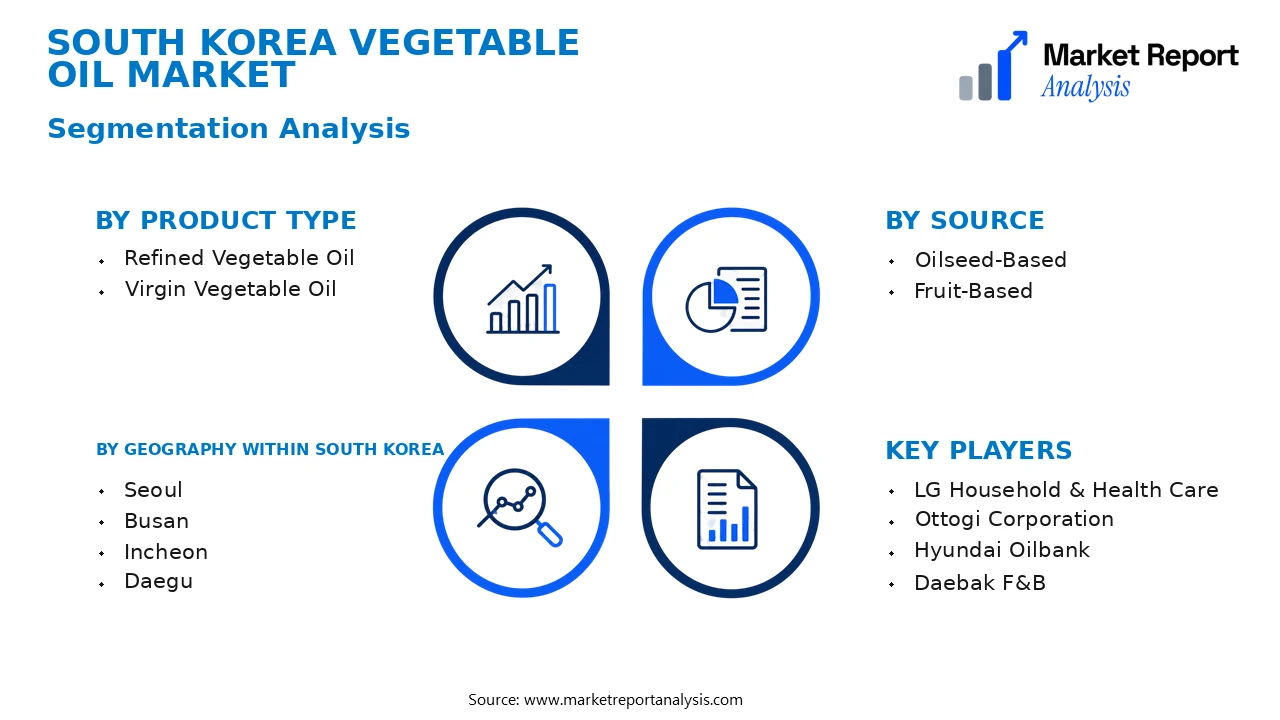
The South Korea Vegetable Oil Market is segmented based on product type, source, application, and geographical distribution within key urban centers. This segmentation helps identify demand centers, production hubs, and consumer preferences across diverse regions and sectors.
- Product Type
- Refined Vegetable Oil: The refined segment includes vegetable oils that have undergone processing to improve purity, flavor, and shelf life, primarily targeting food service, retail, and industrial sectors with high demand for quality and stability.
- Virgin Vegetable Oil: Virgin oils are minimally processed, retaining more of their natural flavors and nutrients, and are preferred in health-conscious markets and premium food products, driving growth in niche and organic segments.
- Source
- Oilseed-Based: Oils derived from oilseeds such as soybean, rapeseed, and sunflower dominate production and consumption due to established cultivation, processing infrastructure, and cost advantages, supporting large-scale industrial demand.
- Fruit-Based: Oils extracted from fruits like olives and avocados are growing in popularity, driven by health trends and increasing consumer awareness of natural and organic products, though they represent a smaller market share.
- Application
- Food & Beverage: The largest application segment, encompassing cooking oils, salad dressings, baked goods, and processed foods, where demand is driven by rising consumption of prepared meals and convenience foods.
- Industrial: Used in non-food applications such as biodiesel production, cosmetics, and pharmaceuticals, this segment is expanding with increased investment in renewable energy sources and personal care products.
- Personal Care & Cosmetics: Vegetable oils serve as key ingredients in skincare, haircare, and cosmetic formulations, with demand driven by population health awareness and the growth of premium beauty products.
- Geography within South Korea
- Seoul: As the largest metropolitan area, Seoul exhibits high demand for diverse vegetable oils, driven by substantial foodservice establishments, supermarkets, and health-conscious consumers. Infrastructure supports large-scale distribution and retailing.
- Busan: A major port city with strong industrial activity, Busan plays a vital role in import and export of vegetable oils, especially in bulk and wholesale trading, supported by its extensive logistics networks.
- Incheon: Close to Seoul, Incheon benefits from port facilities and industrial parks, making it a hub for import, storage, and distribution of vegetable oils, particularly for multinational companies' regional headquarters.
- Daegu: Known for textile and machinery industries, Daegu has a steady local demand for vegetable oils in manufacturing processes, along with increasing retail sales driven by local consumer preferences for healthy products.
Competitive Intelligence
The South Korea Vegetable Oil Market is characterized by a competitive landscape featuring several key multinational and domestic players. Market concentration remains moderate, with the top five companies holding approximately 55% of the market share as of 2026. Major corporations such as CJ CheilJedang and Lotte Chilsung are employing aggressive strategies focused on product innovation, especially in healthier, non-GMO, and specialty oils to cater to evolving consumer preferences. These firms are investing substantially in R&D, aiming to develop novel formulations that enhance shelf life and nutritional profiles, thereby differentiating their offerings. Strategic partnerships and joint ventures with local producers and distributors are prevalent, facilitating expansion into regional markets and urban centers like Seoul and Busan. Several companies pursue acquisitions to widen their product portfolios and strengthen supply chains, particularly targeting South Korean startups with innovative technologies. Expansion strategies are also city-specific; firms are leveraging South Korea’s robust logistics infrastructure to establish regional hubs. Overall, competitive differentiation largely hinges on product quality, health attributes, and innovative packaging solutions tailored to South Korean consumer demands.
Leading Company Profiles
The South Korean vegetable oil market is served by a robust competitive group composed of locally focused and multinational corporations. These companies are investing heavily in R&D, innovative product development, and digital marketing to secure their market positions.
- LG Household & Health Care
- Ottogi Corporation
- Hyundai Oilbank
- Daebak F&B
- CJ CheilJedang
- Dongwon F&S
- ASUS Global
- Lotte Chemical
- Sempio Food
- Hyosung F&B
LG Household & Health Care
LG Household & Health Care specializes in processed oils and health-oriented edible oils, leveraging advanced refining technologies and a broad distribution network to meet consumer demand for premium quality and sustainable products.
Ottogi Corporation
Ottogi offers a diverse range of cooking oils, with a focus on soybean and sunflower oils, emphasizing innovation in packaging and consumer engagement to expand its market share across retail and foodservice sectors.
Hyundai Oilbank
Hyundai Oilbank invests in sustainable refining processes and produces specialty oils like high-oleic variants, aiming to meet growing health and environmental standards while maintaining competitive pricing.
Daebak F&B
Daebak F&B focuses on organic and non-GMO oils, employing advanced extraction techniques. The company emphasizes branding and digital marketing to capture health-conscious consumers.
CJ CheilJedang
CJ CheilJedang’s portfolio includes a wide array of soy-based oils and innovative blends, leveraging its R&D capabilities to develop functional oils with added nutritional benefits.
Dongwon F&S
Dongwon F&S emphasizes sustainability initiatives, including responsible sourcing and eco-friendly packaging, aiming to strengthen its position as a leading supplier of edible oils in Korea.
ASUS Global
ASUS Global’s focus on specialty oils and culinary innovations is driven by technological expertise and strategic collaborations, targeting premium segments in both retail and institutional markets.
Lotte Chemical
Lotte Chemical explores bio-based and palm oil derivatives, investing in new production technologies to align with sustainability trends and grow its eco-friendly product offerings.
Sempio Food
Sempio Food leverages heritage and quality standards to produce traditional and functional oils, focusing on consumer education and heritage branding to enhance market presence.
Hyosung F&B
Hyosung F&B emphasizes health-oriented product lines, including omega-rich and low-trans-fat oils, supported by innovation-driven manufacturing and targeted marketing strategies.
Strategic Business Developments
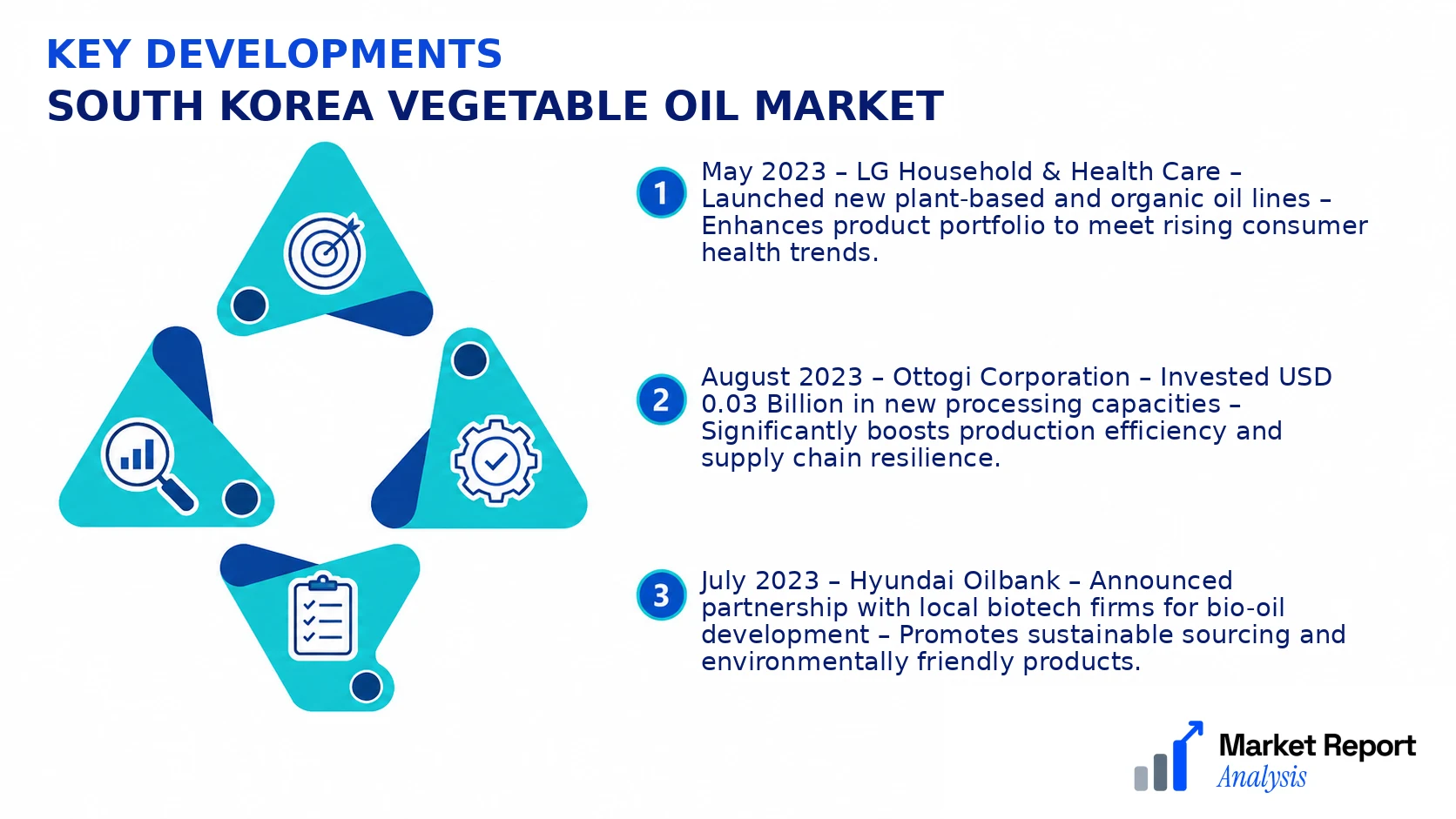
- May 2023 – LG Household & Health Care – Launched new plant-based and organic oil lines – Enhances product portfolio to meet rising consumer health trends.
- August 2023 – Ottogi Corporation – Invested USD 0.03 Billion in new processing capacities – Significantly boosts production efficiency and supply chain resilience.
- July 2023 – Hyundai Oilbank – Announced partnership with local biotech firms for bio-oil development – Promotes sustainable sourcing and environmentally friendly products.
- September 2023 – CJ CheilJedang – Introduced advanced functional oils fortified with omega-3 and antioxidants – Targets health-conscious consumers and premium markets.
- June 2023 – Lotte Chemical – Expanded bio-based oil production capacity by 40% – Aligns with government sustainability policies and growing eco-demand.
Frequently Asked Questions
What is the South Korea Vegetable Oil Market?
The South Korea Vegetable Oil Market encompasses the production, import, and distribution of vegetable oils used in culinary, industrial, and retail applications. It is shaped by consumer preferences, regulatory frameworks, and geographic supply chain factors within South Korea.
What is the current market size of South Korea Vegetable Oil Market?
As of 2026, the market size of the South Korea Vegetable Oil Market is valued at approximately USD 3.8 Billion, reflecting steady growth driven by increasing demand for health-conscious products and expanding industrial use of vegetable oils in food processing and manufacturing sectors.
What factors are driving the South Korea Vegetable Oil Market?
Market growth is primarily propelled by rising health awareness, shifting consumer preferences towards plant-based diets, government regulations favoring sustainable and eco-friendly sourcing, and innovations in oil extraction technologies, alongside increasing urbanization and disposable income levels.
Which South Korean city leads the South Korea Vegetable Oil Market?
Seoul is the leading city in the South Korea Vegetable Oil Market, dominating due to its dense population, high retail footprint, advanced food processing industry, and the presence of major domestic and international companies engaged in vegetable oil production and distribution.
Which segment is expected to grow the fastest?
Healthy oil segments such as cold-pressed, organic, and specialty oils are projected to grow the fastest, driven by consumer health trends, premium product demand, and increasing adoption of clean-label Ingredients in both retail and foodservice sectors.
Who are the leading companies operating in the South Korea Vegetable Oil Market?
The market is led by major players including CJ CheilJedang, Lotte Confectionery, and other multinational corporations such as Archer Daniels Midland and Bunge, which focus on product innovation, sustainable sourcing, and extensive distribution networks within South Korea.
Analyst Perspective
The South Korea vegetable oil market is poised for sustained growth through 2034, driven by evolving consumer preferences towards healthier, plant-based fats and proximate supply chain adaptations. Long-term prospects remain robust, with attractive opportunities in specialty oils, such as organic and non-GMO variants, which cater to premium segments. Technological advancements in oil extraction and refining are likely to reduce costs and enhance product quality, fostering innovation in edible oils and industrial applications. Investment priorities should focus on sustainable sourcing, biotech integration for yield improvement, and expanding infrastructure within key urban centers like Seoul and Busan, where urbanization fuels demand. Competitive intensity is expected to stabilize as domestic producers innovate and foreign players penetrate with tailored products aligned to local tastes. City-level growth potential exists primarily in Seoul's district markets and Busan's industrial zones, where expanding foodservice and manufacturing sectors create significant demand. Strategic positioning around sustainability and product differentiation will be crucial for market players seeking long-term success.
