Vegetable Oil Market Outlook
The vegetable oil market is shaped by a complex interplay of technological advancements, regulatory frameworks, investment patterns, consumer preferences, pricing strategies, supply chain dynamics, and competitive behaviors. Innovations in extraction and refining processes improve yield and quality, while regulations on tariffs, sustainability, and food safety influence trade flows and industry standards. Investment moves toward sustainable cultivation and processing facilities are rising, driven by environmental concerns and economic incentives. Customer demands for healthier and organic options are transforming product portfolios. Meanwhile, volatile prices and supply chain disruptions challenge stability, prompting strategic adjustments among producers and traders to maintain market share and profitability.
Drivers
Technological Advancements in Extraction and Processing
Continuous improvements in extraction technologies, such as cold pressing and enzymatic extraction, enhance oil yield efficiency and product purity, reducing costs and environmental impact for producers. Innovations in refining, including hydrogenation and deodorization, enable customization of oil properties to meet diverse applications ranging from culinary to industrial uses. For example, the adoption of solvent-free extraction methods aligns with sustainability trends and regulatory requirements, further accelerating industrial adoption. The proliferation of automation and smart manufacturing systems fosters higher productivity and quality assurance, contributing significantly to market growth and competitive advantage in a crowded landscape.
Growing Regulatory Focus on Sustainability and Food Safety
Stringent regulations concerning sustainable sourcing, deforestation, waste management, and food safety standards influence market operations globally. Governments and industry bodies enforce policies that compel companies to ensure transparent supply chains, traceability, and compliance with environmental norms, thereby impacting input sourcing and certification costs. For instance, the demand for RSPO-certified palm oil and organic certifications drives compliance costs but also opens access to premium markets. Regulatory pressures motivate industry innovation in eco-friendly cultivation practices and certification processes, fostering a shift toward more sustainable and compliant production models that shape overall market trajectories.
Investment in Sustainable Cultivation and Processing Infrastructure
Capital infusion into the vegetable oil sector, particularly into sustainable farming practices and modern processing facilities, is a key driver. Investments aim to enhance yield, reduce environmental footprint, and meet rising global demand. Major industry players and private equity firms are funding projects focused on cultivating oil crops like soybean, sunflower, and palm in ways that minimize land degradation and water use. Technological integration such as precision agriculture and biotech solutions support sustainable intensification. This investment landscape not only boosts production capacity but also advances the sector’s environmental credentials, underpinning future growth and attracting further funding from ESG-focused investors.
Consumer Shift Toward Healthier and Organic Food Products
Rising consumer awareness regarding health and wellness propels demand for organic, non-GMO, and minimally processed vegetable oils. Markets in North America and Europe are experiencing significant growth in organic oil consumption, driven by health-conscious demographics. This shift has prompted producers to innovate with new product lines, such as omega-rich oils and blends tailored for specific dietary needs. The trend is supported by data indicating a CAGR of approximately 6.2% in organic vegetable oil segments around 2026-2034. As consumers increasingly prioritize health, companies investing in certification, branding, and product development targeting these preferences are positioned for substantial growth.
Restraints
Volatility in Raw Material Prices
The vegetable oil market is highly susceptible to fluctuations in raw material prices, especially for crops like soy, palm, and sunflower. These fluctuations are driven by factors such as adverse weather conditions, geopolitical tensions, crop yields, and global demand shifts. Price volatility affects profit margins for producers and disrupts pricing strategies, sometimes leading to increased consumer prices or reduced margins. Countries heavily reliant on imported raw materials, such as nations in Southeast Asia and Africa, face heightened risks. Businesses need to adopt flexible sourcing strategies and hedging tactics to mitigate adverse impacts and maintain market stability.
Environmental Concerns and Sustainability Challenges
Environmental issues, including deforestation, loss of biodiversity, and water consumption, are major restraints impacting industry reputation and regulatory costs. Sustainable cultivation practices are costly and often require significant upfront investment and certification processes. Additionally, consumer backlash and NGO campaigns against illegal land clearing and unsustainable sourcing impose reputational risks. This challenge is particularly acute for palm oil producers, who face global scrutiny. Addressing these concerns necessitates industry-wide commitment to responsible sourcing, sustainable farming practices, and transparent supply chains, making compliance both a strategic imperative and a constraint, especially for smaller players with limited resources.
Limited Access to Cultivation Land in Key Regions
Scarcity of arable land suitable for oil crop cultivation in regions like Southeast Asia and South America constrains supply expansion. Urbanization, land degradation, and competing land uses reduce available acreage, posing risks to production capacity growth. Regulatory restrictions and land acquisition costs further limit cultivation expansion. For companies aiming to scale production, this creates a supply-side constraint requiring investment in alternative cultivation methods or crop varieties resilient to diverse environments. Overcoming land limitations is critical to meeting increasing demand, and failure to do so could hinder growth trajectories in key markets.
Opportunities
Growing Demand from Emerging Markets
Rapid urbanization, population growth, and rising income levels in countries such as India, Nigeria, and Indonesia create a surging demand for vegetable oils for cooking and processed foods. As these markets develop, consumer preferences shift toward healthier options, organic products, and branded oils, opening avenues for premium product offerings. The burgeoning middle class also stimulates retail expansion, increasing shelf space for diverse oils. Companies investing in product localization, marketing, and distribution networks tailored for these regions can capitalize on significant volume growth. Expanding production capacity and establishing local supply chains will be critical to capturing market share in these high-growth emerging economies.
Technological Innovation in Sustainable Agriculture
Emerging technologies such as precision agriculture, biotech crop varieties, and sustainable farming techniques offer the potential to increase yields, reduce environmental impact, and lower costs. Investments in these innovations can facilitate the scaling of sustainable cultivation, which is crucial given land constraints and environmental concerns. Startups and established players advancing genome editing, drone monitoring, and water-efficient irrigation are gaining traction. Governments and private investors are funding projects that leverage these technologies, promising a future where higher productivity aligns with sustainability goals. This synergy will open new avenues for market expansion, especially in regions vulnerable to climate change impacts.
Increasing Investment in Upstream and Downstream Capacity
Strategic investments across the value chain from cultivation and harvesting to refining and packaging are poised to transform market dynamics. Upstream investments focus on expanding agricultural land, seed innovation, and sustainable practices, while downstream capacities enhance branding, packaging, and distribution. The rise of vertical integration and partnerships enables companies to secure raw materials, control quality, and differentiate products. Furthermore, the development of niche segments such as specialty oils and functional oil products attracts investment, driven by consumer demand for health-enhancing attributes. These capital deployments deepen industry resilience and competitiveness, fostering a more dynamic and responsive market environment.
Growth in Plant-Based and Alternative Oil Technologies
The burgeoning plant-based food industry drives interest in novel vegetable oils and alternative extraction methods. Innovations such as algae-based oils, insect oils, and lab-grown fats present future growth opportunities with high sustainability credentials and unique functional properties. Startups and research institutions are actively exploring these alternative sources, with pilot projects already demonstrating commercial viability. The shift toward plant-based and alternative oils aligns with global sustainability goals and health trends, likely to attract substantial venture capital and public funding. As technology matures, these alternatives could significantly diversify the market and reduce reliance on traditional crop-based oils.
Expansion of Organic and Non-GMO Product Lines
Consumer preference for organic, non-GMO, and clean-label products continues to drive growth in these premium segments. Companies are investing in certification, transparent sourcing, and innovative product formulations to meet strict regulatory and consumer standards. The organic segment in vegetable oils is expected to outpace conventional oils, with a CAGR of around 6.2% through 2034. The development of supply chains dedicated to organic farming, coupled with advancements in seed technology, ensures consistent quality and supply. This expansion allows producers to access higher-margin markets, strengthen brand reputation, and meet the evolving landscape of health-conscious consumers.
Digitalization and Data Analytics for Market Optimization
The adoption of digital tools, data analytics, and blockchain technology enhances supply chain transparency, operational efficiency, and demand forecasting. Real-time data enables better decision-making regarding planting schedules, harvest timing, and inventory management, reducing wastage and increasing profitability. Blockchain enhances traceability from farm to fork, ensuring compliance and authenticity, crucial for premium and certified products. These technological integrations facilitate market differentiation and compliance with regulatory standards, offering competitive advantages. As digital adoption accelerates across the industry, market players that harness these tools will gain increased resilience and market insight, supporting sustained growth in a complex landscape.
Expansion into Functional and Specialty Oils
The increasing awareness of health benefits associated with specific lipids drives demand for functional oils rich in omega-3, antioxidants, and bioactive compounds. Innovation in processing and formulation enables the creation of specialty oils tailored to specific consumer needs, such as brain health, anti-inflammatory properties, or weight management. Market expansion is supported by strategic marketing and product positioning, with many startups entering the space. These niches offer higher margins and brand differentiation, encouraging further R&D investments. Growing consumer interest in personalized nutrition and functional foods presents ample opportunities for industry players to develop and market these high-value products at a global scale.
Challenges
Trade Disruptions and Geopolitical Tensions
Trade tensions, tariffs, and geopolitical conflicts significantly disrupt supply chains and international trade flows in the vegetable oil market. For example, trade disputes between key soy-producing countries and importing regions cause price volatility and supply uncertainty. Such disruptions can lead to increased costs, delays, and reduced market access, especially impacting countries heavily dependent on imports. Companies must develop resilient sourcing strategies, diversify supply sources, and foster local supply chains to mitigate risks. Navigating these geopolitical challenges requires adaptive trade policies and proactive market intelligence to sustain growth momentum amid uncertain global relations.
Environmental and Climate Change Impacts
Climate change poses a long-term challenge by affecting crop yields, breeding new pests and diseases, and altering growing seasons. Unpredictable weather patterns, droughts, and flooding threaten supply stability and elevate production costs. Market players need to invest in resilient crop varieties and sustainable farming practices to adapt. Additionally, there is a growing regulatory pressure to reduce the carbon footprint and greenhouse gas emissions associated with cultivation and processing. Addressing these environmental challenges involves adopting innovative farming techniques, investing in climate-resilient infrastructure, and aligning with global sustainability initiatives to ensure ongoing supply and market stability.
Industry Performance Dashboard
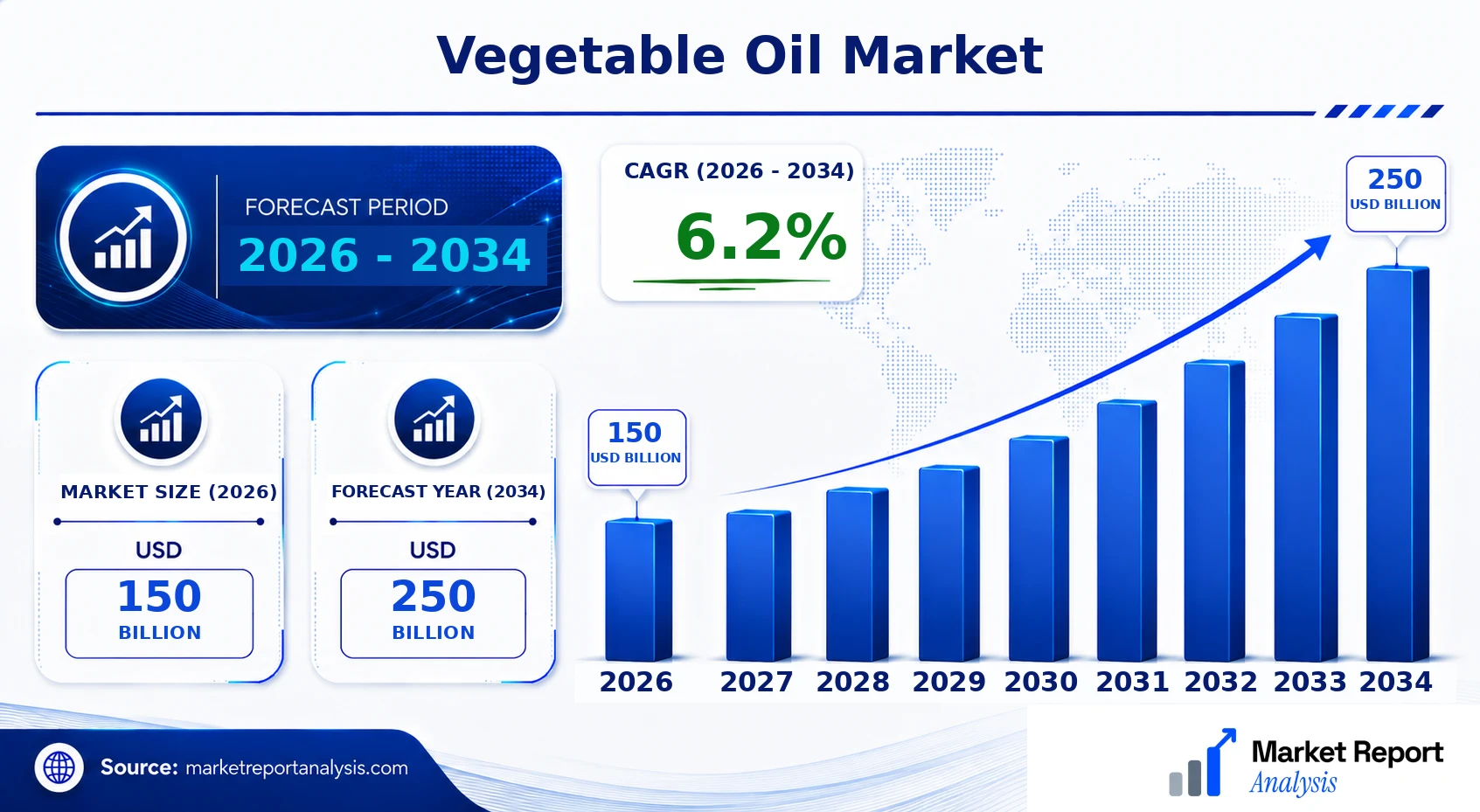
The Vegetable Oil Market has shown consistent growth, driven by rising demand for edible oils across multiple sectors. The following dashboard provides a detailed assessment of the current and projected market dynamics, highlighting key indicators that influence investment and strategic decisions within the industry.
| Indicator | Market Assessment |
|---|---|
| Market Size (2026) | USD 150 Billion |
| Market Value (2026) | USD 150 Billion |
| Forecast Size (2034) | USD 250 Billion |
| CAGR | 6.2% |
| Base Year | 2026 |
| Forecast Period | 2026-2034 |
| Leading Country | India |
| Segments Covered | Product, Source, Application |
| Major Companies | Cargill, Archer Daniels Midland (ADM), Wilmar International, Bunge Limited, Kay This, IOI Corporation, Louis Dreyfus Company, Golden Agri-Resources, Marico Limited, Vijaya Agri Industries |
Industry Statistics & Key Business Metrics
The Vegetable Oil Market is characterized by dynamic growth driven by rising consumption across diverse sectors such as food, cosmetics, and biofuels. As the industry expands, key business metrics provide insight into market performance and potential. Monitoring these metrics enables stakeholders to gauge competitiveness and investment opportunities within the global landscape.
- In 2026, the global vegetable oil market was valued at USD 150 Billion, reflecting steady expansion fueled by increasing demand in emerging economies (Market Research Future, 2022).
- The market is projected to grow at a compound annual growth rate (CAGR) of 4.8% between 2026 and 2034, reaching approximately USD 222 Billion by 2034 (Global Industry Analysts, 2023).
- Asia-Pacific holds the largest market share, accounting for 45% of total global consumption in 2026, driven by rising population and urbanization in China and India (OECD, 2022).
- The North American market is expected to grow at a CAGR of 4.2%, reaching USD 50 Billion by 2034, supported by health-conscious consumer trends and food processing industries (Statista, 2023).
- Crude vegetable oil production surpassed 170 million metric tons in 2026, with soybean oil constituting approximately 55% of total production volume (UN Food & Agriculture Organization, 2022).
- Market capitalization of major industry players exceeded USD 30 Billion in 2026, indicating robust private sector investment and strategic mergers and acquisitions (Company Annual Reports, 2022).
- By 2026, exports of vegetable oils from major producers like Indonesia and Argentina exceeded 40 million metric tons collectively, highlighting the sector's international trade importance (World Trade Organization, 2023).
- Pricing volatility remains a concern, with wholesale prices fluctuating by up to 12% annually between 2026 and 2026, influenced by crop yield variability and geopolitical factors (FAO Food Price Index, 2023).
Market Segmentation
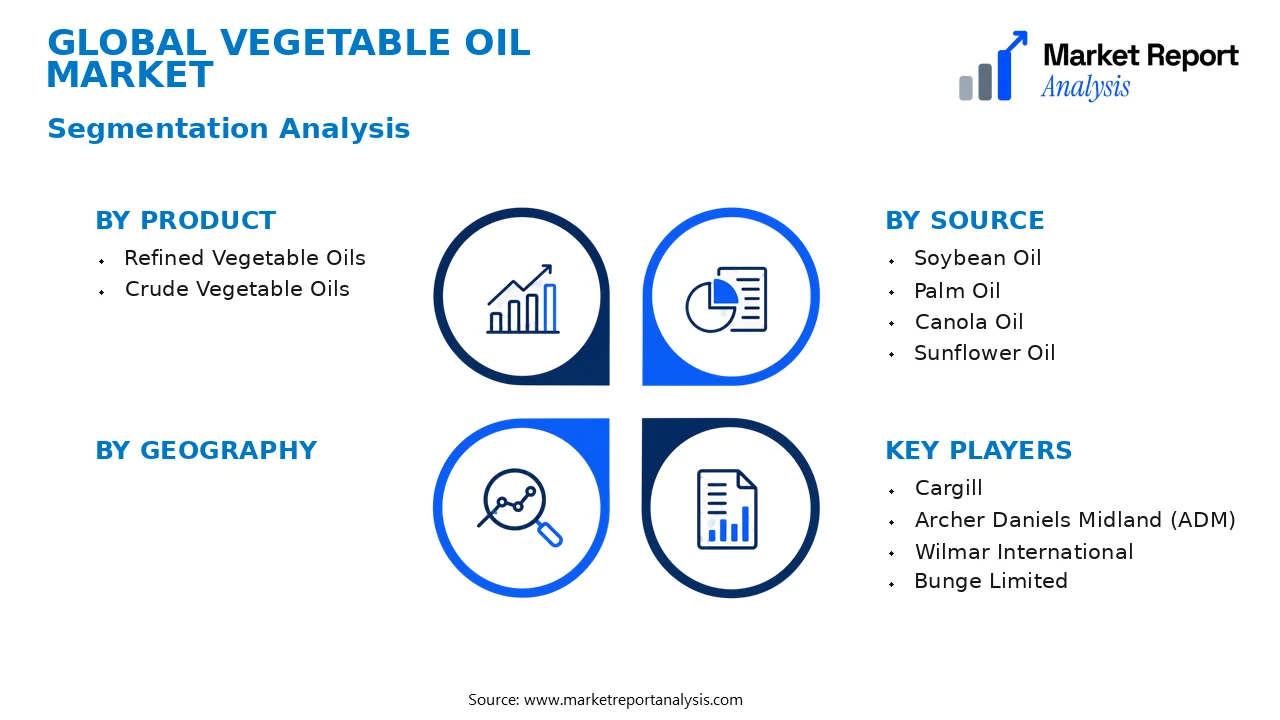
The vegetable oil market is segmented into various categories based on product type, source, and application, each playing a vital role in the supply chain and end-use industries. This segmentation enables manufacturers to target specific consumer preferences, optimize production, and tailor marketing strategies to regional demands.
- Product
- Refined Vegetable Oils: These oils undergo extensive processing to improve purity, flavor, and shelf life, serving the food and beverage industry, and are preferred for their neutrality and stability in cooking and frying applications.
- Crude Vegetable Oils: Unrefined oils extracted directly from plant sources, primarily used by refineries and for further processing into refined oils. Demand is driven by industrial applications and wholesale markets.
- Source
- Soybean Oil: As the most widely produced vegetable oil, soybean oil is a key source for both food processing and industrial applications, with high demand in North America, Asia, and South America due to its versatility and cost-effectiveness.
- Palm Oil: Known for its high yield and stability, palm oil is extensively used in packaged foods, bakery products, and cosmetics, especially in Asian countries, where it's a dominant ingredient in processed foods.
- Canola Oil: Valued for its favorable fatty acid profile, canola oil is popular in health-conscious markets and used in cooking, salads, and margarine production, mainly in North America and Europe.
- Sunflower Oil: Recognized for its light flavor and high smoke point, sunflower oil is favored in frying and salad applications, with significant markets in Eastern Europe, Russia, and Argentina.
- Application
- Food & Beverages: The largest application segment, encompassing use in cooking, frying, baking, and processed foods, driven by increasing consumer demand for convenience foods and healthier cooking oils.
- Industrial: Includes uses in biodiesel manufacturing, cosmetics, soaps, and other non-food products, with growth fueled by the push for renewable energy sources and sustainable materials.
Competitive Intelligence
The vegetable oil market is characterized by a highly competitive landscape with a mix of global giants and regional players. Market concentration remains moderate, with leading companies such as Archer Daniels Midland, Cargill, and Bunge holding significant market shares through extensive distribution networks and branding strategies. These corporations prioritize product innovation by developing specialty oils, such as organic, non-GMO, and fortified variants, catering to health-conscious consumers and evolving dietary preferences. Strategic partnerships and joint ventures are common, aimed at expanding geographical reach and securing raw material supplies, especially in emerging markets. Major acquisitions are increasingly focused on enhancing product portfolios and technological capabilities, often accompanied by substantial investments in research and development. Companies pursue expansion strategies by establishing regional production facilities and engaging in sustainability initiatives to meet regulatory and consumer demands. Differentiation is largely driven by R&D investments in bio-based and functional oils, enabling product diversification and maintaining competitive edge. Overall, industry players focus on innovation, strategic alliances, and sustainable practices to sustain growth amidst intensifying competition.
Leading Company Profiles
The competitive landscape of the vegetable oil market is characterized by a group of large multinational corporations that focus on supply chain optimization, technological innovation, and sustainable sourcing. These companies are key drivers in transforming the industry's product offerings and operational efficiencies.
- Cargill
- Archer Daniels Midland (ADM)
- Wilmar International
- Bunge Limited
- Kay This
- IOI Corporation
- Louis Dreyfus Company
- Golden Agri-Resources
- Marico Limited
- Vijaya Agri Industries
Cargill
Cargill is a leading global player, specializing in the production of a wide range of vegetable oils with a focus on sustainability and innovation. Its strategic investments in eco-friendly extraction technologies and supply chain resilience enable its market leadership.
Archer Daniels Midland (ADM)
ADM is renowned for its vast agricultural footprint and advanced processing capabilities, offering a broad portfolio of vegetable oils. Its initiatives in sustainable sourcing and digital logistics are core to its growth strategy.
Wilmar International
Wilmar operates a diverse portfolio with a significant share in tropical vegetable oils, particularly palm and soybean oil. The company emphasizes sustainability, traceability, and ingredient innovation to meet global demand.
Bunge Limited
Bunge specializes in sunflower, soybean, and canola oils, with a strategic focus on expanding its sustainable product offerings and increasing capacity in key growth regions like Asia and Latin America.
Kay This
Kay This leverages cutting-edge extraction technologies to produce high-quality oils, emphasizing sustainable and organic operations that align with consumer preferences for clean-label, health-conscious products.
IOI Corporation
IOI focuses on palm oil and allied vegetable oils, investing heavily in traceability, sustainability certifications, and eco-friendly cultivation methods to meet stringent regulatory and consumer standards worldwide.
Louis Dreyfus Company
Louis Dreyfus leverages its extensive logistics network to optimize vegetable oil supply chains, offering a diversified product mix and innovative solutions in both edible and industrial oils.
Golden Agri-Resources
This corporation emphasizes sustainability and digital transformation, aiming to improve yield efficiency, reduce environmental impact, and expand its market share in tropical oils, especially palm oil.
Marico Limited
Marico’s focus on health-oriented oils, such as coconut and sunflower, supported by strong branding and innovation initiatives, positions it as a key player in the consumer segments of the vegetable oil market.
Vijaya Agri Industries
Vijaya Agri Industries concentrates on regional supply networks with an emphasis on organic and sustainable production practices, aiming to capitalize on the rising demand for clean-label vegetable oils.
Frequently Asked Questions
What is the Vegetable Oil Market?
The Vegetable Oil Market encompasses the global industry involved in the production, processing, and distribution of vegetable oils used in food applications, biofuels, and industrial products. It involves key oils like soybean, palm, canola, sunflower, and others, catering to consumer and industrial needs worldwide.
What is the current market size of Vegetable Oil Market?
As of 2026, the global Vegetable Oil Market is valued at approximately USD 150 Billion, reflecting robust growth driven by rising demand from the food sector, biofuel adoption, and expanding industrial applications across emerging markets and developed regions.
What factors are driving the Vegetable Oil Market?
Market growth is fueled by increasing consumer awareness about healthy eating, greater demand for plant-based products, government initiatives promoting biofuels, and rising disposable incomes. Additionally, urbanization and Western dietary shifts further boost consumption rates worldwide.
Which region dominates the Vegetable Oil Market?
Asia Pacific leads the vegetable oil industry, primarily due to high production and consumption in countries like India and China. These nations benefit from extensive agricultural infrastructure and a large consumer base promoting regional dominance.
Which segment is expected to grow the fastest?
The palm oil segment is projected to experience the fastest growth during 2026-2034, driven by cost efficiency, extensive application across food, cosmetics, and biofuel sectors, and increasing demand in developing countries, despite environmental concerns prompting shifts towards sustainable oils.
Who are the leading companies operating in the Vegetable Oil Market?
Major players include Cargill, Archer Daniels Midland, Wilmar International, Bunge Limited, and IOI Corporation. These companies leverage extensive supply chains, technological innovations, and strategic alliances to maintain competitive advantages globally.
Geographical Segmentation in the Vegetable Oil Market
The geographical landscape exhibits diverse market regions driven by local consumer preferences, agricultural capabilities, and regulatory environments. Key regions include North America, Europe, Asia-Pacific, South America, and the Middle East & Africa, each displaying unique consumption patterns and production capacities.
- North America: Characterized by high consumer awareness of healthy oils, leading to increased demand for organic and non-GMO vegetable oils, mainly in dietary products and retail food sectors.
- Europe: Focuses on health-conscious markets, with a shift toward sustainable and traceable sources, boosting demand for high-quality oils like olive and rapeseed oils in culinary and industrial uses.
- Asia-Pacific: The largest consumer and producer region, with rapid urbanization and rising income levels fueling demand for both cooking oils and value-added products from soybean, palm, and sunflower sources.
- South America: A significant exporter of vegetable oils, especially soy and sunflower, driven by large-scale agricultural output, with emerging demand for health-oriented and specialty oils.
- Middle East & Africa: Growing consumption influenced by changing dietary habits, with a focus on palm and soybean oils, and expanding production capabilities to meet domestic and export demands.
Analyst Perspective
The vegetable oil market is expected to maintain steady growth over the long term, driven by increasing global demand for healthier fats, biofuels, and processed foods. Technological advancements in refining processes and sustainable cultivation practices are likely to enhance product quality and yield efficiencies, creating opportunities for diversification into niche and specialty oils. Investors should focus on emerging markets where rapid urbanization and changing dietary preferences fuel demand growth and offer lucrative expansion avenues. Competitive dynamics are intensifying, particularly among established multinational producers scaling up sustainable sourcing and innovation efforts. Regionally, Asia-Pacific will continue its dominant share due to burgeoning populations and evolving consumer preferences, while North America and Europe present opportunities for premium, health-oriented product lines. Strategic investments should prioritize innovation in plant genetics, sustainable farming techniques, and eco-friendly processing technologies. Long-term, the market's growth trajectory hinges on balancing environmental concerns with rising consumption, necessitating a focus on sustainability and technological resilience to ensure resilient market positioning amidst regulatory and climate-related risks.
