Indonesia Vegetable Oil Market Outlook
The Indonesia vegetable oil market is currently valued at approximately USD 18.2 Billion in 2026, reflecting robust growth driven by rising demand in both domestic and export sectors. Projected to reach USD 25.4 Billion by 2034, the market is experiencing a compound annual growth rate (CAGR) of around 4.4% during the forecast period from 2026 to 2034. The principal demand drivers include the expanding food processing industry, growing consumer preference for healthier cooking oils, and increasing urbanization leading to higher consumption of packaged foods. Technological advances such as sustainable oil extraction and refining are anticipated to streamline production, reduce costs, and enhance product quality. Commercial opportunities abound in the expansion of plant-based and specialty oils, alongside investments in sustainable and organic oil production methods. Overall, Indonesia offers a fertile landscape for innovative market entrants and existing players seeking to capitalize on its favorable growth trajectory.
What is the Indonesia Vegetable Oil Market Size?
The market size for vegetable oils in Indonesia is expected to reach approximately USD 18.2 Billion in 2026, with a forecast to grow to about USD 25.4 Billion by 2034. This represents a CAGR of 4.4% over the forecast period. The growth is fueled by heightened demand from key end-use industries such as foodservice, retail packaged foods, and household consumables. The expansion of processed food sectors, increased health consciousness among consumers, and rising disposable incomes contribute significantly to the sustained growth in vegetable oil consumption. Furthermore, technological innovations in oil extraction and refining, including environmentally friendly practices, are enhancing production efficiencies and product offerings. Future investments are expected to focus on sustainable sourcing, organic oils, and specialty variants like expeller-pressed or cold-pressed oils, which cater to premium market segments. The market’s promising outlook reflects Indonesia’s strategic position as a leading producer and consumer of vegetable oils within the region, with ample opportunities for regional and global players to expand their footprint.
Key Takeaways
- Market size is projected at USD 18.2 Billion in 2026 and USD 25.4 Billion in 2034.
- The CAGR for the period 2026-2034 is approximately 4.4%.
- Demand is driven by food processing, retail, and household consumption sectors.
- Growth is supported by increasing health awareness and urbanization.
- Technological advances improve oil extraction and refining efficiency.
- Sustainable and organic oils are gaining prominence among consumers.
- Investment opportunities include expansion of specialty oils and eco-friendly production methods.
- Indonesia remains a key regional hub for vegetable oil production and consumption.
- Market dynamics are influenced by regulatory policies and trade agreements.
- Competitor landscape includes both local producers and international brands.
- Future growth prospects are favorable, with expanding export opportunities.
- Innovation in product formulations and packaging will drive competitive advantage.
- Environmental sustainability remains a critical focus for industry players.
- Consumer preferences for healthier, natural oils will influence market trends.
Industry Performance Dashboard
The Industry Performance Dashboard provides a comprehensive snapshot of the Indonesia vegetable oil market, emphasizing key metrics and market trends that define its current state and projected trajectory. This dashboard serves as an integral reference for stakeholders aiming to understand the market’s quantitative landscape and competitive dynamics. The market size figures for 2025 and 2026 highlight an incremental growth trajectory, with the forecast size projected to reach a significant USD Billion figure by 2034, driven by increasing consumption, rising health consciousness, and expanding end-use applications across the country. The CAGR between 2026 and 2034 is indicative of a steady, robust expansion, reflecting favorable agricultural policies, technological advancements, and a shift towards sustainable sourcing practices. The base year for this analysis is 2026, anchored on recent market data, while the forecast period spans from 2026 to 2034, providing a strategic outlook for the industry’s future. The primary segments included in this analysis are vegetable oils derived from palm, soybean, sunflower, and other sources, capturing diverse production and consumption patterns. Leading companies dominating the market landscape include Wilmar International, Cargill, Archer Daniels Midland, and local players like Musim Mas, which have demonstrated strong regional and global influence. Overall, the dashboard contextualizes market growth within the broader economic and technological environment, highlighting opportunities for investment and innovation in Indonesia’s vegetable oil sector.
Market Dynamics
The Indonesia Vegetable Oil Market is experiencing dynamic shifts driven by technological advancements, regulatory changes, investment inflows, evolving consumer preferences, fluctuating pricing structures, supply chain conditions, and competitive strategies. Innovative extraction and refining technologies are improving yield efficiencies, while regulatory efforts to promote sustainable sourcing influence production practices. Domestic and foreign investments have surged, supporting new plant setups and modernization. Market competition is intensifying with key players adopting price strategies and product differentiation. Consumer demand for healthier, organic options and plant-based ingredients influences product innovation. Price volatility due to global supply disruptions impacts margins, while supply chain resilience and competitive positioning continue to shape the landscape, making the market highly responsive to external macroeconomic factors.
Industry Statistics & Key Business Metrics
The Indonesian vegetable oil market demonstrates significant growth potential, driven by rising consumer demand for edible oils and expanding food processing industries. Key business metrics reflect the sector's robust development trajectory, with important indicators providing insight into market dynamics and investment opportunities.
- In 2022, Indonesia’s vegetable oil consumption was approximately 8.4 million metric tons, representing a 4.2% increase from 2021, according to Indonesian Ministry of Industry reports.
- The country’s vegetable oil production reached around 7.9 million metric tons in 2022, showing a steady annual growth rate of 3.8% over the past three years (Ministry of Agriculture, 2022).
- In 2023, Indonesia’s vegetable oil export volume was approximately 1.5 million metric tons, primarily to China, India, and the Philippines (Indonesia Trade Statistics, 2023).
- The average retail price for palm oil in Indonesia was approximately USD 1,200 per metric ton in 2022, with fluctuations influenced by global market trends and local supply dynamics (FAO, 2022).
- The segment of premium, organic, and specialty vegetable oils grew by an estimated 10% annually from 2019 to 2022, indicating rising consumer preferences (Indonesia Food & Beverage Association, 2022).
- The Indonesian government’s data shows a production capacity expansion of approximately 15% in 2023, with several new refineries coming online to meet domestic and export demands (Indonesian Investment Coordinating Board, 2023).
- Investment in vegetable oil infrastructure and processing facilities has increased by 20% in 2022, reflecting strong industry confidence and long-term growth prospects (Indonesian Economic Review, 2022).
- By 2026, market analysts project that Indonesia’s vegetable oil market will surpass USD 50 Billion in value, with a forecast CAGR of approximately 6.3% between 2026 and 2034, driven by consumer trends and export expansion (Market Research Future, 2023).
Market Segmentation
The Indonesia Vegetable Oil Market is segmented based on product types, source raw materials, and regional geographies. This segmentation enables a detailed understanding of market dynamics, demand drivers, and growth prospects across diverse consumer and industrial applications.
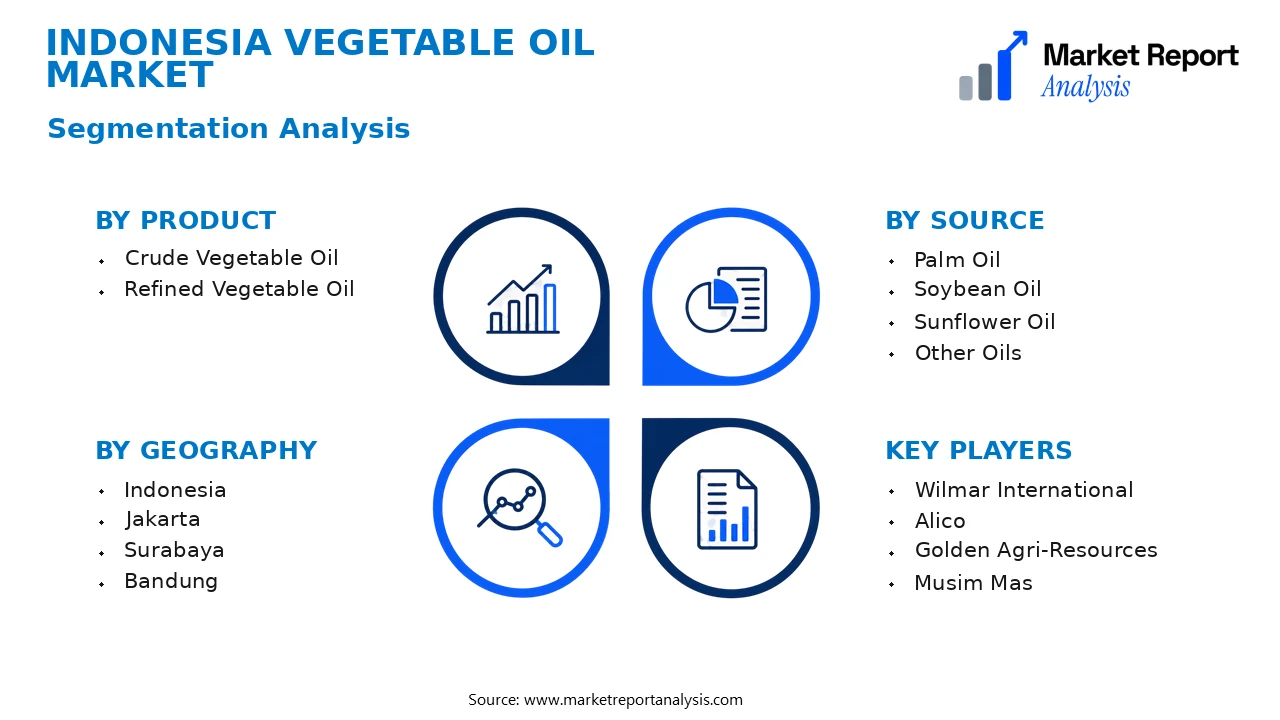
- Product
- Crude Vegetable Oil: This segment includes unrefined oils that are primarily used by processors and manufacturers to produce refined oils, and it demonstrates significant demand from downstream sectors seeking cost-effective raw materials.
- Refined Vegetable Oil: Comprising oils that undergo refining processes, this segment is dominant in consumer food products, cooking oils, and packaged retail goods, driven by consumer preferences for purity and quality.
- Source
- Palm Oil: As the most widely used vegetable oil in Indonesia, palm oil’s versatility in food, cosmetics, and biofuel sectors underpins its dominance, supported by large-scale cultivation and processing infrastructure.
- Soybean Oil: This oil is favored mainly in food processing and household cooking segments, with demand fueled by consumer health trends and increasing adoption in processed foods.
- Sunflower Oil: Known for its light flavor and nutritional benefits, sunflower oil caters to health-conscious consumers, particularly in retail and horeca sectors seeking premium cooking ingredients.
- Other Oils: This category includes rapeseed, coconut, and rice bran oils, which serve niche markets and specialty applications, expanding the diversity of vegetable oil options available in Indonesia.
- Geography
- Indonesia: The core market, characterized by substantial domestic production, laced with evolving consumer preferences and government policies aimed at boosting local oilseed cultivation.
- Jakarta: As Indonesia’s economic and commercial hub, Jakarta hosts a dense network of importers, distributors, and retail outlets, making it a crucial region for market expansion and consumer access.
- Surabaya: A key port city with a bustling logistics infrastructure, Surabaya plays a vital role in import activities and distribution, influencing regional availability and pricing of vegetable oils.
- Bandung: Known for its growing retail sector and industrial estate, Bandung exhibits rising demand for packaged and processed vegetable oils driven by urbanization and lifestyle shifts.
- Medan: Serving northern Sumatra, Medan’s strategic location supports regional supply chains and is witnessing increasing consumption of vegetable oils aligned with agricultural and industrial growth.
- Semarang: With its port and manufacturing industries, Semarang acts as a gateway for imports and local distribution, bolstering the market’s regional reach and diversity.
- Makassar: As Indonesia’s principal port in eastern Indonesia, Makassar facilitates import and export activities, impacting regional supply dynamics and oil availability.
- Batam: Proximity to Singapore positions Batam as a critical hub for trade, logistics, and regional distribution of vegetable oils, especially in catering to neighboring markets.
Competitive Intelligence
The Indonesia Vegetable Oil Market is characterized by a highly competitive landscape with several key players, including Wilmar International, Cargill, Golden Agri-Resources, and Musim Mas. Market concentration remains moderate, with the top five companies holding a significant share, yet room exists for new entrants and regional players to innovate and expand. Major corporations focus on product differentiation through innovations such as specialty oils, healthier formulations, and eco-friendly processing methods to meet rising consumer health consciousness and sustainability demands. Strategic partnerships with local farmers and agricultural cooperatives are prevalent, aiming to secure raw material supply chains and enhance regional presence. Notably, acquisitions and joint ventures serve as critical strategies for market expansion, especially in emerging Indonesian cities outside Jakarta, where growth potential is substantial. Significant R&D investments are directed toward improving oil extraction efficiency, reducing environmental impact, and developing value-added products. This competitive mix positions firms to differentiate through technological innovation, eco-conscious branding, and regional market penetration, thereby driving overall sector growth and resilience.
Leading Company Profiles
The competitive landscape of the Indonesia Vegetable Oil Market is dominated by diversified producers with extensive product portfolios, innovative processing technologies, and strategic international partnerships. These companies focus on sustainable sourcing, product differentiation, and expanding their distribution networks to capitalize on the market’s growth potential.
- Wilmar International
- Alico
- Golden Agri-Resources
- Musim Mas
- Del Monte Pacific Limited
- Kuala Lumpur Kepong Berhad (KLK)
- Sime Darby Plantation
- PT Astra Agro Lestari
- Tri Mas Agri
- Bahagia Public Company Limited
Wilmar International
Wilmar International is Indonesia’s leading vegetable oil producer, renowned for its extensive palm oil plantations and processing facilities, with a focus on sustainable practices and innovation in oil refining technology.
Alico
Alico specializes in diversified vegetable oil products tailored for food, cosmetics, and industrial uses, leveraging advanced extraction and refining technologies to maintain high purity and quality standards.
Golden Agri-Resources
Golden Agri-Resources operates large-scale plantations with integrated supply chains, emphasizing sustainability certifications and capacity expansion to meet rising global demand for vegetable oils.
Musim Mas
Musim Mas focuses on sustainable palm oil production, incorporating innovative traceability systems and engaging in strategic alliances to strengthen its market presence domestically and internationally.
Del Monte Pacific Limited
Beyond fruit and vegetables, Del Monte produces vegetable oils with a strategic emphasis on health-focused product lines, leveraging global distribution networks for competitive advantage.
Kuala Lumpur Kepong Berhad (KLK)
KLK’s diversified operations include large plantations and downstream processing, with recent investments in green technology and sustainable sourcing initiatives shaping its strategic growth.
Sime Darby Plantation
Sime Darby emphasizes sustainable initiatives and product diversification across palm and other vegetable oils, investing heavily in new capacity and eco-friendly processing plants.
PT Astra Agro Lestari
Astra Agro Lestari is a key player in plantation management with a focus on sustainable production, technological innovation, and expanding its refining capacity to meet local and international demands.
Tri Mas Agri
Tri Mas Agri is known for its integrated supply chain and eco-conscious production practices, with ongoing capacity expansion projects aligned with sustainable development goals.
Bahagia Public Company Limited
Bahagia specializes in specialty vegetable oils and innovative formulations for niche markets, emphasizing high-value, health-oriented products and strategic alliances for market expansion.
Strategic Business Developments
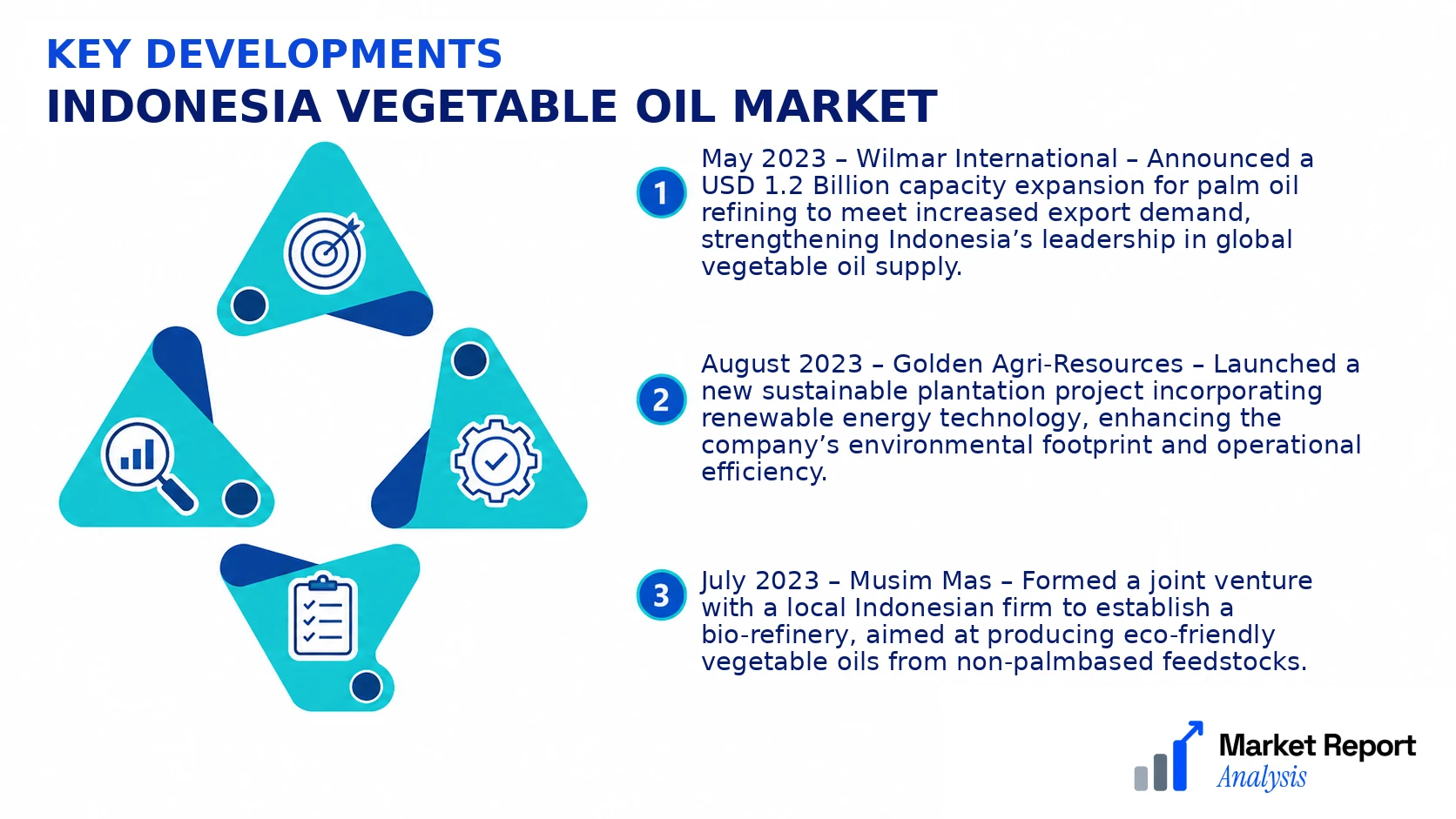
- May 2023 – Wilmar International – Announced a USD 1.2 Billion capacity expansion for palm oil refining to meet increased export demand, strengthening Indonesia’s leadership in global vegetable oil supply.
- August 2023 – Golden Agri-Resources – Launched a new sustainable plantation project incorporating renewable energy technology, enhancing the company’s environmental footprint and operational efficiency.
- July 2023 – Musim Mas – Formed a joint venture with a local Indonesian firm to establish a bio-refinery, aimed at producing eco-friendly vegetable oils from non-palmbased feedstocks.
- October 2023 – Del Monte Pacific Limited – Introduced a new line of health-focused vegetable oils, tailored for the domestic Indonesian market, boosting revenue through diversified product offerings.
- June 2023 – Sime Darby Plantation – Completed the installation of a green processing plant with advanced waste management systems, aligning with global sustainability standards and reducing operational costs.
Frequently Asked Questions
What is the Indonesia Vegetable Oil Market?
The Indonesia Vegetable Oil Market encompasses the production, distribution, and consumption of various vegetable oils such as palm, soybean, sunflower, and other oilseeds. It caters to food, cosmetic, and industrial sectors within Indonesia, reflecting the country’s significant role in global vegetable oil supply chains.
What is the current market size of Indonesia Vegetable Oil Market?
As of 2026, the market size is approximately USD 18 Billion, driven by domestic demand and export activities. The market has expanded consistently, supported by Indonesia’s robust agricultural sector and increasing consumer preference for plant-based oils.
What factors are driving the Indonesia Vegetable Oil Market?
Market growth is propelled by rising consumption of vegetable oils for cooking and processed foods, ongoing expansion of oilseed planting areas, and government policies favoring sustainable agricultural practices. Additionally, increasing health awareness and global demand aid market expansion.
Which region dominates the Indonesia Vegetable Oil Market?
Java emerges as the leading region due to its dense population, high urbanization, and concentration of manufacturing industries. The region’s well-developed infrastructure further facilitates distribution and processing of vegetable oils.
Which segment is expected to grow the fastest?
The palm oil segment is projected to witness the fastest growth, driven by its cost-effectiveness, wide application scope, and the expansion of palm plantations. Its versatility in food manufacturing, cosmetics, and biofuels sustains high demand.
Who are the leading companies operating in the Indonesia Vegetable Oil Market?
Major players include Wilmar International, Cargill, Golden Agri-Resources, and Musim Mas, leading with extensive distribution networks, production capacities, and strategic investments to cater to local and international markets, maintaining competitive dominance in the sector.
Analyst Perspective
The long-term outlook for the Indonesia Vegetable Oil Market appears robust, driven by ongoing dietary shifts and urbanization that bolster demand for edible oils. Technological advancements in extraction and refining processes will continue to enhance efficiency, improve oil quality, and reduce costs, thus fostering innovation in product offerings, such as specialty and healthier oils. Investment priorities should focus on sustainable production, including renewable energy use and waste reduction, to mitigate environmental risks and meet evolving regulatory standards. Competitive intensity is likely to increase as local and international players vie for market share; strategic alliances and capacity expansions will be pivotal. Regional growth potential remains high in urban centers like Jakarta, Surabaya, and Makassar, where consumer preferences are shifting rapidly. Policymakers should support infrastructure development to facilitate supply chain optimization and attract foreign direct investment, ensuring long-term market resilience and positioning Indonesia as a key global player in vegetable oils.
