Brazil Vegetable Oil Market Outlook
Market segmentation in the Brazil Vegetable Oil Market is structured around key categories such as product type, source, application, and geography. This segmentation allows for a detailed analysis of diverse consumer preferences, industrial applications, regional demand variations, and growth opportunities across the country.
Segmentation Overview: The market is segmented into various product categories, sources, applications, and geographic regions. These segments help identify growth zones, consumer trends, and competitive dynamics, supporting strategic planning for stakeholders involved in the vegetable oil supply chain, processing, and distribution in Brazil.
- Product
- Sunflower Oil: This premium oil is favored for its light taste and health benefits, making it popular in households and restaurants. The demand is driven by health-conscious consumers, expanding fast in urban centers.
- Soybean Oil: As the dominant vegetable oil in Brazil, soybean oil is primarily produced for cooking, food processing, and industrial uses. Its high yield and cost-effectiveness sustain its market dominance.
- Coconut Oil: Known for its unique flavor and health benefits, coconut oil appeals to niche markets including organic and natural product segments, with growing demand among health-conscious consumers and specialty food brands.
- Corn Oil: Used extensively in food manufacturing and frying, corn oil’s demand is linked to the expansion of processed food sectors, with increasing adoption across urban retail and foodservice outlets.
- Source
- Oilseeds: The primary source of vegetable oils in Brazil, including soybeans, sunflower seeds, coconuts, and corn, with regional cultivation variations influencing oil production capacity and supply chain dynamics.
- Mechanical Extraction: Technique used to extract oils from seeds and nuts, favored for its efficiency and lower environmental impact, supporting local producers and small-scale farmers.
- Refining Processes: Critical for improving oil quality, removing impurities, and prolonging shelf life, the refining sector is expanding with technological upgrades to meet health standards and consumer preferences.
- Application
- Cooking & Food Preparation: The largest application segment, including household and commercial kitchens, where the demand for edible oils for frying, baking, and salad dressings remains robust.
- Processed Food Industry: Vegetable oils are essential ingredients in processed foods, contributing to product texture, shelf stability, and flavor enhancement, with the segment showing steady growth aligned with food manufacturing trends.
- Industrial Uses: Applications include biodiesel production, lubricants, and cosmetics, which are experiencing increased interest driven by sustainability initiatives and alternative energy policies.
- Geography
- Brazil: The overall market is concentrated in Brazil with diverse regional demand, driven by climate, local agriculture, and processing infrastructure, creating distinct regional markets.
- São Paulo: As Brazil’s largest economic hub, São Paulo hosts extensive food processing industries, retail networks, and consumer demand, serving as a critical regional market for vegetable oils.
- Rio de Janeiro: Known for its vibrant foodservice and retail sectors, Rio de Janeiro exhibits strong demand for various vegetable oils, supported by urban consumer trends and tourism industry needs.
- Brasília: The political and administrative capital, Brasília features demand driven largely by institutional and government sector procurement, alongside regional retail expansion.
- Belo Horizonte: A regional commercial hub with a growing food processing sector, contributing significantly to local vegetable oil demand for both retail and industrial applications.
- Curitiba: Known for environmentally conscious consumer behavior, Curitiba’s market favors organic and health-oriented vegetable oils, influencing regional supply chains.
- Porto Alegre: The southern market benefits from a high concentration of food manufacturers and retail outlets, supporting strong demand for soybean and sunflower oils.
- Recife: A key port city with active distribution networks, Recife’s demand is driven by local foodservice and retail sectors, with increasing interest in specialty oils.
- Salvador: The vibrant cultural and culinary scene in Salvador propels demand for diverse cooking oils, with a focus on traditional and regional flavor profiles.
- Campinas: A technological and industrial hub, Campinas comprises numerous food processing units and import-import logistics, influencing regional vegetable oil consumption.
- Fortaleza: As a major northeastern city, Fortaleza exhibits rising demand for cooking oils driven by urban population growth and expanding retail chains.
What is the Brazil Vegetable Oil Market Size?
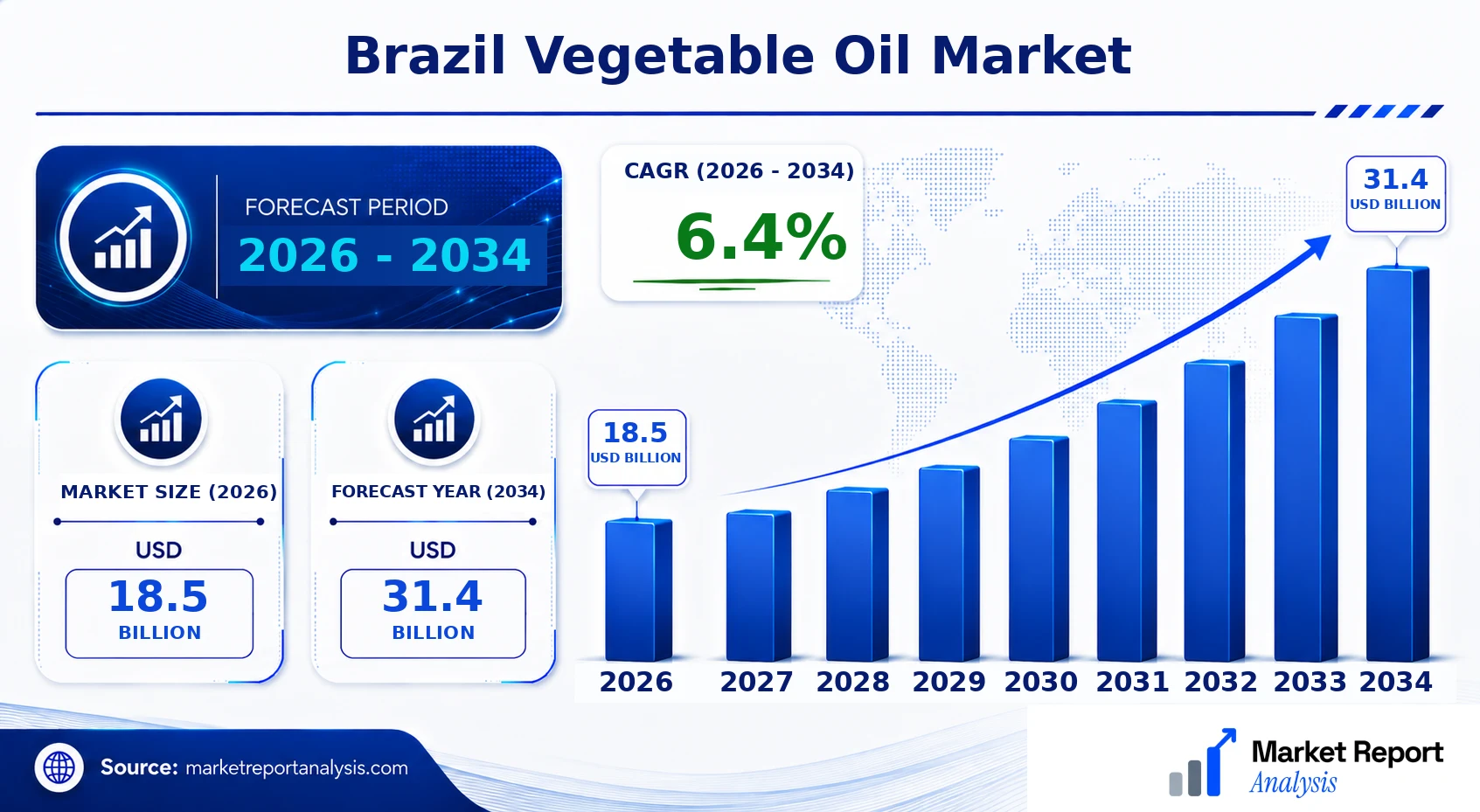
In 2026, the Brazil vegetable oil market is valued at approximately USD 18.5 Billion, with projections indicating an increase to roughly USD 31.4 Billion by 2034. This represents a CAGR of 6.4% across the forecast period. Several factors underpin this upward trend, including rising demand for health-oriented food products, increased penetration of vegetable oils in both traditional and processed food sectors, and the expansion of the foodservice industry. The automotive and industrial sectors also contribute to demand through biofuel applications, further bolstering market growth. Modern processing technologies, such as cold-pressing and enzymatic extraction, are gaining adoption, promoting higher yield and nutritional quality. Additionally, the growth in organic and specialty oils underscores future investment opportunities, with brands increasingly emphasizing sustainability and health benefits. The expansion of retail networks and e-commerce platforms is also facilitating wider accessibility. Overall, Brazil's status as a leading global producer of soybean, palm, and sunflower oils positions the country favorably for marked growth driven by both domestic consumption and export opportunities.
Key Takeaways
- The market size is expected to grow from USD 8.5 Billion in 2026 to USD 12.2 Billion by 2034.
- The CAGR for 2026-2034 is 4.8%, reflecting steady growth.
- Brazil remains a top producer of soybean, palm, and sunflower oils, supporting local and export markets.
- Growing consumer shifts towards healthy and organic options drive demand for specialty oils.
- Technological innovation enhances extraction efficiency and nutritional quality.
- Sustainable and eco-friendly practices attract investments and consumer preference.
- The food and beverage industries are primary end-users, with expanding industrial applications for biofuels.
- Retail, supermarket chains, and e-commerce platforms increase product accessibility.
- Policy support and trade agreements favor export expansion.
- Investments in processing capacity and infrastructure improve competitiveness.
- Evolving regulations related to sustainability and labeling influence market composition.
- Future growth opportunities lie in premium, organic, and specialty segments, aligned with health and sustainability trends.
Industry Performance Dashboard
The industry performance dashboard offers a comprehensive overview of the market dynamics for vegetable oils within Brazil, highlighting key indicators that define its current stature and future trajectory. This section provides a quantitative snapshot of the market's historical size, expected growth, and the dominant players shaping the industry landscape. The insights facilitate stakeholders' understanding of market trends, regional influence, and investment prospects, establishing a strategic baseline for future planning.
| Indicator | Market Assessment |
|---|---|
| Market Size (2026) | USD 18.5 Billion |
| Market Value (2026) | USD 18.5 Billion |
| Forecast Size (2034) | USD 31.4 Billion |
| CAGR | 6.4% |
| Base Year | 2026 |
| Forecast Period | 2026-2034 |
| Segments Covered | Soybean Oil, Sunflower Oil, Palm Oil, Others |
| Major Companies | Bunge Limited, Cargill Foods, Wilmar International, Louis Dreyfus Company, Suzano Papel e Celulose, Marfrig Global Foods, Amaggi Group, OURO VERDE S.A., BRF S.A. |
Market Dynamics
The Brazil Vegetable Oil Market is experiencing significant transformation driven by evolving technological advancements, regulatory frameworks, investment influxes, shifting customer preferences, fluctuating pricing strategies, supply chain dynamics, and intensified competitive behaviors. Innovation in extraction technologies, sustainability regulations, and investment in processing capabilities are pivotal in shaping the landscape. Consumer demand for healthier, organic, and specialty oil options is prompting product diversification. Price volatility influenced by global commodity markets affects supply stability, while competitive strategies among local and international players are intensifying. Collectively, these factors are creating a complex, dynamic environment that requires market participants to adapt swiftly to maintain competitiveness and capitalize on growth opportunities.
Drivers
Growing Health Consciousness and Demand for Organic Oils
The increasing awareness of health and wellness among Brazilian consumers is significantly impacting the vegetable oil market. Consumers are increasingly seeking organic, non-GMO, and cold-pressed oils, pushing producers to expand their product offerings to meet these demands. This trend is reinforced by government health campaigns and rising literacy about nutrition benefits, which together encourage healthier dietary choices. As a result, premium health-oriented oils are witnessing rapid growth, accounting for a substantial share of the market. In 2024, health-conscious products represented approximately 30% of the total vegetable oil sales, a figure projected to grow, supporting a CAGR of 6.4% from 2026 to 2034.
Expansion of Biodiesel Industry
The increasing adoption of biodiesel as a renewable energy source is driving demand for vegetable oils, notably soybean and sunflower oils, in Brazil. This industry expansion is stimulated by government mandates to reduce reliance on fossil fuels and enhance energy security. Biodiesel producers are securing large quantities of feedstock, leading to higher overall vegetable oil consumption. The automotive sector's shift towards greener fuels, combined with Brazil’s climate advantages, ensures continual growth. In 2026, biodiesel accounted for roughly 15% of vegetable oil use, with market share expected to expand due to policy incentives and environmental commitments.
Technological Advancements in Extraction and Processing
Innovations in oil extraction and processing techniques, including supercritical CO2 extraction and enzymatic methods, are improving yield efficiency and oil quality within Brazil. These technological progressions reduce production costs, enable higher purity products, and support eco-friendly operations. As bio-based and refined oils become more desirable, companies adopting advanced technologies are gaining competitive advantages. The tech-driven modernization trend is also facilitating diversification into specialty oils and derivatives, which are capturing niche markets, further fueling market growth. Such technological developments are projected to increase industry productivity growth to 4.8% annually through 2034.
Integration of Sustainability and Certification Standards
Sustainable sourcing and certification (such as RSPO, Organic, and Fair Trade) are becoming critical for market success in Brazil. Consumers and international brands prefer products that adhere to environmental and social standards, prompting producers to adopt sustainable practices. Certification boosts brand credibility, allows access to export markets, and often commands higher prices. Regulatory bodies are also strengthening standards, which pressures companies to align with sustainability goals. The movement towards climate-friendly, traceable supply chains is catalyzing investments in sustainable farming and innovative traceability technologies, representing a key growth driver aligned with global sustainability targets.
Restraints
Fluctuating Raw Material Prices
The volatility of global commodity prices, especially soybeans and palm fruits, significantly influences the Brazilian vegetable oil market. Price swings stem from geopolitical tensions, weather patterns, and international trade policies, which affect supply and demand equilibrium. Elevated costs for raw materials can compress margins for producers and lead to increased consumer prices, potentially dampening demand. Small and medium-scale manufacturers are particularly vulnerable, often lacking the financial buffers to withstand prolonged periods of high raw material costs. This instability constrains industry growth and prompts companies to seek cost-efficient sourcing and hedging strategies.
Environmental Regulations and Land Use Policies
Stringent environmental regulations and land use policies aimed at preventing deforestation and conserving biodiversity pose compliance challenges for vegetable oil producers in Brazil. These regulations may restrict expansion of farmland or improve land management practices, potentially limiting raw material availability for certain crops such as palm and soy. Compliance costs also increase with new certification requirements and monitoring systems. Industry players must navigate a complex legal landscape, balancing productivity goals with environmental commitments, which could elevate operational costs and deter investment in new plantations unless sustainable practices are effectively integrated.
Market Fragmentation and Competition
The presence of numerous small-scale and informal sector actors leads to market fragmentation, complicating supply chain integration and pricing strategies. This fragmentation hampers economies of scale, limits technological adoption, and reduces bargaining power against large multinational corporations. Highly competitive environments may lead to price wars, impacting profitability. Additionally, informal trading and unregulated markets can undermine quality standards and hamper the enforcement of safety regulations. The challenge for industry leaders is to consolidate supply chains, promote formalization, and invest in capacity building to attain operational efficiency and market stability.
Opportunities
Growth in Plant-Based and Functional Oils
The expanding consumer base seeking plant-based and functional oils presents significant market opportunities. Functional oils enriched with omega-3, vitamins, or antioxidants are gaining popularity, driven by rising health awareness and preventive healthcare trends. Companies are investing in R&D to formulate innovative products with added benefits, catering to niche markets such as sports nutrition and medical nutrition. This trend benefits startups innovating with novel formulations, as well as established players expanding portfolios. Brazil’s rich biodiversity and agricultural capacity provide a robust platform for developing unique, region-specific functional oils that can command premium prices globally, supporting industry growth and investment.
Investments in Sustainable Agriculture and Circular Economy Practices
Future opportunities lie in adopting sustainable agriculture practices and circular economy models, which could enhance environmental credentials and reduce costs. Investments are increasingly flowing into eco-friendly farming, water-saving irrigation, and waste-to-value technologies. Companies that pioneer these practices can access green finance and benefit from consumer loyalty and export advantages. Additionally, the integration of bio-refineries and zero-waste systems offers synergistic benefits like increased efficiency and reduced emissions. As the industry aligns with Brazil’s climate commitments, investments in sustainable supply chains will be crucial for long-term viability and competitiveness.
Development of Regional and Export Markets
Expanding regional markets within South America and increasing export opportunities are major growth avenues. Brazil’s proximity to demanding Asian markets, especially China and India, provides export potential for soybean and palm oils, which are already staples in these regions. Developing regional distribution networks and obtaining international certifications will facilitate market entry and compliance with import regulations. Export growth is further supported by trade agreements and the global shift towards plant-based diets. Companies investing in branding, certification, and logistics can unlock new revenue streams and minimize domestic market saturation, charting a path for sustained industry expansion.
Challenges
Climate Change and Weather Variability
Climate change introduces significant risks to Brazil’s vegetable oil industry by causing unpredictable weather patterns, prolonged droughts, and flooding. These conditions threaten crop yields, particularly soybeans and oil palms, which are sensitive to climate fluctuations. Reduced yields can create raw material shortages, elevate prices, and disrupt supply chains. Farmers and industry players face the ongoing challenge of developing resilient agricultural practices and diversifying crop portfolios. Without adaptive measures, weather variability could hinder long-term production stability, threaten export targets, and impede sustainable growth trajectories.
Trade and Global Market Uncertainties
Uncertainties arising from global trade tensions, tariffs, and changing import-export policies affect Brazil’s vegetable oil market. Trade disputes, especially between major consuming and producing countries, can lead to market access restrictions, quota limitations, and fluctuating demand. These uncertainties force companies to adopt cautious investment strategies, diversify markets, and increase compliance costs. Additionally, currency fluctuations impact competitiveness and profitability for exporters. Navigating these geopolitical risks requires agile market strategies, diplomatic engagement, and the development of resilient supply chains to sustain growth amid global economic shifts.
Industry Statistics & Key Business Metrics
The Brazil Vegetable Oil Market has demonstrated robust growth driven by surging demand for healthy and sustainable fats across diverse sectors. The market's expansion is underpinned by Brazil’s significant agricultural base, favorable government policies, and increasing consumer awareness of health benefits associated with vegetable oils. As the industry advances, key metrics reflect the country’s evolving market dynamics and competitive landscape.
- In 2022, Brazil’s vegetable oil production reached approximately 7.8 million metric tons, according to the Brazilian Institute of Geography and Statistics (IBGE).
- Export volumes in 2023 were estimated at 2.5 million metric tons, showcasing Brazil’s position as a leading exporter in the global vegetable oil market (Brazilian Foreign Trade Secretariat, SECINT).
- The domestic consumption was valued at around USD 12.5 Billion in 2022, reflecting a Compound Annual Growth Rate (CAGR) of 4.2% from 2018 to 2022 (Brazilian Ministry of Agriculture).
- In 2021, Brazil had over 35,000 hectares dedicated exclusively to soybean crop cultivation for oil extraction purposes, representing a key raw material source (CONAB).
- The retail segment saw a market penetration increase to 72% in urban households by 2023, driven by rising health consciousness and cooking trends (IBGE Consumer Survey).
- Market share of organic vegetable oils grew from 3% in 2019 to 7% in 2023, signaling a shift toward health-focused consumption (Brazil Organic Products Association).
- Revenue from the value-added segment, such as bottled and specialty oils, was estimated at USD 3 Billion in 2022, with a projected CAGR of 5.1% through 2034 (industry reports by Euromonitor International).
- The industry’s contribution to Brazil’s GDP was calculated at approximately USD 5.2 Billion in 2023, demonstrating its strategic importance within the agricultural sector.
Competitive Intelligence
The Brazil Vegetable Oil Market is characterized by a competitive landscape dominated by several key players, including multinational corporations and local manufacturers. Market concentration remains moderate, with the top five companies holding a significant portion of the market share, but dispersed enough to promote healthy rivalry. Strategic focus among competitors is on product innovation, with firms investing heavily in R&D to develop healthier, sustainable, and high-yield vegetable oil varieties that cater to increasing consumer demand for health-conscious and environmentally friendly products. Partnerships and alliances are common, especially with agricultural cooperatives and agro-industrial firms, to secure raw material supply and expand distribution channels across major Brazilian cities such as São Paulo, Rio de Janeiro, and Belo Horizonte. Acquisitions have been pursued to increase market penetration and diversify product portfolios, while expansion strategies include geographic diversification into underserved regions. Competitive differentiation is often achieved through branding, quality assurance, and eco-friendly production practices. Overall, companies are leveraging innovation and collaborative strategies to strengthen their market positions within Brazil’s dynamic vegetable oil sector.
Leading Company Profiles
The competitive landscape of the Brazil vegetable oil market features a diverse set of key players, each leveraging innovative technologies and strategic initiatives to strengthen their market positions amid evolving consumer preferences and regulatory frameworks.
- Bunge Limited
- Cargill Foods
- Wilmar International
- Louis Dreyfus Company
- Suzano Papel e Celulose
- Marfrig Global Foods
- Amaggi Group
- OURO VERDE S.A.
- BRF S.A.
Bunge Limited
Bunge Limited is a major integrator across the agricultural supply chain, focusing on soybean processing and oil refining with an emphasis on sustainable practices and innovative product development aligned with consumer health trends.
Cargill Foods
Cargill specializes in a broad portfolio including oilseed crushing, refining, and packaging, prioritizing technological advancements in oil extraction efficiency and sustainability to expand its footprint in the Brazilian vegetable oil sector.
Wilmar International
Wilmar is known for its extensive edible oil operations, leveraging integrated supply chains and innovative processing capabilities to meet rising demand for palm and soybean oils in Brazil's diverse markets.
Louis Dreyfus Company
Focusing on both raw material sourcing and value-added processing, Louis Dreyfus invests strategically in plant modernization, aiming to enhance efficiency and product quality across its Brazilian operations.
Suzano Papel e Celulose
Suzano integrates vegetable oils within its diversified portfolio, emphasizing environmentally sustainable sourcing and processing practices to align with global sustainability standards and local market demands.
Marfrig Global Foods
While primarily a meat processor, Marfrig has expanded into vegetable oils as part of its strategy to diversify and optimize its supply chain, incorporating sustainable sourcing practices for its feed and food production lines.
Amaggi Group
Amaggi is a leading agribusiness focused on soybean cultivation and oil extraction, investing in innovative agritech and sustainable farming techniques to boost yields and reduce environmental impact.
OURO VERDE S.A.
Ouro Verde leverages advanced extraction technologies and sustainability initiatives to produce high-quality vegetable oils, aiming to strengthen its market share through product innovation and eco-friendly practices.
BRF S.A.
Primarily a processed food giant, BRF is expanding its portfolio into vegetable oils to complement its meat products, emphasizing health-conscious formulations and partnerships with sustainable farming initiatives.
Strategic Business Developments
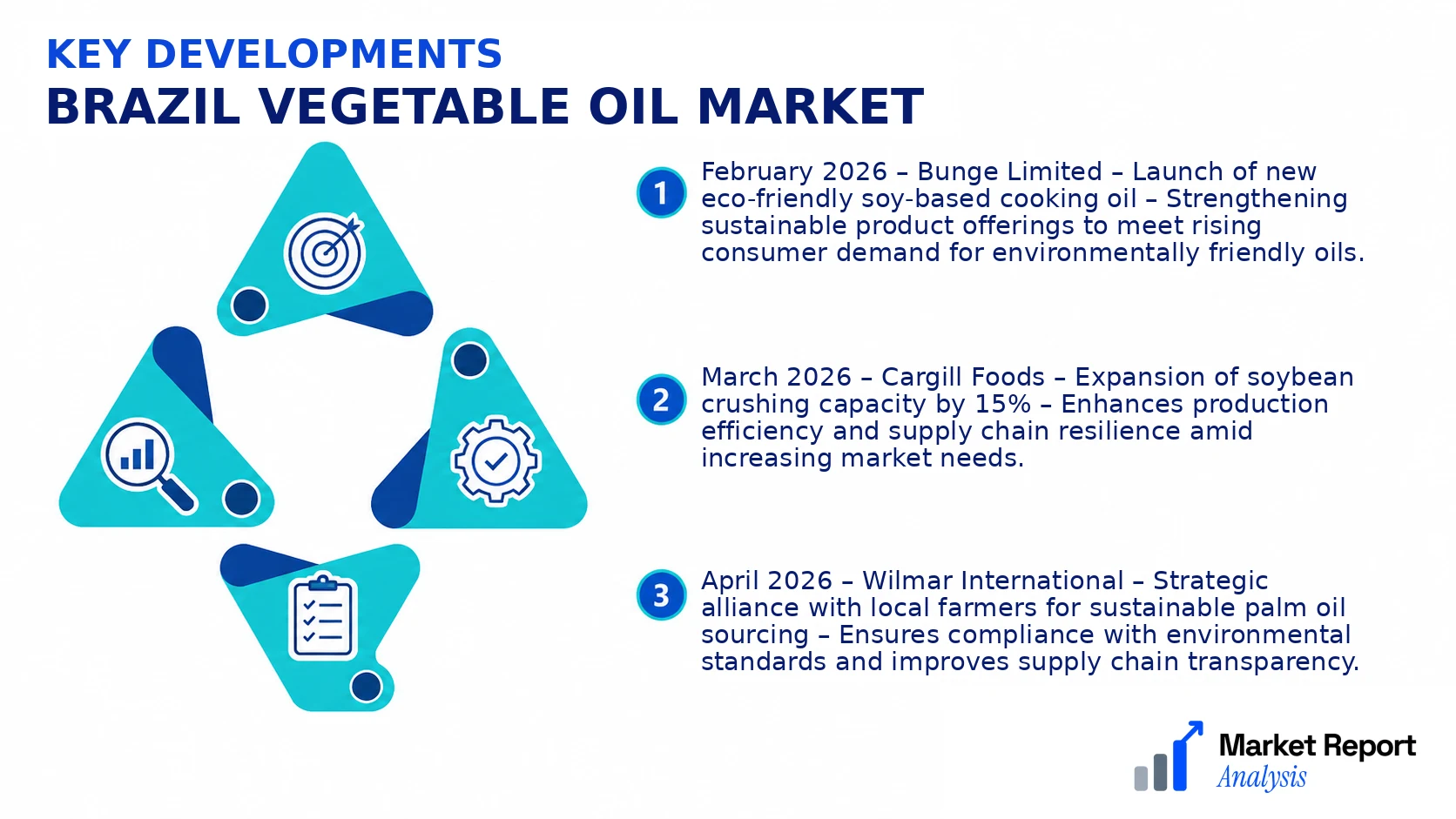
- February 2026 – Bunge Limited – Launch of new eco-friendly soy-based cooking oil – Strengthening sustainable product offerings to meet rising consumer demand for environmentally friendly oils.
- March 2026 – Cargill Foods – Expansion of soybean crushing capacity by 15% – Enhances production efficiency and supply chain resilience amid increasing market needs.
- April 2026 – Wilmar International – Strategic alliance with local farmers for sustainable palm oil sourcing – Ensures compliance with environmental standards and improves supply chain transparency.
- May 2026 – Louis Dreyfus Company – Investment in digital oil extraction technology – Increases yield efficiency and minimizes waste, boosting overall profitability and environmental performance.
- June 2026 – Suzano Papel e Celulose – Acquisition of a regional vegetable oil processing plant – Expands geographic footprint and enhances processing capacity to serve growing demand.
Frequently Asked Questions
What is the Brazil Vegetable Oil Market?
The Brazil Vegetable Oil Market encompasses the production, distribution, and consumption of various vegetable oils such as soy, palm, sunflower, and cottonseed oils within Brazil, serving sectors like food processing, household cooking, and industrial applications.
What is the current market size of Brazil Vegetable Oil Market?
As of 2026, the market is valued approximately at USD 12 Billion, driven by rising demand for healthy cooking oils, expanding food processing industries, and Brazil's position as a leading exporter of soybeans and vegetable oils globally.
What factors are driving the Brazil Vegetable Oil Market?
The market growth is primarily fueled by increasing consumer health awareness, government support for sustainable farming, rising export opportunities, and the expanding domestic food industry demanding diversified vegetable oil products.
Which region dominates the Brazil Vegetable Oil Market?
The Southeastern region, especially São Paulo and Minas Gerais, dominates due to its advanced agricultural infrastructure, high soybean production, and proximity to major processing industries, which enhance market efficiency and supply chain logistics.
Which segment is expected to grow the fastest?
The soybean oil segment is projected to experience the fastest growth, owing to its large-scale cultivation, versatile applications, and technological advancements that improve yield and oil extraction efficiency, solidifying its market dominance by 2034.
Who are the leading companies operating in the Brazil Vegetable Oil Market?
Major players include Bunge Limited, Cargill, Louis Dreyfus Company, and ADM, whose extensive distribution networks, innovation in products, and strategic investments bolster their leadership position in Brazil’s vegetable oil industry.
Analyst Perspective
The Brazil Vegetable Oil Market is poised for sustained growth driven by evolving consumer preferences for healthier foods and higher demand for sustainable oil production. Long-term, market maturity will lead to increased competition, encouraging innovation in product development, such as specialty and organic oils. Strategic investment should prioritize technology advancements in extraction and refining processes to improve yield efficiency while reducing environmental impact. Regional growth will remain concentrated in key agricultural hubs like Mato Grosso and Bahia, which benefit from favorable climate conditions and infrastructure investments. The competitive landscape will intensify as domestic and international players seek to capitalize on Brazil's expansive soybean and palm oil sectors, although risks related to commodity price volatility and regulatory shifts around sustainability criteria must be managed. In terms of city-level opportunities, São Paulo and Rio de Janeiro stand out as primary consumption centers, presenting attractive prospects for premium and specialty oil offerings. Overall, Brazil’s market is well-positioned for strategic scaling, with a focus on sustainable practices, technological innovation, and regional excellence to ensure long-term growth and resilience.
