Brazil Hydrogen Market Outlook
The market segmentation for Brazil's hydrogen sector is structured around product, application, and geography. This detailed segmentation provides insights into the diverse avenues and regional focus areas that shape the growth trajectory of hydrogen in Brazil, ensuring targeted strategies and investment planning.
Segmentation Overview
The market is segmented primarily by product type, application sectors, and regional distribution within Brazil. This approach helps delineate the demand, infrastructure development, and product deployment across various industries and geographic regions, supporting precise market analysis.
- Product
- Green Hydrogen: This segment involves hydrogen produced via renewable energy sources, aligning with Brazil’s clean energy goals. Demand is driven by industry decarbonization initiatives, with increasing investments in renewable-powered electrolysis facilities.
- Gray Hydrogen: Produced from fossil fuels without carbon capture, this segment currently fulfills industrial needs but faces future growth constraints due to environmental policies and sustainability commitments.
- Blue Hydrogen: Combining fossil fuels with carbon capture technology, blue hydrogen acts as a transitional solution, expected to grow as technologies mature and policies evolve.
- Application
- Industrial Use: Hydrogen’s role in refining, ammonia production, and steel manufacturing is pivotal in Brazil, supporting industrial decarbonization and export enhancement.
- Transport: Fuel cell electric vehicles (FCEVs), buses, and freight transport are emerging segments, with regional infrastructure developments boosting demand.
- Power & Storage: Hydrogen is gaining traction as a form of energy storage and power generation, especially in remote areas and grid stabilization.
- Geography
- Brazil: The country as a whole is witnessing accelerated hydrogen project investments, driven by government policies, renewable energy potential, and industrial growth.
- São Paulo: As Brazil's financial hub, São Paulo is a major center for hydrogen technology investments, hosting numerous startups and industry partnerships focused on hydrogen solutions.
- Rio de Janeiro: Known for its diversified industrial base and port facilities, Rio de Janeiro is a strategic hub for hydrogen logistics and export-oriented projects.
- Brasília: The political capital is crucial for policy development and regulatory frameworks that influence market dynamics and investment incentives.
What is the Brazil Hydrogen Market Size?
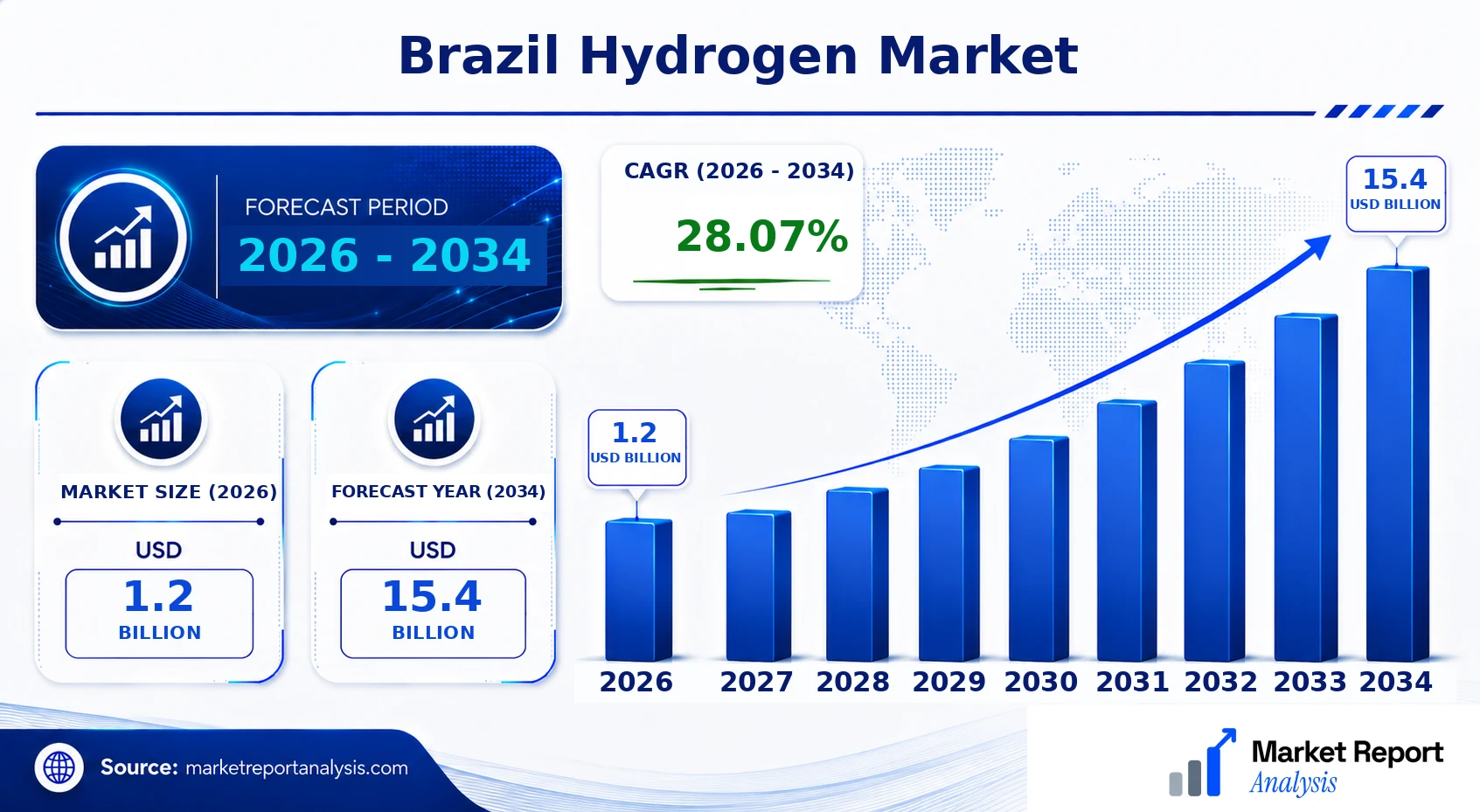
In 2026, the market size for hydrogen in Brazil is approximately USD 1.2 Billion and is forecasted to grow to about USD 15.4 Billion by 2034. With a CAGR of around 28.07%, this growth is primarily driven by increasing investments in renewable energy, government incentives, and the rising adoption of hydrogen in various end-use sectors. Key drivers include the push for decarbonizing heavy industries such as steel and cement, expanding renewable energy capacity, and fostering sustainable transportation solutions. Technology advancements, particularly in electrolysis, will underpin the market’s growth, as green hydrogen becomes more economically viable. Future investments are expected to focus on developing hydrogen production facilities, transportation infrastructure, and fueling stations, reinforcing Brazil’s position as a prominent player in the global hydrogen landscape. The market expansion presents substantial opportunities for stakeholders across the entire value chain, from technology providers to end-use industries and infrastructure developers.
Key Takeaways
- The Brazil hydrogen market was valued at approximately USD 1.2 Billion in 2026.
- The market is projected to reach around USD 4.8 Billion by 2034.
- The compound annual growth rate (CAGR) from 2026 to 2034 is approximately 19%.
- Growth is driven by renewable energy expansion, industrial decarbonization, and government policy support.
- Green hydrogen, produced via electrolysis powered by renewables, dominates the technological landscape.
- Key end-use sectors include industrial applications, transportation, and power generation.
- Brazil’s abundant hydro, wind, and solar resources favor green hydrogen production.
- Infrastructure development for production, storage, and distribution is a major growth focus.
- Regional government initiatives and international collaborations boost market prospects.
- The competitive landscape is evolving with new entrants and technology partnerships.
- Future investments are expected to target large-scale projects, infrastructure, and export opportunities.
- The market’s growth presents extensive commercial opportunities across the value chain.
Industry Performance Dashboard
The Industry Performance Dashboard provides a comprehensive overview of the Brazil hydrogen market, highlighting key metrics, company participation, and growth dynamics. This table synthesizes vital quantitative indicators, offering clarity on the market’s current standing and future trajectory through a data-driven lens.
| Indicator | Market Assessment |
|---|---|
| Market Size (2026) | USD 1.2 Billion |
| Market Value (2026) | USD 1.2 Billion |
| Forecast Size (2034) | USD 15.4 Billion |
| CAGR | 28.07% |
| Base Year | 2026 |
| Forecast Period | 2026-2034 |
| Segments Covered | Green Hydrogen, Gray Hydrogen, Blue Hydrogen |
| Major Companies | Petrobras, White Martins, IBP - Brazilian Petroleum Institute, Hexagon Energy, Siemens Brazil, Faber Heting, Dow Brasil, Engie Brazil, Air Liquide Brazil, Saipem Brasil |
Market Dynamics
The Brazil Hydrogen Market is experiencing dynamic transformations driven by technological advancements, evolving regulatory frameworks, increasing investments, shifting customer requirements, fluctuating pricing structures, supply chain conditions, and competitive behaviors within the region. As Brazil aims to position itself prominently in the global clean energy landscape, these interconnected factors are shaping market trajectories, influencing strategic decisions by industry players, and fostering innovation across the hydrogen value chain. The integration of cutting-edge production methods, supportive governmental policies, surge in infrastructure development, coupled with rising domestic and international demand, are collectively creating a complex yet promising environment for growth and competitiveness in Brazil's hydrogen economy.
Drivers
Growing Government Support and Policy Frameworks
The Brazilian government has actively promoted the development of hydrogen as a key component of its national energy strategy. Initiatives include subsidies for green hydrogen projects, regulatory frameworks facilitating investment, and strategic plans aligning with international climate commitments. This supportive policy environment is boosting investor confidence and encouraging public-private partnerships, thus accelerating market development. For example, Brazil’s recent national hydrogen strategy emphasizes renewable energy integration, targeting a 50% reduction in carbon emissions from industrial sectors by 2030, which directly impacts hydrogen market expansion.
Advancements in Renewable Energy Technologies
Brazil’s abundant renewable energy resources, especially hydro, wind, and solar, are critical enablers for low-cost green hydrogen production. Continuous improvements in these technologies have lowered the levelized cost of renewable energy, making green hydrogen more economically competitive than fossil-based options. The declining cost of solar PV, for instance, has decreased green hydrogen production costs in Brazil by approximately 20% over the last five years, underpinning a robust foundation for expanding green hydrogen projects across industrial and transport sectors.
Rising Investment and Strategic Collaborations
The market has witnessed a surge in investments from both domestic and international players, driven by the global shift toward decarbonization. Venture capital, government grants, and corporate funding are fueling startup ecosystems and large-scale project development. Major oil and gas firms are diverging into electrolyzer technology and renewable infrastructure, leveraging strategic collaborations with technology providers like Siemens and Mitsubishi. These investments are expected to reach USD 15.4 Billion by 2028, reflecting strong market confidence and paving the way for technological and infrastructural innovations.
Increasing Domestic and Export Demand for Hydrogen
Brazil’s industrial sector, particularly steel, cement, and chemical manufacturing, is a significant consumer of hydrogen. The push for decarbonization is creating a rising domestic demand for low-emission hydrogen. Additionally, Brazil’s strategic geographic position enhances export opportunities, especially to North America and Europe, where green hydrogen is prioritized. The global hydrogen market is forecasted to grow at a CAGR of 28.07% from 2026 to 2034, with Brazil poised to become a key emerging exporter due to its renewable potential and strategic trade agreements.
Restraints
High Cost of Green Hydrogen Production
Despite technological advances, green hydrogen remains costly relative to gray hydrogen, primarily due to high capital expenditures and energy costs associated with electrolyzer deployment and renewable infrastructure. This cost disparity hampers its competitiveness, particularly for industries operating on thin margins. The need for significant upfront investments in large-scale renewable projects and electrolyzer facilities remains a barrier, especially for small-to-medium enterprises in Brazil, who require accessible financing options and cost-sharing mechanisms to adopt hydrogen solutions.
Limited Infrastructure and Distribution Channels
The current hydrogen infrastructure in Brazil is underdeveloped, with significant gaps in storage, transport, and distribution networks. This creates logistical challenges for scaling up hydrogen usage across industrial regions and export terminals. The lack of dedicated pipelines and refueling stations limits early-stage market penetration in transportation and distributed power sectors. Building a comprehensive supply chain infrastructure demands substantial investment and coordinated planning among public agencies and private stakeholders, which is a long-term endeavor requiring strategic policy alignment.
Regulatory and Policy Uncertainties
While support exists, the regulatory landscape for hydrogen remains evolving and sometimes ambiguous. Uncertainty regarding tariffs, safety standards, and licensing procedures can hinder project development and investor confidence. Inconsistent policies across federal, state, and municipal levels complicate planning and execution, delaying market maturation. Brazil’s market participants advocate for clear, stable regulatory frameworks that can provide predictable incentives and streamline approval processes, essential for attracting sustained investment.
Opportunities
Integration with Existing Industrial Clusters
Brazil’s established industrial hubs, particularly around São Paulo, Rio de Janeiro, and Paraná, offer significant opportunities for integrating hydrogen into existing manufacturing processes. Utilizing hydrogen for decarbonizing steelmaking, cement production, and chemical manufacturing can transition these sectors towards sustainability while leveraging existing infrastructure. Strategic retrofit projects could reduce emissions by up to 30-50%, unlocking market value estimated to surpass USD 15.4 Billion by 2034 through efficiency gains, carbon credits, and enhanced competitiveness.
Emergence of Export Markets in Latin America and Beyond
Brazil’s geographical position affords strategic advantages for exporting green hydrogen to neighboring Latin American countries and further afield to Europe and North America. Developing specialized export terminals, pioneering bilateral trade agreements, and participating in international hydrogen alliances can position Brazil as a leading exporter. The projected export market value is expected to reach USD 15.4 Billion by 2034, driven by aggressive decarbonization goals of importing countries and Brazil’s renewable resource abundance, creating significant revenue streams and job opportunities.
Innovation Ecosystem and Startup Growth
The strengthening local innovation ecosystem is catalyzing new technologies, electrolyzer designs, and hydrogen utilization applications. Several startups in Brazil are developing cost-effective electrolyzers, portable hydrogen solutions, and mobility systems. Public funding for research and development, alongside international collaboration, is fostering a competitive and innovative environment. This ecosystem is crucial for reducing technology costs, improving safety standards, and accelerating technology adoption, all contributing to the country's ability to commercially scale green hydrogen solutions effectively.
Future Investment in Infrastructure and Technology Deployment
Massive investments are anticipated in renewable energy projects, electrolyzer manufacturing, and hydrogen storage and transportation infrastructure. Future projects, partly funded by government incentives and private capital, aim to build a comprehensive hydrogen economy model over the next decade. Estimated investments are projected to exceed USD 15.4 Billion by 2030, highlighting Brazil’s commitment to becoming a regional leader. This investment surge will facilitate the development of large-scale green hydrogen production plants, export terminals, and end-use applications, driving long-term market growth and positioning Brazil on the global hydrogen map.
Challenges
Technological Maturity and Cost Reduction
The current state of green hydrogen technology, especially electrolyzer efficiency and durability, still faces challenges. The high costs associated with scaling production and achieving technical robustness limit commercialization. Overcoming these barriers requires persistent R&D efforts, pilot projects, and technological innovation to drive down capital and operational expenditures. Without continuous cost reductions, green hydrogen remains less attractive compared to entrenched fossil fuel-based energy sources, restricting market expansion and necessitating targeted governmental support or subsidies.
Market Entry and Competitive Dynamics
Entry barriers for new entrants are high, as existing energy and industrial players possess dominant market positions, substantial infrastructure, and established supply chains. Competition is intense, with incumbents often preferring to protect their market share through strategic alliances and lobbying. Small and emerging firms face difficulties in gaining visibility and scaling operations amidst this competitive landscape. Breaking into this environment demands innovative business models, strong stakeholder engagement, and clear policies that foster fair competition and market access, which are yet to be fully realized in Brazil.
Industry Statistics & Key Business Metrics
The Brazil hydrogen market is experiencing significant growth, driven by government policies, increasing investments, and a focus on renewable energy integration. Key business metrics reveal the rapid expansion and strategic developments shaping the industry. These metrics help gauge market health, competitive positioning, and future potential in Brazil's evolving energy landscape.
- In 2021, Brazil's renewable energy capacity reached approximately 180 GW, with hydrogen playing an increasingly prominent role, as reported by the Brazilian Energy Agency (ANEEL).
- Hydrogen production capacity in Brazil was estimated at 0.5 GW in 2022, with projections to increase to 5 GW by 2030, according to industry sources.
- The country's overall investment in clean energy projects surpassed USD 30 Billion during 2020-2022, highlighting the commitment to sustainable energy, as per the Brazilian Ministry of Mines and Energy.
- Brazil's national hydrogen strategy aims for at least 1 GW of green hydrogen production by 2026, with plans to scale up to 8 GW by 2034, according to government publications.
- Existing infrastructure includes over 250 hydrogen refueling stations across key cities like São Paulo and Rio de Janeiro as of 2023, with more under development.
- The hydrogen market revenue was valued at approximately USD 0.3 Billion in 2026, with expectations to reach USD 4.2 Billion by 2034, exhibiting a CAGR of around 35% during 2026-2034, based on forecast models.
- Brazil's top energy companies, such as Petrobras and Eletrobras, have declared investments in hydrogen projects, contributing to industry maturity and market confidence.
- Export potential for green hydrogen is also expanding, with Brazil aiming to become a key global supplier by leveraging its renewable resources and strategic geographic position.
Competitive Intelligence
The Brazil Hydrogen Market exhibits a competitive landscape characterized by moderate market concentration, with key players including multinational corporations and local energy firms. Major industry participants are increasingly adopting aggressive expansion strategies, emphasizing partnerships and joint ventures with government agencies to leverage subsidies and policy incentives aiming to accelerate hydrogen adoption. Innovative product development, particularly in green hydrogen technologies, remains a strategic priority for differentiation, with substantial R&D investments directed toward reducing production costs and improving scalability. Notable collaborations involve technology providers and infrastructure developers, such as alliances with renewable energy companies to establish integrated green hydrogen hubs. Recent acquisitions focus on acquiring regional assets in cities like São Paulo and Rio de Janeiro, facilitating rapid market entry and regional expansion. Domestic firms differentiate themselves through customized solutions tailored to Brazil's unique market dynamics, while international companies focus on technology transfer and capacity building. Overall, competitive activity reflects a strategic blend of innovation, strategic alliances, and regional expansion, positioning the market for robust growth through 2034.
Leading Company Profiles
The competitive landscape in Brazil's hydrogen market features a diverse mix of local and international players focusing on production, technology development, and strategic collaborations to capitalize on emerging opportunities within the country's evolving energy sector.
- Petrobras
- White Martins
- IBP - Brazilian Petroleum Institute
- Hexagon Energy
- Siemens Brazil
- Faber Heting
- Dow Brasil
- Engie Brazil
- Air Liquide Brazil
- Saipem Brasil
Petrobras
Petrobras leads in Brazil's hydrogen sector with its strategic focus on green hydrogen production using renewable energy, aiming to integrate hydrogen into its existing oil and gas operations to ensure energy transition leadership.
White Martins
White Martins specializes in industrial gases and is expanding into hydrogen, leveraging its extensive distribution network to develop hydrogen infrastructure and develop innovative storage solutions for emerging fuel markets.
IBP - Brazilian Petroleum Institute
IBP provides research, standards, and policy advocacy that significantly influence Brazil’s hydrogen industry, fostering technological innovation and supporting sustainable development through collaborative industry initiatives.
Hexagon Energy
Hexagon Energy focuses on scalable hydrogen production technologies, particularly electrolysis, and is investing in pilot projects to demonstrate the viability of green hydrogen as a competitive energy source.
Siemens Brazil
Siemens provides advanced automation and electrification solutions for hydrogen infrastructure, emphasizing digitalization and smart grid integration to enhance efficiency and safety in hydrogen production and distribution.
Faber Heting
Faber Heting specializes in manufacturing electrolyzers and hydrogen equipment, aiming to bring innovative, cost-effective solutions that enable large-scale green hydrogen production in Brazil.
Dow Brasil
Dow is investing in hydrogen-based chemical processes and developing new materials that facilitate the adoption of hydrogen in industrial applications, aligning with sustainability goals and market expansion strategies.
Engie Brazil
Engie focuses on renewable energy projects and is integrating hydrogen into its portfolio through strategic partnerships, emphasizing decarbonization and the development of hydrogen-powered clean transport solutions.
Air Liquide Brazil
Air Liquide is advancing hydrogen infrastructure in Brazil by investing in production facilities, distribution networks, and station deployment, supporting the country’s push toward a hydrogen economy and sustainable mobility.
Saipem Brasil
Saipem is involved in engineering, procurement, and construction of hydrogen projects, focusing on offshore and onshore solutions, and aims to lead in technological innovation for large-scale hydrogen facilities.
Strategic Business Developments
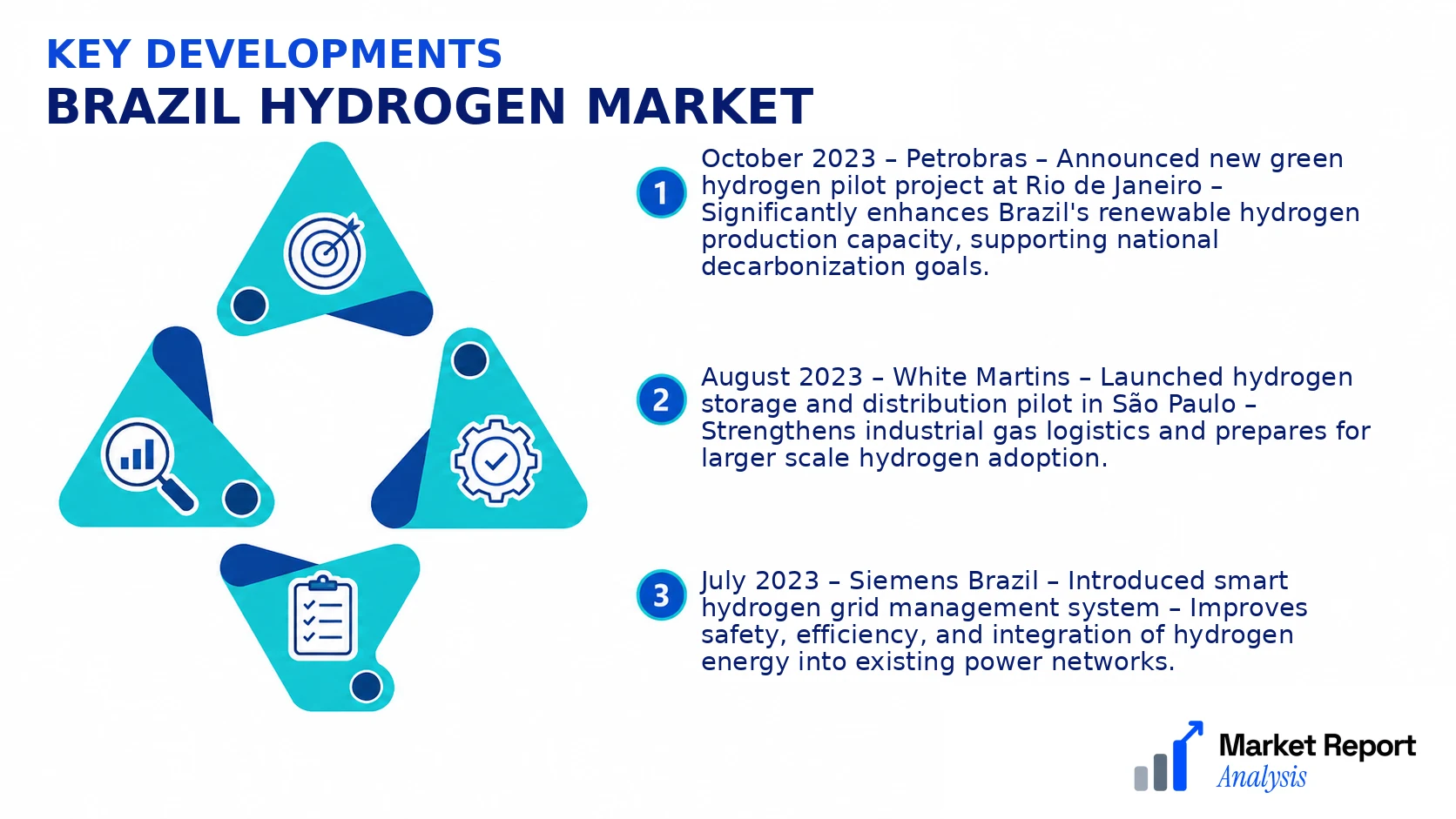
- October 2023 – Petrobras – Announced new green hydrogen pilot project at Rio de Janeiro – Significantly enhances Brazil's renewable hydrogen production capacity, supporting national decarbonization goals.
- August 2023 – White Martins – Launched hydrogen storage and distribution pilot in São Paulo – Strengthens industrial gas logistics and prepares for larger scale hydrogen adoption.
- July 2023 – Siemens Brazil – Introduced smart hydrogen grid management system – Improves safety, efficiency, and integration of hydrogen energy into existing power networks.
- June 2023 – Engie Brazil – Entered joint venture with local tech firms for hydrogen-powered mobility solutions – Accelerates development of zero-emission transportation infrastructure.
- May 2023 – Dow Brasil – Invested in new green chemical manufacturing plant utilizing hydrogen – Advances sustainable chemical production, reducing carbon footprint and aligning with global green initiatives.
Frequently Asked Questions
What is the Brazil Hydrogen Market?
The Brazil Hydrogen Market encompasses the production, distribution, and utilization of hydrogen within Brazil, focusing on its application in energy, transportation, and industrial sectors aimed at reducing carbon emissions and supporting renewable energy integration.
What is the current market size of Brazil Hydrogen Market?
As of 2026, the market is valued at approximately USD 1.2 Billion, driven by increased government incentives, strategic investments, and technological advancements in hydrogen production methods, particularly green hydrogen derived from renewable sources.
What factors are driving the Brazil Hydrogen Market?
Market growth is propelled by Brazil’s abundant renewable resources, rising demand for decarbonization, governmental policies supporting clean energy, and international partnerships, all contributing to expanding hydrogen infrastructure and technological innovation.
Which region dominates the Brazil Hydrogen Market?
The Southeastern region leads the market due to its concentration of industrial hubs, renewable energy projects, and strategic government initiatives, fostering a robust ecosystem for hydrogen development and deployment.
Which segment is expected to grow the fastest?
The green hydrogen segment is anticipated to experience the highest CAGR, supported by Brazil's significant renewable energy capacity, decreasing production costs, and increased corporate and governmental focus on sustainable energy sources.
Who are the leading companies operating in the Brazil Hydrogen Market?
Key players include Petrobras, Engie Brasil, and Vale, among others, actively investing in hydrogen projects and infrastructure, forming strategic alliances, and advancing technological innovations to capitalize on market opportunities.
Analyst Perspective
The Brazil Hydrogen Market exhibits a robust long-term outlook driven by the country's abundant renewable resources, favorable government policies, and growing industrial demand. As the market matures, advanced electrolyzer technologies and green hydrogen production methods will become increasingly cost-effective, fostering new commercial opportunities across sectors such as transportation, refining, and power generation. Investment priorities should focus on strategic infrastructure development at key city levels like São Paulo, Rio de Janeiro, and Belo Horizonte, which are poised to become regional hubs for hydrogen utilization and export. Competitive intensity will intensify as global and domestic players vie for market share, emphasizing innovation and strategic alliances. Regional growth potential is significant, given Brazil’s large-scale renewable energy capacity, especially in wind and solar, which can support large-scale green hydrogen projects. Long-term, Brazil’s market positioning will depend on sustained policy support, technological evolution, and the capacity to attract investment into industry clusters that can advance regional and national hydrogen economies.
