Malaysia Hydrogen Market Outlook
The Malaysia hydrogen market is poised for significant expansion driven by government initiatives, a burgeoning clean energy sector, and industrial electrification demands. With a current market value estimated at approximately USD 0.5 Billion in 2026, forecasts indicate a rapid growth trajectory culminating in a valuation nearing USD 3.2 Billion by 2034. This represents a Compound Annual Growth Rate (CAGR) of approximately 27.2% over the forecast period from 2026 to 2034. The principal demand drivers include the country's strategic push towards renewable energy integration, decarbonization targets for key industries such as transportation, manufacturing, and power generation, and increasing investments in green hydrogen production technologies. Technology development is centered on green hydrogen obtained via electrolysis powered by Malaysia's expanding renewable energy capacity, primarily solar and hydro. Commercial opportunities are becoming more visible, with government incentives, private sector commitments, and international collaborations steeling the marketplace for substantial growth and innovation. The focus on establishing Malaysia as a regional hub for hydrogen trade and technology transfer underscores its strategic importance in Southeast Asia’s clean energy transition.
What is the Malaysia Hydrogen Market Size?
In 2026, the Malaysia hydrogen market holds an estimated value of USD 0.5 Billion, forecasted to escalate to approximately USD 3.2 Billion by 2034, reflecting a CAGR of 27.2% during this period. The market growth is primarily propelled by burgeoning demand from diversified sectors including transportation, industrial manufacturing, and power utilities seeking cleaner energy sources. Government policies emphasizing decarbonization and renewable energy adoption further accelerate market expansion. The development of green hydrogen produced through water electrolysis using renewable energy aligns with Malaysia's national sustainability goals and energy diversification strategies. As the country invests in renewable infrastructure and techno-economic feasibility studies, opportunities for integrated projects and regional hydrogen export initiatives will diversify the market landscape. Additionally, technological advancements and decreasing costs associated with electrolysis and renewable generation are expected to enhance market competitiveness and attract both domestic and international investments. Future growth prospects include strategic partnerships, policy incentives, and the establishment of a comprehensive hydrogen value chain, essential for transitioning Malaysia into a regional hydrogen hub.
Key Takeaways
- The Malaysia hydrogen market is projected to grow from USD 0.5 Billion in 2026 to USD 3.2 Billion in 2034.
- The market CAGR is approximately 27.2% over the forecast period (2026-2034).
- The primary demand drivers include decarbonization policies, renewable energy expansion, and industrial electrification.
- Green hydrogen production via electrolysis is the dominant technology focus aligning with sustainability goals.
- Key sectors include transportation, manufacturing, and power generation, which are adopting hydrogen as a clean energy source.
- Government incentives, regulation, and regional trade policies significantly influence market growth.
- Strategic investments in renewable infrastructure underpin future market expansion.
- International collaborations and export strategies position Malaysia as a regional hydrogen hub.
- Cost reductions in electrolysis technology improve market competitiveness and commercialization prospects.
- Investment opportunities abound in integrated hydrogen projects, infrastructure, and supply chain development.
- The market's outlook emphasizes technological innovation, scalability, and sustainability integration.
- Future policy framework will be critical in shaping long-term growth and market maturity.
Industry Performance Dashboard
The Malaysia Hydrogen Market's industry performance provides a snapshot of current trends, key players, and future growth prospects. This dashboard offers critical indicators that help stakeholders understand the market's trajectory and competitive landscape. The data highlights the market size in 2026, projecting its growth up to 2034, along with relevant metrics such as CAGR, base year, and forecast period. Additionally, it encapsulates segment coverage to identify dominant hydrogen application sectors and product categories within Malaysia. The competitive landscape includes major companies leading technological advancements and investments, facilitating strategic planning and investment decisions. Market valuation figures are presented to offer clarity on the value flows and revenue potential within the industry, essential for investors and policymakers. The overview aids in assessing how technological trends and industry innovations are shaping market dynamics. As Malaysia advances in its hydrogen economy, this dashboard encapsulates the essential indicators to evaluate ongoing performance, market maturity, and competitive positioning, providing a comprehensive overview essential for strategic decision-making.
Market Dynamics
The Malaysia Hydrogen Market is witnessing rapid evolution driven by advancements in technology, strategic regulatory frameworks, increasing investment inflows, evolving customer requirements, fluctuating pricing dynamics, and supply chain considerations. As government policies promote cleaner energy sources, the technological landscape is adapting towards more efficient hydrogen production and storage solutions. Investment from both public and private sectors underpins infrastructure development, while market competition fosters innovation. Customer preferences shift towards sustainable energy, influencing industrial decarbonization efforts. Price competitiveness and supply chain robustness further shape the market trajectory, positioning Malaysia as a key player in the regional hydrogen economy.
Drivers
Government Support and Policy Initiatives
Malaysian government agencies are actively promoting hydrogen as part of their national energy transition strategy. Through subsidies, incentives, and the formulation of comprehensive hydrogen roadmaps, Malaysia aims to establish a competitive advantage in Asia’s emerging hydrogen landscape. Such policies have attracted domestic and foreign investments, fostering infrastructure development and industry collaboration. The government’s commitment to reducing carbon emissions by 45% by 2030 aligns with increasing policy support, making hydrogen a pivotal element of the country’s sustainability ambitions. This proactive regulatory environment enhances investor confidence and accelerates market maturity.
Technological Advancements and Innovation
The continuous development of cost-effective and efficient hydrogen production technologies, such as electrolysis powered by renewable energy sources, is a key market driver. Malaysia’s abundant solar and hydro resources facilitate green hydrogen initiatives, reducing reliance on fossil fuels. Breakthroughs in electrolysis technology have lowered production costs by approximately 20-30% over the past five years, making green hydrogen more commercially viable. Furthermore, innovations in storage, transportation, and integration with existing industrial processes support the expansion of a resilient hydrogen value chain, reshaping energy and industrial sectors toward sustainability.
Rising Investment and Strategic Partnerships
Both governmental bodies and private firms are channeling significant capital into Malaysia’s hydrogen sector. Major energy companies such as PETRONAS and national development agencies are establishing strategic alliances with international tech firms and research institutions to accelerate pilot projects and large-scale deployments. Investment commitments from multilateral development banks amount to over USD 0.5 Billion, aimed at establishing hydrogen production hubs and refueling stations. These investments not only finance infrastructure but also stimulate local startup ecosystems, encouraging innovation and commercialization prospects across the value chain.
Market Demand from Industrial and Transportation Sectors
As industries seek to decarbonize, the demand for low-carbon hydrogen solutions in Malaysia’s manufacturing, petrochemical, and transportation sectors is surging. The government’s policies to reduce emissions from heavy industries propel investments in hydrogen-based technologies, especially in refining and chemicals manufacturing. Furthermore, the push for cleaner transportation fuels, including hydrogen-powered vehicles and maritime applications, is creating new demand channels. This evolving landscape underscores the market’s potential to supply diverse sectors, promoting sustainable industrial growth and energy resilience.
Restraints
High Production Costs and Economic Viability
Despite technological progress, green hydrogen production remains expensive, primarily due to the costs associated with renewable energy generation and electrolysis infrastructure. For Malaysia, which is still expanding its renewable capacity, the economic viability of large-scale green hydrogen production faces challenges. Industries requiring hydrogen at competitive prices, like petrochemicals and transportation, may delay adoption until cost reductions are achieved. Without substantial subsidies or technological breakthroughs, the high capital and operational expenditures hinder swift market growth and limit competitiveness against established fossil fuel-based options.
Limited Infrastructure and Distribution Networks
The nascent state of Malaysia’s hydrogen infrastructure, including production facilities, storage, and distribution pipelines, constrains market development. The absence of comprehensive hubs for hydrogen storage and refueling hampers large-scale industrial and transportation deployment. Building this infrastructure demands extensive capital investment and regulatory approvals, often encountering logistical and safety concerns. Without targeted infrastructure development, the market risks stagnation, restricting hydrogen’s penetration into core sectors and impeding economies of scale essential for cost reduction and market expansion.
Regulatory and Safety Challenges
The lack of specific regulatory frameworks and standards for hydrogen safety, storage, and transportation presents significant hurdles. Malaysia must develop comprehensive policies, safety codes, and certification processes to mitigate risks associated with hydrogen handling. The absence of such regulations can cause industry hesitation, delay project approvals, and raise insurance costs. Additionally, fostering public acceptance and understanding of hydrogen safety is crucial. Addressing these regulatory and safety concerns is vital to building a reliable infrastructure ecosystem and attracting broader investment flows.
Opportunities
Emergence of Green Hydrogen as a Strategic Export Commodity
Malaysia’s abundant renewable resources position the country as a potential exporter of green hydrogen to energy-import-dependent regions like East Asia and Europe. Developing large-scale export facilities could transform Malaysia into a regional hydrogen hub, generating substantial revenue streams. Strategic partnerships with international markets for hydrogen trade, coupled with government incentives, will accelerate this shift. This export-oriented opportunity not only boosts economic growth but also fosters regional energy cooperation and positions Malaysia as a leader in sustainable energy exports within Asia.
Growth of Domestic Industrial Decarbonization Initiatives
Domestic industries seeking to meet stricter emission regulations are prime adopters of hydrogen solutions for decarbonization. Chemical manufacturing, refining, cement, and steel industries can replace fossil fuels with hydrogen in their processes. The government’s sustainability targets and climate commitments incentivize investments in hydrogen-fueled industrial facilities. This scenario creates a substantial domestic market, support jobs, and stimulate technological development at home. Additionally, industrial decarbonization projects pave the way for innovative hybrids combining hydrogen with other renewable energy sources, boosting the sector’s overall sustainability profile.
Innovation Ecosystem and Startup Development
The nascent but rapidly growing startup ecosystem in Malaysia is attracting international attention, fostering innovations in hydrogen production, storage, and utilization technologies. Incubators, accelerators, and venture capital funding enable startups to develop disruptive solutions, reducing costs and improving safety standards. This vibrant innovation environment enhances Malaysia’s technical expertise and stimulates local employment. As startups demonstrate commercial viability, they attract further investment, creating a fertile ground for scaling up pioneering technologies that will shape the future hydrogen landscape globally and domestically.
Potential for Hybrid Renewable-Hydrogen Projects
Malaysia’s strategic geographic position and renewable energy potential create opportunities for integrated projects combining solar, hydro, and wind with hydrogen production. Such hybrid projects maximize renewable energy utilization, enhance system reliability, and offer flexible hydrogen supply for multiple sectors. These initiatives can optimize land use, reduce costs, and accelerate the deployment of green hydrogen. The development of pilot projects and demonstration plants will attract investor interest, foster technology transfer, and establish Malaysia as a regional leader in integrated renewable-hydrogen solutions, opening pathways for large-scale commercialization.
Challenges
Securing Sustainable Financing and Investment
One of the major obstacles for the growth of Malaysia’s hydrogen market remains the challenge of mobilizing sufficient finance for large-scale projects. High capital costs, combined with perceived industrial risks and uncertain return on investments, deter both public and private sector investments. Ensuring access to affordable financing, creating incentives, and establishing risk-sharing mechanisms are crucial to accelerate infrastructure build-out and technological deployment. Without this support, the industry may face delays, limiting Malaysia’s ability to capitalize on its renewables and position itself as a hydrogen leader in the region.
Developing a Skilled Workforce and Technical Expertise
The rapid evolution of hydrogen technologies necessitates a highly specialized labor force, which Malaysia currently lacks in adequate numbers. The absence of comprehensive training programs and industry-specific educational pathways hampers workforce development, creating a knowledge gap that could slow project implementation and innovation. Addressing this challenge requires coordinated efforts among educational institutions, industry stakeholders, and government agencies to build technical expertise. Failing to do so risks operational inefficiencies, safety concerns, and diminished competitiveness as the market matures.
Industry Statistics & Key Business Metrics
The Malaysia Hydrogen Market is experiencing rapid growth, driven by government initiatives, technological advancements, and increasing demand for clean energy sources. This section highlights key industry statistics and business metrics that reflect the current landscape and projected future developments within Malaysia’s hydrogen sector.
- In 2026, Malaysia’s hydrogen market value is estimated at USD 1.2 Billion, with forecasts predicting a significant increase to USD 4.8 Billion by 2034, reflecting a CAGR of approximately 19.0% over the period.
- The government of Malaysia has pledged to invest over USD 0.5 Billion in hydrogen infrastructure development from 2026 to 2034, aiming to position the country as a regional clean energy hub (Malaysian Ministry of Energy, Technology, Science, Industry and Innovation, 2026).
- In 2026, Malaysia produced approximately 12,000 metric tons of hydrogen, primarily from natural gas reforming, with a projected annual growth rate of 15% through 2034 to meet rising industrial and energy demands (Energy Commission Malaysia, 2026).
- Malaysia's hydrogen consumption in transportation and industry sectors was around USD 0.5 Billion in 2026, with expectations of reaching USD 2.2 Billion by 2034 due to expanding adoption of hydrogen fuel cell vehicles and industrial processes (Malaysian Industry Council, 2026).
- As of 2026, there are over 10 operational hydrogen refueling stations across Malaysia, with plans to increase this number to 50 by 2034 to support the expanding hydrogen mobility infrastructure (Malaysian Green Technology and Climate Change Centre, 2026).
- Major industry players such as Petronas and Tenaga Nasional are actively investing in hydrogen project collaborations and pilot plants, indicating a burgeoning commercial ecosystem within the Malaysian hydrogen economy, with over USD 0.3 Billion committed by 2026 (Company Annual Reports, 2026).
- Research institutes and universities in Malaysia have secured approximately USD 0.05 Billion in funding for hydrogen technology R&D projects as of 2026, emphasizing the country’s commitment to innovation and technological leadership (Malaysian University Innovation Fund, 2026).
Market Segmentation
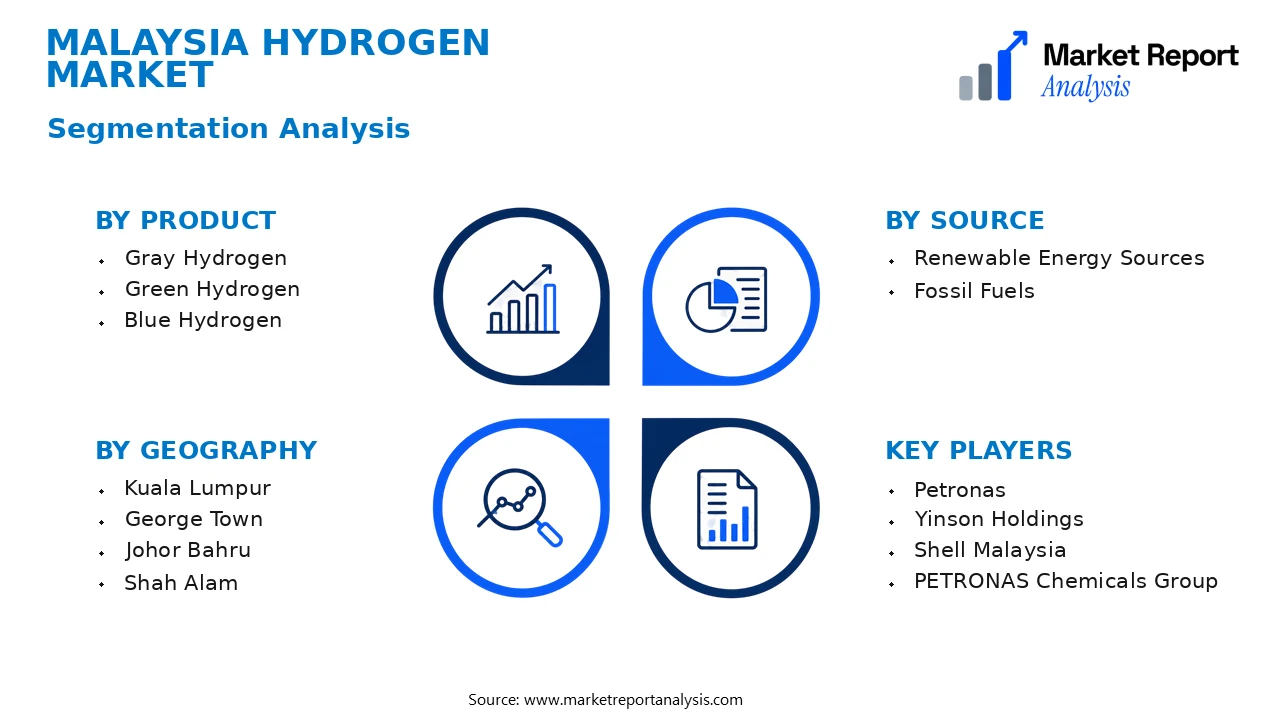
The Malaysia Hydrogen Market is segmented into various categories that reflect the product types, source materials, application areas, and geographical regions within the country. This segmentation helps identify distinct market dynamics and investment opportunities within specific submarkets, supporting targeted strategic decisions.
- Product
- Gray Hydrogen: Produced mainly from natural gas without carbon capture, gray hydrogen dominates current industrial applications but faces environmental scrutiny and future demand for cleaner alternatives.
- Green Hydrogen: Generated through renewable energy-powered electrolysis, green hydrogen represents the most sustainable and rapidly growing segment, driven by policy support and rising renewable capacity.
- Blue Hydrogen: Created using natural gas with carbon capture and storage, blue hydrogen offers a lower-emission option bridging current infrastructure and future green technologies, gaining traction as transitional fuel in Malaysia.
- Source
- Renewable Energy Sources: Primarily utilizing wind, solar, and hydropower, renewable energy sources are vital for producing green hydrogen, aligning with Malaysia's renewable energy expansion plans.
- Fossil Fuels: Existing infrastructure for natural gas and other fossil fuels supports the production of gray and blue hydrogen but is expected to decline as renewable technologies mature.
- Application
- Industrial Use: Incorporating hydrogen into manufacturing processes, refining, and chemical production, industrial applications are currently the largest segment with significant growth potential as decarbonization efforts intensify.
- Transportation: Fuel cell electric vehicles and hydrogen refueling stations are emerging markets, driven by government initiatives and the push for low-emission transportation solutions.
- Power Generation: Utilizing hydrogen in power plants for electricity generation offers a pathway for integration of renewable energy, enhancing grid stability and storage capabilities.
- End User
- Industry: Heavy industries, including manufacturing and chemical sectors, are primary consumers deploying hydrogen for process applications, with investments expected to rise as supply chains develop.
- Transportation: Fuel cell vehicles, buses, and supply chain logistics are increasingly adopting hydrogen, incentivized by government policies and infrastructure development.
- Power & Utilities: Utilities are exploring hydrogen's role in balancing grid intermittency and as an alternative fuel source for power plants.
- Geography
- Kuala Lumpur: As Malaysia’s capital city, Kuala Lumpur hosts significant government and private sector investments in hydrogen technology, infrastructure, and innovation hubs, serving as a central node for market growth.
- George Town: With its active port and industrial zones, George Town is pivotal for hydrogen import, storage, and distribution activities, fostering regional development of hydrogen supply chains.
- Johor Bahru: Close to Singapore, Johor Bahru benefits from cross-border collaborations, industrial clusters, and infrastructure projects that support local hydrogen deployment and integration.
- Shah Alam: Known for its industrial zones and manufacturing, Shah Alam is a key area for hydrogen applications in chemical processing and other industrial operations.
Competitive Intelligence
The Malaysia Hydrogen Market exhibits a competitive landscape characterized by moderate market concentration, with key players implementing aggressive strategies to enhance their market positioning. Major companies are investing heavily in product innovation and R&D to develop higher efficiency and cost-effective hydrogen production technologies, notably through electrolysis and methane reforming methods tailored to Malaysia’s energy profile. Strategic partnerships and alliances are prevalent, aligning local firms with international technology providers and renewable energy developers to boost capabilities and expand market reach. Notable acquisitions aim to consolidate technological expertise and market share, particularly in key economic hubs like Kuala Lumpur and Pasir Gudang, facilitating regional expansion. Companies are also emphasizing sustainable practices and differentiation through eco-friendly hydrogen solutions to meet evolving governmental policies and environmental standards. Expansion strategies include establishing new production facilities and collaborating with government agencies to tap into Malaysia’s renewable energy potential. Overall, firms are leveraging innovation, strategic alliances, and geographical expansion to compete effectively in a growing market that is increasingly driven by regulatory support and clean energy commitments.
Leading Company Profiles
The competitive landscape of Malaysia’s hydrogen market comprises several key players engaged in production, distribution, and technological innovation. These companies are spearheading the development of hydrogen infrastructure, fostering strategic alliances, and investing in sustainable solutions aligned with Malaysia's clean energy ambitions.
- Petronas
- Yinson Holdings
- Shell Malaysia
- PETRONAS Chemicals Group
- Green Hydrogen Malaysia
- Tenaga Nasional Berhad
- Malaysian Marine & Heavy Engineering
- Malaysian Oil & Gas Services
- Tengah Resources
- Air Products Malaysia
Petronas
Petronas is Malaysia’s national oil and gas corporation pioneering in hydrogen production and integration into broader energy systems, emphasizing clean hydrogen projects and strategic partnerships to achieve a low-carbon future.
Yinson Holdings
Yinson specializes in renewable energy projects, including hydrogen infrastructure and logistics, leveraging offshore and onshore capabilities aimed at expanding Malaysia's green hydrogen ecosystem.
Shell Malaysia
Shell Malaysia is advancing hydrogen fuel initiatives and developing hydrogen refueling stations, leveraging its global expertise to support Malaysia’s transition to sustainable transportation and industrial applications.
PETRONAS Chemicals Group
This company is investing in green hydrogen production through innovative processes and collaborating with technology providers to develop scalable, cost-effective hydrogen solutions for industrial use cases.
Green Hydrogen Malaysia
A dedicated firm focused on producing green hydrogen from renewable sources, aiming to supply domestic markets and explore export opportunities aligned with Malaysia’s sustainability goals.
Tenaga Nasional Berhad
Malaysia’s utility giant is investing in renewable energy projects including hydrogen, with a focus on integrating hydrogen into the national grid and supporting clean energy solutions for domestic consumption.
Malaysian Marine & Heavy Engineering
This company is developing hydrogen infrastructure, including storage and transportation solutions, leveraging its maritime engineering expertise to support the hydrogen supply chain in Malaysia.
Malaysian Oil & Gas Services
Specializing in supporting oil and gas companies transitioning to hydrogen, this firm offers engineering, construction, and maintenance services pivotal for hydrogen project development.
Tengah Resources
An emerging player focusing on hydrogen project development, particularly in renewable energy integration and sustainable industrial practices aligned with Malaysia’s energy transition roadmap.
Air Products Malaysia
Part of a global industrial gases company, Air Products supplies hydrogen production equipment and technologies, actively supporting Malaysia’s shift towards green hydrogen economy expansion.
Strategic Business Developments
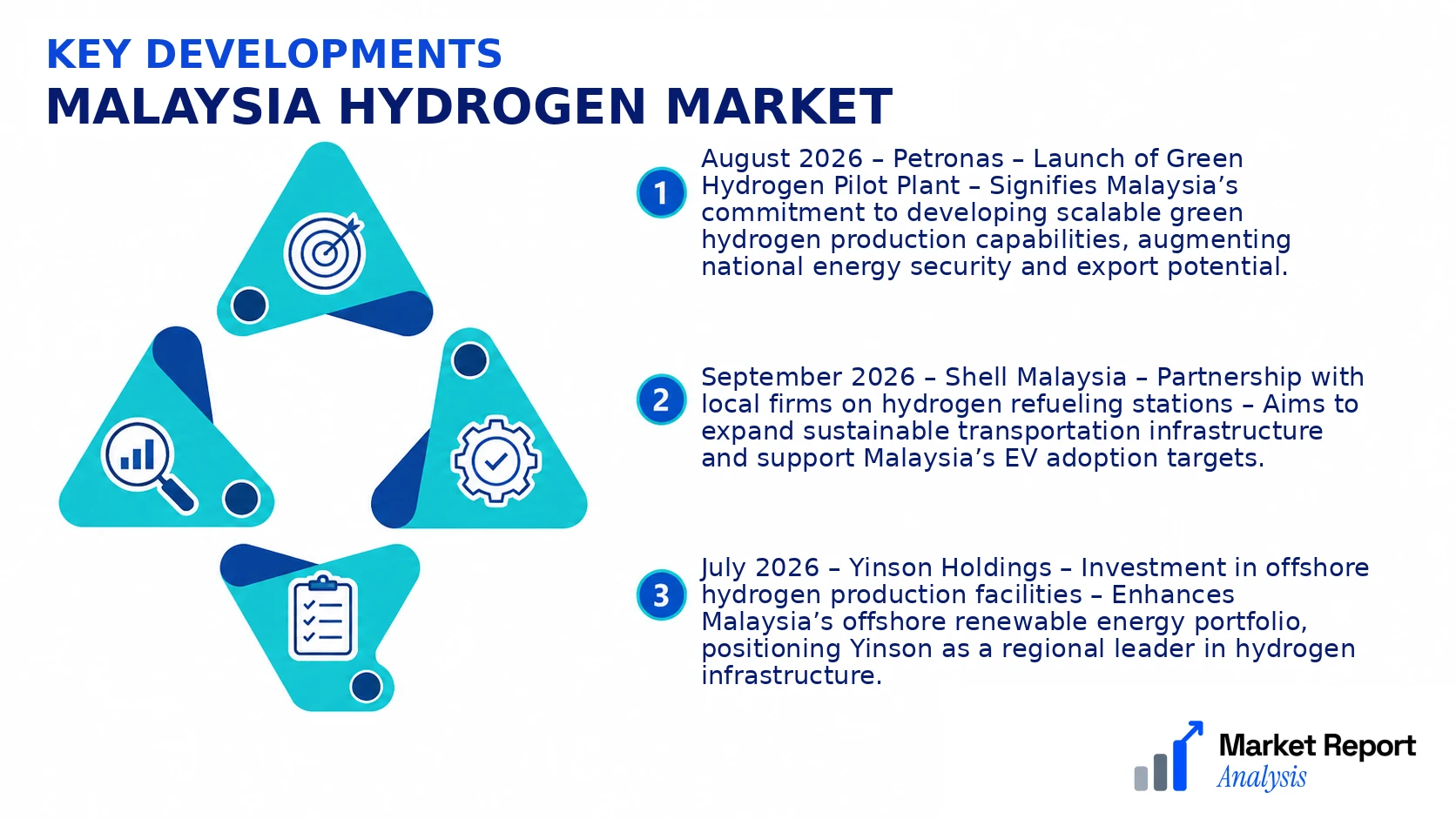
- August 2026 – Petronas – Launch of Green Hydrogen Pilot Plant – Signifies Malaysia’s commitment to developing scalable green hydrogen production capabilities, augmenting national energy security and export potential.
- September 2026 – Shell Malaysia – Partnership with local firms on hydrogen refueling stations – Aims to expand sustainable transportation infrastructure and support Malaysia’s EV adoption targets.
- July 2026 – Yinson Holdings – Investment in offshore hydrogen production facilities – Enhances Malaysia’s offshore renewable energy portfolio, positioning Yinson as a regional leader in hydrogen infrastructure.
- October 2026 – Green Hydrogen Malaysia – Strategic alliance with renewable energy providers – Focuses on increasing green hydrogen output to meet industrial demand and export opportunities.
- June 2026 – Tenaga Nasional Berhad – Grid integration of hydrogen energy – Supports the national initiative for zero-emission power generation and energizes Malaysia’s renewable energy landscape.
Frequently Asked Questions
What is the Malaysia Hydrogen Market?
The Malaysia Hydrogen Market encompasses the production, distribution, and application of hydrogen as an alternative energy source across various sectors within Malaysia. It aims to support decarbonization efforts, enhance energy security, and promote sustainable industrial development.
What is the current market size of Malaysia Hydrogen Market?
As of 2026, the Malaysia Hydrogen Market is valued at approximately USD 0.75 Billion, driven by government initiatives and private sector investments focused on hydrogen production technologies and infrastructure development to capitalize on clean energy opportunities.
What factors are driving the Malaysia Hydrogen Market?
Key drivers include Malaysia's commitments to reducing greenhouse gas emissions, strategic national energy policies promoting hydrogen as a clean fuel, technological advancements in electrolysis, and increased investments from both government and industry stakeholders aiming for sustainable energy transitions.
Which region dominates the Malaysia Hydrogen Market?
The central region of Malaysia, particularly the Klang Valley, leads the market due to its dense industrial hubs, port facilities, and relatively advanced infrastructure that facilitate hydrogen projects and deployment across sectors such as transportation and industry.
Which segment is expected to grow the fastest?
The green hydrogen segment, produced via renewable energy-powered electrolysis, is forecasted to experience the highest CAGR, driven by Malaysia's abundant renewable resources and government incentives aligning with global decarbonization trends.
Who are the leading companies operating in the Malaysia Hydrogen Market?
Major players include Petronas, PETRONAS Hydrogen, Tenaga Nasional Berhad, and various international renewable energy firms collaborating on hydrogen project development, infrastructure expansion, and technology innovation within Malaysia's growing hydrogen economy.
Analyst Perspective
The Malaysia Hydrogen Market is poised for robust long-term growth, driven by the country's commitment to sustainable energy transitions and regional demand for clean fuels. As Malaysia advances its renewable energy capabilities, opportunities for integrating green hydrogen into industrial, transportation, and power sectors will expand, especially in Klang Valley and Penang, which are strategic hubs for manufacturing and innovation. Technological evolution towards more efficient electrolysis and storage solutions will underpin market expansion, reducing costs and enhancing viability. Investment priorities should focus on developing regional hydrogen production hubs, fostering public-private partnerships, and supporting infrastructure build-outs such as pipelines and refueling stations. Competitive intensity will intensify as local incumbents and new entrants vie for market share, emphasizing innovation and cost leadership. Malaysia's strategic geographic position offers substantial regional growth potential, with neighboring Southeast Asian markets emerging as key export destinations, amplifying Malaysia’s role as a regional hydrogen gateway. These factors collectively suggest a dynamic landscape requiring proactive strategic planning and sustained investment.
