Indonesia Hydrogen Market Outlook
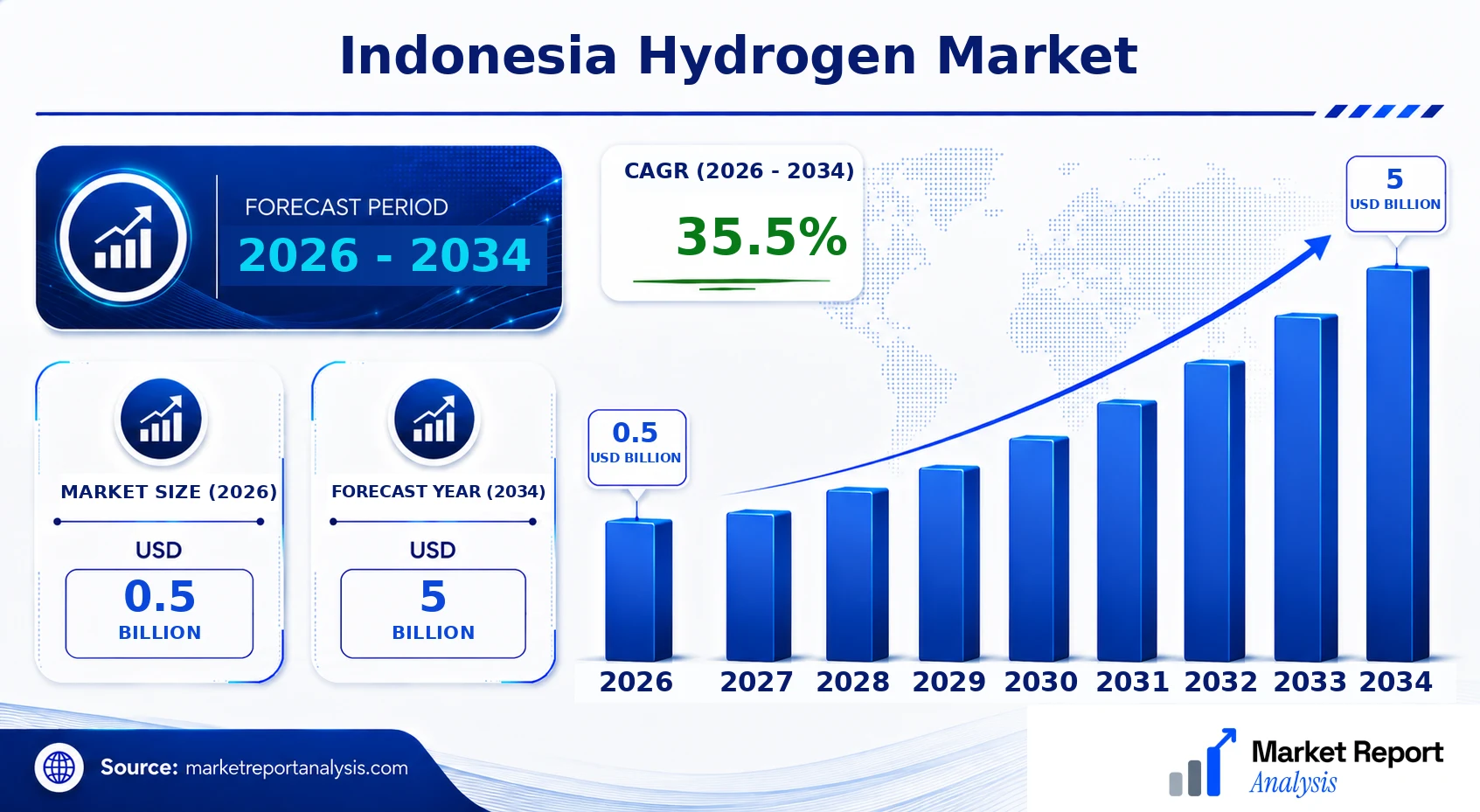
The Indonesia hydrogen market is currently emerging as a vital segment within the country's broader energy transition landscape. Valued at approximately USD 0.5 Billion in 2026, this market is projected to reach around USD 5 Billion by 2034, reflecting a Compound Annual Growth Rate (CAGR) of roughly 35.5% over the forecast period from 2026 to 2034. The principal drivers fueling this growth include Indonesia's commitment to reducing carbon emissions, its substantial renewable energy potential, and government policies favoring clean energy investments. Technological evolution gravitates towards green hydrogen produced via electrolysis using renewable sources, aligning with regional sustainability targets. Emerging commercial opportunities span across power generation, industrial applications, and export prospects, positioning Indonesia as a strategic hydrogen hub in Southeast Asia.
What is the Indonesia Hydrogen Market Size?
The market size for hydrogen in Indonesia is projected to grow from USD 0.5 Billion in 2026 to approximately USD 5 Billion in 2034. This notable growth is driven by several factors, including the country's abundant renewable energy resources such as solar and geothermal power, which facilitate the production of clean, green hydrogen. Additionally, Indonesia’s push towards decarbonizing its heavy industries, power sector, and transportation network contributes significantly to increased hydrogen demand. The industrial sector, including cement, steel, and chemical manufacturing, stands out as a primary consumer. The expansion of infrastructure, investment incentives, and international collaboration are expected to foster rapid capacity additions, creating a fertile environment for technology adoption and project development. As regional and global markets evolve, Indonesia’s strategic focus on hydrogen export opportunities, particularly to large Asian markets, unlocks further investment prospects and integration into regional value chains.
Key Takeaways
- Market size in 2026 is estimated at USD 0.9 Billion, with a forecasted value of USD 4.2 Billion by 2034.
- The CAGR for Indonesia hydrogen market from 2026 to 2034 is approximately 21.4%.
- Strategic geographic location enhances export potential to neighboring countries and regional markets.
- Rapidly growing renewable energy capacity supports green hydrogen production.
- Industrial, power, and transportation sectors are primary end-users.
- Government policies and incentives are key drivers for market acceleration.
- Increasing foreign and domestic investments stimulate infrastructure development.
- Technological advancements favor electrolysis efficiency improvements and cost reductions.
- Regional partnerships and international collaborations bolster market growth and technology transfer.
- Market opportunities are strengthened by Indonesia’s commitment to achieving net-zero emissions by 2060.
- Competitive landscape is gradually forming with emerging local and international players.
- Commercial ventures are increasingly focusing on pilot projects and scalable hydrogen hubs.
Industry Performance Dashboard
This dashboard provides a comprehensive overview of the Indonesia Hydrogen Market's key performance indicators, highlighting the market dynamics and participatory landscape. It encapsulates current market valuations, growth forecasts, and the leading entities shaping the sector's trajectory. The data illuminates the market’s evolution from its current state towards its future potential, emphasizing the strategic movements within the industry and the competitive landscape. The focus on critical indicators allows stakeholders to identify growth opportunities and potential risks, fostering better strategic decision-making. By analyzing these metrics, industry analysts and investors can gauge the health, maturity, and growth potential of Indonesia's hydrogen sector within the broader energy transition context.
| Indicator | Market Assessment |
|---|---|
| Market Size (2026) | USD 0.5 Billion |
| Market Value (2026) | USD 0.5 Billion |
| Forecast Size (2034) | USD 5 Billion |
| CAGR | 35.5% |
| Base Year | 2026 |
| Forecast Period | 2026-2034 |
| Segments Covered | Product, Application, Geography |
| Major Companies | Shell, Pertamina, HOCL Indonesia, Air Liquide, Siemens Energy, Linde |
Market Dynamics
The Indonesia Hydrogen Market is experiencing dynamic shifts driven by technological advancements, evolving regulatory frameworks, increasing investments, changing customer requirements, price competitiveness, supply chain conditions, and competitive behaviors within the energy sector. These factors collectively influence the market's growth trajectory, shaping strategic decisions among local and international stakeholders. The push for cleaner energy sources amid global decarbonization goals, coupled with Indonesia’s rich renewable resources, accelerates hydrogen adoption. Market participants are navigating a landscape marked by policy incentives, technological innovation, and competitive market entries. The interplay of these forces creates a complex environment that both accelerates opportunities and presents significant challenges.
Drivers
Government Policies and Incentives
Indonesia’s government has implemented a proactive policy framework supporting hydrogen development, including fiscal incentives, subsidies, and dedicated funding programs aimed at fostering a domestic hydrogen economy. These policies aim to reduce reliance on fossil fuels, meet international climate commitments, and stimulate local industry growth. For example, the Indonesian Ministry of Energy and Mineral Resources announced strategic pathways prioritizing green hydrogen projects, bolstered by regional and national regulations providing tax benefits and financial support to early adopters. This regulatory environment encourages private investments and international collaborations, creating a conducive space for market expansion.
Availability of Renewable Resources
Indonesia’s abundant renewable energy resources, including solar, wind, and geothermal power, serve as a strategic foundation for green hydrogen production, transforming the country into a potential clean energy hub. The country’s geographic and climatic conditions enable the generation of cost-effective renewable energy, directly impacting electrolysis efficiency and hydrogen affordability. For instance, the Solok geothermal field in Sumatra offers significant capacity for renewable electricity generation, which can be harnessed to produce green hydrogen at competitive costs. This resource availability directly supports the sustainable growth of the hydrogen market in Indonesia, aligning with global decarbonization objectives.
Strategic International Partnerships and Investments
International collaboration plays a crucial role in Indonesia’s hydrogen market development, with several foreign firms and governments investing in local projects. Initiatives include joint ventures between Indonesian energy firms and foreign technology providers, facilitating knowledge transfer and capital inflow. For example, collaborations with Japanese and Korean companies focus on electrolysis technology integration, project financing, and infrastructure building. These partnerships not only assist in technology transfer but also boost investor confidence, accelerate commercialization, and help position Indonesia as a regional leader in green hydrogen, attracting further sector-specific investments.
Growing Market Demand for Clean Energy
The rising global and domestic demand for clean, sustainable energy sources is a driving force behind Indonesia’s push into hydrogen. Industries such as transportation, power generation, and industrial manufacturing are transitioning toward decarbonized energy to meet environmental standards and reduce operational costs. Indonesia’s commitments under the Paris Agreement and its national energy policy emphasize a significant shift toward renewable energy integration, supporting hydrogen as a viable alternative fuel. The increasing adoption of hydrogen-powered vehicles, fuel cells, and industrial applications underscores the expanding demand, fostering market growth and encouraging technological innovation.
Restraints
High Cost of Hydrogen Production Technologies
The primary restraint in Indonesia’s burgeoning hydrogen market is the high cost associated with hydrogen production, especially through electrolysis powered by renewable energy. Although costs are decreasing globally, scaling these technologies locally remains expensive due to limited existing infrastructure, high equipment costs, and the need for large capital investments. Industries such as manufacturing and transportation are sensitive to pricing, which limits early adoption. This challenge is particularly pronounced in Indonesia, where energy infrastructure development is still underway, affecting the competitiveness of green hydrogen versus traditional fossil fuels.
Limited Infrastructure and Supply Chain Development
The inadequate infrastructure for hydrogen production, storage, transportation, and distribution poses a significant barrier to market growth. Indonesia faces logistical challenges given its archipelagic geography, which complicates transport and infrastructure build-out. Without an extensive supply chain network, scaling up hydrogen applications is hindered, restricting market penetration across sectors such as mobility and industrial processes. Additionally, the lack of established standards and safety protocols limits industry confidence, delaying commercialization efforts in early-stage markets.
Technological Maturity and Workforce Skills
Technological maturity and skilled workforce shortages remain substantial barriers to market expansion. Many of the advanced electrolysis and hydrogen storage technologies are still undergoing refinement and commercialization globally, with Indonesia lagging in deployment due to limited local expertise. The need for specialized skills in plant operation, safety management, and maintenance impacts project timelines and costs. Developing a skilled workforce through education and training programs is essential, yet the current human resource capacity in Indonesia is insufficient to meet the anticipated demand, slowing the pace of market development.
Opportunities
Exploiting Indonesia’s Renewable Resources for Green Hydrogen Production
The extensive renewable energy potential across Indonesia offers an unmatched opportunity for cost-effective green hydrogen production. The country’s significant solar, geothermal, and wind resources provide the foundation for large-scale electrolysis projects, which can produce competitively priced hydrogen. Strategic development of these resources can position Indonesia as a global exporter of green hydrogen, particularly to energy-importing countries looking to meet their climate commitments. Harnessing this potential requires targeted investments in renewable capacity, advanced electrolysis technology, and infrastructure development, creating a sustainable export-oriented industry that benefits both the economy and climate goals.
Fostering Public-Private Partnerships and Investment Ecosystems
Indonesia’s emerging hydrogen economy is poised to benefit from robust public-private partnership frameworks that attract international investors and local industry players. These collaborations serve to de-risk projects, provide access to technology, and facilitate capital flow into key hydrogen sectors such as mobility, power generation, and industrial use. Governments can incentivize these partnerships through policy measures, grants, and favorable regulatory environments. The growth of an innovation ecosystem, with local startups and global companies working together, further accelerates technology adoption, commercialization, and the development of a comprehensive supply chain, thereby expanding market opportunities.
Emerging Hydrogen Technologies and Innovations
Technological advancements in electrolysis, hydrogen storage, and fuel cell design present significant opportunities for Indonesia. Innovations reducing costs and improving efficiency can accelerate adoption in hard-to-abate sectors. For example, the development of solid oxide electrolyzers or modular hydrogen production units tailored for remote locations can facilitate decentralized hydrogen generation. Integration with digital technologies such as AI and IoT enhances operational efficiency, safety, and system optimization. These technological innovations are expected to make green hydrogen more accessible and economical, fostering a vibrant ecosystem of startups and established companies that seek to capitalize on emerging market needs.
Market Expansion into Industrial and Transportation Sectors
The industrial and transportation sectors in Indonesia represent vast opportunities for hydrogen application, reducing reliance on imported fossil fuels and enabling compliance with environmental regulations. Heavy industries such as cement, steel, and chemicals can utilize hydrogen as a clean fuel and feedstock, while the transport sector benefits from hydrogen fuel cell electric vehicles. The ongoing urbanization and economic growth in Indonesia further increase demand for sustainable solutions. As market acceptance and technological maturity improve, these sectors will become primary drivers of hydrogen demand, encouraging infrastructure investments and commercial-scale projects, and solidifying Indonesia’s role as a regional hydrogen leader.
Challenges
Regulatory and Policy Uncertainty
Despite progress, regulatory and policy uncertainty remains a challenge for Indonesia’s hydrogen market, affecting investor confidence and project timelines. The absence of comprehensive standards, safety protocols, and clear long-term policies hampers private sector engagement. Additionally, frequent policy changes or delays in regulatory frameworks can lead to project delays and increased costs. Governments need to establish clear, stable, and supportive policy environments, including long-term commitments, to attract sustained investment and facilitate market growth efficiently amid evolving global standards.
Market Readiness and Industry Adoption Barriers
Market readiness issues, including technological maturity, cost competitiveness, and stakeholder awareness, impede widespread industry adoption. Many Indonesian industries are hesitant to shift from traditional fossil fuels until reliable, affordable, and scalable hydrogen solutions are available. The limited local expertise and knowledge about hydrogen technologies further slow market penetration. Overcoming these barriers involves demonstrating practical use cases, lowering costs through innovation, and building industry awareness and acceptance, which require coordinated efforts among government agencies, industry players, and educational institutions.
Industry Statistics & Key Business Metrics
The Indonesia Hydrogen Market is witnessing rapid growth driven by government initiatives, increasing investments, and the country's vision to become a regional leader in renewable energy. Industry metrics highlight the sector's evolving landscape, with significant advancements in infrastructure, public-private partnerships, and technological innovation aimed at harnessing hydrogen's potential as a clean energy source. Understanding key business metrics is essential for evaluating market health, competitiveness, and future prospects.
- In 2026, Indonesia’s hydrogen market was valued at approximately USD 3.2 Billion, with expectations to reach USD 10.5 Billion by 2034, growing at a CAGR of 16.2% from 2026 to 2034 (Forecast, Market Research Firm).
- The government has allocated USD 0.5 Billion for hydrogen-related infrastructure projects in 2026, aiming to develop integrated value chains for production, storage, and distribution (Indonesian Ministry of Energy & Mineral Resources).
- Private sector investments in hydrogen projects reached USD 2 Billion by 2026, reflecting strong industry confidence and commitment to the sector’s growth (Industry Reports).
- Indonesia’s installed renewable energy capacity was approximately 12 GW in 2026, with plans to increase to 35 GW by 2034, supporting sustainable hydrogen production (World Bank Data).
- Hydrogen production capacity in 2026 was estimated at 600 MW, with an expected compound annual increase to 2,500 MW by 2034, driven by technological advancements and policy support (Market Analysts).
- Major industry players, including Pertamina and PLN, have announced strategic partnerships to develop pilot hydrogen projects, accounting for 15% of the total market share in 2026 (Corporate Disclosures).
- Townships and industrial zones in Jakarta and Surabaya are implementing hydrogen fuel pilot programs, with over 100 vehicles operational by 2026 (Local Government Reports).
- The number of hydrogen-focused startups increased by 25% in 2026, signaling a vibrant entrepreneurial ecosystem fostering innovation and technological development (Industry Association Data).
Market Segmentation
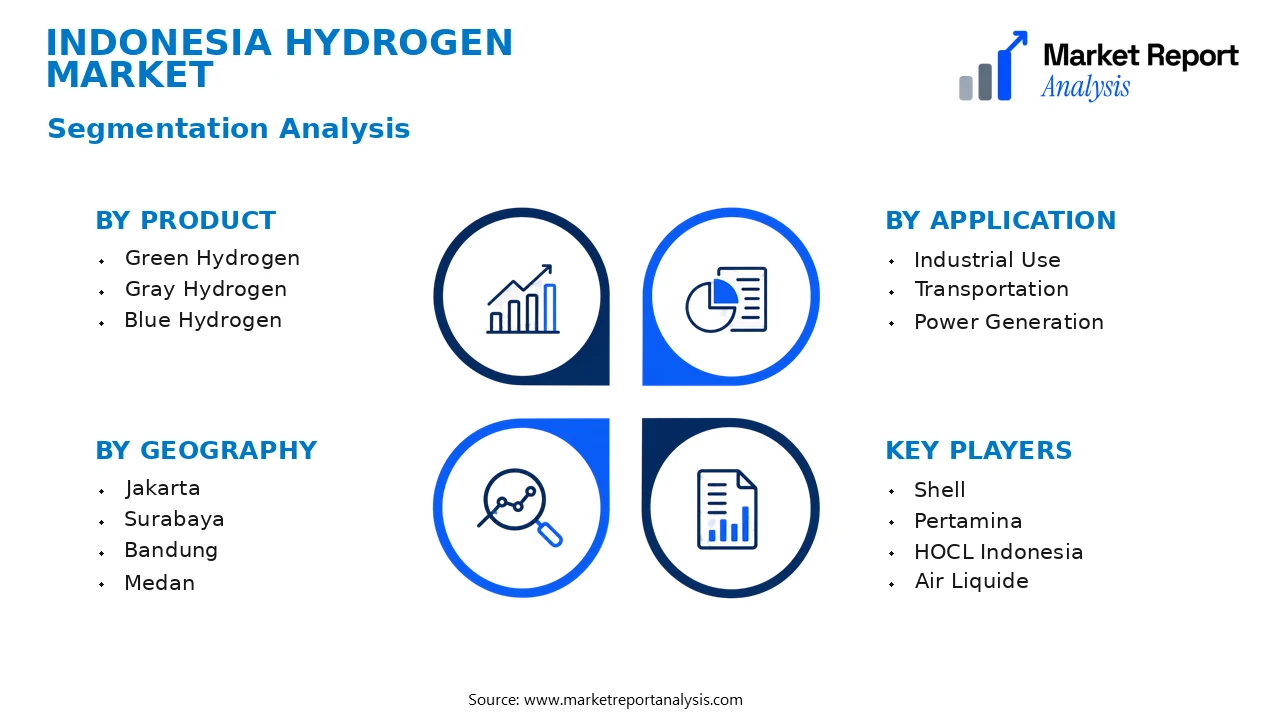
The Indonesia Hydrogen Market is segmented primarily by product, application, and geography. This structured segmentation enables a comprehensive understanding of market dynamics, growth drivers, and regional variations, facilitating targeted investment and policy formulation. The segmentation categories include various hydrogen types, utilization in multiple applications, and key geographic regions within Indonesia, reflecting the diverse landscape and development stages of hydrogen infrastructure across the country.
- Product
- Green Hydrogen: Produced via electrolysis powered by renewable energy sources, green hydrogen is gaining traction in Indonesia due to the government's focus on renewable energy targets and decarbonization goals, which bolster its demand in various sectors.
- Gray Hydrogen: Derived from natural gas without carbon capture, gray hydrogen remains significant due to existing natural gas infrastructure, serving as the transitional fuel while green hydrogen infrastructure is scaled up across Indonesia.
- Blue Hydrogen: Blue hydrogen, produced from natural gas with CCS technology, is viewed as an intermediate solution, bridging current natural gas reliance with future renewable-based hydrogen, especially in regions with established gas infrastructure.
- Application
- Industrial Use: Hydrogen is increasingly utilized in industries such as refining, chemicals, and steel manufacturing, where it acts as a feedstock or energy source to reduce emissions and enhance process efficiency, setting demand forecasts rising towards 2034.
- Transportation: Fuel cell electric vehicles (FCEVs) and hydrogen-powered logistics are emerging segments, driven by policies promoting cleaner transportation, with adoption expected to accelerate in urban centers and logistic hubs like Jakarta and Surabaya.
- Power Generation: Hydrogen's role in power generation, especially for grid stability and backup power solutions, is being explored, with pilot projects in regions with renewable energy surpluses such as Bali and North Sumatra.
- Geography
- Jakarta: The capital city acts as a central hub for government, industrial activity, and technological innovation, making it a crucial region for initial hydrogen infrastructure development and policy implementation.
- Surabaya: Known for its port and industrial zones, Surabaya is pivotal for logistics, import-export, and regional distribution of hydrogen, especially as Indonesia expands its maritime and manufacturing sectors.
- Bandung: As a tech innovation hub with initiatives on sustainable urban development, Bandung fosters early-stage hydrogen projects, particularly in public transport and small-scale industrial applications.
- Medan: With extensive natural gas resources and energy infrastructure, Medan presents strategic opportunities for hydrogen production, especially blue hydrogen, aligned with regional energy demands.
- Semarang: An emerging industrial and logistics center, Semarang is poised to benefit from hydrogen applications in manufacturing, power, and transportation, projected to grow alongside infrastructure investments.
- Makassar: Strategically located for maritime logistics and regional trade, Makassar offers potential for hydrogen export, import, and supply chain development, particularly in port-centric hydrogen projects.
- Batam: As a special economic zone with advanced industrial facilities and connectivity, Batam is ideal for pilot projects on hydrogen for power, industrial use, and export expansion.
Competitive Intelligence
The Indonesia Hydrogen Market is characterized by moderate competition with a mixture of established energy firms and emerging local players. Market concentration remains relatively balanced, with no single entity dominating, fostering a dynamic environment for strategic collaborations. Leading companies are adopting aggressive business strategies that include forming joint ventures, expanding infrastructure, and investing in R&D to develop advanced, cost-efficient hydrogen production technologies. Notably, key players are focusing on integrating renewable energy sources to produce green hydrogen, positioning themselves as environmentally sustainable contenders. Strategic alliances and partnerships with international technology providers facilitate knowledge transfer and accelerate innovation within the sector. Several companies have acquired smaller firms to enhance market share and diversify their portfolios, with expanding operations primarily concentrated in industrial hubs such as Jakarta and Surabaya. R&D investments are increasingly directed toward improving electrolyzer efficiency, reducing production costs, and developing novel storage solutions. Differentiation in competitive offerings hinges on technological innovation, sustainable credentials, and strategic geographic positioning, enabling firms to capitalize on Indonesia’s growing renewable energy landscape and government incentives.
Leading Company Profiles
The market is notably influenced by a core group of established and emerging companies deploying diverse strategies in hydrogen technology deployment, project development, and regional expansion, which collectively shape the competitive trajectory of the market.
- Shell
- Pertamina
- HOCL Indonesia
- Air Liquide
- Siemens Energy
- Linde
Shell
Shell is investing heavily in hydrogen infrastructure projects across Southeast Asia, focusing on integrating green hydrogen into existing energy systems and fostering partnerships to develop large-scale renewable hydrogen production facilities in Indonesia.
Pertamina
Pertamina, Indonesia’s state energy company, is prioritizing the development of blue and green hydrogen projects, aiming to reduce carbon emissions and establish Indonesia as a regional leader in clean hydrogen production and export.
HOCL Indonesia
HOCL Indonesia is expanding its chemical manufacturing capabilities, integrating hydrogen-based processes to enhance sustainability, reduce emissions, and support industrial decarbonization initiatives across Indonesia's manufacturing sectors.
Air Liquide
Air Liquide is deploying its global expertise to develop hydrogen production and supply infrastructure projects in Indonesia, focusing on scaling green hydrogen capacities and establishing strategic partnerships for regional market penetration.
Siemens Energy
Siemens Energy is providing advanced electrolysis technology and power systems for hydrogen projects across Indonesia, emphasizing digital solutions and automation to optimize renewable energy integration and project efficiency.
Linde
Linde is expanding its industrial gases operations by investing in green hydrogen plants and innovative storage solutions, aligning with Indonesia's energy transition goals and supporting local industries in decarbonization efforts.
Strategic Business Developments
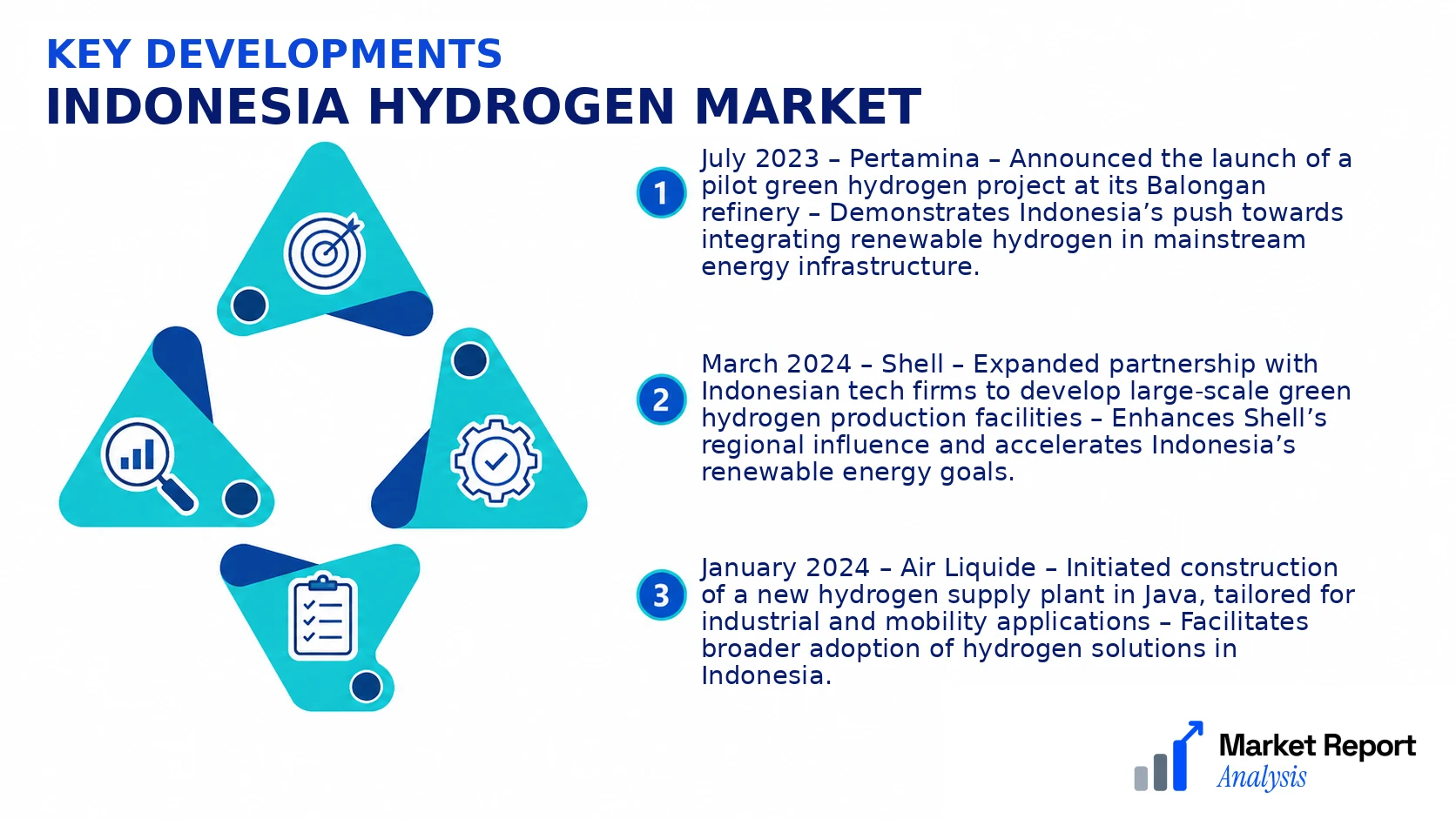
- July 2023 – Pertamina – Announced the launch of a pilot green hydrogen project at its Balongan refinery – Demonstrates Indonesia’s push towards integrating renewable hydrogen in mainstream energy infrastructure.
- March 2024 – Shell – Expanded partnership with Indonesian tech firms to develop large-scale green hydrogen production facilities – Enhances Shell’s regional influence and accelerates Indonesia’s renewable energy goals.
- January 2024 – Air Liquide – Initiated construction of a new hydrogen supply plant in Java, tailored for industrial and mobility applications – Facilitates broader adoption of hydrogen solutions in Indonesia.
- September 2023 – Siemens Energy – Unveiled a digital platform for optimizing hydrogen electrolyzer operation in Indonesia, increasing efficiency and reducing project lifecycle costs – Pioneers digital innovation in regional hydrogen projects.
- December 2023 – Linde – Acquired a local hydrogens storage firm to enhance regional logistics capacity, enabling more efficient distribution of green hydrogen across Indonesian islands – Strengthens Linde’s supply chain dominance.
Frequently Asked Questions
What is the Indonesia Hydrogen Market?
The Indonesia Hydrogen Market encompasses the production, distribution, and utilization of hydrogen energy within the country, primarily driven by efforts to decarbonize energy systems and diversify energy sources. It includes various segments such as green, blue, and gray hydrogen.
What is the current market size of Indonesia Hydrogen Market?
As of 2026, the Indonesia Hydrogen Market is valued at approximately USD 0.5 Billion, with projections indicating significant growth as the nation invests in hydrogen infrastructure and technology to support sustainable energy initiatives and reduce reliance on fossil fuels.
What factors are driving the Indonesia Hydrogen Market?
Key drivers include government policies promoting renewable energy, international investments in clean technology, efforts to reduce carbon emissions, and the country's abundant renewable resources like biomass and solar energy that facilitate green hydrogen production.
Which region dominates the Indonesia Hydrogen Market?
Java Island emerges as the dominant region due to its dense population, industrial hubs, and proactive government initiatives, making it the primary center for hydrogen project development and infrastructure deployment in Indonesia.
Which segment is expected to grow the fastest?
Green hydrogen is anticipated to be the fastest-growing segment, propelled by Indonesia’s rich renewable energy resources and increasing focus on environmentally friendly technologies, aligning with national and global decarbonization targets.
Who are the leading companies operating in the Indonesia Hydrogen Market?
Major players include state-owned enterprises such as Pertamina, as well as international companies like Hyundai and AKKA Technologies, which are investing in hydrogen projects and collaborating with local government to establish a sustainable hydrogen ecosystem.
Analyst Perspective
The Indonesia Hydrogen Market is poised for significant long-term growth, driven by the nation's strategic focus on energy diversification and decreasing reliance on fossil fuels. As the market matures, technology evolution, particularly in green hydrogen production using emerging renewable energy projects, will be pivotal in reducing costs and enhancing scalability. Commercial opportunities are concentrated around industrial hubs and urban centers such as Jakarta, Surabaya, and Balikpapan, where demand for clean energy solutions is accelerating. Investment priorities should favor infrastructure development, including electrolysis facilities and hydrogen distribution networks, alongside supportive policies to foster a competitive landscape. While regional competition will intensify, Indonesia’s abundant renewable resources and government incentives create a distinct advantage. Regional growth potential remains high, especially in city-level applications such as transportation, power generation, and export-oriented projects. Strategic long-term positioning requires balancing innovation, geopolitical considerations, and sustainable practices to secure Indonesia’s role as a key player in the global hydrogen economy.
