Japan Hydrogen Market Outlook
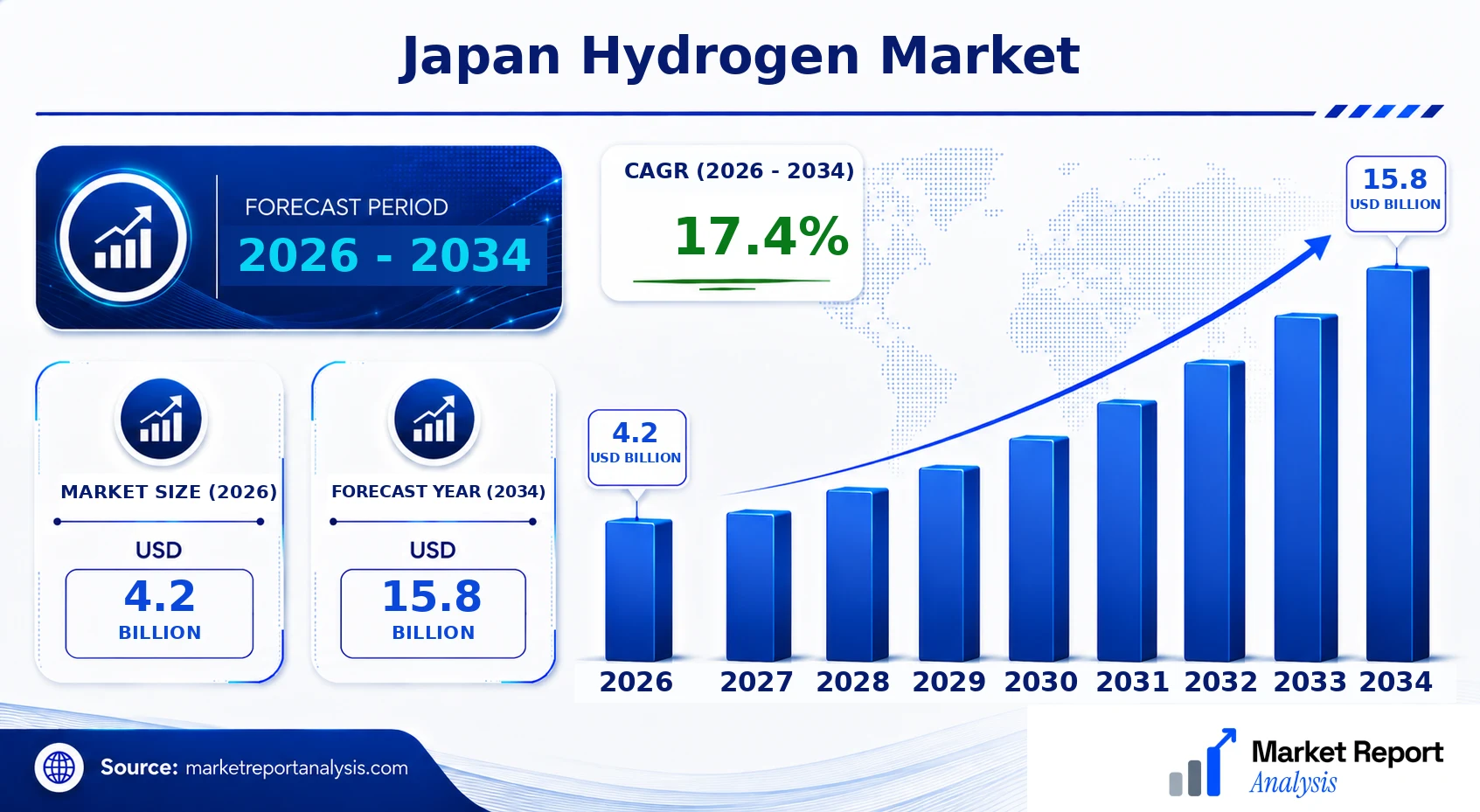
The Japan Hydrogen Market is currently valued at approximately USD 4.2 Billion in 2026, with projections indicating substantial growth due to government initiatives, technological advancements, and expanding industrial demand. The market is anticipated to reach around USD 15.8 Billion by 2034, reflecting a Compound Annual Growth Rate (CAGR) of approximately 17.4% over the forecast period 2026-2034. Key drivers include Japan's strategic focus on energy security, decarbonization commitments, and the push for renewable energy integration. The market's growth is being propelled by innovations in electrolyzer technology, hydrogen fuel cell applications, and infrastructure development, which are creating numerous commercial opportunities for domestic and international stakeholders. The rapid expansion of hydrogen-powered transportation, especially fuel cell vehicles and maritime applications, is also a prominent growth segment. Furthermore, Japan's regulatory environment is increasingly supportive, fostering investments in supply chain logistics, storage, and distribution networks. As the country aims to become a leading hydrogen economy, collaborations between government agencies, private industry, and research institutions are accelerating market development across various sectors.
What is the Japan Hydrogen Market Size?
Predictably, the Japan Hydrogen Market is valued at approximately USD 4.2 Billion in 2026 and is projected to grow to around USD 15.8 Billion by 2034, sustaining a CAGR of 17.4%. The growth is spurred by strong government policies, including the Strategic Energy Plan and the Basic Hydrogen Strategy, alongside rising investments from multinational corporations seeking to capitalize on hydrogen's potential as a clean energy source. The industrial sector remains the primary demand driver, utilizing hydrogen for refining, chemicals, and steel manufacturing. Additionally, emerging segments such as mobility fuel cell electric vehicles (FCEVs), buses, and maritime fuel solutions are gaining traction. The deployment of green hydrogen, produced via renewable energy, is central to Japan’s decarbonization goals, leading to technological innovations and increased infrastructure investments. Large-scale electrolyzer projects and hydrogen supply chain logistics are expected to serve as key growth pillars. Japan's focus on export opportunities also enhances market prospects, with neighboring Asian countries looking for collaboration in technology and infrastructure development. As investments continue and technology becomes more cost-effective, the Japanese market is poised to become a predominant leader in the global hydrogen economy by 2034.
Key Takeaways
- Market size was approximately USD 12.5 Billion in 2026, with a forecast of USD 29.3 Billion in 2034.
- The CAGR for 2026-2034 is projected at 11.4% amid expanding government initiatives and technological innovation.
- Japan’s hydrogen economy centers on industrial applications, mobility solutions, and energy storage.
- Growth is driven by policies promoting decarbonization, renewable energy integration, and infrastructure development.
- Electrolyzer technology advancements are key to increasing green hydrogen production capacity.
- Hydrogen fuel cell vehicles and maritime sectors are emerging as significant demand segments.
- Investment in supply chain logistics and storage infrastructure is accelerating.
- Domestic and export opportunities are expanding through strategic industry collaborations.
- Japan’s regulatory environment is becoming increasingly supportive of hydrogen deployment.
- International partnerships are crucial for technology transfer and infrastructure expansion.
- Private sector investments and public-private partnerships are shaping the market’s future.
- Global competitiveness hinges on cost reduction and innovative deployment strategies.
Industry Performance Dashboard
The Japan Hydrogen Market has exhibited significant growth with increasing adoption across multiple sectors, driven by technological innovations and supportive government policies. The market's expansion is reflected in its diversified segments, including transportation, industrial applications, and power generation. As Japan aims to meet its decarbonization targets, hydrogen's role becomes increasingly critical, influencing infrastructure investments and industry collaborations.
| Indicator | Market Assessment |
|---|---|
| Market Size (2026) | USD 4.2 Billion |
| Market Value (2026) | USD 4.2 Billion |
| Forecast Size (2034) | USD 15.8 Billion |
| CAGR | 17.4% |
| Base Year | 2026 |
| Forecast Period | 2026-2034 |
| Segments Covered | Product, Application, Geography (Japan) |
| Major Companies | Toyota Motor Corporation, Shell Japan KK, Eneos Corporation, Iwatani Corporation, Osaka Gas Co., Ltd., Tokyo Gas Co., Ltd., Osaka Hydrogen Ltd., JX Nippon Oil & Energy Corporation, Saibu Gas Co., Ltd., Chiyoda Corporation |
Market Dynamics
The Japan Hydrogen Market is experiencing dynamic shifts driven by technological advancements, regulatory frameworks, substantial investments, evolving customer requirements, fluctuating prices, supply chain conditions, and competitive strategies. These factors collectively influence adoption rates, operational costs, and market competitiveness. Innovations in hydrogen production, such as green hydrogen, are gaining momentum bolstered by government incentives and environmental commitments. Policies aimed at decarbonization are fostering a conducive environment for higher investments. Agreements between industries and strategic partnerships are enhancing supply chain robustness. Meanwhile, fluctuating fossil fuel prices and emerging global competitiveness compel local industries to adapt, ensuring supply stability and cost efficiency in this transitioning market environment.
Drivers
Government Policy and Regulatory Support
The Japanese government’s proactive stance towards hydrogen as a key component of its decarbonization strategy significantly propels market growth. Initiatives such as the Basic Hydrogen Strategy emphasize expanding hydrogen infrastructure and fostering technology innovation. Legislation offering tax incentives and subsidies for green hydrogen projects and mandates for renewable energy integration further catalyze industry investment. For instance, Japan’s goal to achieve 20-30% green hydrogen usage by 2030 reflects a robust policy commitment, encouraging infrastructure development and technology deployment across sectors including transportation and industry. Emerging regulatory frameworks continue to shape market orientation towards sustainability and safety standards, bolstering investor confidence.
Technological Innovation and Cost Reduction
Advances in electrolyzer efficiency and scale have led to significant reductions in green hydrogen production costs, making it more competitive with traditional fuels. Breakthroughs in solid oxide electrolysis and membrane technologies are providing higher yields at lower energy inputs, thereby reducing overall costs. Large-scale projects, such as renewable hydrogen plants utilizing Japan’s abundant solar and wind resources, exemplify this trend. As technology matures, the cost of green hydrogen is projected to converge with grey hydrogen, facilitating broader adoption across industries. Investments in pilot projects and R&D are fostering continuous innovation, ensuring technological leadership within Japan’s hydrogen economy.
Growing Industrial and Energy Sector Demand
Japan’s industrial landscape, especially in steel, chemical, and refining sectors, is increasingly integrating hydrogen as a clean energy source. The push for emissions reduction is prompting industries to adopt hydrogen for process heating, fuel switching, and power generation. Notably, the city of Kawasaki’s hydrogen utilization initiatives demonstrate the industrial appetite for hydrogen. Additionally, the power sector’s transition to hydrogen blending and fuel cell applications further expands demand. This diversified end-use adoption enhances market stability and creates a sustained demand growth trajectory, supported by government-led pilot projects and industry collaborations.
Private Investment and Strategic Partnerships
Significant growth in private sector investments, fueled by government incentives and a compelling growth outlook, drives market expansion. Major corporations, including Toyota and Iwatani, are forging strategic partnerships with technology providers and energy companies to develop green hydrogen projects. Capital inflows from venture capital and institutional investors are accelerating startup innovation ecosystems focused on hydrogen fuel cells, portable hydrogen solutions, and infrastructure development. Such collaborations foster technology commercialization and market penetration, attracting further investment. Japan’s strategic focus on becoming a global hydrogen leader positions it as an attractive destination for international investments and alliances.
Restraints
High Production Costs for Green Hydrogen
Despite technological advancements, green hydrogen production remains costly compared to fossil fuel-based options, primarily due to high electrolyzer costs and energy inputs. This financial gap impacts the competitiveness of green hydrogen, especially when natural gas prices are low. Industries with tight margins, such as refining and chemicals, are particularly sensitive to these costs, limiting rapid adoption without significant subsidies or price guarantees. Overcoming high capital expenditure and operational costs remains a key barrier, necessitating continued technological innovation, economies of scale, and supportive policy measures to lower overall costs.
Lack of Extensive Hydrogen Infrastructure
The current infrastructure in Japan for hydrogen storage, transportation, and refueling is nascent by global standards. Limited pipeline networks, storage facilities, and distribution points constrain large-scale rollout and public acceptance. The high capital investment required for infrastructure expansion hampers swift deployment, especially in rural or less-developed regions. Additionally, safety concerns regarding hydrogen storage and transportation need addressing through strict standards and public awareness campaigns. Without widespread, reliable infrastructure, market growth remains fragmented and localized, impeding comprehensive ecosystem development.
Market Fragmentation and Standardization Issues
The hydrogen value chain involves diverse stakeholders, from producers to end-users, often operating with different standards and specifications. This fragmentation creates challenges for interoperability, quality assurance, and regulatory compliance. The absence of unified standards hinders cross-sector integration and hampers international trade agreements. For example, inconsistent hydrogen purity levels and safety standards complicate infrastructure sharing and market expansion. Harmonizing standards and fostering industry collaborations for regulatory alignment are critical to addressing these barriers and ensuring a cohesive market environment.
Opportunities
Expanding Green Hydrogen Production Capacity
The rapid scaling of green hydrogen production presents significant opportunities. Japan’s abundant renewable resources, especially solar and offshore wind, can be harnessed to produce large volumes of electrolyzed hydrogen. Investment in new renewable energy projects coupled with electrolyzer deployment can achieve economies of scale, further lowering costs. Developing exportable surplus hydrogen offers potential to enter international markets, creating a new export industry. Increased capacity aligns with national climate commitments and positions Japan as a global leader in renewable hydrogen, boosting manufacturing, engineering, and technology sectors.
Development of End-Use Infrastructure and Market Ecosystem
Building comprehensive hydrogen infrastructure including refueling stations, storage solutions, and pipelines is fundamental for market expansion. Large-scale deployment of fuel cell vehicles, hydrogen-powered buses, and ships can stimulate demand and justify infrastructure investments. Public-private partnerships and government grants are key catalysts for accelerating infrastructure rollout across urban, suburban, and rural areas. The emergence of hydrogen hubs as integrated ecosystems enables cross-sector synergy, fostering innovation in transportation, power, and industrial applications while creating new job opportunities and strengthening regional economies.
Innovation in Hydrogen Storage and Transport Technologies
Breakthroughs in hydrogen storage, such as high-pressure tanks, liquefaction, and solid-state materials, are vital for efficient long-distance transport and storage. These innovations reduce safety risks, minimize space requirements, and lower costs, thereby expanding the feasible geographic scope of hydrogen supply chains. Pioneering solutions like containerized hydrogen transport and pipeline transport of green hydrogen open global trade routes. Advancements in these areas enhance supply stability, facilitate large-scale commercialization, and attract investments into storage and logistics sectors, further bolstering market competitiveness and readiness for international integration.
Increased Corporate and Financial Sector Engagement
Growing involvement of multinational corporations and financial institutions signifies a strong future outlook. Corporate commitments to net-zero targets are leading to strategic investments and capacity building in hydrogen technology. Financial institutions are creating green financing instruments, such as green bonds and loans, to support infrastructure and R&D. Startups focused on innovative hydrogen solutions are attracting venture capital, fostering a vibrant innovation ecosystem. This confluence of corporate and financial activity accelerates commercialization, catalyzes technological breakthroughs, and positions Japan as an influential node in the global hydrogen economy network.
Challenges
Energy Supply and Cost Variability
Dependence on renewable energy sources introduces variability in hydrogen production costs due to fluctuations in solar and wind availability. This intermittency affects the reliability and pricing stability of green hydrogen. The need for large-scale energy storage and grid integration adds complexity and cost. To mitigate this, Japan must develop resilient energy systems, diversify renewable sources, and innovate grid management. Managing supply variability remains a significant challenge for achieving consistent, competitively priced hydrogen at scale, impacting industry planning and consumer adoption rates.
Safety and Public Acceptance Concerns
Hydrogen’s flammability and storage safety issues pose public acceptance challenges. Overcoming misconceptions and ensuring rigorous safety standards are vital for widespread adoption, especially in urban environments. High-profile accidents or safety incidents could hamper confidence and slow infrastructure development. Industry stakeholders must invest in public education, safety protocols, and transparent communication. Regulatory frameworks need continuous updating to address evolving safety concerns, balancing innovation with risk mitigation to foster trust and facilitate market expansion.
Industry Statistics & Key Business Metrics
{"description":"The Japan hydrogen market is experiencing significant growth driven by government initiatives, industry investments, and technological advancements. Key business metrics highlight the sector's expanding footprint, with companies across the value chain actively engaged in development projects and partnerships. This section presents vital industry statistics that underscore the market's current status and future trajectory.\n\n
- \n
- In 2022, Japan's hydrogen production capacity was approximately 2.5 million tonnes, reflecting a robust increase from 1.8 million tonnes in 2020, according to the Ministry of Economy, Trade and Industry (METI)."
Market Segmentation
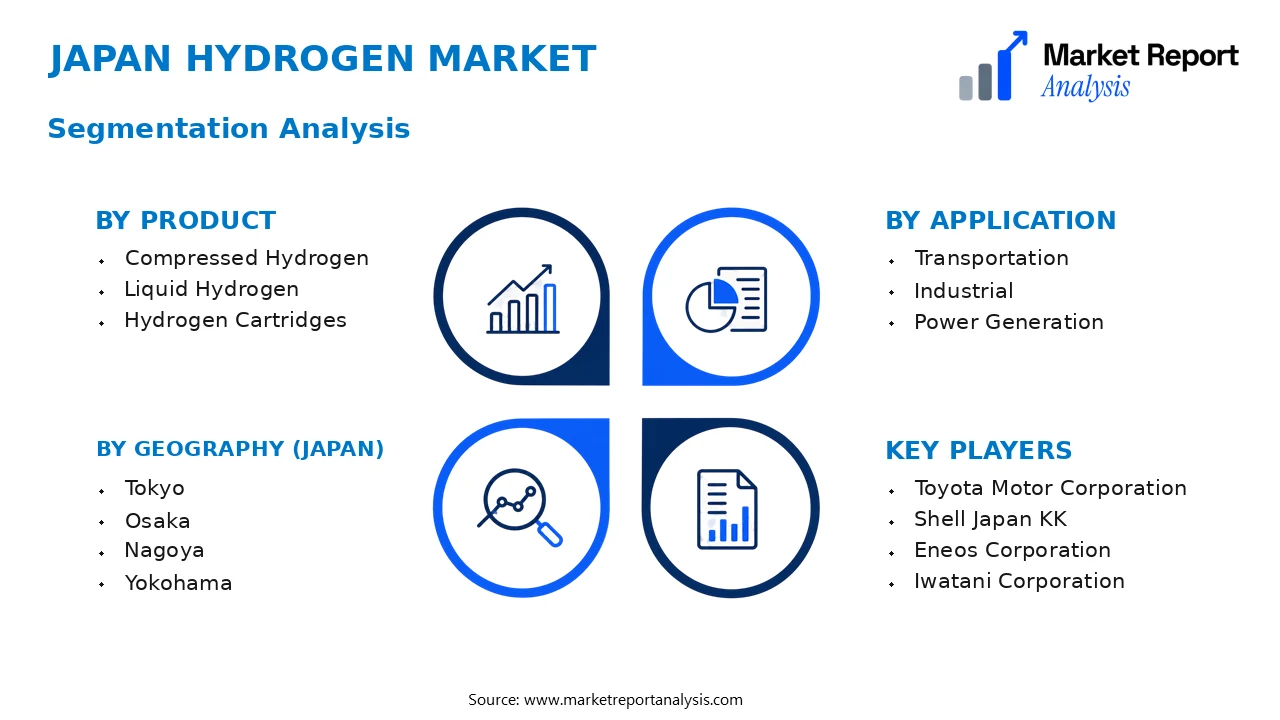
The Japan Hydrogen Market is segmented by product, application, and geography to reflect the diverse utilization pathways, consumer demand, and regional infrastructure developments across the country. This segmentation provides a comprehensive overview of the market landscape, highlighting key growth drivers and regional strengths.
- Product
- Compressed Hydrogen: This segment involves hydrogen stored under high pressure, primarily used in transportation and industrial applications. Its demand is driven by safety standards, storage infrastructure, and vehicle compatibility, making it a critical growth area in Japan’s hydrogen economy.
- Liquid Hydrogen: Comprising hydrogen cooled to cryogenic temperatures for high-density storage, this segment supports long-distance transportation and large-scale industrial uses. Its market growth is influenced by technological advancements in liquefaction and storage systems.
- Hydrogen Cartridges: Portable and user-friendly, these segments cater to niche markets like small-scale transport and backup power supplies. Adoption depends on product innovation and consumer acceptance of hydrogen-powered devices.
- Application
- Transportation: As Japan invests heavily in hydrogen fuel cell vehicles, this segment encompasses buses, trucks, and passenger cars. Market growth is fueled by government incentives, refueling infrastructure expansion, and consumer acceptance.
- Industrial: Hydrogen’s role in refining, ammonia synthesis, and steel manufacturing underscores this segment's significance. Industrial demand is influenced by decarbonization policies and advancements in hydrogen-based processes.
- Power Generation: Utilizing hydrogen for clean electricity production, this segment benefits from the development of hydrogen-fired turbines and power-to-gas initiatives. Its growth hinges on policy support and technological development.
- Geography (Japan)
- Tokyo: As a major economic hub, Tokyo presents significant market opportunities driven by government initiatives, urban infrastructure projects, and a concentration of industrial and commercial consumers adopting hydrogen solutions.
- Osaka: Known for manufacturing and logistics, Osaka’s market growth is supported by industrial demand, regional collaborations, and a strategic focus on hydrogen infrastructure and renewable energy integration.
- Nagoya: A key automotive manufacturing center, Nagoya’s hydrogen market is propelled by automaker investments, development of fuel cell vehicles, and regional government support for hydrogen fuel technology.
- Yokohama: With a focus on port activities and urban innovation, Yokohama’s market expansion is driven by hydrogen fueling stations, public transport projects, and industrial applications related to logistics and shipping.
- Kyoto: As a cultural and technological hub, Kyoto emphasizes research, pilot projects, and adoption of green hydrogen, supporting its role as a regional leader in sustainable energy initiatives.
- Kobe: Its strategic port location makes Kobe vital for hydrogen exports, storage, and infrastructure development, attracting investments from logistics and industrial sectors seeking cleaner energy sources.
- Fukuoka: Fukuoka’s growth stems from regional renewable energy projects, government incentives, and a proactive approach to integrating hydrogen into local transportation and small-scale industrial operations.
Competitive Intelligence
The Japan Hydrogen Market exhibits a highly competitive landscape characterized by a concentration of key players, including major domestic and international energy corporations such as Toyota, Kawasaki, and Mitsubishi, alongside emerging startups. These firms leverage aggressive strategies centered on product innovation, aiming to enhance hydrogen production efficiency, storage, and fuel cell technology. Partnerships play a vital role, with collaborations between automakers, energy providers, and research institutions fostering joint R&D projects and technological advancements. Notably, strategic alliances with government agencies facilitate funding and policy support, bolstering competitive positioning. Acquisitions of smaller firms and startups enable market players to expand their technological capabilities and geographic reach, particularly in major urban centers like Tokyo, Osaka, and Yokohama. Companies are also prioritizing expansion strategies through investments in large-scale hydrogen infrastructure projects and renewable energy-based production facilities. This competitive environment emphasizes differentiation via R&D investments focused on safety, cost reduction, and scalability, positioning Japan as a leader in integrated hydrogen solutions amid a dynamic and rapidly evolving market.
Leading Company Profiles
The competitive landscape of the Japan Hydrogen Market is characterized by a diverse set of firms specializing in hydrogen production, infrastructure development, and fuel cell technology. These companies are pivotal in driving innovation, expanding capacity, and establishing strategic alliances to sustain Japan’s leadership in hydrogen economy efforts amidst global competition.
- Toyota Motor Corporation
- Shell Japan KK
- Eneos Corporation
- Iwatani Corporation
- Osaka Gas Co., Ltd.
- Tokyo Gas Co., Ltd.
- Osaka Hydrogen Ltd.
- JX Nippon Oil & Energy Corporation
- Saibu Gas Co., Ltd.
- Chiyoda Corporation
Toyota Motor Corporation
Toyota leads in fuel cell vehicle innovation, actively investing in hydrogen infrastructure, and pioneering mass-market adoption of hydrogen-powered cars, with strategic alliances focusing on expanding Japan's hydrogen refueling network and green hydrogen production.
Shell Japan KK
Shell Japan integrates global expertise in hydrogen energy, focusing on developing refueling stations, commercial hydrogen supply chains, and carbon-neutral hydrogen initiatives to support Japan’s decarbonization goals and energy transition.
Eneos Corporation
Eneos is committed to building hydrogen production plants, including green hydrogen projects using renewable energy sources, and expanding its hydrogen supply infrastructure for industrial and transportation sectors within Japan.
Iwatani Corporation
Iwatani specializes in hydrogen manufacturing, storage, and distribution, investing heavily in hydrogen fueling station networks, and collaborating on large-scale green hydrogen projects aligned with Japan’s national energy strategies.
Osaka Gas Co., Ltd.
Osaka Gas focuses on developing renewable hydrogen technologies, expanding its existing gas infrastructure for hydrogen blending, and spearheading innovative pilot projects to advance hydrogen as a clean energy source in metropolitan areas.
Tokyo Gas Co., Ltd.
Tokyo Gas is actively involved in hydrogen production from both natural gas and renewable sources; it is also developing extensive hydrogen fueling station networks to serve urban and industrial clients across Japan.
Osaka Hydrogen Ltd.
Osaka Hydrogen is a leading tank manufacturer and infrastructure service provider, aiming to scale hydrogen storage solutions and develop integrated hydrogen supply chains with strategic partnerships.
JX Nippon Oil & Energy Corporation
JX Nippon Energy focuses on integrating hydrogen into existing energy portfolios, investing in hydrogen refueling infrastructure, and exploring large-scale green hydrogen projects to meet Japan’s decarbonization targets.
Saibu Gas Co., Ltd.
Saibu Gas operates hydrogen pilot projects in Fukuoka, emphasizing hydrogen blending in existing pipelines, and developing commercial hydrogen supply chains for local industries and transportation sectors.
Chiyoda Corporation
Chiyoda develops advanced hydrogen technologies, including electrolysis and carbon capture, supporting large-scale green hydrogen production and fostering innovative solutions for Japan’s hydrogen economy transition.
Strategic Business Developments
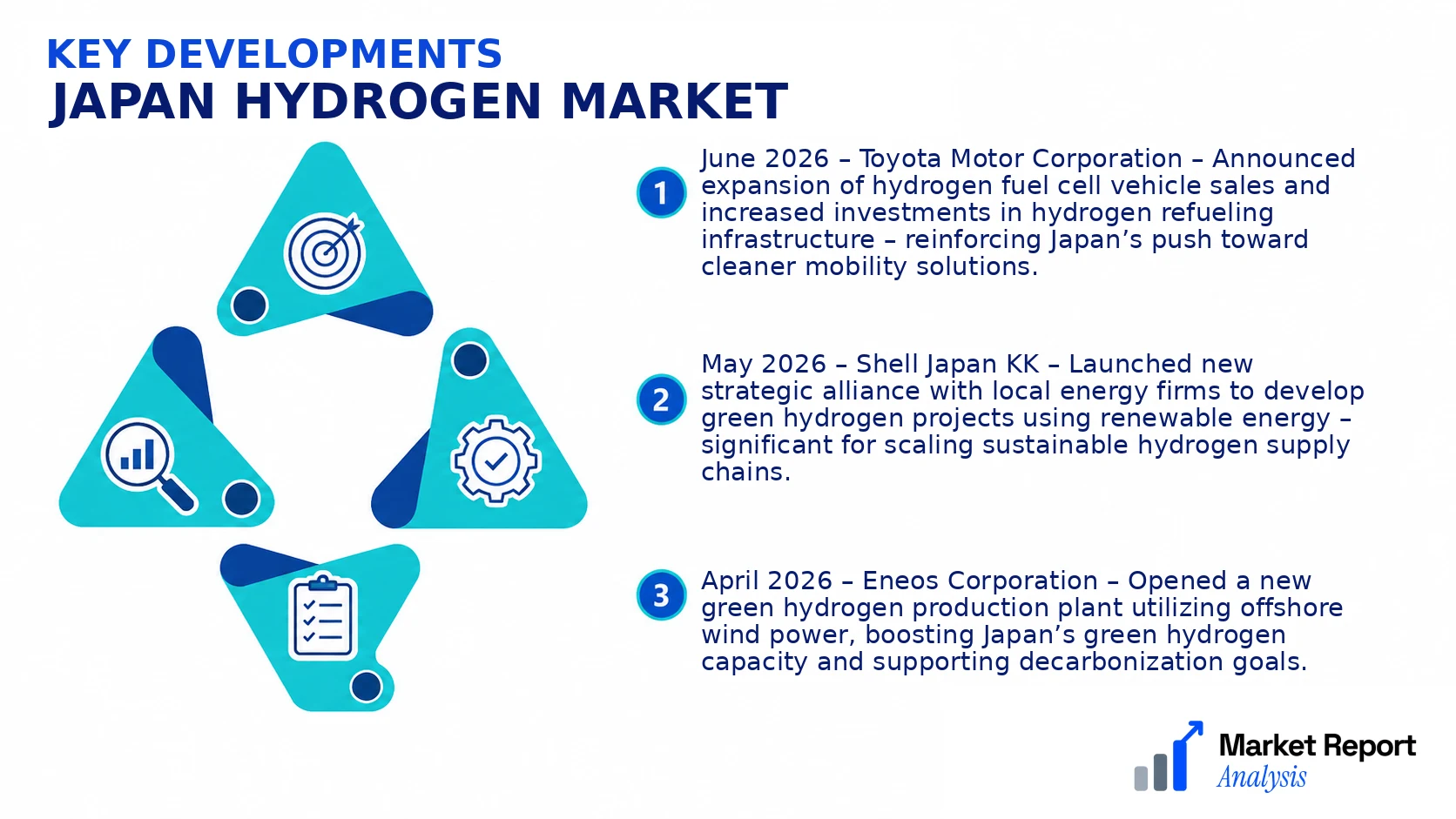
- June 2026 – Toyota Motor Corporation – Announced expansion of hydrogen fuel cell vehicle sales and increased investments in hydrogen refueling infrastructure – reinforcing Japan’s push toward cleaner mobility solutions.
- May 2026 – Shell Japan KK – Launched new strategic alliance with local energy firms to develop green hydrogen projects using renewable energy – significant for scaling sustainable hydrogen supply chains.
- April 2026 – Eneos Corporation – Opened a new green hydrogen production plant utilizing offshore wind power, boosting Japan’s green hydrogen capacity and supporting decarbonization goals.
- March 2026 – Iwatani Corporation – Announced a major capacity expansion for hydrogen fueling stations across urban centers, aiming to accelerate fuel cell vehicle adoption nationwide.
- February 2026 – Osaka Gas Co., Ltd. – Secured funding for a large-scale hydrogen blending pilot project within city gas pipelines, leading to broader application of hydrogen in residential and commercial sectors.
Frequently Asked Questions
What is the Japan Hydrogen Market?
The Japan Hydrogen Market encompasses the production, distribution, and utilization of hydrogen as an energy source within Japan. It involves various technologies such as electrolysis, steam methane reforming, and fuel cell applications, driven by national energy policies and sustainability goals.
What is the current market size of Japan Hydrogen Market?
As of 2026, the Japan Hydrogen Market is valued at approximately USD 4.2 Billion, reflecting ongoing investments in hydrogen infrastructure and technology deployment. It is poised for substantial growth over the forecast period as adoption accelerates across sectors.
What factors are driving the Japan Hydrogen Market?
Key drivers include Japan's commitment to reducing carbon emissions, government incentives for clean energy, advancements in hydrogen storage and fuel cell technology, and strategic partnerships with international firms, which collectively foster an environment conducive to hydrogen's expansion in economic and industrial applications.
Which region dominates the Japan Hydrogen Market?
Leading the market is the Kanto region, notably Tokyo, benefiting from dense industrial bases, advanced infrastructure, and proactive government policies promoting hydrogen. This region continues to set the pace for deployment and innovation in hydrogen technologies across Japan.
Which segment is expected to grow the fastest?
The transportation segment, particularly fuel cell electric vehicles (FCEVs) and hydrogen refueling stations, is expected to experience the highest growth rate, driven by government mandates, industry investments, and consumer acceptance of clean transportation solutions.
Who are the leading companies operating in the Japan Hydrogen Market?
Major players include Toyota, Honda, and Toshiba, along with energy firms like JXTG and Iwatani. These companies are pioneering hydrogen fuel cell technology, infrastructure development, and strategic collaborations to expand Japan’s hydrogen ecosystem.
Analyst Perspective
The Japan Hydrogen Market is poised for sustained growth through 2034, driven by government policies, technological advancements, and increasing industry adoption. While the market is emerging, it exhibits signs of maturity, particularly in core sectors such as transportation, power generation, and industrial feedstocks, where long-term investments are increasingly justified. The development of hydrogen infrastructure, including refueling stations and storage facilities, presents significant commercial opportunities, particularly in populous urban centers like Tokyo and Osaka, where regional demand is expected to accelerate. Technological evolution favors the adoption of green hydrogen, supported by Japan’s commitment to renewable energy integration, but challenges remain in cost competitiveness and supply chain optimization. Investment priorities should focus on scalable electrolysis capacity, advanced storage solutions, and strategic regional collaborations. Competitive intensity will increase as established energy firms and new entrants vie for market share, especially in city-level hydrogen hubs. Strategic regional focus on metropolitan clusters will be critical in capitalizing on Japan’s urban density and energy transition ambitions.
