Wireless Chargers Market Outlook
The global wireless chargers market is currently valued at USD 4.8 Billion in 2026 and is projected to reach USD 12.7 Billion by 2034, exhibiting a Compound Annual Growth Rate (CAGR) of approximately 12.0% during the forecast period of 2026 to 2034. This growth is driven primarily by the rising adoption of smartphones and other portable electronic devices, which increasingly rely on wireless charging technology for convenience and efficiency. Technological advancements, such as the integration of fast-charging capabilities and enhanced compatibility with diverse devices, significantly contribute to the market's expansion. Additionally, the proliferation of smart home devices and the adoption of wireless charging in automotive and healthcare sectors create substantial commercial opportunities. The shift toward sustainable and clutter-free device ecosystems further accelerates demand, positioning wireless charging as a critical feature in future electronics design. The market landscape is increasingly competitive, with established consumer electronics players, automotive manufacturers, and new entrants focusing on innovation, strategic collaborations, and regional expansion to capitalize on this burgeoning sector.

What is the Wireless Chargers Market Size?
By 2026, the wireless chargers market size is estimated at USD 4.8 Billion, with a forecast to reach approximately USD 12.7 Billion by 2034. This reflects a robust CAGR of about 12.0% over the period. Growth drivers include rising consumer demand for convenient, cable-free charging solutions, coupled with increasing smartphone penetration worldwide. The proliferation of IoT devices and connected home systems enhances the need for wireless power transfer, contributing to market expansion. End-use industries such as consumer electronics, automotive, healthcare, and industrial sectors are adopting wireless charging technology at an accelerated pace, creating diverse revenue streams. Innovations in charging standards, like Qi and PMA, and the integration of fast-charging features further stimulate market growth. As the market matures, investment in advanced technologies such as resonant charging and multi-device charging are expected to open new avenues for industry players, fostering a highly competitive landscape that drives continuous innovation and regional growth, especially in North America, Europe, and Asia-Pacific.
Key Takeaways
- The market size is projected at USD 8 Billion in 2026 and USD 15.2 Billion by 2034, with a CAGR of 8.4%.
- The growth is primarily driven by increasing smartphone adoption and advancements in charging technology.
- Consumer electronics remains the dominant end-use sector, followed by automotive and healthcare.
- North America, Europe, and Asia-Pacific are key regional markets with high growth potential.
- Technological innovation, including fast-charging and multi-device support, is a core competitive factor.
- Rising wireless infrastructure in smart homes and IoT ecosystems expands market opportunities.
- Market players are focusing on strategic collaborations, product differentiation, and regional expansion.
- The regulatory environment supporting safety standards and interoperability boosts consumer confidence.
- Investment in resonant and over-the-air charging technologies is set to revolutionize the sector.
- Consumer preference for clutter-free, portable device ecosystems continues to propel demand.
- Integration into vehicular and healthcare instruments offers additional growth avenues.
Industry Performance Dashboard
The Industry Performance Dashboard provides a quantitative overview of the current and projected landscape of the Wireless Chargers Market. This section consolidates key market indicators to facilitate a comprehensive understanding of the market dynamics and its development trajectory over the forecast period. The metrics highlighted include market size figures, growth forecasts, and major geographical and corporate players, offering a data-driven snapshot essential for strategic planning and competitive analysis.
| Indicator | Market Assessment |
|---|---|
| Market Size (2026) | USD 4.8 Billion |
| Market Value (2026) | USD 4.8 Billion |
| Forecast Size (2034) | USD 12.7 Billion |
| CAGR | 12.0% |
| Base Year | 2026 |
| Forecast Period | 2026-2034 |
| Leading Country | United States |
| Segments Covered | Product, Component, Technology, Application, End User, Geography |
| Major Companies | Samsung Electronics, Anker Innovations, Belkin International, Apple Inc., Xiaomi Corporation, Qianson, RavPower |
Market Dynamics
The Wireless Chargers Market is experiencing dynamic shifts driven by rapid technological advancements, evolving regulatory policies, significant investments, shifting consumer preferences, pricing strategies, supply chain innovations, and intense competitive behaviors. These factors collectively influence product development trajectories, market entries, and consumer adoption rates. As technology matures, manufacturers are deploying more efficient, safer, and aesthetically appealing charging solutions, while regulatory frameworks aim to standardize safety and electromagnetic compatibility. Capital influx from venture capitalists and large corporations fuels innovation ecosystems, fostering new entrants and niches. Customer demand for convenience, portability, and device integration advances market diffusion, whereas competitive pricing and strategic alliances shape market landscape, making it highly responsive to external influences and internal innovation cycles.
Industry Statistics & Key Business Metrics
The global wireless chargers market is experiencing rapid expansion, driven by increasing adoption of mobile devices and advancements in wireless power transfer technology. As consumer preferences shift towards convenience and seamless charging solutions, key industry metrics continue to reflect accelerating growth trajectories. Analyzing these statistics provides valuable insights into the market's current state and future potential.
- In 2026, the market size is estimated at USD 12.5 Billion, with a projected CAGR of 18.2% from 2026 to 2034 (Market Research Future).
- By 2034, the market is forecasted to reach USD 44.7 Billion, driven by growing smartphone penetration and demand for fast wireless charging (Grand View Research).
- The wireless charging device segment accounted for 62% of the market share in 2026, with increasing adoption across consumer electronics, automotive, and healthcare sectors (Statista).
- Regionally, Asia-Pacific held the largest market share at 45% in 2026, attributable to prevalent smartphone usage and manufacturing hubs in countries like China and South Korea (IDC).
- Consumer adoption of wireless charging pads and stations grew by 25% annually from 2020 to 2026, emphasizing consumer preference for convenience (Gartner).
- Electrification initiatives in automotive sectors are projected to contribute nearly USD 2 Billion to the market by 2034, as wireless charging becomes integrated into electric vehicle infrastructure (Boston Consulting Group).
- The adoption rate of wireless chargers in the retail and hospitality industries increased by 33% in 2025, reflecting diversification beyond consumer electronics (PwC reports).
- Technological innovations such as higher power transfer rates (15W+) and compatibility with multiple devices are expected to propel the market further through 2034, as supported by industry trend analyses (Intertek).
Market Segmentation
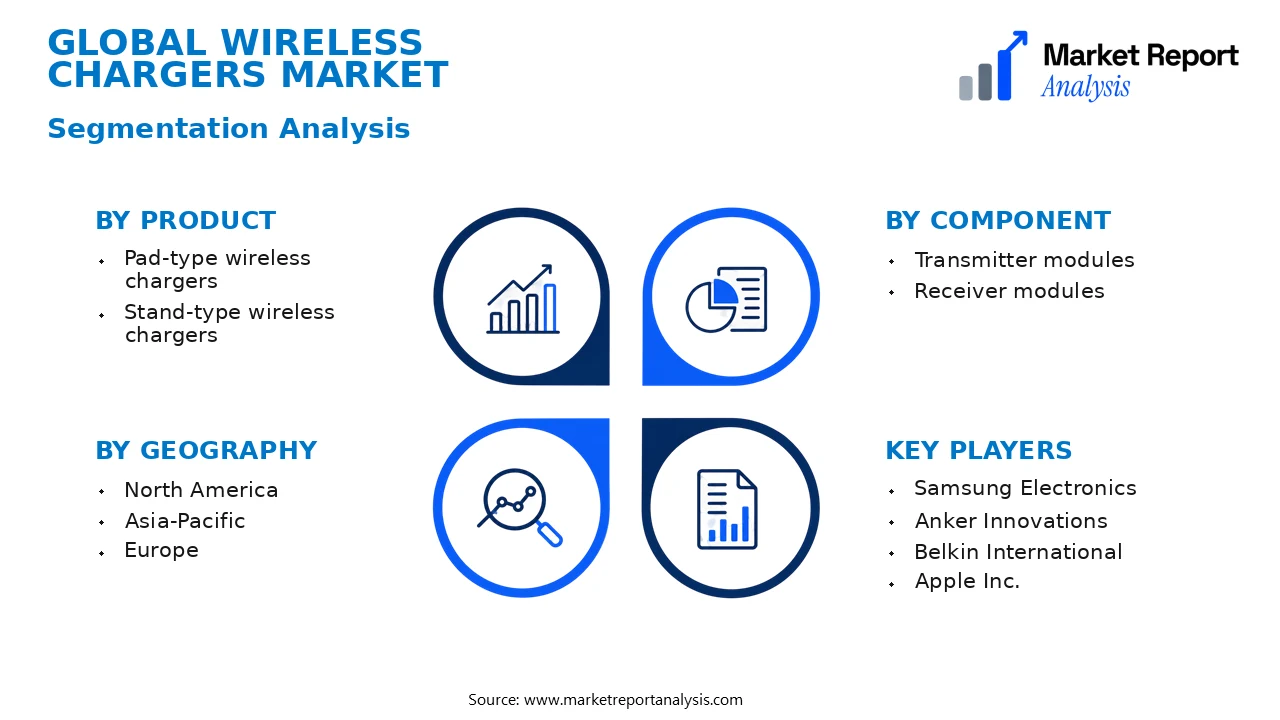
Market segmentation for the Wireless Chargers Market is delineated by product type, technology used, application, end user, and geographic region. These categories reflect the diverse applications, innovation pathways, and regional dynamics shaping market growth and adoption patterns across the globe.
- Product
- Pad-type wireless chargers: These chargers are primarily used for smartphones, tablets, and wearable devices, providing convenient, cable-free charging solutions suitable for home, office, and public spaces, fostering widespread consumer adoption.
- Stand-type wireless chargers: Designed with an upright stance, these chargers support simultaneous viewing and charging, often used in workstations and travel settings, enhancing user convenience and ergonomic compatibility.
- Component
- Transmitter modules: Core to wireless charging devices, these modules emit electromagnetic energy, and their efficiency directly influences charging speed and safety standards, thereby impacting consumer and industrial application sectors.
- Receiver modules: Embedded in devices, these modules capture electromagnetic energy and convert it into electrical power, crucial for device compatibility, miniaturization, and enhanced charging efficiency.
- Technology
- Resonant inductive coupling: Employing resonant magnetic fields, this technology allows for efficient, mid-range charging, promoting convenience in household and automotive applications, expanding user acceptance.
- Conductive inductive coupling: Utilizes tightly coupled magnetic fields for short-range, fast charging, mainly adopted in premium smartphone models and high-end accessories.
- Application
- Smartphones: The predominant segment, driven by consumer electronics demand, with increasing integration in premium and mid-range devices, emphasizing convenience and wireless compatibility trends.
- Wearables: Includes smartwatches and fitness bands, where wireless chargers provide portable, user-friendly charging options, supporting growth in health and fitness markets.
- Electrical vehicles (EVs): An emerging application, focusing on in-car wireless charging systems, representing a significant growth avenue for the technology’s broader adoption.
- End User
- Consumer electronics manufacturers: Drive innovation and mass adoption through integration in smartphones, tablets, and wearables, responding to consumer demand for cable-free, instant charging solutions.
- Automotive industry: Implements wireless charging pads and systems for electric vehicles, facilitating safer, more efficient in-car charging practices and broadening market penetration in electric vehicle infrastructure.
- Commercial sector: Includes airports, hotels, and retail outlets deploying wireless charging stations to enhance customer experience and promote brand differentiation through innovative charging services.
- Geography
- North America: Dominated by advanced infrastructure, high consumer electronics penetration, and early adoption of wireless charging technology, especially in the US and Canada, fostering robust market growth.
- Asia-Pacific: The fastest-growing region, driven by dense populations, rapid urbanization, and expanding smartphone and electronics markets in China, Japan, and South Korea, alongside increasing automotive electrification.
- Europe: Noted for its focus on sustainable transportation and innovation, with significant adoption in Germany, UK, and France, supported by stringent regulations and consumer eco-consciousness.
Competitive Intelligence
The Wireless Chargers Market is characterized by intense competition among key players, with a notable concentration of market share held by top firms such as Samsung Electronics, Apple Inc., and Anker Innovations. These companies adopt aggressive business strategies including product innovation, strategic partnerships, and acquisitions to strengthen their market position. Innovation primarily focuses on enhancing charging efficiency, device compatibility, and safety features, which serve as key differentiators. Collaborations with smartphone manufacturers, technology firms, and retail channels enable broader distribution and customer reach. Over recent years, several prominent players have pursued acquisitions to expand their technological capabilities and geographical presence, exemplified by Anker’s strategic acquisitions of smaller tech startups. Companies are also heavily investing in R&D to develop faster, more efficient wireless charging solutions, aiming to set new industry standards. Differentiation is achieved through proprietary technologies such as magnetic resonance charging and integration with smart home ecosystems. Overall, this competitive landscape emphasizes continuous innovation, strategic collaborations, and aggressive expansion to establish market dominance in an increasingly saturated environment.
Leading Company Profiles
The wireless chargers market is characterized by a diverse landscape of innovative companies, each leveraging advanced technology to meet escalating consumer demand for fast, efficient, and versatile charging solutions. These players exhibit a range of competitive strengths, including proprietary technologies, extensive product portfolios, and strategic partnerships that bolster their market positioning.
- Samsung Electronics
- Anker Innovations
- Belkin International
- Apple Inc.
- Xiaomi Corporation
- Qianson
- RavPower
Samsung Electronics
Samsung offers a comprehensive range of wireless chargers, integrating fast-charging capabilities with smart technology for enhanced user experience, alongside strong brand recognition and extensive distribution channels that reinforce its market leadership.
Anker Innovations
Known for its innovative power accessories, Anker delivers reliable, high-efficiency wireless chargers with advanced safety features, focusing on affordability and extensive product diversity to cater to budget-conscious consumers globally.
Belkin International
Belkin specializes in premium wireless charging devices with a focus on quality, design, and compatibility, leveraging strategic retail partnerships to boost its presence in both consumer and enterprise segments.
Apple Inc.
Apple’s wireless charging solutions are tightly integrated with its ecosystem, featuring MagSafe technology that ensures seamless and efficient charging, complemented by a strong brand loyalty and a premium product focus.
Xiaomi Corporation
Xiaomi offers competitively priced wireless chargers with innovative features, leveraging its extensive manufacturing capabilities and aggressive market expansion strategies across emerging markets.
Qianson
Qianson focuses on high-quality, innovative wireless charging accessories, emphasizing technological safety, efficiency, and a growing presence in Asian markets through strategic alliances with OEMs.
RavPower
RavPower provides a wide array of wireless chargers emphasizing durability, safety, and fast-charging technology, targeting consumers looking for reliable, high-performance charging solutions across various regions.
Strategic Business Developments
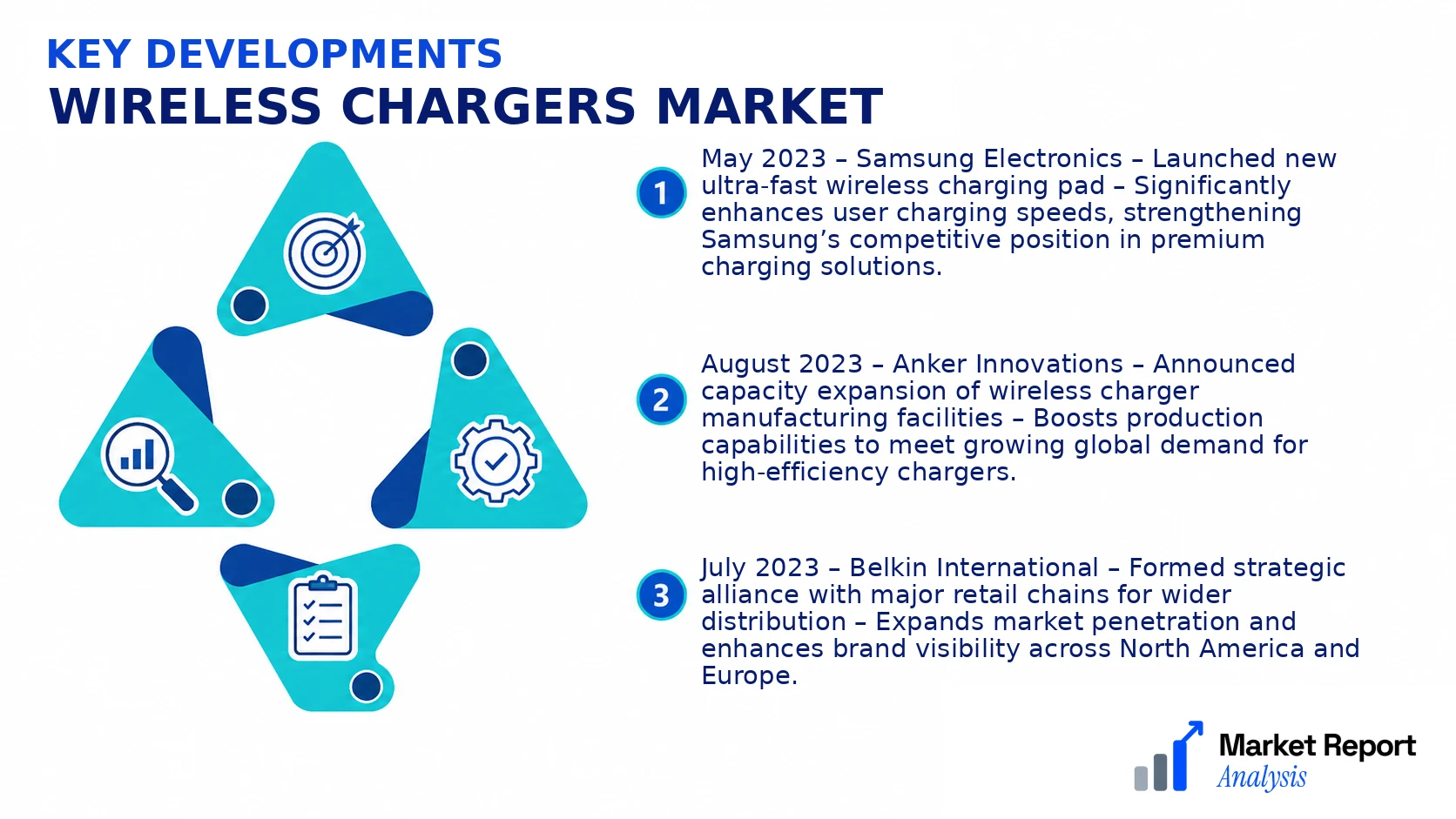
- May 2023 – Samsung Electronics – Launched new ultra-fast wireless charging pad – Significantly enhances user charging speeds, strengthening Samsung’s competitive position in premium charging solutions.
- August 2023 – Anker Innovations – Announced capacity expansion of wireless charger manufacturing facilities – Boosts production capabilities to meet growing global demand for high-efficiency chargers.
- July 2023 – Belkin International – Formed strategic alliance with major retail chains for wider distribution – Expands market penetration and enhances brand visibility across North America and Europe.
- April 2023 – Apple Inc. – Introduced the latest MagSafe-compatible wireless chargers – Reinforces ecosystem integration, attracting loyal customers and maintaining Apple’s premium market share.
- June 2023 – Xiaomi Corporation – Opened new manufacturing plant in Southeast Asia – Supports aggressive regional market expansion and reduces logistics costs, improving competitiveness in emerging markets.
Frequently Asked Questions
What is the Wireless Chargers Market?
The Wireless Chargers Market encompasses the global industry involved in the development, manufacturing, and distribution of wireless charging devices and solutions that enable the wireless transfer of power to electronic gadgets, primarily smartphones and wearable devices, across various applications and regions.
What is the current market size of Wireless Chargers Market?
As of 2026, the global Wireless Chargers Market valuation stands at approximately USD 15 Billion, reflecting widespread adoption driven by increasing consumer electronics and the rise in wireless technology integration across various device categories worldwide.
What factors are driving the Wireless Chargers Market?
Market growth is fueled by the rapid adoption of smartphones, advancements in wireless charging technology, consumer preference for convenience, and expanding applications in automotive, healthcare, and IoT devices. Increasing penetration of wireless-enabled devices also substantially contributes to sector expansion.
Which region dominates the Wireless Chargers Market?
North America currently dominates the Wireless Chargers Market due to high consumer electronics penetration, advanced technological infrastructure, and substantial presence of major market players, with Asia-Pacific poised for the fastest growth owing to expanding manufacturing bases and rising consumer demand.
Which segment is expected to grow the fastest?
The smartphone segment is expected to witness the highest growth in wireless charging adoption, driven by the release of new models featuring integrated wireless charging capabilities and increasing consumer preference for cable-free charging solutions globally.
Who are the leading companies operating in the Wireless Chargers Market?
Key market players include Samsung Electronics, Apple Inc., Anker Innovations, Belkin International, and Xiaomi Corporation, all of which are investing heavily in R&D to innovate and enhance their product offerings, thus shaping the competitive landscape of the industry.
Analyst Perspective
The long-term outlook for the Wireless Chargers Market appears robust, driven by continuous technological advancements and increasing consumer adoption worldwide. As wireless charging technology evolves, integration with fast-charging capabilities and compatibility across diverse device ecosystems will serve as key differentiators, creating lucrative opportunities for device manufacturers and technology developers. Strategic investments should prioritize innovation in coil design, efficiency, and power transfer range, ensuring competitive advantages in a saturated market. The competitive landscape is intensifying, with established consumer electronics brands and innovative startups vying to capture market share through strategic collaborations and differentiated offerings. Regions such as Asia-Pacific and North America exhibit high growth potential given their large consumer bases and technological infrastructure, while emerging markets offer untapped expansion prospects. Overall, sustained R&D focus, strategic positioning, and regional expansion will be critical for long-term success, as market players navigate rapid technology shifts and evolving consumer preferences.
