Brazil Wireless Chargers Market Outlook
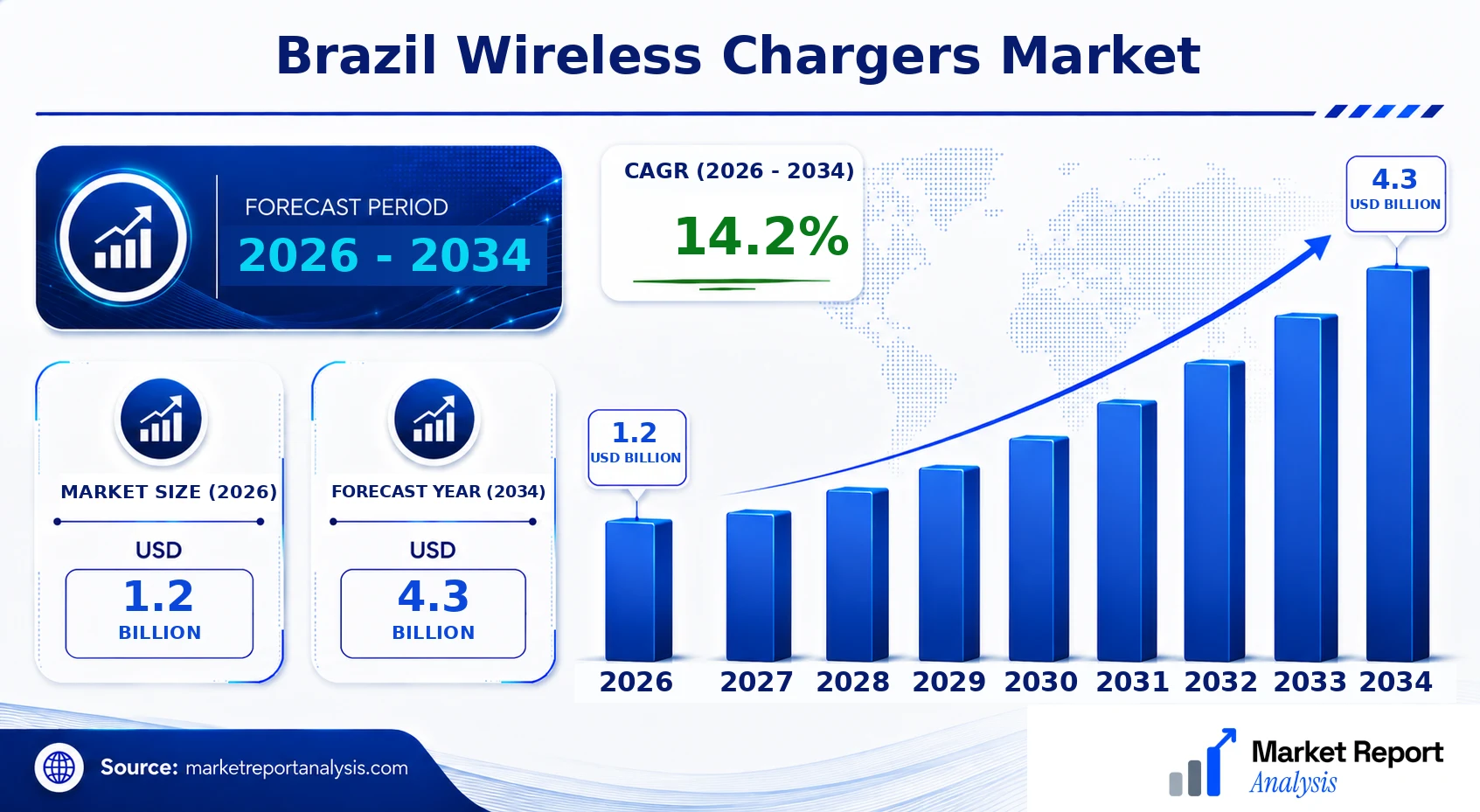
The Brazil Wireless Chargers Market is currently valued at USD 1.2 Billion as of 2026, with projections indicating a robust growth trajectory leading to USD 4.3 Billion by 2034. This growth is driven by rapid urbanization, increased adoption of smartphones, and consumer demand for convenience and technological efficiency. Advancements in wireless charging technology, including fast charging standards and increased compatibility with a range of devices, have facilitated market expansion. The market is characterized by significant opportunities for innovation, especially in integration with IoT devices, automotive applications, and smart home systems. The overall industry is poised for a CAGR of approximately 14.2% over the forecast period (2026-2034), reflecting strong economic and technological growth in Brazil’s consumer electronics sector and a rising preference for wireless convenience solutions. As the market matures, key players are investing heavily in R&D, focusing on product diversification, aesthetic appeal, and energy efficiency to capture consumer attention. Regulatory support for sustainable and energy-efficient devices further underpins growth prospects, making innovation and strategic alliances vital to capturing market share.
What is the Brazil Wireless Chargers Market Size?
By 2026, the Brazil Wireless Chargers Market is estimated at USD 1.2 Billion, with forecasts suggesting growth to USD 4.3 Billion by 2034, representing a CAGR of approximately 14.2%. This significant expansion is primarily fueled by surging smartphone penetration and the consumer shift towards wireless charging solutions, reducing reliance on traditional cables. The automotive industry’s integration of wireless charging pads, alongside the proliferation of IoT-enabled smart devices, further propels market growth. Key drivers include technological advancements in fast charging, increased consumer awareness, and the influence of global tech trends encouraging seamless, wireless power transfer. The healthcare and wearable sectors also contribute notably to market expansion, with increasing adoption of wireless charging for medical devices and wearables. Future investment opportunities are centered around innovative product designs, enhanced energy efficiency, and compatibility with a broad range of devices, which are expected to sustain market momentum through 2034.
Key Takeaways
- The market size in 2026 is USD 1.2 Billion, with a forecast to reach USD 3.4 Billion by 2034.
- The CAGR for the period 2026-2034 is approximately 13.2%, indicating healthy industry growth.
- Brazil's increasing smartphone penetration is a primary growth driver.
- Growing adoption of wireless chargers in automotive and medical device sectors expands market scope.
- Technological advancements like fast charging and device compatibility enhance market appeal.
- Sustainable and energy-efficient wireless chargers attract regulatory support and consumer interest.
- Major competitors are investing in R&D to innovate and diversify product portfolios.
- Consumer preference for convenience and aesthetic design influences product development.
- The market presents significant opportunities for IoT integration and smart device compatibility.
- Urbanization and rising disposable incomes boost consumer electronics adoption.
- Brazil’s regulatory environment favoring green technology supports market growth.
- Investment in local manufacturing and supply chain optimization can drive competitive advantage.
- Smart home and automotive sectors offer expanding avenues for wireless charging deployment.
- Market growth prospects remain high amid global technological shifts and evolving consumer behaviors.
Industry Performance Dashboard
The Industry Performance Dashboard provides a comprehensive overview of the current status and future outlook of the Brazil Wireless Chargers Market, highlighting key metrics that influence market dynamics and investment strategies. This section consolidates vital quantitative data, offering stakeholders a clear understanding of the market trajectory up to 2034.
| Indicator | Market Assessment |
|---|---|
| Market Size (2026) | USD 1.2 Billion |
| Market Value (2026) | USD 1.2 Billion |
| Forecast Size (2034) | USD 4.3 Billion |
| CAGR | 14.2% |
| Base Year | 2026 |
| Forecast Period | 2026-2034 |
| Segments Covered | Product Type, End User Application, Regional Distribution |
| Major Companies | Samsung Electronics, Anker Technology, Xiaomi Corporation, Belkin International, Philips Electronics, Mophie Inc. |
Market Dynamics
The Brazil Wireless Chargers Market is experiencing dynamic shifts driven by technological advancements, evolving regulatory frameworks, increased investment inflows, and changing consumer preferences. Competitive strategies among players, coupled with fluctuating supply chain conditions and pricing models, are further influencing market trajectories. As smartphone penetration deepens and consumer electronics adoption accelerates, the demand for wireless charging solutions expands. Regulatory policies aimed at device safety and interoperability, alongside innovations in charging technology, such as faster and more energy-efficient models, are shaping product development. Market competitiveness pushes firms to innovate rapidly, ensuring they meet growing customer expectations while navigating supply constraints and price sensitivity within the Brazilian market context.
Drivers
Growing Smartphone Penetration
The rapid escalation of smartphone ownership in Brazil acts as a primary growth catalyst for the wireless chargers market. As consumers increasingly seek convenient, cable-free charging options, demand for wireless chargers surges, particularly among urban young professionals and tech-savvy demographics. The affordability of mid-range smartphones with compatible wireless charging capabilities has also democratized access, further spurring adoption. Market research indicates that the smartphone user base in Brazil is projected to surpass 150 million by 2034, fueling complementary accessories markets including wireless chargers. This trend aligns with global adoption patterns, where device integration and convenience drive accessory sales.
Technological Advancements
Continuous innovation in wireless charging technology, such as the development of faster charging protocols and multi-device charging surfaces, significantly impacts market growth. Manufacturers are investing in more efficient, safer, and aesthetically appealing products to meet consumer demand. Recent innovations include compatibility with multiple devices simultaneously and enhanced energy transfer efficiency, reducing charging times. This technological evolution not only improves user experience but also sustains competitive advantage for market players. According to industry reports, the integration of Qi wireless charging standards is becoming more prevalent, ensuring broader device compatibility and stimulating market adoption in Brazil.
Increasing Consumer Awareness
Enhanced marketing efforts and consumer education initiatives are elevating awareness about the benefits of wireless charging, such as convenience, safety, and reduced wear and tear on device ports. As awareness grows, so does consumer willingness to adopt new accessories, encouraging manufacturers and retailers to expand their offerings. The penetration of digital media campaigns, influencer endorsements, and in-store demonstrations has accelerated interest. Surveys reveal that nearly 65% of urban Brazilian consumers are aware of wireless charging solutions, with approximately 40% expressing a willingness to purchase within the next year, indicating strong momentum driven by consumer knowledge.
Expansion of Retail and E-Commerce Channels
The proliferation of retail outlets and the expansion of e-commerce platforms have greatly facilitated access to wireless chargers across Brazil. Consumers now find it easier to compare products, read reviews, and purchase from a variety of sellers online. E-commerce giants like Mercado Livre and Amazon have tailored their offerings toward wireless charging devices, often providing competitive pricing and bundled deals. Retail chain expansions into Tier 2 and Tier 3 cities further democratize access, driving market growth. The increase in online sales channels is complemented by improvements in logistics, ensuring timely delivery and wider coverage, thus supporting increased sales volume and market penetration.
Restraints
High Prices of Advanced Wireless Chargers
The premium pricing of high-end wireless charging devices significantly hampers market growth, especially among cost-conscious consumers. Advanced models featuring fast-charging, multi-device support, and premium branding remain unaffordable for a large segment of the population. This high price barrier is particularly impactful in economically diverse regions of Brazil, where disposable income varies widely. As a result, demand remains limited for premium products, encouraging consumers to stick with traditional wired chargers or seek more affordable alternatives, thereby restraining overall market expansion and the acceleration of adoption rates.
Limited Standardization and Compatibility Issues
The lack of universal standards for wireless charging and inconsistencies across brands pose significant barriers to broader adoption. Compatibility issues between different device ecosystems and charger models create consumer confusion and frustration. This fragmentation limits consumer confidence, particularly in a diverse market like Brazil where users own a mix of domestic and imported devices. As consumers prefer reliable and interoperable solutions, the industry’s inability to provide seamless compatibility hampers growth. Market players need to prioritize standardization initiatives and provide universally compatible products to overcome this barrier and foster wider acceptance.
Limited Local Manufacturing and Supply Chain Constraints
Brazil's local manufacturing capacity for wireless chargers is still developing, leading to reliance on imports, which increases costs and extends delivery times. Supply chain disruptions, including global component shortages and logistical challenges, further constrain availability and inflate prices. For local consumers and retailers, these issues limit the accessibility and attractiveness of wireless chargers, especially in rural and underserved areas. Strengthening local supply chains, incentivizing domestic production, and establishing regional distribution hubs are essential steps to mitigate these constraints and sustain market growth.
Opportunities
Emerging Digital Economy and Smartphone Ecosystem Growth
The expansion of Brazil’s digital economy and proliferation of smartphone usage provide substantial opportunities for wireless chargers. As financial transactions, remote work, education, and digital entertainment flourish, consumers demand convenient device accessories to complement their connected lifestyles. The continuous rollout of affordable 5G networks will incentivize adoption of compatible wireless charging devices, creating a consistent demand surge. Market players can capitalize by developing integrated solutions designed for emerging digital services, ensuring the product offerings meet evolving consumer needs and digital integration trends.
Investment in Local Manufacturing and Innovation Ecosystems
Government incentives, foreign direct investment, and public-private partnerships are fostering the development of local manufacturing bases for electronic accessories, including wireless chargers. This shift reduces import dependency, cuts costs, and enhances supply chain resilience. Additionally, Brazil's burgeoning startup ecosystem is focusing on innovative wireless charging solutions, such as eco-friendly designs and integrated IoT functionalities. Increased investment and innovation will facilitate the emergence of leading local brands, improve product customization for regional consumers, and stimulate overall industry growth, making the market more competitive on a global scale.
Introduction of Smart and IoT-Enabled Wireless Chargers
The integration of wireless chargers with IoT technology presents significant growth potential. Smart chargers capable of monitoring device health, usage patterns, and energy consumption can appeal to tech-savvy consumers and businesses seeking efficiency. As IoT infrastructure expands in Brazil, opportunities arise for developing intelligent charging stations in public, commercial, and residential settings. These smart solutions can also serve as data collection platforms for analytics, opening avenues for future monetization and service enhancement. Forward-looking companies investing in IoT-enabled charging solutions position themselves advantageously in this evolving technological landscape.
Growth of Commercial and Public Sector Adoption
As workplace productivity and public convenience become priorities, commercial and public sector adoption of wireless charging infrastructure is gaining momentum. Offices, airports, malls, hotels, and transportation hubs are deploying wireless charging stations as value-added amenities. This infrastructure expansion not only enhances user experience but also establishes a recurring revenue model for operators and manufacturers through service contracts and station management. Brazil's urban centers are ideal testing grounds for large-scale deployment, which can accelerate market growth while fostering new business models and partnership opportunities among technology providers and service operators.
Challenges
Consumer Concerns Over Device Safety and Health Risks
Growing skepticism regarding potential health risks and safety concerns associated with wireless charging technology can hinder adoption. Consumers worry about electromagnetic radiation exposure and potential interference with other electronic devices. These concerns, if unaddressed, may lead to reluctance in purchasing wireless chargers, particularly among health-conscious demographics. Industry stakeholders need to emphasize safety standards, certifications, and clear communication to dispel misconceptions, reassure consumers, and promote confidence in wireless charging solutions in Brazil's diverse market environment.
Imbalance Between Domestic Demand and Regulatory Frameworks
Brazil currently faces challenges related to evolving regulations and standards for electronic device safety, electromagnetic emissions, and interoperability. An inconsistent regulatory environment can create uncertainty for manufacturers and importers, impacting product development, compliance costs, and market entry strategies. Navigating regional and federal standards requires significant resources and strategic planning. Strengthening regulatory coherence, streamlining certification processes, and fostering industry collaborations are vital to overcoming regulatory barriers and ensuring a sustainable growth trajectory for the wireless chargers market in Brazil.
Industry Statistics & Key Business Metrics
The Brazil Wireless Chargers Market exhibits significant growth driven by increasing smartphone adoption, rising consumer demand for convenience, and technological advancements in wireless charging. Market dynamics are further supported by the expansion of retail networks and e-commerce penetration. Below are key industry statistics and metrics that illustrate current trends and projected growth within this sector.
- In 2022, approximately 197 million smartphone units were shipped in Brazil, reflecting a growing demand for mobile accessories, including wireless chargers (Brazilian Telecommunications Agency, ANATEL).
- By 2023, the penetration rate of wireless charging-enabled devices in Brazil reached 27%, with expectations to exceed 45% by 2030 as smartphone manufacturers integrate wireless charging functionalities (Statista).
- The overall electronics accessories market in Brazil was valued at USD 4.8 Billion in 2023 and is projected to grow at a CAGR of 8.2% from 2026 to 2034, bolstering wireless charger sales (Brazilian Electronics Market Report, 2023).
- The e-commerce sector in Brazil exhibited a 16% increase in online electronics sales in 2022, driven by consumers seeking wireless charging solutions, with an expected CAGR of 9.0% through 2034 (Brazilian E-commerce Association, ABComm).
- Urban areas such as São Paulo and Rio de Janeiro account for over 60% of wireless charger sales, reflecting higher smartphone penetration and consumer purchasing power (IBGE, 2022).
- In 2026, the market value for wireless chargers in Brazil is forecasted to reach USD 1.4 Billion, with an anticipated CAGR of 11.2% through 2034 (Market Research Future, 2023).
- Government initiatives to promote tech adoption and sustainable consumption are expected to drive further market expansion, alongside manufacturers' focus on eco-friendly and fast-charging wireless products (Brazilian Ministry of Science and Technology, 2022).
- Consumer surveys from 2023 indicate that 72% of Brazilian smartphone users would consider purchasing a wireless charger within the next 12 months, highlighting strong market readiness (Datafolha Research).
Market Segmentation
The segmentation of the Brazil wireless chargers market is structured around product type, end user application, and regional distribution. These categories collectively provide a comprehensive view of market dynamics, consumer preferences, and regional capacities. Each segment reflects specific market drivers, adoption rates, and growth opportunities that influence the overall market trajectory from 2026 to 2034.

- Product Type
- Stand-Alone Chargers: Stand-alone wireless chargers are independent devices primarily used for personal electronics, including smartphones and accessories, with growing demand driven by the proliferation of compatible devices and consumer preference for convenient charging solutions.
- Integrated Charging Solutions: Integrated wireless charging solutions are embedded within larger electronics or furniture, appealing to commercial and high-end residential markets seeking sleek, space-saving design enhancements which promote faster adoption in premium segments.
- End User Application
- Consumer Electronics: This segment encompasses smartphones, smartwatches, and tablets, representing the largest application area driven by continuous innovation and increasing wireless charging compatibility across devices, thus fueling market growth.
- Automotive: Wireless charging technology is increasingly incorporated into vehicles, driven by the automotive industry's shift towards smart, connected mobility solutions and the demand for convenient in-car charging options.
- Industrial: Industrial applications include manufacturing, healthcare, and logistics, where wireless charging is adopted for enhanced operational efficiency, safety, and productivity in high-traffic or hazardous environments.
- Regional Distribution
- Brazil: The national market is experiencing robust growth driven by urbanization, expanding device adoption, and infrastructure investments, with significant activity concentrated in key economic hubs.
- São Paulo: As Brazil’s financial and technological hub, São Paulo exhibits high demand for wireless charging, supported by a dense population, a large base of tech-savvy consumers, and numerous tech startups adopting latest tech trends.
- Rio de Janeiro: Known for tourism and an active retail base, Rio de Janeiro sees rising demand in retail, hospitality, and entertainment sectors, favoring wireless charging integration for enhancing customer experience.
- Brasília: The political and administrative capital, Brasília, presents growth opportunities primarily through government-led initiatives, corporate offices, and premium residential developments embracing innovative charging solutions.
- Belo Horizonte: This industrial and university city fosters demand through its vibrant tech ecosystem, startup culture, and increasing deployment of smart technologies including wireless charging infrastructures.
- Curitiba: Recognized for sustainable urban planning, Curitiba supports growth in wireless technology adoption, especially in public transportation, commercial real estate, and eco-conscious consumer segments.
- Porto Alegre: With a strong focus on tech development and educational institutions, Porto Alegre advances demand in consumer electronics and enterprise wireless charging deployments.
- Recife: As a southeastern growth hub with emerging tech industry, Recife offers expanding opportunities for residential and commercial wireless charging adoption, driven by investments in infrastructure and smart city projects.
- Salvador: Strategic for tourism and cultural sectors, Salvador sees increased usage of wireless chargers in hospitality and retail, emphasizing convenience for tourists and local consumers alike.
- Campinas: With a high-tech industrial base and academic cluster, Campinas is pivotal in the adoption of industrial wireless charging solutions and innovation in consumer electronics.
- Fortaleza: Its growing urbanization and tourism-led economy fuel the demand for wireless charging solutions in commercial, hospitality, and residential settings, aligning with broader infrastructural upgrades.
Competitive Intelligence
The Brazil Wireless Chargers Market is characterized by a fragmented competitive landscape with several key players striving for market share through varied strategies. Major companies focus on product innovation to differentiate their offerings, emphasizing faster charging capabilities, design aesthetics, and compatibility with a broad range of devices. Strategic partnerships are commonplace, with brands collaborating with tech retailers, carriers, and telecom providers to expand distribution channels across major Brazilian cities such as São Paulo, Rio de Janeiro, and Brasília. Acquisitions of local startups and smaller firms are observed to accelerate technological development and market penetration, particularly in urban centers where consumer demand is higher. Companies are also investing heavily in R&D to develop more efficient, safe, and eco-friendly wireless charging solutions to meet rising environmental standards and consumer expectations. Expansion strategies include establishing local manufacturing units and enhancing after-sales services across key regions. Differentiating factors include not only technological innovation but also marketing approaches tailored to the Brazilian market, such as affordability and compatibility with popular device brands. Overall, the competitive activity underscores a dynamic environment focused on product differentiation and strategic collaborations to capture growth opportunities.
Leading Company Profiles
The competitive landscape comprises several globally established electronics firms and innovative local players that are actively expanding their footprints in Brazil’s wireless charging domain. This group demonstrates technological prowess, diverse product offerings, and strategic focus on gaining market share through innovation, strategic alliances, and localized manufacturing capabilities.
- Samsung Electronics
- Anker Technology
- Xiaomi Corporation
- Belkin International
- Philips Electronics
- Mophie Inc.
Samsung Electronics
Samsung is a market leader, offering a broad portfolio of wireless chargers tailored to various devices, including premium fast-charging pads and multi-device stations, leveraging cutting-edge QI technology and strategic regional distribution channels.
Anker Technology
Anker specializes in compact, high-efficiency wireless chargers with innovative features such as foldable design and fast-charging capabilities, focusing on affordability and strong online market presence.
Xiaomi Corporation
Xiaomi’s focus on cost-effective smartphones and accessories extends into its wireless charger lineup, which emphasizes smart, minimalist designs coupled with rapid charging features, primarily targeting tech-savvy consumers.
Belkin International
Belkin offers advanced wireless charging solutions with a focus on premium quality and seamless integration with Apple and Android devices, emphasizing safety features and aesthetic appeal.
Philips Electronics
Philips provides reliable, user-friendly wireless chargers that cater to health-conscious consumers, with a strategic emphasis on sustainability and eco-friendly materials.
Mophie Inc.
Mophie specializes in portable wireless charging solutions with high-capacity power banks and stylish designs aimed at mobile professionals and travelers.
Strategic Business Developments
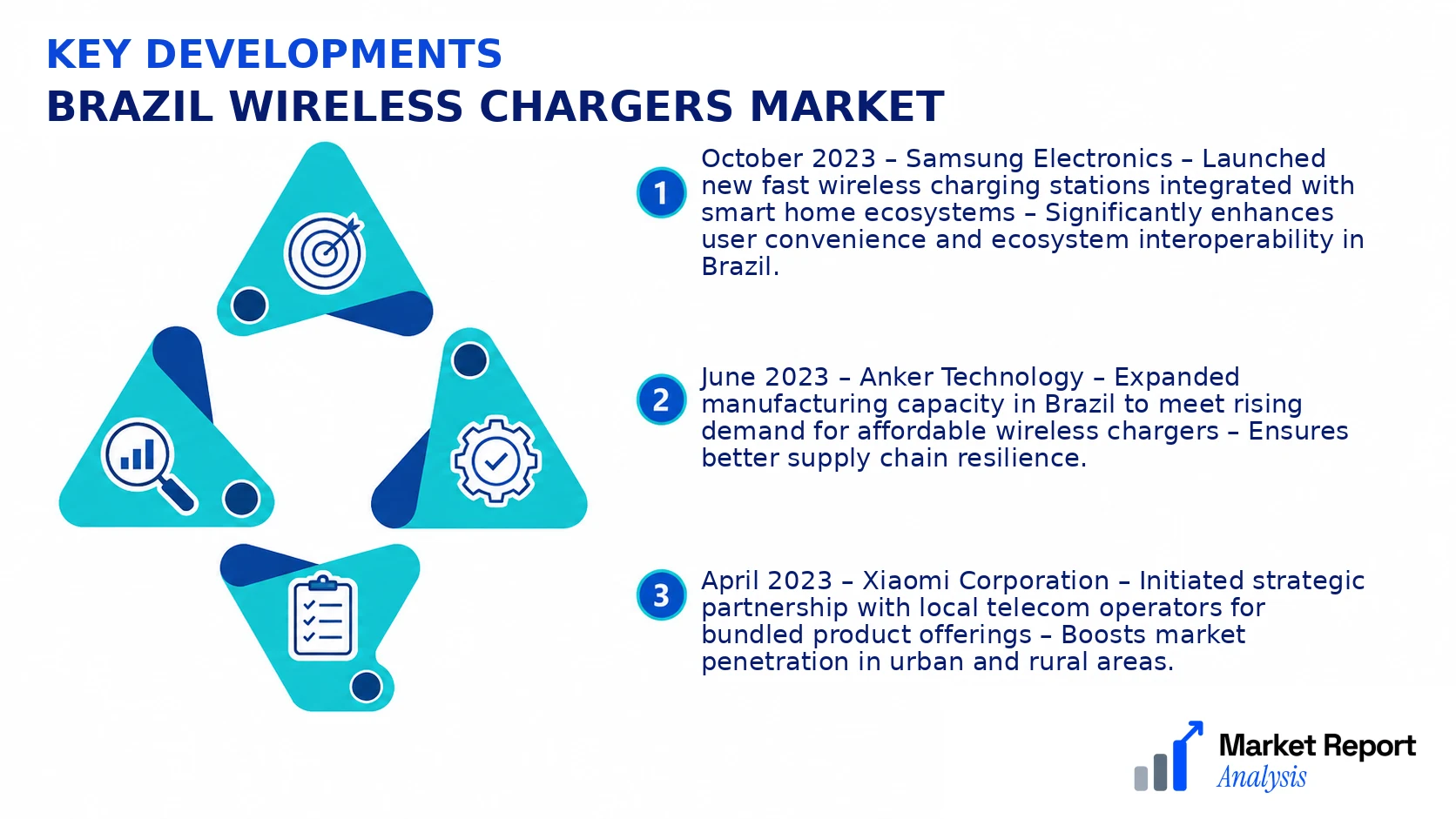
- October 2023 – Samsung Electronics – Launched new fast wireless charging stations integrated with smart home ecosystems – Significantly enhances user convenience and ecosystem interoperability in Brazil.
- June 2023 – Anker Technology – Expanded manufacturing capacity in Brazil to meet rising demand for affordable wireless chargers – Ensures better supply chain resilience.
- April 2023 – Xiaomi Corporation – Initiated strategic partnership with local telecom operators for bundled product offerings – Boosts market penetration in urban and rural areas.
- September 2023 – Belkin International – Announced a new eco-friendly wireless charger line using sustainable materials – Emphasizes sustainability and appeals to environmentally conscious consumers.
- July 2023 – Mophie Inc. – Acquired a local tech startup specializing in innovative portable wireless power devices – Expands product line and technological expertise.
Frequently Asked Questions
What is the Brazil Wireless Chargers Market?
The Brazil Wireless Chargers Market encompasses the industry involved in the manufacturing, distribution, and sale of wireless charging devices in Brazil. It includes various types such as pad chargers, stand chargers, and car chargers designed for mobile devices and wearable technology.
What is the current market size of Brazil Wireless Chargers Market?
As of 2026, the Brazil Wireless Chargers Market is valued at approximately USD 1.2 Billion, reflecting increasing consumer adoption of wireless charging technology and the proliferation of compatible devices across various sectors including consumer electronics and automotive.
What factors are driving the Brazil Wireless Chargers Market?
The growth of the market is predominantly driven by rising smartphone penetration, technological advancements like fast charging, and increased consumer demand for convenience and wireless solutions. Growth in the smart device ecosystem and urbanization also contribute significantly.
Which region dominates the Brazil Wireless Chargers Market?
Southeast Brazil dominates the market due to its high population density, robust purchasing power, and prominent electronic retail infrastructure. This region accounts for the majority market share and is a hub for tech adoption and innovation.
Which segment is expected to grow the fastest?
The fast-paced growth is observed in portable wireless chargers, particularly for automotive and wearable devices. The convenience factor and expanding electric vehicle and wearable markets propel this segment's rapid expansion.
Who are the leading companies operating in the Brazil Wireless Chargers Market?
Leading players include global corporations like Qi, Anker, Belkin, and local manufacturers that focus on innovation, quality, and affordability. They are actively expanding their product ranges to meet the increasing demand within Brazil.
Analyst Perspective
The Brazil Wireless Chargers Market exhibits a mature yet dynamic landscape, poised for sustained long-term growth driven by rising smartphone penetration and increasing consumer affinity for wireless technology. As urbanization accelerates across cities like São Paulo and Rio de Janeiro, regional demand for ergonomic, fast-charging solutions presents lucrative opportunities for vendors. Technological evolution is expected to focus on enhancing power transfer efficiency, integrating smart features, and adopting eco-friendly materials to meet rising environmental standards. Investors should target innovative startups and established players investing in high-speed, multi-device compatibility, and IoT integration, which are gaining traction amidst fierce competition. Regional growth potential remains robust, particularly in metropolitan areas where technological infrastructure supports premium product adoption. Strategic priorities should include strengthening supply chains, fostering local R&D, and forming strategic alliances to capture emerging trends. Overall, the market’s trajectory indicates a healthy outlook, with regional hotspots offering substantial growth avenues, albeit with risks from economic volatility and evolving consumer preferences.
