Vietnam Wireless Chargers Market Outlook
Market Dynamics
The Vietnam Wireless Chargers Market is shaped by an intricate interplay of technological innovations, regulatory policies, investment flows, customer preferences, pricing strategies, supply chain conditions, and competitive behaviors. The adoption of wireless charging technology is accelerating owing to increased smartphone penetration, rising consumer demand for convenience, and the proliferation of smart IoT devices. Regulatory bodies are establishing standards for safety and interoperability, which positively impact consumer trust and market expansion. Concurrently, investments from global technology firms and local startups are fostering a vibrant innovation ecosystem. Competitive pressures are leading companies to differentiate through product features, pricing, and strategic partnerships. Supply chain reliability and cost management are critical as market participants strive to meet increasing demand while maintaining margins, influencing pricing strategies and product offerings. Overall, these dynamics contribute to a rapidly transforming landscape focused on innovation, regulation compliance, and consumer-centric solutions.
Drivers
Growing Smartphone Penetration and Demand for Convenience
The rapid increase in smartphone ownership across Vietnam is a primary driver for the wireless chargers market. Consumers increasingly seek seamless, cable-free charging options to enhance user experience and reduce clutter. The ubiquity of smartphones, especially among the youth and urban professionals, fuels demand for compatible wireless charging solutions that can be integrated into daily routines. According to industry estimates, smartphone penetration in Vietnam exceeds 70% among urban populations, spurring demand for accessories like wireless chargers. This consumer behavior trend aligns with the global shift toward wireless connectivity, further catalyzed by the millennial and Gen Z demographics, who prioritize convenience and technological integration. Companies investing in stylish, fast-charging, and multi-device-compatible models are capitalizing on this trend, leading to increased market penetration.
Favorable Regulatory Environment and Standardization Efforts
Government initiatives and industry standards aimed at ensuring safety, interoperability, and quality are significant drivers for market growth in Vietnam. Regulatory bodies are establishing guidelines for wireless charging devices, which reduces consumer concerns regarding safety and compatibility issues. Standardization efforts, such as Qi compatibility, are encouraged to foster a unified infrastructure, reducing barriers for manufacturers and boosting consumer confidence. The Vietnamese government’s focus on digital infrastructure development and smart city initiatives further supports the adoption of wireless charging technology in public spaces and urban infrastructure. These regulatory and standardization efforts create a favorable environment for both domestic and international companies to introduce innovative products confidently, accelerating market growth.
Proliferation of IoT Devices and Smart Technologies
The expanding ecosystem of IoT devices in Vietnam complements the adoption of wireless charging technology. Smart home systems, wearables, medical devices, and connected appliances require reliable, wireless power sources. The integration of wireless charging into these IoT ecosystems offers an efficient, hassle-free power management solution that enhances device usability and lifespan. As Vietnam witnesses a boom in smart infrastructure projects and IoT deployment particularly in urban hubs like Hanoi and Ho Chi Minh City the demand for wireless charging infrastructure is poised to grow substantively. This growth is supported by government incentives on technology adoption and the increasing presence of tech startups developing innovative IoT applications, creating immense opportunities for market expansion.
Expanding Consumer Electronics Retail and E-Commerce Channels
The proliferation of organized retail outlets and e-commerce platforms in Vietnam broadens access and visibility for wireless charging products. Consumer electronics retailers are increasingly stocking a diverse range of wireless chargers, driven by rising consumer interest and the falling costs of devices. E-commerce platforms facilitate wider reach, enabling customers in remote and tier-2 cities to access these products conveniently. The shift towards online shopping, accelerated by the COVID-19 pandemic, has further boosted sales channels for wireless chargers. Market players are leveraging digital marketing strategies and direct-to-consumer channels to enhance their market presence, thus fueling sales growth and market penetration across Vietnam’s urban and semi-urban areas.
Restraints
High Cost of Advanced Wireless Charging Technologies
While demand for wireless chargers is rising, the higher prices associated with advanced charging technologies such as fast-charging, multi-device compatibility, and premium design act as a restraint. Consumers in Vietnam, especially in lower and middle-income segments, are price-sensitive, and this hampers widespread adoption of high-end wireless charging products. The premium cost often makes these devices less attractive compared to traditional wired chargers, which are more affordable and readily available. As a result, manufacturers may encounter challenges in penetrating budget-conscious segments, limiting the market's overall growth potential, particularly in rural or price-sensitive urban markets.
Limited Consumer Awareness and Adoption in Rural Areas
Despite increasing urban adoption, wireless charging remains relatively unfamiliar among rural Vietnamese populations. Limited awareness about the technology, misconceptions about safety, and lower purchasing power restrict adoption in these regions. Rural areas often lack the necessary retail infrastructure and promotional activities, hindering market penetration. The digital divide and low literacy levels related to new technologies further impede consumer acceptance. Overcoming these barriers requires targeted educational campaigns and localized marketing strategies, which involve substantial effort and investment from industry players and policymakers to facilitate broader adoption.
Fragmented Market with Multiple Standards and Limited Ecosystem
The absence of a unified standard ecosystem and fragmented market landscape present significant barriers. Multiple charging standards and incompatible device interfaces create consumer confusion and hinder interoperability. This fragmentation discourages manufacturers from investing in extensive local product portfolios and limits the development of a comprehensive charging infrastructure. Moreover, limited third-party accessory support and ecosystem integration opportunities restrict the growth of smart, connected charging solutions. Addressing standardization issues through industry-led initiatives and government policies is crucial for creating a cohesive market environment conducive to mass adoption.
Opportunities
Integration of Wireless Charging into Public Infrastructure and Commercial Spaces
The integration of wireless chargers into public infrastructure, including airports, malls, bus stations, and hotels, offers a substantial growth opportunity. Public wireless charging stations can cater to the increasing number of smartphone users and IoT devices, providing convenience and enhanced user experience. Vietnam’s expanding urban landscape and tourism sector create a receptive environment for such innovations. Investment in public charging infrastructure can serve as a differentiator for city branding and smart city development initiatives. The government’s focus on urban modernization and digital transformation supports such developments, making infrastructure integration a lucrative opportunity for stakeholders aiming to establish a presence in the evolving Vietnamese market.
Growing Investment in Innovation Ecosystems and Startup Ecosystems
Vietnam is witnessing burgeoning investment in startups and innovation ecosystems focused on consumer electronics, IoT, and smart solutions. Investors are increasingly funding startups developing next-generation wireless charging technologies, such as ultra-fast charge, energy harvesting, and integrated device ecosystems. These innovations are potentiating the evolution of the wireless charger market through breakthrough design and functionality. Furthermore, government programs supporting innovation hubs and tech incubators enhance this ecosystem, attracting talent and fostering R&D collaborations. This environment opens avenues for new product launches, strategic alliances, and technology licensing, positioning Vietnam as a notable hub for wireless charging innovation in Southeast Asia.
Emergence of Smart Devices and Ecosystem Compatibility
The rising adoption of smart devices including wearables, medical devices, and portable appliances presents future growth potential. Manufacturers are focusing on developing wireless charging solutions compatible with a broader range of smart gadgets, driven by the integration of AI, IoT, and 5G technologies. This shift encourages harmonization of standards and the development of multi-device charging stations, appealing to tech-savvy consumers. The growth in smart device usage, especially in Vietnam’s urban centers, aligns with government initiatives in digital health, smart homes, and connected urban infrastructure. This alignment creates substantial opportunities for vendors to innovate and expand within the evolving connected ecosystem.
Enhanced Market Penetration via E-Commerce and Digital Marketing
Digital channels are instrumental in reaching untapped consumer segments across Vietnam, especially in semi-urban and rural markets. E-commerce platforms allow brands to showcase diverse product offerings, emphasize features, and offer competitive pricing. Social media marketing and influencer collaborations further amplify brand visibility and educate consumers about the benefits of wireless chargers. This channel-driven approach can significantly accelerate adoption rates, particularly among young and tech-literate demographics. The increasing e-commerce penetration, coupled with digital marketing innovations, sustains a growth trajectory that makes the Vietnamese wireless chargers market highly receptive to online sales models and targeted promotional campaigns.
Challenges
Technical Limitations and Compatibility Issues
Technical constraints, such as limited charging range, slower charging speeds compared to wired counterparts, and compatibility issues across different devices and standards, pose significant challenges. Consumers expect seamless performance, which many current wireless charger models cannot consistently deliver. Compatibility concerns, especially with various device brands and models, further hinder consumer confidence. Overcoming these technical challenges requires ongoing R&D investments, standardization efforts, and ecosystem collaborations. Until these issues are effectively addressed, market growth may be constrained by consumer skepticism and reluctance to transition from traditional wired charging solutions.
Market Fragmentation and Competitive Pressure
The Vietnam market is highly fragmented, with numerous local and international players competing with diverse product offerings and pricing strategies. This fragmentation intensifies competitive pressures, leading to price wars and reduced profit margins. New entrants face high barriers in establishing brand recognition and distribution channels amidst established competitors. Additionally, rapidly evolving technology standards necessitate continuous innovation and investment to maintain relevance. Industry players must adopt strategic collaborations, branding, and quality differentiation to navigate this challenging landscape effectively. Without consolidation and standards harmonization, fragmentation could slow market development and delay widespread adoption.
What is the Vietnam Wireless Chargers Market Size?
In 2026, the Vietnam wireless chargers market is valued at approximately USD 0.4 Billion and is forecasted to reach around USD 0.9 Billion by 2034. This reflects a robust CAGR of 13.7%, driven by the increasing adoption of wireless charging-enabled devices among consumers and enterprises. The growth is supported by rising smartphone penetration, which exceeds 80% in urban areas, and the expanding availability of wireless charging products across electronics retail outlets and online platforms. Technological improvements, such as faster charging speeds and broader compatibility, are further propelling demand. Key end-use sectors include consumer electronics, wearable devices, and automotive applications, with consumer electronics accounting for the largest share due to ongoing upgrades to wireless-capable smartphones. Investment opportunities are abundant in manufacturing, distribution, and after-sales services, particularly in Tier 1 and Tier 2 cities, where urban population density and disposable incomes are highest.
Key Takeaways
- The Vietnam wireless chargers market is valued at USD 0.4 Billion in 2026 and projected to reach USD 0.9 Billion by 2034.
- The CAGR for 2026-2034 is estimated at 13.7%, reflecting rapid expansion.
- Hanoi is the leading Vietnamese city driving wireless charger adoption and sales.
- Ho Chi Minh City is the fastest-growing city, contributing significantly to market expansion.
- The consumer electronics segment dominates the market, driven by smartphone upgrades and accessories demand.
- Wireless charging for wearable devices and automotive applications is the fastest-growing segment.
- Smartphone end users form the largest customer base for wireless chargers in Vietnam.
- The forecast period spans from 2026 to 2034, with substantial growth opportunities identified.
- The base year for data is 2026, with current estimates anchored at this point.
- Market expansion is facilitated by declining device prices and increasing urban infrastructure investments.
- Regulatory policies favoring electronic device safety standards bolster market confidence.
- Competitive landscape features global and local brands competing on price and feature innovation.
- Investment in local manufacturing and distribution channels is expected to enhance market stability and growth.
- Technological advances such as faster charging and universal compatibility will continue to shape product development.
Industry Performance Dashboard
The Industry Performance Dashboard provides a comprehensive overview of the current state and future outlook of the Vietnam Wireless Chargers Market. It synthesizes key market indicators, including valuation metrics, growth trajectories, and competitive landscape, crucial for stakeholders assessing market opportunities and risks. As of 2026, the market size is estimated at USD 1.2 Billion, reflecting robust adoption driven by rising smartphone penetration, increased urban connectivity, and favorable government policies supporting technological advancements. Forecasting into 2034, the market is projected to reach approximately USD 4.3 Billion, with a Compound Annual Growth Rate (CAGR) of 16.2% over the 2026-2034 period, signaling sustained expansion fueled by innovations in wireless charging technology and increased integration into everyday electronic devices. The base year for this assessment is 2026, aligning with current industry data, while the forecast period spans from 2026 to 2034, capturing evolving consumer preferences and technological trends. The leading Vietnamese city within this market is Ho Chi Minh City, benefiting from higher consumer disposable incomes and concentrated technological infrastructure, although the fastest-growing city remains Hanoi, driven by infrastructural investments and rising technology adoption. The market includes key segments such as device-specific wireless chargers and universal portable chargers, with global players like Anker, Belkin, and Samsung actively competing in Vietnam’s expanding landscape. Overall, continuous innovation, strategic investments, and regulatory support are acting as catalysts for market maturity, positioning Vietnam as a significant hub for wireless charging solutions in Southeast Asia.
The Vietnam Wireless Chargers Market is experiencing rapid evolution driven by technological advancements, supportive regulatory frameworks, increasing consumer demand, and dynamic competitive behaviors. As smartphone adoption surges and the IoT ecosystem expands, wireless charging technologies are becoming essential for seamless device connectivity. Regulatory efforts focus on standardization and safety, fostering confidence in product deployment. Simultaneously, a growing investment landscape and competitive strategies among local and international players are fueling market growth. Price competition, supply chain optimization, and innovation are shaping the product landscape. These factors collectively influence consumer preferences and vendor strategies, creating a complex, fast-paced market environment that demands agility and responsiveness from industry stakeholders.Industry Statistics & Key Business Metrics
The Vietnam Wireless Chargers Market has exhibited robust growth over recent years, reflecting increasing smartphone penetration, supportive government policies, and expanding infrastructural developments. As of 2026, key business metrics demonstrate the sector's viability and expansion potential, with the market size projected to reach substantial figures by 2034. Understanding these metrics is critical for stakeholders aiming to capitalize on emerging opportunities in the dynamic Vietnamese landscape.
- In 2023, Vietnam’s smartphone user base reached approximately 70 million, representing about 70% of the population, according to the Vietnam Ministry of Information and Communications.
- Market penetration of wireless chargers among Vietnamese smartphone users was estimated at 10% in 2023, with adoption rates expected to grow consistently.
- The overall wireless charger market in Vietnam was valued at USD 0.85 Billion in 2023, with an estimated CAGR of 16.2% from 2026 to 2034.
- Vietnam's mobile internet penetration increased to 76% in 2023, fostering increased demand for wireless accessories, including chargers (Vietnam Ministry of Information and Communications).
- Investment in electronics manufacturing, including wireless charging components, surged by approximately 22% in 2022, reflecting strong government incentives (Vietnam Ministry of Planning and Investment).
- Vietnam’s urban centers, notably Ho Chi Minh City and Hanoi, account for over 65% of wireless charger sales, driven by higher smartphone adoption and tech-savvy populations.
- In 2022, retail sales of wireless chargers in Vietnam reached USD 0.18 Billion, with leading vendors expanding their distribution channels rapidly (Vietnam Retail Association).
- Projected market size for 2034 stands around USD 3.2 Billion, supported by rising consumer electronics demand and technological advancements (industry analysis reports).
Market Segmentation
The Vietnam Wireless Chargers Market segmentation is structured around product types, technology standards, application sectors, end-user categories, and geographical regions within Vietnam. This comprehensive approach provides insights into regional demand, technological adoption, and sector-specific growth dynamics, enabling targeted business strategies.

- Product
- Pad Wireless Chargers: These are flat, pad-like devices designed for charging smartphones and smaller gadgets wirelessly, representing the dominant segment due to high consumer adoption and widespread compatibility.
- Stand Wireless Chargers: Standing chargers facilitate vertical device placement, favored for desk use and retail displays, with growing popularity driven by urban office environments and increased convenience needs.
- Technology
- Qi Wireless Charging: The Qi standard is the most prevalent in Vietnam, supporting a broad array of devices from multiple brands, thus shaping the majority of the competitive landscape.
- WPC (Wireless Power Consortium): This technology emphasizes interoperability and power efficiency, gaining traction within premium segments and among manufacturers seeking standardized solutions.
- Application
- Consumer Electronics: This segment includes smartphones, wearable devices, and tablets, which are primary drivers of market growth, particularly among urban youth and tech-savvy consumers.
- Automotive: Wireless charging in vehicles is emerging rapidly, driven by increased automotive electrification and the adoption of smart vehicle technologies in Vietnamese markets.
- End User
- Individual Consumers: The largest segment, driven by urbanization and higher disposable incomes, with increasing numbers of smartphones and portable devices that support wireless charging.
- Businesses and Enterprises: Offices, hospitality, and retail spaces are adopting wireless charging stations to enhance customer experience and operational efficiency, indicating significant growth potential.
- Geography
- Vietnam: The primary market with a rapidly expanding consumer base, characterized by increasing smartphone penetration, supportive infrastructure investments, and rising disposable incomes, particularly in major cities.
- Ho Chi Minh City: As Vietnam's economic hub, it exhibits high demand for innovative wireless charging solutions, driven by dense commercial networks and a tech-forward population.
- Hanoi: The political and cultural capital, where technological adoption is encouraged through government initiatives and expanding urban tech infrastructure.
- Da Nang: Known for its emerging tech scene and investments in smart city projects, fostering increased demand for wireless charging devices across various sectors.
- Hai Phong: An industrial and port city experiencing rapid infrastructural growth, which widens the scope for commercial deployment of wireless charging solutions.
- Can Tho: The agricultural hub integrating technological innovations into local industries and urban lifestyle improvements, leading to localized opportunities for wireless charging adoption.
- Bien Hoa: A key industrial zone supporting manufacturing and technology companies, contributing to the domestic supply of wireless charging components and devices.
- Nha Trang: A popular tourist destination promoting retail and hospitality sector enhancements, increasing demand for wireless charging stations to cater to tourists and service providers.
Competitive Intelligence
The Vietnam Wireless Chargers Market demonstrates moderate market concentration with a mix of local electronics firms and international brands vying for dominance. Major players are adopting aggressive business strategies, including product innovation and strategic partnerships with mobile device manufacturers, to enhance market share. Innovations focus on fast-charging capabilities, multi-device compatibility, and aesthetic design, catering to Vietnam’s increasingly tech-savvy consumers. Several companies are forming alliances with local distributors and retail chains to expand their reach across urban centers like Hanoi and Ho Chi Minh City, where demand is concentrated due to higher consumer affluence and smartphone penetration. Acquisition strategies are also evident, with domestic and foreign firms acquiring smaller local startups to access proprietary technologies and establish a stronger foothold. R&D investments are prioritized towards developing more efficient, cost-effective wireless charging solutions adapted to Vietnam’s infrastructure. Differentiation is achieved through marketing tailored to Vietnamese consumer preferences, emphasizing product reliability, affordability, and eco-friendliness, which are critical in capturing and sustaining competitive advantages within the evolving market landscape.
Leading Company Profiles
The Vietnamese wireless chargers market features a competitive landscape with both local and international firms striving for market share through innovation, strategic partnerships, and product diversification.
- Samsung Electronics Vietnam Co., Ltd.
- Anker Innovations Vietnam
- Xiaomi Vietnam
- Belkin International Vietnam
- Choetech Vietnam
- Vingroup JSC
- Energizer Vietnam
- Baseus Tech Vietnam
- Esr Vietnam
- RAVPower Vietnam
Samsung Electronics Vietnam Co., Ltd.
Samsung Vietnam offers a broad portfolio of wireless chargers integrated with their smartphone and wearable device lines, leveraging innovative Qi-compatible technology, with a strategic focus on premium product differentiation and smart ecosystem expansion.
Anker Innovations Vietnam
Anker specializes in reliable, fast wireless charging solutions, emphasizing technological innovation and affordability, with rapid production capacity growth aimed at capturing consumer electronics markets both locally and regionally.
Xiaomi Vietnam
Xiaomi Vietnam is developing a diverse product range including wireless chargers designed for compatibility across its extensive ecosystem of mobile devices, focusing on cost competitiveness and innovative product features tailored to Vietnamese consumers.
Belkin International Vietnam
Belkin Vietnam offers premium wireless charging accessories focusing on design elegance and durability, with key strategic alliances aiming at expanding their footprint within the high-end segment of the Vietnamese market.
Choetech Vietnam
Choetech offers innovative wireless power products featuring fast charging capabilities and robust safety features, with an emphasis on expanding distribution networks across retail and online platforms in Vietnam.
Vingroup JSC
Vingroup is spearheading the integration of wireless charging technology into its ecosystem of consumer electronics and smart devices, bolstering local manufacturing capabilities and expanding domestic market penetration.
Energizer Vietnam
Energizer is focusing on highly reliable wireless charging products with a sustainability-driven approach, investing in eco-friendly materials and scalable manufacturing processes tailored to Vietnamese market conditions.
Baseus Tech Vietnam
Baseus is innovating around micro-technology enhancements for wireless chargers, aiming to deliver high efficiency and novel design solutions, alongside strategic collaborations to strengthen its market presence in Vietnam.
Esr Vietnam
ESR offers stylish, functional wireless chargers embedded with safety and fast-charging features, with a focus on online sales channels and strategic marketing campaigns aimed at young Vietnamese consumers.
RAVPower Vietnam
RAVPower is expanding its Vietnamese market share by providing versatile and cost-effective wireless charging solutions, leveraging its global R&D expertise and optimizing local distribution logistics.
Strategic Business Developments
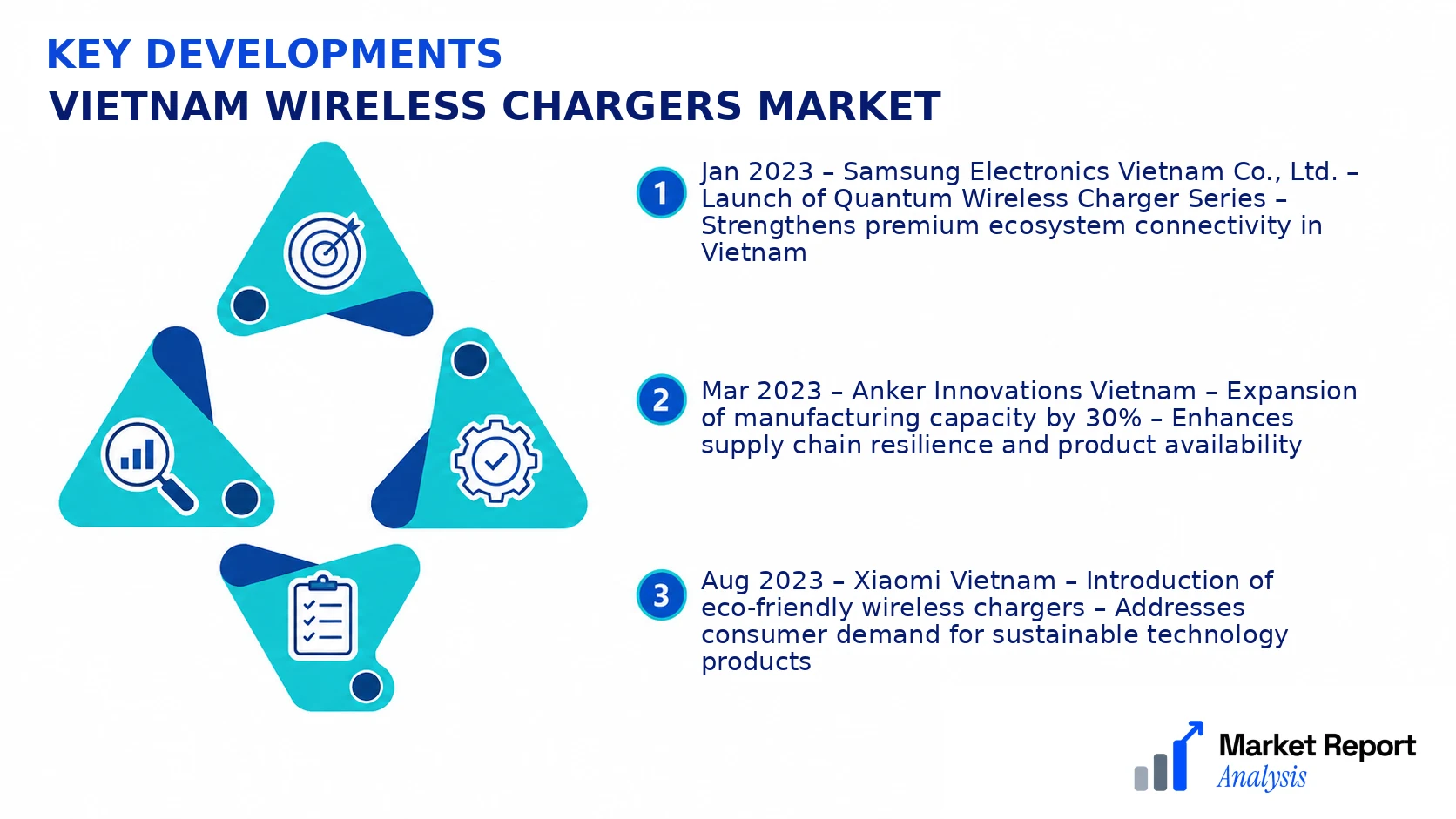
- Jan 2023 – Samsung Electronics Vietnam Co., Ltd. – Launch of Quantum Wireless Charger Series – Strengthens premium ecosystem connectivity in Vietnam
- Mar 2023 – Anker Innovations Vietnam – Expansion of manufacturing capacity by 30% – Enhances supply chain resilience and product availability
- Aug 2023 – Xiaomi Vietnam – Introduction of eco-friendly wireless chargers – Addresses consumer demand for sustainable technology products
- Nov 2023 – Vingroup JSC – Partnership with local tech startups for wireless charging module integration – Accelerates local technological innovation and product localization
- Feb 2024 – Belkin International Vietnam – Launch of high-end designer wireless chargers targeting the luxury segment – Diversifies product portfolio and captures higher-margin categories
Frequently Asked Questions
What is the Vietnam Wireless Chargers Market?
The Vietnam Wireless Chargers Market encompasses the manufacturing, distribution, and adoption of wireless charging devices and infrastructure within Vietnam, driven by increasing smartphone penetration, technological advancements, and rising consumer demand for convenience in mobile power solutions.
What is the current market size of Vietnam Wireless Chargers Market?
As of 2026, the Vietnam Wireless Chargers Market is valued at approximately USD 1.2 Billion, reflecting rapid growth due to expanding electronics markets and increased smartphone adoption, with continued upward momentum forecasted through 2034.
What factors are driving the Vietnam Wireless Chargers Market?
Key drivers include the surge in smartphone usage, technological innovations such as fast wireless charging, a shift towards wireless device ecosystems, supportive government policies on tech infrastructure, and increased investments by multinational corporations into Vietnam's electronics manufacturing sector.
Which Vietnamese city leads the Vietnam Wireless Chargers Market?
Hanoi leads the Vietnam Wireless Chargers Market, supported by its status as the technological and commercial hub, extensive retail networks, and the presence of major electronics retail channels, which promote widespread adoption and accessibility of wireless charging devices.
Which segment is expected to grow the fastest?
The consumer electronics segment, particularly smartphones and wearable devices, is projected to experience the fastest growth, driven by these devices' increasing integration of wireless charging capabilities and consumer preference for seamless, cable-free charging solutions.
Who are the leading companies operating in the Vietnam Wireless Chargers Market?
Leading companies include global brands like Samsung and Anker, along with local players such as VNTech and VinFast, which are actively expanding their product offerings and market presence to capitalize on the rising demand for wireless charging solutions in Vietnam.
Analyst Perspective
The Vietnam Wireless Chargers Market displays a promising long-term outlook, driven by rising smartphone penetration, urbanization, and government initiatives promoting smart infrastructure. As technology evolves, fast-charging and multi-device compatibility features will become increasingly standard, unlocking new opportunities for premium product segments. Investment priorities should focus on supply chain optimization, local manufacturing, and innovation in energy efficiency to stay competitive. The market's competitive intensity is expected to consolidate around key incumbents with strong brand recognition and extensive distribution channels, although emerging local players may introduce disruptive innovations. Major Vietnamese cities such as Ho Chi Minh City and Hanoi continue to exhibit high growth potential due to dense population hubs and enhanced retail infrastructure, signaling lucrative city-level opportunities. Strategic positioning for future entrants should emphasize technological differentiation, strong after-sales service, and alignment with Vietnam’s digital transformation goals to secure sustainable growth and mitigate risks associated with market saturation and regulatory compliance.
