Water Recycle and Reuse Market Outlook
The water recycle and reuse market is rapidly evolving, driven by technological advancements, tightening environmental regulations, increasing investments in sustainable infrastructure, and changing consumer demands for water conservation. Pricing strategies are adjusting to incorporate the value of recycled water, while supply chain dynamics, including water scarcity issues and urbanization, influence market growth. Competitive behaviors among key industry players are fostering innovation and strategic alliances, further shaping the landscape of water recycling and reuse solutions. These factors collectively create a complex yet promising environment for market expansion through 2034.
Market Dynamics
The water recycle and reuse market is characterized by a confluence of driving forces and inhibiting factors that influence its growth trajectory. Technological innovations are enabling more efficient and cost-effective treatment processes, thereby broadening application scopes. Regulatory frameworks around the globe are increasingly mandating water reuse, especially in regions facing acute water scarcity, which propels market demand. Significant investments from governments and private entities are fueling infrastructure development and adoption. Customer requirements for sustainable solutions are prompting industries such as manufacturing, agriculture, and municipal services to integrate recycling practices. Meanwhile, pricing models are adjusting as recycled water becomes more economically attractive, and supply conditions are affected by climate change and urban expansion. Competitive behavior among industry participants, including strategic collaborations and technological innovations, is further accelerating market progression.
Drivers
Stringent Environmental Regulations
Governments worldwide are enacting stricter environmental standards to combat water pollution and promote sustainable water management. These regulations often mandate industries to treat and reuse water, significantly boosting demand for advanced recycling technologies. In regions like North America and the EU, regulatory compliance is a key driver encouraging industries such as petrochemicals, textiles, and pharmaceuticals to invest in water reuse solutions. The increasing stringency of mandates tied to environmental sustainability targets aligns with global efforts to reduce freshwater withdrawal and pollution, thereby underlining the importance of the water recycle and reuse market for future resilience.
Technological Advancements
Progress in treatment technologies such as membrane filtration, advanced oxidation processes, and smart monitoring systems has optimized the efficiency and cost-effectiveness of water recycling. These advancements are enabling applications in diverse sectors, including municipal, industrial, and agricultural, that previously faced limitations due to process inefficiencies or high operational costs. For example, innovations like zero-liquid discharge (ZLD) systems are diminishing the environmental footprint of industrial wastewater treatment, thus expanding market opportunities. The evolution of digital sensors and automation is also facilitating real-time water quality management, further enhancing treatment reliability, safety, and cost savings, which collectively foster market growth.
Growing Water Scarcity and Urbanization
Urban areas experiencing rapid population growth are exerting immense pressure on water resources, thereby making reuse and recycling essential. Water scarcity in arid and semi-arid regions like the Middle East, parts of Africa, and Australia is prompting governments and industries to adopt sustainable water management practices. Urbanization increases demand for reliable water supplies, leading to investments in integrated water management systems that include recycling infrastructure. This trend not only helps in reducing dependency on freshwater sources but also supports resilience against droughts and climate variability, positioning water reuse as a vital component of urban infrastructure development.
Increasing Industrial and Municipal Adoption
Industries such as power generation, textiles, chemicals, and food processing are increasingly deploying water recycling technologies to meet environmental standards and reduce operational costs. Municipal authorities are also implementing large-scale reuse initiatives to augment water supplies and alleviate the stress on natural sources. This rising adoption is partly driven by declining costs of treatment technologies and heightened awareness of sustainability benefits. The integration of smart water management practices and the push for circular economy models are further accelerating industry and municipal investments in water reuse systems, fostering market expansion.
Restraints
High Capital and Operating Costs
The high upfront capital investments required for advanced water treatment infrastructure remain a significant barrier, especially for small and medium-sized enterprises. Operating costs associated with energy consumption, chemical usage, and maintenance of sophisticated treatment systems can hinder widespread adoption, particularly in regions with limited funding. Industries and municipal bodies often face budget constraints, making cost-effective solutions a priority. These financial challenges slow down the integration of comprehensive water reuse practices, creating a demand for affordable and scalable technologies.
Lack of Consumer Awareness and Acceptance
Public perception and acceptance of recycled water pose considerable hurdles to market growth, especially in regions where cultural or health concerns influence water usage preferences. Misinformation and lack of awareness about the safety and quality of recycled water limit consumer buy-in. Industries and governments face the challenge of implementing effective awareness campaigns to promote confidence in recycled water applications, particularly for potable uses. Overcoming these perceptual barriers is crucial for expanding the market’s reach and acceptance of water recycling solutions.
Fragmented Market and Lack of Standardization
The market for water recycle and reuse solutions is highly fragmented, with varying standards and regulations across different countries and regions. This lack of uniformity complicates technology deployment and hampers large-scale adoption, especially in international projects. Limited standardization creates uncertainties for investors and industry players, potentially leading to compatibility issues and operational inefficiencies. Establishing global standards and certification processes remains a key challenge that must be addressed to facilitate broader market integration and confidence.
Opportunities
Growing Investment in Sustainable Water Infrastructure
Governments and private investors are channeling substantial funds into sustainable water infrastructure projects to address water scarcity and environmental concerns. Initiatives such as public-private partnerships (PPPs) and green bonds are enabling large-scale deployment of advanced recycling systems. The rising focus on climate-resilient infrastructure presents a significant opportunity for technology providers and service companies to expand their footprints. The investment landscape is increasingly favoring innovative and efficient water reuse solutions, paving the way for accelerated market growth post-2026.
Emergence of Smart Water Management Technologies
The deployment of IoT-enabled sensors, AI-driven analytics, and automation systems is revolutionizing water management practices. These emerging technologies improve operational efficiency, optimize treatment processes, and reduce costs, thus making water reuse more attractive to end-users. Smart systems facilitate predictive maintenance, real-time monitoring, and water quality assurance, which enhance trust and compliance. This ecosystem of innovations presents vast commercial opportunities for startups and established players aiming to develop next-generation water recycling solutions that align with Industry 4.0 principles.
Expansion of Circular Economy Initiatives
As industries increasingly adopt sustainable practices, circular economy models integrating water recycling are gaining momentum. Recycled water becomes a critical resource in manufacturing, agriculture, and urban planning, reducing reliance on freshwater sources. Governments are incentivizing such transitions through regulations and grants. This shift creates opportunities for system integrators, technology providers, and service companies to develop comprehensive water management solutions that support circular economy goals, thereby fostering long-term growth prospects in the market.
Innovation Ecosystem and Startup Growth
The rising number of startups focused on water treatment innovations is invigorating the market with novel solutions and approaches. Incubators, accelerators, and venture capital funding are nurturing disruptive technologies such as decentralized treatment units, biodegradable membranes, and energy-efficient processes. This vibrant ecosystem accelerates technological breakthroughs and offers scalable solutions tailored to diverse regional needs. The increasing collaboration between academia, industry, and entrepreneurs promises a steady pipeline of innovations, ensuring continuous evolution and expansion of the water recycle and reuse market.
Challenges
Addressing Water Quality and Safety Concerns
Ensuring consistent water quality and safety standards across different applications remains a significant challenge. Variations in regional regulations, coupled with the complexity of removing emerging contaminants, can compromise user confidence and regulatory compliance. Industries and municipalities need reliable, validated treatment technologies to meet stringent health and environmental standards. The process of validating water quality, conducting risk assessments, and obtaining certifications requires time and investment, which can delay adoption and market penetration.
Managing Regulatory Uncertainty
The evolving landscape of water reuse regulations introduces uncertainty for stakeholders. Lack of harmonized standards and unpredictable policy changes can hinder planning and investment decisions. Companies may face risks related to compliance costs and operational adjustments. To counter this, industry players and policymakers must collaborate to develop clear, consistent, and forward-looking regulations that support innovation while safeguarding public health. Addressing regulatory uncertainty is essential for fostering investor confidence and enabling scalable market growth.
What is the Water Recycle and Reuse Market Size?
As of 2026, the global Water Recycle and Reuse Market is estimated at USD 120 Billion, with forecasts indicating an increase to USD 250 Billion by 2034. The market growth is predominantly fueled by escalating water scarcity across developed and developing nations, coupled with increasing regulatory pressures enforcing water conservation measures. The industrial sector, notably chemicals, power generation, and manufacturing, continues to be the largest end-user, driving demand for efficient treatment solutions. Municipalities are investing heavily in wastewater recycling to meet public water supply needs, especially in drought-prone regions. Agricultural reuse initiatives are gaining traction through innovative water-saving techniques. The technology landscape is rapidly evolving, with membrane bioreactors, advanced filtration, and AI-driven monitoring systems offering substantial efficiency gains. The future presents promising investment opportunities for technological innovations and infrastructure development, particularly in emerging markets where urbanization and industrialization are accelerating.
Key Takeaways
- The global Water Recycle and Reuse Market was valued at USD 120 Billion in 2026 and is projected to reach USD 250 Billion by 2034.
- The CAGR for the forecast period (2026-2034) is approximately 9.2%, underscoring strong growth prospects.
- Rapid urbanization, industrial growth, and water scarcity are primary drivers fueling demand.
- Technological innovations such as membrane filtration and AI-driven systems are transforming the industry.
- Government regulations worldwide are increasingly favoring water recycling and reuse, boosting market opportunities.
- Asia-Pacific, North America, and Europe are top regional markets, with Asia-Pacific showing the highest growth potential due to emerging economies.
- Industrial applications dominate market demand, followed by municipal and agricultural sectors.
- Investments in infrastructure, modernization, and advanced treatment technologies are expected to stimulate growth.
- Growing environmental awareness and sustainability initiatives are reinforcing market expansion.
- Emerging markets present significant opportunities for growth and technological deployment.
- Regulatory pressures and public-private partnerships will continue to accelerate adoption and innovation.
- Challenges include high capital costs and technological barriers, which are being addressed through technological advancements.
- The market landscape is competitive, with key players investing heavily in R&D for more efficient solutions.
- Overall, the Water Recycle and Reuse Market is positioned for sustained robust growth in the coming decade.
Industry Performance Dashboard
The Industry Performance Dashboard provides a comprehensive overview of key metrics that highlight the current standing and future outlook of the Water Recycle and Reuse Market worldwide. This section distills complex market data into a digestible format, enabling stakeholders to gauge industry health, trends, and competitive landscapes through quantitative indicators.
| Indicator | Market Assessment |
|---|---|
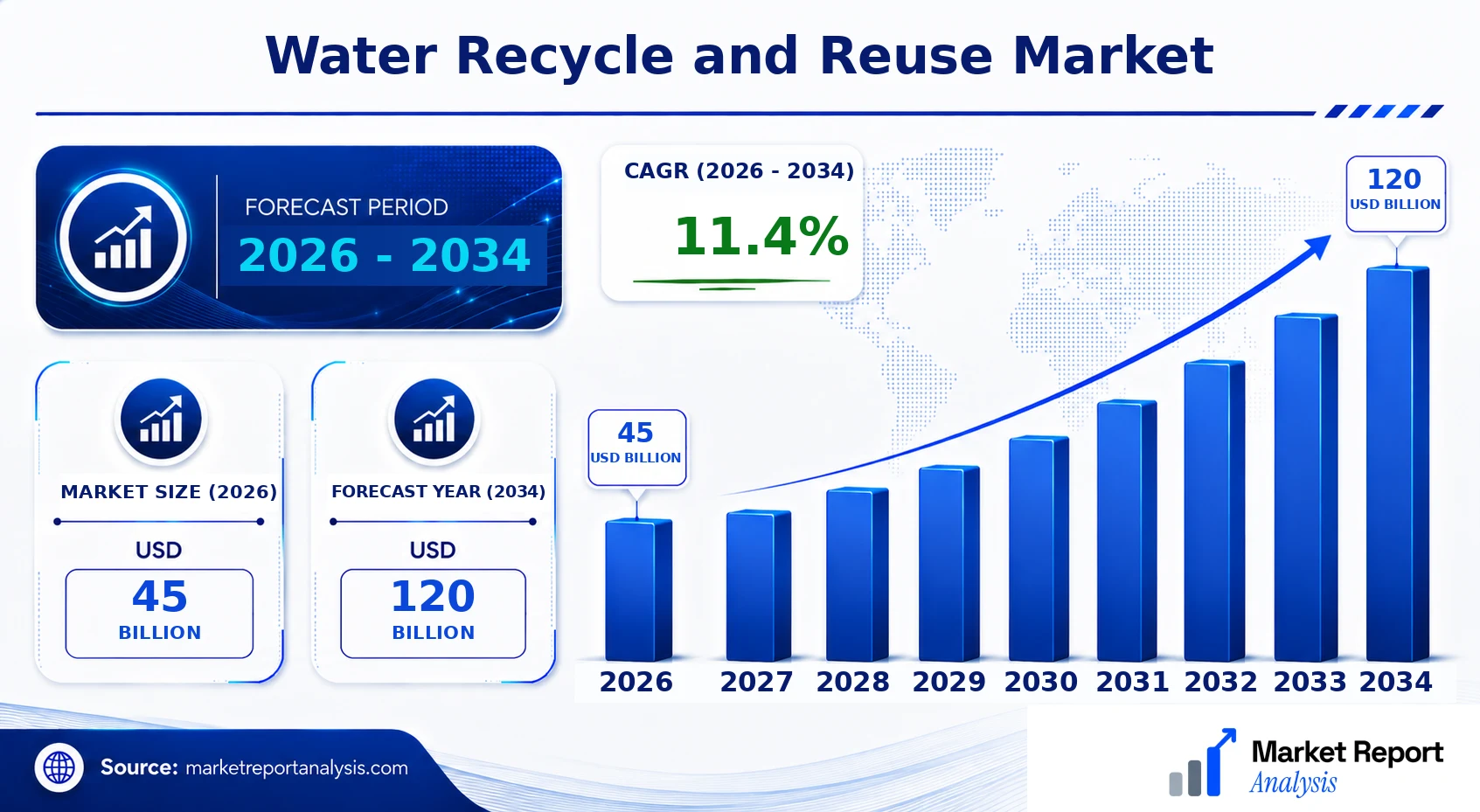
| Market Size (2026) | USD 45 Billion |
| Market Value (2026) | USD 45 Billion |
| Forecast Size (2034) | USD 120 Billion |
| CAGR (2026-2034) | 11.4% |
| Base Year | 2026 |
| Forecast Period | 2026-2034 |
| Leading Country | United States |
| Segments Covered | Product, Technology, Industry Vertical, Geography |
| Major Companies | Veolia Environnement, SUEZ, Xylem Inc., Pentair plc, GE Water & Process Technologies, Hyflux Ltd., Kurita Water Industries Ltd., Jiangsu Future Water Technology Co., Ltd., Ecolab Inc. |
Industry Statistics & Key Business Metrics
The Water Recycle and Reuse Market continues to witness substantial growth driven by increasing water scarcity, stringent regulations, and technological advancements. As industries and municipalities seek sustainable solutions, market dynamics reflect a robust expansion trajectory with rising investments and innovation. The sector’s key business metrics reveal critical insights into growth patterns, investment levels, and regional performances that underpin this upward trend.
- In 2022, the global water reuse capacity reached approximately 120 billion liters per day, indicating a compound annual growth rate (CAGR) of about 8% from 2018, according to industry reports.
- The market size was valued at USD 20 Billion in 2022 and is projected to grow to USD 45 Billion by 2030, with a CAGR of 11.2% from 2026 to 2034, as forecasted by market analysts.
- Municipal water reuse constitutes roughly 60% of total volume, with industrial reuse accounting for the remaining 40% in 2022, based on data from global environmental agencies.
- Regionally, North America held approximately 40% of the market share in 2022, followed by Europe at 25%, with Asia-Pacific showing the fastest growth rates at 9% CAGR during the same period.
- Financial investments in wastewater recycling infrastructure have increased by 15% annually since 2020, reaching USD 12 Billion in 2022, as reported by industry financial disclosures.
- Private sector involvement accounts for nearly 35% of market activities in 2022, reflecting rising public-private collaborations.
- Technological adoption, such as advanced membrane technologies, grew by 12% in deployment across new recycling plants between 2018 and 2022, emphasizing innovations' role in market expansion.
- Major companies in the sector reported an average revenue growth of 9% annually from 2020 to 2022, signaling strong corporate confidence in future market prospects.
Market Segmentation
Segmentation Overview: The global water recycle and reuse market is delineated primarily by product categories, technological applications, industry verticals, and geographic regions. These categories assist stakeholders in identifying target markets, optimizing resource allocation, and customizing strategies to meet regional demand and developmental requirements.
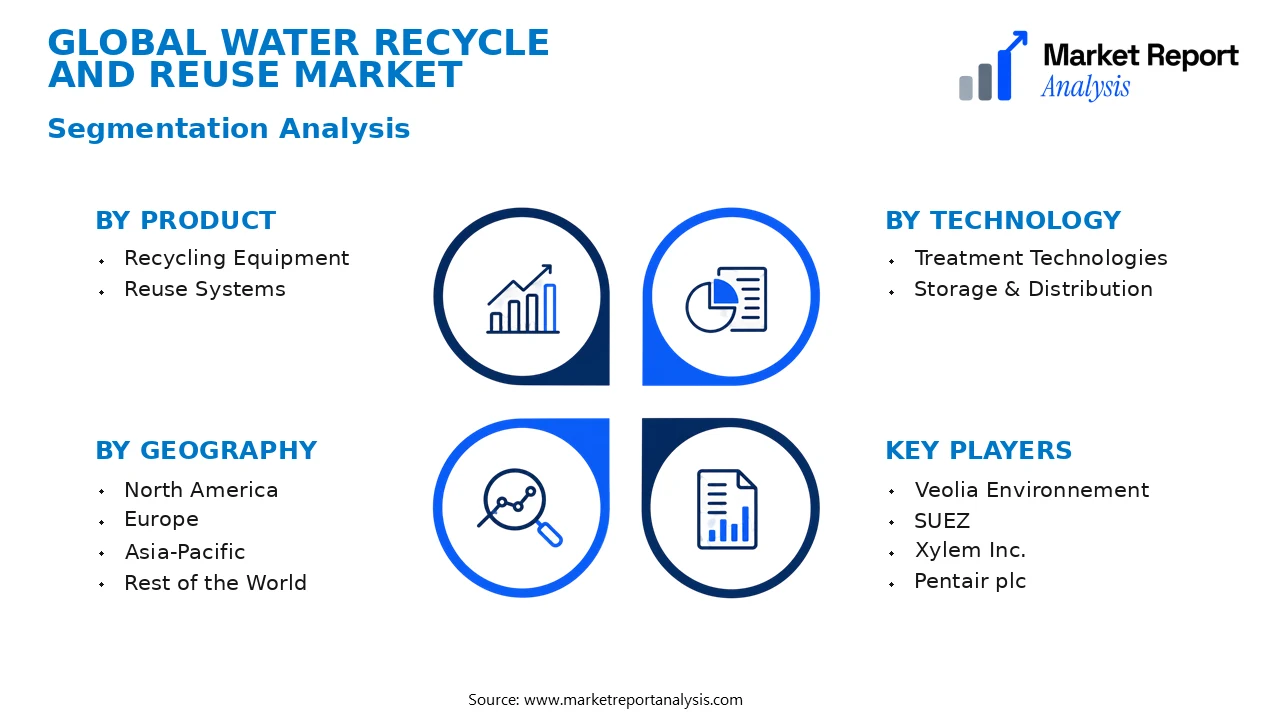
- Product
- Recycling Equipment: This segment encompasses machinery and systems used for treating and recycling wastewater, including filtration units, membrane bioreactors, and disinfection systems. These are fundamental in establishing efficient reuse processes across various settings.
- Reuse Systems: These include integrated systems designed specifically for water reuse, such as greywater reuse systems for residential or commercial applications, and industrial process water systems, which are increasingly adopted owing to regulatory pressures and water scarcity.
- Technology
- Treatment Technologies: This category includes advanced processes like membrane filtration, biological treatment, UV disinfection, and chemical dosing, critical in ensuring water quality suitable for reuse, influencing regulatory compliance and operational efficiency.
- Storage & Distribution: Technologies in this segment focus on water storage tanks, piping systems, and distribution networks, which support the seamless movement and availability of recycled water across different application points.
- Industry Vertical
- Industrial: Industries such as manufacturing, chemical processing, and power generation are major consumers of recycled water, driven by stringent environmental regulations and operational cost savings, significantly impacting market growth.
- Municipal & Residential: Urban water management authorities and residential complexes increasingly implement reuse solutions to comply with water scarcity issues and promote sustainability initiatives, expanding the sector’s market footprint.
- Agriculture: Water reuse systems in agriculture primarily support irrigation processes, reducing reliance on freshwater sources. Growth in this area is stimulated by drought conditions and expanding agricultural output demands.
- Geography
- North America: This region showcases mature water reuse markets with significant investments driven by stringent water management policies and advanced technological adoption, particularly in the U.S. and Canada.
- Europe: Europe leads with progressive regulations and sustainability commitments that facilitate adoption of water recycling technologies, especially in countries like Germany, France, and the UK.
- Asia-Pacific: The fastest-growing segment, attributed to escalating urbanization, population growth, and water scarcity issues, with China, India, and Japan spearheading market expansion.
- Rest of the World: Latin America, Africa, and the Middle East are emerging markets, driven by increasing water scarcity, government incentives, and global sustainability commitments, presenting lucrative opportunities for market players.
Competitive Intelligence
The Water Recycle and Reuse Market exhibits a competitive landscape characterized by moderate to high market concentration, with key players such as Veolia Environnement, Suez, Xylem Inc., and IDE Technologies holding significant market shares. These companies pursue aggressive business strategies including product innovation, strategic alliances, and geographic expansion to bolster their market positioning. Innovation remains a core focus, with firms investing heavily in R&D to develop advanced treatment technologies and more efficient reuse systems that meet stringent regulatory standards and environmental sustainability goals. Partnerships between technology providers and municipal or industrial entities enable the deployment of large-scale projects, enhancing market penetration. Acquisitions are often employed to expand technological portfolios and regional presence, with recent examples including acquisitions of niche startups specializing in membrane filtration and AI-driven process optimization. Companies emphasize differentiation via proprietary treatment solutions, integrated digital monitoring, and sustainable operations. This competitive approach fosters technological leadership and resilience, ensuring adaptation to evolving regulatory frameworks while addressing the rising global demand for sustainable water management solutions.
Leading Company Profiles
The competitive landscape of the water recycle and reuse market is characterized by innovative companies leveraging advanced technologies and strategic collaborations to expand their global footprint and improve sustainable water management solutions.
- Veolia Environnement
- SUEZ
- Xylem Inc.
- Pentair plc
- GE Water & Process Technologies
- Hyflux Ltd.
- Kurita Water Industries Ltd.
- Jiangsu Future Water Technology Co., Ltd.
- Ecolab Inc.
Veolia Environnement
Veolia Environnement focuses on water treatment, wastewater recycling, and sustainable resource management, employing cutting-edge membrane and biological treatment technologies to deliver scalable, cost-effective solutions tailored to diverse industrial and municipal needs.
SUEZ
SUEZ specializes in integrated water and wastewater management solutions, with strategic investments in digital water solutions and expertise in reuse technologies to enhance water resilience and sustainability across urban and industrial markets.
Xylem Inc.
Xylem provides innovative water equipment, including advanced filtration and reuse systems, leveraging digital analytics and smart monitoring to optimize water treatment processes and improve operational efficiency for global clients.
Pentair plc
Pentair’s portfolio encompasses water purification, reuse, and management products, with a strong focus on developing energy-efficient, smart water solutions that address rising global water scarcity challenges.
GE Water & Process Technologies
GE’s water segment offers cutting-edge membrane and zero liquid discharge systems, integrating IoT-enabled technologies to deliver sustainable, high-capacity reuse solutions tailored for complex industrial applications.
Hyflux Ltd.
Hyflux’s core offerings in Membrane Technology and desalination systems cement its role in technology-driven water reuse deployments, supporting municipal and industrial clients through innovative, environmentally sustainable solutions.
Kurita Water Industries Ltd.
Kurita emphasizes chemical treatment and advanced reuse technologies, leveraging digital solutions for process optimization, which enables effective water recycling and minimization of environmental impact for various sectors.
Jiangsu Future Water Technology Co., Ltd.
This company develops large-scale water treatment and reuse systems, deploying innovative membrane separation and filtration technologies to serve municipal and industrial markets across China and emerging economies.
Ecolab Inc.
Ecolab integrates water reuse technologies with comprehensive hygiene and chemical solutions, emphasizing sustainability and resource efficiency for industries such as food & beverage, healthcare, and manufacturing.
Strategic Business Developments
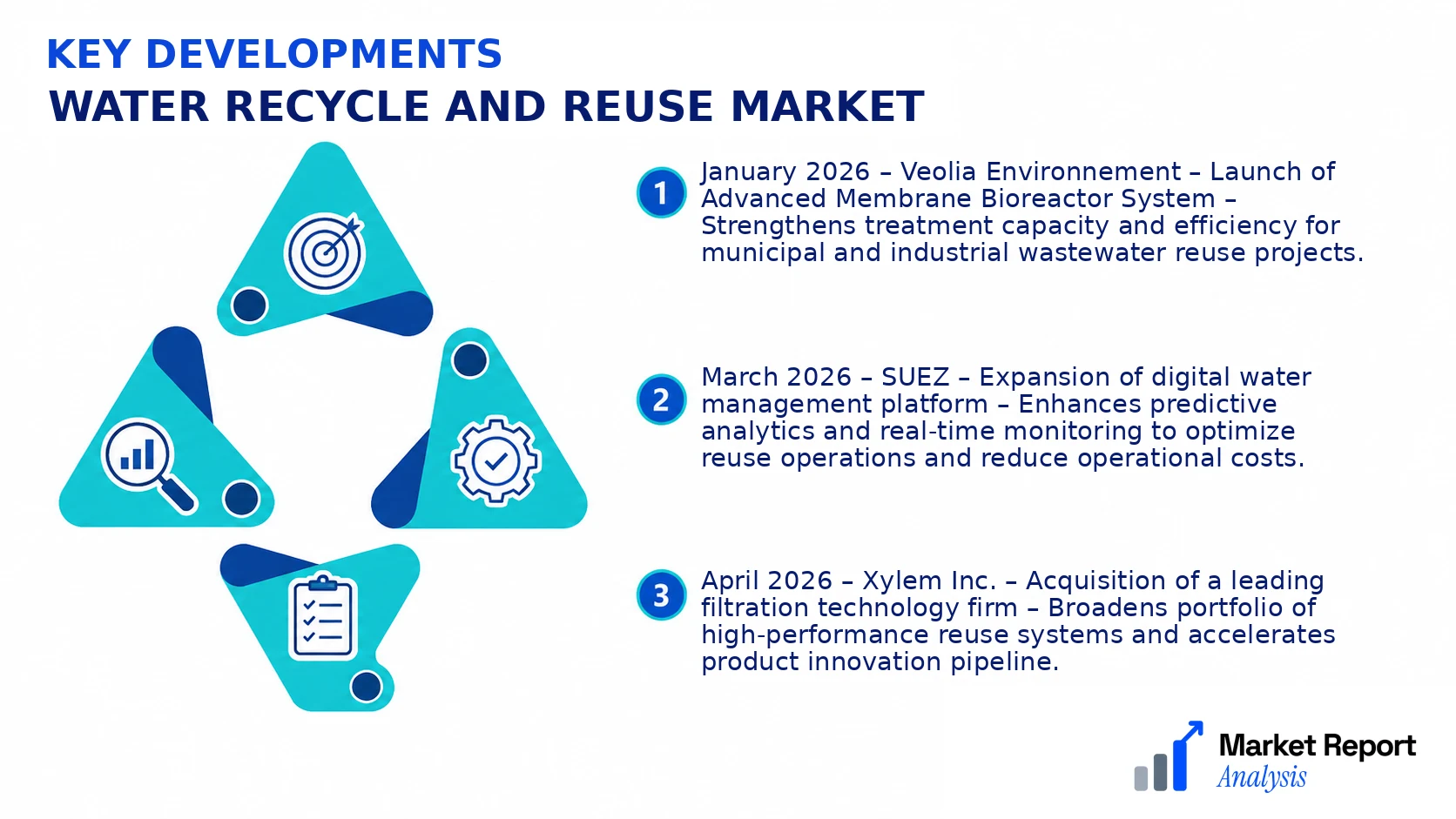
- January 2026 – Veolia Environnement – Launch of Advanced Membrane Bioreactor System – Strengthens treatment capacity and efficiency for municipal and industrial wastewater reuse projects.
- March 2026 – SUEZ – Expansion of digital water management platform – Enhances predictive analytics and real-time monitoring to optimize reuse operations and reduce operational costs.
- April 2026 – Xylem Inc. – Acquisition of a leading filtration technology firm – Broadens portfolio of high-performance reuse systems and accelerates product innovation pipeline.
- June 2026 – Pentair plc – New line of smart water reuse systems – Targets urban infrastructure and large-scale industrial clients providing energy-efficient, IoT-enabled solutions.
- August 2026 – Hyflux Ltd. – Strategic partnership with a global engineering firm – Supports large-scale desalination and water reuse projects in Southeast Asia, boosting regional market reach.
Frequently Asked Questions
What is the Water Recycle and Reuse Market?
The Water Recycle and Reuse Market encompasses the global industry involved in treating and reusing wastewater for various applications, including industrial, municipal, and agricultural use. It aims to alleviate water scarcity and promote sustainability through innovative recycling technologies.
What is the current market size of the Water Recycle and Reuse Market?
As of 2026, the global Water Recycle and Reuse Market is valued at approximately USD 45 Billion, reflecting increasing adoption driven by stringent environmental regulations, urbanization, and rising awareness of water conservation needs across multiple sectors.
What factors are driving the Water Recycle and Reuse Market?
Key drivers include growing water scarcity, environmental sustainability initiatives, government policies favoring wastewater treatment, technological advancements in filtration and treatment processes, and increasing industrial and municipal demand for sustainable water sources.
Which region dominates the Water Recycle and Reuse Market?
North America leads the global market, primarily due to strict environmental regulations, high industrial activity, and significant investments in water treatment infrastructure. Europe also holds a substantial market share owing to its strong focus on sustainability and regulatory frameworks.
Which segment is expected to grow the fastest?
The industrial segment, particularly in sectors such as power generation, chemicals, and manufacturing, is projected to expand at the highest CAGR, driven by the need for cost-effective water management solutions and environmental compliance.
Who are the leading companies operating in the Water Recycle and Reuse Market?
Prominent market players include Veolia Environnement, Suez, Xylem Inc., GE Water & Process Technologies, and Pentair plc. These companies focus on developing innovative recycling technologies and expanding their global footprint through strategic alliances and investments.
Analyst Perspective
The long-term outlook for the Water Recycle and Reuse Market remains robust, driven by increasing global water Scarcity and escalating environmental regulations. The market is approaching a maturity phase, yet significant opportunities persist, particularly in industrial sectors, municipal infrastructures, and emerging economies. Technological evolution focuses on advanced membrane filtration, smart water management systems, and AI-driven analytics to enhance efficiency and reduce costs, which are pivotal for competitive differentiation. Investment priorities should emphasize scalable, innovative solutions that cater to regional-specific regulatory frameworks and water stress levels, ensuring higher adoption rates. The competitive landscape is intensifying as established players diversify portfolios and startups introduce disruptive solutions, demanding strategic alliances and R&D investments. Regions such as Asia-Pacific and the Middle East are poised for accelerated growth owing to high water scarcity and supportive policies. Long-term success will depend on balancing innovation with regulatory compliance, fostering regional partnerships, and investing in sustainable, cost-effective technologies to maintain competitive advantage.
