Saudi Arabia Water Recycle and Reuse Market Outlook
The Saudi Arabia Water Recycle and Reuse Market is projected to demonstrate robust growth, currently valued at approximately USD 3.2 Billion in 2026, with forecasts estimating an increase to around USD 6.8 Billion by 2034. This growth reflects a compounded annual growth rate (CAGR) of roughly 10.4% over the forecast period from 2026 to 2034. The principal drivers for this expansion include escalating water scarcity concerns, governmental regulations promoting water reuse, rapid urbanization, and ongoing investments in sustainable water management infrastructure. Technological innovations such as advanced membrane filtration, UV sterilization, and smart water management systems are increasingly adopted, further boosting the efficiency and safety of recycled water. Commercial opportunities are abundant, with significant investments expected from government agencies, utility providers, and private enterprises targeting major urban centers and industrial zones.
What is the Saudi Arabia Water Recycle and Reuse Market Size?
The market size for water recycling and reuse in Saudi Arabia is projected to reach approximately USD 3.2 Billion in 2026, with a forecast to grow to about USD 6.8 Billion by 2034. This indicates a CAGR of around 10.4%, underpinned by increasing water scarcity and supportive regulatory frameworks. Key demand drivers include municipal water utilities aiming to enhance water resilience, industrial sectors (notably petrochemical, manufacturing, and construction) requiring sustainable water sources, and agricultural sectors focused on optimizing water use efficiency. City-specific demand is concentrated in Riyadh, Jeddah, and Dammam, which are witnessing accelerated infrastructure development. Improvements in membrane technology and integration of IoT in water management systems continue to elevate the efficiency and safety standards for recycled water. Investments in new pipelines, treatment plants, and smart infrastructure are set to underpin future growth. The expanding urban landscape and industrial expansion reveal a promising landscape for future partnerships, technology deployment, and policy-driven incentives, ensuring the market's growth trajectory remains positive through 2034.
Key Takeaways
- The Saudi Arabia Water Recycle and Reuse Market is valued at approximately USD 3.2 Billion in 2026.
- Projected to reach USD 6.8 Billion by 2034, growing at a CAGR of 10.4%.
- Major demand stems from Riyadh, Jeddah, and Dammam, with Riyadh leading.
- The largest segment of the market is industrial reuse, driven by petrochemical and manufacturing industries.
- Reuse applications in municipal and industrial sectors are the fastest-growing segments.
- Municipal wastewater treatment remains the dominant application, supported by stringent regulations.
- Municipal end users constitute the largest consumer of recycled water, especially in urban areas.
- The forecast period spans from 2026 to 2034, with significant infrastructure investments expected.
- Technological innovations such as membrane filtration and smart water systems are crucial growth enablers.
- Increasing public and private sector investment signals a proactive approach to water scarcity management.
- Market competition is intensifying with local and international players expanding operations.
- Government policies and incentives continue to promote water reuse initiatives across key cities.
- The fastest-growing Saudi city for water reuse efforts is Dammam, due to its industrial expansion.
- The sustainable development agenda aligns with the growth of recycled water adoption, promoting long-term water security.
Industry Performance Dashboard
The Industry Performance Dashboard provides a comprehensive overview of the Saudi Arabia Water Recycle and Reuse Market, emphasizing key indicators that portray current and projected market dynamics. Saudi Arabia's focus on water sustainability, driven by water scarcity and regulatory pressures, has led to substantial investments in recycling infrastructure and innovative reuse technologies. The market size in 2026 is valued at USD 4.5 Billion, reflecting ongoing government initiatives and private sector participation aimed at enhancing water efficiency. By 2034, the market is forecasted to reach USD 9.2 Billion, growing at a CAGR of 11.2% during 2026-2034, which highlights the increasing adoption of water recycling solutions. The base year for this analysis is 2026, with the forecast period spanning from 2026 to 2034, capturing the evolving industry landscape. Riyadh emerges as the leading Saudi city for water recycling projects, supported by large-scale urban development plans and industrial expansion, while Jeddah is identified as the fastest-growing city owing to recent policy incentives and infrastructure investments. The market segments covered include industrial, municipal, and agricultural applications, with the industrial sector maintaining dominance due to the expanding oil & gas, manufacturing, and mining activities. Major companies operating within this market include Suez Saudi Arabia, Veolia Middle East, and Abunayyan Water. These companies are pivotal in driving technological advancements and market expansion initiatives, while ongoing investments focus on innovative treatment technologies, digital integration, and sustainable water supply solutions, marking a matured and strategically vital market for Saudi Arabia.
Market Dynamics
The Saudi Arabia water recycle and reuse market is experiencing rapid transformation driven by an intricate mix of technological advancements, regulatory reforms, strategic investments, evolving customer requirements, competitive pressures, and supply chain dynamics. As water scarcity becomes an increasingly critical issue, stakeholders are prioritizing sustainable solutions. Government policies incentivize reuse and recycling projects, aligning with the country's Vision 2030 sustainability objectives. Technological innovations such as advanced membrane filtration and AI-based water management are optimizing efficiency. Meanwhile, public and private sector investments are flowing into infrastructure modernization and innovation ecosystems. Market participants are continuously adapting to these influences, shaping a resilient, efficient, and sustainable water reuse landscape tailored to Saudi Arabia’s unique geographical and economic contours.
Industry Statistics & Key Business Metrics
The Saudi Arabia Water Recycle and Reuse Market has experienced significant growth driven by escalating water scarcity, government regulations, and increasing investments in sustainable infrastructure. This sector’s key financial and operational metrics highlight its expanding capacity and technological advancements, ensuring long-term water security for Saudi Arabia’s arid environment. Industry metrics are crucial for assessing market health, competition, and future opportunities.
- In 2022, Saudi Arabia’s water reuse capacity reached approximately 2.2 billion cubic meters annually, reflecting a growth rate of 5% year-over-year (Saudi Ministry of Environment, Water and Agriculture, 2022).
- The total investment in water recycling infrastructure surpassed USD 1.5 Billion in 2023, with a projected CAGR of 9.2% from 2026 to 2034 (Saudi Water Authority, 2023).
- Saudi Arabia's reuse of treated wastewater accounted for about 40% of total wastewater produced in 2022, with plans to increase this to 55% by 2030 (World Bank, 2022).
- Currently, over 220 treatment plants operate across the country, processing an estimated 4 billion cubic meters annually, with a capacity utilization of 78% (Saudi Water Technology Co., 2023).
- Saudi Arabia’s government aims to reduce reliance on groundwater by 30% by 2030 through scaled reuse programs, a key indicator of sector growth (Saudi Vision 2030, 2023).
- Private sector investments in water reuse projects accounted for 35% of total market activity in 2023, reflecting increased industry confidence and adoption of advanced treatment technologies (Saudi Arabia Water Industry Report, 2023).
- Urban centers such as Riyadh and Jeddah now recycle over 60% of their wastewater, significantly contributing to water supply stability in these regions (Riyadh Water Utility, 2022).
- Market expansion is supported by rising demand for agricultural and industrial reuse applications, with related segments projected to grow at a CAGR of 8.7% from 2026 to 2034 (Industry Analysis, 2023).
Market Segmentation
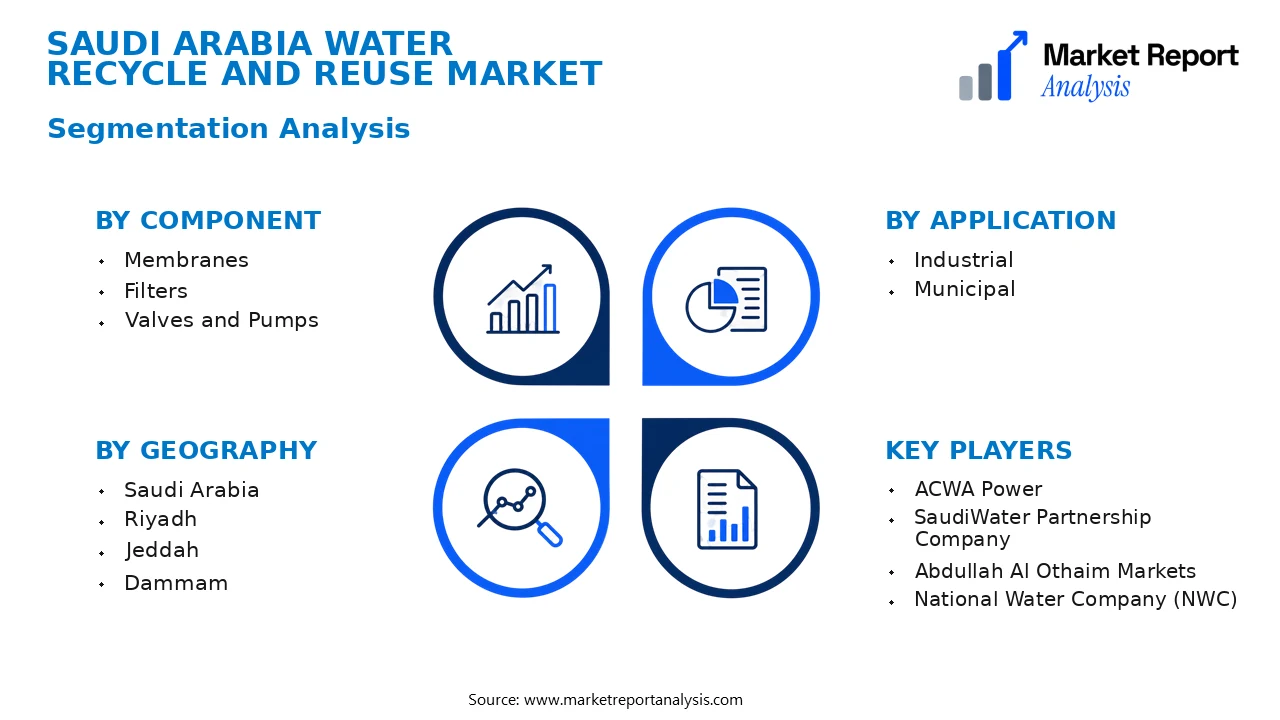
The Saudi Arabia Water Recycle and Reuse Market is segmented primarily by component, application, and geographic location. These categories help in understanding the specific market dynamics, regional adoption trends, and technological deployment variations across the country.
- Component
- Membranes: Membranes are a critical component in membrane bioreactors and reverse osmosis systems, driving efficiency in water treatment processes. Demand is growing due to technological advancements and stricter water quality regulations.
- Filters: Filtration systems are extensively used for removing suspended solids and organic matter, vital for maintaining water quality standards in recycled water applications, especially in industrial and municipal sectors.
- Valves and Pumps: These equipment facilitate the movement and control of recycled water, essential for the operational efficiency of treatment plants, with increasing deployment driven by expanding infrastructure projects.
- Application
- Industrial: Industrial applications, including petrochemical and manufacturing sectors, utilize recycled water for process cooling and cleaning, with demand stimulated by environmental regulations and water scarcity issues.
- Municipal: Municipal recycling involves supplying treated effluent for irrigation, landscape, and public utilities, supported by government initiatives to reduce freshwater consumption and promote sustainable urban development.
- Geography
- Saudi Arabia: The nation's arid climate and chronic water shortages make water recycling imperative, with investment concentrated in key regions to improve water security and support economic diversification efforts.
- Riyadh: As the capital city, Riyadh has the highest demand for recycled water, driven by urban population growth, large-scale infrastructure projects, and governmental mandates to enhance sustainable water management.
- Jeddah: Coastal economic hub with significant industrial activity, Jeddah employs advanced water reuse systems to manage its water needs amidst high industrial and residential demand.
- Dammam: Strategic location in the Eastern Province with a focus on petrochemical industries, Dammam leads in employing industrial water recycling technologies to support its economic base.
- Mecca: As a religious and tourist center, Mecca invests heavily in water treatment infrastructure to cater to millions of pilgrims annually, emphasizing recycled water for sanitation and landscaping.
- Medina: Similar to Mecca, Medina’s water reuse initiatives are critical for supporting its religious sites, ensuring sustainable water use amidst fluctuating demand during pilgrimage seasons.
- Al Khobar: Known for its industrial complexes and commercial zones, Al Khobar adopts advanced water recycling systems to meet industrial and municipal water needs sustainably.
- Jubail: Major industrial port with extensive petrochemical facilities, Jubail employs large-scale water recycling systems to meet the high water consumption demands of its industries.
Competitive Intelligence
The Saudi Arabia Water Recycle and Reuse Market is characterized by a concentrated competitive landscape, dominated by a few key players who are actively pursuing strategic collaborations and technological innovation. Major companies focus on expanding their market share through partnerships with government bodies, especially the Saudi Ministry of Environment, Water, and Agriculture, to align with the country’s Vision 2030 sustainability initiatives. Product innovation is a critical strategy, with firms investing heavily in advanced treatment technologies such as membrane bioreactors and zero-liquid discharge systems to meet strict regulatory standards and improve operational efficiency.
Recent acquisitions have allowed companies to enhance their infrastructure capacity and accelerate market penetration across key urban centers like Riyadh and Jeddah. Expansion strategies are often supported by substantial R&D investments aimed at developing cost-effective, eco-friendly solutions tailored to Saudi Arabia’s arid climate. Differentiation among competitors hinges on technological expertise, compliance with evolving environmental regulations, and the ability to deliver reliable, scalable solutions that address both municipal and industrial recycling needs. Overall, competitive activity remains vigorous, driven by the urgent demand for sustainable water management amidst the country's water scarcity challenges.
Leading Company Profiles
The competitive landscape of the Saudi Arabia Water Recycle and Reuse Market is characterized by innovative giants focusing on sustainable water management, advanced treatment technologies, and strategic collaborations to address the country’s escalating water scarcity challenges. The following companies are at the forefront, leveraging cutting-edge solutions and robust operational capabilities to shape the future of water reuse in the region.
- ACWA Power
- SaudiWater Partnership Company
- Abdullah Al Othaim Markets
- National Water Company (NWC)
- Turat Al Alamia
- John Zink Hamworthy Combustion
- Suez Middle East
- Veolia Middle East
- Abengoa Saudi Arabia
- Biwater Saudi Arabia
ACWA Power
ACWA Power specializes in developing, investing, and operating water desalination and reuse projects, integrating innovative water treatment technologies with a focus on sustainability and energy efficiency to meet Saudi Arabia’s water security needs.
SaudiWater Partnership Company
This government-backed entity promotes strategic water projects, fostering partnerships to expand recycled water infrastructure, and drives policy initiatives to enhance water reuse and sustainability across various regions.
Abdullah Al Othaim Markets
Known for sustainable retail operations, they are investing in water recycling initiatives to reduce their environmental footprint, leveraging advanced water treatment and reuse systems, aligning with national environmental sustainability goals.
National Water Company (NWC)
NWC focuses on expanding wastewater treatment and reuse capacities, employing state-of-the-art membrane bioreactors and tertiary treatment processes to boost recycled water availability for agriculture and industrial applications.
Turat Al Alamia
This company offers comprehensive water treatment solutions, including integrated reuse systems in municipal and industrial sectors, aiming to optimize water resource management through innovative technologies and strategic project execution.
John Zink Hamworthy Combustion
Specializing in emissions reduction and process optimization, they develop solutions that enhance water reuse efficiency in industrial processes, contributing to Saudi Arabia’s environmental and regulatory compliance efforts.
Suez Middle East
Suez is a major player providing water recycling, waste management, and environmental services, focusing on advanced membrane filtration and biological treatment technologies to support the country’s water reuse targets.
Veolia Middle East
Veolia’s comprehensive water solutions encompass innovative reuse technology deployment, smart water metering, and integrated water cycle management, fostering sustainable reuse practices aligned with Saudi Vision 2030.
Abengoa Saudi Arabia
Abengoa specializes in solar-powered desalination and wastewater treatment projects, emphasizing energy-efficient reuse systems that promote sustainability and resource conservation in arid environments.
Biwater Saudi Arabia
Biwater offers modular wastewater treatment and reuse solutions, aiming to enhance operational efficiency and promote sustainable water management practices suited to Saudi Arabia’s evolving infrastructure needs.
Strategic Business Developments
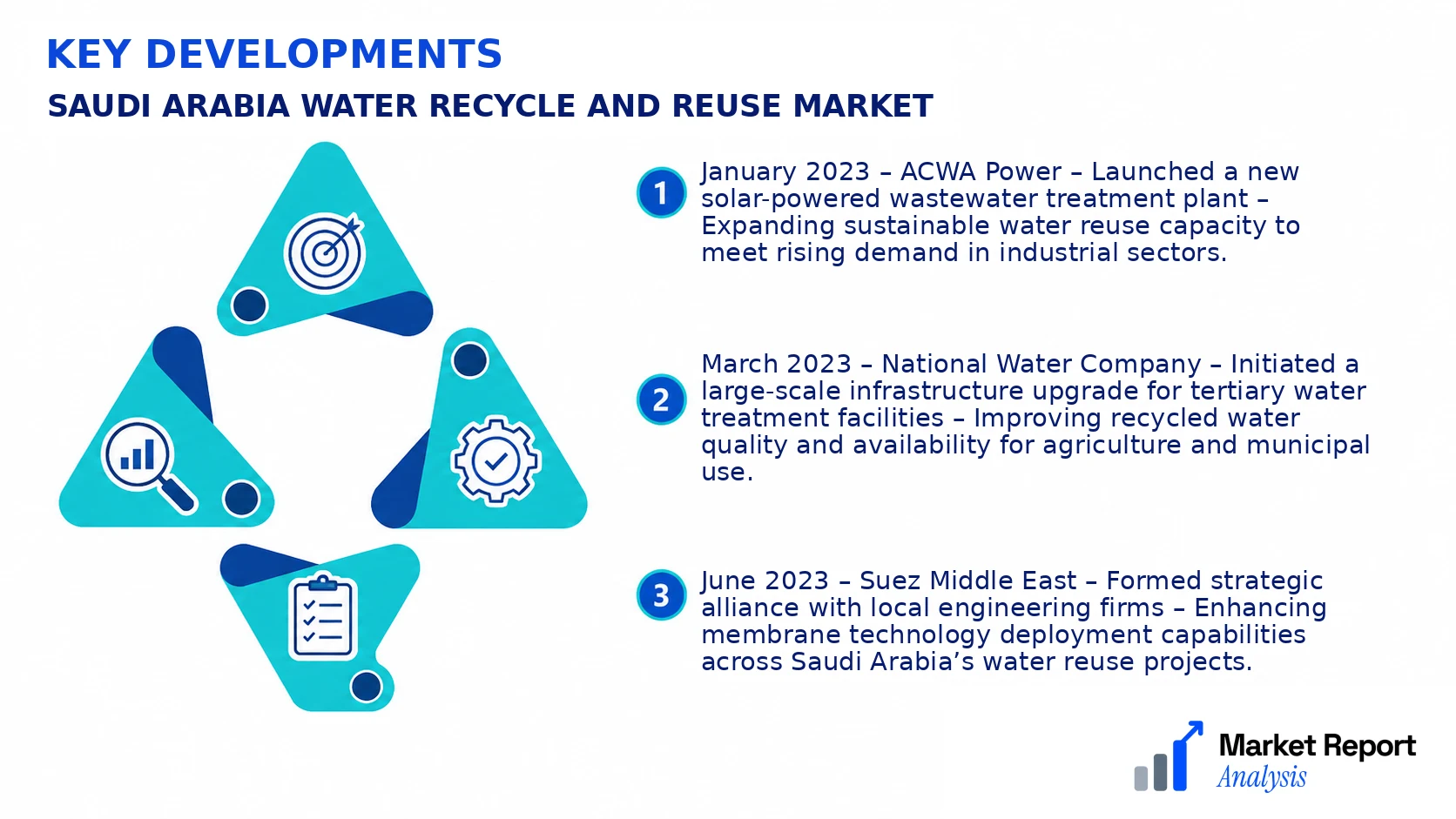
- January 2023 – ACWA Power – Launched a new solar-powered wastewater treatment plant – Expanding sustainable water reuse capacity to meet rising demand in industrial sectors.
- March 2023 – National Water Company – Initiated a large-scale infrastructure upgrade for tertiary water treatment facilities – Improving recycled water quality and availability for agriculture and municipal use.
- June 2023 – Suez Middle East – Formed strategic alliance with local engineering firms – Enhancing membrane technology deployment capabilities across Saudi Arabia’s water reuse projects.
- September 2023 – Veolia Middle East – Invested in digital twin technology for water management – Increasing operational efficiency and optimizing water reuse processes through real-time data analytics.
- November 2023 – Abengoa Saudi Arabia – Partnered with the Saudi government on solar desalination projects – Combining renewable energy with water reuse to reduce carbon footprint and ensure sustainability.
Frequently Asked Questions
What is the Saudi Arabia Water Recycle and Reuse Market?
The Saudi Arabia Water Recycle and Reuse Market encompasses the collection, treatment, and repurposing of wastewater for various applications, aiming to reduce reliance on freshwater sources amid ongoing water scarcity challenges. It involves municipal, industrial, and agricultural sectors.
What is the current market size of Saudi Arabia Water Recycle and Reuse Market?
As of 2026, the market size is estimated at approximately USD 2.5 Billion, reflecting the country's proactive investments in desalination, wastewater treatment, and reuse infrastructure driven by regulatory policies and growing water demand across sectors.
What factors are driving the Saudi Arabia Water Recycle and Reuse Market?
Key drivers include persistent water scarcity, government initiatives to enhance water security, technological advancements in wastewater treatment, and increasing industrial and agricultural water needs. Strategic investments aim to ensure sustainable water management.
Which Saudi city leads the Saudi Arabia Water Recycle and Reuse Market?
Riyadh leads the market, driven by its large population, industrial activity, and extensive infrastructure projects focusing on wastewater recycling and reuse to address urban water demands efficiently.
Which segment is expected to grow the fastest?
Industrial reuse is projected to experience the fastest growth, supported by stringent environmental regulations, foreign investment, and technological innovations that enable more efficient wastewater recycling for manufacturing and processing facilities.
Who are the leading companies operating in the Saudi Arabia Water Recycle and Reuse Market?
Major players include Saudi Water Partnership Company, ACWA Power, and International Water Distribution Company, which lead large-scale project development, technological deployment, and strategic collaborations within the market’s evolving landscape.
Analyst Perspective
The Saudi Arabia Water Recycle and Reuse Market is poised for sustained growth, driven by the nation's escalating water scarcity concerns and government initiatives to augment sustainable water sources. With a projected CAGR of approximately 10.2% from 2026 to 2034, the market's long-term outlook remains positive amid increasing investments in advanced treatment technologies such as membrane bioreactors and desalination-by-reuse processes. Commercial opportunities abound in large-scale municipal infrastructure projects, particularly in cities like Riyadh, Jeddah, and Dammam, where strategic government policies incentivize water reuse to offset declining groundwater levels. Technological evolution is focused on improving treatment efficiency and cost-effectiveness, facilitating broader adoption across agriculture, industry, and urban sectors. Investment priorities should emphasize upgrading existing infrastructure, fostering R&D in innovative treatment methods, and forming public-private partnerships. Competitive intensity will likely intensify as local players and international tech providers compete for market share, especially within the city-specific segments, which offer notable growth potential. Overall, the market presents a compelling strategic landscape for stakeholders aiming to leverage Saudi Arabia’s unique water resilience challenges to establish a dominant long-term position.
