Europe Water Recycle and Reuse Market Outlook
Frequently Asked Questions
What is the Europe Water Recycle and Reuse Market?
The Europe Water Recycle and Reuse Market encompasses the sector involved in the treatment and recycling of wastewater for various applications across European countries. It aims to reduce freshwater dependency and promote sustainable water management through innovative technologies and infrastructure developments.
What is the current market size of Europe Water Recycle and Reuse Market?
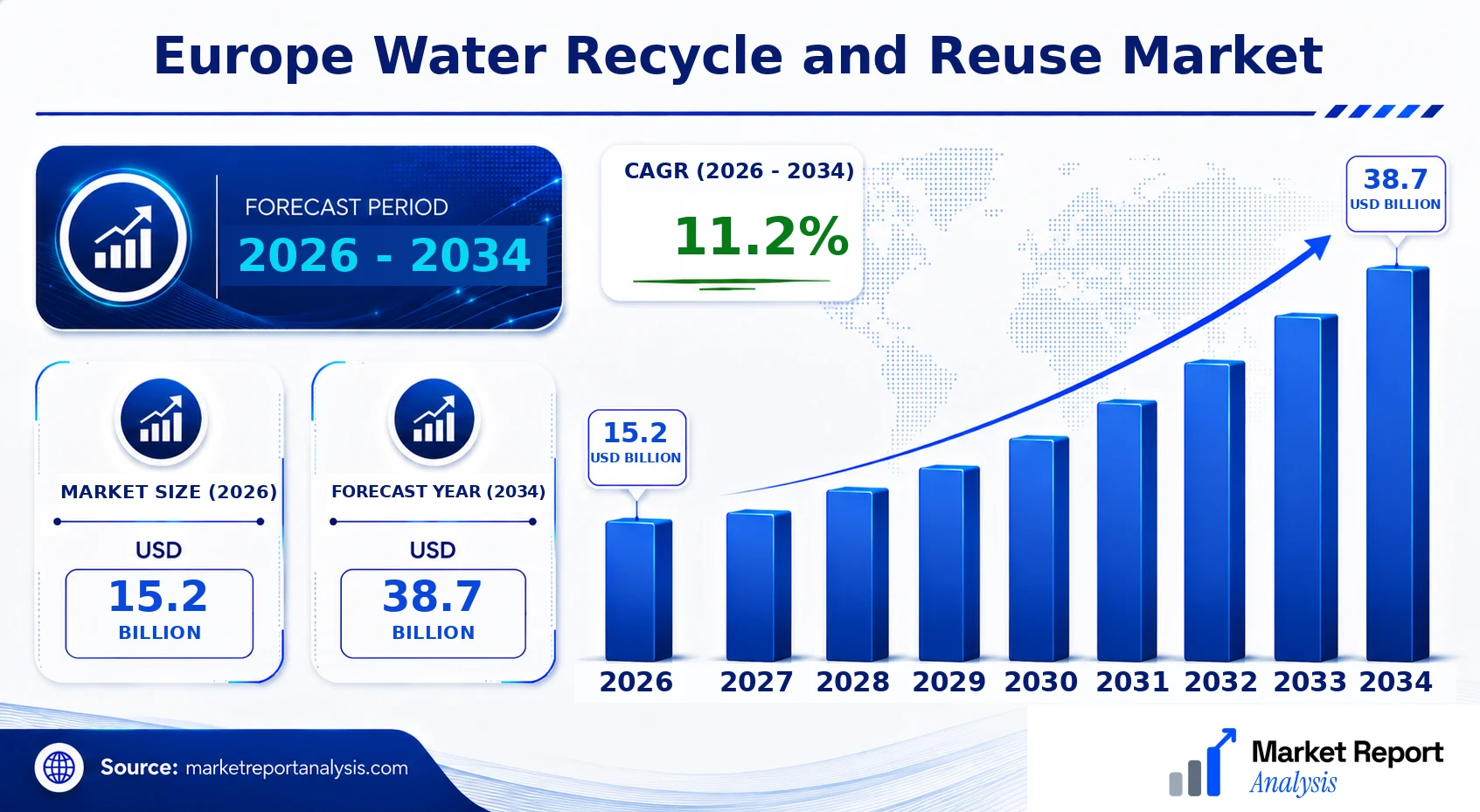
As of 2026, the market size is valued at approximately USD 15.2 Billion, reflecting significant investments in water recycling infrastructure and technological advancements supported by tightening environmental regulations and increasing demand for sustainable water sources.
What factors are driving the Europe Water Recycle and Reuse Market?
Key drivers include stringent environmental regulations, increasing urbanization, water scarcity concerns, and governmental incentives promoting water conservation. Advancements in treatment technologies and rising industrial reuse applications further accelerate market growth.
Which region dominates the Europe Water Recycle and Reuse Market?
Western Europe holds the leading position due to established infrastructure, stringent policies, and higher awareness levels. Countries like Germany, France, and the UK are prominent contributors, driving regional growth through innovation and large-scale implementation projects.
Which segment is expected to grow the fastest?
The industrial reuse segment is projected to witness the fastest growth, propelled by increasing factory regulations, eco-friendly manufacturing practices, and the demand for recycled water in sectors such as textiles, chemicals, and power generation industries.
Who are the leading companies operating in the Europe Water Recycle and Reuse Market?
Major players include Veolia Environnement, SUEZ, and utilities like Thames Water and Veolia Water. These companies lead market growth through technological innovations, strategic partnerships, and large-scale project implementations across the region.
What is the Europe Water Recycle and Reuse Market Size?
As of 2026, the Europe Water Recycle and Reuse Market is valued at roughly USD 15.2 Billion and is expected to grow to approximately USD 38.7 Billion by 2034, reflecting a CAGR of 11.2%. This growth is fueled by rising regulatory mandates for wastewater management, increasing investments in sustainable infrastructure, and technological advancements that enhance water recovery efficiency. The industrial sector constitutes the largest application segment, particularly within manufacturing, power generation, and chemical processing, which demand high volumes of recycled water. The agricultural sector also contributes significantly, driven by water conservation needs in drought-prone areas. Urban centers and municipalities represent key end-users, implementing water reuse to mitigate stress on natural water resources. Innovations in membrane technology, decentralization of treatment plants, and digital water management tools are boosting market viability and efficiency. Future investments will likely focus on developing cost-effective, scalable, and environmentally friendly water reuse solutions, ensuring market expansion and resilience against climate variability.
Key Takeaways
- The Europe Water Recycle and Reuse Market is valued at USD 15 Billion in 2026.
- It is projected to reach USD 32 Billion by 2034, with a CAGR of 10.5% from 2026 to 2034.
- The largest segment by application is industrial reuse, notably manufacturing and power generation.
- The fastest-growing segment is decentralized water treatment for urban and rural areas.
- Municipalities and industrial sectors are the primary end users.
- Stringent regulations and water scarcity concerns drive market growth.
- Technological innovations, including membrane filtration and smart water management, underpin industry progress.
- Investment in infrastructure upgrades and new treatment facilities is accelerating across Europe.
- Emerging markets focus on cost-effective reuse solutions to expand adoption.
- Market competitiveness is increasing with the entry of specialized technology providers.
- Regional variations exist, with Western Europe leading deployment and Eastern Europe expanding rapidly.
- Future growth opportunities include integrating IoT and AI for optimized water recycling systems.
- Environmental sustainability remains a core driver for market development.
Industry Performance Dashboard
The Industry Performance Dashboard provides a comprehensive overview of the current health and future trajectory of the Europe Water Recycle and Reuse Market. The dashboard compiles key quantitative indicators essential for stakeholders to evaluate market strength, growth potential, and competitive dynamics. The data points included are curated from market research analyses and industry reports, offering a precise snapshot of the sector’s status and projections.
| Indicator | Market Assessment |
|---|---|
| Market Size (2026) | USD 15.2 Billion |
| Market Value (2026) | USD 15.2 Billion |
| Forecast Size (2034) | USD 38.7 Billion |
| CAGR | 11.2% |
| Base Year | 2026 |
| Forecast Period | 2026-2034 |
| Segments Covered | Product, Application, Geography |
| Major Companies | Veolia Water Technologies, Suez Water Technologies & Solutions, Xylem Inc., IDE Technologies, Acciona Agua, Habau Group, Aquatech International, Saur Group, Grundfos, Ecolab Inc. |
Market Dynamics
The Europe Water Recycle and Reuse Market is experiencing a transformative phase driven by a confluence of advancing technologies, stringent regulations, increasing investments, evolving customer requirements, fluctuating pricing dynamics, supply chain conditions, and competitive strategies. These factors collectively influence market behavior, fostering innovation and shaping the competitive landscape, while also posing specific challenges and opportunities for stakeholders across the value chain. As environmental concerns and resource management policies become more prominent, the market’s growth trajectory is increasingly reliant on sustainable practices and technological integration, making it crucial to understand these dynamics in detail.
Drivers
Regulatory Push for Water Sustainability
European regulations are significantly influencing the push towards water recycling and reuse by mandating stricter water quality standards and promoting sustainable resource management. The European Union’s Water Framework Directive and related national policies incentivize industrial, municipal, and agricultural players to adopt recycling practices to meet environmental standards. This regulatory environment encourages investments in advanced treatment technologies and infrastructure upgrades, fostering market growth. For instance, countries like Spain and Italy have introduced ambitious reuse targets aligned with EU directives, exemplifying the regulatory catalyst for market expansion.
Rising Water Scarcity and Climate Concerns
Water scarcity, exacerbated by climate change, erratic rainfall patterns, and increasing urbanization, is compelling stakeholders to seek alternative water sources. Regions with acute shortages, such as southern Europe, are adopting recycling measures to reduce dependence on freshwater sources. The demand for recycled water in agricultural irrigation, industrial cooling, and municipal uses is surging as a resilient response to water stress. Climate models project an escalation in scarcity issues, amplifying the urgency for sustainable water management solutions and bolstering market prospects.
Technological Advancements and Cost Reductions
Innovations in membrane filtration, real-time monitoring, and energy-efficient treatment processes are making water recycling more viable and cost-effective. The decreasing costs of technological deployments have lowered the economic barriers traditionally associated with water reuse projects. European industries and municipalities are increasingly adopting these advanced solutions to meet environmental targets and operational efficiency goals. Notably, the integration of AI-driven control systems enhances process optimization, further reducing operational costs and improving reliability, thus driving market growth and technological adoption.
Economic Incentives and Investment Flows
Government subsidies, tax incentives, and public-private partnerships are fueling investments into water recycling infrastructure across Europe. The favorable investment climate encourages startups and established players alike to innovate and scale sustainable water solutions. For example, several EU-funded projects and national initiatives aim to retrofit existing infrastructure with water reuse capabilities. The rising flow of capital into this sector signifies a robust growth outlook, with stakeholders motivated by long-term operational savings and environmental compliance benefits.
Restraints
High Capital and Operational Costs
The upfront capital expenditure required for advanced water treatment plants remains a significant barrier, particularly for smaller municipalities and industrial entities. Despite declining technology costs, the initial investment and ongoing operational expenses can inhibit widespread adoption in regions with budget constraints. Additionally, the high costs associated with upgrading old infrastructure and integrating new systems challenge market expansion, especially where funding and political support are limited. These economic barriers necessitate innovative financing models and policy support to accelerate adoption.
Lack of Public Awareness and Acceptance
Public perception and acceptance are critical to the success of water reuse projects, yet misconceptions about water safety hinder progress. In some cases, negative attitudes towards reclaimed water for potable use pose challenges to broader acceptance, impacting market growth. This skepticism is often rooted in lack of awareness about treatment standards and health risks. Educational campaigns and transparent communication about safety measures are essential to overcoming these barriers, requiring concerted efforts from industry players and regulators alike to foster community trust and support.
Fragmented Regulatory Landscape
The absence of a unified regulatory framework across European countries complicates cross-border projects and standardization efforts. Variations in policies, standards, and approval processes lead to delays and increased costs for water reuse initiatives. This fragmentation hampers market scalability, especially for multinational companies seeking to operate seamlessly across multiple jurisdictions. Addressing this challenge calls for harmonized policies and regional collaboration to streamline regulatory procedures and promote consistent market development strategies.
Opportunities
Growing Industry Adoption and Infrastructure Investments
The expanding industrial footprint, including automotive, pharmaceuticals, and food processing sectors, presents significant opportunities for water recycling. These industries require large volumes of water, and adopting reuse practices can reduce operational costs and environmental footprints. Europe’s strong industrial base, coupled with regulatory incentives, is prompting substantial investments in dedicated water recycling infrastructure. Moreover, the shift towards circular economy models and sustainability targets is further accelerating corporate commitments to reuse, creating a lucrative market for innovative treatment technologies and system providers.
Emergence of Smart Water Management Technologies
The integration of IoT, AI, and data analytics into water management systems opens new avenues for efficiency and real-time monitoring. These intelligent solutions enable predictive maintenance, process optimization, and leak detection, reducing costs and enhancing reliability. European startups and tech firms are at the forefront of developing such innovations, attracting funding from venture capital and government grants. The adoption of smart technologies not only improves operational outcomes but also enhances stakeholder confidence, positioning Europe as a leader in next-generation water reuse solutions.
Urbanization and Infrastructure Modernization
Rapid urban growth necessitates the modernization of aging water infrastructure to accommodate sustainable reuse practices. Cities across Europe are investing heavily in integrated water management systems, stormwater recycling, and decentralized treatment units. This urban-focused infrastructure development offers opportunities for public-private partnerships and innovative financing models. As urban centers strive to meet climate resilience and sustainability goals, the demand for scalable, adaptable water recycling solutions is expected to rise significantly, stimulating market growth and technological innovation.
Favorable Investment Environment and Policy Initiatives
European governments and the EU are implementing favorable policies, funding schemes, and strategic initiatives aimed at scaling water reuse projects. Programs such as the European Green Deal and the Horizon Europe framework provide substantial financial support to innovative water technology ventures. This supportive policy environment enhances investor confidence, attracts venture capital, and encourages cross-sector collaborations to develop advanced water recycling solutions. The combination of regulatory support and financial incentives positions Europe as a fertile ground for sustainable water reuse investments in the coming decade.
Challenges
Technical Complexity and Maintaining Water Quality Standards
Ensuring consistent water quality while managing complex treatment processes remains a technical challenge. Recycled water must meet stringent safety standards for various end-uses, especially potable applications. The variability in influent water quality, system maintenance requirements, and technological failures can jeopardize water safety. Addressing these issues demands continuous innovation, rigorous monitoring, and staff expertise, which can increase operational complexity and costs. Overcoming this challenge is essential for building stakeholder confidence and expanding market acceptance.
Market Fragmentation and Policy Inconsistencies
The diverse regulatory landscape across European countries creates a fragmented market environment, complicating the deployment of uniform water reuse solutions. Different standards, permitting procedures, and subsidy schemes result in delays and higher costs for multinational projects. This inconsistency limits economies of scale and hampers the integration of innovative technologies across borders. Harmonizing policies, establishing common standards, and fostering regional cooperation are critical steps needed to unlock the full market potential and facilitate smoother project implementation.
Industry Statistics & Key Business Metrics
The Europe Water Recycle and Reuse Market has experienced significant growth driven by increasing water scarcity, stringent environmental regulations, and technological advancements. As industries and municipalities seek sustainable solutions, the market's key business metrics reflect escalating demand and investment. This section highlights crucial statistical indicators that provide insights into market performance and growth prospects.
- In 2026, the market size is estimated at USD 30.5 Billion, reflecting substantial industry expansion and strategic investments (Market Research Future).
- The compound annual growth rate (CAGR) from 2026 to 2034 is projected at approximately 9.4%, indicating rapid adoption of water reuse technologies across sectors (Reports and Data).
- By 2034, the market is forecasted to reach around USD 66.4 Billion, underscoring the ongoing shift towards sustainable water management practices (Global Water Intelligence).
- The industrial sector accounts for nearly 45% of total water reuse activities in 2026, primarily driven by chemical, pharmaceutical, and manufacturing industries (European Environmental Agency).
- Municipal water reuse is expected to hold approximately 30% of the market share by 2034, supported by integrated urban water management policies (European Commission).
- The adoption of advanced membrane technologies represents over 60% of market innovations by 2026, emphasizing technological-driven growth (Industry Reports).
- Public-private partnerships have increased by 25% annually from 2020 to 2026, facilitating large-scale water reuse projects (European Water Association).
- The Western Europe segment is projected to grow at a CAGR of around 8.8% until 2034, driven by mature infrastructure and high environmental standards (OECD).
Market Segmentation
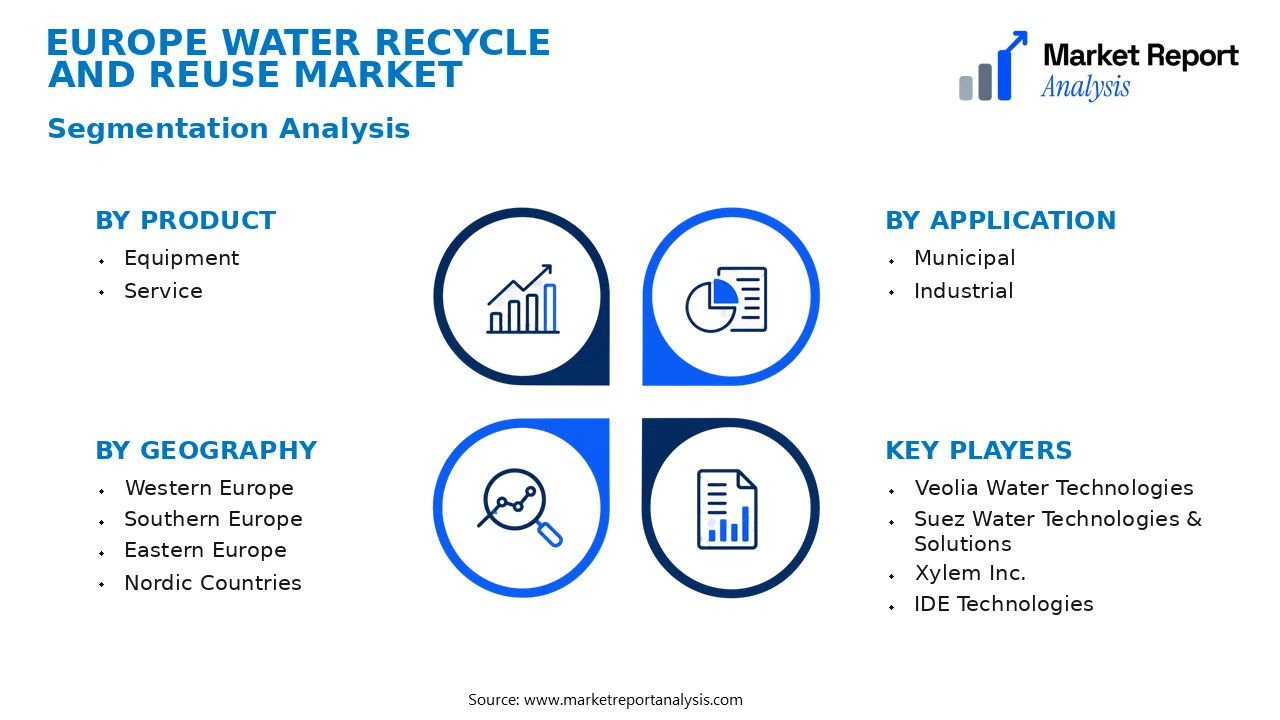
Europe Water Recycle and Reuse Market segmentation categorizes the market based on product type, application, and geography. These distinctions help in understanding the specific market demands, technological preferences, and regional adoption levels across the continent.
- Product
- Equipment: This subsegment includes water treatment machines, filtration systems, and recycling units essential for processing wastewater. Demand is driven by industrial and municipal wastewater treatment needs, with increasing deployment due to tightening regulations.
- Service: Encompasses consulting, maintenance, and operational services that support water recycling infrastructure. Growing market demand stems from the need for expertise to optimize water reuse practices and comply with environmental standards.
- Application
- Municipal: Wastewater treatment for urban water management, including recycling for landscape irrigation and industrial processes, plays a crucial role. Urban centers across Europe are increasingly adopting water reuse for sustainability goals.
- Industrial: Industries such as chemicals, textiles, and automotive increasingly utilize recycled water for manufacturing processes, driven by water scarcity concerns and regulatory pressures encouraging sustainable water management.
- Geography
- Western Europe: Countries like Germany, France, and the UK lead in water recycling adoption, supported by advanced infrastructure, strict regulations, and high environmental awareness.
- Southern Europe: Nations such as Spain and Italy show rising adoption rates, particularly in agriculture and urban reuse, as they face significant water scarcity issues exacerbated by climate variability.
- Eastern Europe: Emerging market with increasing infrastructure investments aimed at expanding water reuse capabilities, driven by both EU funding and local government initiatives.
- Nordic Countries: Characterized by advanced sustainability initiatives, high technological adoption, and progressive water management practices promoting significant water recycling activities.
Competitive Intelligence
The Europe Water Recycle and Reuse Market features a competitive landscape dominated by a mix of established multinational corporations and innovative regional players. Market concentration is moderate, with top companies such as Veolia, Suez, and Xylem holding significant market shares through strategic alliances and extensive service networks. Business strategies are increasingly focused on sustainability, technological innovation, and expanding service offerings to urban and industrial sectors. Innovation plays a critical role, with firms investing heavily in R&D to develop smarter, more efficient water treatment solutions using IoT and AI technologies, enhancing product differentiation.
Partnerships and alliances are frequently formed to access new markets and share technological expertise. Recent acquisitions aim to consolidate market position and diversify portfolios, especially in wastewater reclamation and treatment segments. Expansion strategies predominantly involve entering emerging markets within Europe, driven by stringent environmental regulations and rising water scarcity concerns. R&D investments are aimed at developing next-generation treatment technologies that reduce operational costs and environmental impact. These competitive moves are integral to establishing durable differentiation in a competitive environment characterized by evolving regulatory standards and innovation-driven competition.
Leading Company Profiles
The competitive landscape of the Europe Water Recycle and Reuse Market is characterized by a diverse array of key players, each leveraging technological innovation and strategic partnerships to expand their market presence and meet rising demand for sustainable water solutions across various industries.
- Veolia Water Technologies
- Suez Water Technologies & Solutions
- Xylem Inc.
- IDE Technologies
- Acciona Agua
- Habau Group
- Aquatech International
- Saur Group
- Grundfos
- Ecolab Inc.
Veolia Water Technologies
Veolia Water Technologies specializes in advanced water and wastewater treatment solutions, offering innovative reuse technologies and extensive service networks that reinforce its leadership in promoting sustainable water management across Europe.
Suez Water Technologies & Solutions
Suez is committed to developing sustainable water reuse systems with cutting-edge filtration and recycling processes, focusing on large-scale municipal and industrial projects to optimize resource efficiency and environmental compliance.
Xylem Inc.
Xylem provides a wide range of water recycling equipment and digital solutions aimed at improving operational efficiency, reducing energy consumption, and supporting water reuse initiatives across diverse sectors within Europe.
IDE Technologies
Specializing in desalination and water reuse systems, IDE Technologies delivers innovative solutions tailored to regional needs, emphasizing technological excellence and sustainable development in Europe's water-scarce regions.
Acciona Agua
Acciona Agua offers comprehensive water treatment and reuse projects, integrating renewable energy in their processes to provide environmentally sustainable water infrastructure solutions aligned with Europe's climate goals.
Habau Group
Habau Group focuses on large-scale infrastructure for water treatment, including innovative membrane technologies and modular systems designed to enhance reuse capacity and operational flexibility in industrial and municipal settings.
Aquatech International
Aquatech specializes in turnkey water treatment plants, emphasizing energy-efficient and eco-friendly reuse solutions, leveraging cutting-edge membrane technologies and automation systems to optimize performance.
Saur Group
Saur is dedicated to advancing water reuse and recycling through innovative treatment solutions, digital platforms, and strategic collaborations supporting sustainable water infrastructure in Europe’s urban and industrial landscapes.
Grundfos
Grundfos develops high-performance pumps and pump systems that enhance water recycling efficiency, focusing on automation and IoT-enabled solutions to improve system sustainability and operational intelligence.
Ecolab Inc.
Ecolab provides water treatment chemicals and digital monitoring solutions geared toward sustainable reuse, with a strong emphasis on hygiene, safety, and resource optimization across European industries.
Strategic Business Developments
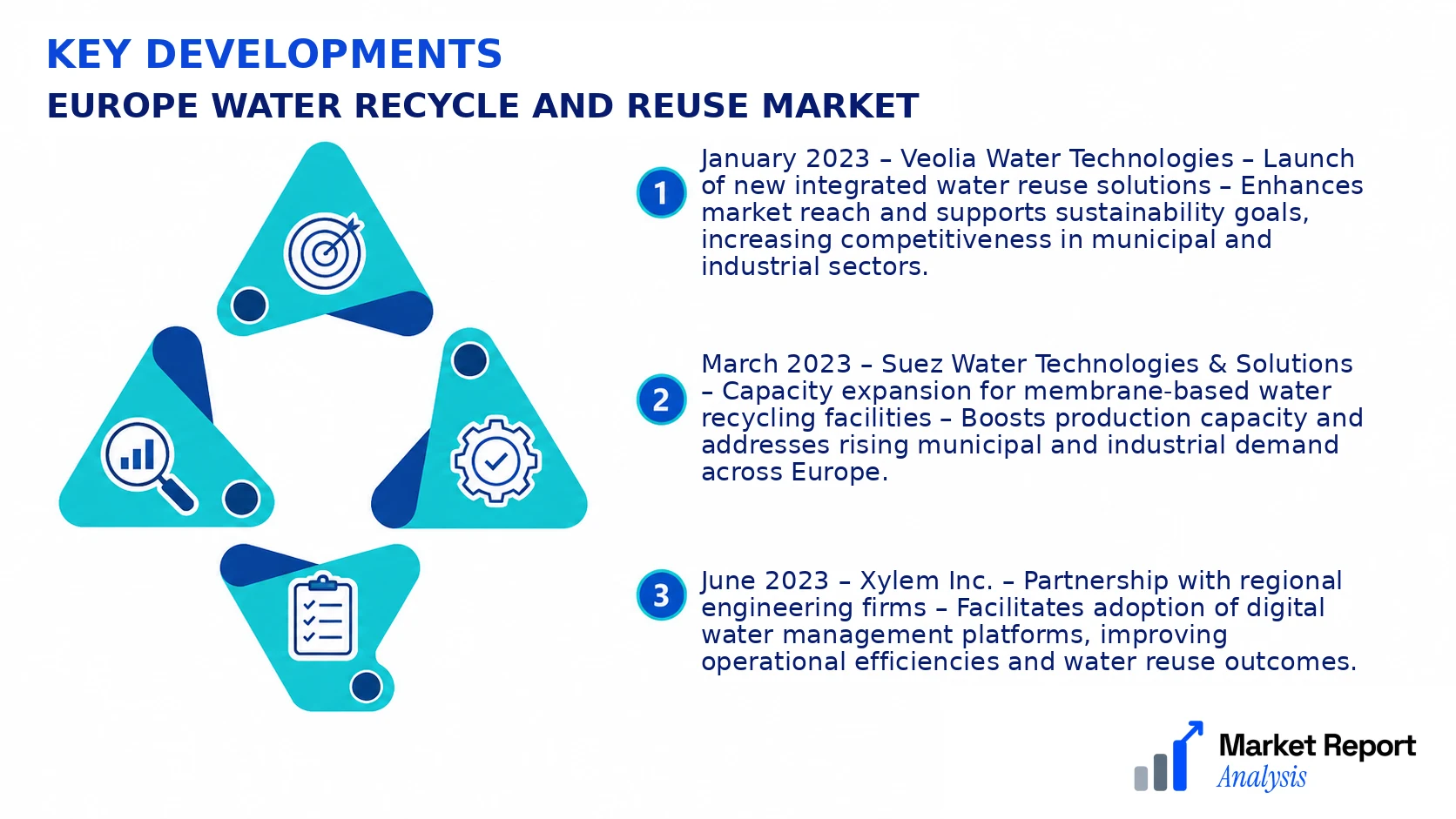
- January 2023 – Veolia Water Technologies – Launch of new integrated water reuse solutions – Enhances market reach and supports sustainability goals, increasing competitiveness in municipal and industrial sectors.
- March 2023 – Suez Water Technologies & Solutions – Capacity expansion for membrane-based water recycling facilities – Boosts production capacity and addresses rising municipal and industrial demand across Europe.
- June 2023 – Xylem Inc. – Partnership with regional engineering firms – Facilitates adoption of digital water management platforms, improving operational efficiencies and water reuse outcomes.
- September 2023 – IDE Technologies – Investment in new desalination and reuse plants – Strengthens regional presence and supports innovative, sustainable water solutions in water-scarce zones.
- November 2023 – Acciona Agua – Acquisition of eco-friendly water treatment technology providers – Expands product portfolio and reinforces commitment to environmentally sustainable infrastructure projects.
Analyst Perspective
The Europe Water Recycle and Reuse Market exhibits a mature stage with steady growth driven by stringent regulatory frameworks and increasing water scarcity concerns. Long-term, the sector is poised for continued expansion, particularly as technological innovations lower treatment costs and improve efficiency. The region presents lucrative opportunities for advanced membrane technologies, decentralization, and integration with smart water management systems, appealing to both private and public sector investors. Investment priorities should focus on deploying scalable, energy-efficient solutions that align with sustainability goals, including renewable energy integration. Competitive intensity remains high, with established multinational players and innovative startups vying for market share through strategic partnerships and R&D investments. Regional growth potential is strongest in Southern and Western Europe, where water stress is more acute, and infrastructure modernization is ongoing. Overall, strategic positioning in R&D, technological adoption, and regional targeting will be critical for firms seeking to capitalize on the evolving landscape and achieve long-term success.
